


Debt-to-income ratio was cited in more than 30% of mortgage application denials in 2023, making it the most common denial reason in the Urban Institute's mortgage application data. That finding covers mortgage applications broadly, not just refinances. Still, it highlights an important question for homeowners: how much of your income will already be committed after the new loan closes?
Your debt to income ratio for refinance isn't necessarily the ratio you have today. The proposed mortgage payment can change the calculation, even if your paycheck stays exactly the same.
Table of Contents
- Why Refinance DTI Decides More Applications Than You Think
- How to Calculate Your Refinance DTI Step by Step
- Typical DTI Limits for Each Refinance Loan Type
- Which Monthly Debts Lenders Count
- Worked Refinance Scenarios With Real Numbers
- When a Higher DTI Can Still Qualify
- Lower Your DTI and Confirm Readiness Before You Apply
- Refinance DTI Questions Answered
Why Refinance DTI Decides More Applications Than You Think
A refinance replaces your existing mortgage with a new loan. For a refinance requiring income qualification, the lender evaluates the proposed obligation rather than just carrying your current mortgage payment into the calculation. That distinction can help explain why an apparently attractive offer doesn't always improve qualification.
Think of DTI as a weight limit on a household budget. The lender wants to understand how much income is already committed to required payments. A smaller replacement mortgage payment leaves more room, while a larger payment uses more of that capacity.

What the lender is measuring
Keep these distinctions in mind before gathering statements:
- Income means gross income. Start with qualifying earnings before taxes and deductions, not the amount deposited into your checking account.
- Debt means required monthly payments. Your outstanding balances matter elsewhere, but DTI focuses on recurring payment obligations.
- The replacement payment matters. Use the lender's proposed housing payment when estimating your post-refinance ratio.
DTI isn't a complete approval decision. Credit history, financial reserves, home equity, occupancy, and the purpose of the refinance can also affect the underwriting result.
A comfortable-looking ratio doesn't erase inaccurate credit reporting or an unresolved payment-history problem. For the credit side of preparation, Superior Credit Repair's refinance guide offers a companion resource to the budget calculation.
How to Calculate Your Refinance DTI Step by Step
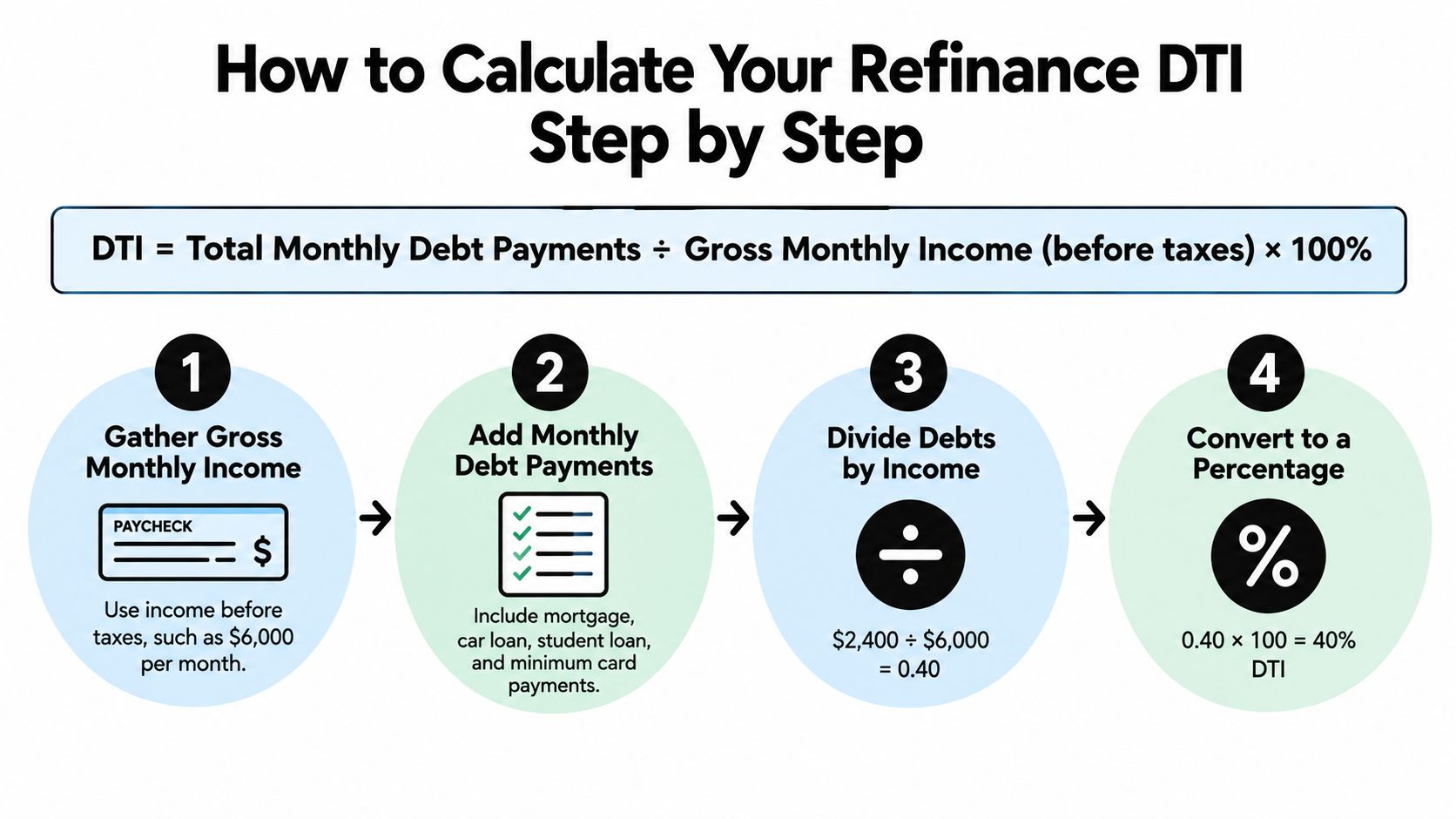
DTI equals total qualifying monthly debt payments divided by gross monthly income before taxes, expressed as a percentage.
The arithmetic is straightforward. The careful work happens before you divide, when you identify the income and obligations the lender will use.
Build the calculation from documents
Gather your gross monthly income. Start with pay records showing earnings before deductions. Ask the lender how it will evaluate hourly work, overtime, bonuses, pension income, disability income, or support income rather than assuming every receipt qualifies.
Write down the proposed housing payment. Request a complete estimate covering principal and interest, property taxes, homeowners insurance, applicable mortgage insurance, and any association obligations the lender must consider. A principal-and-interest quote alone may understate the housing expense.
List recurring debt payments. Include credit-card minimums, auto loans, personal loans, student loans, support obligations, and potentially co-signed debts. Use payment statements and agreements to resolve differences between your records and the credit report.
Add qualifying payments and divide by qualifying income. Keep the income figure and debt figure on the same monthly basis. Don't substitute annual earnings or total account balances into a monthly-payment calculation.
Calculate the housing-only ratio separately. Divide the proposed housing payment by qualifying gross monthly income. This separates the cost of the home from the rest of your monthly debt commitments.
The front-end ratio measures housing expense alone. The back-end ratio, usually what people mean by total DTI, combines housing with other qualifying debts.
A plain-English worked calculation
The Consumer Financial Protection Bureau's DTI example starts with a $1,500 mortgage payment. It adds a $100 auto payment and $400 in other monthly debts, producing $2,000 in total monthly obligations. With $6,000 in gross monthly income, dividing the debt total by income gives approximately 33% DTI.
In plain English, about a third of that borrower's pretax monthly income goes toward the obligations included in the calculation. That doesn't mean the remaining income is freely available, because taxes and ordinary living expenses still need room in the household budget.
For your own worksheet, label each amount with its document and statement date. Mark uncertain obligations for the lender to review instead of leaving them out without comment.
A home calculation is a planning tool, not an underwriting finding. The useful comparison is between your documented estimate and the requirements of the specific refinance path you're considering.
Typical DTI Limits for Each Refinance Loan Type
A refinance changes the debt side of your DTI: the new housing payment replaces the old one, while your income may stay the same. So the ratio can rise if the replacement payment is higher, even when your paycheck has not changed. Program limits offer a starting point, not a guarantee of approval.
For conventional loans, Fannie Mae's DTI requirements set a 36% total DTI benchmark for manual underwriting. A borrower may qualify up to 45% with specified credit-score and reserve conditions, while Desktop Underwriter may allow up to 50%. Certain cash-out casefiles may have a lower maximum, so the standard figures do not automatically apply to every cash-out refinance.
Traditional FHA ratios provide reference points of 31% for housing costs and 43% for total debt. These figures describe the housing and overall portions of the calculation, respectively. HUD's qualifying-ratio guidance explains that permitted manual exceptions require documented justification. Automated findings may produce a different risk-based result.
Typical DTI limits by refinance loan program
| Loan program or case | Typical DTI benchmark | How it is reviewed | Notes |
|---|---|---|---|
| Conventional, manual underwriting | 36% standard ceiling; up to 45% with qualifying credit-score and reserve conditions | Person reviews the file | The higher figure depends on meeting those conditions |
| Conventional, Desktop Underwriter | Up to 50% | Automated evaluation followed by lender review | Findings may add conditions |
| Conventional cash-out refinance | No single figure applies; the maximum may be below 36%, 45%, or 50%, depending on the casefile | Manual or automated | Check the applicable casefile requirements |
| FHA traditional benchmarks | 31% housing ratio and 43% total DTI | Manual or downgraded files | Higher ratios need permitted, documented compensating factors |
| FHA streamline, non-credit-qualifying | No DTI calculation required when the transaction qualifies | Eligibility-based | The streamline rules determine eligibility |
| FHA streamline, credit-qualifying | DTI is calculated; no single benchmark is stated here | Credit review | Income and liability documentation is required |
| VA interest rate reduction refinance | Confirm transaction-specific requirements | Ask whether income or residual-income review applies | Check current VA rules and lender requirements |
| USDA guaranteed refinance | Confirm the applicable refinance pathway | Lender review under applicable program requirements | Do not assume conventional or FHA limits apply |
| RefiNow | Up to 65% for eligible borrowers under the program provision reported for 2025 | Program-specific eligibility review | Verify current requirements and availability |
The FDIC's FHA streamline refinance guide explains the distinction between non-credit-qualifying and credit-qualifying streamline refinances. Separately, Fannie Mae's RefiNow program information reports an allowance of up to 65% DTI for eligible borrowers in 2025. That is a dated, program-specific provision, not a universal current limit.
How to read the benchmarks
Manual underwriting means a person applies the program rules to your file. Automated underwriting evaluates the information submitted and returns findings, while the lender still verifies the application. A ratio near the applicable limit leaves less room for other parts of the file to support approval.
For a moving-target check, put the old and proposed housing payments side by side, then recalculate total monthly debt against the same gross income. If the new payment rises, DTI rises too, unless another part of the calculation changes. VA and USDA borrowers should ask for transaction-specific guidance rather than use another program's benchmark. USDA debt guidance for first-time buyers can help prepare questions, though a refinance still needs its own eligibility review.
Which Monthly Debts Lenders Count
A refinance can change your debt-to-income ratio even if your income stays the same. The new housing payment replaces the old one in the monthly debt total, so an increase can raise DTI while a decrease can lower it. Start by listing every payment the lender may count.
Usually counted and often overlooked
Lenders generally review the proposed housing payment, credit-card minimums, auto loans, personal loans, and other qualifying installment payments. They may also ask about co-signed accounts, alimony, child support, leases, and buy now, pay later plans. A credit report is a useful starting point, but it may not show every obligation.
For installment debts, remaining payment terms can matter. FHA guidance says installments with fewer than ten payments remaining may sometimes be excluded, but the lender must consider whether the payments affect your ability to make early mortgage payments. Other lender or program rules may differ. Check the mortgage underwriting materials in First Seacoast Bank's public file for one lender's documented approach, and review HUD's underwriting guidance for FHA files. Don't remove a debt from your own estimate just because its payoff is near.
Buy now, pay later plans can be easy to miss because their payments may sit in an app rather than a familiar monthly statement. If you use Affirm, Klarna, Afterpay, Sezzle, or PayPal payment plans, collect each agreement and schedule. The lender needs the required payment, not just the app's current balance.
Make omissions harder to miss
| Creditor | Debt type | Monthly payment | Months remaining | Supporting document |
|---|---|---|---|---|
| Example BNPL plan | Payment plan | $50 | 4 | Payment schedule and account statement |
Treat the row as a worksheet example, not a lender rule. Replace it with your actual required payment and remaining schedule. A personal loan can be recorded the same way: use the payment shown in the loan agreement and confirm how many payments remain.
Lenders may compare your disclosures with bank statements, credit reports, contracts, and payment histories. A recurring withdrawal that does not match the debts on your application can prompt questions or delay review. Keep documents that explain unfamiliar payments.
If a reported payment looks wrong, save the statement that supports your concern and follow a documented verification process. The Superior Credit Repair FHA DTI guide can help organize your figures, while the lender determines which obligations count for your refinance.
Worked Refinance Scenarios With Real Numbers
A refinance can move your debt-to-income ratio in either direction. The new mortgage payment replaces the old one in the calculation, so even with income unchanged, a higher payment can raise DTI. The examples below use hypothetical figures, not customer results or lender offers.
Assume a household earns $6,000 in gross monthly income. That is the income figure used as the denominator in each calculation. Its current monthly debts are a $1,500 mortgage payment, a $350 car payment, $150 in credit-card minimums, and a $200 student-loan payment. Together, those payments total $2,200, or 36.7% of gross income.
DTI before and after refinance scenarios
| Scenario | Gross monthly income | Monthly debts counted | DTI |
|---|---|---|---|
| A. Current position | $6,000 | $1,500 housing + $350 car + $150 cards + $200 student loan = $2,200 | 36.7% |
| B. Rate-and-term refinance, new payment $1,420 | $6,000 | $1,420 housing + $350 car + $150 cards + $200 student loan = $2,120 | 35.3% |
| C. Cash-out of $40,000, new payment $1,750, card minimums kept at $150 | $6,000 | $1,750 housing + $350 car + $150 cards + $200 student loan = $2,450 | 40.8% |
| D. Same cash-out, $12,000 of cards paid at closing, card minimums drop to $0 | $6,000 | $1,750 housing + $350 car + $200 student loan = $2,300 | 38.3% |
| E. Current position after income decreases | $4,500 | Same current obligations totaling $2,200 | 48.9% |
| F. Rate-and-term refinance after income decreases | $4,500 | Same proposed obligations as scenario B, totaling $2,120 | 47.1% |
Each figure is an assumption or arithmetic based on the assumptions. The cash-out amount does not determine the monthly payment by itself. An actual quote depends on the proposed loan terms.
What changes between the rows
Compare scenarios A and B side by side. Income stays at $6,000, while the housing payment drops from $1,500 to $1,420. Total monthly debt falls from $2,200 to $2,120, and DTI moves from 36.7% to 35.3%.
Now compare A and C. The proposed housing payment rises to $1,750, while the other payments stay the same. Total debt reaches $2,450, so DTI climbs to 40.8%. The ratio has moved even though income has not.
In scenario D, paying $12,000 of card balances at closing reduces the assumed card minimums from $150 to $0. That brings total monthly debts down to $2,300 and DTI to 38.3%. The larger mortgage payment still counts, so the ratio remains above the current 36.7%.
Lower DTI does not automatically mean the refinance is the right financial choice. Weigh closing costs, repayment terms, savings left after closing, and whether the card balances are likely to build up again.
A refinance can improve a lender's ratio without solving every pressure in the household budget.
Scenarios E and F show how income changes the same calculation. At $4,500 in gross monthly income, the current $2,200 in obligations produces a 48.9% DTI. The lower $2,120 debt total in scenario F brings DTI to 47.1%, but the payment reduction does not erase the effect of lower income.
When a Higher DTI Can Still Qualify
A higher debt-to-income ratio may still qualify when the loan program and the rest of the application support it. Start by asking the lender which factors count under the specific program. A strength that helps one loan review may not be a formal compensating factor in another.
DTI is also a moving target during a refinance. The proposed mortgage payment replaces the current one in the calculation, while other monthly debts and income may stay the same. For example, if the new payment is higher, DTI rises even with unchanged income. Ask the lender to compare the current and proposed payments side by side, using the same income and non-housing debts in both calculations.
Compensating factors that can offset a higher DTI
| Compensating factor | Why lenders weigh it | Documentation to gather |
|---|---|---|
| Verified cash reserves | Shows funds available after closing | Recent bank and investment statements |
| Credit score | The conventional limits discussed earlier vary by review method: 36% for manual underwriting, about 45% with specified credit-score and reserve conditions, and up to 50% through Desktop Underwriter | Current credit report and score information |
| Lower loan-to-value | Shows more equity relative to the proposed loan | Appraisal or valuation and current loan balance |
| Stable employment or income history | Helps support income continuity | Pay stubs, tax records, and employer verification |
| Clean housing payment history | Documents performance on the current mortgage | Mortgage statements and payment history |
| No added cash-out or new debt | Avoids adding another source of payment pressure | Loan estimate and closing disclosure |
These factors are not approval credits that can be added together. The lender decides which ones the program allows and what records are needed to support them. Keep the focus on evidence, such as funds remaining after closing, documented earnings, and an accurate credit history.
Check student-loan assumptions carefully
Student-loan payments can be treated differently depending on the loan program and the payment documentation. Ask the lender which monthly amount will be included in your refinance DTI, and whether the payment shown on your credit report is acceptable. Don't assume a published formula applies to your application without confirmation.
The conventional limits above also show why a single DTI number cannot answer whether you qualify. A ratio that may fit an automated review can exceed the limit for manual underwriting. Ask which review path applies and what conditions the lender needs to verify.
For more on how debt-to-income ratio and loan approval relate, review the factors lenders consider. Compensating factors do not guarantee approval, and decisions vary by program and application.
Lower Your DTI and Confirm Readiness Before You Apply
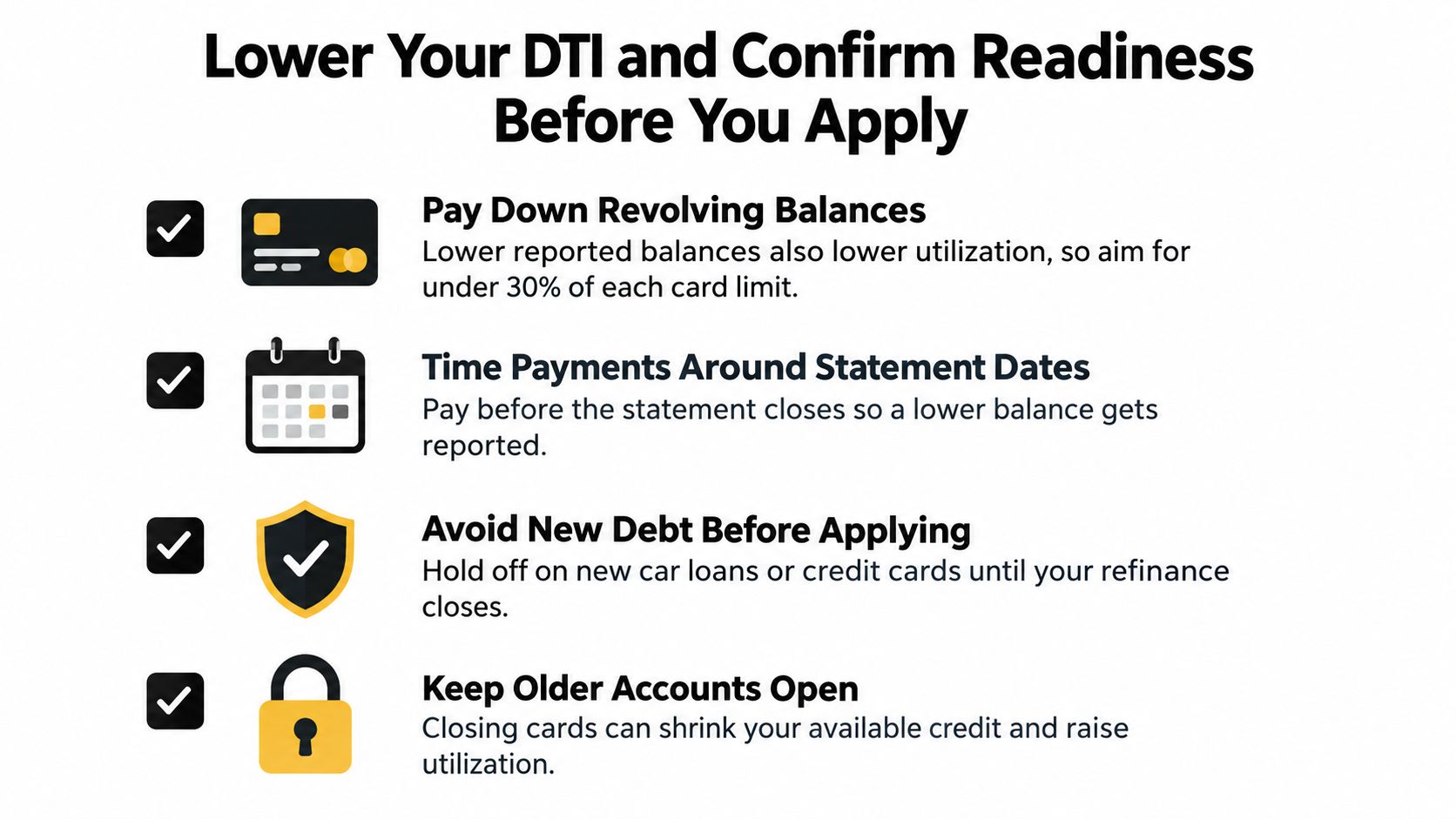
- Pay down revolving balances thoughtfully. A lower balance helps DTI only when the qualifying required payment falls; it can also reduce credit utilization, meaning the share of available revolving credit you're using.
- Check reporting dates. Ask the card issuer when it reports account information rather than assuming a payment appears on the credit report immediately.
- Avoid unnecessary new obligations. A new auto loan, personal loan, or scheduled payment plan can complicate a file you've already prepared.
- Document income changes. Bring evidence of a raise or additional earnings, but let the lender determine whether the income qualifies.
- Review account details. Compare reported balances, payment amounts, ownership, and account status against your records.
These changes serve different purposes. Debt reduction addresses payment obligations, while credit-report review addresses accuracy; neither should be presented as a substitute for the other.
Separate reporting errors from accurate negative history
A collection, late payment, or charge-off should be reviewed for factual accuracy, not disputed just because it's unfavorable. A charge-off describes an account's reporting status; don't treat the label alone as proof that the lender will disregard the obligation.
Compare dates, amounts, payment records, and account ownership. If you're seeking collections dispute help or late payment dispute help, organize supporting records before challenging a specific detail.
Superior Credit Repair offers a structured credit review and legal dispute-and-verification process for inaccurate, outdated, unverifiable, or misleading reporting. Its credit restoration work can also include rebuilding guidance, but it doesn't replace the mortgage lender's qualification review.
Results vary based on each person's credit file, documentation, creditor responses, account history, and current credit behavior. A dispute doesn't guarantee deletion, a score increase, a lower DTI, or refinance approval.
Decide whether to apply or prepare further
Use the complete inventory under “Which Monthly Debts Lenders Count” rather than rebuilding a shorter list from memory. Then compare the current housing payment with the proposed payment and calculate both the housing-only and total-debt ratios.
Ask the lender to explain closing costs, any debts being paid at closing, and the amount of verified reserves expected afterward. Request a preliminary qualification review before treating a payment quote as an approval.
Readiness check: A refinance should make sense in your household budget as well as in the lender's calculation.
If your documented ratio fits the program and the overall cost is reasonable for your goals, proceeding may make sense. If it doesn't, a planned period of debt reduction, documentation, and credit-file review may be more useful than another application.
For additional preparation steps, learn how to address high DTI before mortgage approval. Keep the goal practical: a file the lender can verify and a payment you can sustain.
Refinance DTI Questions Answered
Does a refinance always raise DTI?
No. The proposed payment and any other debt changes determine whether your DTI rises or falls. For example, if the new mortgage payment is lower, the ratio may decrease. If the new payment is higher, it may increase, even if your income stays the same. Compare the current housing payment and total monthly debts with the proposed payment and debts after refinancing. Cash-out consolidation also needs a before-and-after calculation: paying off other debts may change the total, but it does not guarantee a lower DTI.
Does rent count in refinance DTI?
Your current rent generally does not count as a qualifying payment once the refinance replaces your mortgage. Rent or another housing payment for a separate residence that you will keep paying is typically counted. For example, if you own the home being refinanced and also rent an apartment you will continue living in, tell the lender about both. The lender confirms which payments apply to your specific loan. Keep ordinary living costs, such as groceries and utilities, in your personal budget, even if they are not counted as qualifying debt payments.
Can a credit repair company guarantee lower DTI or approval?
No. DTI is calculated using qualifying income and the monthly payments the lender counts. A credit repair company can help address reporting concerns, but it cannot guarantee that an item will be removed, that your score will change, or that a lender will approve your refinance.
How long before refinancing should I start?
There is no fixed preparation timeline. Start when you can gather statements, review your credit reports, identify missing documents, and discuss the proposed loan with a lender. If a report item needs investigation, allow time for documentation and verification rather than assuming it will be resolved by a specific date.
What can I ask Superior Credit Repair about?
Superior Credit Repair Online provides educational credit guidance for people preparing for goals such as refinancing or rebuilding after credit challenges. Ask what a credit review covers and what steps may help address reporting concerns. Any review can inform your preparation, but the mortgage lender decides how your debts and income qualify.
Visit Superior Credit Repair to request a documentation-based credit review and a step-by-step plan for addressing reporting concerns before refinancing. If you found this information useful, you can share your experience with Superior Credit Repair on its Google Business Profile.