

Credit repair can work when it corrects inaccurate information, but it can't legally erase accurate negative history or guarantee a score increase. In an FTC study, about 20% of consumers had an error corrected after a dispute, yet only slightly more than 10% saw a score change after a disputed error was modified (FTC study).
So, does credit repair work? The answer depends on what you mean by “work.” A first-time homebuyer might find an account that isn't theirs, a late payment recorded incorrectly, or a collection reported with the wrong balance. Correcting a genuine mistake may help make a credit report more accurate, but it won't automatically solve high card balances, recent missed payments, or a lender's concerns about debt.
It helps to separate error correction, score rebuilding, and mortgage readiness. They're connected, but they're different outcomes, and confusing them can lead to unrealistic expectations. Here's what the process can do, what it can't do, and how to approach it carefully.
Table of Contents
- What Credit Repair Actually Is
- How the Credit Dispute Process Works
- What Credit Repair Can and Cannot Do
- Common Credit Repair Methods Explained
- Credit Repair and Mortgage Readiness
- Realistic Timelines and What to Expect
- Choosing a Compliant Credit Repair Partner
What Credit Repair Actually Is
Consider a renter preparing to buy a home who sees a collection account on a credit report. The account might belong to someone else, show the wrong balance, or be accurate but unfamiliar because it was transferred between companies. Those situations call for different next steps. A dispute may be appropriate for incorrect information, while an accurate account may require documentation and a conversation with a mortgage lender.
Credit repair is a structured review of credit reports, followed by disputes and verification when information appears inaccurate, incomplete, outdated, or unverifiable. It's not a legal way to erase unfavorable information because it's making it harder to qualify for financing. Consumers can dispute report errors themselves, and professional assistance doesn't give a company special authority over credit bureaus or creditors (FTC guidance on correcting credit report mistakes).
Three outcomes to keep separate
- Error correction: A bureau or information provider investigates a specific problem and updates, removes, or confirms the item.
- Score rebuilding: You improve the habits and account patterns that affect your profile, such as paying bills on time and managing revolving balances.
- Mortgage readiness: You and your lender consider whether your credit history, debts, income, documents, and loan requirements fit the application.
A report can become more accurate without producing an immediate score change. A score can improve while a lender still needs more information about collections, income, or debt-to-income ratio. And a corrected item doesn't guarantee a loan approval or a particular interest rate.
Practical rule: Start with the facts on each report. Don't assume every negative entry is wrong, and don't assume a corrected entry will solve every financing concern.
Results vary with the contents of your file, the records you can provide, creditor responses, account history, and your current credit behavior. The most useful goal is a report that accurately reflects your history, paired with a realistic plan to build stronger credit habits over time.
How the Credit Dispute Process Works
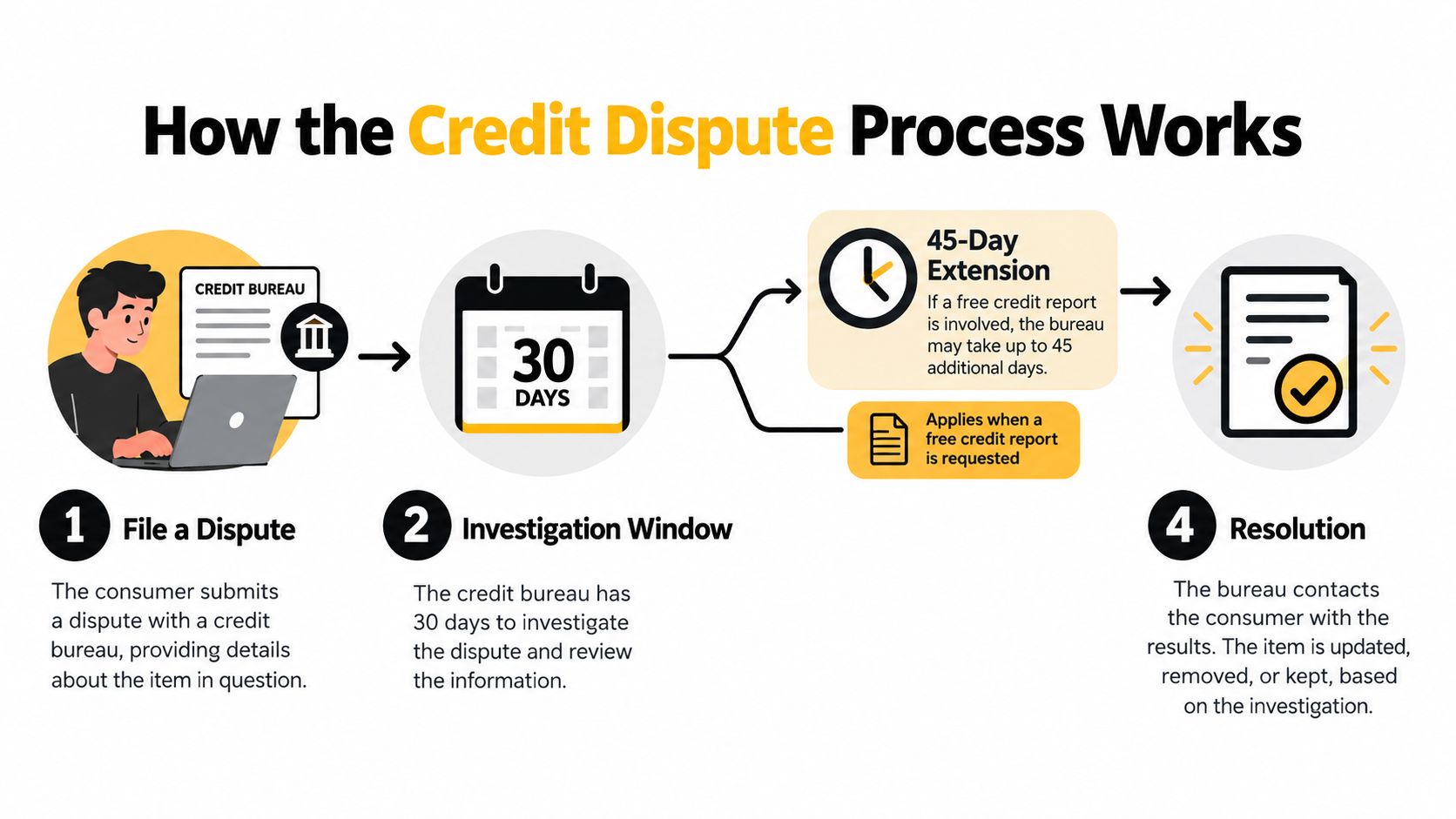
A dispute should identify a particular item and explain what's wrong with it. Under the Fair Credit Reporting Act, a credit reporting company generally has 30 days to investigate. The period can extend to 45 days in specified situations, including when a consumer obtains a free annual credit report before disputing or submits relevant information during the original investigation. After the investigation, the company generally has five business days to send written results and an updated report (CFPB explanation of credit report error timelines).
Build a dispute around evidence
A clear dispute connects the item, the error, and the documents that support your account. For example, if a payment was made on time but reported late, a payment confirmation or account statement may help explain the discrepancy. If an account isn't yours, identity records and relevant correspondence may help show why the reporting doesn't match your file.
Useful supporting records can include:
- Account statements that show balances or payment dates.
- Payment confirmations or bank records relevant to the disputed entry.
- Identity documents when the issue involves mixed-file information.
- Settlement letters or correspondence that clarify an account's status.
Keep copies of what you send, when you sent it, and how the bureau or furnisher responded. If a furnisher confirms information was inaccurate and corrects it, it must forward the correction to credit reporting companies that received the incorrect information. Review each report afterward rather than assuming every bureau has updated its file.
For practical guidance on organizing the process, these FTC credit report dispute tips can help you think through how to describe an issue clearly. If you're preparing your own explanation, this guide to writing a credit dispute letter can help you structure a focused request.
What Credit Repair Can and Cannot Do
Credit repair gets judged against three different outcomes, and mixing them up creates disappointment: correcting errors, rebuilding score strength, and becoming mortgage ready. A corrected report is the first outcome. A higher score is a possible second outcome. Approval readiness is a wider lender review that can include income, debts, down payment, and documentation.
As noted earlier, the FTC study found that corrected errors rarely translate into score gains; it also reported that about 5% of consumers saw a maximum increase of more than 25 points, while roughly 0.4%, or 1 in 250, saw a maximum increase above 100 points. Treat those figures as context for how uneven results can be, not as a forecast for one file.
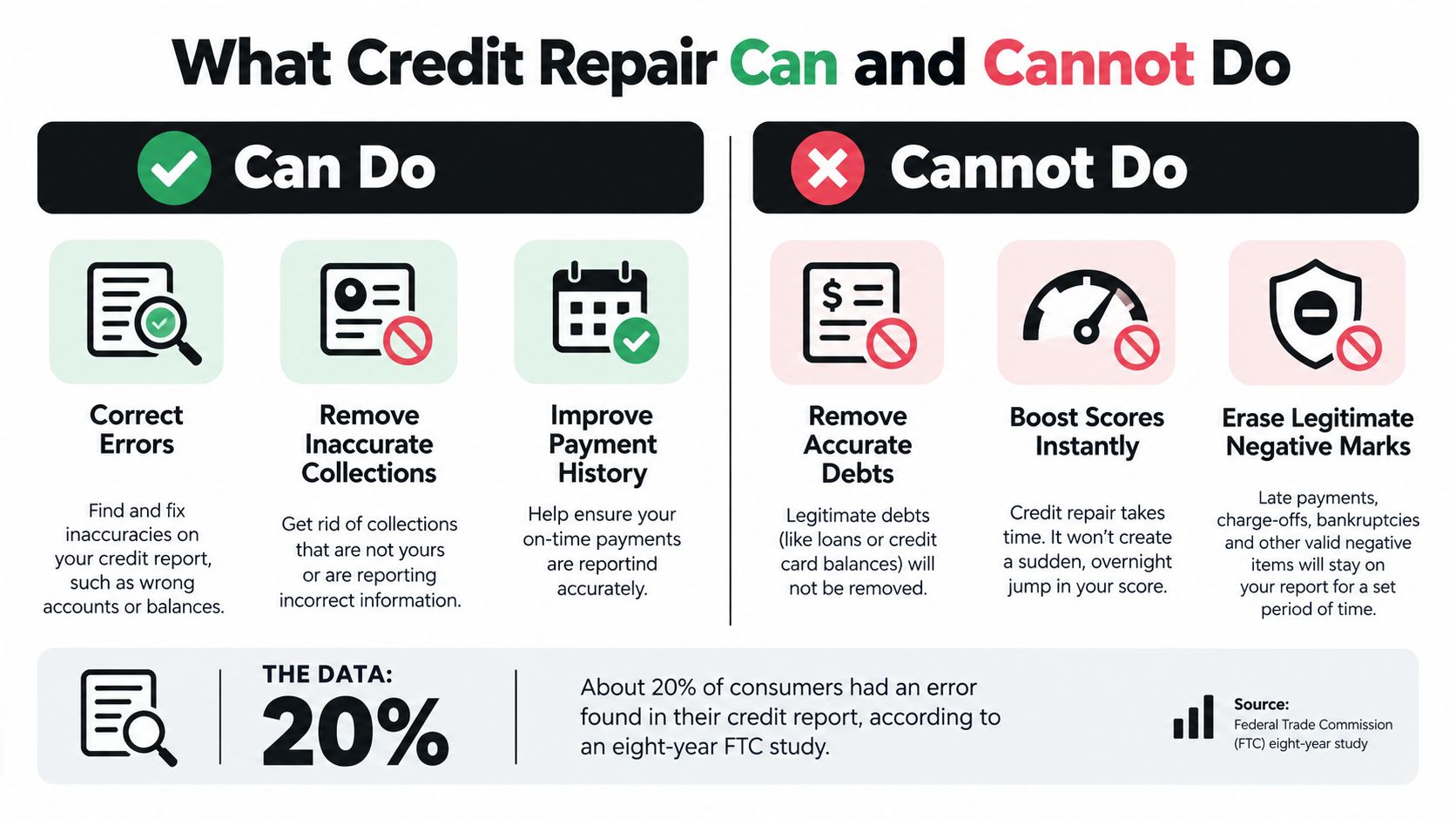
| Can do | Cannot do |
|---|---|
| Help identify and dispute information that is inaccurate, incomplete, outdated, or unverifiable. | Legally remove accurate negative information just because it lowers a score. |
| Help organize records that support a specific, good-faith dispute. | Guarantee that a bureau or creditor will change or delete an item. |
| Support better habits, such as paying on time and managing card balances. | Promise a specific score increase, mortgage approval, or immediate results. |
A charge-off, late payment, or collection that is accurately reported does not become removable just because it creates a challenge for a homebuyer. Even when a bureau corrects a genuine error, other factors may remain. FICO identifies payment history as approximately 35% of a conventional FICO Score calculation and amounts owed as approximately 30% (FICO explanation of score components). Lowering reported card balances can change the utilization signal; that belongs to score rebuilding rather than error correction.
For buyers weighing fixing credit before a mortgage, the practical test is sequence: address verifiable mistakes first, then strengthen payment and balance patterns, then confirm the file meets lender standards. When people expect dispute work to deliver all three outcomes at once, even a legitimate correction can feel like failure.
Common Credit Repair Methods Explained
Legitimate credit work doesn't rely on one tactic for every account. The right approach depends on whether the information is wrong, the account is accurate but difficult to manage, or the consumer needs to explain a past event.
Match the method to the problem
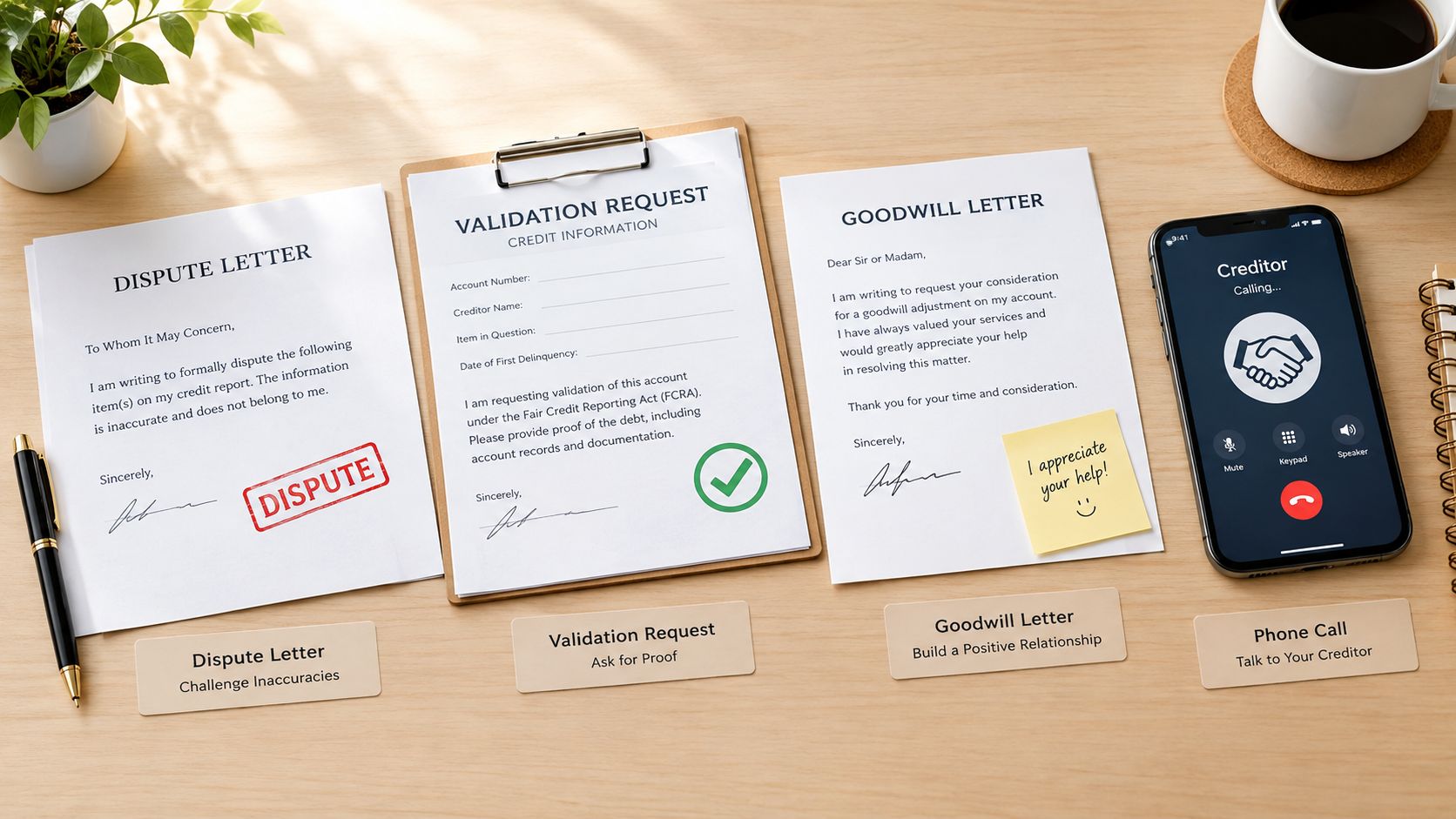
A bureau dispute fits a specific reporting error. If a card balance is wrong or a payment is marked late despite records showing it was on time, explain the discrepancy and provide relevant documents. Avoid disputing information you believe is accurate just to see whether it disappears. The FTC identifies that kind of mass dispute as a warning sign.
A request to validate or clarify a debt can help when you need information about a collection account or don't recognize its details. Ask for records that clarify the account and compare them with your own paperwork. A request for more information isn't proof that the debt is inaccurate, so keep the distinction clear.
A goodwill request asks a creditor to consider an accurate late payment in light of your circumstances and payment history. A creditor may decline, and there's no guaranteed result. The letter should be honest about what happened, explain relevant context, and avoid claiming the report is wrong if it isn't.
A conversation about repayment or settlement may be appropriate for an accurate debt, depending on your finances and lender's guidance. Before agreeing to terms, make sure you understand the arrangement and keep written records. A payment plan doesn't automatically remove accurate negative history from a report.
These approaches shouldn't be blended into one sweeping request to delete all negative accounts. The FTC's Credit Repair Organizations Act information describes consumer protections for people using credit repair services. Whatever method you use, keep the claim specific, truthful, and supported by records.
Credit Repair and Mortgage Readiness
Mortgage readiness is broader than a score or a single disputed account. Lenders consider credit history alongside debt obligations, income, assets, and the rules for the loan program. FHA, VA, conventional, and USDA loans have different requirements, and a lender can explain how those rules apply to your circumstances. A report correction may be useful, but it doesn't resolve every underwriting question.
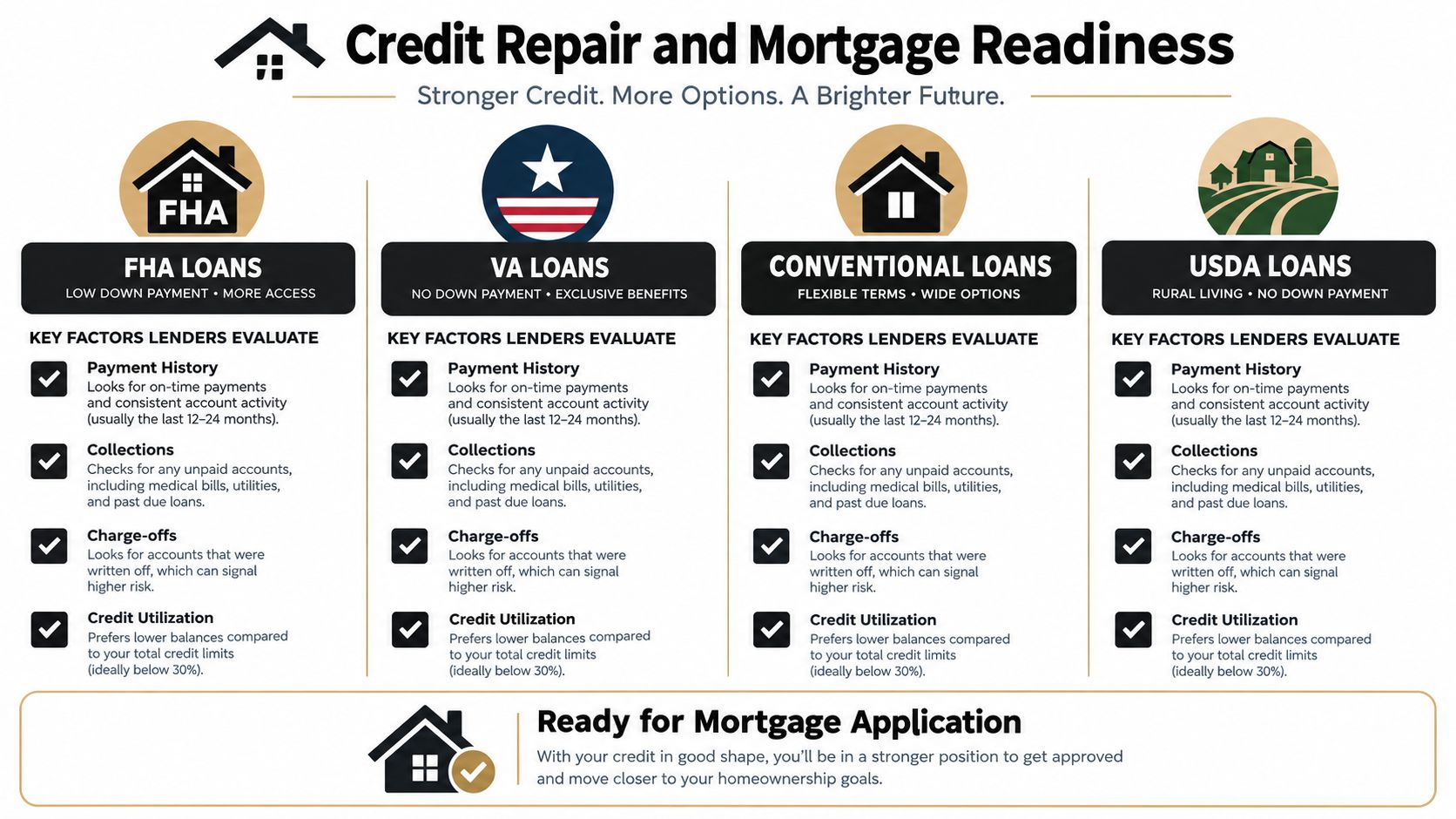
How recent payment patterns and collections matter
For FHA manual underwriting, HUD guidance says an underwriter may view payment history as acceptable when housing and installment payments were made on time during the previous 12 months, with no more than two 30-day late mortgage or installment payments during the previous 24 months. The underwriter also considers why delinquent accounts occurred and documents the analysis in the loan file (HUD guidance on FHA credit history).
Collections need context too. FHA guidance says borrowers must explain collections and judgments in writing, and lenders must document their reasons for approving a mortgage when those accounts are present. HUD also requires a capacity analysis for collection accounts with an aggregate balance of $2,000 or more. When the borrower uses a payment arrangement, the lender needs the agreement, evidence of timely payments, and at least three months of scheduled payments before credit approval (HUD FHA Single Family Housing Policy Handbook).
That doesn't mean every collection should be disputed or that paying an account automatically improves a score. First determine whether the reporting is accurate, then ask the lender how the account affects the application. High utilization, late payments, charge-offs, and debt-to-income concerns may also need attention. For practical guidance on preparing credit for a home loan, coordinate changes with your lender before opening accounts, closing cards, or making decisions that could affect the file.
People researching vacation home buyer assistance may also benefit from planning financing questions early. The same basic lesson applies: clarify the loan requirements and your credit picture before making major decisions.
Realistic Timelines and What to Expect
Credit repair isn't an overnight process. A bureau's investigation generally takes 30 days, and certain circumstances can extend it to 45 days, as explained above. If the result is incomplete or another specific error appears, further review may be needed. Even after a correction, you'll need to check that the updated information appears where expected and allow creditors' reporting cycles to reflect changes.
A dispute outcome is only one milestone. If you're preparing for a mortgage, ask your lender when to review the file again and whether a disputed account affects underwriting. Avoid making major credit changes without checking first. Opening several accounts, closing an older revolving account, or taking on new debt could affect the overall profile the lender reviews.
Keep the reports, letters, supporting documents, investigation results, and updated disclosures together. That record makes it easier to follow what changed and to explain an unresolved issue to a lender.
Consumers should also pay attention to whether a dispute was handled consistently and whether the information changed across reports. Preserve the version of each report you reviewed, then compare it with the updated disclosure. A score notification alone won't show every detail a lender may need.
For a practical way to track credit repair with Superior, focus on documented report changes rather than frequent score checks. The key question isn't just whether a dispute produced an update. It's whether the correction is accurate, properly reflected, and useful to your next financing decision.
Choosing a Compliant Credit Repair Partner
A trustworthy provider should explain what it can review, what evidence may support a dispute, and what outcomes it can't promise. Under the Credit Repair Organizations Act, companies can't demand advance payment, must provide written contracts, and must give consumers cancellation rights. Read the agreement carefully, including the services, costs, and cancellation terms, before proceeding.
Be cautious of promises to delete accurate accounts, produce a specific score increase, or guarantee mortgage approval. A provider shouldn't encourage false statements, false identities, or disputes of information you know is correct. Those tactics don't turn accurate history into an error.
Questions to ask before signing
- What will you review? Ask whether the service includes a line-by-line report review and how it identifies potentially inaccurate items.
- How will disputes be supported? Find out how the company uses your records and shares results with you.
- What will I pay, and when? Review the written terms and make sure the charges are clear.
- Can I do this myself? You can dispute errors directly. Paid assistance may offer organization and education, but it doesn't grant special powers over bureaus or creditors.
For consumers comparing services, this overview of credit repair laws explained by CFPB and the FTC can help frame questions about rights and responsibilities. Superior Credit Repair describes its service as a documentation-based review and dispute process, with transparent billing, no setup fees, no long-term contracts, and payment after work is performed. Its educational guidance may also help clients consider credit habits alongside report corrections, but results vary by file and creditor response.
Frequently asked questions
Can credit repair remove a collection account?
It may help challenge a collection if the reporting is inaccurate, incomplete, outdated, or unverifiable. If the account is accurately reported, a company can't lawfully remove it just because it affects your credit.
Should I dispute every negative item before applying for a mortgage?
No. Dispute information you have a good-faith reason to believe is wrong, and provide relevant records. Ask your lender how an unresolved dispute may affect underwriting before filing or changing an account's status.
Can I improve my credit without hiring a company?
Yes. You can review your reports, file disputes directly, make on-time payments, and manage card balances yourself. Professional help is an option for people who want support organizing their records and understanding a process, not a requirement for exercising their rights.
Superior Credit Repair can review your credit report, help identify inaccurate or questionable items, and explain a step-by-step plan for improving your credit profile. You can request a free credit analysis or consultation to better understand your options. Visit Superior Credit Repair to explore support for credit restoration and mortgage readiness.
If this information helped you better understand your credit report or your next steps, we would appreciate your honest feedback. You are welcome to share your experience with Superior Credit Repair on our Google Business Profile.