
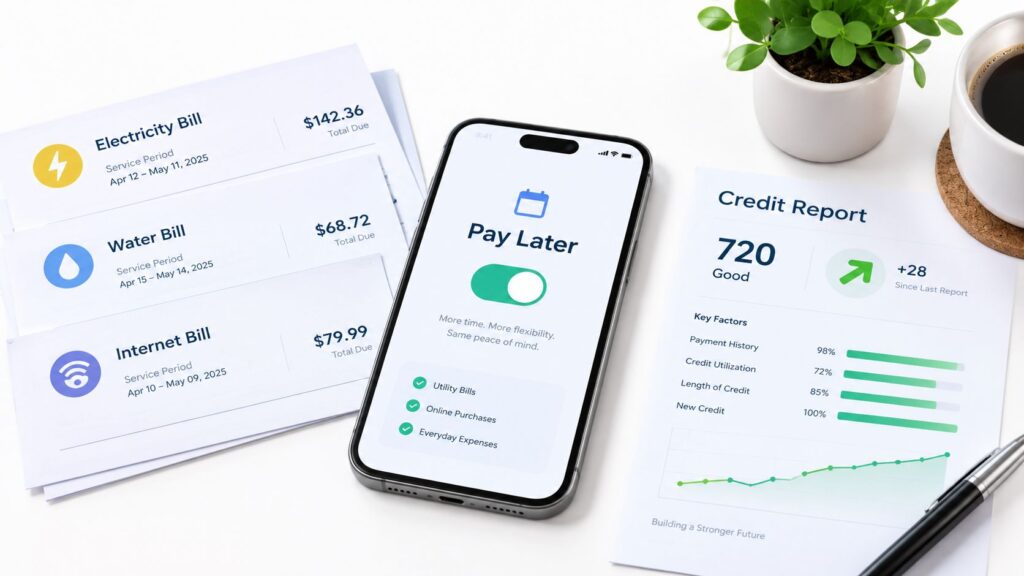
You're standing in the kitchen, checking the balance in your bank account while the electricity bill, phone payment, and medical invoice wait on the counter. Payday is close, but not close enough. A buy now pay later app offers to divide one of those bills into smaller payments, and the option feels like a practical bridge rather than a new loan.
That relief can be real. Buy now pay later for bills can help a household manage the timing of fixed expenses, but it can also turn one difficult payment into several obligations landing together. If those accounts become late, frozen, or sent to collections, the consequences may reach far beyond the original bill, especially when you're preparing for a mortgage.
The right question isn't whether BNPL is always good or bad. It's whether the arrangement fits your cash flow, whether you understand its reporting rules, and whether every account on your credit report is accurate. Credit restoration should never promise a deletion, score increase, or loan approval. It should focus on documentation, lawful disputes, responsible repayment, and a lender-ready credit profile.
Table of Contents
- The Rise of Buy Now Pay Later for Essential Bills
- How BNPL Services Interact with Credit Bureaus
- Weighing the Real Costs and Credit Risks
- Steps to Dispute Inaccurate BNPL Negative Items
- Protecting Your Mortgage Readiness and Loan Approval
- How Superior Credit Repair Helps Rebuild Your Profile
- Common Questions About BNPL and Credit Scores
The Rise of Buy Now Pay Later for Essential Bills
A family may use BNPL after an unusually expensive month. A child needs medical care, groceries cost more than expected, or a utility bill arrives before a paycheck. The household pays part of the obligation today and schedules the rest, expecting the next paychecks to restore the budget.
That pattern has moved beyond online retail. Federal Reserve-linked research estimated that total BNPL transaction value reached about $70 billion in 2025, growing roughly 20% per year since 2021 and representing about 1.1% of total credit card spending. The same research recorded sharp early growth in nominal origination values, followed by continued strong expansion, as reported in CNBC Select's overview of BNPL for bills.
Lenders now market BNPL arrangements for recurring essentials such as electricity, broadband, water, mobile phone service, health insurance, mortgage-related bills, and groceries. Coverage cited survey results showing that 39% of BNPL customers used it for utility bills, 42% for medical or dental expenses, and 46% for groceries (Deferit's bill-payment BNPL resource). These uses reflect a household trying to control timing, not necessarily a shopper chasing a discretionary purchase.
Why the payment feels smaller
Suppose a utility provider requires the full amount by its due date, but your income arrives later. A bill-splitting service may reduce the immediate amount leaving your account. That can help you avoid an immediate nonpayment, but the remaining installments still represent a real obligation.
The risk appears when several services solve several shortfalls at once. One installment may be manageable. Multiple installments, a credit card minimum, rent, and the next utility bill can consume the same future paycheck. A separate LendingTree survey cited in the same bill-payment coverage found that 54% of borrowers said they wouldn't be able to make ends meet without BNPL. That finding shows how closely this product can be tied to household cash-flow stress, rather than simple convenience.
For readers considering buy now pay later credit impact, the practical lesson is simple: record every provider, balance, due date, automatic debit, and fee. A payment plan that protects this month's budget can weaken next month's flexibility, and repeated use may complicate mortgage preparation even before a lender sees a traditional late payment.
How BNPL Services Interact with Credit Bureaus
A family can pay every BNPL installment on time and still gain little or no credit-building value. BNPL reporting does not operate like revolving credit card reporting. Providers often do not report standard pay-in-four payment history to the major credit bureaus, so regular payments may not strengthen a credit profile. The CFPB guidance on BNPL and credit scores explains that ordinary payment activity generally does not affect a score unless the balance moves into collections.
That creates an uneven risk. Positive payment history may remain invisible, while a serious delinquency can lead to account restrictions, collection activity, and credit damage. Some applications also involve credit checks. The impact depends on the provider and product, so read the application disclosures before assuming an inquiry will have no effect.
What may appear on a credit file
A BNPL account may stay absent from the report while payments remain current. If the provider sends an unpaid balance to a debt collector, the collection account may become visible to the bureaus. The CFPB notes that providers may charge late fees, suspend the account, and refer unpaid debt for collection. Once a collector receives the account, credit reporting can lower scores (CFPB guidance on unpaid BNPL balances).
For mortgage preparation, review all three major credit reports instead of searching only for the original BNPL app. Check collection accounts, inquiries, addresses, account names, balances, dates, and comments. Underwriters may also request bank statements or liability documentation, particularly when several short-term obligations compete for the same income.
For context about a major payment platform, see Superior Credit Repair on PayPal reporting. Reporting practices vary by provider and product. An account that is absent today can still create a collection or documentation issue later.
Weighing the Real Costs and Credit Risks
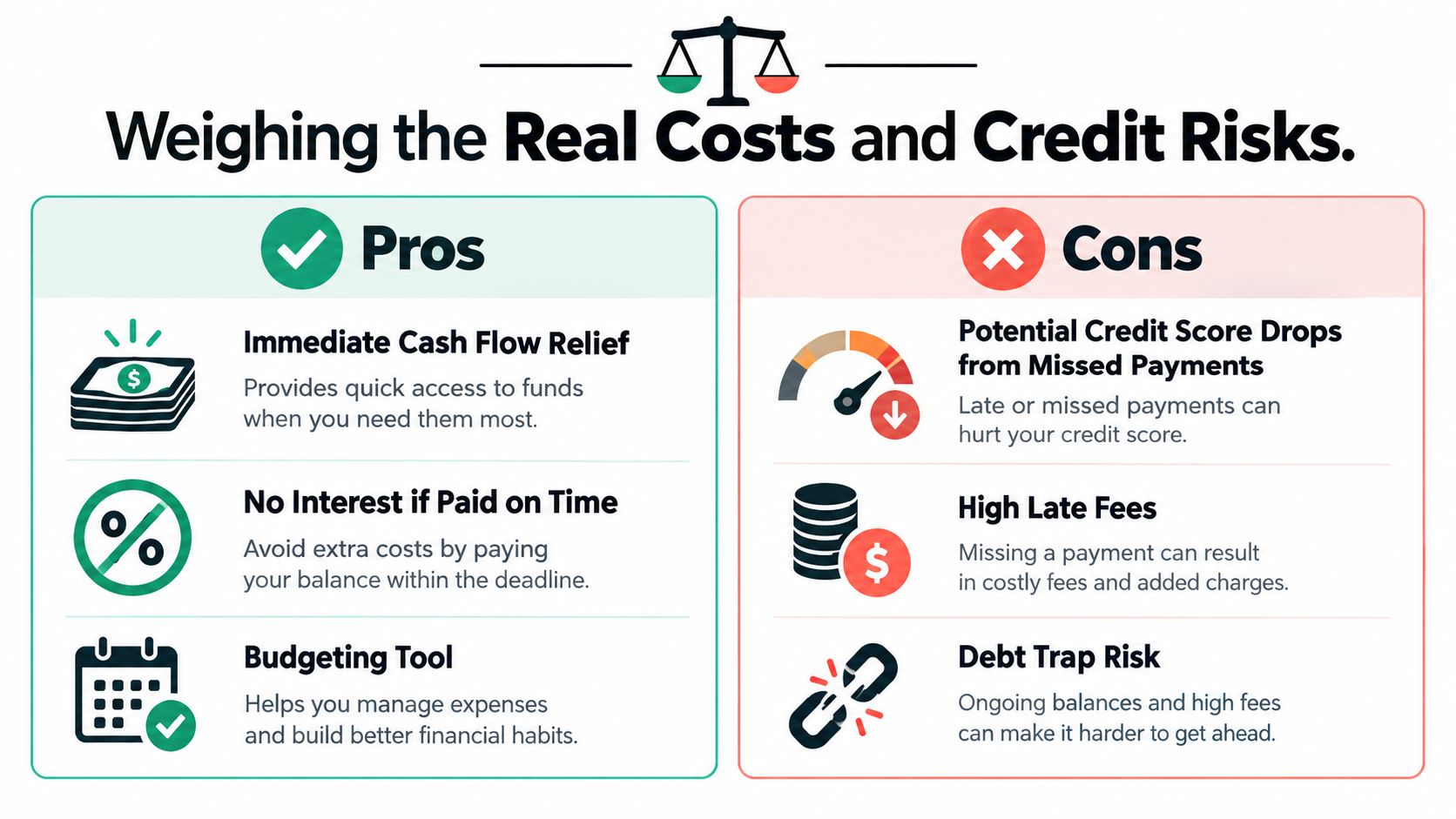
BNPL can offer a narrow benefit: it changes when money leaves your account. It doesn't reduce the underlying bill. Before using it for an essential expense, compare the complete repayment obligation with the consequence you're trying to avoid.
| Question | What to examine |
|---|---|
| Immediate relief | How much cash remains available after the first payment? |
| Total obligation | What will every installment, fee, and financing charge cost? |
| Timing pressure | Do future payments land before your next reliable income? |
| Bill consequence | Would the original provider charge a late fee, restrict service, or begin another collection process? |
| Credit exposure | What happens if the BNPL balance becomes delinquent or reaches collections? |
Some products advertise no interest when paid on time. Other arrangements can include financing charges. Federal Reserve reporting in 2026 noted that some products carried late fees of $7 to $8 per payment and that total financing charges could reach 36% (Federal Reserve overview of BNPL products). Those costs may compare differently with a utility late charge, a shutoff consequence, a rental penalty, or a credit card minimum payment. You need the specific terms for your account before deciding.
When stacking becomes the problem
A household may use one service for electricity, another for broadband, and another for groceries. Each obligation appears small in isolation, but all three can debit during the same pay period. If income is irregular, an automatic payment can overdraw the account, trigger a fee, or cause the next payment to fail.
A German consumer survey cited by BaFin found that 14% of BNPL users had lost track of outstanding bills and installments, rising to 24% among users under 30, while 26% had paid late fees because a bill or installment was late (BaFin's BNPL consumer article). U.S. CFPB data also reported that 4.1% of BNPL loans were assessed a late fee in 2023, with late-fee revenue equal to 0.18% of total origination, as described in the same BaFin resource.
A practical rule is to treat every BNPL plan as a separate bill in your budget. If you can't identify the payment source for every due date, don't add another plan until the existing obligations are under control. Readers seeking credit repair for BNPL users should also preserve statements and payment confirmations before disputing any reporting.
Steps to Dispute Inaccurate BNPL Negative Items
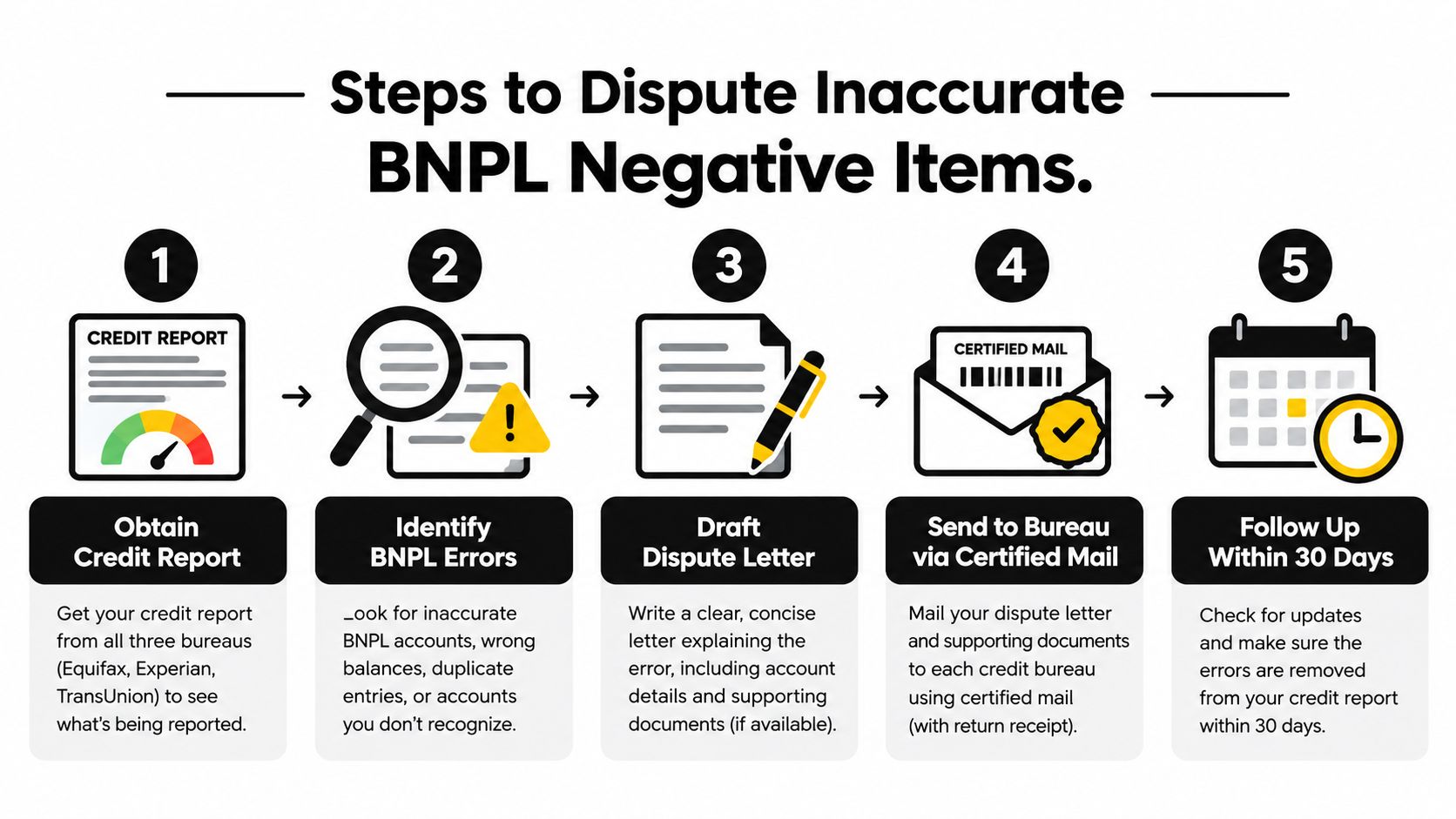
A family preparing for a mortgage may see a BNPL collection that looks like another small bill. Its effect can be larger if the account is inaccurate, duplicated, or tied to the wrong person. A legitimate late payment or collection may remain reportable, so a lawful credit repair process must identify a specific error, such as information that is inaccurate, outdated, incomplete, misleading, or unverifiable.
Start with documents, not assumptions
Order your credit reports from the major bureaus and create a separate file for each BNPL account. Collect the original agreement, billing statements, payment confirmations, bank records, emails, collection notices, and proof of payment, cancellation, duplicate billing, or identity error. These records turn a general complaint into a fact-based request.
Review each entry line by line:
- Confirm ownership. Check your name, address, account details, and identity against the reported obligation.
- Compare the balance. Look for payments, refunds, credits, or cancelled services missing from the reported amount.
- Review dates. Match the alleged delinquency date, collection placement date, and account status with your records.
- Test duplication. Check whether the original provider and a collector are reporting the same balance in a misleading way.
- Separate fact from disagreement. State the reporting error clearly. Difficulty repaying a valid debt is not, by itself, a reporting error.
The CFPB BNPL FAQ explains that, for certain pay-in-four arrangements, a required minimum periodic payment may not be treated as late if received within 14 calendar days after the statement was mailed or delivered. Compare that timing with the statement date, payment confirmation, and any reported late status before disputing the entry.
Send a focused dispute
Write to the credit bureau reporting the item and, when appropriate, to the data furnisher or collector. Identify the account, describe the exact error, list the enclosed records, and request an investigation and correction. Keep a copy of everything, along with proof of delivery and the date sent.
The Richmond Fed explains that, in May 2024, BNPL lenders were classified as credit card providers under Regulation Z for certain purposes, including dispute investigations, billing statements, and credits for returned or cancelled services (Richmond Fed's explanation of the Regulation Z treatment). This classification does not guarantee deletion. It supports using the formal billing and dispute procedures that apply to the transaction.
The Superior Credit Repair letter guide can help organize the account details, error explanation, and supporting documents. Avoid sending identical disputes repeatedly without new evidence. Track the recipient, delivery date, documents enclosed, response, and next action.
Documentation principle: A precise dispute supported by records is stronger than a broad demand for removal.
If the furnisher verifies the information as accurate, consider repayment arrangements, written settlement terms, budgeting, and positive credit habits. Results depend on the credit file, available documentation, creditor response, account history, and current credit behavior.
Protecting Your Mortgage Readiness and Loan Approval
Mortgage underwriting is broader than a credit score. A lender reviews payment history, reported debts, collections, balances, income, assets, and the consistency of your financial behavior. BNPL may create a fragmented picture because several small obligations can sit outside the traditional credit account view while still reducing the money available for housing expenses.
This matters for FHA, VA, USDA, and conventional mortgage preparation. Each loan program has its own underwriting rules, but all lenders need a reliable view of liabilities and repayment capacity. A collection tied to a BNPL account can raise a creditworthiness issue. Repeated account use can also prompt questions about cash flow, especially if bank statements show frequent short-term borrowing or automatic debits.
Prepare before the application
Start mortgage credit repair well before you submit an application. Pull your reports, list every BNPL account, resolve inaccurate entries, and stop opening new plans while your lender is evaluating your file. Keep balances and payment obligations organized so you can explain them accurately if asked.
Pay particular attention to:
- Collections and charge-offs: Verify ownership, dates, balances, and documentation before choosing a response.
- Late payments: Confirm whether the reported timing matches statements and payment records.
- Credit utilization: High revolving balances can make the profile appear pressured, even when BNPL accounts aren't reported in the same way.
- Debt-to-income concerns: Include every recurring obligation in your personal budget, whether or not it appears on a standard report.
- File stability: Avoid unnecessary new accounts, unexplained deposits, and payment changes during underwriting.
A future homeowner should also understand the broader cost of borrowing and ownership. For tax-related questions about eligible mortgage interest, the home mortgage interest tax guide from Allied Tax Advisors is a useful resource, but tax guidance doesn't replace mortgage underwriting or credit advice.
Think beyond closing
A lender-ready profile should remain stable after approval. New BNPL obligations taken on immediately after purchasing a home can strain the budget for utilities, repairs, insurance, and reserves. Planning for BNPL and post-closing credit stability helps protect the financial foundation you worked to establish.
Congress introduced H.R. 9275 in June 2026, and Illinois enacted a BNPL lender registration law in June 2026, signaling that consumer protections and reporting practices are still developing (New York Times coverage of BNPL regulation and household credit). Because rules can change, read current disclosures and ask your loan officer how the lender wants BNPL obligations documented.
How Superior Credit Repair Helps Rebuild Your Profile
A responsible credit restoration process doesn't begin with a promise. It begins with a review of the reports, account records, and consumer's goals. For a family preparing for a mortgage, that may mean examining BNPL collections alongside credit card utilization, medical collections, late payments, charge-offs, repossessions, and debt-to-income concerns.
Superior Credit Repair provides credit restoration services built around documentation and legal dispute procedures. Its stated process includes reviewing inaccurate, outdated, unverifiable, or misleading information, explaining possible dispute strategies, and supporting stronger long-term credit habits. The company reports 20+ years of experience, BBB accreditation, nationwide service, no setup fees, no long-term contracts, and pay-as-you-go billing after work is performed.
What a careful review should identify
A useful review separates correct information from questionable reporting. It may ask whether a BNPL collection belongs to you, whether the balance reflects payments or refunds, whether the dates are consistent, and whether the same debt appears more than once. It should also distinguish a legitimate negative item from one that lacks adequate verification.
Credit rebuilding extends beyond disputes. A practical plan may include:
- Utilization planning: Creating a repayment strategy for revolving balances.
- Positive account guidance: Understanding secured or starter credit cards and responsible account management.
- Thin-file support: Learning how positive payment activity can be developed through appropriate products.
- Mortgage timing: Deciding when the file is stable enough to discuss FHA, VA, USDA, or conventional financing.
- Budget controls: Tracking BNPL and other obligations so new late payments don't undermine progress.
Superior Credit Repair can be one option for consumers who want help reviewing BNPL-related reporting and organizing a credit improvement plan. No company can lawfully guarantee deletions, an immediate score increase, a specific score outcome, or mortgage approval. Results depend on the facts, evidence, furnisher responses, account history, and future payment behavior.
A sound credit strategy corrects the record where needed and strengthens the habits that keep the record healthy.
Families should ask what work will be performed, how disputes will be documented, what fees apply, and what the company can and cannot promise. Compliance-focused credit repair is a process, not a shortcut.
Common Questions About BNPL and Credit Scores
Does paying BNPL on time build my credit?
Usually, standard pay-in-four payment history is not reported to major credit bureaus, so on-time payments may not build a traditional credit score. The CFPB credit-score guidance explains that ordinary payment activity generally does not affect the score unless the debt reaches collections. Providers and products differ, so read the disclosure before enrolling.
Can a missed BNPL payment hurt my credit?
Yes. A provider may charge fees, restrict further purchases, or send an unpaid balance to collections. Once reported, a collection account can lower your score and create another debt for a lender to review.
What does the 14-day rule mean?
For some pay-in-four arrangements, a required minimum payment may not be treated as late if received within 14 calendar days after the statement was mailed or delivered, according to the CFPB BNPL FAQ. Check your statement and agreement because the rule depends on the product and arrangement.
Will closing a BNPL account remove it from my report?
No. Closing an account does not erase accurate credit-report information. If an entry is inaccurate, incomplete, outdated, duplicated, or unverifiable, dispute that specific error with records. Accurate history remains.
Should I use BNPL while preparing for a mortgage?
Use caution. BNPL can divide one household obligation into several payment dates, like placing small leaks across the monthly budget. Even when routine payments are not reported like traditional loans, the obligations can affect cash flow and may require documentation during underwriting.
Before applying, review your reports, address inaccurate collections, limit new obligations, and ask the lender how BNPL payments enter its debt analysis. Mortgage readiness depends on a clear, supportable financial picture, not only the score.
Superior Credit Repair can review BNPL-related reporting and explain possible next steps. Visit Superior Credit Repair for a credit analysis or consultation. No company can guarantee deletions, a score increase, or mortgage approval.
Share your experience on the Google Business Profile.