

For most USDA home loans, the standard benchmarks are a 29% housing ratio and a 41% total debt ratio, but those numbers are guidelines, not always hard stop rules. Some borrowers can still qualify above those benchmarks depending on the underwriting path, the lender's internal rules, and whether strong compensating factors are present.
If you're trying to buy a home in a rural or eligible suburban area, this is probably the part that feels confusing. You may have heard one lender say your numbers look fine, while another says your debt is too high. That doesn't always mean someone made a mistake. It usually means they looked at your file through a different approval path.
For first-time buyers, the debt to income ratio USDA uses can feel more stressful than the credit score itself. A buyer may have decent income, manageable rent, and a home payment that seems affordable, yet still run into trouble because of credit card minimums, a car loan, or student loan obligations. That's why it helps to slow the process down and look at USDA debt-to-income rules the same way an underwriter does.
Table of Contents
- How USDA Loans Really Look at Your Debt to Income Ratio
- What Counts as Income and Debt for a USDA DTI Calculation
- USDA DTI Calculation Examples That Show the Rule in Action
- GUS, Manual Underwriting, and Lender Overlays Explained
- Smart Ways to Lower Your Debt to Income Ratio Before Applying
- Compensating Factors and Refinance Rules Most Buyers Miss
- Your USDA Loan Readiness Plan and How Superior Credit Repair Helps
How USDA Loans Really Look at Your Debt to Income Ratio
You can see why this gets confusing. Two buyers can have the same income, the same car payment, and the same target house, yet one gets a green light and the other gets told to pay down debt first.
The reason is simple. USDA does not look at your mortgage payment in isolation. It looks at your whole monthly picture, then weighs that picture through a specific approval path.
The two USDA ratios that matter
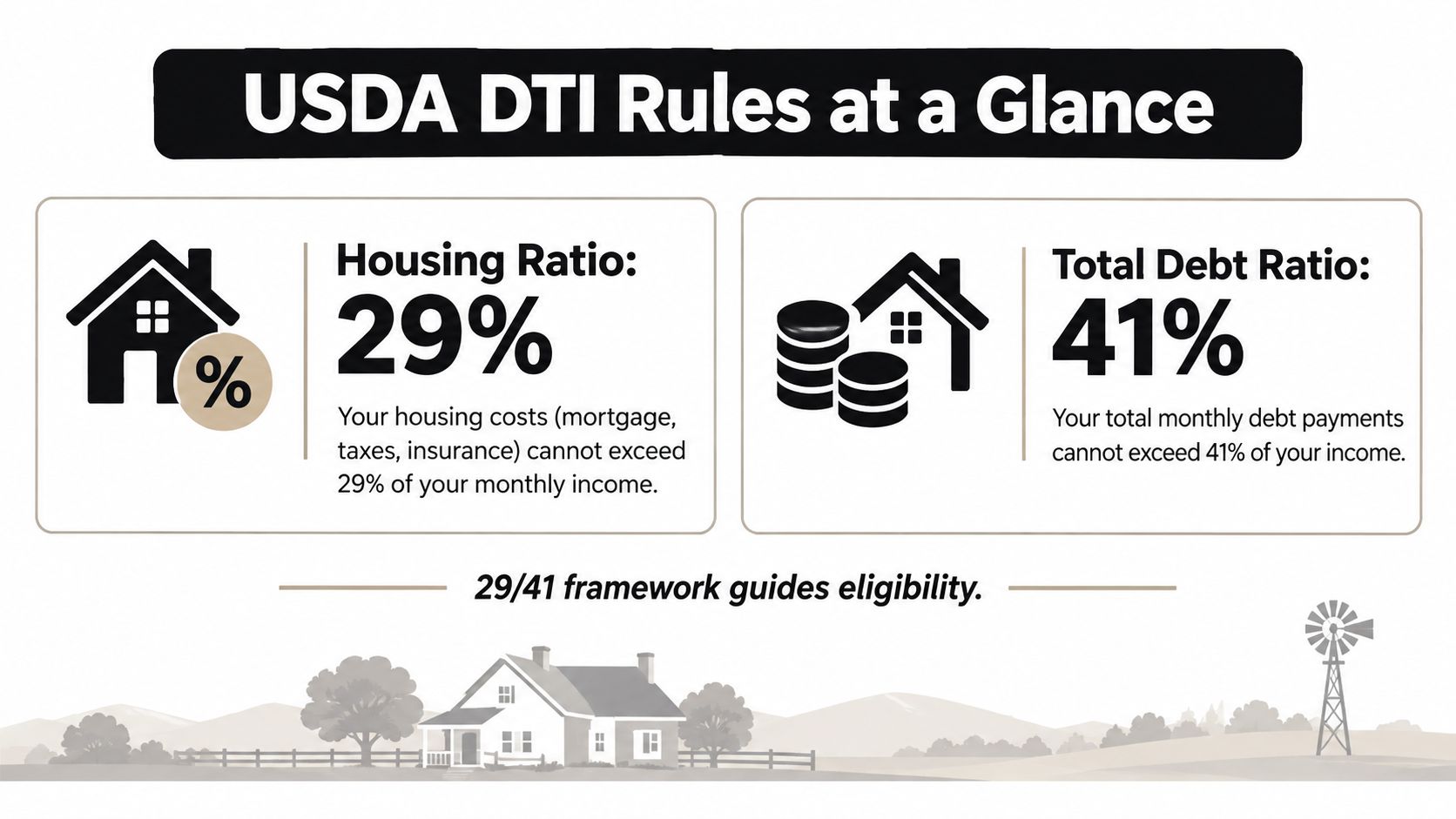
USDA guaranteed loan guidance uses two standard repayment benchmarks: monthly housing costs at 29% of repayment income and total monthly debt at 41% of repayment income, according to the USDA single-family housing ratio guidance.
Those two ratios answer two different questions.
- Housing ratio: Can your monthly home payment fit your income on its own?
- Total debt ratio: Can your home payment still fit after your other required monthly debts are added in?
A helpful way to picture it is a grocery budget. One extra item might seem affordable by itself. The full cart is what decides whether you stay within budget. USDA applies the same logic to a mortgage. The house payment may look fine alone, but the approval decision also depends on the rest of the bills already in your cart.
Why the same borrower can get different answers
USDA's current underwriting chapter says a borrower generally shows repayment ability when housing costs stay at or below 29% and total debt stays at or below 41%. It also allows higher ratios in some cases when strong compensating factors are documented, with purchase files capped at 34% for the housing ratio, as explained in the current USDA chapter guidance.
That is why one lender may say your file looks workable while another says the ratio is too high.
The difference often comes from four places:
- GUS findings: An automated approval can be more flexible than a file that has to be reviewed by hand.
- Manual underwriting: A manual review usually applies tighter ratio limits unless the file has strong strengths elsewhere.
- Lender overlays: Some lenders add stricter internal rules on top of USDA's baseline rules.
- Loan purpose: A purchase file and a refinance file can be judged under different ratio and documentation standards.
For a first-time buyer, that means your debt to income ratio is not just one number. It is one number interpreted through a specific lane.
What lenders are really trying to measure
Lenders use DTI to estimate payment strain. They want to know whether the new mortgage leaves enough room for the debts you already have to carry every month.
That is where credit profile decisions become practical, not theoretical. Paying off a small credit card can improve the total debt ratio. Lowering a student loan payment can matter if underwriting is allowed to use the updated obligation. Avoiding a new auto loan before applying can keep a file in the automated lane instead of pushing it into manual review.
So the USDA question is not just, “What is your ratio today?” It is, “Which approval path does your current mix of income, debt, credit history, and lender rules place you in?”
What Counts as Income and Debt for a USDA DTI Calculation
A borrower can earn a solid salary and still get tripped up here because USDA does not count money and bills the way a household budget app does. It sorts each item into two buckets. Money that is stable enough to rely on. Payments that are required often enough to strain the monthly budget.
A simple way to picture it is a seesaw. One side holds usable monthly income before taxes. The other side holds required monthly payments, including the new housing payment. If income is irregular, hard to document, or too new, it may not carry its full weight. If a debt shows up as a required monthly obligation, it usually goes on the other side even if the balance itself is small.
That distinction matters because two borrowers with the same paycheck can end up with different USDA DTI results based on credit choices they still have time to change. One person may have a low credit card balance but a high required minimum payment. Another may have side income that feels real in daily life but cannot be counted fully yet. The numbers on paper can shift long before income changes.
What usually counts as debt
For USDA DTI, lenders focus on bills that come due again and again. The question is not, “How much do you owe in total?” The question is, “What must be paid each month if this loan closes?”
That usually includes:
- New housing payment: Principal, interest, property taxes, homeowners insurance, and applicable guarantee fee or similar loan costs included in the payment
- Credit cards: The minimum payment shown on the credit report or account statement
- Auto loans and leases: The required monthly payment
- Student loans: The monthly amount the lender is allowed to use for underwriting
- Installment loans: Personal loans, furniture loans, and other fixed monthly debts
- Child support or alimony: Court-ordered or otherwise required recurring obligations
- HOA or condo dues: If the property requires them
Voluntary spending usually does not belong in the ratio. Groceries, gas, utilities, childcare, and streaming services affect your real-life budget, but they are not typically part of USDA DTI because they are not installment or revolving debt payments reported and underwritten the same way.
What usually counts as income
Income needs to be stable, documented, and likely to continue. For a salaried employee, that can be straightforward. For a borrower with overtime, bonuses, part-time work, seasonal income, commission income, or self-employment income, the lender often has to study the history and decide what average monthly figure is safe to use.
That is why a strong recent month does not always solve the problem.
If your hours bounce around, the underwriter may average them over time instead of using your highest pay period. If you recently started a side job, that income may help later but not right away. If you are self-employed, tax return income often matters more than gross business deposits.
A quick way to separate counted items from ignored items
| USDA Income and Debt Inputs | Usually Counted | Usually Not Counted |
|---|---|---|
| Income side | Stable pay that can be documented and expected to continue | Income with little history or weak documentation |
| Debt side | Required recurring monthly obligations | One-time bills or irregular personal expenses |
| Credit cards | Minimum required payment | Extra amount you choose to pay above the minimum |
| Installment debts | Monthly payment amount | Total balance alone |
Why the same borrower can get different DTI treatment
Credit profile decisions become practical.
Suppose a borrower pays $400 a month toward a credit card to wipe it out fast, but the required minimum is only $75. USDA DTI usually cares about the $75, not the extra $325. On the other hand, if that same borrower takes on a new car loan right before applying, that new required payment can change the file immediately.
Student loans create similar confusion. The payment used for underwriting may depend on the approval path and the documentation available. A documented lower payment can help in one file, while another file may be forced into a more conservative calculation. That is one reason borrowers should not assume an online calculator tells the whole story.
Purchase and refinance files can also land differently. A purchase borrower may be judged with one set of documentation and approval options, while a refinance borrower may have different ratio flexibility or reserve expectations. Add lender overlays to the mix, and the same person can look acceptable at one lender and tight at another.
If you want a basic formula refresher before sorting out these USDA-specific details, the Superior Credit Repair DTI guide gives a plain-English foundation.
And if you have gone through major financial stress before, it helps to see how other systems define income and obligations differently. This overview of Athens bankruptcy qualification explained shows that the label “income” or “debt” can change depending on the rules being applied.
USDA DTI Calculation Examples That Show the Rule in Action
The easiest way to understand USDA DTI is to run the numbers. Once you see the formula in action, most of the confusion disappears.
Example one that fits comfortably
Borrower A has:
- Monthly income: $5,200
- Monthly housing payment: $1,200
- Car payment: $300
- Credit card minimums: $200
Housing ratio calculation:
- $1,200 ÷ $5,200 = about 23%
Total debt calculation:
- $1,200 + $300 + $200 = $1,700
- $1,700 ÷ $5,200 = about 33%
This borrower sits below the standard USDA benchmarks for both housing and total debt. On paper, that file usually looks much easier to underwrite because there's room in the budget.
Example two that runs into a problem
Borrower B has:
- Monthly income: $4,500
- Monthly housing payment: $1,400
- Auto loan: $450
- Student loan: $250
- Credit card minimums: $180
Housing ratio calculation:
- $1,400 ÷ $4,500 = about 31%
Total debt calculation:
- $1,400 + $450 + $250 + $180 = $2,280
- $2,280 ÷ $4,500 = about 51%
This borrower is above the standard benchmark on both sides. Even before anyone talks about lender overlays or underwriting style, the file is under pressure because the recurring monthly obligations already consume too much of the available income.
| Two USDA DTI Scenarios Compared | Borrower A (Qualifies) | Borrower B (Fails) |
|---|---|---|
| Monthly income | $5,200 | $4,500 |
| Housing payment | $1,200 | $1,400 |
| Other recurring debt | $500 | $880 |
| Housing ratio | 23% | 31% |
| Total debt ratio | 33% | 51% |
| Likely outcome | Within standard USDA benchmark | Outside standard USDA benchmark |
A borrower can feel “close” based on the house payment alone and still be far outside the workable range once the full monthly debt picture is included.
How to use this for your own file
Start with the proposed housing payment. Then add every recurring monthly debt listed on your credit report or disclosed to the lender. Divide each total by monthly income.
If you want a basic worksheet-style tool to compare numbers and practice the math, the Superior Credit Repair DTI guide can help you organize the payment side before you apply.
GUS, Manual Underwriting, and Lender Overlays Explained
Many borrowers think USDA either approves or denies them directly. That's not how it feels in practice. Approved lenders evaluate the file under USDA guidelines, and the path used to review the file matters a lot.
GUS is the automated path
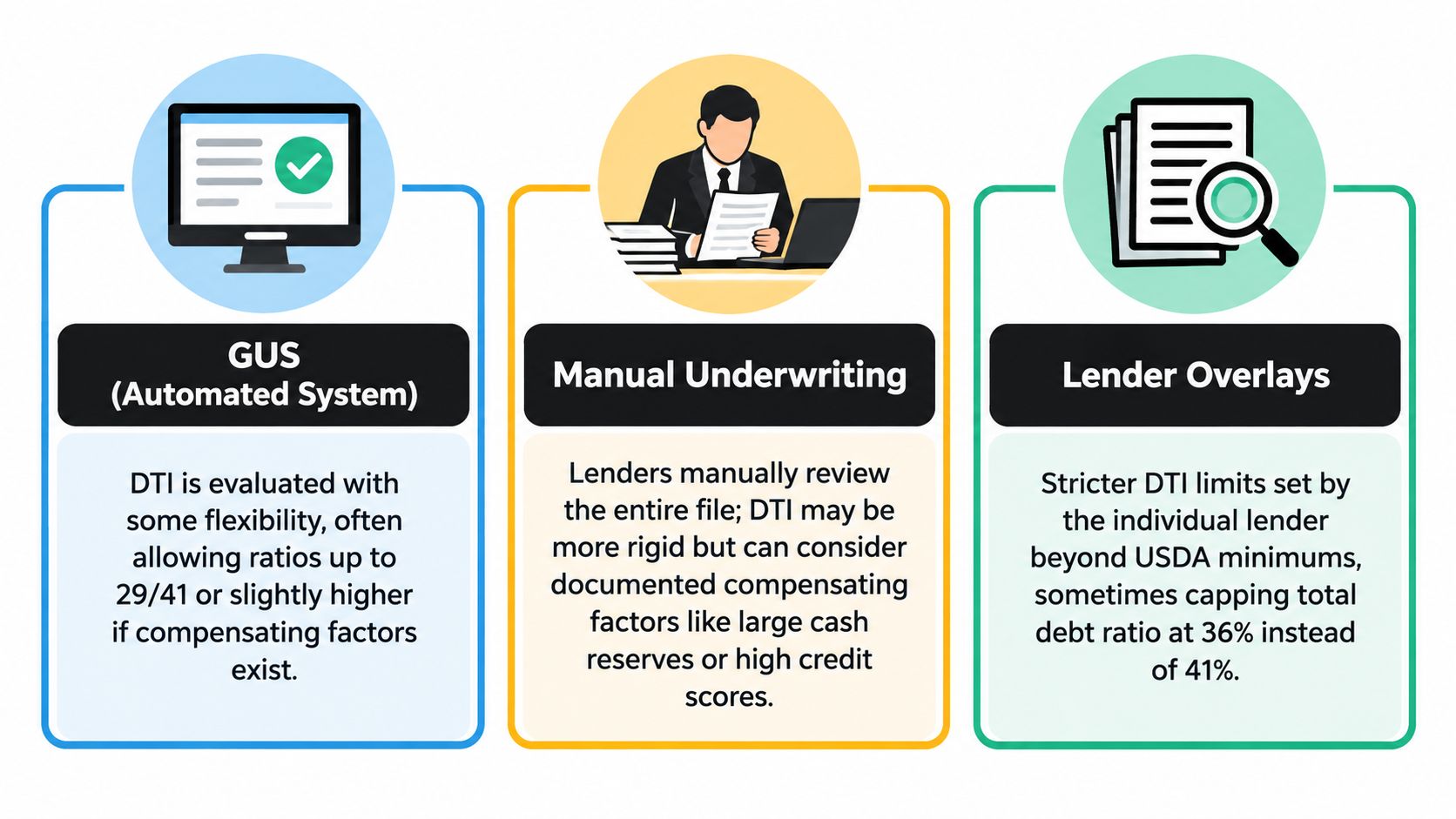
GUS stands for the USDA's automated underwriting system. It looks at the whole file, not only the ratio. Neutral lender guidance notes that an automated underwriting “Accept” can allow ratios above 29/41 without a separate waiver in some cases, while manually underwritten files may require compensating factors and may also face lender-specific overlays, as outlined in these USDA underwriting guidelines.
That's why two borrowers with similar debt numbers can get different results. The automated system may view one file as lower risk because of the overall profile.
Manual underwriting is more hands-on
When a file doesn't receive the right automated recommendation, a human underwriter may review it manually. Manual underwriting often means more scrutiny. The underwriter may ask tougher questions about payment history, reserves, employment stability, or whether the borrower has enough margin in the budget after all debts are paid.
A manual review isn't automatically worse. It's just less forgiving of weak spots that an automated system might have balanced differently.
Lender overlays sit on top of USDA rules
A lender overlay is a stricter internal rule. USDA may allow something in principle, but the lender may decide they won't.
Common overlay issues include:
- Stricter ratio tolerance: The lender may want more cushion than the baseline
- Tighter credit expectations: A file with recent credit issues may get less flexibility
- Additional documentation rules: Some lenders want more support for income or debt treatment
Important distinction: USDA guidelines set the floor. A lender can still set a stricter house rule above that floor.
This is one reason shopping with more than one USDA-approved lender can matter. If one lender applies heavier overlays, another may evaluate the same file differently. Before you get far into the process, it also helps to understand the broader requirements to qualify for USDA loans so you're not focusing on DTI alone.
Smart Ways to Lower Your Debt to Income Ratio Before Applying
Most borrowers can't change their DTI overnight, but they can improve it with targeted moves. The best strategy is to focus on the monthly payments that drive the ratio, not just the balances that look emotionally frustrating.
Focus on recurring payments first
If a debt doesn't create a meaningful monthly obligation, paying it may not improve DTI much. But if a debt carries a required monthly payment, reducing or eliminating that payment can make a direct difference.
Useful moves often include:
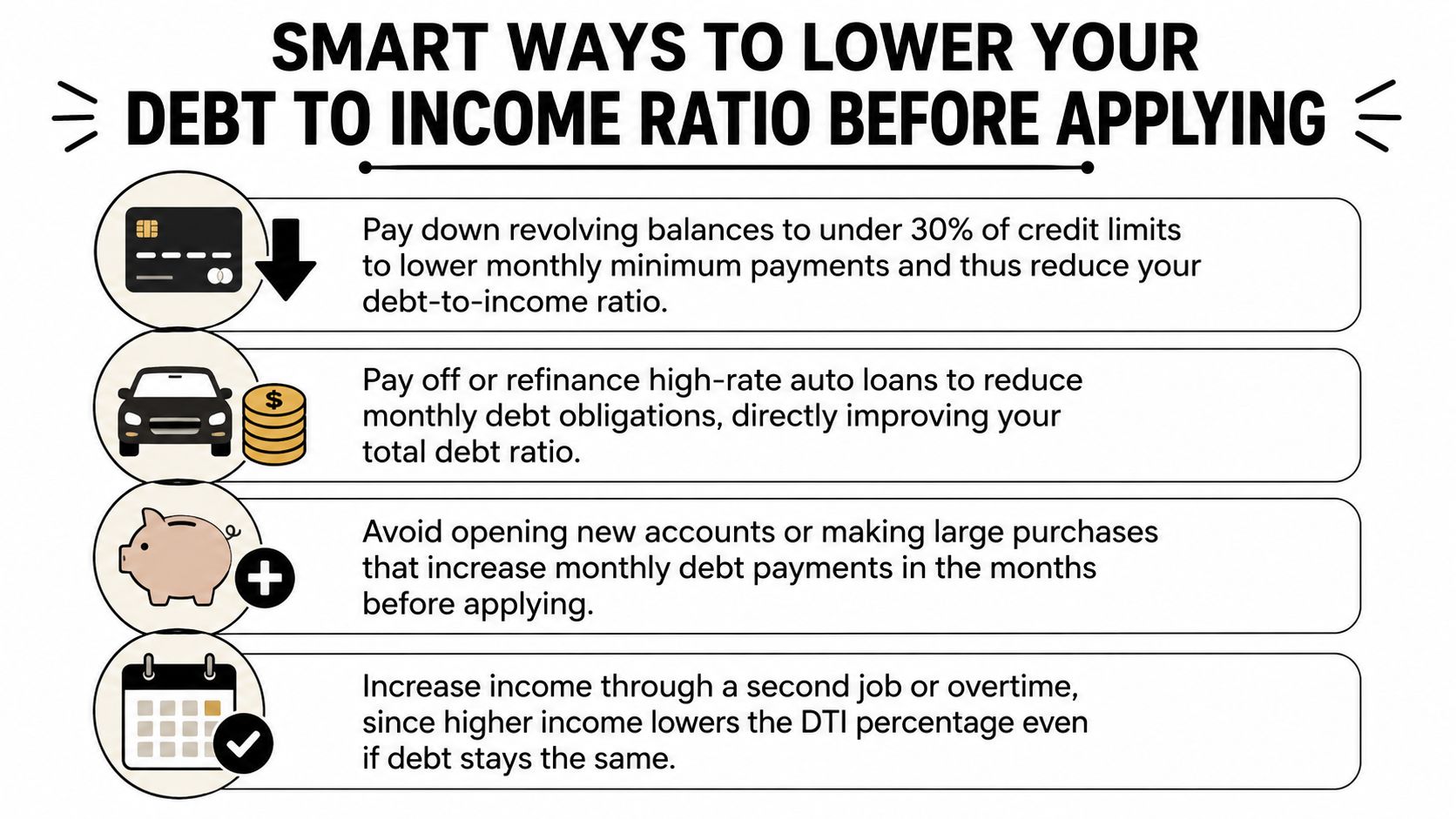
- Pay down revolving accounts: Lower card balances can reduce the minimum payment and may also help your credit profile.
- Pay off a small installment loan: Removing one required monthly payment can improve the total ratio immediately.
- Avoid new financed purchases: A car loan, furniture financing, or new personal loan can change the file fast.
- Review student loan reporting carefully: If the reported payment is higher than it should be, documentation matters.
Don't ignore the income side
Some borrowers fixate on debt and forget the denominator. If you have stable overtime, part-time income, or other documented qualifying income, better documentation may improve the calculation without changing the debt itself.
That doesn't mean every extra dollar will count. It means sloppy documentation can hurt a file that might otherwise work.
Watch timing, not just intent
A payoff you plan to make later doesn't always help the file today. Underwriters work from documented statements, credit reports, and verifiable records. If your monthly obligations changed recently, give those updates time to show up in the places the lender will review.
For buyers trying to clean up spending patterns before applying, a simple budgeting tool like our spending tracker tool sessions budget smarter can help identify payments that are inflating monthly obligations. If you need more practical ideas for reducing the ratio before a mortgage application, this guide on how to fix a high debt ratio is a useful next step.
Compensating Factors and Refinance Rules Most Buyers Miss
A low DTI helps, but it doesn't guarantee approval. A higher DTI can hurt, but it doesn't always end the conversation either. The details around compensating factors and refinance rules are where many buyers get surprised.
Compensating factors can change the outcome
USDA guidance allows some flexibility when the rest of the file is strong. As noted earlier in USDA guidance, the total debt ratio may go to 44% in some cases with strong compensating factors, and the housing ratio may exceed 29% subject to the purchase cap already discussed in the earlier section.
Compensating factors often include things like:
- Stronger cash reserves
- Stable employment history
- A lower housing burden relative to total debt
- A cleaner recent payment record
- Overall file strength that reduces repayment risk
What matters is not just that a positive factor exists, but that the lender can document it clearly enough to support the file.
Refinance and purchase files aren't always treated the same
This is another area where online summaries often blur important differences. Mortgage-industry coverage notes that lenders still commonly reference 41% back-end DTI as the baseline, while some are discussing exceptions into the mid-40s with compensating factors. That same coverage also notes that some refinance discussions cite up to 46% for certain existing USDA refinance situations, and it highlights rural debt pressure more broadly, including a projected $605.1 billion farm-sector debt figure in 2026, in this mortgage-industry USDA overview.
That doesn't mean every refinance borrower gets more flexibility. It means loan purpose can affect how the lender evaluates the file.
| USDA Purchase vs Refinance DTI Considerations | Typical DTI Flexibility | Key Compensating Factors | Notable Rules |
|---|---|---|---|
| Purchase | Often benchmarked around standard USDA ratios, with some flexibility depending on approval path | Stable income, reserves, cleaner credit profile, stronger overall file | Underwriting path and lender overlays matter a lot |
| Refinance | May be evaluated differently depending on product and lender interpretation | Existing payment history, documented benefit of refinance, file strength | Product-specific rules can differ from purchase rules |
Why this matters for buyers with credit issues
A borrower with old collections, disputed balances, or reporting issues may think the problem is “my score.” Sometimes the more immediate issue is that those accounts affect the lender's view of monthly obligations or overall file stability.
If you're dealing with older negative items while preparing for USDA financing, this USDA loan readiness guide can help you think through what still needs attention before underwriting.
Your USDA Loan Readiness Plan and How Superior Credit Repair Helps
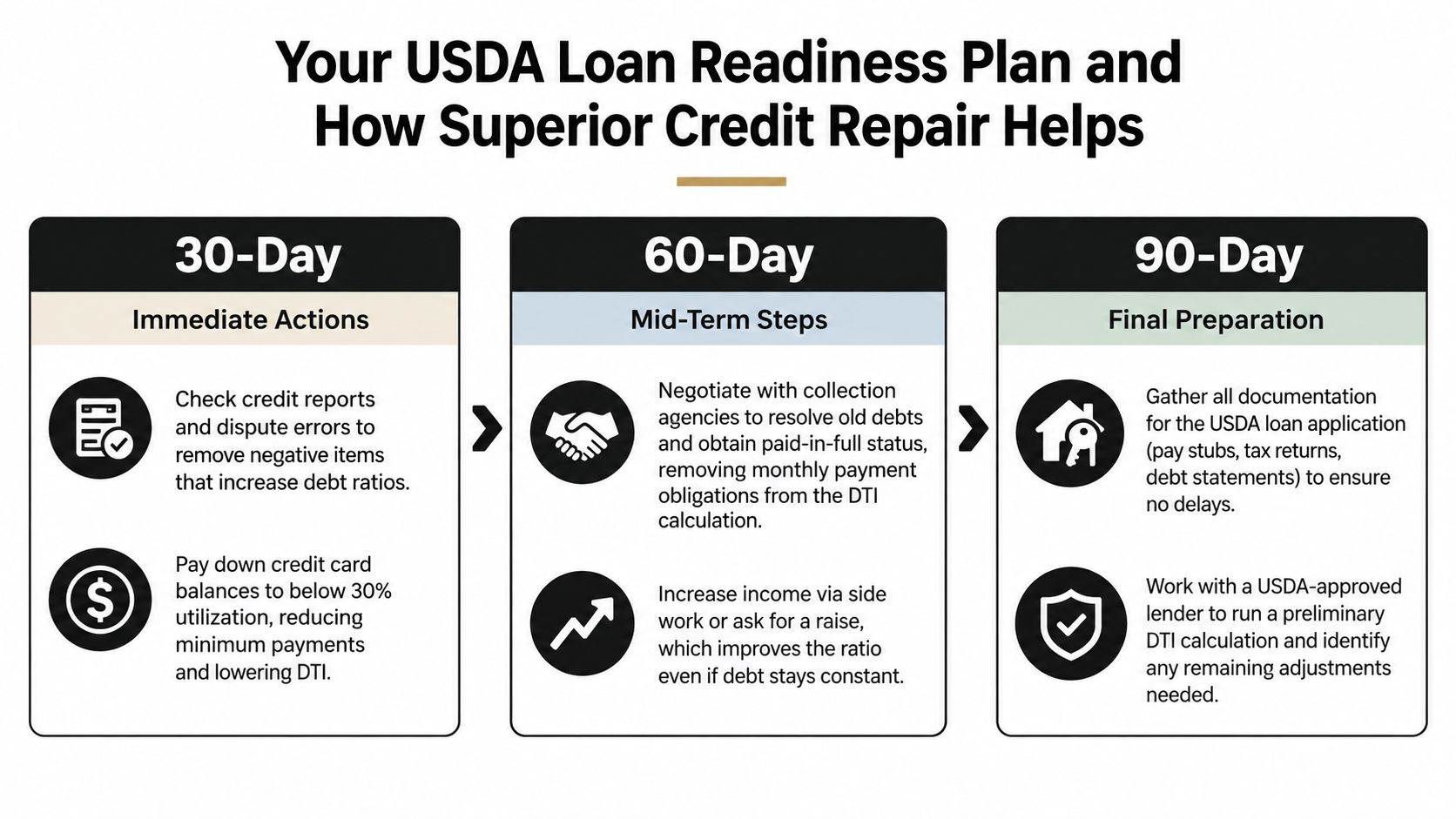
USDA approval gets easier when you stop treating it like one giant yes-or-no event and start treating it like a preparation timeline. Most borrowers benefit from breaking readiness into short phases.
The first phase
During the first month, pull your credit reports, list each recurring obligation, and compare those obligations to what you believe you owe. Many buyers find reporting issues, outdated balances, or accounts that need documentation before a lender reviews the file.
That first review should also separate emotional debt stress from underwriting reality. The lender won't underwrite “everything that worries you.” The lender will underwrite specific documented monthly obligations and repayment income.
The middle phase
The next stretch is where practical changes happen. Focus on accounts that affect required monthly payments, reported utilization, and lender perception of risk.
Useful actions may include:
- Reducing revolving balances: This can improve minimum payments and overall credit profile stability
- Resolving questionable reporting issues: Inaccurate, outdated, unverifiable, or misleading information should be reviewed through a documentation-based dispute process
- Avoiding new obligations: Keep the file steady while you prepare for underwriting
- Organizing income paperwork: Stable documentation matters as much as the number itself
A mortgage-ready file is usually built before the application, not during the panic after a denial.
The final phase
As you move closer to application, gather the documents a lender will want for income, debts, and any factors that support the file. This is also the right time to think realistically about whether the file is better suited to an automated approval route or whether it may need a stronger manual-underwrite presentation.
For borrowers whose reports contain inaccurate or questionable items, credit repair isn't a shortcut. It's a structured review process, a legal dispute and verification process, and a long-term rebuilding strategy. Results vary based on the credit file, documentation, account history, creditor responses, and current credit behavior.
Common questions buyers still ask
Does USDA use hard debt caps
Not always. USDA publishes standard benchmarks, but file outcome can still depend on underwriting path, compensating factors, and lender overlays.
Does paying off a credit card always help DTI
It can help if the required monthly minimum payment drops or disappears, because recurring monthly payments are what drive DTI most directly.
Can one lender deny me and another approve me
Yes. Different lenders may apply different overlays, and the same file may be handled differently depending on whether it receives an automated approval or a manual review.
Is credit repair the same as lowering DTI
No. They overlap, but they're not the same. Credit repair focuses on reviewing and disputing inaccurate, outdated, unverifiable, or misleading credit reporting, while DTI improvement focuses on income and recurring monthly obligations.
Should I wait to apply until my file looks perfect
Most buyers don't need a perfect file. They need an accurate file, realistic documentation, and a plan that addresses the biggest underwriting issues first.
Was this guide helpful?
Superior Credit Repair Online provides educational credit guidance for individuals and families preparing for major financial goals like buying a home, applying for a mortgage, refinancing, or rebuilding after credit challenges.
Superior Credit Repair can review your credit report, help identify inaccurate or questionable items, and explain a step-by-step plan for improving your credit profile before a USDA, FHA, VA, or conventional mortgage application. If you want help understanding how your credit report and recurring debts may affect mortgage readiness, visit Superior Credit Repair to request a free credit analysis or consultation and better understand your options.
If this information helped you better understand your credit report or your next steps, we would appreciate your honest feedback. You are welcome to share your experience with Superior Credit Repair on our Google Business Profile. Superior Credit Repair Google Business Profile