

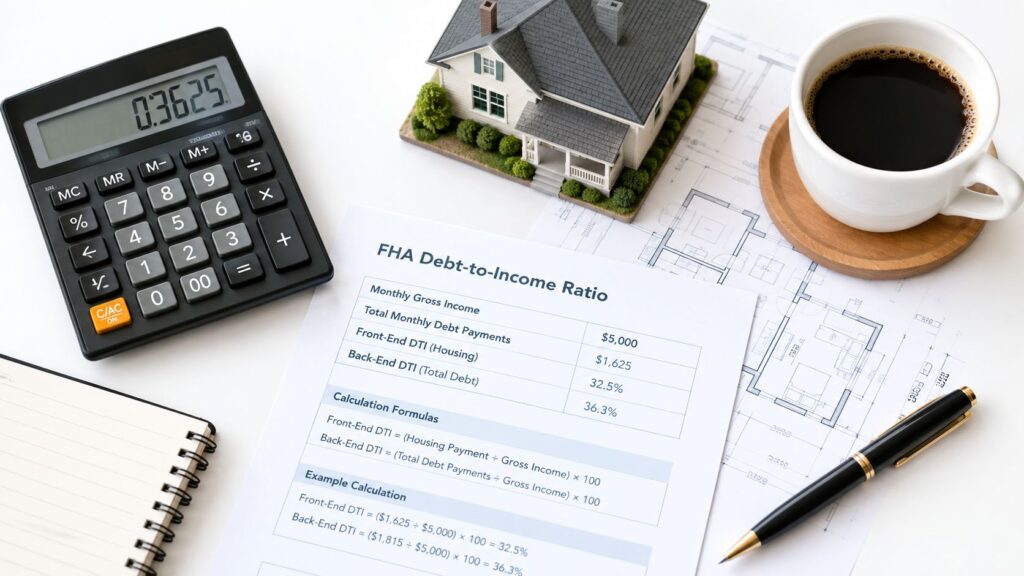
You've run the numbers online, and the result looks close enough to move forward. Your rent fits your budget, your income appears stable, and an FHA loan seems like the practical path to homeownership. Then a lender asks about student loans, credit card minimums, child support, reserves, property taxes, mortgage insurance, and the payment you'll have after closing. Suddenly, the debt to income ratio calculator FHA result feels less like an answer and more like a first draft.
That's the right way to view it. A calculator is useful for screening, but it isn't an approval decision. FHA underwriting evaluates the complete file, including verified income, recurring obligations, credit history, assets, and the proposed housing payment. Your result may change once the lender replaces your current rent with the full FHA payment, including escrowed taxes, insurance, mortgage insurance, and applicable HOA dues.
Table of Contents
- Why Your DTI Number Matters Before You Talk to a Lender
- How FHA Defines Front-End and Back-End Debt Ratios
- Calculating Your Ratios With a Real FHA Example
- Which Debts FHA Lenders Actually Count
- Compensating Factors and the AUS Flexibility Most Buyers Miss
- Modeling Your Future FHA Payment Before You Apply
- Lower Your DTI and Build a Lender-Ready Credit Profile
Why Your DTI Number Matters Before You Talk to a Lender
A debt-to-income ratio compares your monthly debt obligations with your gross monthly income, meaning income before taxes and other payroll deductions. For a first-time buyer, that number answers a practical question: can your income support the new housing payment while also carrying every debt the lender must count?
Use a calculator before contacting a lender, but treat the result as a screening point. The lender will verify your pay, determine which income is stable and usable, pull debts from your credit reports, review statements, and calculate the proposed payment using the actual property. A result that looks comfortable online can move higher after the lender includes obligations you forgot or didn't realize mattered.
Practical rule: Calculate the payment you'll have after closing, not the payment you hope to find.
Underwriters also look beyond the ratio itself. They want to understand whether your employment and income are reliable, whether your assets are documented, whether funds needed for closing are properly sourced, and whether your credit history supports the risk. A slightly higher ratio can make the file more difficult before the lender has a chance to rely on compensating factors.
The biggest mistake I see is comparing a future mortgage payment with today's rent as though they're interchangeable. They aren't. A future FHA payment may include principal, interest, property taxes, homeowners insurance, mortgage insurance premium, HOA dues, flood insurance, and special assessments when applicable. That full obligation can create payment shock even when your current budget feels manageable.
For a plain-English introduction to the formulas and lender perspective, review this guide to DTI for first time homebuyers. Then rebuild your estimate with verified debts and the complete proposed housing cost.
How FHA Defines Front-End and Back-End Debt Ratios
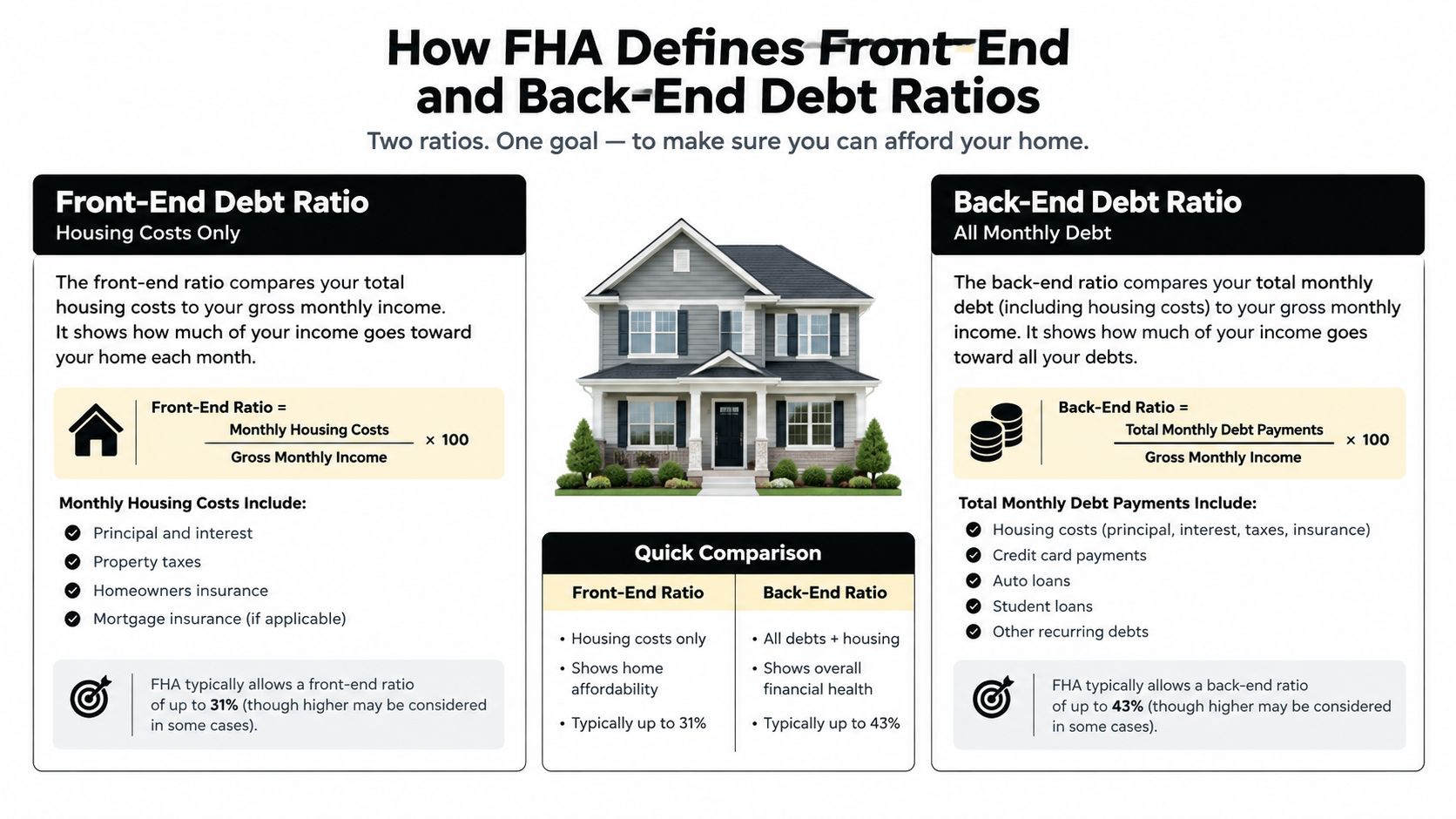
FHA's traditional framework uses two ratios, not one. The front-end ratio measures the proposed housing payment against gross monthly income. The back-end ratio measures the proposed housing payment plus recurring monthly debts against that same income.
HUD's archived underwriting guidance identifies the classic FHA benchmark as 31% for housing costs and 43% for total recurring obligations. Amounts above those ratios require documented justification and compensating factors under the guidance in HUD's archived underwriting material. The same guidance identifies higher ratios of 33% and 45% for Energy Efficient Home loans, a limited historical exception tied to the property and loan type.
What belongs in the housing payment
For FHA qualification, the front-end payment should reflect the complete proposed housing obligation:
- Principal and interest: The scheduled payment on the mortgage balance.
- Property taxes: The estate tax amount used for escrow.
- Homeowners insurance: The required hazard insurance premium.
- Mortgage insurance premium: FHA mortgage insurance, including the applicable monthly amount.
- HOA dues: Association dues when the property belongs to a homeowners or condominium association.
- Other property charges: Flood insurance and special assessments when they apply.
The front-end formula is:
Housing payment ÷ gross monthly income = front-end ratio
The back-end formula is:
Housing payment + recurring monthly debts ÷ gross monthly income = back-end ratio
What income can support the calculation
Gross qualifying income can include base wages, qualifying overtime, commissions, bonuses, rental income, retirement income, and documented self-employment or side income when the lender can verify its history and stability. Variable income generally needs supporting documentation and an averaging method that reflects the borrower's actual earnings rather than a favorable single month.
FHA borrowers who want a broader overview of the program can review this FHA mortgage by New American Funding from New American Funding, LLC. For the credit and documentation side of the process, this mortgage approval requirements resource helps organize the information lenders commonly request.
Calculating Your Ratios With a Real FHA Example
Let's use a representative borrower with $5,200 in gross monthly income and a proposed housing payment of $1,450, including principal, interest, taxes, insurance, mortgage insurance, and HOA dues.
The front-end calculation is:
$1,450 ÷ $5,200 = 27.9%
Suppose the borrower also has an auto loan, a student loan, and two credit card minimum payments totaling $420 per month. Total monthly obligations become $1,870.
The back-end calculation is:
($1,450 + $420) ÷ $5,200 = 35.9%
Both results fall below the traditional FHA 31% front-end and 43% back-end benchmarks. That doesn't guarantee approval, but it gives the file a reasonable starting position before credit, assets, income history, and lender-specific requirements are reviewed.
Now keep the same income and housing payment, but increase other recurring debts to $780 per month. Total obligations become $2,230, producing this result:
$2,230 ÷ $5,200 = 42.9%, rounded to 43%
That borrower is sitting at the traditional back-end benchmark. There's much less room for a newly discovered debt, a higher tax estimate, or a revised insurance premium.
| Scenario | Gross Monthly Income | Housing Payment (PITI + MIP + HOA) | Other Monthly Debts | Front-End Ratio | Back-End Ratio | FHA 31/43 Status |
|---|---|---|---|---|---|---|
| Housing only | $5,200 | $1,450 | $0 | 27.9% | 27.9% | Below baseline |
| Existing debts | $5,200 | $1,450 | $420 | 27.9% | 35.9% | Below baseline |
| Higher debt load | $5,200 | $1,450 | $780 | 27.9% | 43% | At back-end benchmark |
For another plain-English explanation of the calculation, review this debt to income mortgage guide. Then compare your own debts with the payment shown on a formal loan estimate, not just a generic calculator.
If inaccurate collection balances, late payments, or charge-offs are making your file look worse than it should, document them before applying. A credit repair with Superior Credit Repair review can help you organize the report issues that need attention.
Which Debts FHA Lenders Actually Count
The back-end ratio depends on the debts the lender is required to include. Underwriters don't copy every line from a credit report, and they don't ignore obligations because another person usually makes the payment. They evaluate the payment responsibility, documentation, and remaining term.
Credit card debt is a frequent source of errors. The lender generally uses the reported minimum payment, not the full balance. If the report doesn't show a usable minimum payment, the lender may apply the required calculation under the applicable underwriting rules.
Installment debts can include auto loans, personal loans, and student loans. Child support and alimony can count when the obligation has sufficient time remaining, and co-signed debts can remain relevant when the borrower is legally responsible. BNPL accounts from services such as Affirm, Klarna, Afterpay, or Sezzle deserve special attention because recurring installment obligations can affect the lender's affordability analysis even when consumers don't think of them as traditional loans.
| Debt Type | Counted in DTI? | How It's Calculated |
|---|---|---|
| Credit cards | Generally yes | The required minimum payment, not the full balance |
| Auto and personal loans | Yes | The recurring monthly installment |
| Student loans | Yes | The payment required under applicable FHA underwriting treatment |
| Child support and alimony | Often yes | The documented recurring obligation when it meets the applicable remaining-term test |
| Co-signed loans | Potentially yes | The borrower's legal responsibility must be documented |
| BNPL installments | Review carefully | Recurring payments may affect the file and should be disclosed |
| HOA dues | Yes | Included in the housing payment |
| Voluntary 401(k) loan repayment | May be excluded | Treatment depends on the repayment obligation and documentation |
| Utilities and cell phones | Generally no | Everyday service bills aren't normally included as recurring debt |
| Medical accounts | Treatment varies | Review the account status and applicable FHA rules |
| Deferred student loans | Yes, under FHA treatment | The lender applies the required qualifying payment method |
Consider two borrowers with the same gross income and identical proposed FHA housing payments. Borrower A has only a reported credit card minimum and an auto payment. Borrower B has those obligations plus a BNPL installment, a co-signed personal loan, and documented child support. Their calculator results can look very different because the second borrower has more recurring obligations that the lender must evaluate.
Collections require separate analysis. A collection account may not function like a regular installment payment in the DTI formula, but its balance, type, documentation, and FHA treatment can still affect underwriting. Read these Superior Credit Repair collection insights before assuming that paying or disputing an account automatically solves the mortgage issue.
If court-ordered repayment, bankruptcy, or a repayment plan is involved, legal advice may be appropriate. This why hire a Chapter 13 lawyer resource explains why legal guidance can matter in a Chapter 13 situation.
Compensating Factors and the AUS Flexibility Most Buyers Miss
A borrower with a 43% back-end ratio is not automatically outside FHA financing. The familiar benchmark is 31% for housing and 43% for total debt, but an automated underwriting system can approve a stronger overall file above those figures.
Some automated FHA approvals have exceeded 50% back-end DTI when the borrower receives an automated approval and presents strengths that support the risk. Treat that result as a possibility, not a promise. Each lender can apply its own rules, and the calculator shows only the ratio, not the full underwriting decision.
Manual underwriting follows clearer limits. The commonly used tiers are 31/43 without compensating factors, 37/47 with one compensating factor, and 40/50 with two or more, as summarized by Lower's FHA DTI requirements.
| Qualifying Ratios | Required Compensating Factor(s) |
|---|---|
| 31% front-end and 43% back-end | No compensating factors |
| 37% front-end and 47% back-end | One documented compensating factor |
| 40% front-end and 50% back-end | Two or more documented compensating factors |
What strengthens a borderline file
A lender may consider substantial reserves beyond the required funds, limited payment shock, additional income that cannot be used for qualifying, strong residual income, or reliable household support from a non-borrowing spouse. The factor must be documented and tied to the borrower's ability to manage the proposed payment.
Payment shock is central. A modest increase from rent to the proposed mortgage is easier to defend than a dramatic jump. Reserves give the household room to handle repairs, employment interruptions, and other financial pressure. Strong credit and a consistent payment history also show how the borrower has managed obligations over time.
Credit repair alone does not create an AUS approval. Correcting inaccurate reporting helps, but the lender still evaluates income stability, reserves, debts, and the future mortgage payment. A borrower who removes an error but cannot manage the new payment has not solved the underwriting problem.
An AUS result is not a final guarantee. Banks and mortgage brokers can impose lender overlays, which are stricter internal rules than the FHA baseline. A system approval above 50% may still be declined by a lender with a lower risk limit.
If AUS declines, ask whether a manual underwrite is available and realistic. Manual review requires more documentation. Disputed debts, unexplained deposits, unstable income, or incomplete payment records can make the file harder to defend.
For preparation involving collections, review what Superior Credit Repair recommends. Use credit repair to correct inaccurate reporting, then model the future payment and strengthen the rest of the file.
Modeling Your Future FHA Payment Before You Apply
A first-time buyer can handle the current rent comfortably and still struggle after closing. Underwriters qualify the proposed FHA housing payment, not a hopeful principal-and-interest estimate.
Build that payment in layers. Start with principal and interest based on the available rate and loan amount. Add the 1.75% upfront mortgage insurance premium under FHA debt ratio guidance, which may be financed into the loan. Then include the applicable annual mortgage insurance factor as a monthly amount, along with property taxes, homeowners insurance, and HOA dues when applicable.
Property taxes need a realistic escrow estimate. The lender's figure may differ from an owner's current bill or an online estimate. Include hazard insurance, flood insurance when required, and special assessments. These costs affect the payment even when a basic calculator leaves them out.
A practical payment-stress test
Run two calculations:
- Current position: Existing recurring debt divided by gross monthly income.
- Post-close position: The complete FHA housing payment plus every counted recurring debt divided by gross monthly income.
The post-close result drives qualification and shows whether the budget can absorb the payment. It also exposes payment shock that credit repair alone cannot solve. Correcting inaccurate credit reporting may improve the file, but it does not make a future mortgage payment affordable.
Underwriters also review how the new payment compares with current rent, available reserves, and the borrower's documented income. An automated underwriting system may approve a file above 50%, yet a lender's own rules can still require a lower ratio or stronger compensating factors.
Recheck the model if rates move more than 50 basis points, and update it before relying on the earlier result. Common errors include underestimating tax escrows, overlooking insurance changes, forgetting condo HOA fees, and assuming the first estimate will remain unchanged through closing.
Lower Your DTI and Build a Lender-Ready Credit Profile
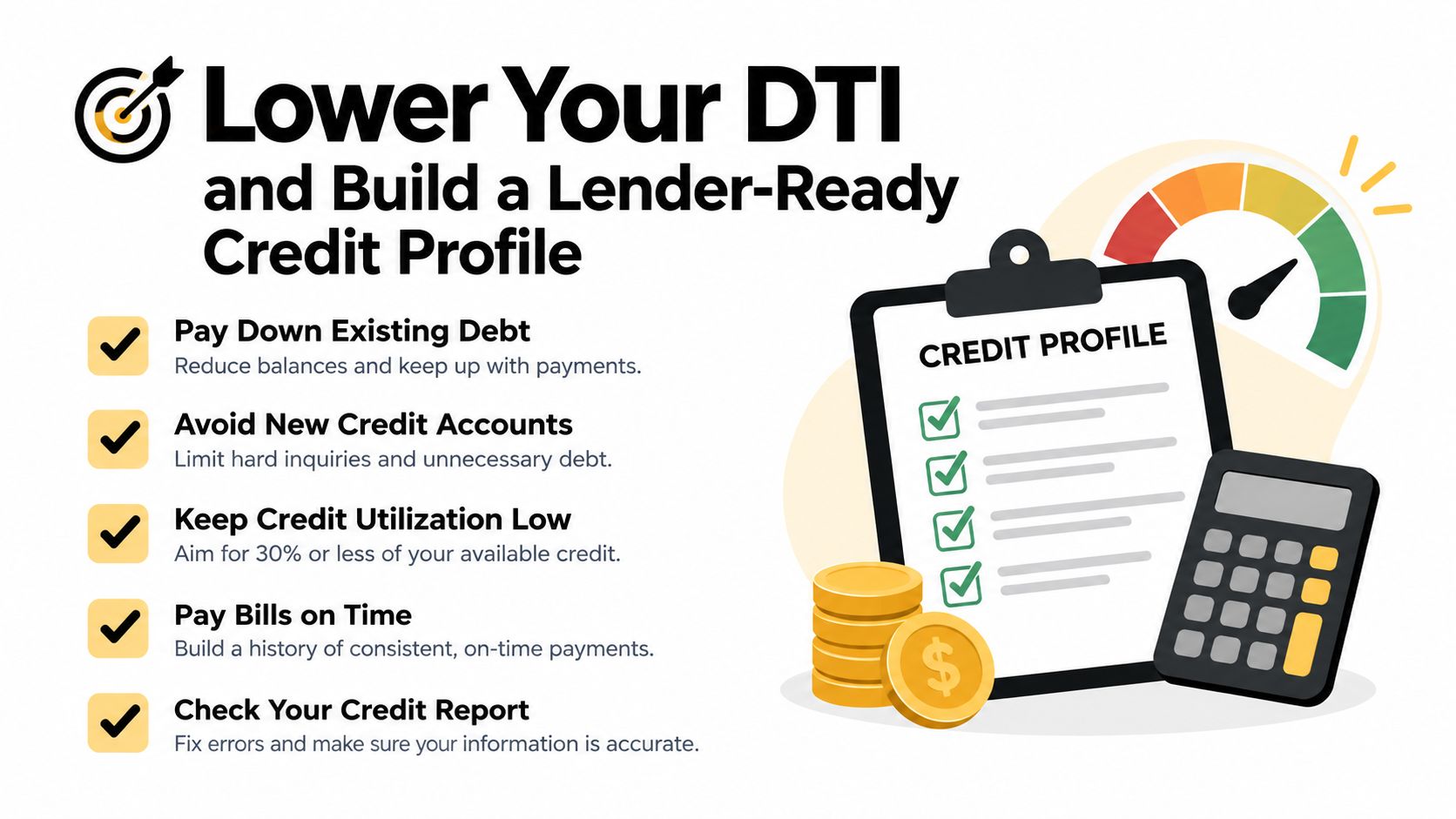
Lowering DTI and repairing credit are related, but they aren't the same task. DTI measures monthly obligations against gross income. Credit repair addresses inaccurate, outdated, unverifiable, or misleading information on credit reports and helps you build better long-term habits. You may need both, but correcting a credit report error won't automatically eliminate a genuine monthly debt.
Your first 30 days
Start with accurate information. Pull your reports from AnnualCreditReport.com and compare all three bureaus. Look for collection accounts, late payments, charge-offs, duplicate accounts, incorrect balances, accounts that don't belong to you, and outdated information.
At the same time, list every recurring payment the lender may count. Include student loans, minimum card payments, auto loans, personal loans, child support, alimony, co-signed obligations, and BNPL installments. Keep the documentation that supports each payment, including statements and court orders where relevant.
Prioritize credit card utilization because high balances can affect the credit profile even when the required minimum payment is relatively small. Aim to bring cards below 10% utilization, as recommended in the assigned preparation plan, but don't close established accounts because you've paid them down. Closing an account can reduce available credit and change the profile you're trying to strengthen.
Days 31 through 60
Dispute only information you can support. A proper dispute identifies the inaccurate or unverifiable item, explains the error, and includes relevant documentation. The credit bureaus and furnishers must investigate the dispute under applicable law, but the outcome depends on the evidence, the creditor's response, and the accuracy of the underlying account.
Collections, late payments, charge-offs, and medical collections need different review strategies. Don't send a generic dispute claiming that every negative account is wrong. A compliance-focused credit restoration process should identify the specific issue, preserve records, track responses, and avoid asking a bureau to remove accurate information merely because it is negative.
If a debt collector contacts you, a debt validation letter may be appropriate in the circumstances. Validation isn't a magic deletion request. It's a documentation step that asks the collector to substantiate the debt and its authority to collect, subject to the timing and requirements of applicable law.
Days 61 through 90
Stop creating new underwriting problems. Avoid opening new credit lines within 90 days of applying, and don't finance furniture, appliances, vehicles, or other purchases before the mortgage closes. Don't co-sign for someone else while preparing for FHA approval.
A debt payoff can help DTI most when it removes a required monthly payment. For example, removing a $300 monthly car payment lowers the ratio by $300 divided by gross monthly income. For a borrower whose calculated back-end ratio is 47%, removing that payment can bring the ratio back under 43% when the borrower's income and other obligations support the change. The exact result depends on the borrower's gross income and the debts remaining in the file.
Keep paid-down credit cards open when the lender and overall strategy support that choice. Rebuilding can also involve secured cards or small reporting installment loans, but only when the payment fits the budget and the account reports consistently. A new account can help establish positive history over time, yet opening one immediately before a mortgage application may create a new inquiry, a new payment, and a new underwriting question.
Superior Credit Repair can review reports, help identify potentially inaccurate information, explain dispute documentation, and discuss rebuilding options such as utilization planning and responsible secured-credit use. Its process is based on legal disputes, creditor investigations, documentation, and education. Results vary according to the credit file, supporting records, creditor responses, account history, and current credit behavior.
What the lender-ready file should contain
Prepare the documentation before the lender asks for it:
- Income records: Keep two years of W-2s and the income documents applicable to your employment situation.
- Bank statements: Prepare two months of statements and be ready to document the source of funds used for closing.
- Credit explanations: Write a clear explanation for any credit inquiry over $1,000, including what was purchased, who paid it, and whether a new obligation remains.
- Debt records: Gather current statements for student loans, auto loans, cards, personal loans, support obligations, and BNPL accounts.
- Dispute records: Preserve copies of disputes, responses, account statements, and supporting evidence.
Answers to questions buyers still ask
Can a co-signer lower DTI for FHA?
A co-signer or co-borrower may change the income and debt picture, but the lender evaluates that person's income, debts, credit, occupancy status, and legal responsibility. A co-signer doesn't automatically lower DTI. If the person brings substantial counted income and limited obligations, the combined calculation may improve. If the person brings significant debt or weak credit, the file may become more difficult.
Does a 580 score qualify with a 50% back-end ratio?
A 580 credit score doesn't guarantee approval at a 50% back-end ratio. FHA underwriting still considers the AUS result or manual-underwriting path, documented compensating factors, credit history, income, assets, and lender overlays. A borrower above the baseline needs a complete file, not just a qualifying score.
How long after bankruptcy can FHA approve?
There isn't one answer for every bankruptcy. The lender reviews the chapter, discharge or dismissal date, waiting-period rules, re-established credit, payment history, and any documented extenuating circumstances permitted by the applicable guidelines. Ask an FHA lender for a written eligibility review based on your exact dates rather than relying on a general calculator.
Does child support counted as debt vanish when the obligation ends?
Yes, once the legal obligation has ended and the borrower provides acceptable documentation. Until then, the lender generally treats the required payment as a recurring obligation when the applicable remaining-term rules are met. A verbal statement that payments will end soon isn't enough.
A free credit profile review is a sensible next step before submitting an FHA application. Superior Credit Repair can review your credit report, help identify inaccurate or questionable items, and explain a step-by-step plan for improving your credit profile. You can request a free credit analysis or consultation to better understand your options.
Results vary. No credit repair company can guarantee deletions, a score increase, or mortgage approval. The responsible approach is to correct report inaccuracies where support exists, reduce avoidable monthly obligations, maintain on-time payments, manage utilization, and give the lender a complete, well-documented file.
Superior Credit Repair can review your credit reports for inaccurate collections, late payments, charge-offs, and other reporting problems while helping you organize a practical FHA mortgage-readiness plan. Visit Superior Credit Repair to request a free credit analysis or consultation and understand what to address before speaking with a lender.
If this information helped you better understand your credit report or your next steps, we would appreciate your honest feedback. You are welcome to share your experience with Superior Credit Repair on our Google Business Profile. Share your feedback on Google.