


Most accurate derogatory marks stay on a credit report for up to seven years from the date of the first missed payment, while Chapter 7 bankruptcies can remain for up to ten years. The date a debt is paid, sold, or updated usually doesn't start that federal reporting period over.
You may be asking because a mortgage application is approaching, a lender has raised concerns about an old collection, or a credit report shows an account that seems far older than it should be. The answer to “how long do derogatory marks stay on credit” is important, but the expiration date is only one part of the decision. A mark can remain visible while becoming less influential, and an item that disappears doesn't automatically guarantee mortgage approval.
A practical review asks three questions: Is the information accurate? Is it still legally reportable? How might a lender view the rest of the file today? Superior Credit Repair approaches credit restoration through documentation, lawful disputes, and stronger credit habits rather than promises of guaranteed deletions or approval. Results vary with the credit file, account history, evidence, creditor responses, and current payment behavior.
Table of Contents
- Understanding the Federal Reporting Timeframes
- Reporting Limits for Specific Negative Items
- The Original Delinquency Date and Re-Aging Myths
- Mortgage Underwriting and Lender Overlays
- Auditing Your Report for Inaccurate Dates
- Rebuilding Credit While Waiting for Deletions
- Common Questions About Credit Repair Timelines
Understanding the Federal Reporting Timeframes
Most accurate negative account information generally remains on a consumer credit report for up to seven years. That commonly includes late payments, collections, charge-offs, foreclosures, and other delinquencies, as explained by the Consumer Financial Protection Bureau's guidance on credit-report timeframes. Chapter 13 bankruptcy is generally reported for seven years, while Chapter 7 bankruptcy may remain for up to ten years.
These limits are connected to federal credit-reporting rules, including the Fair Credit Reporting Act. The reporting period generally begins with the original delinquency date, meaning the first missed payment that led to the account's negative status. It usually doesn't begin when a collector buys the debt, when a creditor charges it off, or when a consumer later makes a payment.
Why the date matters
Suppose an account first became delinquent and was never brought current. A later sale to a collection agency changes who may report or contact the consumer, but it generally doesn't create a new federal reporting window. That distinction protects consumers from an old account being treated as newly negative merely because ownership or servicing changed.
The rule also separates credit reporting from other legal issues. A debt may no longer be reportable while a creditor or collector's rights under state collection law involve a different analysis. The statute of limitations for being sued can vary by state, and it isn't the same as the federal credit-reporting period.
Practical rule: Never calculate an account's removal date from the date you paid it or from the date a collector purchased it. Start by locating the first delinquency that led to the negative status.
Accurate, current negative information generally can't be removed just because it hurts a score or makes a consumer uncomfortable. A dispute is appropriate when the information is inaccurate, incomplete, outdated, duplicated, associated with the wrong person, or unverifiable. Consumers who want more context on the rules can review federal credit repair regulations before deciding how to proceed.
Reporting Limits for Specific Negative Items
Different derogatory marks can share a general reporting period, but they don't have identical meanings for a lender. A late payment, collection, repossession, foreclosure, or bankruptcy tells a different story about past repayment behavior. The table below provides a plain-English starting point.
Standard reporting timeframes
| Derogatory Item Type | Maximum Reporting Time |
|---|---|
| Late payments | Up to seven years |
| Collection accounts | Up to seven years |
| Charge-offs | Up to seven years |
| Foreclosures | Up to seven years |
| Repossessions | Up to seven years |
| Chapter 13 bankruptcy | Generally seven years |
| Chapter 7 bankruptcy | Up to ten years |
For late payments, collections, charge-offs, foreclosures, and repossessions, the period generally relates to the first delinquency that led to the negative status. Equifax explains that a collection account transferred after a charge-off generally follows the original account's delinquency timeline, not a new timeline created by the transfer. A paid or settled account may show a different status, but payment doesn't ordinarily erase the item immediately.
A charge-off is an accounting classification indicating that the creditor treats the account as a loss. It doesn't necessarily mean the debt disappears. A collection account may be reported by a collection company after an unpaid obligation is assigned or sold. A repossession involves secured property, such as a vehicle, while a foreclosure concerns a mortgage or other home-secured debt.
Medical and newer account types
Medical collections require careful interpretation. Federal reporting rules may allow collection information to remain for up to seven years, but the CFPB has noted that many medical collections are removed well before that maximum in the reporting system described in its medical debt rule materials. Scoring models also differ. VantageScore states that its 4.0 model doesn't use medical debt or medical-collection information, while mortgage lenders may use different scores, reports, and underwriting requirements.
Buy Now, Pay Later and fintech accounts can create another source of confusion. Whether an account appears on a report, whether missed payments become collections, and how recurring obligations affect debt-to-income calculations can vary. A mortgage applicant should review statements and obligations rather than assume that an account is irrelevant because it doesn't look like a traditional credit card.
Chapter 7 and Chapter 13 bankruptcy deserve separate attention because their reporting periods differ. An older bankruptcy may still be relevant to a lender's overall review even after other accounts have aged, so homebuyers should discuss the complete file with a qualified mortgage professional. Consumers looking for mortgage-ready credit repair strategies from Superior Credit can use this information as a starting point, not as a promise of a particular result.
The Original Delinquency Date and Re-Aging Myths
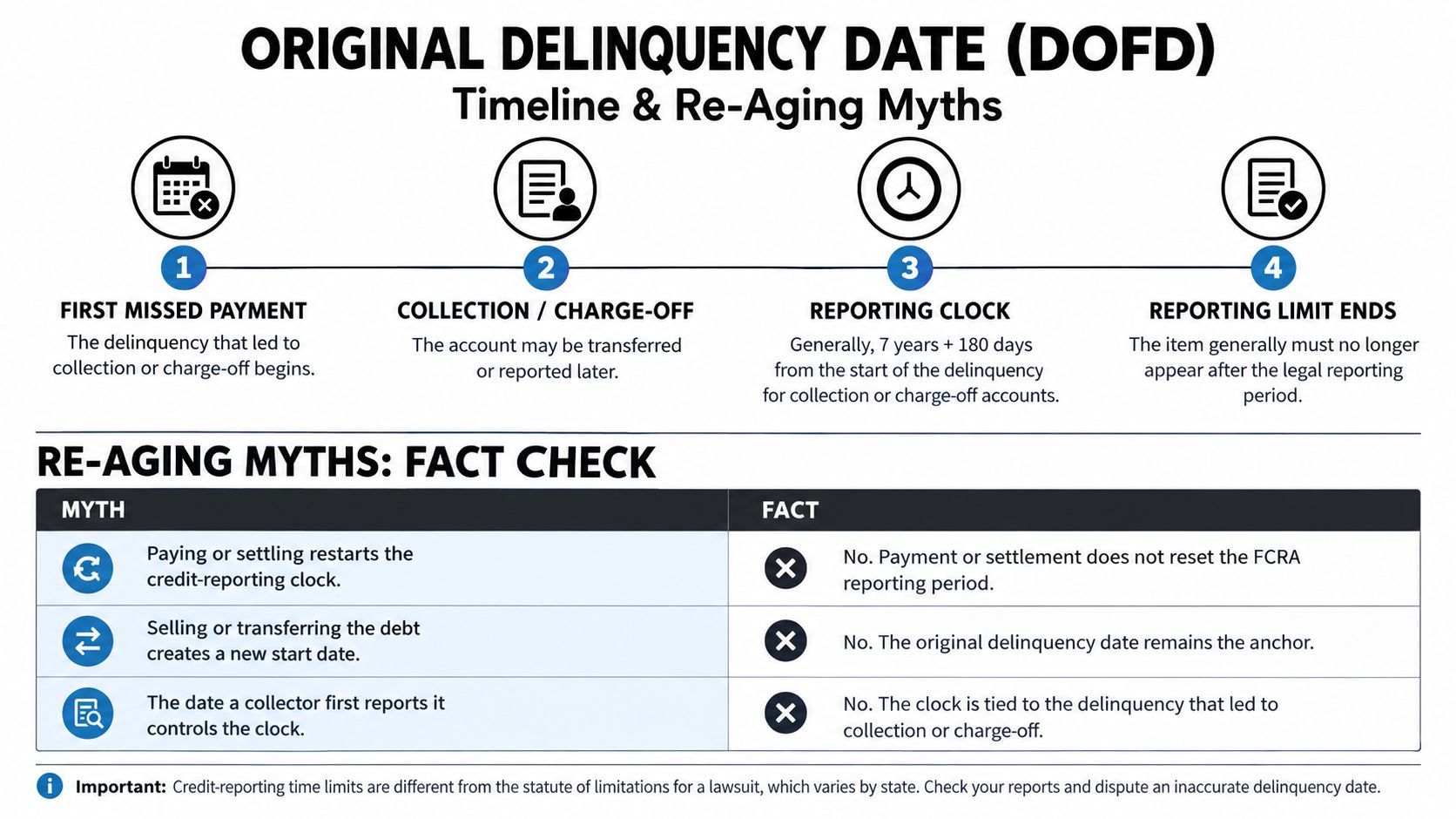
A homebuyer can lose months by planning from the wrong date. For federal reporting, the clock generally tracks the first missed payment that led to the collection or charge-off, often called the original delinquency date, not a later sale, settlement, charge-off posting, or collection update.
A simple worksheet helps. If an account first went seriously delinquent in March 2019, was charged off in July 2019, and was sold in January 2020, the reporting timeline generally still traces back to March 2019. That distinction matters because a mortgage applicant may look at the newer activity and assume the item will remain much longer than federal reporting rules allow. The report's expiration timeline and the lender's separate underwriting review are different tracks, and mixing them up leads to bad planning.
Paying isn't the same as restarting
Paying or settling changes status. It can show an underwriter that the debt was resolved, and it may affect how a scoring model reads the file, but it does not ordinarily create a brand-new seven-year reporting period. A practical way to view it is this: payment changes the condition of the entry, while the original delinquency date still anchors the federal reporting window.
State collection law is a different timeline. In some states, a payment or written acknowledgment can affect how long a creditor may have to sue, depending on the facts and the law that applies. That issue should be reviewed separately from the federal rule on how long accurate credit reporting may remain.
What re-aging can look like
Re-aging happens when an older delinquency is reported as if it started later. Common warning signs include the original creditor and the collection account showing dates that do not line up, an expected removal date shifting later without a clear factual basis, or a recent update being treated like a fresh default.
Good records make these problems easier to address. Keep statements, collection letters, payment records, and older credit reports so you can compare the sequence of events line by line. If you dispute an error, point to the exact date conflict and the supporting document. That approach is usually stronger than asking for the whole account to be deleted without explaining what is wrong. If a removed item shows up again, review Superior Credit Repair on reinsertions.
A paid collection can still be accurately reportable. Judge the reporting by whether it is complete, accurate, timely, and verifiable.
Mortgage Underwriting and Lender Overlays
A credit-report expiration date and a mortgage decision are not the same thing. A derogatory mark that disappears may improve the file's presentation, but it doesn't guarantee approval. An older mark that remains visible may not automatically cause a denial if the applicant has established recent stability and can satisfy the lender's complete requirements.
Mortgage underwriting usually considers the broader file. Payment behavior, revolving utilization, debt-to-income ratio, reserves, account stability, disputed information, and the nature of the derogatory event can all influence the review. Lenders may also apply overlays, meaning requirements that are stricter than the baseline rules associated with a loan program.
Comparing mortgage preparation paths
FHA preparation often requires careful review of recent payment history, collections, judgments, bankruptcy history, and overall affordability. An applicant should address inaccurate reporting early and avoid new late payments while preparing.
VA preparation still involves a complete credit and financial review. Military families may benefit from planning around income stability, obligations, collections, and recent repayment behavior rather than relying solely on an old mark's age.
Conventional preparation can be sensitive to the strength of the entire file, including utilization, debt-to-income ratio, reserves, and the pattern of recent payments. A borrower with an older derogatory item and strong current behavior may present a different risk profile from someone with a recently missed payment.
USDA preparation also requires attention to repayment history, qualifying debts, and the lender's interpretation of the file. Program names don't replace individualized underwriting.
For a broader discussion of qualifying credit scores in Northeast Florida, prospective buyers can consult a local real-estate resource, then confirm current requirements with a participating lender. Requirements can change, and lenders may evaluate the same report differently.
Why collections need context
A collection before mortgage approval isn't automatically equivalent to a denial, and paying it doesn't automatically make the file mortgage-ready. The underwriter may consider the balance, status, age, documentation, and relationship to the applicant's overall obligations. A buyer should understand how lenders review collection accounts before mortgage approval before choosing whether to dispute, resolve, or document an account.
The most useful strategy is usually a coordinated one: correct report errors, protect every current payment, manage revolving balances, document obligations, and speak with a lender before making major changes. Waiting for an item to age off can be part of a plan, but it shouldn't be the whole plan.
Auditing Your Report for Inaccurate Dates
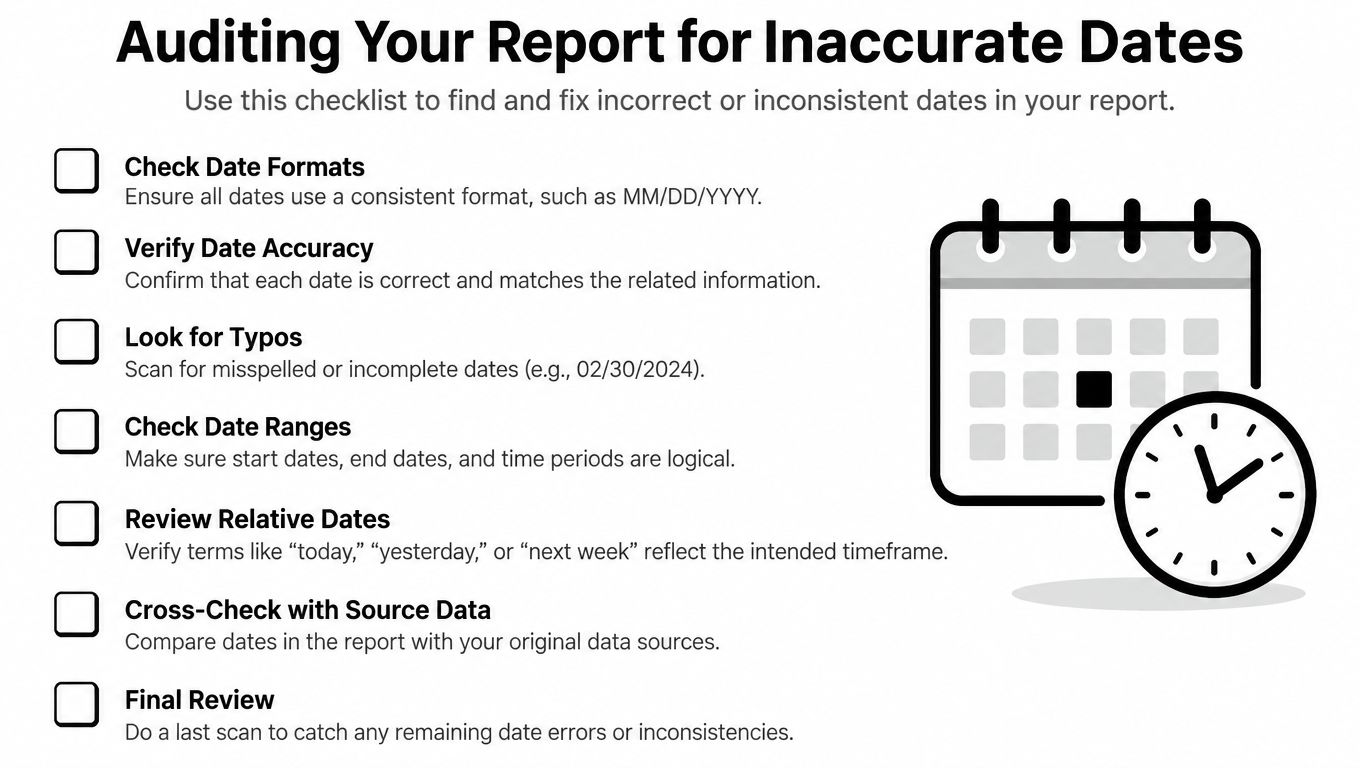
An inaccurate date can keep an old account visible longer than federal rules allow. A proper audit compares the information on all three nationwide credit reports, identifies discrepancies, and connects each concern to supporting records.
A practical audit sequence
Collect all three reports. Compare Equifax, Experian, and TransUnion rather than relying on a single report. The same account may contain different dates, balances, statuses, or descriptions.
Find the first delinquency. Look for the first missed payment that led to the charge-off or collection. Don't substitute the date of the last update, sale, payment, or collection placement.
Compare related accounts. An original creditor account and a collection account may both appear. Check whether they describe the same obligation and whether the dates tell a consistent story.
Check identity and completeness. Confirm the account belongs to you, the balance and status make sense, and the account hasn't been duplicated. Identity-theft documentation may be relevant when the obligation isn't yours.
Preserve evidence. Save reports, statements, account correspondence, payment confirmations, settlement letters, and prior dispute results. A clear file helps you explain the factual issue.
Dispute the specific error
Consumers can dispute inaccurate information with both the credit-reporting company and the business that furnished the data. The CFPB explains that investigations generally must be conducted within 30 days in the circumstances described by its credit-report dispute guidance. A strong dispute identifies the account, states the exact error, explains why the information is wrong, and attaches relevant documentation.
The process isn't a guaranteed deletion mechanism. Accurate, complete, and verifiable information may remain. If an item is found inaccurate, incomplete, outdated, or unverifiable, correction or removal may be appropriate under applicable rules.
Readers who work in property management or are preparing for an apartment application may also benefit from this guide to tenant credit reports. Whether the goal is rental approval or mortgage readiness, understanding dates and statuses prevents broad assumptions about what a report means.
Rebuilding Credit While Waiting for Deletions
Waiting for a derogatory mark to disappear leaves too much of your financial future tied to the calendar. Older negative information generally has less influence than recent negative information, which means current behavior can help reshape the overall file even while an accurate older item remains visible.
Build the current record
Start with payment protection. Set reminders, use automatic minimum payments when appropriate, and review every account before its due date. Automation doesn't replace monitoring, but it can reduce the chance that an avoidable late payment creates a new problem.
Revolving utilization also deserves attention. It describes how much of available revolving credit is being used, and high balances can make a file appear strained. Paying balances down, avoiding unnecessary new applications, and keeping accounts open when appropriate can support a more stable profile.
A secured card may help some consumers establish positive payment history, provided the account reports and the cardholder can manage it without carrying unaffordable debt. A credit-builder product may also be appropriate for certain thin files, but fees, terms, reporting practices, and affordability should be reviewed first.
Coordinate rebuilding with homebuying
Mortgage preparation works best when credit habits and dispute work proceed together. A consumer may need to correct an inaccurate collection while also reducing revolving balances, documenting income, reviewing debt-to-income obligations, and avoiding new credit applications that aren't necessary.
Mortgage readiness means more than an empty negative-history section. It means the current file gives a lender a clear, documented reason to view the applicant as stable.
For readers who want a structured starting point, the 90 day credit rebuild plan can help organize report review, payment habits, utilization management, and lender conversations. It shouldn't be treated as a guarantee of a score change or loan approval. Results depend on the accounts, evidence, responses, and choices involved.
Superior Credit Repair can be one option for a documentation-based review. Its process focuses on identifying inaccurate, outdated, unverifiable, or misleading information and pairing lawful dispute work with credit education. Consumers should compare any provider carefully, avoid companies promising guaranteed deletions, and understand that valid negative information may remain.
Common Questions About Credit Repair Timelines
Does paying a collection remove it?
Usually, no. Payment may update the account to paid or settled, but it doesn't ordinarily require immediate deletion or restart the federal reporting period. Before paying, review the account dates, ownership, balance, and state-law collection issues. A mortgage lender may view a resolved account differently from an unpaid one, but the effect varies by file and underwriting rules.
Can an accurate derogatory mark be deleted early?
Accurate, complete, current, and verifiable information generally can't be removed just because it lowers a score. A dispute is appropriate when the account contains a factual error, duplicate reporting, incorrect dates, identity-theft information, incomplete details, or information that is too old to report.
What should I do if a deleted account comes back?
Save the earlier report showing deletion, the new report, dispute results, and any notice explaining the reinsertion. Compare the account details and dates, then raise a specific dispute if the reappearance is inaccurate or lacks proper support. Don't assume that a returned account is automatically valid or automatically unlawful.
Will waiting seven years guarantee mortgage approval?
No. Reporting expiration addresses what may appear on a credit report. Mortgage approval also depends on current payment behavior, utilization, debt-to-income ratio, reserves, income, obligations, program rules, and lender overlays. A recent late payment can matter more than an older item, while an older visible item doesn't always produce an automatic denial.
Should I seek professional credit repair?
If the report contains multiple accounts, conflicting dates, duplicate collections, or documentation you can't organize, a professional review may help clarify the next steps. Superior Credit Repair offers educational credit analysis and compliance-focused dispute support, but results vary and no ethical provider can guarantee deletion, a score increase, or mortgage approval.
Superior Credit Repair can review your credit report, help identify inaccurate or questionable items, and explain a step-by-step plan for improving your credit profile. Visit Superior Credit Repair to request a free credit analysis or consultation and better understand your options before applying for a mortgage, auto loan, business financing, or personal credit.
If this information helped you better understand your credit report or your next steps, we would appreciate your honest feedback. You are welcome to share your experience with Superior Credit Repair on our Google Business Profile. Share your feedback on Google