


You've found a home you can afford, your offer has been accepted, and then the FHA appraisal identifies a leaking roof, unsafe wiring, or another condition you didn't expect. At the same time, a disputed collection appears on your credit report, and you learn that correcting a legitimate error could affect how the lender underwrites your loan. These situations can feel unrelated, but both involve the same question: what must be resolved before an FHA mortgage can move forward?
FHA loan repair requirements cover more than credit scores and more than physical repairs. The lender evaluates the borrower's credit profile, the property's condition, the available documentation, and the underwriting path. A credit dispute may create additional review, while a property deficiency may require repair, inspection, or an as-repaired appraisal. Results vary based on your credit file, supporting evidence, creditor responses, property condition, lender standards, and current financial behavior.
Table of Contents
- Understanding FHA Loan Repair Standards
- How Lenders Review Your Credit History
- Identifying and Resolving Credit Report Errors
- Connecting Credit Repair to Property Appraisals
- Comparing Credit Repair Needs Across Loan Types
- Planning Your Credit Repair Timeline
- Frequently Asked Questions
Understanding FHA Loan Repair Standards
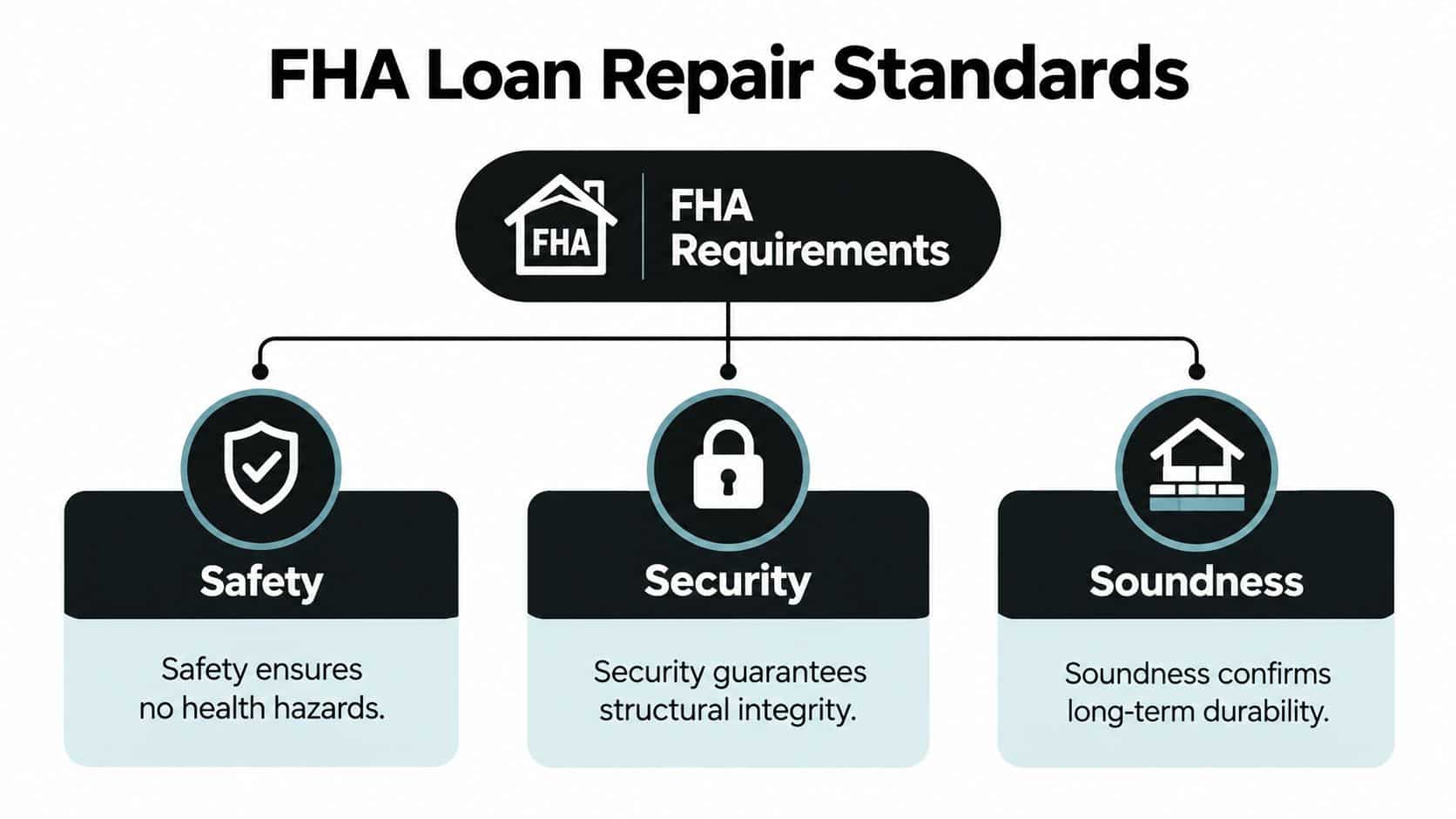
FHA property requirements begin with three foundational standards: safety, security, and soundness. HUD guidance limits required repairs for an existing property to conditions that protect occupants' health and safety, protect the property from security risks, or correct physical deficiencies affecting structural integrity. The FHA appraisal is designed to identify observable conditions relevant to those standards, not to provide the complete evaluation offered by a private home inspection. HUD's FHA appraisal guidance explains how appraisers document visible deficiencies, identify repairs needed to satisfy Minimum Property Requirements or Minimum Property Standards, and estimate the cost to cure.
The three standards in practical terms
Safety concerns conditions that could injure occupants or threaten their health. Unsafe electrical or plumbing systems, hazardous heating conditions, environmental hazards, and serious water intrusion may require attention when the appraiser observes them and the lender determines they affect FHA eligibility.
Security focuses on whether the property remains physically protected. An opening, damaged component, or other deficiency that leaves the home vulnerable can raise concerns even if it doesn't look dramatic during a showing.
Soundness addresses the property's structural integrity and continuing physical condition. Structural movement, excessive dampness, decay, leaks, termites, and other defects may require repair or a qualified inspection, depending on what the appraisal documents.
Cosmetic wear generally isn't an automatic FHA repair requirement. HUD identifies worn floor finishes or carpeting, holes in window screens, and small cracks in windowpanes as examples of conditions that are typically cosmetic or minor deferred maintenance. These issues can still influence the appraiser's overall condition rating and valuation, so “cosmetic” doesn't mean irrelevant in every transaction.
Practical rule: Treat the appraisal report as a decision document, not as a complete home inspection. Ask the lender which observations are mandatory FHA repairs and which ones affect value, condition, or negotiation only.
The lender, not the appraiser alone, ultimately determines which repairs must be completed before FHA-insured financing can proceed. If a property needs specialized work, such as structural or basic-system repairs, the lender may require qualified professionals, permits, certifications, or follow-up documentation. Buyers considering substantial rehabilitation may also benefit from reviewing resources about East Texas home remodel loans before assuming an ordinary FHA purchase loan will cover the work.
Credit readiness remains separate from property readiness. If collections are part of your concern, you can get FHA ready with collection accounts while the lender and real estate professionals evaluate the home.
How Lenders Review Your Credit History
FHA underwriting doesn't look only at a single score. The lender reviews payment history, collections, charge-offs, current obligations, disputes, documentation, and the overall stability of the file. The previous 24 months deserve special attention because disputed charge-offs, collections, and late payments from that period can be classified as disputed derogatory credit accounts under FHA guidance. HUD's handbook update describes how these accounts affect the FHA TOTAL Scorecard calculation.
The key threshold is $1,000 in combined balances for applicable disputed derogatory accounts. If the combined balance reaches that amount, TOTAL Scorecard may downgrade the application to “Refer,” which means the file requires manual underwriting. That result doesn't automatically mean the borrower will be denied, but it can lead to additional explanations, documentation, and review.
Why a legitimate dispute can create a problem
A consumer may dispute an account because the creditor reported the wrong balance, date, ownership, payment history, or status. That dispute may be legally appropriate and still affect the mortgage process while it remains active. The issue isn't that consumers should ignore inaccurate reporting. The issue is that a borrower should understand how the lender will categorize the account before submitting an FHA application.
The FHA calculation has important exceptions. Disputed medical accounts and derogatory accounts connected to identity theft, credit-card theft, or unauthorized use can be excluded when the borrower provides supporting documentation. Examples include a police report or creditor records. Zero-balance disputes, disputes involving late payments at least 24 months old, and accounts that are current and paid as agreed are treated as non-derogatory for this calculation.
Consider a borrower with several small disputed charge-offs. Individually, none may appear significant. Together, their balances could reach the applicable threshold and cause a referral. That borrower needs a documented dispute strategy, not a blanket instruction to dispute every negative item immediately before closing.
Questions to ask before disputing
Before sending a dispute, ask the lender how the account is likely to be categorized, whether the dispute could affect TOTAL Scorecard, and what evidence would support an exception. Keep copies of reports, creditor correspondence, identity-theft records, police documentation, payment records, and dispute results.
Mortgage preparation also includes broader planning around income, debts, and documentation. Consumers can review resources about preparing for loan approval while coordinating credit disputes with a qualified lender.
Identifying and Resolving Credit Report Errors
Credit repair should begin with accuracy, not with a goal of removing every negative account. A late payment, collection, or charge-off that is accurate and verifiable may remain reportable even when it harms a mortgage application. A dispute is appropriate when information is inaccurate, incomplete, outdated, unverifiable, or misleading, and the process depends on evidence that supports the consumer's position.

Build an evidence file first
Obtain the credit reports your lender will use and compare account names, balances, dates, payment history, ownership, and account status. Look for duplicate collections, accounts that don't belong to you, incorrect past-due amounts, obsolete information, and accounts marked as disputed without an accurate explanation.
Create a file for each account. Include the report page, account statements, payment confirmations, correspondence, identity documents when appropriate, and any records showing why the reporting is wrong. A clear dispute explains the specific error and identifies the supporting evidence. Broad statements such as “remove this account” are less useful than a precise explanation of what the furnisher reported incorrectly.
Document medical and identity-theft exceptions
Medical accounts require careful classification because FHA guidance allows disputed medical accounts to be excluded from the disputed derogatory calculation. Keep records showing the account's medical nature and preserve the dispute confirmation. The lender may still request additional documentation, so don't assume the exception will be applied automatically.
Identity-theft and unauthorized-use accounts also require proof. A police report, creditor records, fraud affidavit, account investigation, or other records identifying the unauthorized activity may support the exception. The exact evidence a lender accepts can vary, so ask before relying on an exception.
A correct dispute can still require careful mortgage timing. Accuracy and underwriting strategy need to work together.
Zero-balance disputes receive more favorable treatment for the FHA calculation, as do disputes involving older late payments that are at least 24 months old and accounts that are current and paid as agreed. That classification doesn't erase the underlying reporting history, and it doesn't guarantee approval. It means those items are treated as non-derogatory for the specified balance calculation.
Dispute responses can take different amounts of time depending on the account, evidence, bureau, and furnisher. A documented credit repair timeline helps you plan without assuming that every correction will happen before a desired closing date. Superior Credit Repair can review reports, help identify questionable reporting, and explain a documentation-based path, but no company can guarantee deletion, a score increase, or mortgage approval.
Connecting Credit Repair to Property Appraisals
A lender-ready borrower still needs a lender-acceptable property. Credit repair doesn't replace FHA property repairs, and completing a physical repair doesn't resolve a disputed collection. The borrower and property move through separate evaluations that must both support the mortgage.
The four-step property process
The appraisal process generally follows a defined sequence described in HUD guidance:
- The appraiser identifies visible deficiencies. The appraiser documents observable conditions, generally with photographs, and determines whether a repair or qualified inspection appears necessary.
- The report describes the needed action. The report identifies the repair or inspection and provides an estimated cost to cure.
- The mortgagee determines what's mandatory. The lender decides which reported items must be completed for FHA eligibility. The appraiser doesn't make that decision alone.
- The lender verifies completion. Acceptable evidence may include a compliance inspection, reinspection, professional certification, receipts, permits, or other documentation. HUD's FHA handbook material explains the role of inspections and repair procedures.
This process prevents a common mistake: treating every note in an appraisal as a mandatory FHA repair. The lender separates conditions affecting safety, security, soundness, marketability, or occupant health from observations that primarily influence valuation or condition rating.
Why the $5,000 classification matters
HUD guidance distinguishes a property offered as “Uninsured” when the appraiser estimates that repairs needed to meet FHA standards exceed $5,000 in the property's as-is condition. The appraiser must then complete an as-repaired appraisal, which estimates market value after the proposed rehabilitation or improvements. HUD's handbook material describes this classification and appraisal mechanic.
The threshold doesn't mean every repair below it can be ignored, and it doesn't mean every repair above it results in rejection. The lender still evaluates the scope of work, financing structure, appraisal, and completion evidence. Ask how the property is classified before relying on a closing schedule.
Termites and other wood-destroying conditions may require specialized evaluation. If the property raises those concerns, you may want to schedule a termite inspection via Pestless Inc. and provide the resulting documentation to the lender for review.
A repair escrow may be available in some circumstances, but it's lender-specific and should never be assumed. Confirm contractor requirements, permits, inspection forms, and documentation standards before work begins.
Comparing Credit Repair Needs Across Loan Types
The right mortgage program depends on more than a borrower's preferred payment or down payment structure. FHA, VA, conventional, and USDA loans can evaluate credit history, disputed accounts, debts, property condition, and documentation differently. A borrower who doesn't fit one program's underwriting path may have another option, but switching programs doesn't eliminate the need for accurate reporting and responsible financial management.
| Loan path | Credit-readiness focus | Practical caution |
|---|---|---|
| FHA | Disputed derogatory accounts, collections, payment history, current obligations, and documented exceptions | Disputed balances reaching the applicable FHA threshold can lead to TOTAL Scorecard referral and manual underwriting |
| VA | Overall credit behavior, payment history, debts, and the lender's underwriting analysis | More flexibility in some situations doesn't eliminate property, income, debt, or documentation requirements |
| Conventional | Credit history, utilization, debt obligations, reserves, income, and automated or manual underwriting | Lender overlays and the complete risk profile can affect eligibility |
| USDA | Credit history, income, debts, property eligibility, and program-specific documentation | Rural property and household eligibility remain separate from credit repair |
Choose the program after reviewing the file
A veteran with older derogatory accounts may want to compare VA preparation with FHA preparation. A borrower with high utilization may need to reduce revolving balances and avoid new inquiries before evaluating conventional financing. Someone with collections may need to classify ordinary, medical, disputed, and federal debt separately instead of treating all accounts alike.
Federal debt deserves separate attention. Unresolved federal debt reported through CAIVRS can make a borrower ineligible until the debt is resolved. Paying an ordinary collection doesn't automatically solve a federal debt issue, and correcting a credit report doesn't substitute for satisfying property conditions.
The lender's execution matters as much as the program label. Ask how the lender handles disputed accounts, manual underwriting, payment arrangements, documentation, and property repairs. For more focused education, review these Superior Credit Repair FHA tips, then confirm current requirements with the lender handling your application.
Planning Your Credit Repair Timeline
A realistic mortgage plan starts before you find a house. The right sequence depends on the condition of your reports, the age and type of negative accounts, the strength of your documentation, creditor responses, and your current payment behavior. No responsible credit counselor can promise that a dispute will produce a particular score or that a lender will approve the application.
Start with a complete file review
First, review all relevant reports and list every account that could affect underwriting. Separate factual errors from accurate negative information. Mark disputed collections, charge-offs, late payments from the previous 24 months, medical accounts, identity-theft accounts, federal debt, high-utilization revolving accounts, and debts that may affect your debt-to-income ratio.
Next, preserve documentation before filing disputes. If an account involves identity theft, gather the police report and creditor records. If it's medical, preserve records that identify the account type. If a balance is inaccurate, collect statements and payment evidence. Give the lender a chance to review the strategy before an active dispute changes the underwriting path.
Stabilize current behavior
Pay every current account on time, avoid unnecessary new credit applications, and manage revolving balances carefully. Credit improvement isn't only about negative-item disputes. A lender also reviews whether the borrower has established dependable recent behavior and whether new debt could change affordability.
Use a budget to determine which obligations can be paid down without draining funds needed for closing. If collections are present, ask the lender whether payoff, an acceptable payment arrangement, or another documented solution fits the underwriting path. FHA guidance states that cumulative collections of $2,000 or more may require payment in full by closing or an acceptable arrangement with the required monthly payment included in underwriting. HUD's FHA collection FAQ also explains that manually underwritten files require an assessment of the collection history and any documented extenuating circumstances.
A debt-to-income review can help you understand how proposed payments affect affordability. Use a DTI calculator for FHA applicants as an educational planning tool, then verify the figures with your lender.
Plan around major negative events
Bankruptcy, foreclosure, and other major events may require seasoning periods that depend on the event, circumstances, lender, and applicable FHA rules. Don't rely on a generic waiting-period statement. Ask the lender to assess the event, discharge or completion records, reestablished credit, extenuating circumstances, and current program requirements.
A borrower who starts early has more room to respond if a furnisher verifies an account, the lender requests explanations, or a dispute triggers manual underwriting. The strongest plan is not the most aggressive one. It's the plan that leaves the lender with a clear, accurate, well-supported file.
Frequently Asked Questions
Do FHA loan repair requirements apply only to the home?
No. FHA readiness involves both the borrower and the property. The lender evaluates credit history, debts, disputes, documentation, and payment behavior, while the appraisal evaluates observable property conditions connected to safety, security, soundness, health, and physical integrity.
Can paying collections guarantee FHA approval?
No. When credit reports show cumulative collection balances of $2,000 or more, the lender must verify payment in full by closing or establish an acceptable arrangement and include the required monthly payment in underwriting. Payment doesn't guarantee approval, and a lender may evaluate the account type, documentation, manual underwriting concerns, debt-to-income effect, and the complete file.
What proves identity theft for an FHA dispute exception?
Useful supporting evidence can include a police report, creditor records, fraud documentation, and records showing unauthorized use or identity theft. Ask the lender which documents it requires before relying on the exception. A dispute without adequate evidence may not receive the intended classification.
Can disputing a legitimate credit error hurt an FHA application?
It can affect the underwriting path even when the error is legitimate. Applicable disputed derogatory accounts from the previous 24 months may count toward the FHA disputed-balance calculation, and combined balances reaching $1,000 can cause TOTAL Scorecard to return “Refer.” Medical and qualifying identity-theft or unauthorized-use accounts may be excluded when properly documented.
Does repairing credit remove required property repairs?
No. A corrected credit report doesn't waive an FHA appraisal deficiency. The lender may require repairs, professional inspections, permits, reinspection, or other evidence before the property can support the loan.
Superior Credit Repair can review your credit report, help identify inaccurate or questionable items, and explain a step-by-step plan for improving your credit profile before an FHA application. Visit Superior Credit Repair to request a free credit analysis or consultation and discuss your mortgage-readiness options.
If this information helped you better understand your credit report or your next steps, we would appreciate your honest feedback. You are welcome to share your experience with Superior Credit Repair on our Google Business Profile. https://share.google/ePRpFvtCXwCjiJwOK