


A denial letter from a mortgage lender rarely turns on one thing. But when a buyer with steady income, eight years of on-time rent, and a modest car loan gets turned down, the medical collection sitting on page two of the Experian file is usually the first thing an underwriter asks about.
That $180 lab bill from an emergency room visit in 2023 can follow you into a loan application even after you paid it, even after your insurance processed it, and even after the hospital's billing office told you it was handled. Medical debt is one of the most common types of collection on consumer files, and it's also the one most often reported with the wrong balance, the wrong date, or the wrong owner.
Health-care debt isn't rare. In 2022, 41% of U.S. adults reported having some form of health-care debt, and 24% reported medical or dental bills that were past due or that they could not pay, according to KFF.
Knowing how to get medical debt removed from credit report starts with accepting one uncomfortable distinction. There is a version of removal that is a legal correction of an error, and there is a version that people hope for, which is the erasure of an accurate debt because it's inconvenient. Only the first one exists. The work below is about finding which of your medical entries falls into that first group, documenting it properly, and knowing what a lender will still look at afterward.
Table of Contents
- Check Your Three Credit Reports for Medical Collections
- Federal and State Medical Debt Rules to Know
- Records That Prove a Medical Collection Error
- How to Dispute a Medical Collection Step by Step
- Why Removal Alone Does Not Make You Mortgage Ready
- Common Questions and Your Next Step
Check Your Three Credit Reports for Medical Collections
Pull all three files before you write a single dispute letter. Go to AnnualCreditReport.com, the federally authorized site, and download Equifax, Experian, and TransUnion. The same hospital bill often lands differently on each one. One bureau may still show a balance the other two dropped months ago.
The three reports work like three copies of one chart that three clerks updated on different days. You compare the copies first. Arguing with one clerk while the other two still disagree wastes the letter.
For each medical item, write down six facts: the furnisher's name, the account number, the original delinquency date, the balance, the payment status, and which bureaus display it. That row separates a reporting error from a collection that still matches your records. Those two problems need different handling. A mortgage underwriter later reads the whole file, not only the line you hope comes off, so the same notes show what will remain if an error is corrected.
What the bureaus stopped reporting in 2023
In 2022, the nationwide credit bureaus announced policy changes: paid medical collections would no longer be reported, the waiting period before an unpaid medical collection could appear increased from six months to one year, and medical collections below $500 were expected to stop appearing during the first half of 2023. The bureaus later reported that nearly 70% of medical-collection tradelines were removed under these changes, per the TransUnion newsroom announcement.
A Consumer Financial Protection Bureau study found that about 14% of consumers with a credit record had medical collections reported in March 2022, and that share had fallen to about 5% by June 2023, according to the CFPB's medical debt research. An older entry on your file may be outdated rather than currently reportable.
| Check | Current Guidance | What to Look For |
|---|---|---|
| Paid medical collection | Generally excluded from reports under current bureau policy | Still shown as an open or unpaid collection after payment |
| Unpaid medical collection timing | Generally not reported until one year after the original delinquency | Reported before the waiting period ends or with a re-aged date |
| Amount | Collections under $500 generally excluded | Small collection still listed on one or more reports |
| Reporting period | Generally up to seven years from the original delinquency | Date reset to a later collection or sale date |
| Ownership | Must belong to you | Account you never opened or a debt tied to another person |
| Duplicates | Each debt reported once | Same debt listed twice on one report |
If a small balance is still sitting there, the $500 medical collection reporting rule explains how size, timing, and payment status interact, and why a collector's internal notes do not override any of it.
The clock starts at the original delinquency
Under the Fair Credit Reporting Act, a collection account may generally remain on a consumer report for up to seven years. Bureau policies can remove some medical collections earlier, as the table above describes. The reporting period ties to the delinquency that led to collection, not the date a debt collector bought or updated the account. A 2019 hospital bill resold twice can look new on the report even though the legal clock did not restart.
Keep billing statements, insurance explanations of benefits, payment records, and collection notices beside that six-fact row. If the reported date is re-aged, the amount is wrong, the account belongs to someone else, or the debt cannot be verified, those papers are what you send with the dispute.
An entry that passes every check in the table is accurate reporting. List only the entries that fail a check, and keep the accurate ones in view for the mortgage file a lender will still read. Outcomes depend on what each bureau and furnisher can verify from your documents.
Federal and State Medical Debt Rules to Know
A hospital bill sits unpaid, a collector reports it, and a homebuyer assumes a 2025 federal ban already wiped every medical collection off every credit report. That ban is not in force. The CFPB's Regulation V rule, which would have prohibited medical-debt reporting and lender use, was vacated by a federal court on July 11, 2025, and the CFPB's Regulation V rule page confirms it can't presently be treated as controlling nationwide law.
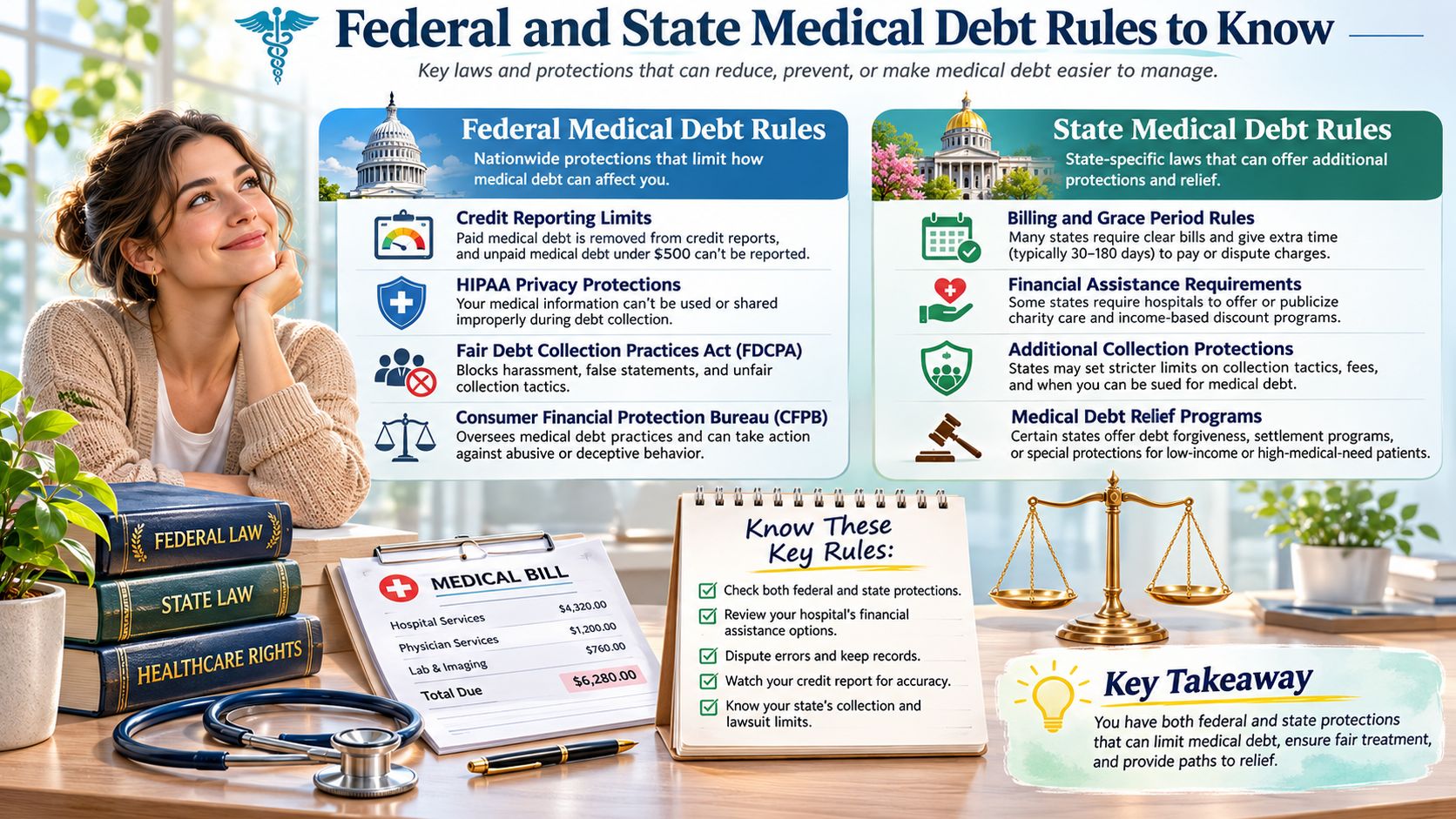
What still applies is narrower. The Fair Credit Reporting Act still permits some medical-debt information when it doesn't identify the provider or reveal the nature of the medical services, according to the Congressional Research Service summary. State law can tighten that further. Several states have enacted laws restricting or banning medical-debt credit reporting. Where you live, and where your lender does business, can change whether a given medical collection is even eligible to appear.
Separate removal analysis from collection defense
These are two different jobs. Mixing them wastes a dispute cycle. Removal analysis asks whether the entry should be on the report at all. Collection defense asks whether the amount is legally owed. The first is a reporting question. The second is a billing question. A bill you still owe can be off the report, and a bill you do not owe can still be sitting on it until someone corrects the file.
Start with an itemized validation request to the collector. Then check whether insurance, financial assistance, the No Surprises Act, bankruptcy, settlement, or a payment already changed the collectible amount. If you suspect a surprise-billing violation, dispute in writing promptly and keep proof. The CFPB advises written disputes and accepts complaints about improper medical-debt collection or negative reporting.
Under current bureau policy, the one-year medical collection reporting wait means an unpaid medical collection generally is not reported until one year after the original delinquency, and collections under $500 are generally excluded. Date of service and the original delinquency are different triggers. A claim resubmitted to insurance long after the visit does not, by itself, restart that clock.
A workable dispute usually rests on a documentary mismatch: insurer explanations of benefits, provider ledgers, payment receipts, charity-care determinations, settlement letters, identity-theft affidavits, or proof the debt is duplicated or outside the reporting period. Hardship by itself is not a mismatch. An accurate, current, verifiable medical collection is not a deletion target just because it hurts a mortgage file.
Two limits are plain. Credit repair can correct inaccurate information, but it cannot legally erase accurate negative history or guarantee a score increase. No company can legally remove accurate, current, or verifiable information, and results vary by consumer file and by bureau or creditor responses. Nobody outside the bureaus and furnishers controls what they report.
Don't pay solely to obtain deletion unless you have written terms. Payment can end collection activity while an otherwise accurate item stays subject to reporting rules for the rest of its window. After any correction, recheck all three reports and give the investigation results to your lender. Removing an inaccurate medical collection does not, by itself, change utilization, payment history, income, or debt-to-income. Those are the pieces a mortgage underwriter still reads.
Records That Prove a Medical Collection Error
You line up the three reports and the medical collection does not agree with itself. One bureau lists a $640 balance. Another shows the same collector with a different date. The third report has no such account. The dispute starts when a document, not a guess, shows which version is wrong.
A wrong balance is the clearest version of that problem. The insurer paid its share, the provider's ledger shows the credit, and the collection still reports the pre-insurance figure. Two documents disagree with the report, so the error is specific enough to name.
Each error needs its own paperwork.
| Error | Records to Gather |
|---|---|
| Wrong balance | Itemized bill, provider ledger, payment receipts |
| Insurance payment not applied | Explanation of benefits, insurer payment confirmation |
| Duplicate listing | Statements showing one debt, both account records |
| Account belongs to someone else | Identity-theft affidavit, identity documents |
| Paid but still reported | Payment confirmation, settlement letter |
| Too recent or under $500 | Report copy with dates and balance, billing statements |
Send copies, never originals. Bureaus and furnishers do not reliably return documents. A lost explanation of benefits is a lost dispute.
Build one folder per item
Label a physical or digital folder with the account number. Put the marked-up report page in first, then the supporting records, then a one-line explanation written before the documents. "Balance reported $640; insurer paid $480 on March 14; provider ledger shows $160 patient responsibility" does more than three pages of narrative. A stranger reviewing the file should see the account, the error, and the proof without hunting.
That same standard is what the Superior Credit Repair collection record tips describe. Accuracy documents include current three-bureau credit reports, creditor statements showing balances, limits, dates, and payment history, plus collection letters, settlement records, student loan records, or debt-buyer notices. Match the stack to the error you circled. Extra pages that do not speak to that error only slow the read.
Read the record before you rely on it
Some documents will hurt the dispute. A provider ledger that confirms the balance, the date, and your responsibility is proof the entry is accurate. Attaching it invites a verified result. Read what each page says before it goes in the envelope.
A bill you can't afford is a hardship. A bill reported with the wrong balance is an error. Only the second one is a dispute.
That line keeps the file honest. Repeated disputes over information a bureau has already verified can be treated as frivolous, and a frivolous determination can close the door on that item for a while. A clean folder is not a request to erase a bill the records confirm.
Take the $640 case through to the sentence you would send. The collection appears on two of your three reports. Your explanation of benefits shows the insurer processed the claim and paid $480 on a specific date, and the provider's itemized bill confirms the remainder. You now have one factual sentence, one date, and two documents. That package is worth sending to the furnisher and to each bureau that shows the account. That's the kind of documented mismatch that can prompt a bureau to correct the balance or remove the tradeline if the furnisher cannot verify it, though results vary by file and by each party's response.
How to Dispute a Medical Collection Step by Step
Disputing an inaccurate medical collection is a documented legal process under the Fair Credit Reporting Act, not a guaranteed deletion strategy. The Federal Trade Commission's guidance on disputing errors on your credit reports lays out the same sequence that works in practice. Move through it in order.
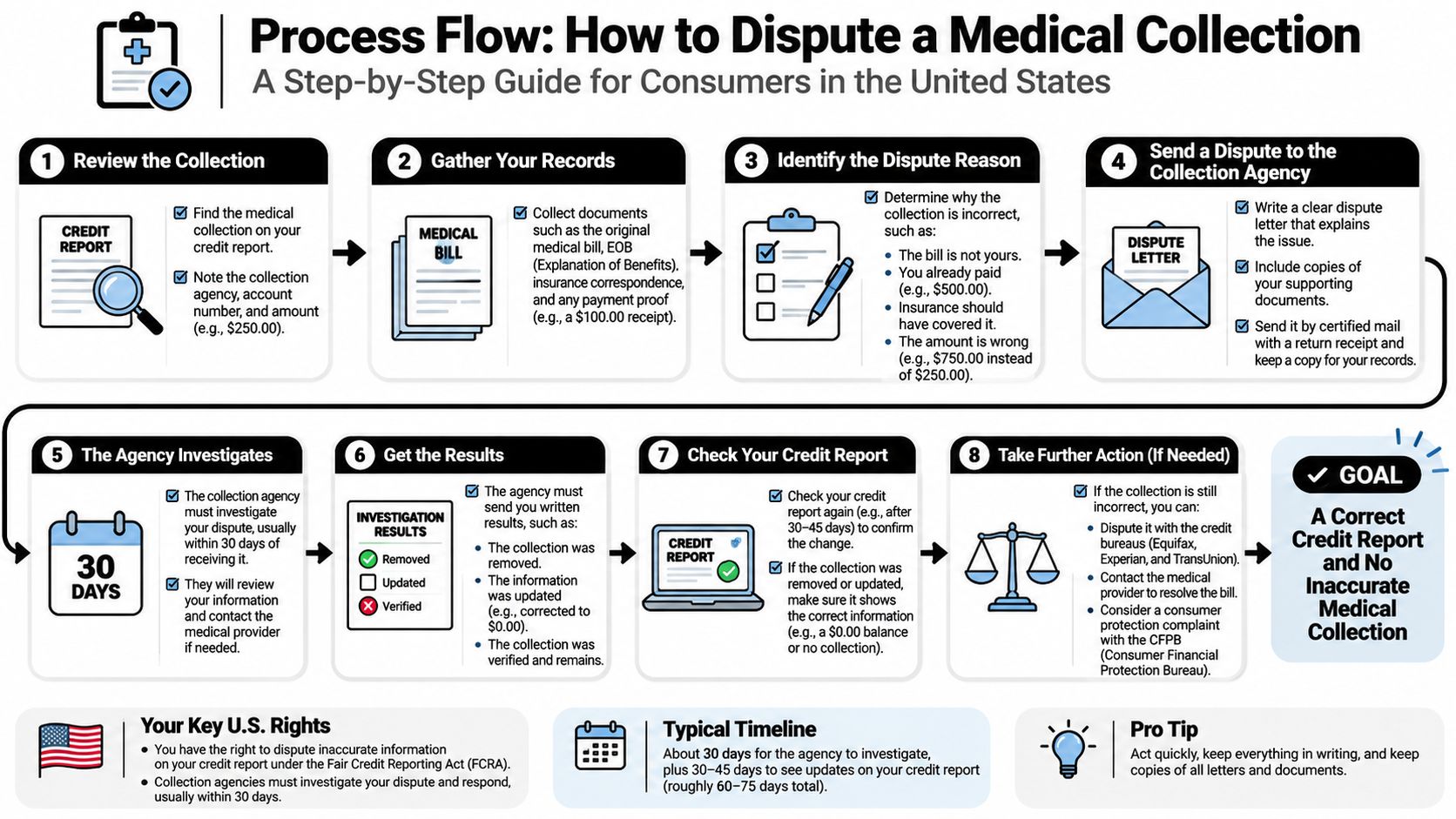
1. Mark the error on a copy of your report. Circle the item, write the account number beside it, and note precisely what's wrong. Vague disputes ("this isn't mine") get vague answers.
2. Gather copies of the proof for that specific error. Provider ledgers, explanations of benefits, payment receipts, identity documents. The mistake here is dumping everything you have. Send only what speaks to the error you're claiming.
3. Write a separate dispute to every bureau showing the item. Same error, three letters if three bureaus report it. Each one should name the account, describe the error, and ask for correction or deletion of that specific information. A bureau won't act on another bureau's file.
4. Send a matching dispute to the furnisher. That's the provider or collection agency that reported it. Furnishers receiving a valid dispute must investigate, and when they find information is inaccurate or can't be verified, they must ask the consumer reporting company to delete or modify it, as the CFPB's report on medical collections removal explains. Skipping this step is the most common reason a bureau "verifies" an item: the furnisher confirmed its own data.
5. Keep delivery confirmations, copies of everything sent, and a dated chronology. Certified mail or the bureau's online confirmation, either works. What matters is that you can show what you sent and when.
6. Allow the 30-day investigation period. Credit reporting agencies generally must investigate within 30 days, and if you submit relevant additional information during that window, the period can extend by up to 15 more days. Filing a dispute doesn't cost anything.
7. Compare the updated reports against the results. If an item remains and the furnisher can't substantiate accurate reporting, escalate with the bureau's reinvestigation procedure and a CFPB complaint that attaches your original dispute and the response.
For a walk-through of the letter itself, the step-by-step credit dispute form guide covers structure and wording. The first step in a credit file review should be a measured review rather than a rushed dispute, and that single habit prevents most of the self-inflicted problems below.
When the bureau verifies the item as accurate
A verified result stings, and it also means something specific: the furnisher responded to the bureau with data supporting the entry. It does not mean the debt was proven false, so your next letter shouldn't claim it was.
What remains available: the item may stay on your report for the balance of its reporting period; you can add a consumer statement of up to 100 words to your file explaining your position; you can write to the furnisher and ask for the basis of its verification; and you can file a complaint with the CFPB. Each of those is a legitimate step. None of them is a deletion.
The most common slip
Disputing an accurate debt only because it's damaging. A bureau may continue reporting information it verifies as accurate, and the FTC is explicit that a dispute shouldn't claim a legitimate debt is false merely because it hurts. That letter burns a dispute cycle, produces a verification, and makes the next dispute on that same item harder to take seriously.
Why Removal Alone Does Not Make You Mortgage Ready
A first-time buyer in the middle of FHA pre-approval gets a $310 medical collection deleted. Two weeks later the loan officer pulls a fresh tri-merge. The conversation moves to two credit cards reporting at 78% and 84% of their limits. The medical line is gone, and the file still has to clear revolving utilization and the debt-to-income ratio those balances feed.
A deleted collection works like one cleaned spot on a shirt an underwriter is checking under a bright light. Payment history, any remaining accurate collections or charge-offs, credit utilization, debt-to-income, and recent delinquencies are still in view. FHA, VA, USDA, and conventional loans each set their own requirements, and individual lenders apply overlays on top. Ask your lender early what its thresholds are rather than guessing from a forum post.
The work that changes the file is the three-report review and the records behind it. Bureaus do not refresh on the same day, so a deletion on one report can still appear on the other two when the tri-merge is ordered. Compare status, balance, and date reported on all three before you treat the correction as finished. Investigation results sitting next to those updated reports let you show the lender that the medical item was a reporting error, separate from the payment pattern and balances the approval still has to survive.
The mechanics of clearing collections before applying for a mortgage go well beyond the collection itself, which is why the sequence matters as much as the correction.
Practical steps between correction and application
Check statement and reporting dates first. Card issuers report to bureaus on a cycle, and a balance paid down after the statement date can still report high.
Plan balances so they report lower. Paying before the statement closes is different from paying before the due date. Ask about mid-cycle reporting if timing is tight.
Don't open new credit before closing. A new card or car loan between pre-approval and closing can change your debt-to-income calculation.
Keep the paper trail organized. Investigation results and updated reports help explain corrections to a lender.
Prepare a short explanation letter. Two or three sentences on what happened and what changed beats a surprised underwriter.
If a high balance is what's dragging the file, why minimum payments drain savings explains how a minimum payment keeps principal high and keeps both utilization and debt-to-income working against you, which is exactly the trade-off a lender is pricing.
Results vary with each credit file, the documentation available, creditor responses, account history, and current credit behavior.
Common Questions and Your Next Step
Does paying a medical bill remove it from my credit report
Payment changes the item's status. It doesn't automatically rewrite history, though paid medical collections are generally excluded under current bureau policy, so paying often does lead to removal once the furnisher updates its reporting. Confirm the status on each of the three reports after the payment posts, because bureaus don't sync instantly. The CFPB has also noted that collectors may use credit reporting to pressure consumers into paying amounts they don't owe, which is one reason to verify the balance before you send money, as the CFPB's letter to the Massachusetts legislature describes.
Can I dispute a bill I actually owe
Yes, if the reporting is wrong. Disputes address inaccurate, incomplete, or unverifiable information, not whether a debt is unpleasant. If the balance is inflated, the dates are wrong, the account isn't yours, insurance already paid, or the collector can't substantiate the entry, that's a dispute. Requesting validation from the collector is a separate step and worth doing first. If everything checks out, a dispute claiming the debt is false won't work, and repeating it can be treated as frivolous.
How long does a credit bureau investigation take
The general period is 30 days, extendable by up to 15 more days when you supply relevant additional information during the investigation. Mail disputes add delivery time on both ends, so build the wait into any mortgage timeline and don't start a dispute two weeks before a closing date.
Do I need a credit repair company
You can file disputes yourself at no cost, and plenty of people do it successfully. A company can help organize records, identify which entries are disputable, and sequence the work so current credit isn't damaged while older items are reviewed. No company can guarantee a deletion, an approval, or a score result, because the bureaus, furnishers, and scoring models sit outside its control.
Three actions for this week
- Pull all three reports from the federally authorized source and save the PDFs.
- Mark every medical entry against the checks table and note which ones fail.
- Gather the documents for each failing item before you write a single dispute letter.
If you'd like a second set of eyes, Superior Credit Repair can review your credit report, help identify inaccurate or questionable items, and explain a step-by-step plan for improving your credit profile. You can request a free credit analysis or consultation to better understand your options. That conversation starts with what's reporting now, what may be inaccurate, and what steps make sense for your goal. Results vary based on your credit file, documentation, creditor responses, account history, and current credit behavior, and we don't control the bureaus, furnishers, or scoring models.
Was this guide helpful?
If this information helped you better understand your credit report or your next steps, we would appreciate your honest feedback. You are welcome to share your experience with Superior Credit Repair on our Google Business Profile.
Superior Credit Repair Online provides educational credit guidance for individuals and families preparing for major financial goals like buying a home, applying for a mortgage, refinancing, or rebuilding after credit challenges.
Superior Credit Repair works with first-time homebuyers and families who need a medical collection reviewed against the bureaus' current reporting rules, not just disputed and hoped over. We start with a three-bureau review, separate the entries that fail a documented check from the ones that are accurately reported, and lay out the sequence so corrections land before your lender pulls a file. Visit Superior Credit Repair to request your free credit analysis and see what's reporting on your file.