


There's no single national deadline for medical bills going to collections. In practice, a provider may refer an unpaid bill to a collector anywhere from about 30 days to 180 days after billing, while the credit bureaus generally wait a full year from the first delinquency before an unpaid medical collection can show up on your credit report.
Say you had a scan in March, the statement arrived in May, and you assumed the bill was handled because your insurance card was on file. Then a letter shows up from a company you've never heard of, and the balance is higher than the estimate you were given. The question that follows isn't really about a due date. It's about which clock is running, who is holding the account now, and what a lender will see when you apply for a mortgage.
Table of Contents
- Typical Timelines Before a Medical Bill Goes to Collections
- Sent to Collections Versus Credit Reporting and What Remains Uncertain
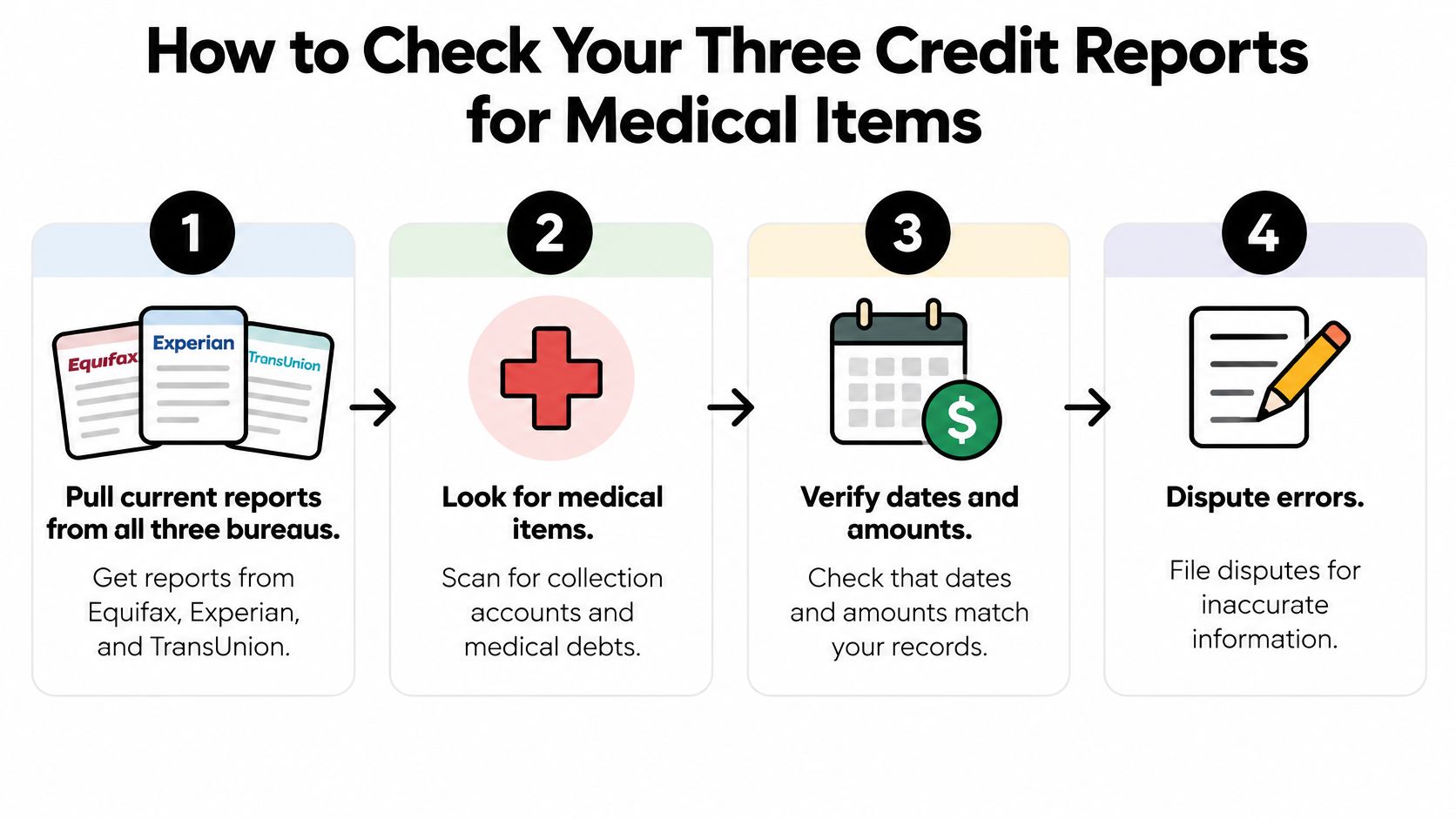
- How to Check Your Three Credit Reports for Medical Items
- Paying, Disputing and Negotiating Before You Apply
- What Medical Collections Mean for FHA, VA and Conventional Loans
- Common Questions About Medical Bills in Collections
- Confirm Your Timeline and Documents Before You Apply
Typical Timelines Before a Medical Bill Goes to Collections
The honest answer to how long until medical bills go to collections is that no single nationwide deadline exists. The Consumer Financial Protection Bureau has reported that some providers refer accounts for collection as soon as about 30 days after billing, while others wait as long as 180 days (CFPB on medical debt collection and reporting). HousingWire reported in 2024 that unpaid medical bills historically went to collections roughly 60 to 180 days after becoming delinquent, depending on the healthcare provider (HousingWire).
Both of those describe a referral, not a legal deadline. The trigger is the provider's own billing cycle, its charity-care policy, and how long it takes to work through insurance. A single physician group can run a 30-day cycle. A hospital system with a financial assistance department usually takes months.
The Stage-by-Stage View
The table below separates the stages people blend into one blur, because each stage has its own clock and its own decision-maker.
| Stage | Typical timing | What sets it |
|---|---|---|
| Provider referral to a collector | As early as about 30 days after billing; in some cases as long as 180 days | Provider billing and charity-care policy |
| Hospital notice under IRS Section 501(r) | At least 120 days after the first post-discharge statement | Federal rules for certain nonprofit hospitals before extraordinary collection actions |
| Financial-assistance application | Up to 240 days after the first post-discharge statement | The hospital's financial-assistance policy |
| Unpaid medical collection on a credit report | Generally not before 365 days past first delinquency | Voluntary nationwide bureau policy in effect since July 1, 2022 |
| Unpaid medical collection with an initial balance under $500 | Removed from consumer reports since April 2023 | Voluntary bureau policy based on the initial reported balance |
| Paid medical collection | Generally excluded from bureau reports | Voluntary bureau policy; confirm on all three reports |
Rows one through three are about the provider. Rows four through six are about credit reporting, and they get their own explanation further down.
What the Federal Hospital Rule Does and Doesn't Do
For hospital care covered by the nonprofit-hospital rules in Internal Revenue Code Section 501(r), a hospital generally must provide a 120-day notification period after the first post-discharge billing statement before taking extraordinary collection actions, such as reporting adverse information to credit bureaus. Patients generally have up to 240 days from that first statement to submit a financial-assistance application (IRS guidance on billing and collections under Section 501(r)).
Those rules restrain certain hospital practices. They don't guarantee your account stays with the provider for 120 or 240 days, and they don't stop ordinary reminders or other permitted collection activity. A bill can be referred before or after those milestones.
Four Moves to Make Before Any Transfer
- Request the itemized bill. The summary statement shows a total. The itemized version shows every charge, code, and date, which is the only way to spot a duplicate or a charge your insurer already paid.
- Confirm insurance processing and appeals. Ask whether the claim was filed, denied, or left unbilled, and whether an appeal is open. A pending appeal is a billing problem, not a payment problem.
- Ask for a financial-assistance review. Ask the billing office to note the request on the account and to state in writing whether it pauses referral.
- Request a written payment plan. Get the monthly amount, the due dates, and the answer to one question: does staying current prevent referral?
Timing shifts by provider, insurer, state, and account type. Insurer contracts and in-network terms can also change when a provider bills and when it refers. State medical-debt laws differ too, and several states restrict medical-debt reporting, so check your state attorney general or financial regulator before you rely on any timeline. And if the account is already with a collector, how long collectors can sue is a separate clock from the reporting one, and it matters before you make a payment on an old bill.
Sent to Collections Versus Credit Reporting and What Remains Uncertain
Being sent to collections and appearing on a credit report are two separate events, set by different rules and measured from different dates.
Think about what happens when a bill is referred. The provider hands your account to a collection agency or sells it outright. That agency can start calling, sending letters, and posting its own balance while the credit bureaus are still barred from showing anything. An overdue invoice sold to a stranger lets the stranger start asking for payment long before the credit reporting system learns the account exists.
The distinction that matters: an account can be owned by a collector and actively pursued while all three of your credit reports still show nothing at all.
Here's a visual version of how to check each file for those items.
What the Three Bureaus Changed and When
Equifax, Experian, and TransUnion announced a voluntary change effective July 1, 2022: unpaid medical collections would generally be withheld from consumer reports for up to one year rather than the former 180-day period. Paid medical collections were removed, and in April 2023 medical collections below $500 were also removed from reporting (CFPB medical debt rule document).
These are industry policies, not statutes. A bill can already be owned or pursued by a collector while remaining invisible to the major credit reports. An unpaid medical collection of at least $500 that stays unresolved for more than a year may still be reportable, while paid accounts and qualifying sub-$500 accounts generally shouldn't appear under those policies.
The Dates to Keep Straight
Write these down for your own account, because each one starts a different countdown.
- Date of service. The anchor many people forget, and the date some furnishers use.
- First statement date. For a nonprofit hospital, this starts the 120-day notice and 240-day assistance periods.
- First delinquency date. This is what the one-year credit reporting clock measures from.
- Placement date. The day the provider referred or sold the account, which you can request in writing.
- Report date. The date a bureau shows the item as furnished, which should not precede the delinquency clock.
A year does not make a bill safe. The one-year waiting period governs reporting. It doesn't pause interest, prevent a lawsuit, stop collector calls, or cancel the debt.
The Federal Rule That Was Vacated
The CFPB finalized a rule in January 2025 that would have removed medical debt from most credit reports and barred lenders from using medical-debt information in underwriting. A federal judge vacated that rule in July 2025, so no federal ban currently protects every medical collection (Congressional Research Service on medical debt and credit reporting).
What remains are voluntary bureau policies and state laws, and those vary by jurisdiction and account type. Confusion persists even where protections exist. That same Congressional Research Service summary cites Urban Institute findings that 35.2% of adults with medical debt had been contacted by a collection agency, while 21.7% said the debt lowered their credit score, including some residents of states that restrict medical-debt reporting.
Will It Hurt a Mortgage Application if It Isn't on the Report
Sometimes yes. It depends on the loan program, the lender's overlays, and your state. Run three checks before you assume you're clear.
- Pull all three reports. A single-bureau view tells you about one file, not your file.
- Confirm your state rules. A state that restricts medical-debt reporting can change what a lender sees, and a state that doesn't leaves the bureau policy in charge.
- Ask the lender what it reviews. Specifically, which medical collections it looks at, whether it requires payoff, and whether an explanation letter is enough.
This is also where the question of does unpaid medical debt hurt credit gets practical rather than theoretical. Track two dates on your own calendar, the placement date and the first delinquency date. Invisible does not mean resolved.
How to Check Your Three Credit Reports for Medical Items
The reporting policies turn on two fields, the date and the amount, and those are exactly where errors tend to live. A wrong delinquency date or a balance inflated by duplicate charges can make a compliant account look worse than it is, or make a paid account look unpaid.
Here's the short version of the check before the detail.
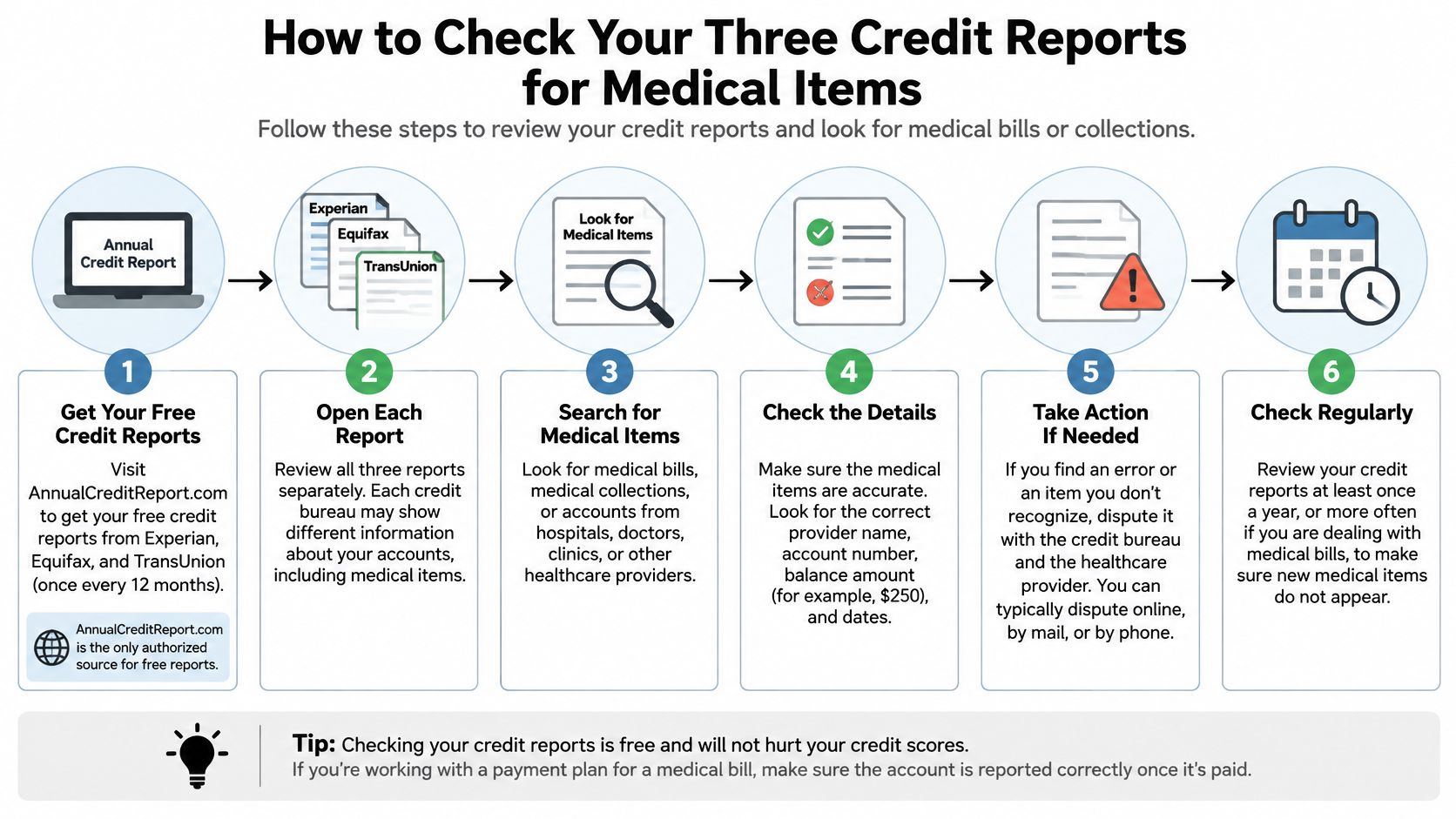
- Pull current reports from all three nationwide bureaus. Use the same day for all three so the comparison is fair.
- List every medical account. Record the creditor or collector name, reported balance, original delinquency date, and account status.
- Compare each entry with your paperwork. Set the itemized bill, the insurance explanation of benefits, and any collection letters beside the report entry.
- Confirm who owns the debt. Note whether it's the original provider, an agency collecting on the provider's behalf, or a debt buyer, and whether the same balance appears under two names.
- Check the dates and the balance math. Compare the delinquency date with the one-year reporting rule, check whether the initial balance sits under $500, and look for fees or duplicate charges that inflated it.
- Compare the same account across bureaus. A balance or status that differs between files is worth documenting, and reviewing bureau differences for first-time homebuyers explains why that gap matters before a mortgage application.
- Start a log. Note the date you pulled each report, what you found, and every response you send or receive.
The Documents That Support a Review
Creditor statements showing balances, dates, and payment history carry the most weight in a dispute, because they're the same records the furnisher keeps.
- Service records: the date of service, the original due date, and the account number.
- Insurance records: explanations of benefits, claim status, denial letters, and appeal confirmations.
- Provider records: billing statements, notices, and any written hold or payment arrangement.
- Collector records: the first written notice, validation responses, and settlement letters.
- Payment proof: receipts, canceled checks, and confirmation that an account was satisfied in full.
A collection account may need ownership and balance review, while a late payment may need payment-history proof. Those are different documents for a reason. Results vary by file and by furnisher response, and a compliant review looks for verifiable errors rather than promising that anything will disappear.
Paying, Disputing and Negotiating Before You Apply
The decision comes down to two questions. Is the balance accurate, and is it affordable? Everything else follows from the answers.

| Option | Best when | Get in writing first | Credit file note |
|---|---|---|---|
| Pay in full | The balance is verified and affordable | A receipt and confirmation of a zero balance | Paid medical collections are generally excluded from bureau reports, so confirm the update on all three |
| Written payment plan | A lump sum isn't possible right now | The monthly amount, the due dates, and what happens if a payment is missed | Confirm how the account reports while the plan is active |
| Negotiated settlement | The balance is large or insurance adjustments are unclear | The settlement amount and a zero-balance letter before you pay | Confirm the updated status appears on each bureau report |
| Dispute an inaccurate item | The balance, date, ownership, or a duplicate listing is wrong | An itemized bill, insurance explanations, and collection letters | Correction depends on whether the error is verifiable and documented |
Why Paying With a Credit Card Changes the Rules
Paid medical collections are generally excluded from the credit reports maintained by Equifax, Experian, and TransUnion under the bureaus' voluntary policies. The exclusion applies even when the account was previously reported, but confirm the tradeline updated or dropped on all three reports after payment (Experian on medical debt and your credit score).
Paying the bill with a credit card is a different transaction. Experian explains that credit-card debt doesn't receive the special medical-debt reporting treatment, and a card payment that becomes 30 days late may be reported as an ordinary credit delinquency. You've traded a medical collection for revolving debt with its own late-payment risk.
How a Dispute Is Built
Start with a specific, verifiable error: a wrong balance, a wrong date, a collection listed under an agency that never owned it, or the same debt reported twice. Then gather the documents that show the correct version, and send a written dispute to the bureau with copies attached. Keep every letter, submission confirmation, and response.
A compliant dispute asks for correction of an error that can be documented. It doesn't claim every negative item must come off, and it doesn't treat a legitimate balance as a reporting mistake. If you're questioning an incorrect medical balance, the itemized bill and the explanation of benefits are where that argument starts.
How to Negotiate Without Losing Leverage
Ask what the collector will accept before you volunteer anything about your budget. Get the settlement figure, the zero-balance language, and the reporting instructions in writing before money moves. A payment made on a promise that isn't documented leaves you with no proof of the terms.
Two practical cautions shape the timeline. Overall duration can be affected by new negative accounts reporting during the process, late or skipped payments on active accounts, creditors verifying accounts during an investigation cycle, reinvestigation cycles, and changes in credit usage. And while disputes are pending, keep a tracking log of every bureau response so nothing closes on you.
What Medical Collections Mean for FHA, VA and Conventional Loans
Lenders read the whole file, not one tradeline. Medical collections sit inside a larger picture that includes debt-to-income ratio, payment history, and account stability, which is why two applicants with similar collections can get different answers.
FHA. FHA guidelines are set at the program level, and each lender can layer its own overlays on top. A collection that a bureau doesn't report can still appear on your application if you disclose it or if the underwriter asks. Ask your lender: which medical collections require payoff or an explanation letter before closing?
VA. VA underwriting looks closely at residual income and overall credit stability, and lender overlays vary widely. Veterans with a single medical collection often need a written explanation rather than a payment, but that decision belongs to the underwriter. Ask: will a payment plan on this account count against my residual income?
Conventional. Automated underwriting systems and investor guidelines can treat collection accounts differently depending on amount and type. Ask: does the automated finding require this account to be paid, and does a settlement satisfy it?
USDA. USDA programs apply their own credit and debt-ratio standards, and the local lender's interpretation matters. Ask: how does this collection affect my total debt ratio for USDA eligibility?
Preparation is mostly paperwork. Gather paid-in-full letters, settlement letters, and zero-balance statements, and confirm all three reports show the correct status well before you apply. Keep utilization and payment history stable in the months before underwriting, because a new late payment does more damage than an old collection.
Timing rule: many credit bureau investigations operate within standard 30-day periods, and responses may extend depending on bureau volume and creditor response times. Start well before a rate lock, not the week of your application.
A balance or an active payment-plan payment can affect debt-to-income, so it belongs in the conversation with your loan officer early. First-time buyers and renters planning to buy should review their files months ahead rather than weeks. State medical-debt rules can also change how a collection is treated, so ask each lender which state rules it applies and which medical collections it reviews for the program you're using. For a deeper walk-through of underwriting concerns, these Superior Credit Repair mortgage readiness tips cover how collections get reviewed. Results vary, and no one can guarantee loan approval.
Common Questions About Medical Bills in Collections
Can a medical bill go to collections while insurance is still processing or under appeal
Yes, it can. Provider billing cycles don't automatically pause for an open claim or an appeal in progress. Call the billing office, ask for the itemized bill, and request a documented hold with an end date while the claim is worked out.
Does a medical debt expire
The debt can remain owed even after a long stretch of inactivity. Statutes of limitations on collection lawsuits vary by state, and a credit reporting timeline doesn't cancel the balance. Never assume that a quiet collector means a closed account.
Can a collector contact me directly, and what can I request
A collector can contact you, and you can request written validation of the debt, including the amount, the original creditor, and the collector's authority to collect. Ask for it in writing and keep copies of every letter and call log.
Will a medical collection affect apartment approval
It can, because rental screening policies vary by landlord and screening company. Pull all three reports, correct what's wrong, and ask the property manager what the screening reviews.
Confirm Your Timeline and Documents Before You Apply
Before you fill out an application, build a one-page timeline for each medical account: service date, insurance or billing status, referral date to collections, first delinquency date, and current reporting status on all three bureaus. Then keep the paperwork that proves each point, because a date you can document is worth more than a date you remember.
Keep two moments separate. A bill can be owed, and a collector can be calling, while nothing appears on a credit report yet. A lender reviews what is reporting, so your file should show the referral date, the balance, the owner of the debt, the account status, and any difference among Equifax, Experian, and TransUnion. Useful records include current three-bureau reports, creditor statements with balances and dates, collection letters, settlement records, and debt-buyer notices. While disputes are pending, keep a tracking log of every bureau response.
Superior Credit Repair approaches this as a structured, documentation-based review. The team checks balances, ownership, dates, status codes, and bureau differences, then pursues corrections through legal dispute and verification steps when an error can be documented. Fees are earned and billed only after services are performed, and clients can cancel within three business days as provided by law.
If you'd like help organizing the file, Superior Credit Repair can review your credit report, help identify inaccurate or questionable items, and explain a step-by-step plan for improving your credit profile. You can request a credit analysis or consultation to better understand your options. Results vary based on each person's credit file, documentation, creditor responses, account history, and current credit behavior, and no provider can guarantee deletions, score changes, or loan approval.
If this information helped you better understand your credit report or your next steps, we would appreciate your honest feedback. You are welcome to share your experience with Superior Credit Repair on our Google Business Profile.
Was this guide helpful?
Superior Credit Repair Online provides educational credit guidance for individuals and families preparing for major financial goals.
Superior Credit Repair works with first-time buyers, veterans, and families who want a cleaner, better-documented file before they apply. We review collections, medical bills, late payments, utilization, and bureau differences, then explain which items can be supported with documentation and which need a payment plan or a direct conversation with the provider. Visit Superior Credit Repair to request a credit analysis or consultation and see where your file stands before a lender does.