


Medical debt usually affects your credit score when it's reported as a collection account, not while it's only an unpaid provider bill; unpaid medical collections generally must have an initial reported balance of at least $500 and be more than 365 days past due to appear. Whether a reported account affects your score also depends on the lender's scoring model.
If medical debt no longer mattered, why could a hospital collection and a credit card used for surgery lead to different credit decisions? Because the medical expense and the account used to finance it aren't the same thing.
For families preparing to buy a home, that distinction creates a practical starting point. Before paying an unfamiliar collector or assuming a bill has damaged your credit, identify what the account is, whether it appears on your reports, and whether the information matches your records.
Table of Contents
- The Short Answer on Medical Debt and Your Score
- Which Medical Debts Show Up on Your Credit Report
- Reporting Timeline From Bill to Collection
- How Mortgage Lenders Weigh Medical Collections
- How to Verify and Dispute a Medical Collection
- Settling, Paying and Rebuilding After Medical Debt
- Medical Debt Questions Homebuyers Ask Most
- Confirm Your Medical Debt Status Before You Apply
The Short Answer on Medical Debt and Your Score
The claim that medical debt no longer affects credit is too broad. Some medical collections are excluded from consumer credit reports, but that doesn't mean every health-related balance is protected or that lenders ignore every related obligation.
The issue has affected many households. In March 2022, the Consumer Financial Protection Bureau estimated that approximately $88 billion in medical bills appeared on U.S. consumer credit reports, affecting an estimated 15 million people.
A collection account is an unpaid balance that a provider has transferred or assigned to a collection agency. If reporting requirements permit it, that agency may report the account to a credit bureau.
A bill is a request for payment. A collection entry tells someone reviewing your credit report that a payment became overdue.
A hospital statement sitting on your kitchen counter isn't automatically a negative credit entry. Conversely, paying that statement with a credit card creates a card balance that follows ordinary credit-card reporting rules.
The terms that make your report easier to read
These definitions help you separate billing questions from credit-reporting questions:
- Tradeline: An account listed on a credit report.
- Furnisher: The company that sends account information to a credit bureau.
- Credit utilization: The share of your revolving credit limit currently in use.
- Debt-to-income ratio: Your monthly debt payments compared with your gross monthly income.
The useful questions are what gets reported, when it becomes eligible for reporting, how lenders evaluate it, and what documentation supports your next action.
At Superior Credit Repair, we treat credit restoration as a structured review and verification process, not a promise of a particular result. Outcomes vary with each person's credit file, documentation, creditor responses, account history, and current credit behavior.
Which Medical Debts Show Up on Your Credit Report
How each medical debt situation is reported
| Medical debt situation | On the credit report? | General score effect | What to verify |
|---|---|---|---|
| Unpaid provider bill under 365 days past due | Not yet reportable as a medical collection | None from the bill itself | Balance, insurance processing, billing errors |
| Unpaid medical collection with an initial reported balance under $500 | Removed from consumer reports since 2023 | Not expected from an excluded item | Removal status across the nationwide bureaus |
| Unpaid medical collection with an initial reported balance of $500 or more, more than 365 days past due | Can be reported | Can lower a score | Original balance, first delinquency date, owner |
| Paid medical collection | Removed under the policy introduced in July 2022 | None expected from an excluded item | Any remaining listing against payment records |
| Medical expense paid with a credit card or personal loan | Reported as an ordinary card or loan account | Card utilization, loan balances, and payment history can affect credit | Statement balance, account terms, on-time payments |
The Congressional Research Service's medical-debt overview describes the nationwide bureaus' exclusions for paid medical collections and collections less than one year old introduced in 2022, followed by collections with original balances below $500 in 2023.
Read the balance and date fields carefully
The initial collection balance isn't necessarily today's balance. A partial payment can reduce what you owe without changing the amount that originally determined the account's reporting eligibility. Don't assume a smaller current balance automatically makes an otherwise reportable collection excluded.
The delinquency timeline also matters. A treatment date, collection-agency assignment date, and original delinquency date describe different events. Matching the wrong dates can make an account appear eligible for reporting before it is.
Identify the account, not just the expense
Say you pay a specialist using a general-purpose credit card. The credit report shows your relationship with the card issuer, not a protected medical collection. Missing the card payment creates a card-account problem even though the purchase involved health care.
For each item, make a short record:
- Account type: Provider bill, medical collection, credit card, or personal loan.
- Reporting location: Which bureau reports contain the item.
- Supporting evidence: Statements, insurance records, and payment confirmations.
- Next action: Investigate billing, request documentation, dispute an error, or evaluate an affordable resolution.
Compare Equifax, Experian, and TransUnion rather than relying on a single monitoring screen. Different entries can require separate, specifically documented disputes.
Reporting Timeline From Bill to Collection
Consider a family finding an old hospital collection while preparing for mortgage preapproval. The age of the hospital visit alone won't tell them whether the listing belongs on their reports. They need both the account's history and the reporting policies that apply to it.
Policy changes that affect an older collection
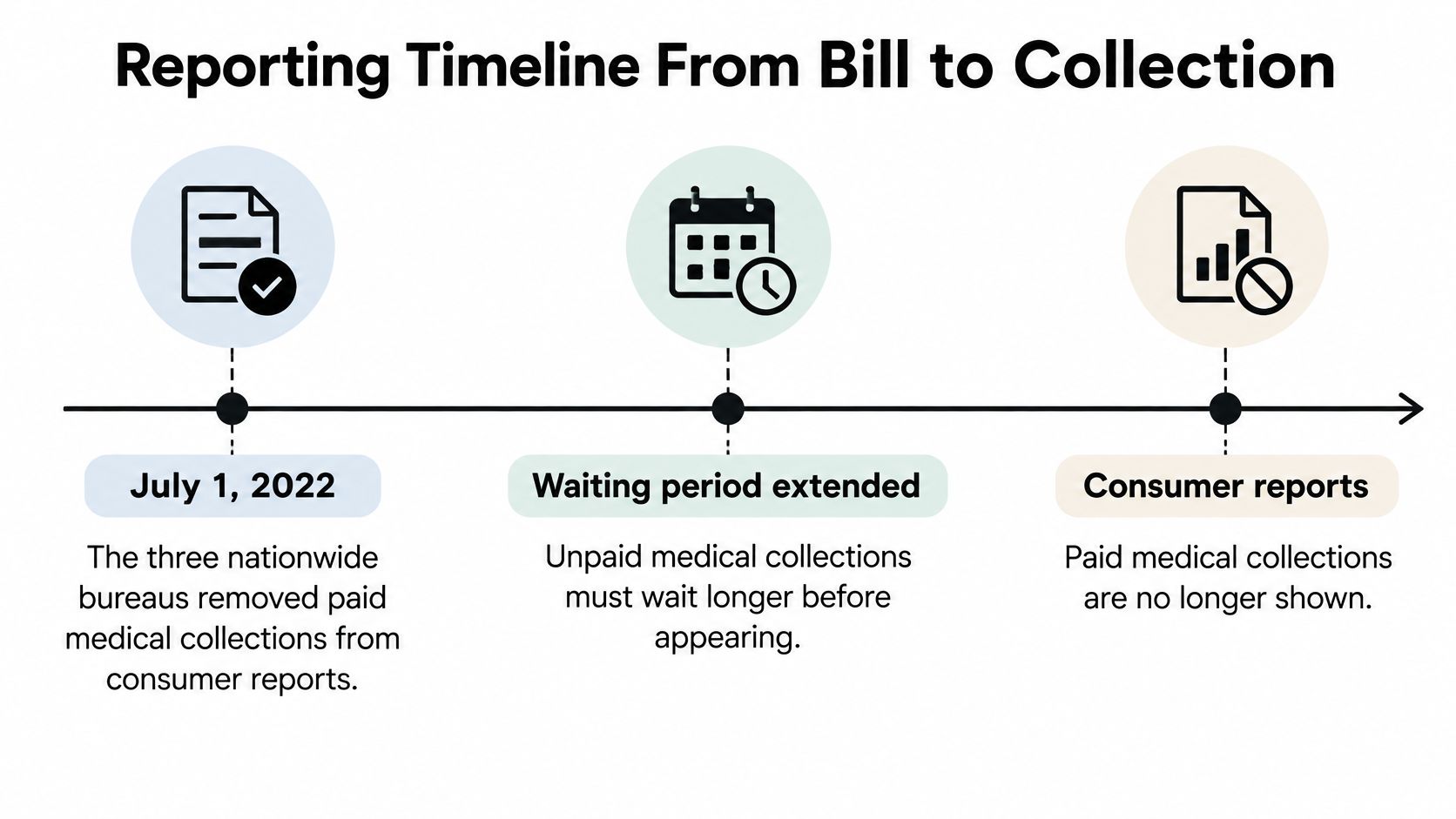
- Paid collections and additional waiting time: Beginning July 1, 2022, the nationwide bureaus removed paid medical collections and extended the unpaid-medical-collection waiting period from six months to one year, according to the bureaus' joint announcement. For consumers, this created additional time to investigate billing and insurance issues before an eligible collection could appear.
- Remaining reported debt: In August 2024, approximately 4.1% of U.S. consumers, or 9.7 million people, still had medical debt in collections on their credit records, according to the Urban Institute. Policy changes therefore didn't eliminate every medical collection.
- Federal rulemaking and litigation: A later attempt to broadly restrict medical-debt reporting didn't remain in effect. Current legal status requires checking the actual court and agency guidance rather than assuming a headline changed every account.
Your account has its own timeline
The family should compare the original delinquency, payment history, insurance adjustments, and collector correspondence. A recently received collection letter doesn't, by itself, establish when the underlying bill became overdue.
Practical rule: Build the timeline from documents, not from the date you first noticed the account.
Credit-review timing can also change while a dispute is underway. New negative accounts, skipped payments on active accounts, creditor verification, reinvestigation cycles, and changes in credit usage can affect the overall process.
We don't promise a completion date. Timing depends on the account, documentation, bureau response cycles, furnisher updates, and current credit behavior.
How Mortgage Lenders Weigh Medical Collections
A mortgage lender may not use the score displayed in your credit-monitoring app. That's why a consumer-facing score can be useful for tracking direction without answering every mortgage-qualification question.
FICO's explanation of medical collections states that FICO Score 9 disregards paid collection accounts, while mortgage lenders commonly use older score versions. Ask your lender which scoring models it will use before treating an app score as your mortgage score.

A score change isn't an approval decision
Removing a reportable negative entry may change how a scoring model evaluates the remaining file. It doesn't create income, reduce every monthly obligation, or resolve unrelated account problems.
For example, a homebuyer might correct a medical collection but still carry large credit-card balances. Another applicant might have low balances but recent late payments. Those applicants need different preparation plans, even if the medical issue looks similar.
Underwriting is the lender's broader review of whether an application meets its requirements. That review can include credit history, income documentation, liabilities, available funds, and program-specific rules.
FHA, VA, conventional, and USDA mortgage preparation therefore shouldn't be treated as interchangeable. Ask how the selected program and lender handle medical collections, disputed accounts, and documented repayment obligations.
Prepare the whole file
Our mortgage-readiness review considers collections, late payments, utilization, dispute comments, and other credit-report issues before preapproval or underwriting. A charge-off, for example, means a creditor has recorded an account as a loss; it isn't another name for a medical collection and requires its own accuracy review.
Our credit guidance for homebuyers with collections can help you organize those concerns without assuming that every collection receives identical treatment.
Before applying, ask the lender:
- Score models: Which credit scores will you pull?
- Collection treatment: Does this particular medical collection require documentation or action?
- Dispute comments: Could an unresolved dispute affect your review?
- Monthly obligations: Which payments enter my debt-to-income calculation?
- Application timing: What should I avoid changing before underwriting?
Don't open financing or move balances solely to make an application look cleaner without understanding the consequences. A new loan can replace one obligation with another.
Credit repair cannot guarantee approval for a mortgage, auto loan, or rental review. The goal is a more accurate, understandable, and stable file, not a promised lending decision.
How to Verify and Dispute a Medical Collection
Start with evidence rather than a blanket dispute of every negative account. Experian's medical-debt guidance emphasizes reviewing medical-collection eligibility and investigating insurance processing, assistance options, and billing errors.
Build an account-specific evidence file
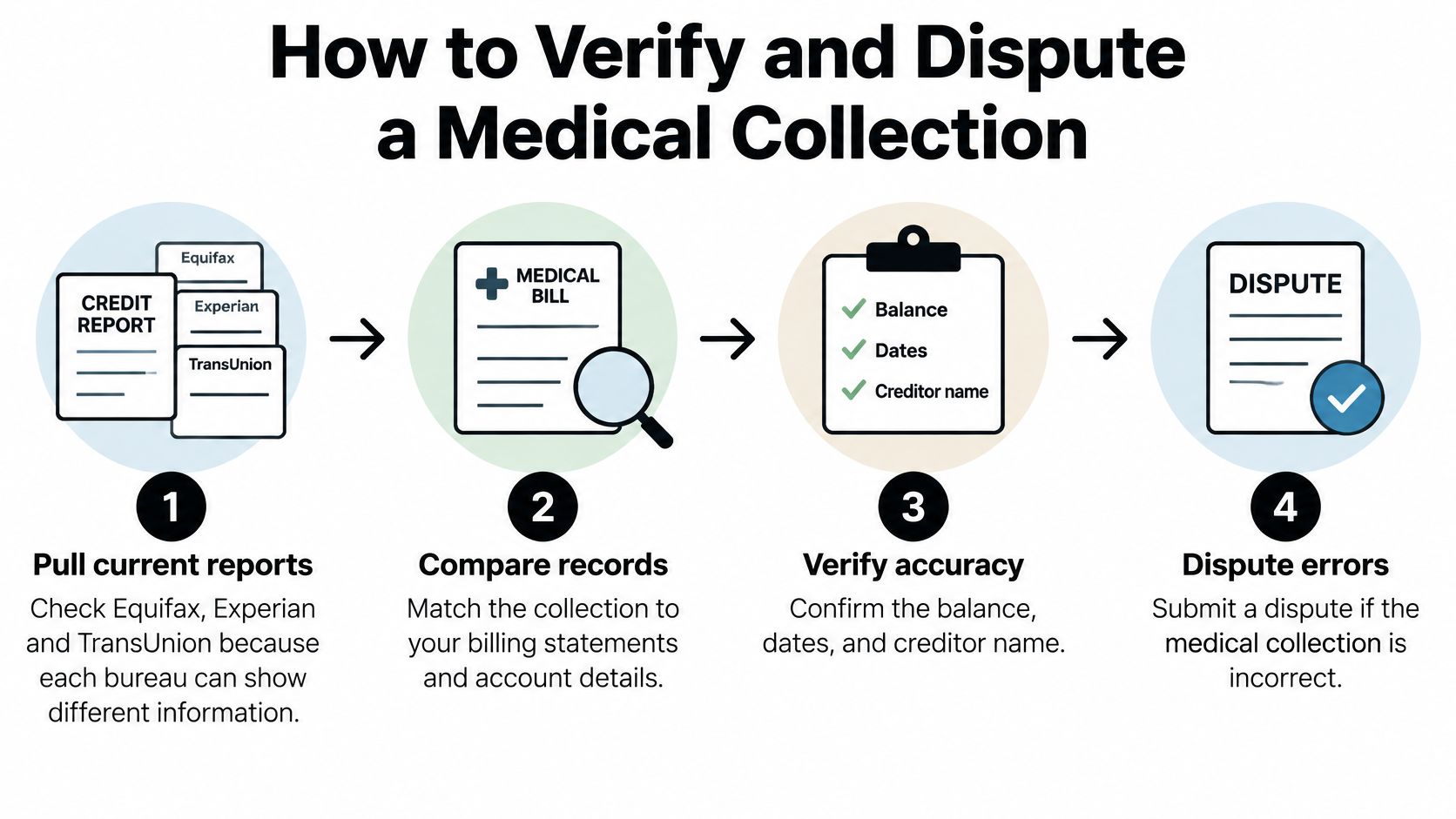
Pull current reports from Equifax, Experian, and TransUnion. Save complete copies so you can compare account details, not just scores. A common mistake is assuming an error visible with one bureau appears identically everywhere.
Record the collection's identifying information. Include original balance, current balance, first delinquency date, owner, account number, and status. Don't confuse a collector's account-opening date with the original overdue date.
Gather billing and payment records. Collect the itemized bill, insurer's explanation of benefits, payment confirmations, assistance decisions, and collector letters. An explanation of benefits shows how insurance processed a claim; it isn't itself a bill, and missing it can leave an apparently inflated balance unexplained.
Compare each reported field with your documents. Look for duplicate accounts, incorrect ownership, inaccurate balances, and paid accounts still described as unpaid. Don't assume unfamiliar collector names prove the debt belongs to someone else; compare the underlying provider and service records.
Make the dispute specific
Write to each bureau reporting the error and to the furnisher. Identify the exact field you challenge, explain why it's wrong, and attach relevant copies. Avoid generic statements that don't tell the investigator what to check.
Keep a complete correspondence log. Save letters, submission confirmations, dates sent, and responses. Sending original documents without retaining copies makes later follow-up harder.
Review the investigation result and updated report. Check whether the disputed field changed and whether the response addresses your evidence. Don't assume a closed investigation means every related billing problem has been resolved.
A billing dispute and a credit-report dispute may require different correspondence. If the provider's charges are the problem, AskLegally's steps for contesting a hospital bill offer additional context for organizing that conversation.
We also explain how to approach questioning an unexpected medical balance before choosing a credit-reporting response.
Our documentation-based review can include current bureau reports, creditor statements showing balances, limits, dates, and payment history, plus collection letters and settlement records. For broader file issues, relevant student-loan records or debt-buyer notices may also help.
No company can legally erase accurate negative history just because it's inconvenient. Information that remains accurate, current, verifiable, and eligible for reporting isn't removable through purchasing credit repair. Verification also doesn't mean ignoring a valid obligation; dispute outcomes depend on the evidence and bureau or creditor responses.
Settling, Paying and Rebuilding After Medical Debt
Medical debt resolution options compared
| Option | Best when | Effect on the report | Get in writing |
|---|---|---|---|
| Pay in full | The balance is accurate and affordable | Paid medical collections qualify for exclusion under bureau policy | Paid-in-full letter and zero-balance statement |
| Payment plan | The balance is accurate but cash is tight | A plan alone doesn't establish removal eligibility; confirm account status | Payment amount, due dates, and reporting terms |
| Settlement | The creditor or collector agrees to accept less | Confirm how the resolved balance and status will be updated | Settlement terms and final balance before payment |
| Financial assistance or charity care | Household finances may meet assistance criteria | Can reduce or cancel the underlying balance | Written decision and adjusted statement |
| Dispute of an inaccurate item | Balance, owner, dates, or status is wrong | Information may be corrected or removed after investigation | Documents supporting the specific error |
Choose a resolution you can sustain
The right option starts with whether the balance is accurate. If insurance hasn't finished processing the claim, clarify the bill before committing money based on an amount that may change.
Then consider available cash, household income, essential expenses, and who currently owns or manages the debt. Paying a collection by missing an active loan payment can create a new credit problem.
Before sending payment:
- Request written terms: Identify the account and exactly what the payment resolves.
- Confirm the ending balance: Make sure you understand whether anything will remain due.
- Clarify reporting treatment: Don't accept a verbal promise as proof of a particular credit outcome.
- Keep completion records: Retain the agreement, payment confirmation, and final statement together.
A medical lien associated with a personal-injury recovery is a different legal issue from an ordinary credit-report collection. If that applies, Bell Law explains considerations that may help you protect settlement funds through lien negotiation; consult qualified legal counsel about your circumstances.
Rebuild while the account is being resolved
Create a manageable routine rather than waiting for a dispute or payment update to do all the work.
- Track statement dates: Use card statements to plan balances and credit utilization.
- Maintain a payment calendar: Include every open account, not just the medical obligation.
- Record financing inquiries: Keep notes about recent applications before another financing review.
- Save feedback: Document specific credit concerns raised by a lender, landlord, or dealer.
Our guidance on mortgage readiness after paying off collections helps distinguish completing a payment from preparing the remaining file.
A resolved medical collection won't address unrelated late payments or inaccurate charge-off reporting. Gather the relevant statements and review the whole file with a qualified professional before choosing your next financing step.
Medical Debt Questions Homebuyers Ask Most
How long does a medical collection stay on my credit report?
The answer requires checking the original delinquency date, reporting eligibility, payment status, and applicable rules. The deadline for reporting information is also different from the time limits for medical debt lawsuits, so don't use one to calculate the other.
Does paying a medical collection remove it?
Paid medical collections qualify for removal under the nationwide bureaus' medical-collection policy. Keep payment confirmation and compare any remaining listing with the account's actual status rather than assuming the report has already updated.
Can I get a mortgage with an unpaid medical collection?
Possibly, but the collection alone doesn't answer the approval question. Your lender must evaluate the program requirements and full application, including other credit history and financial obligations.
Is a medical bill on my credit card still medical debt?
For credit-reporting purposes, the card remains an ordinary credit-card account. Paying for treatment doesn't turn that card balance into a medical collection eligible for the same exclusions.
The account type and reporting status matter more than the word medical.
If you're asking, “Does medical debt affect your credit score?” while preparing to buy a home, bring the actual account details to the conversation. A provider statement, collection notice, and credit-card statement call for different questions, even when they trace back to the same treatment.
Confirm Your Medical Debt Status Before You Apply
A careful review gives you something more useful than a reassuring headline: a documented next step.
- Classify each entry: Identify medical collections, paid accounts, balances potentially excluded by policy, and recently delinquent bills. Match each entry with your records.
- Choose a starting point: Prioritize an unclear status, unsupported balance, or account that your lender has specifically questioned.
- Confirm lender expectations: Ask which scores the lender uses and what medical-collection documentation it needs.
Our guidance on smart credit reports for mortgage approval can help you organize the information before that discussion.
Check the legal status, not an old headline
The CFPB's Regulation V rule page states that its January 7, 2025 medical-debt rule was vacated on July 11, 2025, by the U.S. District Court for the Eastern District of Texas. Don't assume all medical debt is federally excluded from credit reports.
We don't promise deletions, score increases, approvals, or timeframes. Results vary based on your credit file, documentation, creditor responses, account history, and current credit behavior.
Was this guide helpful?
Superior Credit Repair Online provides educational credit guidance for individuals and families preparing for major financial goals like buying a home, applying for a mortgage, refinancing, or rebuilding after credit challenges.
If this information helped you better understand your credit report or your next steps, we would appreciate your honest feedback. You are welcome to share your experience with Superior Credit Repair on our Google Business Profile. https://share.google/ePRpFvtCXwCjiJwOK
Superior Credit Repair can review your credit reports, help identify inaccurate or questionable medical-collection information, and explain a documentation-based plan for strengthening your credit profile. Request a free credit analysis or consultation, and gather your collection notices, insurance explanations, and payment records so you can better understand your options.