

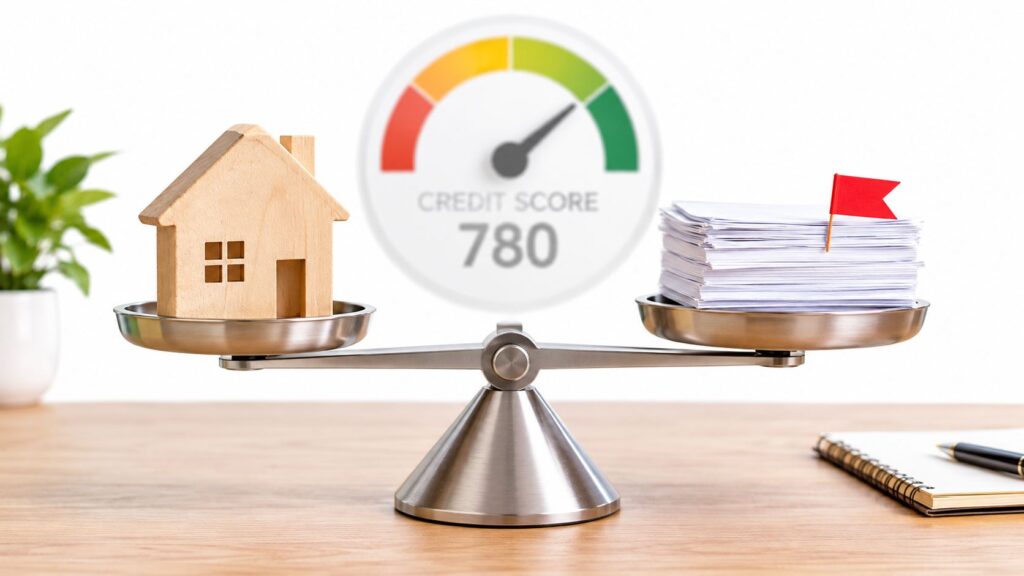
You can do everything right for a home purchase, then one unexpected collection shows up and changes the conversation with the lender. That moment is frustrating because the question isn't just whether the collection hurts your credit score, it's whether it changes how a mortgage lender will review your file.
For many buyers, that confusion starts with a simple gap in understanding. Collections affect credit score calculations, but they also sit inside a separate mortgage underwriting process that can lead to a different result depending on the loan program, the scoring model, and the way the debt is documented. A borrower can see one score effect on paper and still get a very different answer from an underwriter.

A useful way to think about it is this, collections can be a credit report problem, a scoring problem, or a mortgage documentation problem, and sometimes all three at once. If you're also comparing credit readiness with broader financing goals, guides for Houston real estate investors can offer another practical angle on how lenders think about risk and timing. For buyers trying to balance credit repair with home search timing, the right starting point is usually a full report review and a calm plan, not a rushed payment.
One important detail often gets missed. The Consumer Financial Protection Bureau found that consumers with medical-collection tradelines had an average credit score of 573 in the quarter before the collection appeared, compared with a national average of 714, which shows many affected consumers already had weaker credit before the collection was reported (CFPB research). That's one reason collections should be reviewed in context, not treated like a single fixed penalty.
The more you understand the mechanics, the less likely you are to make a costly mistake before speaking with a lender. Superior Credit Repair mortgage help can help you frame the file the right way before you apply.
Table of Contents
- Understanding Why Collections Matter to Your Mortgage Plan
- How Collections Lower Credit Scores and What Drives the Change
- Score Models and Collection Treatment Differences
- Mortgage Underwriting Rules and Collection Requirements by Loan Program
- Charge-Offs, Collections, and Why Deleting Does Not Guarantee Approval
- Disputing Collections and Protecting Your Credit Report Accuracy
- Next Steps for Building a Lender-Ready Credit Profile
Understanding Why Collections Matter to Your Mortgage Plan
A first-time buyer often feels fine after pre-approval, then opens a credit report and sees a collection they never expected. Maybe it's a medical bill from years ago, a balance that was sold to a collector, or an account that looks unfamiliar enough to create immediate panic. That shock is common because collections usually show up at the exact moment someone is trying to turn a credit file into a mortgage file.
Collections catch people off guard for another reason, too. They don't always reflect a recent missed payment, and they don't always belong to the borrower in the way the report makes them appear. A debt may have been paid, transferred, or reported with incomplete information, which is why reviewing the creditor name, balance, dates, and ownership matters before anyone makes a decision.
Practical rule: don't treat a collection as proof that you should pay immediately. First, verify whether it's accurate, reportable, and tied to the right account.
The emotional reaction is understandable, but the better move is methodical. Mortgage planning is not just about getting a number high enough to pass a screen, it's about making sure the credit file tells the truth lenders need to see. That's especially important when the collection is medical, because medical billing problems, insurance timing issues, and duplicate reporting can create confusion that has little to do with a borrower's willingness to repay.
When buyers are also weighing repair work against their timeline, they usually need plain guidance about what matters now and what can wait. A collection can matter a lot, but its effect depends on the full file, the scoring model, and the loan program. That's why the same account can feel devastating in one scenario and manageable in another.
Why medical and old accounts create confusion
Medical collections often surprise people because the debt may start with a service they believed insurance would cover. Old debts create a different problem, because they may have been sold, transferred, or changed hands more than once before they appear on a report. In both cases, the consumer may recognize the story but not the exact reporting details.
Collections also show up with different levels of impact depending on what else is in the file. Someone with a long, stable credit history may see a smaller practical effect than someone with several recent negatives. That's why a lender-ready plan starts with the report itself, not with a guess about the score.
If you're preparing for a home purchase, the safest approach is simple. Review all three reports, identify every collection, and separate the accounts that are clearly accurate from the ones that need documentation or dispute review. That process keeps the focus on the facts instead of the fear.
How Collections Lower Credit Scores and What Drives the Change
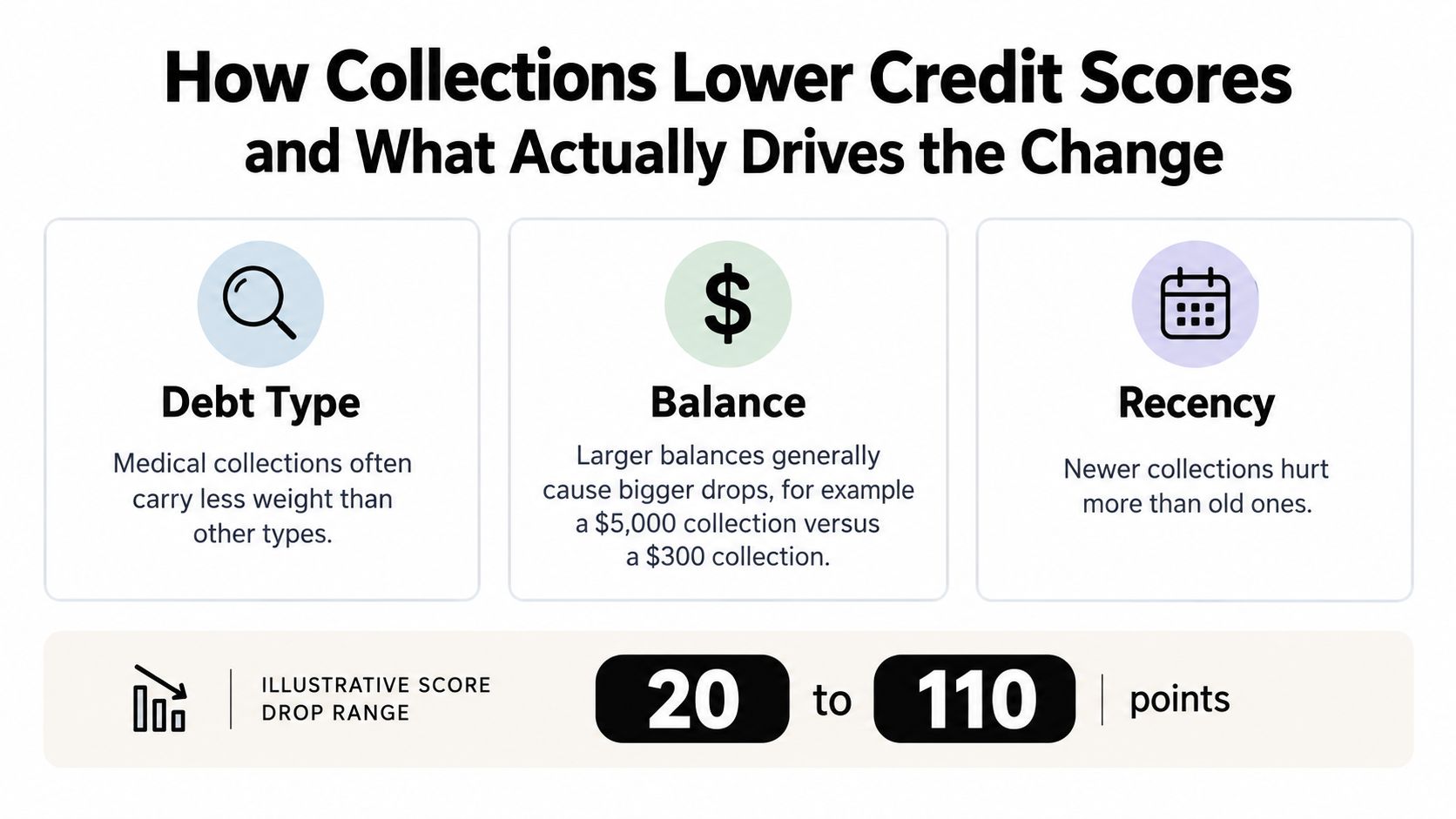
A buyer with one collection might see a sharp score drop, while another sees only a modest change. A third borrower might see little movement under one scoring model and a larger shift under another. The difference depends on the debt type, balance, timing, scoring model, and the rest of the credit report. That is why collections affect credit score results differently from one file to the next.
The mechanics behind the score change
Collections are derogatory payment-history events, so they can change how a scoring model evaluates repayment risk. Mortgage lenders also review the account behind the score. A collection may carry more concern when it appears alongside late payments or other signs of financial strain.
The CFPB reported an average decline of 12 to 17 points during the quarter when a medical collection first appeared, based on its separate analysis of medical debt and credit scores. That range is a reference point, not a guaranteed result. The same account can produce a different outcome under another scoring model or within a different credit file.
A borrower with strong payment history, low revolving balances, and older accounts may experience a smaller practical effect than someone with a thin file and several recent negatives. For example, an isolated older collection may tell a different risk story from a recent collection surrounded by missed payments. The score records one part of that story, while underwriting reviews the broader pattern.
A collection is never just one line item. It becomes part of the whole credit pattern a lender evaluates.
Debt type, balance, and timing all matter
Medical collections may receive different treatment from non-medical debts. Balance can also affect how serious the delinquency appears, while recency matters because newer negative information generally carries more weight than older information. These factors help explain why two similar-looking accounts can produce different results.
Superior Credit Repair explains scoring by outlining how payment history, balances, account age, and other credit factors work together. That broader view helps prevent a common mistake: treating a collection as a fixed point penalty.
A collection that is recent, high-balance, and connected to repeated missed payments may draw more concern than an old, small, isolated account. The score may reflect some of that difference, but mortgage underwriting can examine the account and the overall file more closely. The applicable loan program can therefore determine whether the collection is mainly a scoring issue, an underwriting issue, or both.
Before a home purchase, ask more than, “How many points did I lose?” Ask what type of account it is, how old it is, whether it is isolated, and what other negative information appears on the report. Those details connect scoring results to the lender's risk review.
Score Models and Collection Treatment Differences
A borrower can check one app and see a strong score, then receive a different result from a mortgage lender. Both numbers may be accurate because scoring models apply different rules to the same collection. Understanding collections affect credit score therefore requires looking at the model, not only the debt.
Older and newer models do not treat collections the same way
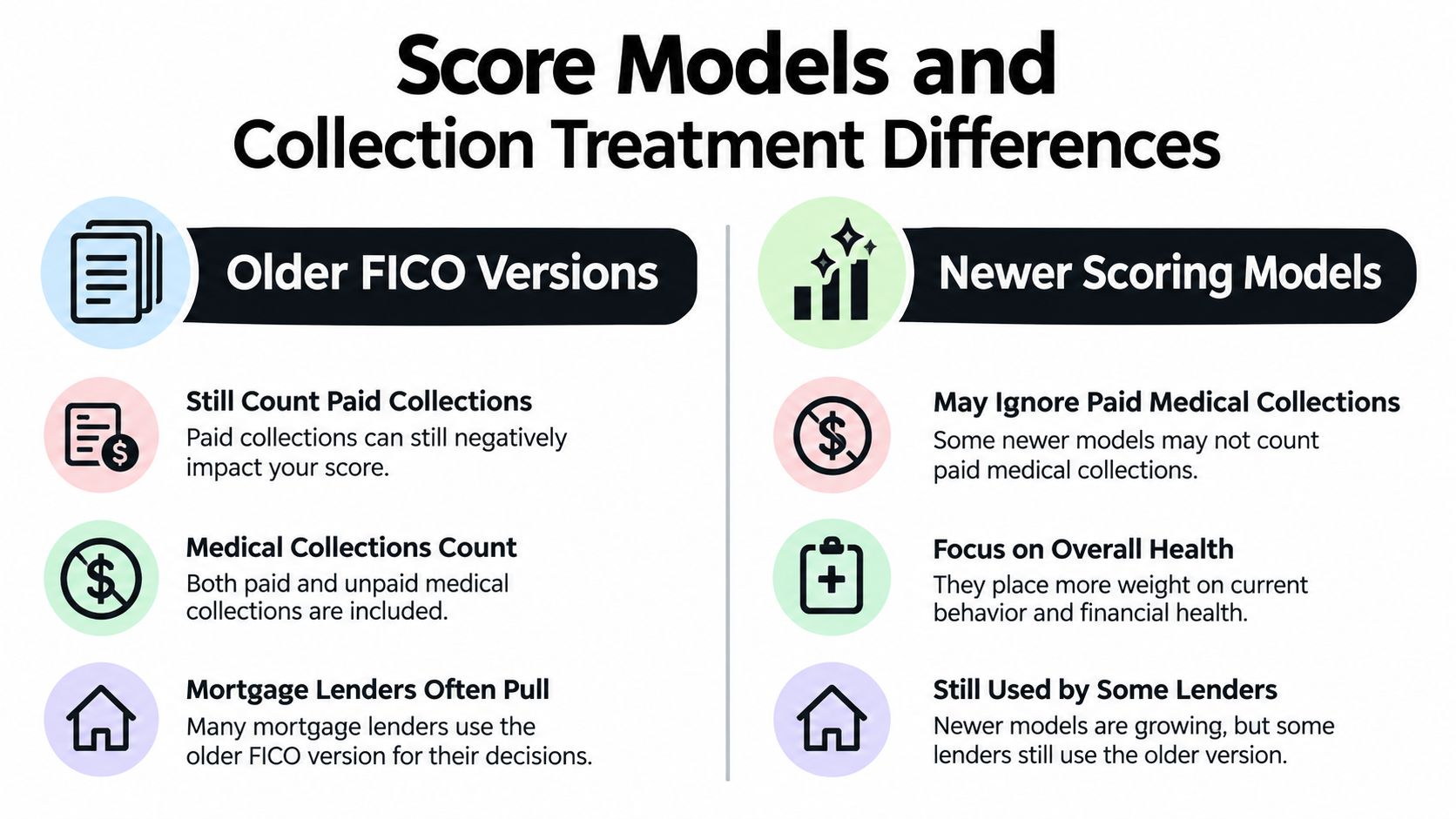
Older FICO scoring generally treats a reported collection of $100 or more as negative whether it is paid or unpaid. FICO Scores 9 and 10 disregard paid third-party collections and ignore collection accounts with an original amount below $100, according to myFICO. Under one model, paying may improve the score. Under another, the account may continue affecting it.
VantageScore 3.0 and 4.0 also disregard paid collections and medical collections in score calculations. Separately, the three national credit bureaus stopped reporting paid medical collections and unpaid medical collections below $500. While excluded from the reports, those accounts cannot affect scores. This helps explain why one score may rise while another remains unchanged.
The model is only one path to the lender's decision.
Why lenders may still see a different risk picture
Mortgage lenders often use older score versions. Those models can respond more negatively to paid and unpaid collections than newer systems, so payment may improve one score, have little effect on another, or leave the lender focused on the underlying debt.
The FICO mortgage scores explained resource from Superior Credit Repair helps distinguish consumer-app scores from the scores a mortgage lender may use. A borrower can therefore appear stronger in one scoring system and weaker in another, even when every system uses the same credit report.
Bottom line: a higher score from one model does not guarantee the lender will use that same model.
For a home purchase, do not assume that paying every collection will produce the same result. First verify the account, identify the score model involved, and learn which scoring and underwriting path applies to the loan. The right question is not only whether the collection was paid. It is how that specific model and loan process evaluate it.
Mortgage Underwriting Rules and Collection Requirements by Loan Program
A borrower can have a collection and still receive different answers from different mortgage programs. For example, an FHA review may follow one set of requirements, while a conventional file processed through automated underwriting follows another. If you're preparing your credit for FHA, start with the program rules rather than assuming that a higher score or paid collection settles the issue.
The loan program sets the rulebook
First identify the loan type. Then confirm whether the lender will use automated or manual underwriting. The same account may receive different treatment under those two paths. Medical and non-medical collections also deserve separate review because the debt type can affect the analysis.
For manually underwritten conventional loans, Fannie Mae guidance says non-medical collections and non-mortgage charge-offs generally do not have to be paid before closing when each account is below $250, or when the combined balance is $1,000 or less (Fannie Mae). A borrower with several small accounts may therefore face a different requirement from someone with one larger collection. The rule does not mean every loan program uses the same threshold.
Payment decisions must fit the file
Paying a collection can change the financial picture if the arrangement creates a monthly obligation that affects debt-to-income calculations. The underwriter may need documentation showing the balance, payment terms, account status, and how the debt is being handled. A payment made without complete records may leave the original underwriting question unresolved.
Medical debt receives separate attention because research cited in the CFPB's 2024 medical debt proposal found medical billing information less predictive of future repayment than other debts. The proposal estimated that affected consumers could see average score increases of about 20 points if medical debt were removed from most credit reports. That estimate does not predict what will happen in a particular mortgage file, and it does not establish one payment rule for every program.
A practical pre-application review follows four steps:
- Identify the exact loan program: FHA, VA, USDA, and conventional loans can apply different collection requirements.
- Pull all three credit reports: Experian, Equifax, and TransUnion may display different balances, dates, or account details.
- Sort accounts by type: Medical and non-medical collections may require different handling.
- Ask which underwriting path applies: Automated and manual systems can reach different conclusions about the same debt.
A borrower trying to avoid unnecessary payments should match the account strategy to the loan program and underwriting method. The key question is not whether the collection was paid. It is how that specific lender, scoring system, and program will evaluate the account.
Charge-Offs, Collections, and Why Deleting Does Not Guarantee Approval
A charge-off and a collection are related, but they are not the same thing. A charge-off usually means the original creditor wrote the debt off as uncollectible, while a collection usually means the debt moved to a third-party collector. Both can remain negative, and both can affect how a lender judges risk.

Why paying or deleting is not a magic fix
Many people think paying every negative account will automatically produce approval. That's not how mortgage review works. A paid collection may look better than an unpaid one in some scoring models, but the lender still sees the history, the balance, the age, and the account notes.
Under the Fair Credit Reporting Act framework, collection information generally may remain on a credit report for up to seven years, measured from the original delinquency date associated with the underlying account (CFPB). That means accurate negative information usually isn't removed just because it's unpaid or harmful.
When accuracy matters more than speed
A consumer sometimes gets better results by challenging an item's accuracy than by rushing to pay it. If the balance is wrong, the dates are off, or the ownership is unclear, a payment can leave the underlying problem untouched. In those situations, the file still needs documentation work.
The more useful question is not “Can I delete this?” It's “Is this reporting accurate, and will payment help the loan file I'm applying for?” That distinction matters because lenders care about the current risk picture, not just a single account label.
A collection that's incorrectly dated or not properly documented can be more damaging than one that is old and accurate. That's why good credit repair focuses on verification, not shortcuts.
Disputing Collections and Protecting Your Credit Report Accuracy
A dispute is a formal investigation process, not a demand for automatic deletion. When a consumer disputes a debt with a credit reporting company, the account is marked as disputed while the bureau investigates, and the bureau generally does not use the disputed debt to calculate a credit score until the investigation is completed (CFPB). That's a meaningful protection when the account may be wrong, incomplete, outdated, or unverifiable.
What a strong dispute file should include
The most effective disputes are written, specific, and documented. The CFPB recommends explaining what information is wrong, why it is wrong, and including copies, not originals, of supporting documents. That can include payment records, identity-theft documents, or account statements, depending on the issue.
A complete review often starts with the three reports side by side, because one bureau may show a different balance, date, or collector than another. Then you can request validation and account-level evidence, check the original creditor name, and compare the dates tied to the original delinquency. If the collector cannot support the reporting, the record may need correction or removal.
Superior Credit Repair's collection dispute documentation checklist is a useful reference for readers who want to keep their records organized during this process. It's especially important for families dealing with medical billing issues, divorce-related account confusion, or accounts that may have been reinserted after prior removal.
Why disputes fit mortgage preparation
Mortgage readiness depends on more than score alone. A disputed item can still matter to underwriting if the lender sees unresolved risk, but a properly documented dispute can also prevent an inaccurate account from driving the decision. That's the genuine value of the process.
Keep every statement, bill, and letter that supports your timeline. In collection disputes, dates and paper trails matter.
The goal is not to promise a deletion. The goal is to make sure the report is accurate before a lender makes a high-stakes decision on your behalf.
Next Steps for Building a Lender-Ready Credit Profile
Start with the three credit reports, not the one score you happen to see online. Pull the reports, list every collection, and mark each account by type, date, balance, and whether it looks accurate. If an item seems questionable, note what needs verification before you pay, settle, or dispute it.
Then decide what belongs in each bucket. Some accounts may need a dispute because the balance, date, or ownership is wrong. Others may need to be left alone while you focus on the rest of the file, especially if payment won't change how the lender evaluates the debt. A few may call for direct lender discussion because the loan program and underwriting path matter more than the raw score.
If you're also planning around income timing or commission-based pay, budgeting for commission swings can help you think about how cash flow affects housing readiness alongside credit cleanup. That kind of planning matters because mortgage approval depends on more than just one tradeline.
Results vary based on each person's credit file, documentation, creditor responses, account history, and current credit behavior. That's why a careful review is more useful than a blanket rule. A collection can be important without being fatal, and a score can improve without guaranteeing approval.
Superior Credit Repair can review your credit report, help identify inaccurate or questionable items, and explain a step-by-step plan for improving your credit profile. You can request a free credit analysis or consultation to better understand your options before you apply.
Superior Credit Repair helps consumers review collections, identify reporting issues, and build a cleaner path toward mortgage readiness with compliant credit restoration strategies. If you want help understanding how collections affect your credit score and your home loan options, visit Superior Credit Repair to start your review.