


You check your credit report before applying for a mortgage and see a lender name you don't recognize. Your first thought may be that your identity has been stolen, or that the inquiry is lowering your chance of approval. The right response is calmer and more precise: identify the inquiry, determine whether it had a permissible purpose, and dispute it only when the information is unauthorized, inaccurate, duplicated, or unverifiable.
That distinction matters. Legitimate credit inquiries usually can't be removed just because they're inconvenient, while an inquiry that doesn't belong on your file may deserve a formal investigation. The process below is designed for people preparing for FHA, VA, USDA, or conventional financing, as well as anyone trying to rebuild a credit profile before applying for an auto loan, apartment, business financing, or personal credit.
Table of Contents
- What Readers Are Really Seeing on Their Credit Report
- Hard Inquiries, Soft Inquiries, and the Two-Year Window
- How to Identify Which Inquiries Are Removable
- Filing a Dispute With Equifax, Experian, and TransUnion
- Realistic Outcomes After the Bureau Investigation
- Reducing the Impact When Removal Is Not an Option
- Prevention Habits and Your Next Steps
What Readers Are Really Seeing on Their Credit Report
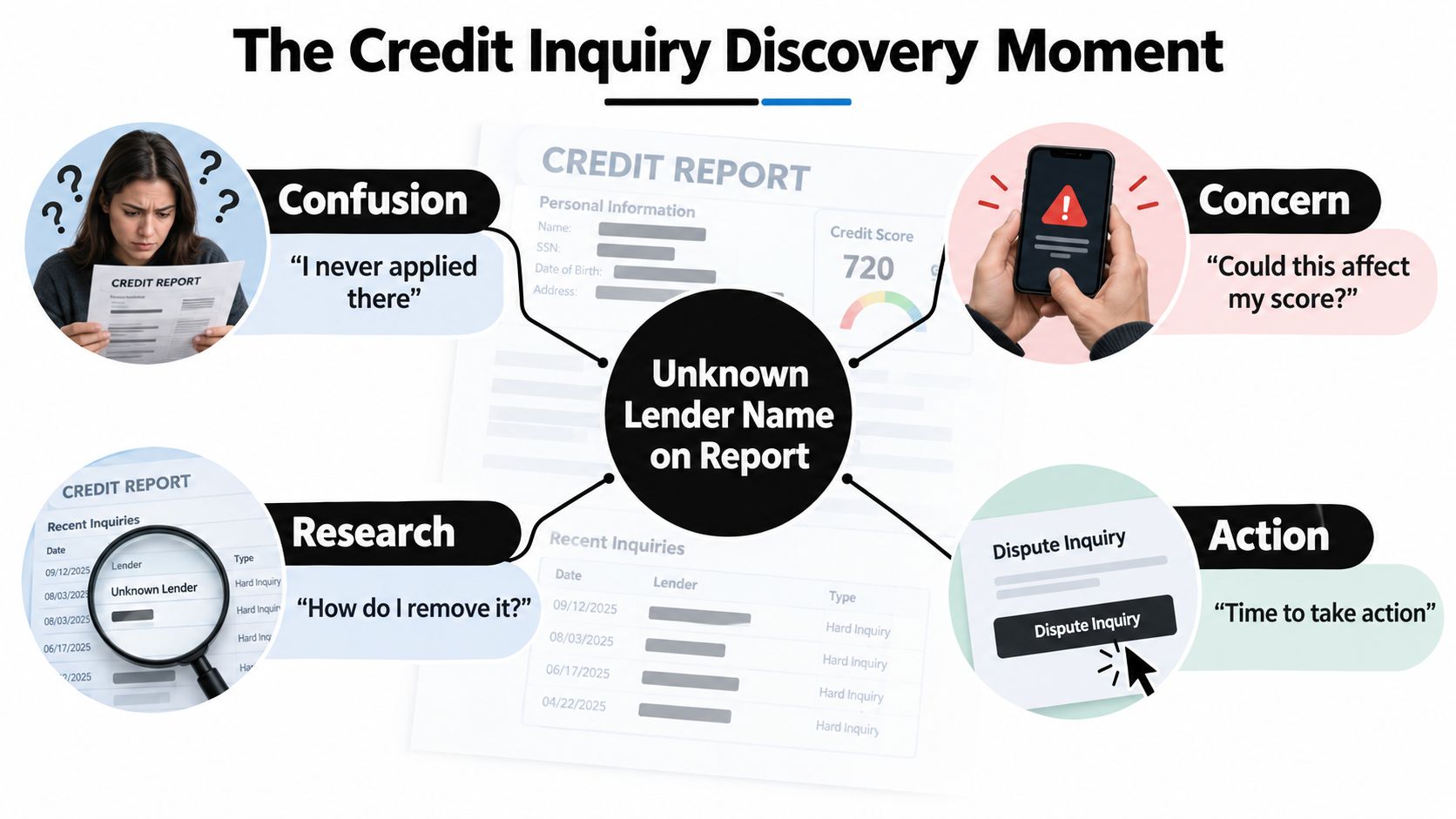
You open a report and spot a lender name that doesn't match anything in your memory. Maybe you applied through a dealership, used a mortgage comparison tool, or accepted a store-card offer without realizing which financial company would access your file. The unfamiliar name creates concern, but the name alone doesn't establish an error.
The inquiries section records companies that accessed a credit file. Depending on the bureau and report format, you may see the company name, access date, and an indication of whether the inquiry was hard or soft. The entry may also relate to a creditor operating under a different name from the retailer, broker, dealership, or platform where you submitted an application.
Start with identification, not deletion
A soft inquiry may come from a prequalification, account review, promotional screening, employer check, or your own request for a report. Soft inquiries don't affect credit scores, and their appearance doesn't automatically indicate fraud. A hard inquiry usually follows an application for new credit, but even a hard inquiry can be legitimate when a lender, broker, or dealer had permission to review your file.
The practical question is not, “How do I erase every inquiry?” It is, “Which inquiry lacks a valid explanation?” Review the creditor name, date, and surrounding account activity. If the company still isn't familiar, contact it before disputing. A retailer may have submitted an application to a bank whose name you recognize only after checking the report details.
Mortgage shoppers should be especially careful. A routine preapproval credit check can look suspicious if you don't connect it to the lender or broker you contacted. Prequalification may use a soft check, but the lender's actual underwriting review can involve a hard inquiry. For help interpreting account remarks and related report language, you can review credit remarks with Superior Credit Repair.
The rest of the decision is straightforward:
- Matched and authorized: Keep the inquiry. It generally isn't removable.
- Unknown but explainable: Contact the company and document what it tells you.
- Unauthorized, duplicated, or inaccurate: Gather proof and dispute it with each bureau reporting it.
- Soft inquiry: Usually focus on identifying it, not removing it for score reasons.
Hard Inquiries, Soft Inquiries, and the Two-Year Window
A hard inquiry appears after you apply for credit and a lender reviews your file to make a decision. A soft inquiry can result from checking your own credit, receiving a prescreened offer, using a prequalification tool, or an existing creditor reviewing your account. Hard inquiries may affect scoring. Soft inquiries do not affect credit scores.
A hard inquiry generally remains on a credit report for up to 24 months, while FICO generally considers it during the first 12 months. For most consumers, one hard inquiry usually lowers a FICO score by less than 5 points, according to Experian's explanation of hard inquiry reporting periods. The scoring effect is usually modest and temporary, even though the entry may stay visible after the score has recovered.
| Feature | Hard Inquiry | Soft Inquiry |
|---|---|---|
| Why it happens | You apply for new credit or financing | You check credit, receive prescreening, use prequalification, or an existing creditor reviews your file |
| Score effect | May affect scoring | Doesn't affect credit scores |
| Typical visibility | May appear to lenders and remain for up to 24 months | May appear on consumer reports, depending on the report format |
| Removal standard | Usually removable only when unauthorized, inaccurate, duplicated, or unverifiable | Usually not a score issue, though inaccurate information can still be questioned |
| Mortgage relevance | May accompany preapproval or underwriting | May accompany an initial qualification or informational check |
An inquiry remains accurate when an application is denied, the offered rate disappoints you, or you change your mind. Disliking the score effect does not support removal. Before seeking a mortgage, verify the entry and confirm that the lender had a permissible purpose. A clear guide to understanding credit checks for home loans can help you compare the lender's stated process with the inquiry on your report.
The reporting period and scoring period answer different questions. The first shows how long the record may remain visible. The second shows how long the scoring model may weigh it. That distinction matters for mortgage readiness, including the 2026 Homebuyers Privacy Protection Act changes. A borrower may still see an inquiry on a report after it has little or no effect on scoring, so removal efforts should focus on inaccurate, unauthorized, duplicated, or unverifiable entries.
How to Identify Which Inquiries Are Removable
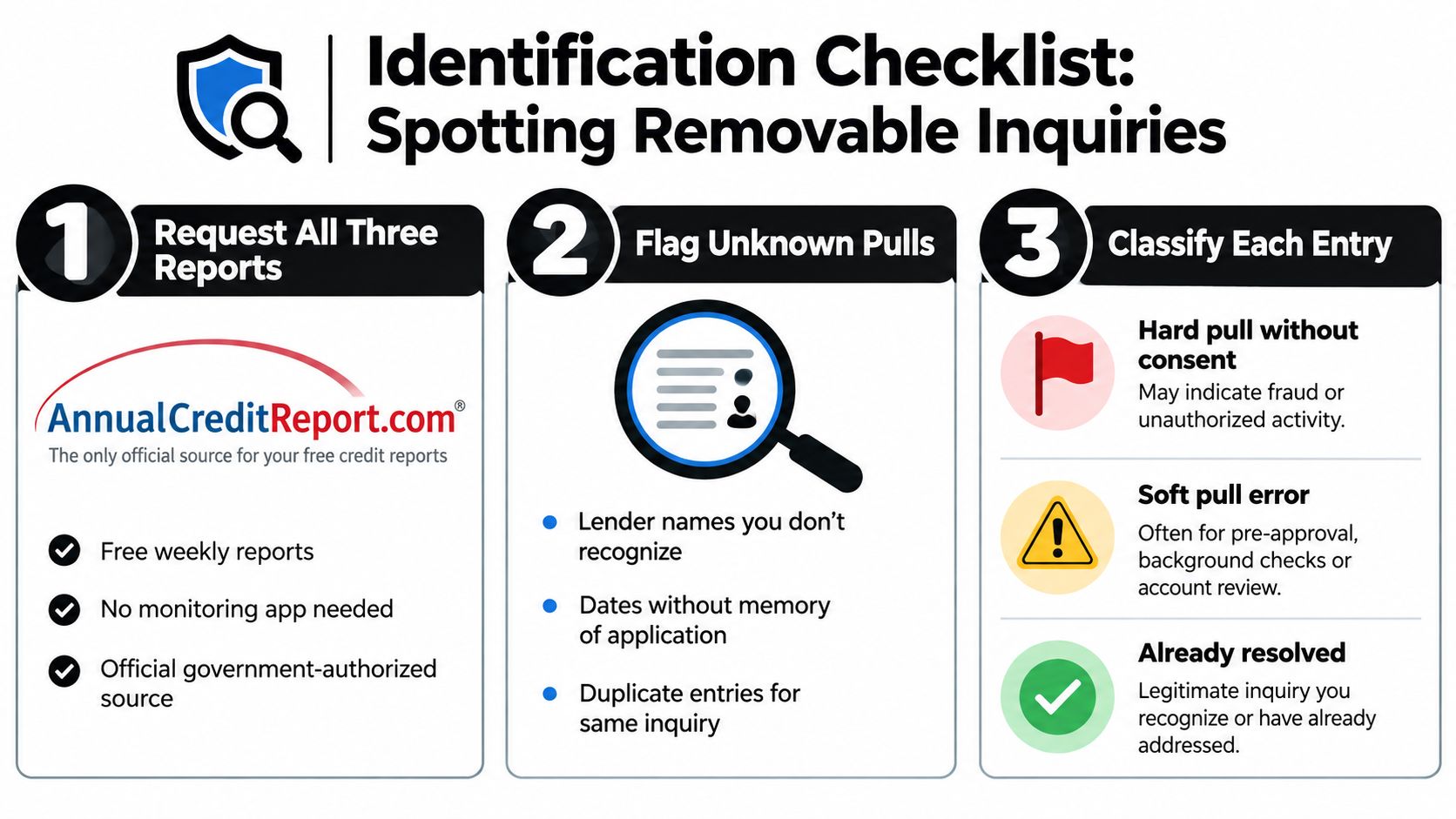
A mortgage applicant may see an unfamiliar lender name, several dealership entries, or an inquiry that appears on only one report. Start with the official reports, not just a credit-monitoring application. Request reports from Equifax, Experian, and TransUnion through AnnualCreditReport.com, then compare each inquiry across all three files. Monitoring apps can alert you to activity, but they may omit creditor details or record the entry differently.
Build an inquiry matching list
Create a worksheet with four columns:
- Creditor name: Copy the name exactly as the bureau displays it.
- Date: Record the access date and whether it appears on one report or several.
- Type: Mark the entry as hard or soft when the report identifies it.
- Explanation: Note the related application, quote, prequalification, account review, or “not recognized.”
Match every entry against your records. Review recent credit-card applications, auto-loan quotes, mortgage conversations, rental applications, and utility or service setups. A dealership may send one application to several lenders. A broker may also connect you with a company whose name differs from the business you contacted.
Mortgage and auto rate shopping need careful review. Depending on the scoring model, multiple inquiries for the same type of installment credit made within a shopping period of 14 to 45 days may be treated as one inquiry for scoring purposes. Experian's rate-shopping guidance explains this treatment. A cluster can represent one borrowing decision, even when several lender names appear. That scoring treatment does not make every visible entry removable.
Separate explainable entries from dispute candidates
Flag an inquiry when you cannot connect it to an application, the creditor confirms no access, the date is wrong, the creditor name is materially inaccurate, or the same access appears duplicated. Also flag entries linked to suspected identity theft. Save screenshots, emails, application confirmations, lender messages, and creditor correspondence.
A dispute must identify a reporting problem. Dissatisfaction with a valid credit decision is not a reporting problem. For structured help reviewing a potentially inaccurate entry, Superior Credit Repair inquiry help is one resource to consider alongside direct contact with the creditor and bureau.
Review each bureau separately. One report may show an inquiry that another does not. If Equifax lists it while Experian and TransUnion do not, begin with Equifax. If all three list it, prepare separate disputes for each bureau. The same evidence can support each submission, but each bureau must investigate the information in its own file. This bureau-by-bureau check is especially useful before mortgage underwriting, when an unexplained entry deserves attention but a valid pull should remain documented.
Filing a Dispute With Equifax, Experian, and TransUnion
Once you've identified an inquiry that appears unauthorized or inaccurate, use the formal dispute process. The Fair Credit Reporting Act requires credit bureaus to investigate disputed information and correct or remove inaccurate data. Consumer guidance commonly describes a 30-day investigation window after a dispute is filed, as explained by ConsumerAffairs' overview of hard inquiry disputes.
Online filing is convenient and can make tracking easier. A mailed dispute creates a stronger paper trail, particularly when you're preparing for mortgage underwriting and need to show what you sent, when you sent it, and which documents accompanied it. Choose the channel that lets you provide a clear explanation and retain the complete record.
Assemble the dispute packet
Include:
- Your identifying information: Full name, current address, and information the bureau can use to locate your file.
- The inquiry details: Creditor name, date, and any reference or account number shown.
- The reason: State that you didn't authorize the inquiry, that the date or name is inaccurate, that it is duplicated, or that the creditor cannot verify the access.
- Supporting documents: Include relevant lender correspondence, identity-theft records, application history, or report pages with the disputed entry marked.
- A copy of identification: Follow the bureau's documentation requirements, and avoid sending original documents.
- A delivery record: If mailing, keep a copy and use a delivery method that provides tracking or confirmation.
The bureau generally forwards the dispute information to the furnisher, meaning the creditor or company that supplied the data. The furnisher must review its records and respond through the investigation process. Don't submit a vague statement such as “remove this inquiry.” Identify the exact line and explain why the entry is inaccurate or unauthorized.
A concise letter can look like this:
[Date][Bureau name][Bureau address]Re: Dispute of unauthorized or inaccurate credit inquiry
I am disputing the inquiry listed under [creditor name] dated [date]. I did not authorize this company to access my credit report, or the entry is inaccurate because [specific explanation]. Please investigate the inquiry, provide the basis for its reporting, and delete or correct it if the creditor cannot verify that it was accurate and had a permissible purpose.
I have enclosed a copy of the relevant report page and supporting documents. Please send me the investigation results and an updated report if a correction is made.
Sincerely,
[Name][Contact information]
You can use this dispute letter template to organize the facts without overstating your position. If identity theft may be involved, the Professional Insurance Advisors, LLC identity theft guide offers additional context about documenting and responding to suspicious activity.
| Bureau | Online dispute URL | Mailing address | Typical response time |
|---|---|---|---|
| Equifax | Equifax dispute center | Use the address listed in your Equifax report or dispute instructions | Commonly within the statutory investigation period |
| Experian | Experian dispute center | Use the address listed in your Experian report or dispute instructions | Commonly within the statutory investigation period |
| TransUnion | TransUnion dispute center | Use the address listed in your TransUnion report or dispute instructions | Commonly within the statutory investigation period |
The Homebuyers Privacy Protection Act introduces an important distinction for mortgage consumers. An Experian analysis says that, as of March 5, 2026, mortgage inquiries face sharp restrictions for prescreening, with use permitted only in specified situations, including explicit consent, the current mortgage holder or servicer, or an existing account-holding bank or credit union. That change addresses unwanted mortgage solicitation and trigger-lead use. It doesn't automatically erase a legitimate inquiry from your report, and it shouldn't replace a bureau dispute when the access itself is inaccurate or unauthorized.
Realistic Outcomes After the Bureau Investigation
A dispute can end in more than one way. The cleanest result is deletion, but verification and correction are also common possibilities. Your evidence should match the issue you raised, because a bureau investigates the accuracy and basis of the specific entry, not whether you generally dislike having inquiries on your report.
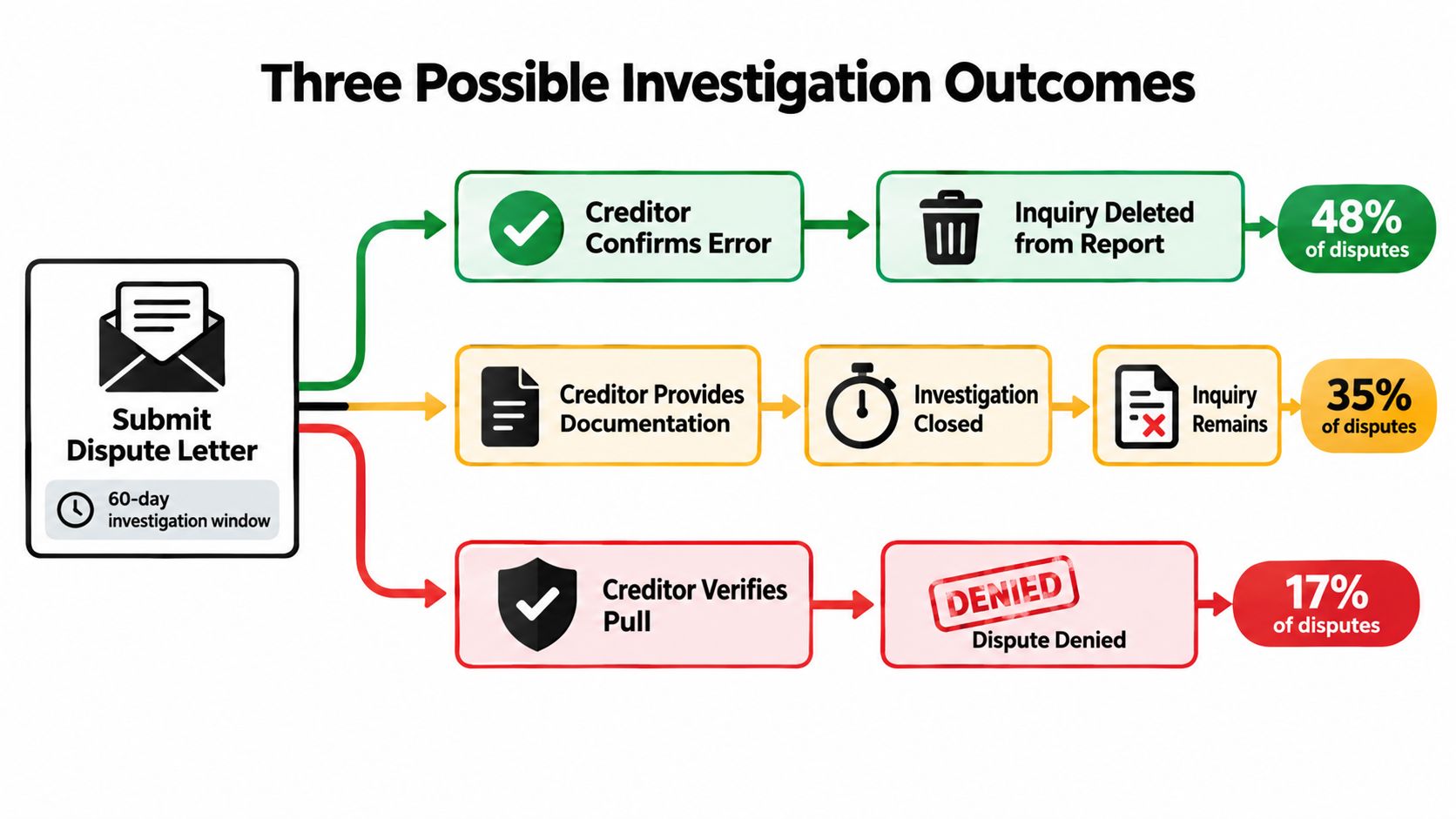
The three possible results
Verification means the creditor confirms that the access occurred and was authorized. The inquiry remains. This is the expected outcome for a legitimate application, even when you forgot the lender's operating name or applied through a broker.
Deletion can occur when the furnisher can't validate the inquiry, the bureau identifies an error, or the investigation confirms unauthorized access. Deletion isn't automatic because the creditor doesn't respond to your first phone call. The bureau must process the dispute and communicate the result.
Partial correction means the line remains, but details such as the date or creditor name are changed. This outcome matters when the inquiry was real but reported inaccurately. Review the updated report rather than assuming that any remaining entry means the bureau ignored your dispute.
A major mistake is challenging every recognizable inquiry to see what disappears. That approach can create confusion, delay legitimate underwriting, and weaken the credibility of your documentation. Mortgage underwriters review the broader file, including applications, debt obligations, payment history, utilization, collections, charge-offs, and account stability. Repeated unexplained applications can raise questions even when the scoring impact is limited.
Prequalification and preapproval aren't interchangeable. A prequalification may rely on information you provide or a soft check, while preapproval commonly involves a more complete review and may include a hard inquiry. Ask the lender which process it uses before authorizing a credit check, especially if you're close to applying for an FHA, VA, USDA, or conventional mortgage.
If the result seems incomplete, compare the response with the report entry. You can request the method and basis of verification, submit additional documentation, or dispute a remaining factual error. If one report shows a materially different result, document the discrepancy and review guidance on one bureau worse than others.
Consumer complaint outcomes vary, and evidence quality matters. CNBC cited complaints about the major bureaus rising from about 1.3 million in 2023 to nearly 5 million in 2025, while reported favorable resolution rates fell sharply for some bureaus, as discussed in its coverage of credit report disputes. That complaint information doesn't predict the result of your inquiry dispute. It does reinforce the need for a specific claim, complete records, and a realistic understanding of what the law addresses.
Reducing the Impact When Removal Is Not an Option
If the inquiry is verified, stop treating deletion as the only useful outcome. The better strategy may be to reduce its practical effect while strengthening the rest of the file. A lender evaluates the complete credit profile, not one isolated line.
Mortgage and auto rate shopping can receive special scoring treatment when applications occur within the applicable 14- to 45-day period. Keep applications for the same loan type together instead of scattering them across months. That strategy can help scoring models recognize one shopping effort, although the visible report may still list individual lender accesses.
Mortgage timing rule: Ask whether a lender's first review is soft or hard, and keep same-purpose loan applications inside one deliberate shopping period.
Rapid rescoring is different from disputing an inquiry. A lender may request rapid rescoring when you have verified credit-report changes, such as a corrected balance or updated account status, that could affect underwriting before closing. It isn't a consumer-controlled deletion method, and it doesn't turn a legitimate inquiry into an error. Ask the lender whether this service is available and what documentation it requires.
Pay-for-delete arrangements usually relate to certain collection accounts, not valid inquiries. A goodwill letter may ask a creditor to consider a courtesy adjustment for an isolated reporting issue, but it doesn't override the bureau's verification process. Waiting for a legitimate inquiry to age off is often the cleanest option when the entry is accurate and the scoring effect is no longer material.
Use this decision framework:
- If the mortgage closing is near: Avoid unnecessary applications, confirm which items the lender needs corrected, and coordinate any rescoring request through the lender.
- If the mortgage is farther away: Prioritize on-time payments, lower revolving utilization, stable accounts, and accurate treatment of collections, late payments, charge-offs, and medical collections.
- If the inquiry is unauthorized: Dispute it with every bureau that reports it, and preserve evidence.
- If the inquiry is legitimate: Leave it alone and direct credit repair effort toward issues that materially affect lender readiness.
Prevention Habits and Your Next Steps
The most useful inquiry-removal plan is a decision tree you can reuse. First, identify whether the entry is hard or soft. Next, connect the creditor to an application or account relationship. Then determine whether the inquiry had a permissible purpose and whether the reporting details are accurate. Dispute only the entries that fail that review.
Prevention starts before the application:
- Freeze each bureau when fraud is a concern: A security freeze can restrict new-credit access until you lift it, which helps reduce unauthorized applications.
- Opt out of prescreened offers: This can reduce certain promotional solicitations, though it doesn't erase prior inquiries or stop every legitimate account review.
- Group mortgage shopping: Ask lenders about their inquiry process and keep same-purpose applications within the applicable scoring window.
- Limit new card applications before a major loan: Retail cards and personal-credit applications can complicate a mortgage review even when each inquiry has a modest scoring effect.
- Review all three reports: Checking reports through AnnualCreditReport.com helps you find bureau-specific errors before an apartment application, auto loan, or mortgage submission.
- Track creditor names: Save lender emails, application confirmations, and prequalification results so an unfamiliar servicing or underwriting company can be identified quickly.
A dispute is worth filing when you can point to unauthorized access, identity theft, duplication, a wrong date, a wrong creditor, or information the furnisher can't verify. Scoring-impact management is the better choice when the inquiry came from a real application. That means timing future applications, protecting payment history, managing utilization, and addressing larger mortgage concerns such as collections, charge-offs, late payments, repossessions, thin files, and debt-to-income.
Results vary with your credit file, documentation, creditor response, account history, and current credit behavior. Credit restoration is a structured review, legal dispute, verification, and rebuilding process, not a promise of deletion, a specific score increase, or approval for an FHA, VA, USDA, or conventional loan.
Superior Credit Repair can review your credit report, help identify inaccurate or questionable items, and explain a step-by-step plan for improving your credit profile. You can request a free credit analysis or consultation to better understand your options.
Superior Credit Repair can review unfamiliar credit inquiries, help organize documentation for accurate bureau disputes, and discuss broader credit restoration steps for mortgage readiness. Visit Superior Credit Repair to request a consultation and learn what your report supports without expecting guaranteed deletions or approval.
If this information helped you better understand your credit report or your next steps, we would appreciate your honest feedback. You are welcome to share your experience with Superior Credit Repair on our Google Business Profile. https://share.google/ePRpFvtCXwCjiJwOK