


61.5% of U.S. adults who received a medical bill they disagreed with or couldn't afford contacted a billing office about it in 2023, according to a nationally representative survey published by USC Dornsife. Questioning a medical balance isn't an unusual reaction. It's a practical step toward understanding what you owe.
For a homebuyer, the challenge is knowing which problem to solve first. The provider's bill, the insurer's decision, and the credit-report entry are separate records. Disputing a medical bill works best when you identify who created the error, secure the supporting documents, and establish the billing correction before asking a credit bureau to update information already reported.
Table of Contents
- Match the Medical Bill Error to the Right Path
- Assemble the Record and Write a Provider Dispute That Works
- Correct the Credit Entry After the Bill Is Clear
- When the Balance Changes or Reaches Collections
- Prepare the File Before You Talk to a Lender
Match the Medical Bill Error to the Right Path
Say a hospital sends you a hypothetical $1,840 balance after an emergency visit. Your insurance explanation of benefits shows a payment, and you're preparing for mortgage pre-approval. Before paying or sending a dispute, determine whether the balance represents legitimate patient responsibility, a missing insurance payment, or an improper charge.
An explanation of benefits, or EOB, shows how your health plan processed a claim. It isn't an invoice, and an insurance payment doesn't necessarily mean you owe nothing. Compare the EOB's patient-responsibility amount with the provider's statement, then request an itemized bill showing individual services and charges.
Disputing a medical bill is a normal verification step, not a confrontation. The useful question is not only whether the amount looks high. It's which entry conflicts with which record.
Where each medical bill dispute goes
| Error | Contact first | Timing rule | Core documents |
|---|---|---|---|
| EOB and bill do not match | Health plan appeal | Plan appeal window, often stated on the EOB | Itemized bill, EOB, eligibility record |
| Surprise out-of-network balance bill | Insurer and No Surprises protections | Protections generally began January 1, 2022, for covered situations, as described in Fortune's No Surprises Act overview | Bill, EOB, facility and provider names |
| Self-pay bill at least $400 over the estimate | Federal patient-provider dispute process | Within 120 days of the initial bill; a nonrefundable $25 fee must be paid before review starts, according to CMS patient-provider dispute guidance | Good-faith estimate, bill, provider details |
| Duplicate, unbundled, or wrong quantity charges | Provider billing office | Prompt dated written request | Itemized statement and challenged line numbers |
| Balance already furnished to a credit bureau | Furnisher, then the bureau if the report is still wrong | After the billing record shows the discrepancy | Bill, EOB, receipts, and credit entry |
For the self-pay process, eligibility also generally requires that you didn't use insurance and received the estimate before scheduled care within the applicable advance-estimate requirements. Don't assume that any difference between an estimate and a bill qualifies.
Balance billing means a provider seeks an additional amount beyond what the plan paid and the patient's applicable cost sharing. Federal surprise-billing protections address qualifying situations, not every expensive service or ordinary coverage disagreement. The CMS complaint and enforcement report distinguishes complaints involving providers, facilities, air ambulances, insurers, and other federal requirements.
Identify the decision that needs correction
A missing prior authorization may require the provider's submission records and the plan's denial explanation. A duplicate charge requires a billing-office review. An incorrect network designation may require both the insurer's review and a qualifying surprise-billing complaint.
Practical rule: Contact the party that can change the disputed record, while preserving every other applicable deadline.
Credit reporting comes under separate consumer reporting accuracy and privacy rules. A bureau doesn't decide whether a hospital coded a procedure correctly.
Choose the table row that best describes your problem. Gather that row's proof first instead of sending every organization the same generic letter.
Assemble the Record and Write a Provider Dispute That Works
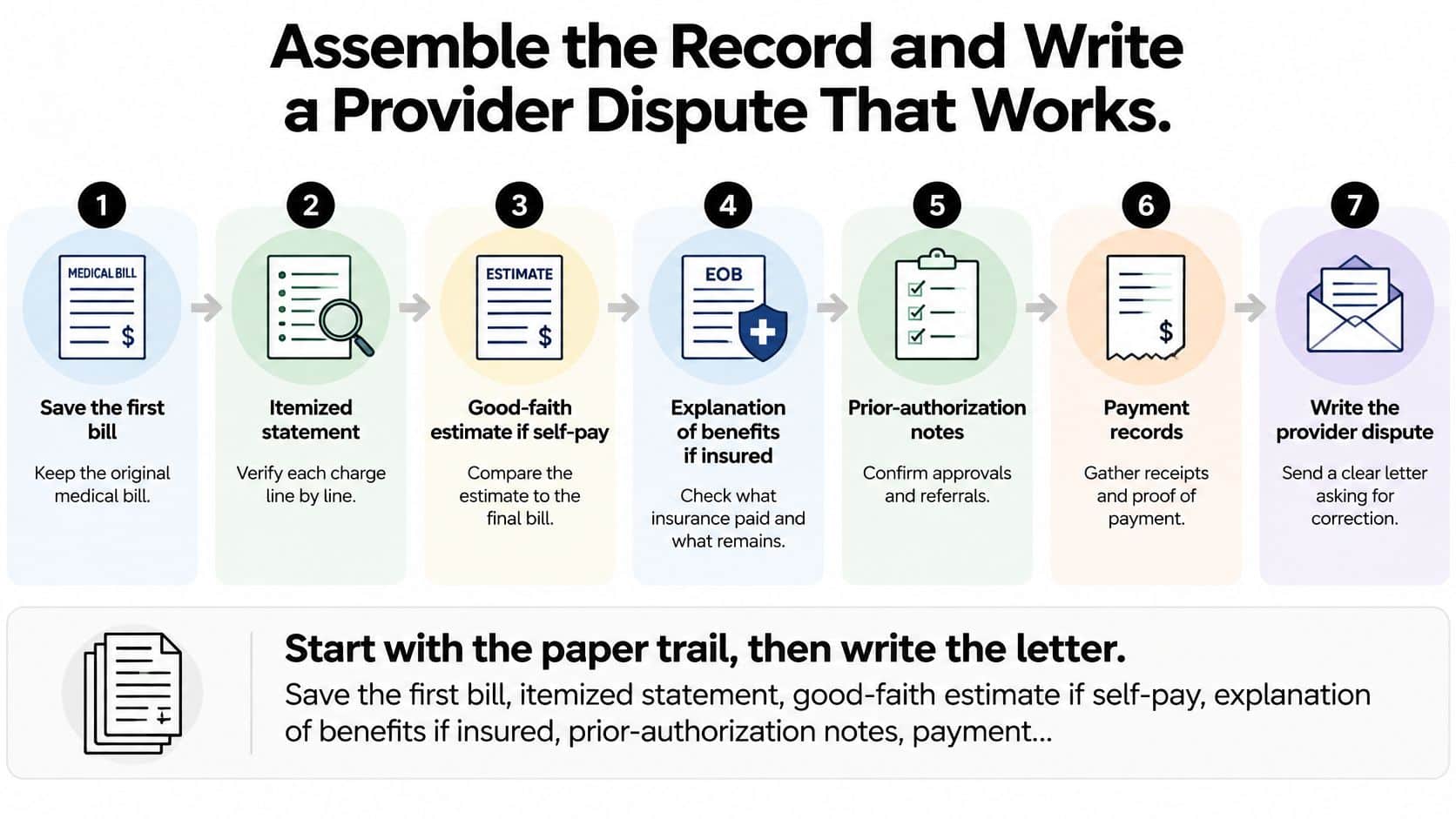
Start with the paper trail, then write the letter. Your first task is to make the account understandable to someone who wasn't present for the care, the insurance call, or the billing conversation.
Keep your EOB and provider invoice separate. One explains an insurance decision; the other requests payment. If the plan processed the claim incorrectly, a provider-only letter may leave the underlying reason for the balance unchanged.
Build a usable document file
- Save the first bill. Preserve its issue date, account number, due date, and original balance. Later statements may replace information you'll need.
- Request an itemized statement. Look for service descriptions, billing codes, quantities, dates, payments, and adjustments.
- Keep the good-faith estimate if self-pay. Include the estimate itself and evidence of when you received it.
- Download the EOB if insured. Save the version for the specific claim, including denial explanations and appeal instructions.
- Collect authorization records. Include referral notes, approval notices, eligibility records, and relevant communications about network status.
- Gather payment and assistance records. Save receipts, payment confirmations, financial-assistance applications, and any settlement terms.
- Preserve correspondence. Keep letters, portal messages, envelopes with relevant dates, and a written call history.
Attach copies to your dispute, not your only originals. Store electronic files under clear names, such as the provider name, service date, and document type, so you can retrieve the correct version.
This workflow keeps the evidence in front of the request.
Reconcile the service lines before drafting
Read each disputed charge against the corresponding estimate, EOB, or payment record. Mark only the entries you can explain: an incorrect service date, a repeated charge, a service you didn't receive, a missing payment, or a patient balance inconsistent with the plan's determination.
Don't assume similar descriptions prove duplication. A facility charge and a professional charge can describe related care without being the same charge. Ask the billing office to explain the distinction when the statement doesn't make it clear.
Call to confirm the correct dispute address or secure submission channel. Record the representative's name, the date, the account reference number, and any instructions. A phone promise is a note, not a corrected statement.
For an insurance denial, follow the plan's appeal instructions and obtain the claim decision before treating the provider's balance as final. My Policy Quote's steps to challenge an insurance denial can help you organize the denial notice, supporting records, and appeal request.
Write a specific correction request
Your letter should identify the account and dates of service, explain the exact factual problem, name the supporting attachment, and request an action the recipient can take. Suitable requests include rebilling insurance, reviewing a code, removing a duplicate line, applying a missing payment, or issuing a revised statement.
For example, a letter about a suspected duplicate might read:
Example wording: I dispute the repeated service charge identified on the attached itemized statement. Both entries show the same service description and service date. Please explain whether they represent separate services and, if one was entered in error, remove it and send a revised statement.
Adapt the wording to the records. Don't state that insurance paid the entire account if your EOB shows only partial payment, and don't demand removal of supported charges merely because the total is difficult to afford.
A useful dispute package identifies a specific factual problem and includes records supporting it. A generic demand to remove everything gives the reviewer less information to evaluate. End with your preferred response method and retain proof of submission or delivery.
Use the self-pay process only when eligible
A good-faith estimate is a written estimate of expected charges, not an insurance coverage determination. According to CMS medical-bill rights guidance, providers generally must provide one for uninsured or self-pay patients when care is scheduled at least three business days ahead or when requested; a bill at least $400 above the estimate may qualify for a federal dispute initiated within 120 days of the initial bill.
Check the eligibility details before filing, including whether you used insurance and when you received the estimate. Prepare the bill, estimate, and provider information, complete the required administrative payment, and retain the submission confirmation. Contact the federal No Surprises Help Desk if you need help identifying the appropriate process.
Don't let a pending telephone discussion cause you to miss a filing deadline. Ask whether the provider will pause collection activity during its review, and obtain written confirmation rather than assuming a pause applies.
Track responses without treating them as a score timer
Use a spreadsheet or notebook with these fields:
- Submission details: Date sent, recipient, account, and delivery confirmation.
- Issue challenged: The charge, balance, status, ownership, or other field at issue.
- Response details: Reply date, explanation received, and any requested follow-up.
- Record changes: Whether the amount, account status, or responsible party changed.
During medical balance reviews with Superior Credit Repair, we distinguish billing evidence from reporting evidence before selecting dispute targets. We also advise clients to track every bureau response while disputes remain pending.
Some balance changes may report within a billing cycle, while disputes, creditor corrections, and positive account age can take longer. The log measures documented progress, not a promised credit-score timeline.
Correct the Credit Entry After the Bill Is Clear
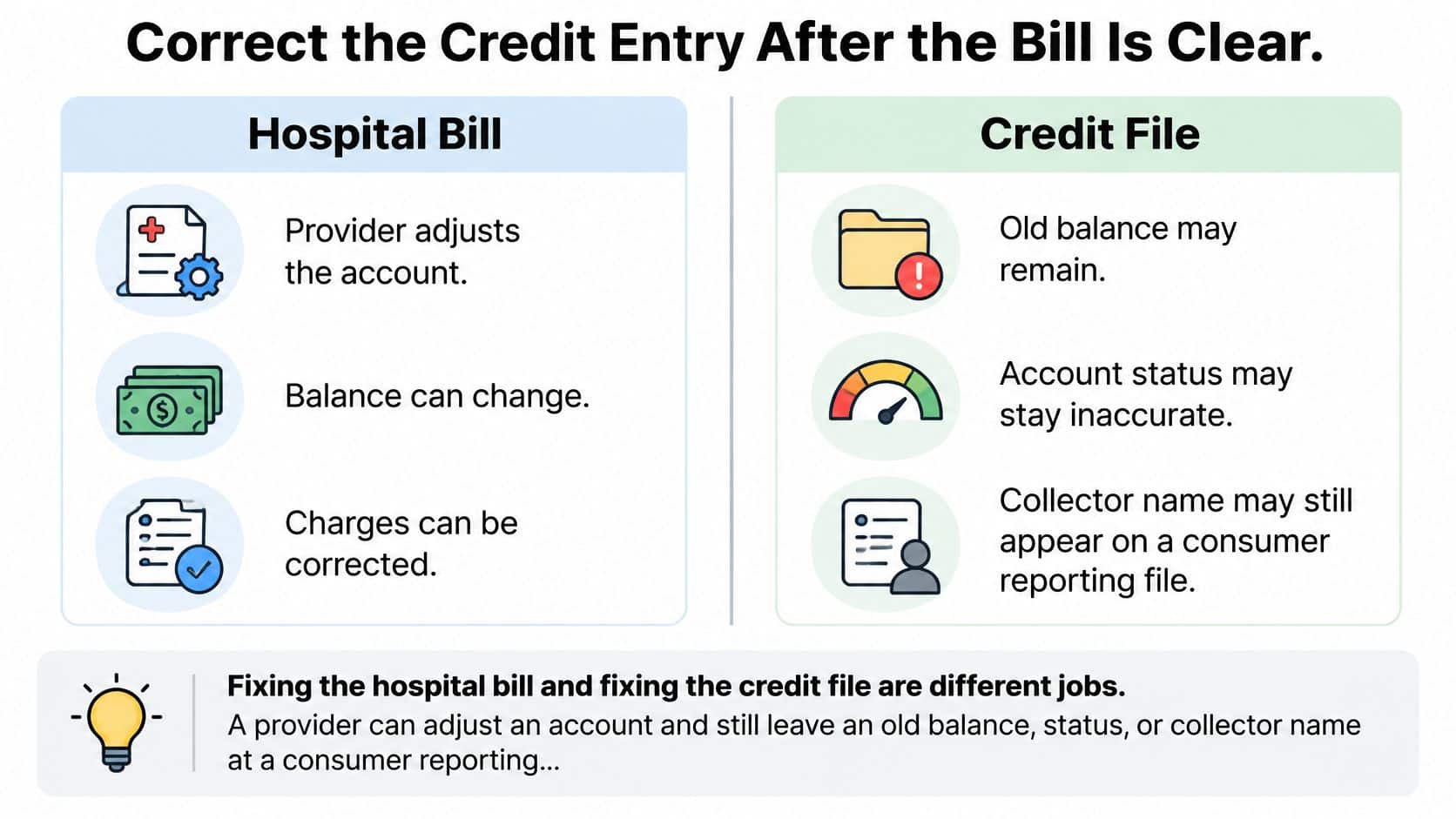
Fixing the hospital bill and fixing the credit file are different jobs. A provider can adjust an account without automatically correcting an old balance, account status, or collector information already furnished to a consumer reporting agency.
A furnisher is an organization that supplies account information to a credit bureau. That may be a creditor or collection agency. A bureau dispute concerns what was reported, not whether your insurer should have approved a claim.
The CFPB's medical-debt rule document discusses billing-error evidence and the financial disruption associated with medical debt. Its discussion isn't a substitute for checking current reporting requirements or the facts of your account.
The distinction matters when you compare the records.
Match the requested correction to the evidence
| Documented mismatch | Appropriate reporting request |
|---|---|
| Insurance payment and provider records show no remaining balance, but the report shows money owed | Correct the reported balance and any related inaccurate status |
| Revised statement shows a reduced amount, but the report retains the original amount | Update the balance using the revised statement |
| Account identifiers show the debt belongs to another person | Investigate ownership and correct the mixed information |
| The same obligation appears duplicated | Investigate the duplicate and correct the unsupported reporting |
| Reported dates conflict with the billing record | Investigate and correct the specific date field |
First, obtain the provider's or insurer's correction in writing. Then compare the credit entry with the itemized statement, EOB, receipts, settlement letter, and correspondence. Identify the bureau and the exact field that remains wrong.
A useful dispute packet names the bureau, account, challenged field, requested correction, and available proof. Explain which attachment supports each request. The Superior Credit Repair dispute letter guide can help you organize that information without replacing the facts with a form letter.
Keep the dispute narrow and track the reply
Keep a complete copy of the submission and its delivery confirmation. Calendar the response deadline applicable to your dispute and retain any notice explaining an extension or requesting information. Compare the result with the actual report rather than assuming that a response letter means every field changed.
A billing correction establishes what changed. A credit-report dispute identifies what still doesn't match.
Review each account separately. If the unpaid amount, ownership, and dates match reliable records, another accuracy dispute may be the wrong tool. An accurate negative account may instead require a payment strategy, rebuilding, documentation, or time.
For FHA, VA, conventional, and USDA mortgage preparation, keep the result understandable to a loan officer: the original discrepancy, the written resolution, and the current record. Medical collections may require underwriting review, but credit repair can't promise deletion, a score change, or mortgage approval.
Results vary with each person's credit file, documentation, creditor responses, account history, and current credit behavior. A well-supported packet improves clarity; it doesn't predetermine the outcome.
When the Balance Changes or Reaches Collections
Read the reply before deciding what to send next. A reduced bill, an upheld insurance decision, and a collection notice call for different actions. Repeating the original letter without addressing the response can leave the actual issue unresolved.
There is reason to pursue a supported challenge without expecting a universal result. In the Commonwealth Fund's analysis of its 2023 survey, 38% of U.S. adults who disputed a medical bill said the balance was reduced or eliminated, as reported by RISE.
What to do after the billing reply
| Reply you received | What it means | Next move |
|---|---|---|
| Balance reduced or removed | The charge changed; the credit file may not | Get the revised statement and compare every bureau |
| Insurer upholds the amount | The charge may be accurate | Ask about assistance or a payment plan; don't resend the same dispute |
| Sent to a collector | The furnisher may have changed | Match amount, creditor, and dates before any accuracy dispute |
| Credit file still shows the old balance | A billing fix didn't update reporting | Dispute that field with the revised bill and proof of payment |
If the insurer upholds the charge, read why. A decision based on missing documentation may call for supplying that documentation through an available appeal. A supported patient-responsibility amount calls for an affordability discussion, not an invented billing error.
Request the provider's financial-assistance or charity-care policy and application instructions. If a payment plan is appropriate, obtain written terms covering the balance, scheduled payments, and how the account will be handled. Don't agree to an installment amount that prevents you from meeting existing obligations.
Treat collection correspondence as a separate record
Collection activity can occur while a consumer still questions a bill. In the 2022 KFF Health Care Debt Survey, 32% of adults with health-care debt who reported an erroneous bill said the disputed bill was sent to collections.
Compare the collector's amount, original creditor, account identifiers, and service dates with your billing file. Request written information identifying the debt and current creditor. To choose the appropriate route, compare debt validation and credit bureau disputes, which address different questions.
A dispute needs a valid basis tied to accuracy, completeness, age, duplication, ownership, or verification. Information that is mixed with someone else's record, incomplete, outdated, or unverifiable deserves a targeted review, not an unsupported assumption.
For injury-related bills tied to a legal settlement, payment negotiations may involve different considerations from an ordinary insurance appeal. Nares Law Group LLC's discussion of negotiating medical bills after a settlement provides context for that situation; coordinate case-specific questions with your attorney.
Mortgage preparation: Resolving a medical billing disagreement doesn't resolve unrelated weaknesses in a credit file.
Keep these pressure points separate:
- Accurate collection: Develop a documented strategy rather than repeatedly disputing supported information.
- Non-medical late payment: Review payment history and prevent another missed due date.
- High credit utilization: Reduce revolving balances where feasible instead of treating borrowing levels as reporting errors.
Credit utilization means the share of available revolving credit you're using. Moving a medical bill onto a credit card may change the account type carrying the debt without solving the affordability problem.
Prepare the File Before You Talk to a Lender
A lender-ready file should show what happened, what you challenged, and what the records establish now. Organize your reports, billing documents, corrections, and unresolved questions before a loan conversation.
Our process follows Review, Document, Dispute, and Rebuild. Review the reports, document the medical mismatch, dispute only what the evidence supports, and rebuild where accurate negative history or current borrowing habits need attention. The Superior Credit Repair collection account guide explains how collection-account documentation fits into mortgage preparation.
Can I dispute the provider, insurer, and bureaus at once?
Start with the party that created the error, then update the credit file if reporting remains wrong. Parallel action may be appropriate when separate deadlines are running or the report already contains an independently documented error. Don't wait for a billing response if doing so would sacrifice an appeal or other applicable deadline.
Does a No Surprises complaint cover every high bill?
No. It addresses qualifying surprise-billing situations, not every coding dispute, coverage denial, or unaffordable charge. Provider-insurer payment arbitration is also separate from a patient's appeal or complaint.
Will paying a medical collection guarantee mortgage approval?
No. FHA, VA, conventional, and USDA preparation involves more than one account. Lenders also consider payment history, utilization, account stability, and debt-to-income, which compares monthly debt obligations with income under the lender's calculations.
Don't assume the same action produces the same result for every borrower. Discuss proposed account changes with your loan officer, especially during an active application.
Should I bring letters I've already sent?
Yes. Include each dispute letter, supporting attachment, response, and revised statement in your first review materials. Existing correspondence helps us understand what was challenged and what remains unresolved.
You can call (888) 715-2400 to discuss the records you have before sending disputes. Bring questions about other accounts too, including late payments, charge-offs, and revolving balances, so the medical issue doesn't distract from the rest of your financing preparation.
Was this guide helpful?
Superior Credit Repair Online provides educational credit guidance for individuals and families preparing for major financial goals like buying a home, applying for a mortgage, refinancing, or rebuilding after credit challenges.
If this information helped you better understand your credit report or your next steps, we would appreciate your honest feedback. You are welcome to share your experience with Superior Credit Repair on our Google Business Profile.
Superior Credit Repair can review your credit report, help identify inaccurate or questionable medical-account information, and explain a documentation-based plan for strengthening your credit profile. Visit Superior Credit Repair to request a free credit analysis or consultation and discuss your billing records, prior responses, and next steps before applying for financing.