


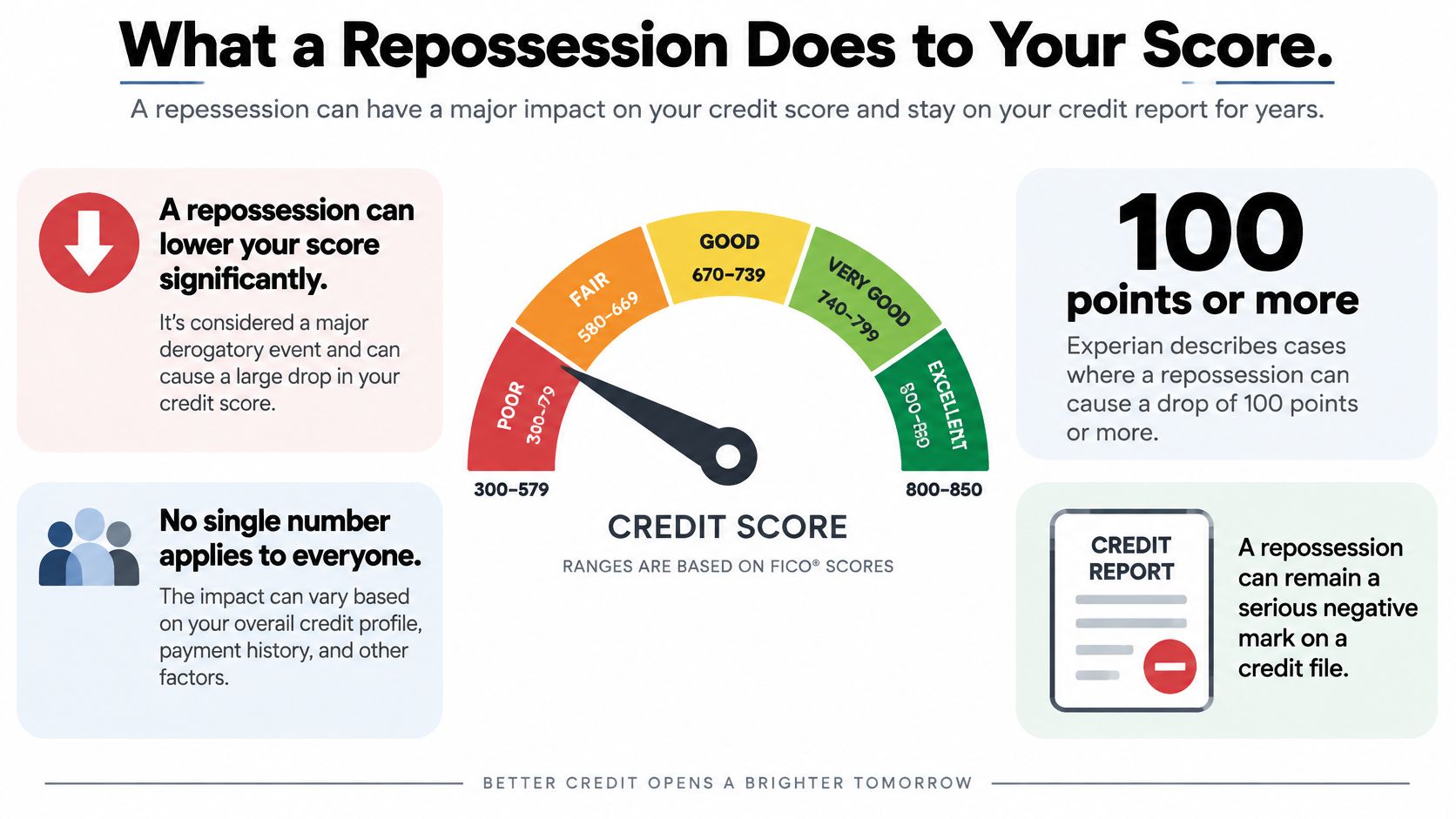
A repossession can stay on your credit reports for up to seven years from the original missed payment, and its score effect is often largest in the early period. Experian reports drops of 100 points or more in some cases, but the size varies by file and isn't guaranteed.
You're probably looking at your report right now, trying to work out what one car loan did to your chances of buying a home. That worry makes sense. The loss of the vehicle was one event, but your credit file may tell a longer story, with late payments, a default, a repossession notation, and possibly a balance still owed after the sale. Once you read those entries in order, the picture becomes clearer, and so do your next steps.
Table of Contents
- What a Repossession Does to Your Score
- How One Repossession Becomes Several Negative Entries
- How Long Each Entry Stays on Your Report
- Checking Your Reports for Errors Before You Apply
- How Repossession Affects Mortgage Eligibility
- How to Rebuild Toward a Lender-Ready Credit Profile
- Confirm Your Readiness Before You Apply for a Mortgage
What a Repossession Does to Your Score
A repossession can lower your score significantly, but there's no single number that applies to everyone. That's the honest answer to how much does repossession hurt your credit. Experian reports that a repossession can cause a score drop of 100 points or more, while also making clear that figure isn't a guaranteed outcome or a universal rule.
The reason the harm can be large is payment history. Payment history accounts for 35% of a FICO Score, the largest single scoring category, and FICO Scores are used by 90% of top lenders, according to the same Experian guidance linked above. A repossession doesn't arrive out of nowhere. The missed payments that lead to it already weigh on your file before the vehicle is taken, so scoring models are often reacting to several problems, not one.
What Shapes the Size of the Change
Think of a repossession as less like one stain on a shirt and more like a stain that spreads through several layers of fabric. How visible it looks depends on what else is there. Your starting score, the number and recency of late payments, other debts, credit card utilization, account age, and whether any deficiency is paid all shape the result.
A borrower with otherwise clean credit may see a sharper visible disruption. Someone whose score was already lowered by multiple delinquencies may see a different change, even though the file still looks risky overall.
Typical credit impact by repossession scenario
| Scenario | Typical effect on the report | Why it matters |
|---|---|---|
| Clean file with one repossession | Often a sharp, visible drop | Payment history is the largest scoring category at 35% of a FICO Score |
| Repossession after several late payments | Usually a deeper, compounding decline | Each negative entry can weigh on the score |
| Repossession with an unpaid deficiency | Additional derogatory account possible | The deficiency may be reported or sent to collections |
| Repossession with the deficiency paid | Collection risk may be reduced | Accurate prior payment history generally remains on the report |
Start by pulling all three credit reports. Find the repossession account on each one and decide which scenario in the table looks closest to yours. That gives you a realistic starting point, instead of guessing based on the word repossession alone.
How One Repossession Becomes Several Negative Entries
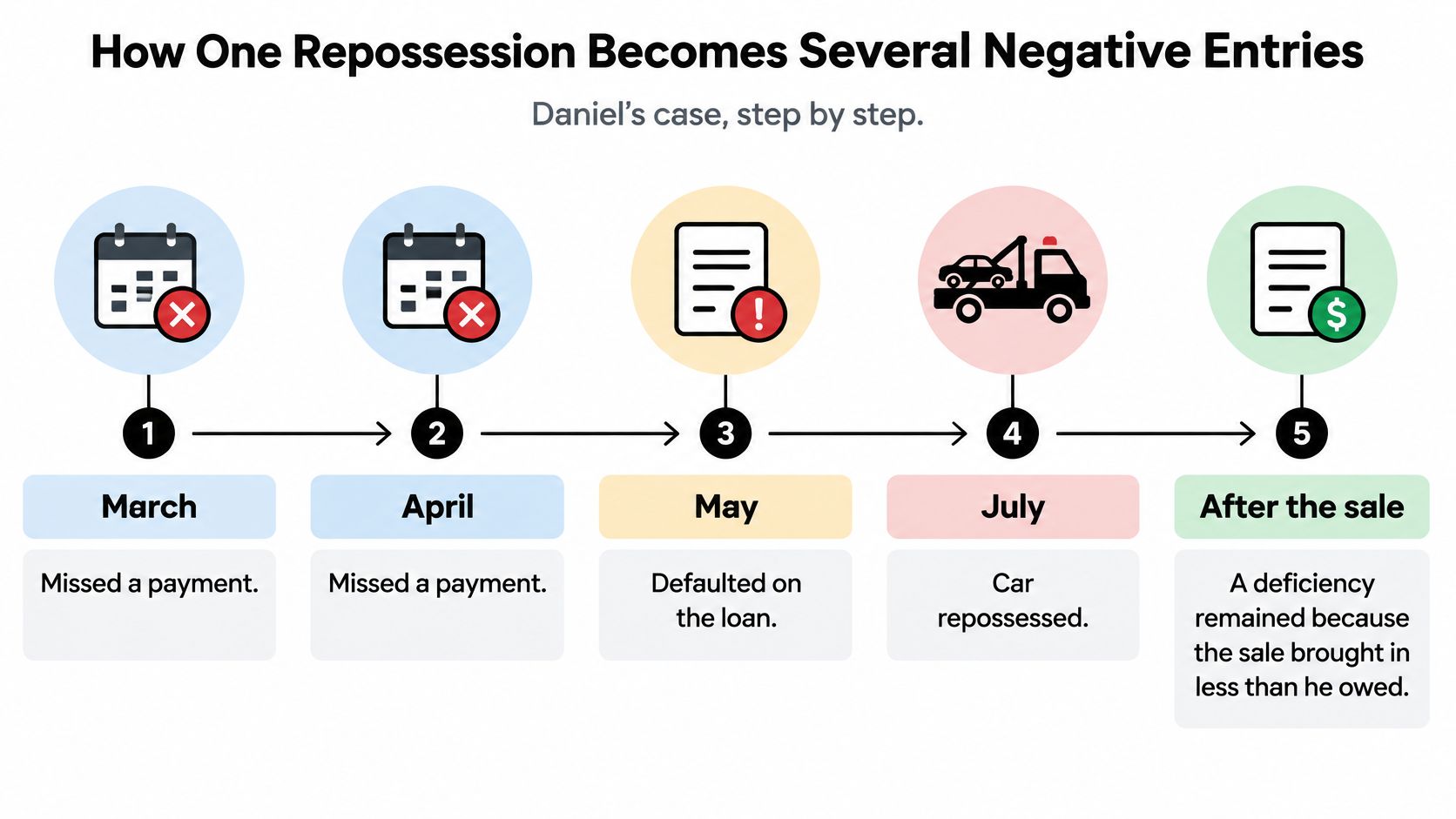
Consider Daniel. He missed a car payment in March, then another in April. By May, the loan was in default, and in July the lender repossessed the car. The sale brought in less than he owed, so a balance remained.
Daniel expected to see one negative mark. Instead, his report told the story in stages, and each stage mattered.
The Chain in Order
- Missed payments come first. Late entries can appear as the account moves further past due, often at 30, 60, and 90 days.
- Default follows. The account becomes seriously delinquent and the lender treats the loan as no longer being repaid as agreed.
- The repossession notation appears. This records that the lender recovered the vehicle.
- The vehicle is sold. The sale price is applied to what you owe.
- A deficiency may remain. If the sale doesn't cover the loan balance and costs, the leftover debt is called a deficiency balance.
- A collection account may appear. If that deficiency goes unpaid or is transferred, it can become another derogatory entry.
FICO explains that a repossession hurts credit through a sequence of separate negative events, and that no universal point loss can be predicted because scoring models evaluate the complete file. That's why you should assess the whole chain, not treat repossession as one isolated mark.
Two plain English terms help here. A furnisher is the lender or collector that reports information to the credit bureaus. A charge-off is when the lender writes the balance off as a loss on its books. It doesn't mean the debt disappeared.
Paying the deficiency may reduce collection risk, but it generally doesn't erase accurate late payment, default, or repossession history that came before it.
What about handing the keys back yourself? A voluntary surrender generally follows the same chain, because the missed payments and default may still be reported. Before you judge the damage on your own file, write your events down in order, with dates. You'll usually find the score drop makes more sense once you see each separate entry.
How Long Each Entry Stays on Your Report
A repossession may remain on credit reports for up to seven years, and the Consumer Financial Protection Bureau explains that falling behind on auto payments can make future borrowing harder or more expensive. The key detail readers miss is where that clock starts.
The reporting period generally begins with the original delinquency date, meaning the first missed payment that led to the default. It doesn't necessarily begin on the later date when the vehicle was physically taken or sold. If Daniel first missed a payment in March and the car was taken in July, March is the date that matters most for the removal timeline.
Visibility and Effect Are Not the Same Thing
An entry can stay visible while its practical effect gradually softens. Newer information typically carries more weight, so on-time payments made after the default build a fresher track record even while the repossession remains listed.
Reporting stages for a repossession
| Time since original delinquency | What typically appears on the report | Typical credit effect |
|---|---|---|
| 0-12 months | Repossession and recent delinquency | Often strongest, because recent information carries more weight |
| 1-3 years | Repossession still listed alongside newer payments | Often softens as on-time history builds |
| 3-5 years | Repossession still listed | Often less influential if the rest of the file is stable |
| 5-7 years | Repossession nearing its removal date | Lenders may still review it during this period |
| After 7 years | Accurate item generally removed from the report | Depends on accurate reporting and standard reporting rules |
Timing in this table is an approximation of the reporting period, not a fixed schedule for your score. You can learn more about removal dates in the credit reporting timeframes from Superior Credit Repair.
Three Common Misunderstandings
Paying the balance doesn't restart the clock, and it doesn't immediately erase it either. Moving to another state doesn't change the reporting period. A voluntary surrender doesn't generally remove the damage, for the reason covered in the section above.
A negative item also isn't automatically inaccurate. A dispute should rest on information that's inaccurate, incomplete, outdated, unverifiable, or misleading, not just on the fact that the item hurts. Copy the original delinquency date from each of your three reports, check that they agree, and calculate the expected removal date from that date. If one bureau uses the repossession date instead, that mismatch is worth documenting.
Checking Your Reports for Errors Before You Apply
One report isn't enough. The three nationwide reports can differ in dates, balances, and account status, because a furnisher may report to one bureau and not another, or update them at different times. A mortgage lender may see a version you haven't reviewed.
Repossession fields to verify on each credit report
| Field | What to confirm | Error to look for |
|---|---|---|
| Account status | Matches the actual account outcome | Shows open or in default after the account was resolved |
| Original delinquency date | First missed payment that led to default | A later date that restarts the reporting clock |
| Balance | Matches the lender statement and sale result | Amounts that are not owed or are double counted |
| Deficiency amount | Matches the lender's deficiency statement | Deficiency reported twice or sale proceeds not credited |
| Repossession notation | Correct vehicle, date and account | Repossession attached to the wrong account or vehicle |
| Duplicate entries | One entry per debt | The same debt listed by the original lender and a collector |
A Simple Checking Process
- Request all three reports. Don't rely on a single score app summary.
- Place each repossession related entry side by side. Compare the same fields across bureaus.
- Match every field against your documents. Use the loan contract, late or default notices, the sale or auction statement, and the payment ledger.
- Note each mismatch. Record the date, amount, and reporting company involved.
Experian notes that the relevant delinquency date should be checked for accuracy across all three major reports, along with payment history, balance, status, and removal date. If a deficiency was sent to collections, this guide to disputing an inaccurate collection entry can help you understand how collection reporting is challenged.
A dispute can go to the credit bureau and, separately, to the furnisher that supplied the information. A strong dispute includes copies of documents, a clear statement of what's wrong, and the specific entry involved, much like the approach used to challenge inaccurate charge-off balances. Keep records of every submission and response.
Documentation rule: dispute what you can show is wrong, incomplete, or unverifiable, and keep a paper trail for each claim.
An accurate repossession stays on the report. A dispute is a legal verification process, not a way to remove accurate history, and results vary based on documentation, creditor responses, and your file history.
How Repossession Affects Mortgage Eligibility
Mortgage lenders don't judge a repossession in isolation. They read it as one factor in a whole file review focused on recency, severity, stability, and repayment capacity. That distinction matters for credit repair before buying a home, whether you're preparing for an FHA, VA, conventional, or USDA loan.
Two terms come up often. Your debt-to-income ratio is your monthly debt payments divided by your gross monthly income. Revolving utilization is your credit card balances divided by your card limits. Both help a lender judge whether your current obligations leave room for a mortgage payment.

Recency Changes How Risky the File Looks
Experian explains that recency and file stability are central to mortgage readiness after a repossession. A recent repossession combined with new late payments, high revolving utilization, or an unpaid deficiency presents substantially more risk than an older, isolated event followed by consistent on-time payments.
That comparison is the heart of mortgage credit repair. Two applicants can both have a repossession on file, yet the one with a clean recent record, lower card balances, and a resolved deficiency presents a very different picture. Reviewing understanding your home loan approval odds can help you think through that whole file view.
How loan programs generally review a repossession
| Loan program | General review focus | Documents that usually help |
|---|---|---|
| FHA loan | Recency, payment history, and any unpaid deficiency | Written explanation, proof the deficiency is resolved or arranged, recent on-time statements |
| VA loan | Recent credit behavior and overall file stability | Credit reports, explanation letter, records of payment changes |
| Conventional mortgage | Recency, severity, utilization, and debt-to-income ratio | Reports, balance statements, debt-to-income worksheet |
| USDA loan | Payment history, existing obligations, and income stability | Income documents, reports, explanation of the past default |
| Any program | Lender overlays and underwriter judgment | Current written guidelines from the lender before applying |
Specific waiting periods and limits vary by lender and change over time, so they aren't listed here. Confirm current requirements with a licensed mortgage professional before setting your timeline.
The Explanation Letter
Lenders often ask for a short written explanation. Keep it factual. Include the dates, the cause of the default, what has changed since, and supporting documents. A job loss followed by stable re-employment reads differently from an unexplained gap.
No credit repair process guarantees mortgage approval. A realistic goal is a lender-ready credit profile, not a promised outcome. Before your first lender conversation, gather your verified reports from the checking process above, written proof of the deficiency status, recent statements showing on-time payments, and income documents.
How to Rebuild Toward a Lender-Ready Credit Profile
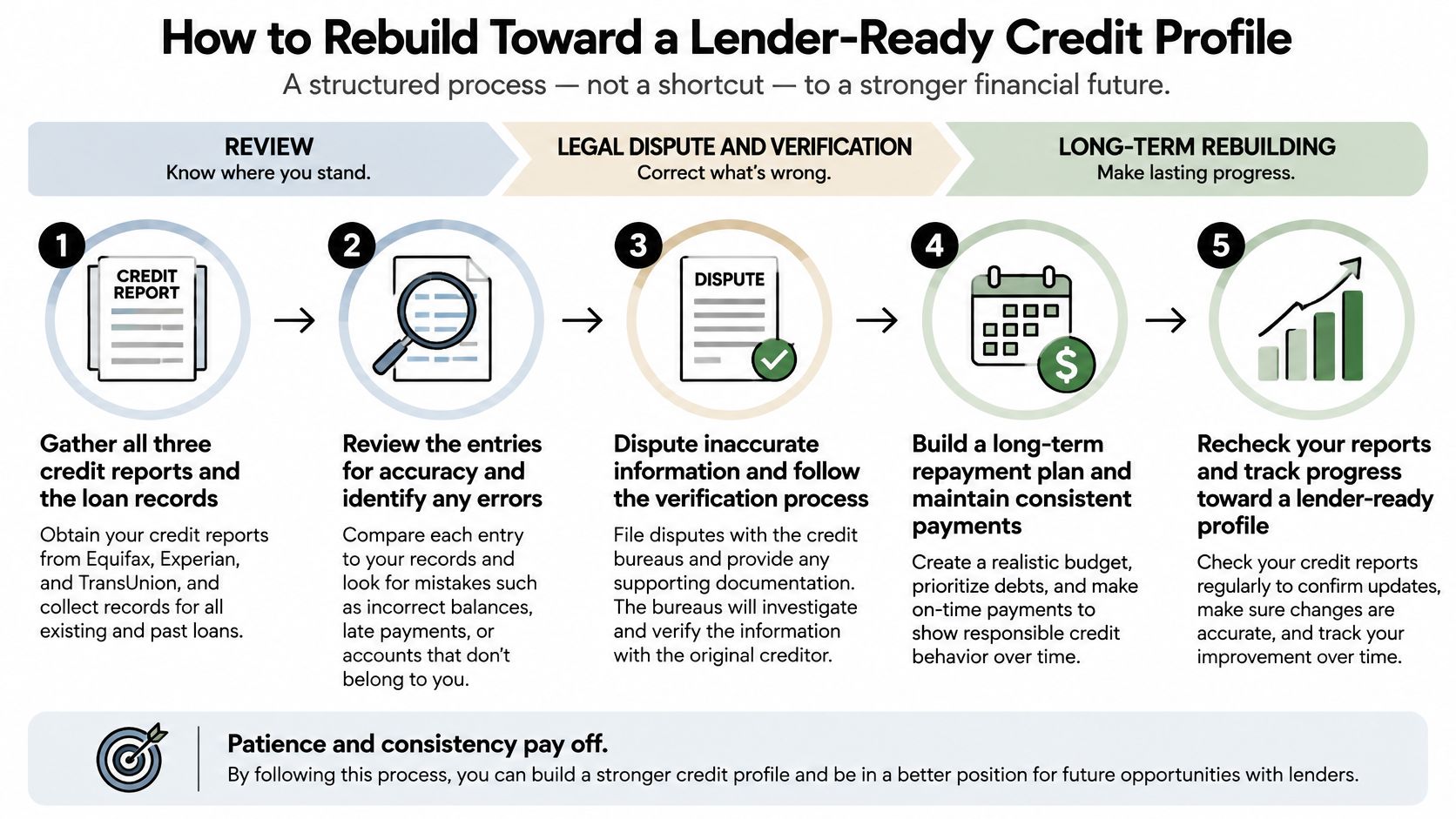
Rebuilding after repossession works best as a structured review process, a legal dispute and verification process, and a long-term improvement plan. It isn't a shortcut. Experian cautions against promising a specific score increase after correcting or paying an account, because scoring depends on your entire file, including prior payment history, account age, balances, and other negative information.
The Steps in Order
- Gather all three reports and your loan documents. You can't verify what you don't have in front of you. A common mistake is starting disputes from memory.
- Verify each entry against those documents. This is how you find genuine credit report errors. Skipping the sale statement can mean missing uncredited proceeds.
- Submit written disputes for inaccurate information. Send them to the bureau and the furnisher, and keep copies. Disputing accurate items just because they're negative wastes time.
- Address any deficiency. Request an itemized statement and, where possible, a written payment arrangement. Paying without documentation is a frequent error, because you may have no proof of the agreement later.
- Bring current accounts current and set up automatic payments. New late payments undermine everything else. Relying on memory for due dates is how avoidable late entries happen.
- Reduce revolving utilization. Paying card balances down can help because balances are typically reported each statement cycle. Don't close older cards without thinking, since that can shorten your credit history and raise utilization.
- Add positive history carefully. A secured card or credit-builder loan, used with low balances and on-time payments, can rebuild your credit profile over time. Opening several accounts at once works against that goal.
- Track progress monthly. Review readiness with a loan officer when your file shows stability, and plan your next credit improvement steps around what still needs work.
Accurate negative information generally cannot be removed simply because it harms a score, and any company promising to delete accurate items isn't taking a compliant approach.
Score changes vary by file, documentation, creditor responses, account history, and current credit behavior, so no specific increase should be expected or promised. Superior Credit Repair's role in this kind of credit restoration is structured review and dispute support based on documentation, alongside guidance on the rebuilding habits above.
Confirm Your Readiness Before You Apply for a Mortgage
Readiness describes file stability, not a score target. Before you apply, run this short check. Have all three reports been reviewed, is the deficiency status known in writing, are current accounts on time, is utilization under control, do you have a rough debt-to-income estimate, and is a folder of documents ready?
If several answers are no, more preparation time usually serves you better than an early application. The Superior Credit Repair mortgage score guide explains which scores lenders typically review, so you can compare the right numbers.
Superior Credit Repair can review your credit report, help identify inaccurate or questionable items, and explain a step-by-step plan for improving your credit profile. You can request a free credit analysis or consultation to better understand your options.
Does Paying the Deficiency Remove the Repossession?
No. Paying may reduce collection risk and show the balance resolved, but accurate late payment and repossession history generally remains for the reporting period.
Can I Apply for a Home Loan Soon After a Repossession?
You can speak with a lender, but a recent repossession usually makes approval harder. Guidelines and lender overlays vary, so confirm current requirements before setting expectations. Results vary by file.
Can Every Repossession Be Disputed?
No. A dispute should be based on information that's inaccurate, incomplete, outdated, unverifiable, or misleading. An accurate repossession isn't removed just because it's negative.
Does Credit Repair Guarantee Mortgage Approval?
No. Credit repair for homebuyers focuses on report accuracy and rebuilding habits. It can't guarantee approval, deletions, or a specific score outcome.
Superior Credit Repair Online provides educational credit guidance for individuals and families preparing for major financial goals like buying a home, applying for a mortgage, refinancing, or rebuilding after credit challenges.
Was this guide helpful? If this information helped you better understand your credit report or your next steps, we would appreciate your honest feedback. You are welcome to share your experience with Superior Credit Repair on our Google Business Profile.
If a repossession is sitting in the middle of your path to a home loan, you don't have to sort through dates, balances, and duplicate entries alone. Superior Credit Repair offers a structured, documentation based review to help you identify inaccurate or questionable reporting and build a realistic plan toward a lender-ready profile. Visit us to request a free credit analysis and talk through your options, with no pressure and no promises, just clear next steps.