

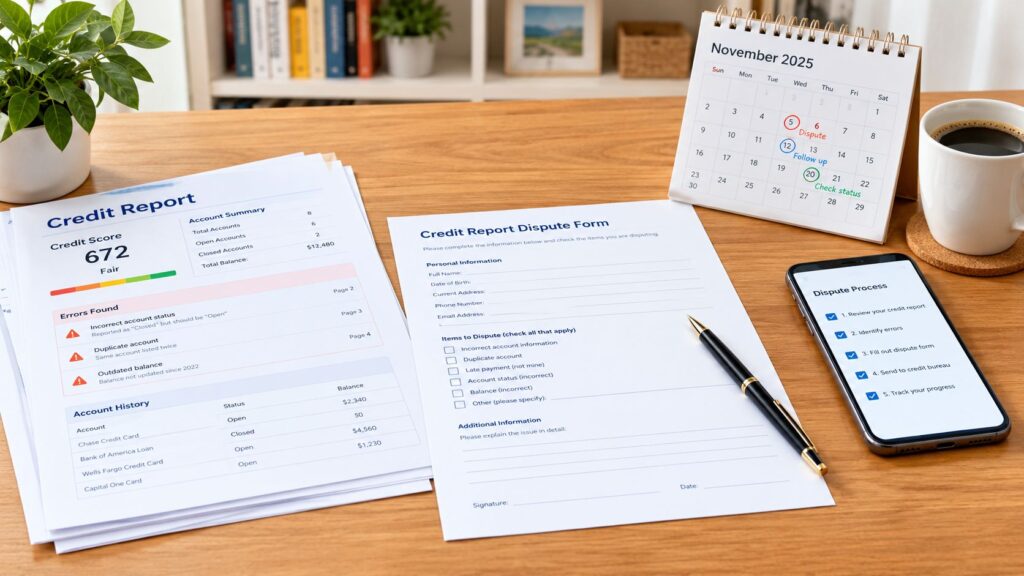
A first-time homebuyer checks a credit report before applying for an FHA loan and finds a paid medical collection still listed as unpaid. On another report, a charge-off shows a balance that doesn't match the creditor's letter. These are specific reporting questions worth investigating, but they don't mean either account will automatically be removed or that a mortgage approval is assured.
A credit report dispute form helps you identify exactly what's wrong, explain why it's inaccurate or incomplete, and submit evidence for a reasonable investigation. For homebuyers, doing this early can help keep a reporting issue from becoming a last-minute underwriting problem. A dispute is one part of credit readiness, alongside responsible payment habits, manageable utilization, and a stable credit profile.
Table of Contents
- Why a Credit Report Dispute Form Matters Before You Apply for a Mortgage
- Gathering Your Reports and Building a Discrepancy Log
- Anatomy of a Defensible Credit Report Dispute Form
- Matching Evidence to Each Disputed Item and Tracking Deliveries
- Understanding the Dispute Timeline and Mortgage-Readiness Timing
- When a Bureau Marks a Dispute as Verified and What Comes Next
- Rebuilding Credit After Disputes and Planning Your Next Steps
Why a Credit Report Dispute Form Matters Before You Apply for a Mortgage
A dispute form isn't a general request to erase negative information. It's a structured record that identifies the account or entry you're challenging, describes the factual error, and gives the consumer reporting agency (CRA) information it can use to investigate.
The Fair Credit Reporting Act (FCRA), enacted in 1970, established duties for CRAs when consumers challenge information in their reports. A CRA generally has 30 days to investigate a properly submitted dispute, though the period can extend to 45 days in certain circumstances. After the investigation, the CRA generally must provide written notice of the results within five days. AnnualCreditReport.com's dispute guidance advises consumers to identify the specific item, explain the error, and provide documentation when available.
Accurate negative information is different from an error
You can challenge information that's inaccurate, incomplete, outdated, or unverifiable. For example, if a creditor's statement shows that you paid an account but the report lists it as unpaid, the payment status may be disputable. If the account is accurate but reflects a late payment you made late, the dispute process isn't a way to remove it because it may affect a mortgage application.
That distinction matters for FHA, VA, USDA, and conventional mortgage preparation. Lenders may review payment history, collections, balances, and other credit-file details, so an unresolved error can complicate a file. Learn more about what mortgage lenders check as you prepare, and consider why pre-approval matters before house hunting when mapping out your homebuying plans.
The CFPB recorded 947,175 complaints in fiscal year 2023 in the category covering credit reporting, credit-repair services, and other personal consumer reports. The three leading complaint issues, all connected to disputes, represented 80.3% of all complaints in the database during that period, according to Congressional Research Service information.
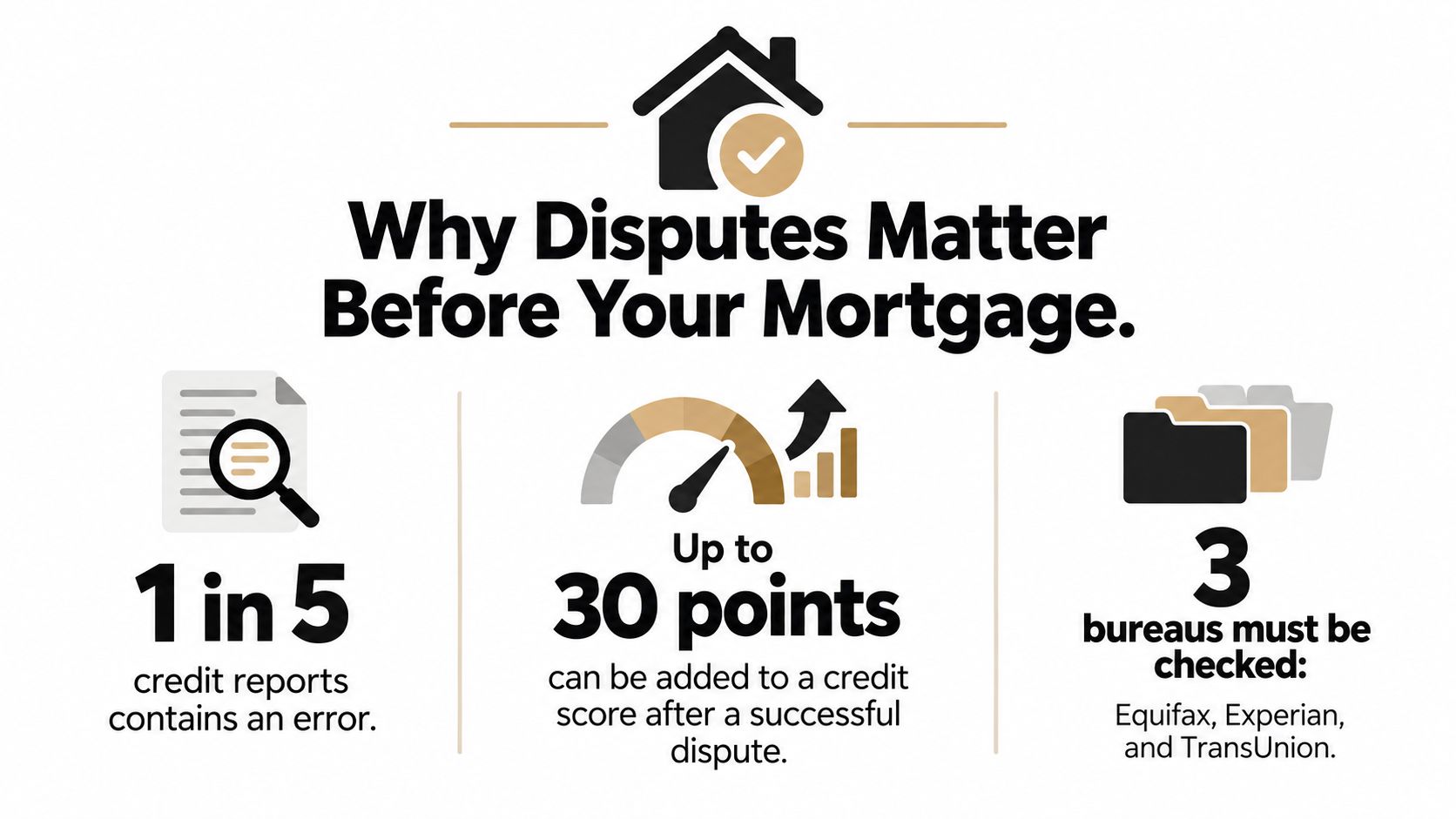
A precise dispute creates a dated record of what you challenged and what evidence you supplied. A vague or blanket complaint may not make clear which account is wrong or what the agency should investigate.
Gathering Your Reports and Building a Discrepancy Log
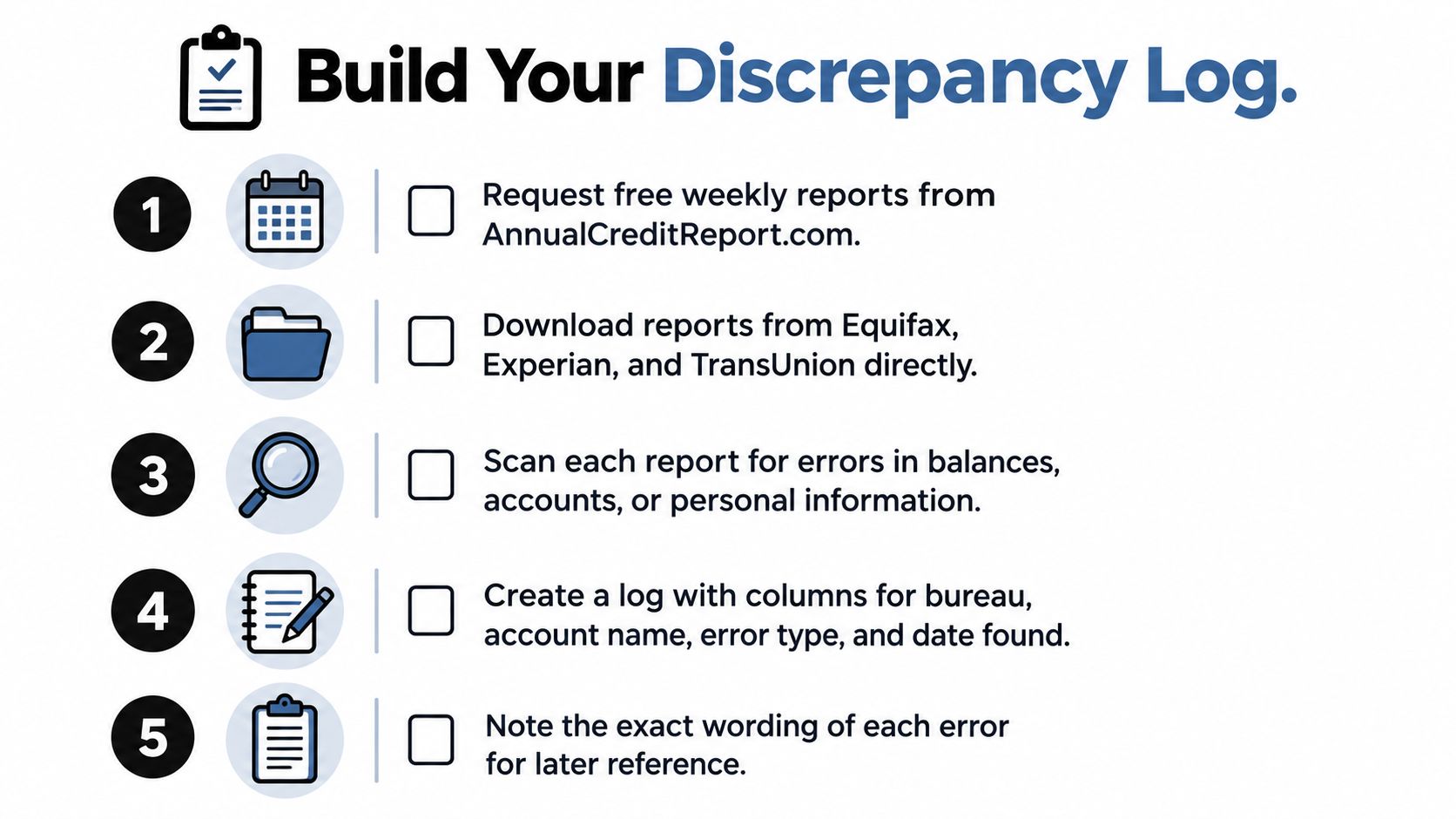
Start with the reports, not the form. A report from one bureau may not show the same accounts or details as reports from the others, so review all three nationwide credit reporting agencies: Equifax, Experian, and TransUnion. You can request reports through AnnualCreditReport.com, then compare the entries with your account statements, payment confirmations, and creditor correspondence.
Record the exact error before choosing how to dispute it
Use a notebook or spreadsheet to capture the bureau, account name, partial account identifier, disputed field, what the report says, what your records show, and where you found supporting documents. Note the wording as it appears on the report. That makes it easier to write a focused explanation rather than relying on memory.
Look for issues such as:
- Balances or limits that don't match: Compare the report with current or relevant statements.
- Payment status that conflicts with your records: Check bank confirmations and creditor receipts against the reported payment history.
- Duplicate accounts or collections: Determine whether separate entries may refer to the same underlying debt.
- Accounts that aren't yours: Review whether identity theft or mixed-file information could explain the entry.
- Dates or public-record details that appear wrong: Compare the reported information with your own documents and official records.
From January 2024 through June 2025, the CFPB received almost 4.8 million credit- and consumer-reporting complaints, including about 3.9 million involving Equifax, Experian, or TransUnion, according to the CFPB's complaint notice. Complaint volume doesn't determine whether an individual dispute is valid. Your report and supporting evidence do.
Choose a submission method you can document
An online portal may be convenient and can give you a submission confirmation. A mailed dispute can provide a strong paper trail, especially if you use certified mail with a return receipt. Either way, save the completed form, uploaded files, confirmation screens or receipts, and any correspondence.
Submit a separate, specific dispute to each bureau reporting the error. If the same account information appears on all three reports, correcting one report doesn't automatically correct the others. Avoid sending a broad request to remove every negative item; focus on each materially different reporting error and its evidence.
Anatomy of a Defensible Credit Report Dispute Form
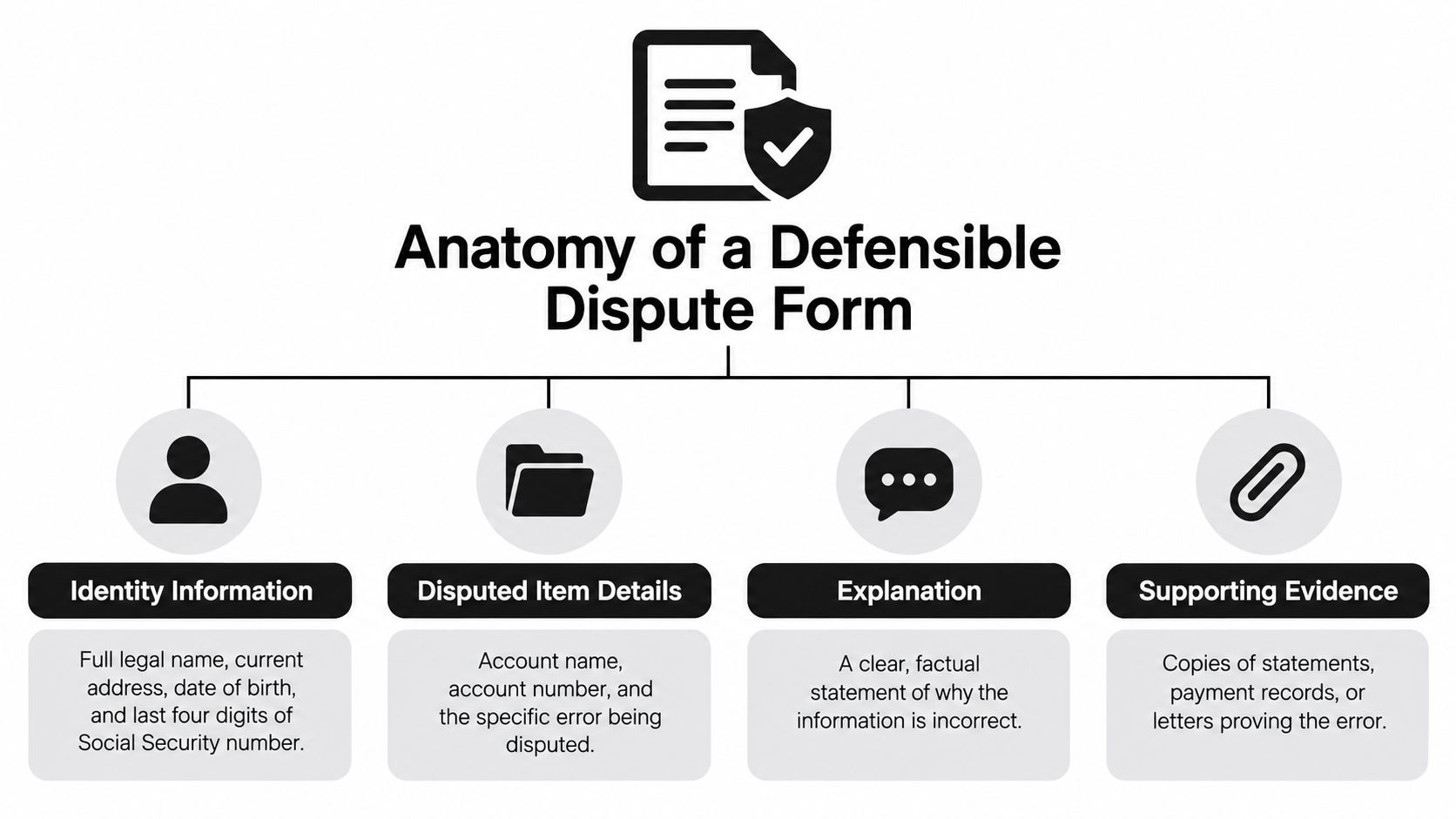
A useful form tells the agency who you are, which entry you're challenging, why the information is wrong, and what correction you're requesting. Include enough information to locate the report and account, but protect your personal data. Follow the bureau's instructions for identity verification and don't include more sensitive information than required.
What to include
- Your identity: Full legal name, current address, date of birth, and the last four digits of your Social Security number, subject to the bureau's form requirements.
- The reporting parties: Name the CRA receiving the dispute and, if known, the creditor, debt collector, or other furnisher that supplied the data.
- The disputed entry: Identify the account by name and account number or partial identifier, then specify the exact field, such as balance, payment status, or account ownership.
- The factual explanation: State what the report says and why that conflicts with your records.
- The requested correction: Ask the agency to investigate and update, delete, or correct the inaccurate information, as appropriate.
- The evidence: List the documents enclosed or uploaded and connect each one to the claim.
The FCRA generally requires a CRA to investigate within 30 days, with a possible extension to 45 days in certain circumstances, as explained by the CFPB's timeline guidance. Read about federal credit repair regulations to better understand the legal framework.
For a late payment that you believe was reported incorrectly, a focused explanation might say: “My report shows a late payment for [month]. My bank confirmation and account statement show the payment was received by the creditor on [date]. Please investigate and correct the payment status if your review confirms the reporting is inaccurate.” That gives the agency a specific entry and a reason to compare against the records.
Send copies, not originals, of statements, cleared checks, payment confirmations, settlement letters, or identity-theft documentation. Don't ask the bureau to remove accurate information because it's unfavorable. A clear request for a factual correction is stronger than a blanket demand to delete an account.
Matching Evidence to Each Disputed Item and Tracking Deliveries
Consider a buyer whose lender notices what may be a duplicate collection on a credit report. Before disputing it, the buyer compares the account names, partial account numbers, original creditor details, dates, balances, and collection history. The entries might represent the same debt reported in different ways, or they might refer to separate obligations. The records need to establish which explanation is accurate.
Attach evidence that proves the point you're making
If the buyer believes the account was paid, a settlement letter and payment confirmation may support that claim. If the concern is a wrong balance, compare the reported balance with creditor statements or correspondence. For a mixed-file or identity-theft issue, relevant identity records or official documentation may help explain why the account doesn't belong in the consumer's file.
Choose documents that directly match the disputed detail. Make sure scans are legible, keep the originals, and redact unrelated sensitive information when appropriate while leaving enough detail for the agency to identify the account. A stack of records without a clear explanation can make the key evidence harder to find.

The CFPB advises consumers to keep a copy of the dispute and says certified mail with a return receipt can document when the credit reporting company received it. Its credit report review checklist also recommends sending copies of supporting records rather than originals.
Keep a log of when you submitted the dispute, when it was received, which documents you included, and when you expect a response. Save online confirmation emails or capture the submission details for your records. If mailing, retain the receipt and delivery confirmation; for bureau-specific mailing instructions, consult the TransUnion address for credit disputes.
After results arrive, compare the relevant reports again. A correction at one bureau doesn't automatically carry over to the other two, so submit the same evidence separately to each agency that continues to report the error.
Understanding the Dispute Timeline and Mortgage-Readiness Timing
A dispute filed shortly before a lender reviews your credit can remain unresolved while the mortgage application is moving forward. The CRA generally has 30 days to investigate a properly submitted dispute, and certain circumstances allow up to 45 days. The CRA generally must send written results within five days after completing the investigation, as described in the earlier timeline guidance.
For mortgage applicants, the practical question is when the lender will review the file, not when you want to send the form. A dispute opened two weeks before a credit pull might still be active when the lender evaluates the report. Ask your loan officer how an open dispute may affect that lender's review, and share the supporting documents and submission record when appropriate.
Align the dispute with the financing calendar
| Milestone | Recommended Timing | Why It Matters |
|---|---|---|
| Review all three reports | Before contacting a lender, when possible | Gives you time to identify bureau-specific differences and locate records. |
| Submit focused disputes | Early enough to allow a full investigation cycle | A pending dispute may overlap with the lender's credit review. |
| Review investigation results | As soon as the agencies respond | You can check whether the report changed and decide whether a focused follow-up is needed. |
| Coordinate with the loan officer | Before underwriting reviews an unresolved item | The lender can explain its documentation needs and how it handles active disputes. |
The FTC's nationally representative accuracy study found that about 20% of consumers who disputed errors had at least one report modified, roughly 13% experienced a score change, and only about 1 in 250 saw a score increase exceeding 100 points. These findings are summarized in the FTC report. A report modification doesn't prove that a score improved, and no form can promise a particular score outcome or mortgage decision.
Planning note: Tell your loan officer about a pending dispute early. Ask what documentation the lender needs rather than assuming the lender will interpret an open dispute the same way you do.
If you're mapping out a broader credit-readiness schedule, review how long credit repair takes. Results vary according to the credit file, the records available, the furnisher's response, and the disputed account history.
When a Bureau Marks a Dispute as Verified and What Comes Next
A “verified” result doesn't necessarily answer every concern you raised. It means the bureau's investigation resulted in the information remaining on the report. If the outcome doesn't address your evidence or the exact field you challenged, read the results carefully and decide what new, specific information should guide a follow-up.
Strengthen the next step instead of repeating the same form
You can contact the furnisher directly as well as the CRA. The CFPB advises consumers to dispute with both parties; a furnisher that receives notice must investigate and report its findings. If the information is inaccurate, incomplete, or cannot be verified, it may need to be corrected, deleted, or otherwise no longer reported.
In a follow-up, identify the earlier dispute, state which documents weren't addressed, and explain what remains inaccurate. You can request information about the method of verification and ask which furnisher responded. Avoid resubmitting an identical form without new evidence or a clearer explanation.
The FCRA also restricts a CRA from reinserting information that was deleted after a dispute unless required procedures are followed. If an item reappears, compare the new report with your saved earlier report and investigation results, then send a focused chronology with copies of the relevant notices.
A 2025 legal summary of CFPB action reported that the agency alleged a credit-reporting company failed to meaningfully review consumer documentation, used unreasonable procedures, issued incomplete dispute results, and improperly reinserted previously deleted information. The company agreed to process improvements and a $15 million civil penalty, as described in this account of the regulatory action.
If you've first disputed the issue with the credit reporting company and still believe the handling was inadequate, you can consider the CFPB complaint process. For an upcoming mortgage review, give your loan officer a concise written explanation and copies of the dispute, evidence, and results. That doesn't guarantee a lender will disregard an unresolved item, but it gives the lender a clear record to review.
Rebuilding Credit After Disputes and Planning Your Next Steps
Correcting an error and rebuilding a credit profile are related, but they aren't the same task. A corrected report may still show accurate late payments, collections, or charge-offs. Those entries generally can't be removed just because they make financing harder, so focus on habits and account management that support a stronger profile over time.
Keep positive activity steady
Pay every account on time and avoid taking on new credit obligations without considering how they fit your finances and mortgage plans. Credit utilization means the amount of revolving credit you're using compared with the credit available to you. Paying down balances can lower utilization, but no single utilization target guarantees a mortgage decision or score result.
Before paying a collection, confirm the account details and understand how the payment will be reported. If you're dealing with a medical collection, charge-off, repossession, or account affected by divorce or hardship, check that the balance, ownership, dates, and payment status are accurately reported before deciding whether to dispute it.
A thin credit file may call for a careful rebuilding approach, such as learning whether a secured or starter card fits your budget and lender timeline. Keep older accounts in good standing when appropriate, avoid missed payments, and don't open new accounts without discussing potential mortgage implications with your loan officer. Debt-to-income concerns also matter to mortgage planning, so review monthly obligations alongside your credit report.
The CFPB recommends contacting both the reporting company and the furnisher when disputing inaccurate information. Its guidance on accurate negative information explains that a furnisher must investigate a dispute and correct or delete information when its investigation finds it inaccurate.
For a structured approach to credit habits and mortgage readiness, see the Superior Credit Repair 90 day plan. A dispute is most useful when it's part of a broader plan: confirm the facts, document a legitimate error, track the response, and keep building sound payment and balance habits. Results vary based on your credit file, documentation, creditor responses, account history, and current credit behavior.
Superior Credit Repair can review your credit report, help identify inaccurate or questionable items, and explain a step-by-step plan for improving your credit profile. You can request a free credit analysis or consultation to understand your options by visiting Superior Credit Repair.
If this information helped you better understand your credit report or your next steps, we would appreciate your honest feedback. You are welcome to share your experience with Superior Credit Repair on our Google Business Profile. Share your feedback.