


You've signed the divorce papers, but a mortgage, credit card, or auto loan may still connect your financial life to your former spouse. You may be trying to rent an apartment, replace a vehicle, or prepare for a first home while wondering why an account assigned to your ex continues appearing on your credit report. That confusion is common, and it can create real lender-readiness problems.
The most reliable answer to how to rebuild credit after divorce doesn't begin with opening several new cards. It begins with separating liabilities, securing your individual credit identity, checking all three credit reports, and documenting what happened. From there, you can correct inaccurate information, establish dependable payment habits, manage utilization, and prepare a file that a mortgage lender can understand.
Table of Contents
- Why Divorce Changes Your Credit File
- Separating Joint Accounts and Protecting Your Credit
- How Divorce Affects Your FICO Score Factors
- Building Credit After Divorce Without Hurting Lender Readiness
- Preparing for Mortgage Approval After Divorce
- Next Steps and Realistic Expectations
Why Divorce Changes Your Credit File
Consider a common post-divorce situation. A divorce decree assigns the marital credit card and mortgage to one former spouse. The other spouse moves out, removes the accounts from their budget, and assumes the legal paperwork has settled the matter. Months later, the spouse responsible for the payments misses a mortgage payment or carries a high balance on the joint card. The creditor may still report that activity for both borrowers because both names remain on the original contracts.
The divorce order and the lender's contract serve different purposes. A court order can assign responsibility between former spouses, but it generally doesn't change the creditor's legal rights. If your name remains on a joint credit card, mortgage, auto loan, personal loan, medical bill, or utility account, the creditor may still pursue you. The Consumer Financial Protection Bureau explains that removal usually requires a creditor-approved release, refinancing, or payoff, not merely a court order or removal from a property title. The CFPB's guidance on debt after divorce explains this distinction.

The difference between family-law responsibility and creditor responsibility
Family law determines what you and your former spouse are expected to pay between yourselves. The lender evaluates the names, signatures, and terms on its account. Until the lender formally releases one borrower or the debt is refinanced or paid, both borrowers may remain exposed to missed payments, collections, and high balances.
That exposure matters even if you never used the account. A former spouse's payment behavior can affect your credit file when the account is jointly held. It can also complicate a future mortgage application because an old mortgage may still appear as an active legal obligation.
This is why a court order alone isn't a credit-rebuilding strategy. Before you apply for new financing, you need evidence showing what happened to each shared liability. Keep refinance documents, payoff statements, account-closure letters, creditor correspondence, and records showing payments made under the divorce agreement.
Practical rule: Treat divorce as a liability-separation project before treating it as a score-building project.
Why opening new accounts comes later
A person who sees negative information after divorce may want to open new accounts immediately. That can be premature. New applications may create hard inquiries and new-account risk, while closing shared accounts can change available credit and reported history. First determine which accounts are still legally connected to you and which entries are inaccurate.
If a joint or cosigned account has already caused damage, recover from a co-signed account problem by reviewing the contract, payment history, and documentation instead of assuming the divorce decree removes the reporting.
The foundation is simple but important: obtain all three credit reports, identify every shared obligation, confirm who remains legally responsible, and document each requested change. Once that work is underway, you can make better decisions about credit repair, credit restoration, mortgage preparation, and new individual accounts.
Separating Joint Accounts and Protecting Your Credit
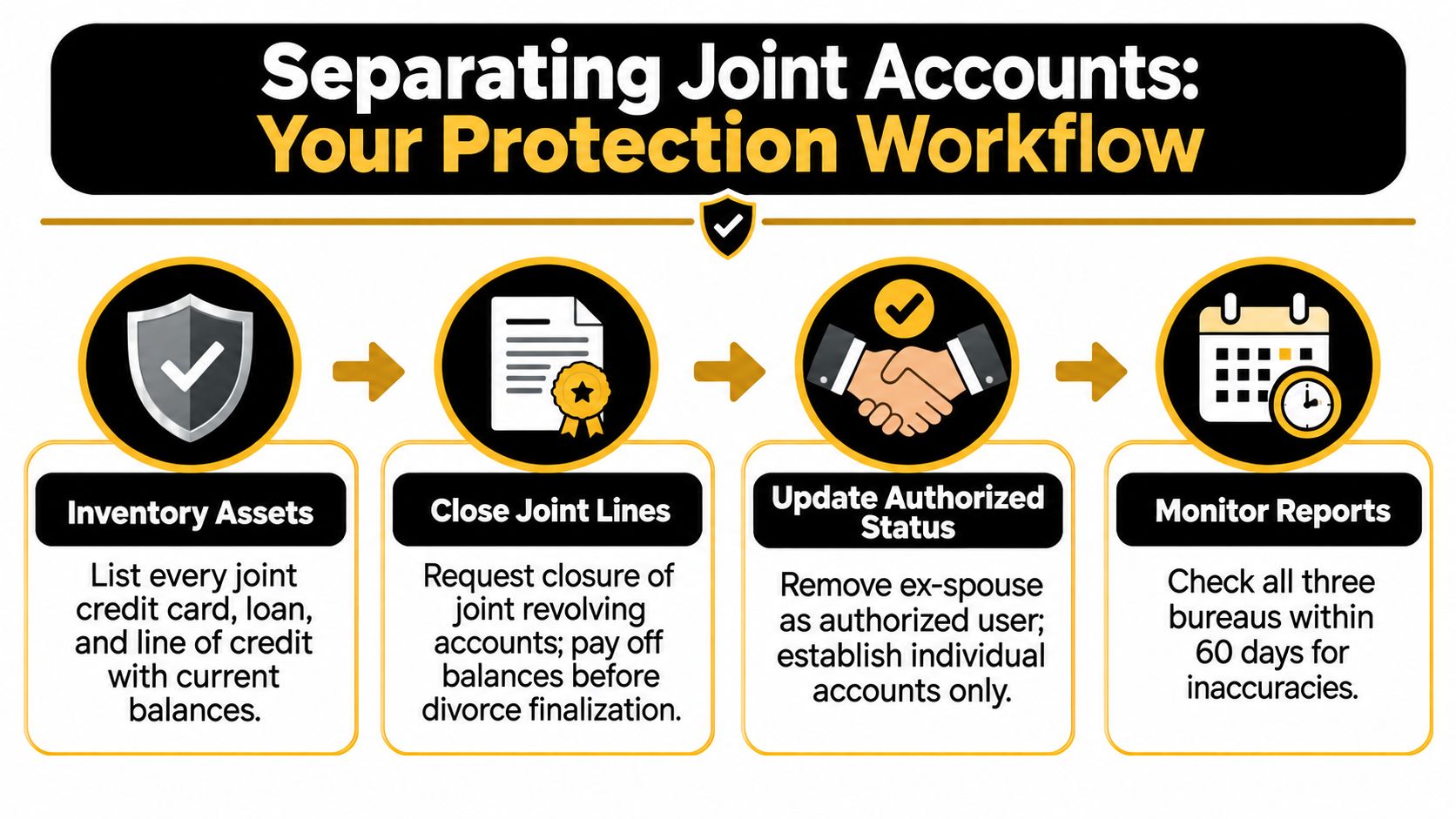
Start with an inventory, not a guess. Pull your reports from all three major credit bureaus and create a working record for every account connected to the marriage. Your list should include the creditor, current balance, credit limit, payment due date, ownership type, authorized-user status, and the name or names shown on each report.
The inventory helps you distinguish a joint account from an authorized-user account. A joint borrower generally has contractual responsibility for the debt. An authorized user may have account activity appearing on a report without being the primary borrower. The correction or removal process can differ, so accurate classification matters.
Build a written separation plan
For each joint account, request a documented outcome. Usually, the practical choices are:
- Refinance or transfer: The responsible former spouse refinances or transfers the obligation into an individual name, subject to creditor approval.
- Payoff and closure: The balance is paid, and the creditor confirms that the account is closed or otherwise no longer creates an obligation.
- Payment-control arrangement: If immediate separation isn't possible, establish a documented arrangement for making and monitoring payments until refinancing, sale, or payoff occurs.
Until the lender confirms the change, continue making at least the minimum payment when necessary to protect the account. A divorce decree may assign the payment to your former spouse, but a missed payment on a still-joint account can affect both borrowers and may remain on a credit profile for up to seven years, as described in Experian's divorce and credit guidance.
This can feel unfair, especially when the divorce agreement clearly says your former spouse must pay. The safest response is to preserve proof of every payment and communicate with the creditor in writing. A payment made to protect your report may later be relevant when you seek reimbursement or enforce the divorce agreement through the appropriate legal process.
Check for identity and reporting errors
Divorce can also create credit-file problems that aren't caused by valid account activity. Review whether:
- a closed account is incorrectly reported as open;
- a balance or credit limit is wrong;
- an account belonging to someone with a similar name appears on your report;
- an ex-spouse remains listed as an authorized user when that status should have ended;
- a duplicate collection or charge-off appears;
- a paid or transferred account still shows an inaccurate obligation.
Dispute only information that is inaccurate, incomplete, outdated, unverifiable, or misleading. Save copies of reports, statements, payment confirmations, the divorce decree, settlement documents, creditor letters, and refinance or payoff records. You can also seek Superior Credit Repair authorized user help when you need help understanding how an authorized-user entry fits into your broader credit profile.
A strong file contains more than corrected entries. It also contains a clear paper trail showing what you requested, when you requested it, and how the creditor or bureau responded.
How Divorce Affects Your FICO Score Factors
Divorce itself doesn't directly lower a credit score. Marital status isn't included in credit reports and isn't part of standard score calculations. The practical changes usually come from what happens to accounts before, during, and after the separation.
The most visible shift often occurs when a joint revolving account closes. Closing a card can remove available credit from your profile. If the balances on your remaining cards stay the same, your utilization can rise because the total available limit is smaller. Utilization means the balance reported on a revolving account compared with that account's credit limit.
What changes after accounts are closed or removed
Suppose a long-standing authorized-user account disappears from your file. You may lose some reported account history or available credit. If you open several replacement accounts, the new applications can add hard inquiries and make your file look newer. These outcomes don't mean you should keep unsafe or inappropriate accounts open. They mean the sequence matters.
Preserve individual accounts with clean payment records when they fit your budget and security needs. Keep revolving balances low relative to their limits, establish at least one account reporting in your own name, and automate at least the minimum payment. Review each card separately as well as your total revolving utilization because one card with a high balance can create concern even when the overall picture looks manageable.
A useful way to think about utilization: Closing an account can change the denominator, even when you haven't added new debt.
FICO identifies payment history and amounts owed as major scoring categories. Its explanation assigns approximately 35% to payment history and approximately 30% to amounts owed, including revolving utilization. FICO also says lower utilization generally indicates less credit risk, but it doesn't identify one universal utilization percentage that guarantees an optimal score. FICO's explanation of score factors provides the relevant context.
Avoid score-chasing after separation
A score may change as creditors update balances, accounts close, disputes resolve, or new information reports. That movement isn't a reason to open every available product. A better approach is to connect each account decision to a purpose:
- Keep an individual account if it has affordable payments and useful positive history.
- Replace an unsafe joint arrangement only after reviewing the liability and budget.
- Avoid carrying balances you can't manage just to create activity.
- Check whether a prospective mortgage lender prefers you to limit new applications before underwriting.
Readers preparing for a home purchase can also review Superior Credit Repair for mortgage approval to understand how account activity fits into broader lender-readiness planning. The goal isn't a dramatic short-term change. It's a stable, accurate file that reflects current behavior.
Building Credit After Divorce Without Hurting Lender Readiness
A newly independent credit profile may need positive reporting, but adding accounts too quickly can work against you. A secured card, credit-builder loan, or carefully selected authorized-user arrangement may help in the right circumstances. None should be treated as a guaranteed score solution.
A secured card typically requires a refundable deposit that supports the account's credit line. Use it for an affordable recurring purchase, monitor the statement balance, and automate payments. A credit-builder loan generally reports installment payments, but you still need to confirm the product's cost, reporting practices, and fit with your budget.
Choose sequence over volume
A measured order is usually easier to manage:
- Secure individual access. Make sure you can log in, receive statements, control payments, and protect accounts in your own name.
- Review authorized-user exposure. Remove or replace an account when it creates security, identity, or utilization concerns.
- Correct reporting errors. Dispute specific inaccurate or unverifiable entries with supporting documents.
- Automate essentials. Set reminders or automatic minimum payments for accounts you intend to keep.
- Add limited positive credit. Choose only products that fit your income, housing plans, and expected mortgage timing.
Opening several products can add inquiries, affect average account age, and create new balances when income has become less predictable. A person covering housing, childcare, legal expenses, and household bills alone may need stability more than additional credit.

Document disputes correctly
A credit-report dispute should identify the exact item, explain why the information is wrong, and include copies of supporting records. The Federal Trade Commission recommends sending disputes to both the credit bureau and the company that furnished the information. A bureau generally has 30 days to investigate, although the period can extend to 45 days in some cases when a consumer obtains a free annual report and disputes information after receiving it. See the FTC's consumer guidance on disputing credit-report errors.
Keep originals in your files. Useful documents may include statements, proof of payment, court records, settlement paperwork, refinance documents, and creditor correspondence. The purpose is correction of information that cannot be verified or is inaccurate, not deletion of accurate negative history.
If you use a secured card, learn how to use a secured card wisely before applying. Superior Credit Repair can help organize credit-report facts, explain dispute documentation, and provide account-level education, but outcomes vary according to the file, documentation, creditor responses, and current credit behavior.
Preparing for Mortgage Approval After Divorce
Mortgage readiness requires more than a score. A lender may review payment history, revolving balances, outstanding debt, recent applications, account stability, and the documents that explain obligations created during the marriage. That applies whether you're preparing for an FHA, VA, conventional, or USDA mortgage.
A former shared mortgage deserves special attention. If it still appears as an active legal obligation, ask the prospective lender how it will affect underwriting and debt-to-income calculations before submitting an application. The CFPB advises recently divorced consumers to confirm that a former shared mortgage has been paid off and no longer creates an outstanding obligation before applying alone.
Fannie Mae's underwriting guidance also treats alimony, child support, equalization payments, and separate-maintenance payments lasting more than 10 months as recurring monthly obligations in relevant circumstances. Debt assigned to an ex may still remain a contingent liability when the creditor hasn't released you. Because underwriting treatment can depend on the loan program and documentation, ask the lender early rather than relying only on the divorce decree.
What lenders need to understand
Payment history and revolving balances deserve consistent attention. FICO assigns approximately 35% of a score to payment history and approximately 30% to amounts owed, including revolving utilization. Lower utilization generally signals less credit risk, but no single utilization percentage guarantees an optimal score or mortgage approval.
The following checklist connects credit repair with underwriting preparation:
| Action | Why It Matters | Documentation Needed |
|---|---|---|
| Confirm the status of a shared mortgage | Shows whether an old obligation remains active | Payoff statement, refinance documents, creditor release, or sale records |
| Review every joint liability | Prevents an overlooked card, loan, or line of credit from appearing during underwriting | All three credit reports, account inventory, statements |
| Explain assigned support or equalization payments | Helps the lender evaluate recurring obligations accurately | Divorce decree, settlement agreement, payment records |
| Correct inaccurate collections, late payments, or charge-offs | Gives the lender a more accurate credit history | Statements, proof of payment, dispute records, creditor responses |
| Manage revolving balances consistently | Supports a stable utilization profile and demonstrates current control | Recent statements, payment confirmations, budget records |
| Ask about debt-to-income treatment before applying | Reduces surprises during loan review | Written questions and the lender's documented guidance |
Match the plan to the loan program
FHA loan preparation, VA loan preparation, conventional mortgage preparation, and USDA loan preparation may involve different underwriting rules and documentation expectations. A veteran with a shared auto loan, a first-time buyer with a former mortgage, and a borrower seeking a conventional mortgage after late payments shouldn't assume the same explanation will work for all three applications.
Mortgage credit repair should therefore focus on accuracy and lender communication. If you need preparing for mortgage approval after late payments, organize the timeline, identify the account responsible, gather proof of current payments, and ask the lender what documentation it requires. The same principle applies to collections dispute help, charge-off dispute help, and medical collection credit repair. The appropriate action depends on whether the reporting is accurate and how the lender evaluates the obligation.
Next Steps and Realistic Expectations
Begin with the account inventory. Separate joint liabilities where possible, secure individual access, and preserve every release, payoff, refinance, and payment record. Then dispute only inaccurate, outdated, unverifiable, incomplete, or misleading information, while building current payment history and managing revolving balances carefully.
If you're also working through housing decisions, the Law Office of Bryan Fagan, PLLC offers a useful resource on rebuilding finances after divorce that can help you consider the broader financial transition alongside credit reporting.
Results vary based on your credit file, documentation, creditor responses, account history, and current behavior. Credit repair is a structured review, legal dispute, verification, and rebuilding process. It doesn't promise guaranteed deletions, overnight improvement, a specific score increase, or mortgage approval. You can also review Superior Credit Repair on mortgage readiness when you need help setting expectations around a lender-focused plan.
Superior Credit Repair can review your credit report, help identify inaccurate or questionable items, and explain a step-by-step plan for improving your credit profile. You can request a free credit analysis or consultation to better understand your options.
Superior Credit Repair can help you organize joint-account concerns, review potential credit-report errors, and build a documented plan for credit restoration after divorce. Visit Superior Credit Repair to learn more and take the next informed step toward mortgage, auto, business, or personal financing readiness.
If this information helped you better understand your credit report or your next steps, we would appreciate your honest feedback. You are welcome to share your experience with Superior Credit Repair on our Google Business Profile. https://share.google/ePRpFvtCXwCjiJwOK