

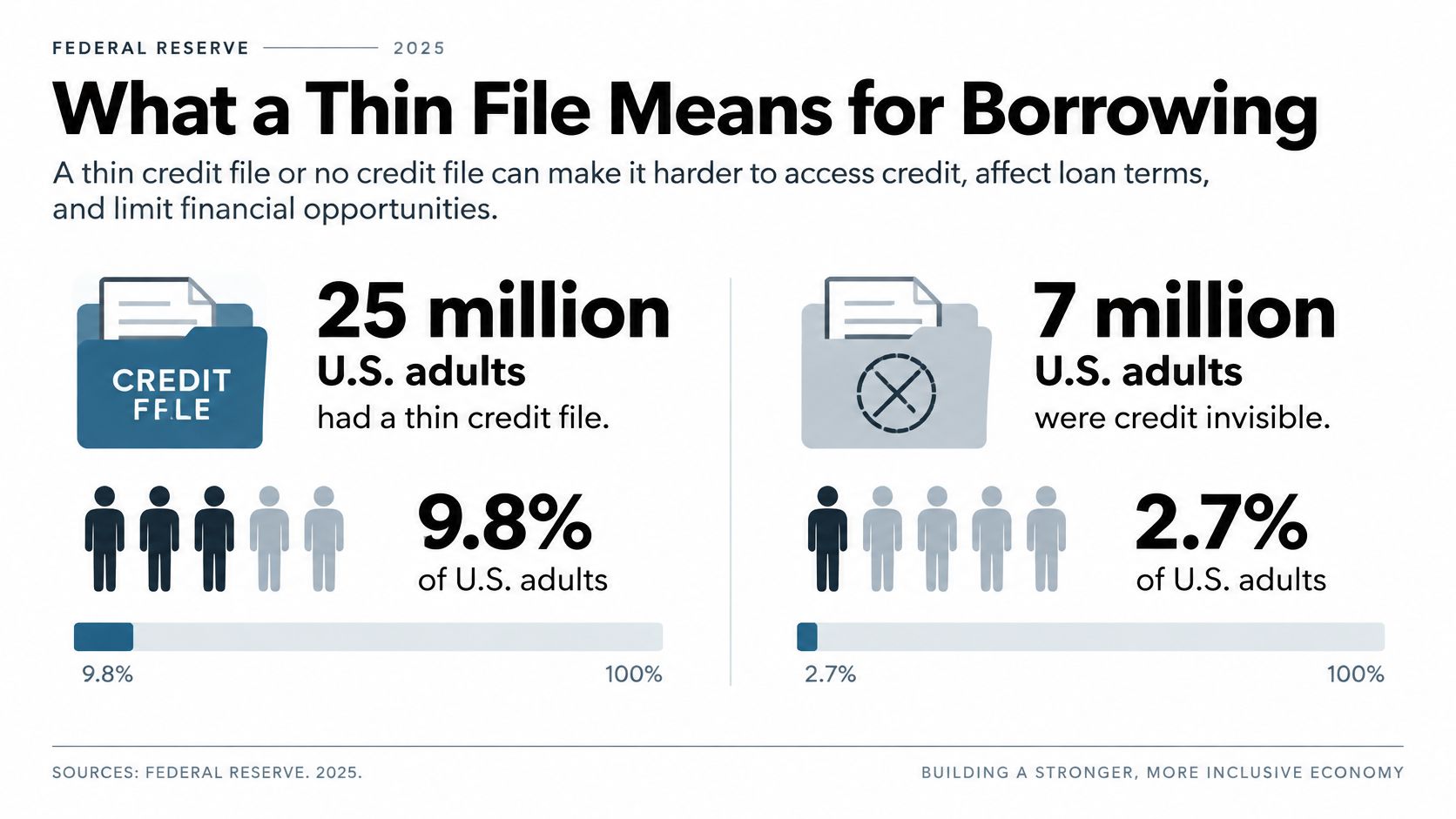
Approximately 25 million American adults, or 9.8% of the adult population, had a thin credit file in 2025, according to the Federal Reserve's Consumer & Community Context publication. Another 7 million adults, or 2.7%, were credit invisible, bringing the combined unscoreable population to roughly 32 million. For someone preparing to buy a home, that distinction matters: missing credit evidence isn't the same as a record of missed payments.
Thin file credit cards can help establish that evidence when they report legitimate account activity and you manage them consistently. The useful question isn't how many cards you can open. It's which affordable account can document responsible borrowing without creating debt you don't need.
Table of Contents
- What a Thin File Means for Borrowing
- Thin File Credit Cards Compared by Type
- How Card Activity Reaches the Credit Bureaus
- A Timeline for a Lender-Readable File
- Rent, BNPL, and Other Ways to Add History
- Pitfalls That Keep a New File Thin
- Questions to Settle Before You Apply
What a Thin File Means for Borrowing
A thin credit file contains too little recent, usable repayment history for a scoring model or lender to evaluate confidently. A low score, by contrast, may reflect reported problems such as late payments or collections. Someone can have limited history without having either problem.
Think of a library checkout record. An empty record doesn't prove that someone returns books late. It gives the librarian little evidence of how that person handles borrowed property.
A prospective homebuyer who has always used debit cards can face a similar problem. Their rent may be current, their paycheck steady, and their savings growing, yet their credit report may say very little about repayment.
Why the definitions differ
There isn't a universal account-count rule. The CFPB's credit-building education transcript describes thin-file consumers as having three or fewer open, active tradelines, while Federal Reserve scoring analysis has used a two-or-fewer-account thin-file scorecard. A tradeline is an account entry on a credit report.
Other organizations use different descriptions. Experian's guidance for consumers without a credit score notes that consumers with fewer than five accounts may not have enough information to generate a score. These descriptions aren't instructions to open that many cards, and account count alone doesn't establish mortgage readiness.
The older CFPB Chicago community profile illustrates the local reach of the issue: more than 450,000 adults, about one in five adults in the city, were credit constrained because their files were invisible, thin, or stale. A stale file contains history but lacks recent activity.
Separate missing history from reporting errors
This situation can affect first-time buyers, renters, young adults, recent immigrants, military families, and people rebuilding after divorce, hardship, or years of paying cash. The starting point is understanding what's missing.
- Accuracy review: Identify inaccurate, outdated, unverifiable, or misleading information and gather documents supporting any dispute.
- History building: Establish legitimate, active accounts that report behavior you can sustain.
Starting principle: Missing evidence calls for careful credit building. Incorrect evidence calls for a documentation-based review.
The Superior Credit Repair guidance for credit newcomers can help you organize those separate tasks. Positive reporting requires timely payments and controlled balances, and results vary by file.
Thin File Credit Cards Compared by Type
| Card type | Who it fits | Typical cost | What it adds | Mortgage caution |
|---|---|---|---|---|
| Secured card | Little or no score | Refundable deposit often sets a few-hundred-dollar limit; watch annual fees | Revolving tradeline if the issuer reports monthly | A modest balance can consume a large share of a small limit |
| Starter or credit-builder card | Some history but still thin | No deposit if approved; possible annual fee and a low limit | Unsecured revolving account and on-time payments | Approval isn't assured, and a tiny limit inflates utilization |
| Student card | Currently enrolled students | May have no deposit; student status required | Early revolving history while in school | Poor match for non-students; still requires timely payment |
| Authorized user | Trusted primary account in good standing | Usually no personal deposit | May receive reported history if the issuer reports users | Primary late payments or high balances can hurt the file |
| Store card | Shoppers at a particular retailer | Often no deposit and a high interest rate | A narrow tradeline | Limited flexibility and easy to overspend before a mortgage |
Thin-file card types and what they add should be compared by reporting value, affordability, and account stability, not just whether an application is accepted. A card that costs too much to maintain isn't a useful foundation for a homebuying plan.
Choose the obligation you can comfortably maintain
A secured card requires a deposit that protects the issuer. That deposit isn't the same as an application or annual fee: under the issuer's terms, it may be returned after graduation to an unsecured account or closure in good standing. Read the refund terms before transferring money.
A starter card may avoid the deposit but substitute fees or a restrictive limit. Approval still requires the issuer's review, and the phrase credit-builder doesn't establish that a product is affordable.
Student products are intended for eligible students, not every adult with limited history. An authorized-user arrangement requires a different kind of review: you need confidence in the primary account holder's habits and confirmation that the issuer reports authorized users.
Store cards may be convenient at checkout, but a discount doesn't establish that the account fits your mortgage preparation. Consider whether you'd want the card without the purchase incentive.
Verify reporting before submitting an application
For each option, ask the issuer:
- Bureau coverage: Does the account report to Equifax, Experian, and TransUnion?
- Ongoing availability: Can you maintain the account without unaffordable fees or an unwanted conversion?
- Budget fit: Can you fund the deposit, absorb the fees, and repay purchases without borrowing elsewhere?
A thin-file card is a reporting tool, not a spending tool.
Start with a manageable account rather than stacking applications. Several new accounts can create hard inquiries, reduce average account age, and complicate your budget without producing established history.
Use the checklist for choosing your first credit card to compare terms before applying. No card type promises a score or mortgage approval.
How Card Activity Reaches the Credit Bureaus
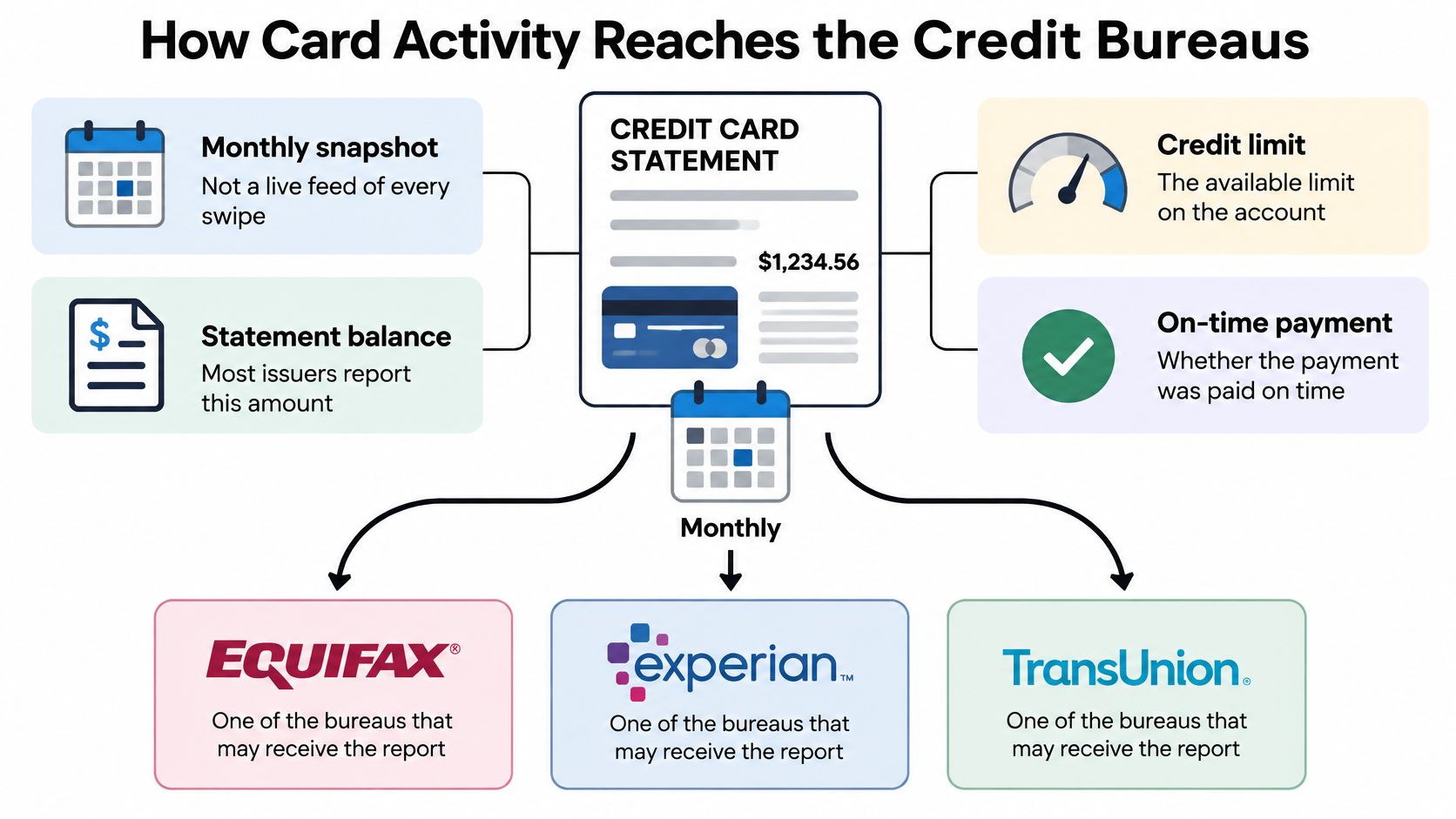
Credit reporting generally works like a monthly snapshot, not a live feed of every purchase. Most issuers send account information, such as the statement balance, credit limit, and payment status, to the bureaus they work with. Your purchase receipt, statement closing date, and payment due date each play a different part.
Credit utilization is the reported revolving balance divided by the credit limit. A $200 reported balance on a $500 limit equals 40% utilization. The same $200 balance on a $2,000 limit equals 10%. Spending is unchanged, but the reported share of available credit differs.
Statement closing and payment deadlines do different jobs
The statement closing date ends a billing period. Paying before it may lower the balance the issuer reports, though reporting practices vary, so confirm the timing with your issuer.
The payment due date is the deadline for making at least the required payment. Paying the statement balance in full by that date can avoid purchase interest when the account's grace-period terms apply. A higher statement balance, however, may already have been reported.
You don't need to carry interest-bearing debt to build credit. A small purchase that fits your budget, followed by full statement payment, can show account activity without turning credit building into ongoing borrowing. For a thin file, one older account that reports consistently and has low utilization can provide steadier evidence than opening several cards in quick succession.
- Ask the issuer: Confirm which bureaus receive account information and when the issuer usually reports.
- Check the reports: After reporting cycles have passed, make sure the account, balance, limit, and payment status appear correctly.
- Protect the payment: Set automatic minimum payments as a backstop, then arrange full statement payment whenever possible.
What the mortgage lender still needs
A missed payment on a new file can leave little established positive history beside it. Autopay can help, but check that your bank account has enough money and that each payment processed.
Positive card activity does not remove accurate collections, charge-offs, or late payments. Those entries call for a separate accuracy review and, when appropriate, a legal dispute supported by documents.
Mortgage lenders may use scoring versions that differ from the score shown in a consumer app. An app score does not establish which score a lender will obtain or whether underwriting requirements are met.
For FHA, VA, USDA, or conventional mortgage preparation, consider card management alongside income records, savings documentation, and recurring debts. Mortgage readiness tips from Superior Credit Repair also cover obligations that may be less apparent on a traditional credit report.
A Timeline for a Lender-Readable File
There's no magic number of thin file credit cards that guarantees a mortgage. A lender needs enough usable history to assess how you manage credit. Adding several new cards quickly can create more accounts without providing much evidence of steady repayment.
FICO's thin-file analysis defines a thin file as fewer than three tradelines and distinguishes it from new-to-credit, meaning less than 36 months of reported history. These terms describe a credit file, not a required number of cards or a mortgage application deadline.
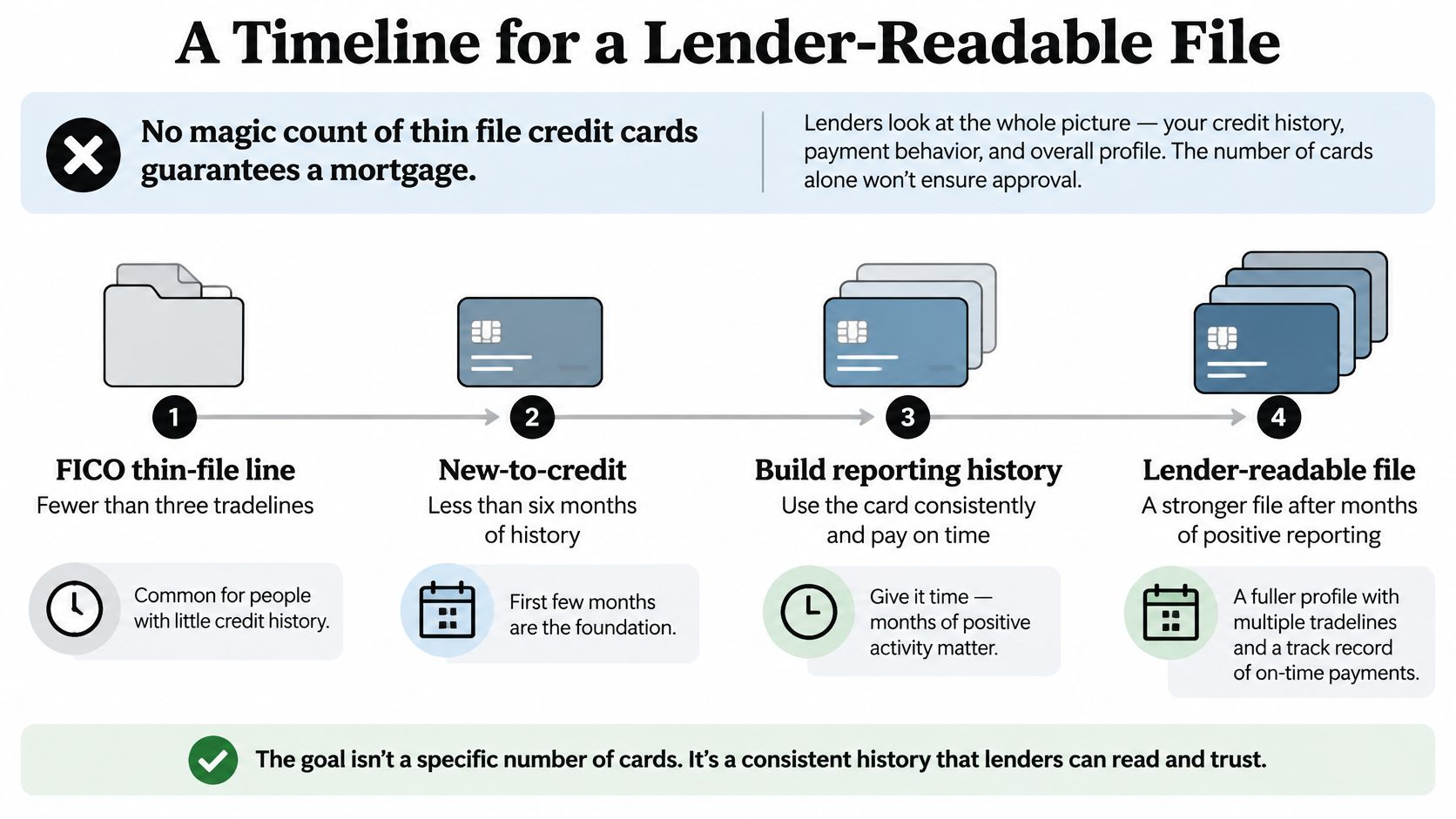
FICO's definition describes the file, while the graphic's timeline illustrates possible progress. Neither sets a deadline for mortgage approval. The pace depends on what is already in your file, what gets reported, and whether payments arrive on time.
Follow a manageable sequence
Review your reports. Obtain reports from Equifax, Experian, and TransUnion. Note whether history is missing or an entry may be inaccurate, and keep statements or correspondence related to any correction request.
Select an affordable reporting card. Confirm which bureaus the issuer reports to and review the account terms before applying. Don't borrow for a deposit or use money set aside for rent, utilities, or emergencies.
Assign a small recurring purchase. A subscription or another predictable expense can make activity easy to manage. Use something already in your budget, rather than spending just to show activity.
Set payment safeguards. Turn on automatic minimum payments and alerts. Pay the statement balance in full whenever possible. If reported balances are a concern, pay attention to the account's closing date.
Keep the account steady. An affordable account that remains open can add continuity to the record. Closing it may reduce available revolving credit, though its reported history does not necessarily disappear immediately.
Check the reporting. After several reporting cycles, confirm that the account appears correctly. If it does not, ask the issuer about its reporting schedule before applying for another card.
Prepare lender documents. Bring income records, information about reserves, and details of your debts to the lender conversation. The debt-to-income ratio compares qualifying monthly debt obligations with qualifying income, and card history does not replace that review.
Measure progress by evidence, not a score deadline
Early progress is accurate reporting and payments made as agreed. Over time, one older, low-utilization account that reports consistently may tell a lender more than several recently opened cards with little payment history. Consider another account only if it serves a clear purpose and your budget can support it.
Credit access can matter beyond a mortgage. The Federal Reserve's household well-being report says 36% of U.S. adults applied for credit in 2023, and just under one-third of applicants were denied or received less credit than requested.
FHA, VA, USDA, and conventional requirements differ. Ask whether the lender offers an appropriate manual or alternative review if your score is absent or your history is limited. For general expectations about timing, see understanding credit recovery timeframes.
Rent, BNPL, and Other Ways to Add History
Alternative payment information can have different uses. It may help a compatible scoring model generate or evaluate a score, support a lender's documentation review, or have no mortgage-scoring effect.
FICO's discussion of alternative credit information highlights why consumers need to distinguish between reported credit history and other evidence of financial reliability. Payment information is useful only when the relevant scoring model or lender can use it.
| Option | May create a traditional score | Mortgage role | Main risk |
|---|---|---|---|
| Secured or starter card that reports | Yes, if furnished and scoring requirements are met | Revolving history lenders can evaluate | Late payment or high utilization on a low limit |
| Rent-reporting service | Sometimes, under compatible models | Often supplemental, not a substitute tradeline | Fees for information the lender doesn't use |
| Bank cash-flow or deposit history | Not by itself on classic scores | Possible manual or alternative-data support | Overdrafts can undermine repayment capacity |
| BNPL plans | Often no | May not function as a scored tradeline | Missed payments or collections can create problems |
| Credit-builder loan | Yes, as installment history if reported and scoring requirements are met | Adds a different account type over time | An unaffordable additional payment |
Alternative data and mortgage usefulness should be evaluated before you pay for a service. More information doesn't automatically mean more usable mortgage evidence.
Ask what the underwriter can use
Say a renter has steady paychecks, consistent savings, and rent paid on time, but no cards. Those facts may support a lender's review, yet the renter still needs to ask which records the loan program accepts and whether rent reporting would change anything.
A rent-reporting service may furnish information to selected bureaus, but the lender's scoring model may not use that information. Bank deposits and average balances can support a cash-flow review without becoming conventional credit tradelines.
Buy-now-pay-later services such as Affirm, Klarna, Afterpay, Sezzle, and PayPal shouldn't be treated as interchangeable credit-building products. Reporting can differ by product and arrangement; successful repayment may not affect a traditional score, while missed payments, collections, or related overdrafts can still create financial problems.
Check the benefit against the obligation
Before paying for rent reporting, a self-reporting tool, or an authorized-user product, confirm:
- Destination: Which bureaus receive the information?
- Use: Will your mortgage lender's scoring or underwriting process consider it?
- Cost: What ongoing fee or payment obligation are you accepting?
- Exit terms: What happens to reporting if you cancel?
A credit-builder loan may add installment history, but taking on a payment solely for account variety can weaken your budget. The guide to strengthening credit before mortgage applications can help you evaluate that tradeoff.
Pay for a credit-building product only after confirming a useful purpose. It doesn't replace correcting wrong collections information or guarantee financing.
Pitfalls That Keep a New File Thin
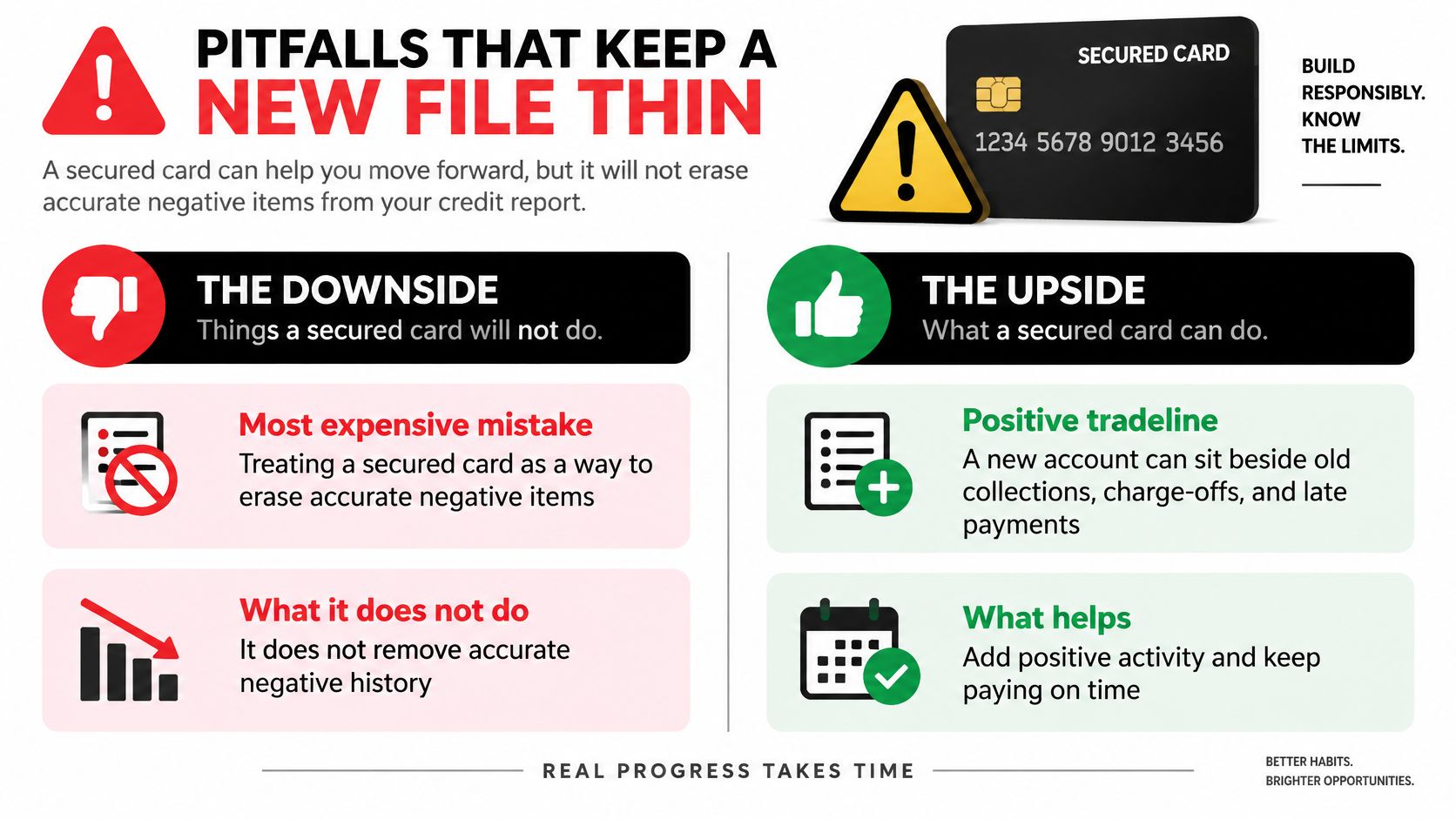
One expensive mistake is treating a secured card as a way to erase accurate negative items. A new positive tradeline sits beside existing collections, late payments, and charge-offs. It doesn't replace a documentation-based review of whether those entries are accurate and reportable.
Experian's thin-file guidance describes using a secured card for a small monthly purchase and paying the statement in full to establish history without carrying interest-bearing debt. Responsible use adds useful activity, but it doesn't remove accurate negative history.
Avoid mistakes that create new problems
- Spending to the limit: A low-limit card can become heavily utilized through ordinary purchases. Set a spending cap based on your budget, not the issuer's maximum.
- Applying repeatedly after denial: Read the explanation first. More applications may add inquiries without addressing why the issuer declined you.
- Closing immediately after a score appears: Review fees and available credit before deciding. Don't assume the account has finished serving a purpose.
- Relying on autopay without checking: A failed payment can occur if funds are unavailable or account details change. Review payment confirmations.
- Ignoring reporting problems: An absent account or incorrectly reported limit deserves investigation, not another application.
- Carrying debt unnecessarily: Interest charges aren't proof of responsible borrowing and don't make credit building faster.
Apartment screening deserves attention too. Someone saving for a home may first need a rental, and limited credit information can complicate that review. Keep rental payment records and ask the property manager what supporting documentation they accept.
Keep restoration focused on accuracy
A collection is an account being pursued for payment by a collection party. A charge-off is an accounting classification by the creditor; it doesn't automatically mean the debt is forgiven. A late-payment entry records a reported delinquency, which should be checked against statements and payment records if you believe it's wrong.
When disputing, identify the specific error, explain why it's incorrect, and provide relevant supporting documents. Keep copies of the dispute, attachments, and responses.
Warning sign: A promise of guaranteed deletions, a fixed score increase, or guaranteed loan approval isn't a substitute for an accuracy-based process.
Credit restoration should combine structured review, legal dispute and verification procedures, and sustainable rebuilding habits. Results depend on the credit file, documentation, creditor responses, account history, and current behavior. Progress requires consistent evidence, not an overnight promise.
Questions to Settle Before You Apply
How long should I build credit before applying for a mortgage?
There's no fixed amount of time that guarantees approval. Ask a lender what reported history, account stability, income documentation, reserves, and debt-to-income position your intended loan program requires. Starting early gives you more time to address gaps without rushing into applications. A single older account with low utilization that reports consistently may offer clearer evidence than opening several cards at once.
Can I use a thin-file card if I have collections?
Yes. A suitable card can add positive payment history while you review collections separately. Opening a new account does not erase accurate negative information. If a collection entry appears inaccurate, outdated, unverifiable, or misleading, gather relevant documents and use the appropriate dispute process.
Will a higher secured-card deposit guarantee a better score?
No. A larger deposit may support a higher reported limit, making the same balance a smaller share of available credit. The effect depends on the full credit file, so don't use emergency savings or borrow money to fund a bigger deposit. Consistent, affordable payments matter more than adding new accounts.
What should I do if a mortgage lender already said no?
Start with the lender's denial explanation. Ask which changes could support review for an FHA, VA, USDA, or conventional loan, including any income or debt concerns. Avoid assuming that more cards are the answer. Choose a reporting account only if it fits the lender's guidance and your budget.
Superior Credit Repair can review your credit report, help identify inaccurate or questionable items, and explain a step-by-step plan for improving your profile. You can request a credit analysis or consultation to better understand your options, and the team will explain its pay-as-you-go billing before any work begins.
Was this guide helpful?
Superior Credit Repair Online provides educational credit guidance for individuals and families preparing for goals such as buying a home, applying for a mortgage, refinancing, or rebuilding after credit challenges. Results vary, and no deletion, score change, or loan approval is promised.
Visit Superior Credit Repair to request a credit review and discuss how accuracy-based disputes and manageable credit-building habits may support mortgage preparation. If this information helped you understand your credit report or next steps, you are welcome to share your honest experience with Superior Credit Repair on its Google Business Profile.