

You've paid rent, kept the lights on, and managed your money without borrowing much. Now you're ready to buy a home, but a lender says there isn't enough credit history to produce a usable score. It can feel as though years of responsible payments don't count.
A no credit history mortgage may still be possible, but the lender needs evidence it can verify. Your existing rent receipts, bank statements, and recurring bills may be more useful than a rush to open new accounts. The starting point is understanding what your file contains, then asking a lender how it will evaluate that evidence.
Table of Contents
- Which Loan Programs Accept a No Credit History Mortgage
- Documenting a Payment Record and Avoiding Common Mistakes
- Credit-Building Tools That Create Reportable History
- A Month-by-Month Timeline Before You Apply
- When Professional Credit Repair Makes Sense
- Questions Readers Ask About No-Score Mortgages
Which Loan Programs Accept a No Credit History Mortgage
A lender can see an empty credit file, a thin file, or a record with negative marks. Those situations call for different reviews. With a thin file, there may be too little reported borrowing activity to produce a usable score. Late payments, collections, or charge-offs point to a different issue. Manual underwriting means a person reviews the borrower's financial documentation under the program's rules instead of relying only on an automated recommendation.
How each loan program treats a no-score file
| Program | Score floor or baseline | How a no-score file is evaluated | Key limits |
|---|---|---|---|
| FHA | Under HUD's FHA guidance, below 500 is ineligible; 500–579 limits loan-to-value to 90%; 580 or higher permits maximum FHA financing, subject to underwriting | Generally manual underwriting using verifiable alternative payment evidence | Collection and court-record restrictions apply to nontraditional histories; lender overlays may be stricter |
| VA | No universal VA minimum score is established in the cited handbook guidance; lenders apply their own standards | Verifiable alternative or nontraditional payment history, alongside residual-income review | No established credit generally isn't adverse; stricter lender overlays are possible |
| USDA | Score requirements vary by lender and program | Ask a USDA-approved lender which alternative payment records it accepts and how they must be documented | Confirm current criteria with a USDA-approved lender |
| Conventional, Fannie Mae manual underwriting | An eligible nontraditional-credit pathway can accommodate borrowers without a score | Fannie Mae's nontraditional-credit guidance requires four credit references for each borrower without a score on manually underwritten loans | Debt-to-income, property, transaction, loan-limit, and reserve restrictions apply |
Loan-to-value compares the mortgage amount with the property's value. FHA score thresholds and the review of a borrower without a usable score are separate considerations. A missing score alone does not mean the borrower falls below a score-based eligibility floor.
For eligible military borrowers, the VA Lender's Handbook directs lenders to assess verifiable alternative payment history rather than treating absent credit as automatically adverse. The lender also reviews residual income, the money left after specified obligations and expenses, to assess whether the household can manage the mortgage.
Ask about the lender's actual process
An overlay is a lender requirement that goes beyond an agency's baseline. Before paying application-related expenses, ask whether the lender accepts no-score applications, offers manual underwriting, and will review your existing payment references.
USDA score and documentation requirements vary by lender and program. Ask a USDA-approved lender for its current criteria, then use the USDA loan guide for first-time buyers to prepare focused questions.
Mortgage rules differ across countries. For a property in France, French mortgage refusal advice is a separate, country-specific resource, not a guide to U.S. loan programs.
Practical rule: Ask what the lender will accept before changing your credit profile. Program eligibility and lender approval are separate decisions.
Documenting a Payment Record and Avoiding Common Mistakes
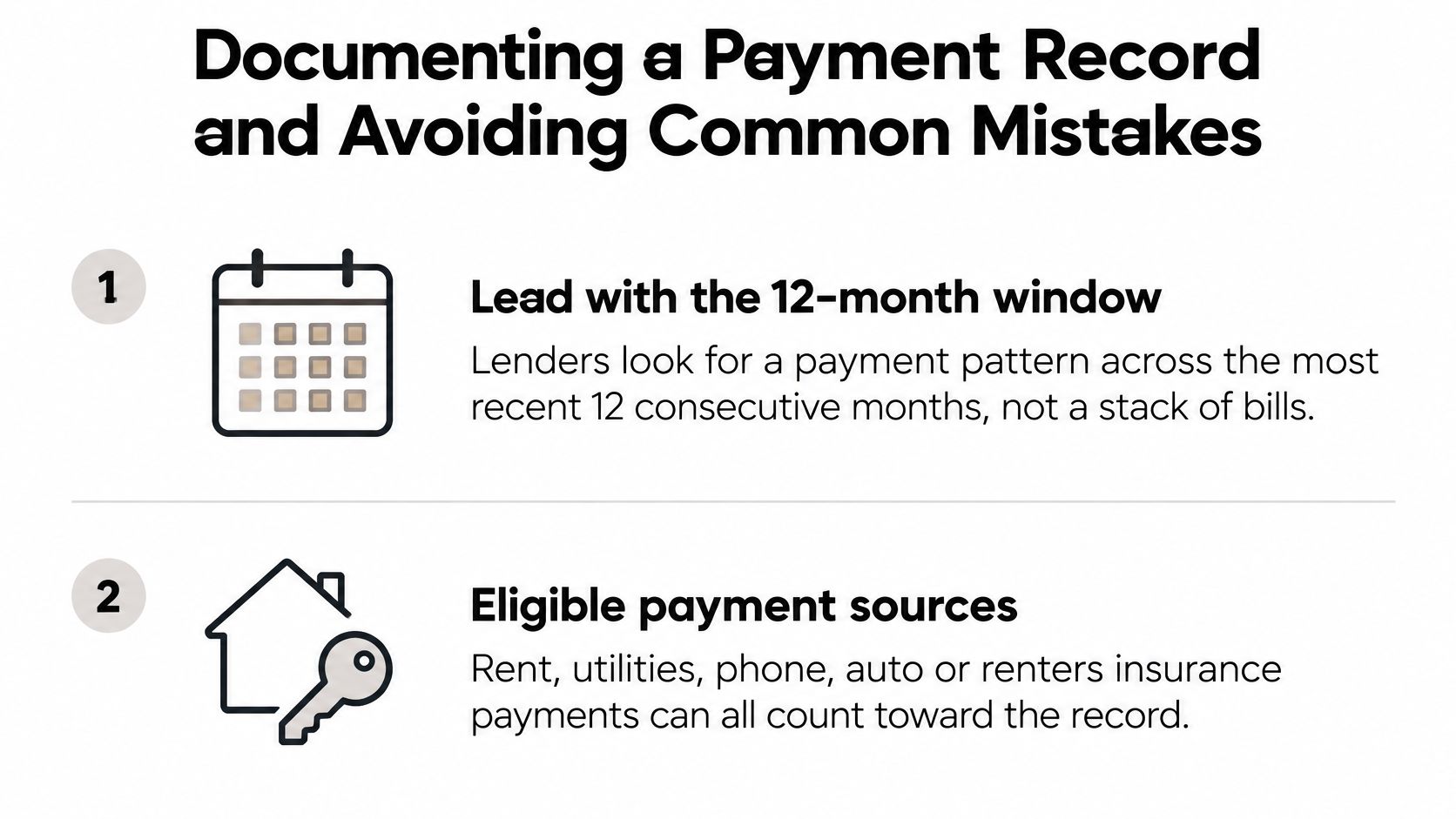
A lender needs a payment pattern, not just a folder of bills. HUD's nontraditional-credit materials describe at least 12 months of satisfactory history, with no more than one 30-day delinquency for specified reference groups, and no collection accounts or court records filed within the previous 12 months, except medical items.
That medical exception doesn't make every medical collection irrelevant to the application. The lender still evaluates the complete file and determines which underwriting requirements apply.
Build a record someone else can verify
Rent, utilities, telephone service, automobile insurance, renters insurance, and other eligible recurring obligations can help establish payment behavior. Acceptance isn't automatic. The lender must be able to connect the obligation, amount due, due date, and actual payment to you.
Fannie Mae's reference rules require regular payment intervals no longer than three months, an interview identifying references covering the most recent consecutive 12 months, and inclusion of all identified references rather than only favorable accounts.
Use this documentation checklist:
- Collect bank statements or canceled checks. Identify the payment recipient and match each payment to the corresponding bill. Preserve complete statements rather than cropped transaction screenshots.
- Request landlord verification. Ask for the rental address, payment amounts, due dates, payment history, and contact information. Confirm whether the lender wants its own verification form before requesting a letter.
- Keep utility and insurance statements. Save statements showing the account holder, service period, amount due, and payment status. A bill establishes an obligation; payment evidence establishes whether you met it.
- Attach receipts for cash rent. Keep dated receipts identifying the landlord, property, rental period, and amount paid. A cash withdrawal alone doesn't prove the landlord received rent.
Say your lease names you and a roommate, but your roommate sends the rent. Don't assume the lender can attribute the entire payment history to you. Gather your lease, transfers to the roommate, and landlord records, then ask whether that arrangement is acceptable.
Fix documentation gaps without creating new problems
Late payments during preparation: Use reminders or automatic payments with balance alerts. Check that scheduled payments clear as expected, especially after changing banks.
Selective records: Disclose unfavorable references and explain discrepancies with supporting documents. Leaving out an account can create questions that a complete, accurate explanation might have resolved.
Mismatched amounts: Separate rent from reimbursements, shared utilities, or other transfers. If the amount changed because of a lease renewal, include the renewal instead of expecting the underwriter to infer the reason.
Several new accounts: New applications can add inquiries, reduce average account age, and create obligations the lender must evaluate. Before applying for credit, ask whether your existing alternative history is already sufficient.
A clean explanation supported by complete records is more useful than a polished folder that leaves important questions unanswered.
A score is only part of the review. Income, assets, debts, and the property still matter, as explained in how lenders assess home loan applications.
If you find credit report errors while gathering records, disputes should address information that is inaccurate, outdated, unverifiable, or misleading. Don't dispute an accurate late payment merely because it complicates the mortgage application, and don't assume a dispute will produce a particular underwriting outcome.
Credit-Building Tools That Create Reportable History
For credit-building purposes, an on-time payment helps establish bureau history only when someone reports it. That's different from alternative mortgage documentation, which a lender may evaluate without the payment appearing on a credit report.
Choose a tool because its reporting, cost, and payment obligation fit your situation, not because you expect an instant score. Before enrolling, ask which bureaus receive information and whether the provider reports the account type you need.

Credit-building tools compared
| Tool | How it reports | What you control | Trade-offs to weigh |
|---|---|---|---|
| Rent reporting service | A participating provider or landlord sends monthly rent payment information to credit bureaus | Choosing a reporting provider and keeping rent current | Possible fees; past payments may not be added retroactively |
| Secured credit card | The issuer reports card activity; a refundable deposit generally establishes the credit limit | Deposit amount, balance size, and on-time payment | Deposit is tied up; annual fees may apply |
| Authorized user | The primary account's history may appear on your file after you're added | Choosing a trusted primary cardholder and confirming reporting | Negative history or high balances on the account can also affect your file |
| Credit-builder loan | A lender reports installment payments while holding the loan funds | Affordable payment selection and timely payments | Funds are typically released after the term; interest and fees may apply |
Match the tool to your mortgage timing
A secured card can provide practice managing utilization, the portion of available revolving credit you're using. Keep purchases affordable and pay the statement balance by its due date. Carrying interest-bearing debt isn't a necessary credit-building strategy.
An authorized-user arrangement requires trust and ongoing communication. You don't control the primary cardholder's payment habits, so review the account's reporting and balances rather than assuming an older account will always help.
Use Superior Credit Repair's starter card guide to compare features before submitting an application. Check deposit refund terms, fees, reporting practices, and whether the payment fits your existing budget.
- For a near-term mortgage: Ask the lender before adding a new account or installment payment.
- For longer-term rebuilding: Choose manageable obligations you can maintain without using emergency savings.
- For rental readiness: Rent reporting and documented on-time bills may support apartment approval or rental screening when the screening process considers them.
Reported history usually takes one or more billing cycles to appear, with timing controlled by the creditor's reporting process. Even after an account appears, that doesn't establish which mortgage scoring model or underwriting method a lender will use.
A Month-by-Month Timeline Before You Apply
Treat these timeframes as planning stages, not deadlines for approval. If you already have complete payment records, your work may focus on verification rather than waiting to accumulate a new history.
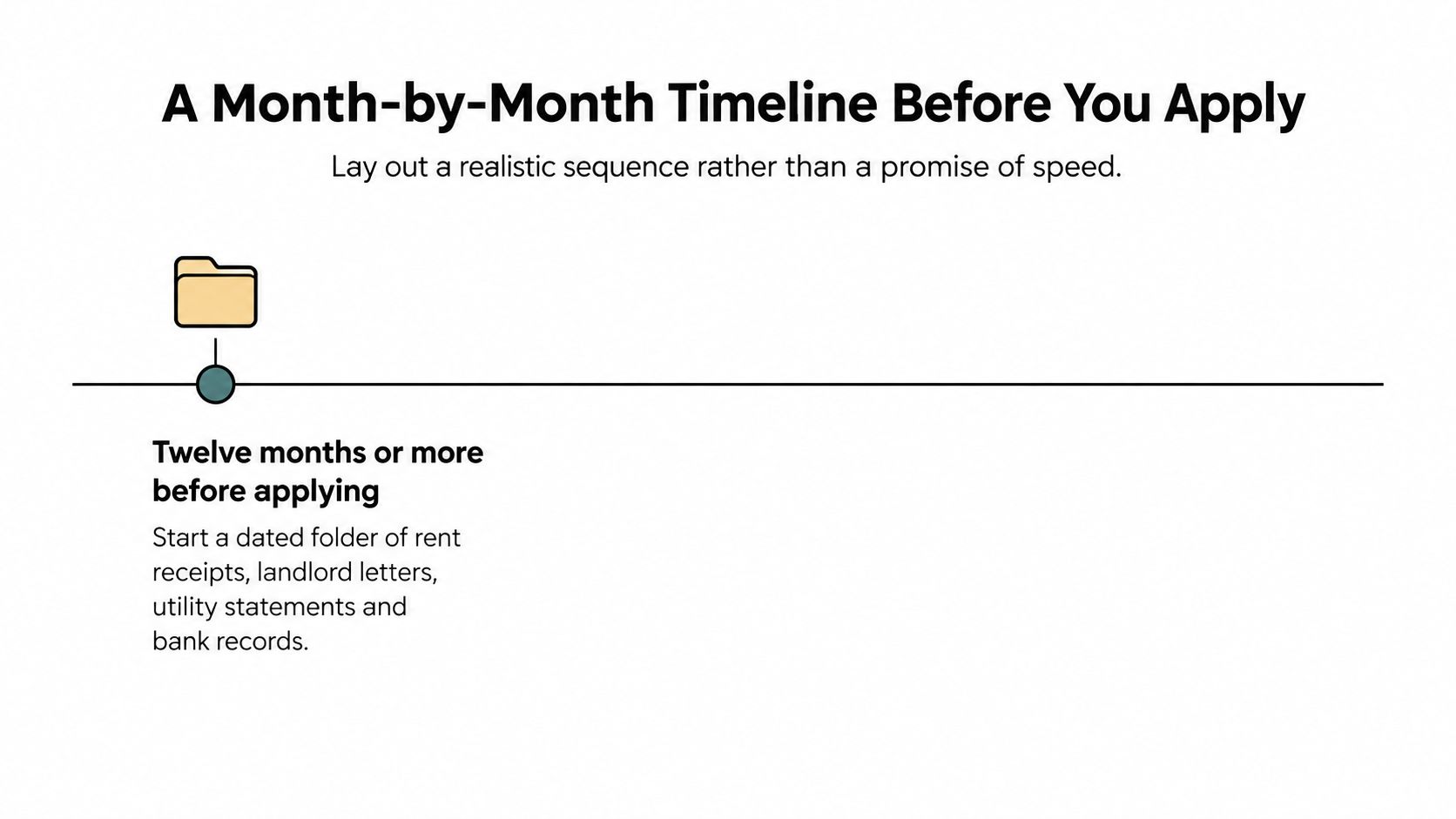
Twelve months or more before applying: Start a dated folder for rent receipts, landlord correspondence, utility statements, and bank records. Keep recurring bills current and preserve documents when you move or change providers. Download statements before closing an online account.
Six to twelve months out: If your file is empty and your lender recommends building reported history, consider a small number of affordable tools rather than submitting applications broadly. Keep card balances low and retain enough cash to cover routine expenses without borrowing again.
Budget checkpoint: Credit building shouldn't leave you unable to pay rent, cover insurance, or handle an unexpected household expense.
Three to six months out: Request a written accuracy review of your credit reports and organize supporting records for any questionable entries. Confirm that your payment references cover a continuous recent period, without missing statements. Understanding why credit recovery takes months can help you plan around verification and creditor responses rather than promises of speed.
Sixty to ninety days out: Avoid opening new accounts unless your lender recommends otherwise, build reserves, and gather income and asset documents. Fannie Mae's nontraditional-credit eligibility rules set a maximum 36% debt-to-income ratio and require 12 months of reserves when no borrower has a qualifying housing-payment reference; when at least one borrower documents that history, this specific rule imposes no minimum reserve requirement.
Before application: Ask which program the lender will use, whether manual underwriting applies, and which references it accepts. Debt-to-income compares qualifying monthly debt obligations with qualifying monthly income, while reserves are eligible assets remaining after closing. Confirm that the property and transaction also qualify, since documentation alone won't resolve an ineligible purchase.
If a temporary cash shortfall has you considering a borrowing product, review its repayment terms and discuss it with your lender before proceeding. Gerald Technologies, Inc.’s cash advance information is a product-specific resource to evaluate, not a mortgage-readiness recommendation or a substitute for savings.
When Professional Credit Repair Makes Sense
Credit repair is a structured review, legal dispute and verification process, and documentation-based rebuilding plan. It isn't a way to manufacture payment history, erase accurate information on demand, or secure guaranteed mortgage approval.
Results vary based on each person's credit file, documentation, creditor responses, account history, and current credit behavior. A professional review adds value when it helps you identify a specific issue and take a documented next step.
First step by file situation
| File situation | What usually helps first | When a professional review may help |
|---|---|---|
| Empty file, clean rent and bill history | Dated documentation and a limited number of reported accounts, if appropriate | Lender requests references you cannot verify |
| Thin file with few tradelines | Consider an affordable secured card or suitable authorized-user account with low utilization | Reports show errors or unfamiliar accounts |
| Collections or charge-offs | Verify each item and gather original records | Items appear inaccurate, outdated, or unverifiable |
| Medical collections | Confirm the balance, insurance status, and reporting status | Accuracy questions remain unresolved |
| Prior mortgage denial | Obtain written denial reasons and address documented issues | A structured file review is needed before reapplying |
| High credit card utilization | Reduce balances before statement dates without missing required payments | Help is needed coordinating payment timing and file review |
A tradeline is an account entry on a credit report. A collection generally involves a debt assigned or transferred for collection, while a charge-off reflects a creditor's accounting treatment of an unpaid account. Neither label, by itself, tells you whether every reported detail is accurate.
Choose assistance based on the unresolved issue
Self-directed preparation may be enough when your reports are accurate, your records are complete, and the lender has explained what it needs. Keep copies of disputes, supporting documents, responses, and corrected reports so you can track what changed.
For collections dispute help, late payment dispute help, or charge-off dispute help, identify the precise disagreement. That might be an account that isn't yours, a payment reported late despite contrary records, or an incorrect balance. Medical collection credit repair should also start with billing and insurance documentation rather than assumptions about removal.
- Ask about the process: Find out who reviews documents and how disputes are supported.
- Confirm current fees: Review enrollment terms directly before committing.
- Separate credit work from underwriting: The mortgage lender makes the lending decision.
Learn what realistic credit repair results can involve before choosing assistance. A useful consultation should leave you understanding the issue, the evidence needed, and the limits of what anyone can promise.
Questions Readers Ask About No-Score Mortgages
Is no credit history the same as bad credit?
No. A Federal Reserve publication estimates that about 32 million U.S. adults are unscoreable, including approximately 7 million who are credit invisible and 25 million with thin files. An empty or limited file gives a lender less information to assess, while negative payment history reflects reported account behavior. Those situations can call for different questions about your application.
Can a no-score mortgage be guaranteed?
No. The lender reviews the complete application and applies its own requirements. Qualifying for an alternative-credit pathway does not by itself establish that your income, assets, debts, or property meet those requirements. Ask which pathway may apply and what documentation the lender needs. A verifiable payment record can help show how you manage regular bills, but it cannot guarantee approval.
How long does preparation take?
The time depends on how much usable payment history you have, whether your records are complete, and whether inaccuracies need investigation. Organized rent and utility records may make documentation easier. Reconstructing missing payment records or addressing unfamiliar accounts can take more work. Use the preparation timeline to organize the process, then ask the lender to review your evidence rather than treating a target date as proof that you are ready.
Will a credit repair company remove accurate history?
A compliant company cannot promise to remove accurate, properly reportable information just because it may hurt an application. Disputes should focus on information that is inaccurate, outdated, unverifiable, or misleading, and should be supported by available records. Results vary. A corrected report or newly established score still does not replace the lender's full underwriting review.
Opening several new accounts just before applying may also create more activity for a lender to assess, rather than strengthening a thin file right away. A consistent, verifiable payment record may be a more useful starting point.
Was this guide helpful? Superior Credit Repair Online provides educational credit guidance for people preparing for goals such as buying a home, applying for a mortgage, refinancing, or rebuilding after credit challenges.
If this information helped clarify your credit report or possible next steps, you can share your experience with Superior Credit Repair on its Google Business Profile.
Superior Credit Repair offers credit-report review, documentation-based dispute assistance, and rebuilding guidance for prospective homebuyers, including those with thin or empty files. Visit Superior Credit Repair to request a credit-report review or consultation, discuss your existing payment records, and understand practical next steps without promises of approval or a specific score outcome.