



A buyer’s target: low reported use, not a magic number
A practical best credit utilization ratio for a buyer is generally in the single digits, while keeping every payment current and enough cash for closing. The credit utilization ratio describes how much of the available revolving line is being used at the moment that information reaches a credit report. A buyer’s credit score is not decided by that ratio alone: credit history, payment record, new accounts and the scoring model all matter. Because lenders can review several credit scores during a purchase, the aim is a stable file rather than a dramatic one-day number.
Consider a couple preparing to apply for a mortgage in six weeks. Their combined credit limit is $18,000 and their latest credit report shows $4,500 in card balances. Their 25% credit utilization rate may not be disastrous, but it is not the same as the 5% utilization ratio they could report after reducing balances to $900. That change might help their credit scores, yet it does not erase late payments or substitute for income documentation.
Readers often ask, what is a good credit utilization ratio before an application? Under 10% is a reasonable planning target for many consumers, not a published approval cutoff. High utilization is usually less favorable than low credit utilization, but a good credit score is possible with a range of ratios. The best action is to ask when the lender expects to check the file, then use the time available to lower high utilization without creating payment risk.
One advantage of working on credit utilization is that you can decide which balance to reduce rather than opening a new product. The mortgage payment, emergency savings and closing costs should come before the last few percentage points of the utilization ratio. Credit scores depend on more than a single calculation; a strong application can still fail affordability tests even when credit utilization is low.
A card issuer’s online balance and the amount shown to the credit bureaus can differ. For credit scoring, use the reported information rather than assuming last night’s payment already changed the credit report. The credit utilization ratio you calculate from an app screenshot is only a planning estimate until the issuer sends an updated figure. If high utilization appears after a payment, verify which reporting period the bureau used.
Buyers building their credit from scratch face a different problem from borrowers who already have mature accounts. A credit builder card may establish monthly account data, but it does not manufacture a good credit score or avoid the need to pay on time. Even with low credit utilization, a thin credit history may yield different credit scores from those of a long-established borrower. The right target therefore depends on both your timeline and the rest of the file.
A single-digit credit utilization ratio is an optimization goal, not a reason to pay interest. You can pay the full statement balance by the due date while allowing a modest amount to appear when a statement closes, if your account terms and timing permit. Credit scoring models may interpret all cards reporting zero differently from one card reporting a small balance; that distinction is separate from what you actually owe after paying the credit card bill.
Overall versus individual-card balances: the two numbers to control
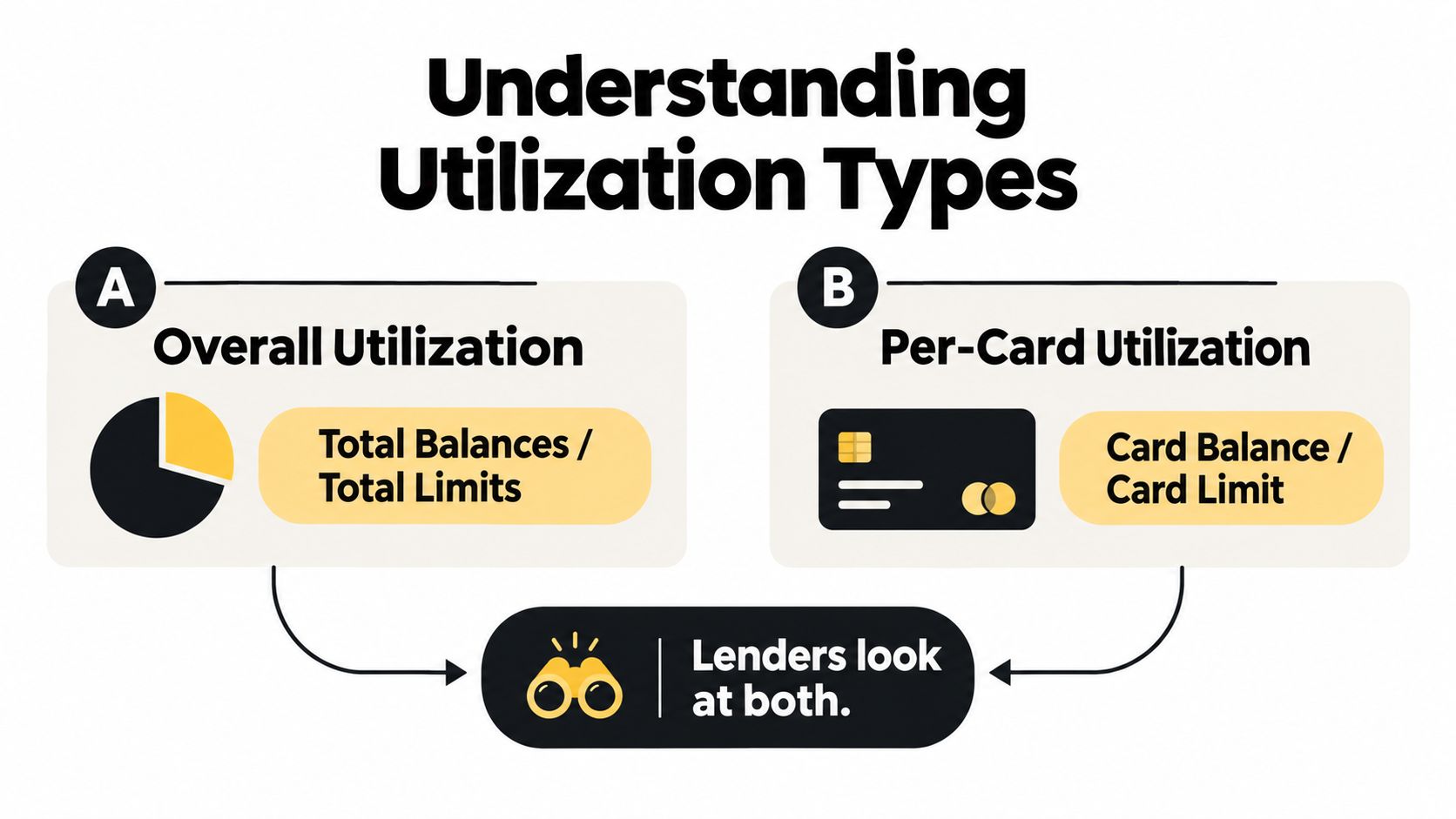
The overall utilization ratio combines eligible balances across revolving accounts and compares them with available limits. A per-card utilization ratio looks at one card at a time. Both can matter to credit scores, so paying the card with the highest percentage may be more useful than splitting a small payment equally. For a simple definition and formula, see the credit utilization calculation explainer; the buyer decisions start with how that calculation changes an actual application.
Suppose two credit cards have very different limits. Card A has a $1,900 balance against a $2,000 credit limit; card B owes $200 against a $10,000 limit. Overall credit utilization is about 17.5%, which looks moderate, but the smaller account is close to its ceiling. A prospective borrower should ask whether lowering that 95% individual utilization ratio is the first realistic use of available cash. This is a revolving utilization problem that an average across all open cards can mask.
Here is a compact way to read that example without confusing a combined ratio with a single-card problem:
| Reported line | Balance | Limit | Utilization | Buyer consequence |
|---|---|---|---|---|
| Small card | $1,900 | $2,000 | 95% | High utilization on one line may be a score drag |
| Large card | $200 | $10,000 | 2% | Already has low credit utilization |
| Combined | $2,100 | $12,000 | 17.5% | Overall utilization ratio hides the nearly maxed-out card |
That borrower could pay $1,500 toward the small card. The overall credit utilization ratio would then be 5%, and the once-crowded card would fall to 20%. This illustration does not predict a particular credit score improvement: credit scoring models and the remaining file determine whether the changed data improves the credit scores the lender orders. The cash needed for that payoff must also be weighed against the down payment.
When you have two credit cards, put their separate percentages on a worksheet instead of working from a single app number. Review credit limits as carefully as balances; a recently lowered line can change the denominator before any new purchase appears. Credit card limits might not be identical across bureau records, and total available credit can change after an issuer review. If a credit limit falls without a corresponding payment, the utilization ratio can rise even though the borrower spent nothing new. It is worth asking the issuer whether the lower limit was deliberate or a reporting mistake.
A credit builder card with a $300 credit limit has little room before even a modest purchase creates high utilization. If the card reports a $150 balance, the individual credit utilization ratio is 50%, regardless of how responsibly you intend to pay it next week. In a thin-file situation, the card can help build credit history over time, but it also makes the reported credit utilization rate unusually sensitive to purchases. Small, predictable charges are generally easier to manage than an emergency expense on that line.
Buyers with a line of credit should ask the lender which of their revolving accounts count toward the version of credit scoring being used. Revolving credit utilization generally includes reported revolving balances and limits, while installment loan balances are treated differently. The fact that a loan is part of the credit report does not mean its original amount should be added to the card-limit denominator. This distinction prevents false optimism about the utilization ratio when a borrower has a large car loan but small card limits.
Even if multiple card balances add up to a good credit utilization ratio, the lender may review how many revolving accounts have reported balances. A household with five low-balance cards may receive different credit scores than one with a single low-balance card, depending on the model and other file details. That comparison also explains why revolving utilization by account is worth reviewing rather than focusing exclusively on the combined figure. Do not close useful accounts just to chase one interpretation; credit scoring is a multifactor decision, not an arithmetic contest.
For a buyer deciding what to pay first, high utilization on a single small card is often the clearest warning sign to investigate. Compare the amount needed to reduce that percentage with the amount needed to lower the overall credit utilization ratio. A spreadsheet showing the current and planned balances can give your loan officer a better conversation than an unsupported claim that credit scores will rise by a specific number.
Why the scoring model changes the best practical target
Credit utilization affects the amounts-owed portion of many credit scoring models because the percentage of available revolving credit in use can indicate financial pressure. But the model does not grade a credit utilization ratio in isolation: the number of accounts with balances, delinquencies, new applications and depth of credit history also count. Two applicants with identical utilization ratios can have different credit scores, even when they apply on the same day.
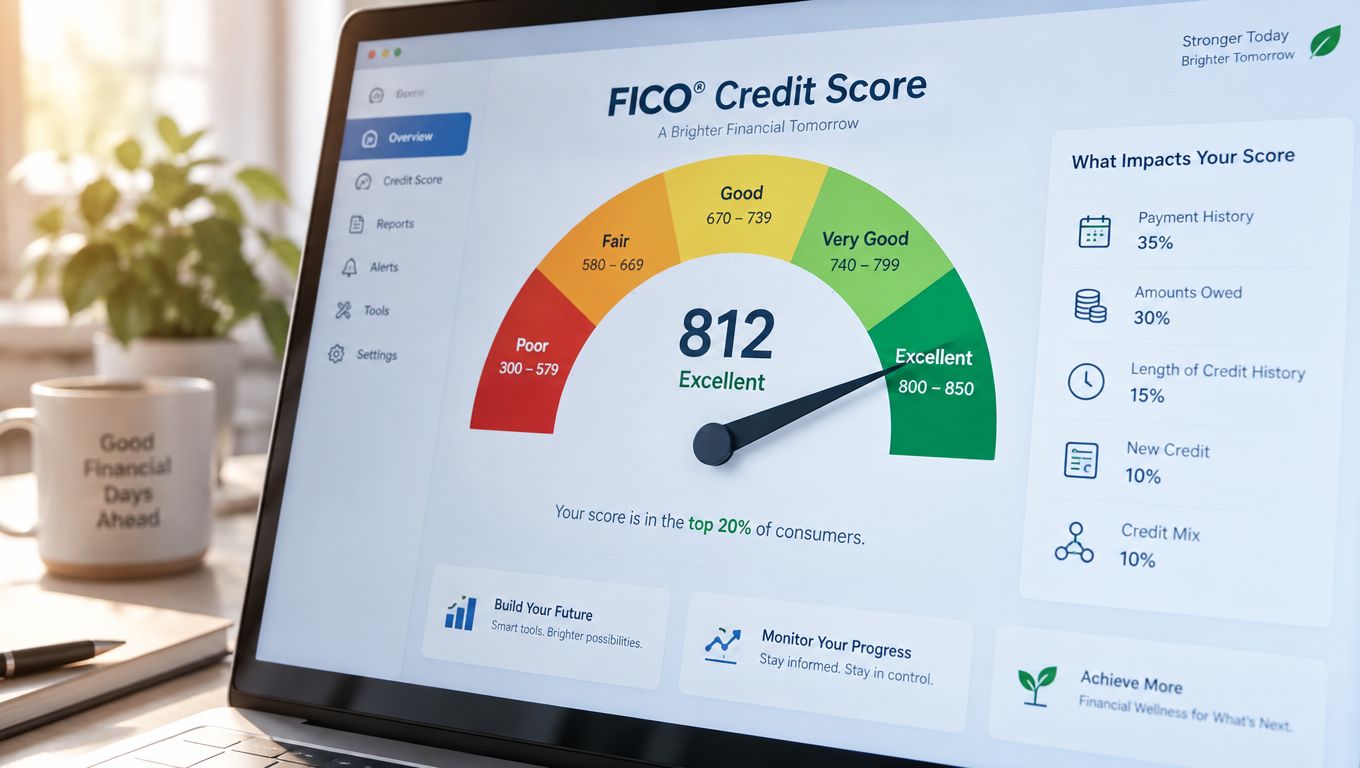
FICO and VantageScore are families of models rather than one universal credit score. Mortgage lenders, auto lenders and card issuers can request different versions, and those versions can produce many credit scores from the same file. A monitoring dashboard is therefore a useful trend indicator rather than proof of which credit score will control a mortgage approval. A good credit score on a consumer dashboard still needs to be confirmed against the model and bureau that the lender uses. This explains why credit score improvement visible on a phone may not match the lender’s next score pull.
One model may assign a different weight to a maxed-out card than another model, and credit scoring models can treat a borrower with almost no active revolving use differently from someone showing modest activity. A low credit utilization ratio is generally directionally helpful, but there is no public model-by-model table that promises a precise result for each one-point reduction. Do not make a payment on the assumption that a 9% utilization ratio guarantees the exact credit score needed for a rate discount.
A buyer considering an auto loan should ask the lender which version it expects to order, then check whether the same credit report still shows high utilization after the latest card payment. Credit scores can differ between bureaus because creditors do not always update all files simultaneously. A borrower can build credit with steady payments while still seeing short-term movement in credit scores driven by which account reported that week. Over time, the borrower can also build credit by keeping current accounts in good standing, without changing them simply to chase a temporary rate.
Small balances are not a substitute for payment discipline. A borrower with late payments may lower credit utilization sharply and still have a material credit score problem because the older delinquency remains. Treat the utilization ratio as the balance-management part of an overall plan, not a credit repair technique that erases an accurate missed-payment record.
Credit scoring models often operate on the most recently reported revolving amounts. Under many commonly used models, utilization has less long-term memory than payment history, although newer trended-data approaches can look beyond a single snapshot. That is why a previously high credit utilization rate can become less important after a fresh, lower balance appears; it is not a claim that every version forgets prior debt overnight. Each individual credit score still reflects the model and file used for that calculation.
One applicant might see credit scores improve after reducing five card balances, while another sees little change because only the smallest card updated. Those different results do not mean the math of the utilization ratio is wrong. They mean credit scoring draws on multiple fields, and any credit score improvement must be confirmed after the underlying accounts report. The breakdown of score factors helps put the balance change in context without guessing a guaranteed number of points.
When comparing lenders, do not interpret high credit limits as a promise of approval. Credit limits make the amount available for borrowing visible, but a low utilization percentage does not establish that a new monthly payment is affordable. Credit limits affect a credit utilization ratio, but a separate underwriting review considers payments, income and debt obligations. With several applications planned, credit checks can also show on the file; the type of credit check matters. A lender-initiated hard inquiry should be distinguished from the soft checks used by many personal monitoring tools.
A credit builder card is most useful when it produces consistent, accurate account reporting and charges terms the borrower understands. It should not be mistaken for a quick credit score reset: credit history and on-time payments take time to establish. If credit utilization on that small card is high, the cardholder can focus on reducing the current reported balance rather than opening a second account just for a larger combined limit.
For a borrower whose credit scores move unpredictably, keep a dated log of balance changes, limits and report dates. The log can show whether a score change coincided with a new statement or a new hard inquiry. That is better evidence than inferring the effect of a particular utilization ratio from a score update that also contained several unrelated changes.
Time the reported balance before a mortgage or car application
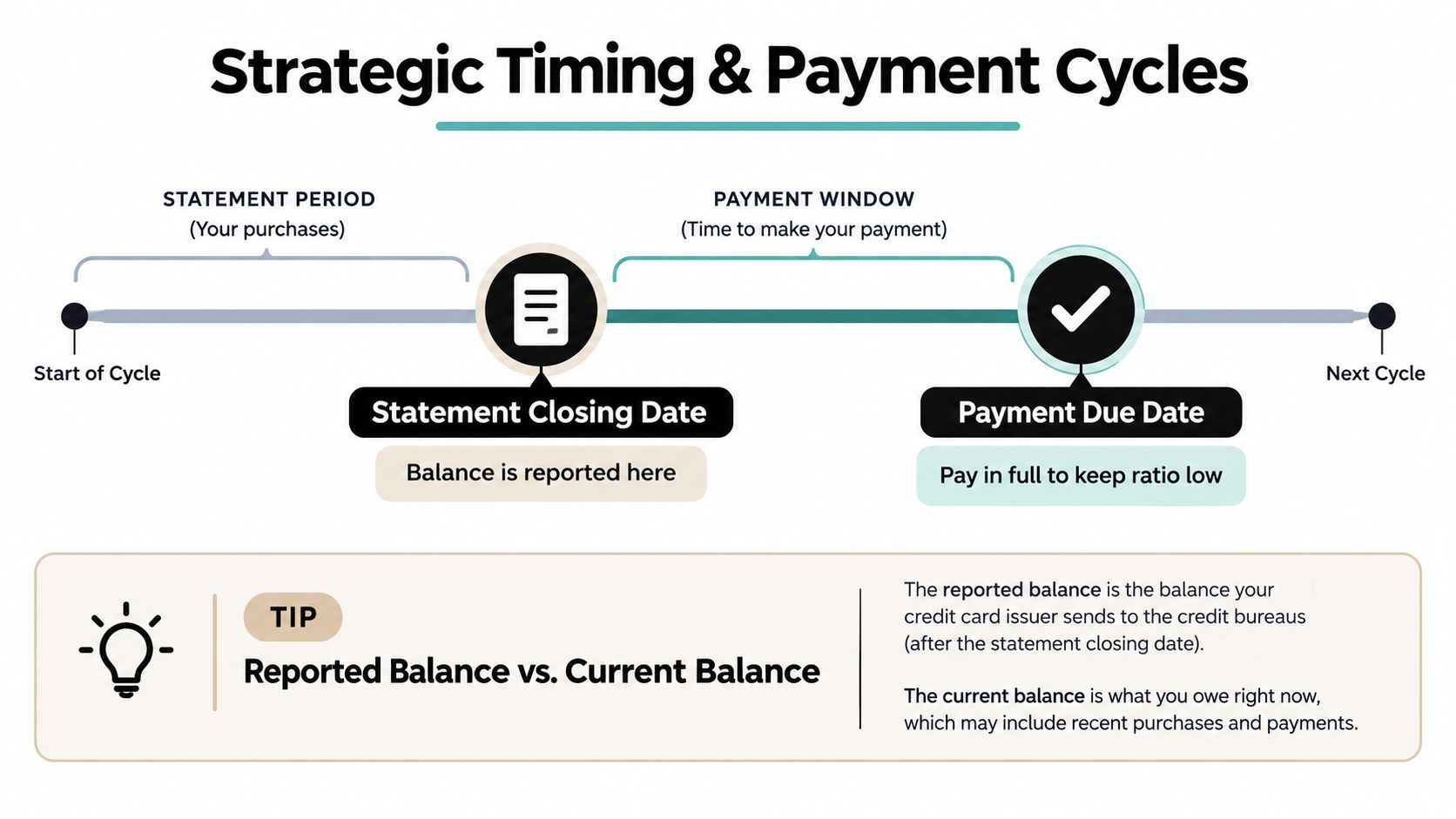
The date that often matters for credit utilization is the statement closing date or the issuer’s separate reporting date, not the date the payment is due. A cardholder can pay the credit card bill in full before its due date and still show a balance in the credit report if the statement closed earlier. Confirm each issuer’s reporting practice rather than assuming the dates are identical. A timely lower reported amount can change the utilization ratio a lender sees without changing the borrower’s long-term habits.
Start by listing the next statement end for each revolving card. If a mortgage preapproval is expected on the 18th but a card typically reports on the 21st, a payment made on the 15th may not reach the credit bureaus in time. Moving a credit utilization ratio from 48% to 8% on paper is not enough until the new balance is reported. Ask the loan officer whether there is time to wait for a normal update and whether any lender-controlled update process is appropriate.
A prospective homebuyer should first protect the monthly budget. Lowering credit utilization helps only if it does not cause a missed housing payment, overdraft or shortage of funds needed at closing. Your credit score may improve with a smaller card balance while the mortgage underwriter simultaneously questions a depleted bank account. Credit scores are important, but mortgage readiness also includes assets and payment capacity.
Suppose the buyer has $2,200 available after ordinary bills and expects closing expenses in five weeks. The highest-utilization card could be reduced with $800, while the remaining cash stays in reserves. That may be safer than using the full $2,200 to achieve a 1% utilization ratio. A mortgage preapproval credit-score discussion can help structure the questions for a loan officer before committing the money.
The best credit utilization ratio is different from an official minimum credit score for a loan program. FHA, VA and conventional underwriting do not share a single published credit utilization threshold that guarantees approval. A buyer with low credit utilization but recent late payments may face a harder review than someone with a slightly higher ratio and a long clean record. Treat the reported balance as one factor in the file rather than a replacement for the lender’s written eligibility guidance.
One household plans to apply for a car loan before the next mortgage credit check. Even if the new vehicle is affordable, the hard inquiry and installment payment may change credit scores and debt-to-income calculations at an inconvenient time. A buyer may be able to build credit over the long term with responsible installment payments, but the application order matters more than chasing an extra percentage point of credit utilization in the final month.
Some buyers monitor several websites that display different credit scores. Each number can help track a trend, but those credit scores are not necessarily the score used for the specific loan. Request the lender’s expected model, obtain your current credit report and confirm that the low credit utilization you planned actually appears there. Avoid acting on an outdated screenshot while the next reporting cycle is already underway.
For a buyer who pays cards weekly, the relevant issue is whether the reported credit utilization rate falls before underwriting. Extra payments inside a billing cycle are not bad, but the payment must clear and the issuer must transmit the update. Credit card payments made immediately before the statement ends also need enough processing time; payment cutoffs vary. Keep proof of the transaction in case a lender asks why the reported amount and the live balance differ.
For applicants with a credit builder card, a small credit limit can make the schedule look unpredictable: a $40 charge on a $200 line is already a 20% utilization ratio. When the mortgage credit pull is near, paying that charge before the reporting date can be more predictable than making a series of new purchases and hoping the credit utilization number remains low. The card’s history of timely payments is more valuable than trying to force a one-week score jump.
Source check: a credit-scoring overview of revolving balances discusses how reported amounts can affect scoring. Use your own card statements and the lender’s actual timeline to interpret general educational material; it cannot tell you which specific credit score your application will receive.
Use the right payoff order without draining closing funds
A useful payment plan begins with a date, a cash reserve and the accounts creating high utilization. Before paying extra, separate the money needed for the next credit card bill, housing costs, closing expenses and emergencies. The credit utilization ratio can improve with a targeted payment, but an underfunded closing account can undermine the very loan you are preparing to receive.
Consider three cards: one at 83% of its credit limit, another at 22% and the third at 4%. If you can spare only $350, a payment toward the near-maxed card may improve its individual utilization ratio; however, compare that with any interest costs and minimum payments due on the others. There is no universal sequence that will maximize all credit scores, so keep the payment order tied to the actual application and budget.
Building your credit over time calls for regular payments; timing a mortgage application calls for knowing which of those payments will be reported soon enough. Build a calendar using three columns: payment date, expected issuer reporting date and the lender’s anticipated credit pull. A reported reduction in credit utilization is only useful for this deadline if the third column falls after the bureau update. The calendar also reveals whether your credit utilization rate is likely to be remeasured between preapproval and final underwriting. Schedule credit card payments so the transactions clear before the issuer takes the balance snapshot, not merely before the loan appointment. Avoid new purchases that reverse the planned reduction.
Ask whether your lender needs a current statement, a transaction record or an actual updated bureau file to document the credit score improvement. A receipt from an online payment proves the payment was submitted, not that the new credit utilization ratio has appeared on all reports. If a lender offers an accelerated bureau update, confirm its rules, cost, availability and eligibility directly; it is not a consumer service that can promise results.
When the buyer’s combined credit limit is small, requesting a credit limit increase might lower the ratio mathematically, but it may involve a hard inquiry and discretionary underwriting. If an issuer will use a soft review, confirm that before asking. Credit checks and credit limit changes should be coordinated with a pending mortgage application, not rushed simply because a calculator shows an attractive utilization ratio.
Before asking an issuer to change credit limits, examine whether a review can be made without a hard inquiry and whether the result is likely before the lender pulls the file. Some applicants are tempted to close a rarely used card once its balance reaches zero. Closing a credit card account may eliminate a credit limit from the pool of total available credit and push the remaining credit utilization ratio upward. Keep legitimate fees, fraud concerns and the loan officer’s advice in the decision; maintaining an account is not always worth an annual charge, but closing it during underwriting can create an avoidable variable.
Consider a borrower who has already reached a good credit score before preapproval. The remaining improvement may not alter eligibility or pricing enough to justify a risky account change. Borrowers with high utilization or thin files should compare an additional payoff with maintaining a stronger financial cushion; both can be rational decisions depending on the deadline. A good credit utilization ratio is the one that supports the whole application, not a target that forces unnecessary debt or fees.
In this phase, a credit builder card is not usually the first tool for lowering high utilization on existing cards. It may help build credit over a longer horizon, but opening it can add a new account and divide attention while a lender checks credit scores. Consider whether there is a genuine shortage of positive account history before applying for another product.
Before signing anything new, compare a general explanation of credit-score qualification questions with the requirements supplied by your own mortgage lender. Published averages are not approval decisions. For consumers reviewing their options locally, an example of a regional utilization planning page illustrates how the same basic balance issue can arise in a particular market without setting a separate local scoring formula.
Thin credit files: when a new card is useful and when it is not
A buyer with no open revolving accounts has a different goal from a buyer whose cards are maxed out. The reason to build credit with a modest secured line is to add a reliable track record, not to borrow an amount that will become another problem. To build credit, the borrower needs accurate reporting and a history of on-time payments. A credit builder card can be one option, but the terms and reporting practices deserve more attention than promotional claims about credit score improvement. Make sure the card actually reports to the credit bureaus relevant to your file.
Before choosing a credit builder card, ask whether a deposit is required, whether there are any fees, how the credit limit is assigned and what happens after a missed payment. A $500 credit limit leaves more room for modest use than a $150 line, but the borrower should not borrow extra to fill that room. Building your credit is a habit of paying on time and watching reported balances, not carrying interest for its own sake.
Can a credit builder card build credit if it reports every month? It may contribute positive account information, subject to the issuer’s policies and whether the borrower pays as agreed. The credit utilization ratio on such a card can change sharply with small purchases, so a simple spending cap is more useful than constantly checking credit scores throughout the day. Do not expect the first statement alone to produce a mature credit history. Credit scoring depends on enough positive information over time, and one low reported balance cannot replace that record.
When evaluating two credit cards for a thin file, compare their fee structures and who reports the account rather than assuming the larger limit automatically wins. Credit card limits influence the reported credit utilization ratio; they do not determine approval odds by themselves. A credit builder card with recurring charges might be manageable, while a card that adds unpredictable monthly fees could strain a fixed budget. Read the agreement and ask for clarification of any fees before applying.
How does a credit builder card build credit when the account reports only to some bureaus? It can potentially contribute data where it reports, but those differences may produce many credit scores across lender models and bureau files. Check the credit report at each bureau instead of assuming a marketing phrase means universal reporting. The credit bureaus do not necessarily receive identical updates on the same date.
Some products described as a credit builder card are prepaid arrangements or products that do not operate like ordinary revolving credit accounts. Find out what account type and balance information are actually furnished. Without that detail, a high credit utilization number in an app may not reflect how the account is scored, and the buyer may mistake a display for a validated credit reporting record.
Rent reporting can be relevant to someone who has paid housing expenses reliably but has little other credit history. Still, rent reporting is not equivalent to revolving credit utilization, and a program that furnishes rental payments may not be captured by every credit scoring model. Some borrowers can build credit through the longer history of rent and installment accounts; others will need an appropriately managed revolving account as well. Verify what the service reports before paying for it.
A secured card may be easier for some applicants to obtain, but the security deposit is money unavailable for closing costs while the account is open. If a family plans to build credit over a year rather than a month, that upfront commitment might be manageable; compare it with the near-term reserve need. If a buyer is only weeks from a mortgage application, a credit builder card may be a distraction rather than the best next move. A small credit limit can also make high utilization appear quickly; plan spending around the statement date while preserving funds for the home purchase.
It is possible to maintain low credit utilization and still have very limited credit scores because the underlying accounts are too new or sparse. A credit builder card contributes information only after it is opened and reported; it cannot retroactively lengthen credit history. Credit decisions made today can support a future loan, but they cannot create a past pattern of payments. For a borrower with a longer preparation horizon, responsible use of a secured card may be more helpful than a last-minute application.
Before choosing any credit education product, look for plain-language terms, a way to check what reaches each bureau and a budget that works without borrowing more. A credit builder card is one component of establishing credit history; credit mix and the age of accounts may also matter to certain credit scoring models. None of these choices eliminates the need to make each required payment on time.
When the ratio is a reporting error, not a debt problem
Before spending cash to lower credit utilization, compare the account statements with the figures on your credit report. An incorrectly high balance or an understated credit limit can make the utilization ratio look worse than it is. Those entries are a reporting-accuracy issue, not evidence that the borrower needs another credit card. The general discussion of credit utilization and scoring is less useful than the original account record when a specific field is wrong.
Review Equifax, Experian and TransUnion separately. The credit bureaus can display different update dates; a payment may appear on Experian and TransUnion before the third file changes. Also compare the reported credit limits on each file, because an omitted increase can distort the calculation without any error in the balance. In addition, Equifax, Experian and TransUnion may show different balances if an issuer furnishes at different times. Request all 3 credit bureaus’ reports and write down which file contains the suspect number.
For all 3 credit bureaus, compare the reported credit limit, status and date with the latest statements; the same account should not be assumed correct everywhere. An accurate $900 balance against a $3,000 limit means 30% credit utilization, while a wrongly reported $1,000 credit limit would make that same balance appear to be 90%. The corrected utilization ratio depends on the accurate limit as well as the amount owed.
When the account was paid down but a prior balance still appears, first distinguish a normal reporting lag from inaccurate information. The credit bureaus may not have received an updated statement yet. A credit report review can establish the dates and supporting documents before any dispute is filed. If the entry remains wrong, the consumer can dispute it with the appropriate bureau and the company that supplied the data.
Consumers may review an explanation of VantageScore score ranges, but scores and credit report fields are different questions. Credit utilization rate errors deserve attention even when the consumer score shown in an app looks stable. A file can show an erroneous credit limit while a consumer app displays a seemingly normal credit score. A good credit score does not prove each underlying field is correct, so keep the issuer statement beside the bureau record during review. Correcting the underlying record should come before trying to estimate how many points any single utilization ratio error caused.
People seeking credit repair services should ask whether the proposed work involves a factual dispute or simply financial coaching. Credit repair services should distinguish inaccurate reporting from balances that the borrower legitimately owes; those two problems require entirely different actions. A credit report repair service can help organize an inaccurate-limit dispute, but the consumer also has the right to contact the bureaus and furnisher directly at no charge. A credit restoration service should not promise to erase a correctly reported card balance merely because it creates high utilization. The evidence, not the sales pitch, determines the dispute.
If you ask, “Can someone repair credit near me by correcting a limit that never belonged to my card?”, request a written explanation of the discrepancy and the records needed to substantiate it. A credit report review should identify the furnisher, date and exact field in question. That is different from credit restoration based on budgeting and future payments, which cannot change truthful historical balances.
Some consumers ask, “Can a local provider repair credit near me before a lender requests my file?” A credit report repair service cannot guarantee a bureau will finish its investigation before the underwriting deadline. A legitimate credit restoration service may instead help the borrower assemble records and communicate clearly with the lender while a dispute proceeds. Do not withhold a material pending dispute from a lender who requests clarification.
Errors are not the only reasons an application looks weak. Late payments, too many new accounts or a shallow credit mix may matter even when credit utilization is already low. A review of mortgage readiness and credit-file preparation can help separate reporting errors from normal financial decisions. The aim is to build credit responsibly, not to submit disputes over accurate information.
Be cautious if a salesperson says every high credit card balance should be disputed. A higher balance is not false merely because it reduces credit scores. If it is accurate, paying it down changes future utilization, while a false dispute could consume valuable time. When credit scoring depends on a number you can prove is wrong, pursue that specific correction and keep copies of your evidence.
Final decisions buyers should make before applying
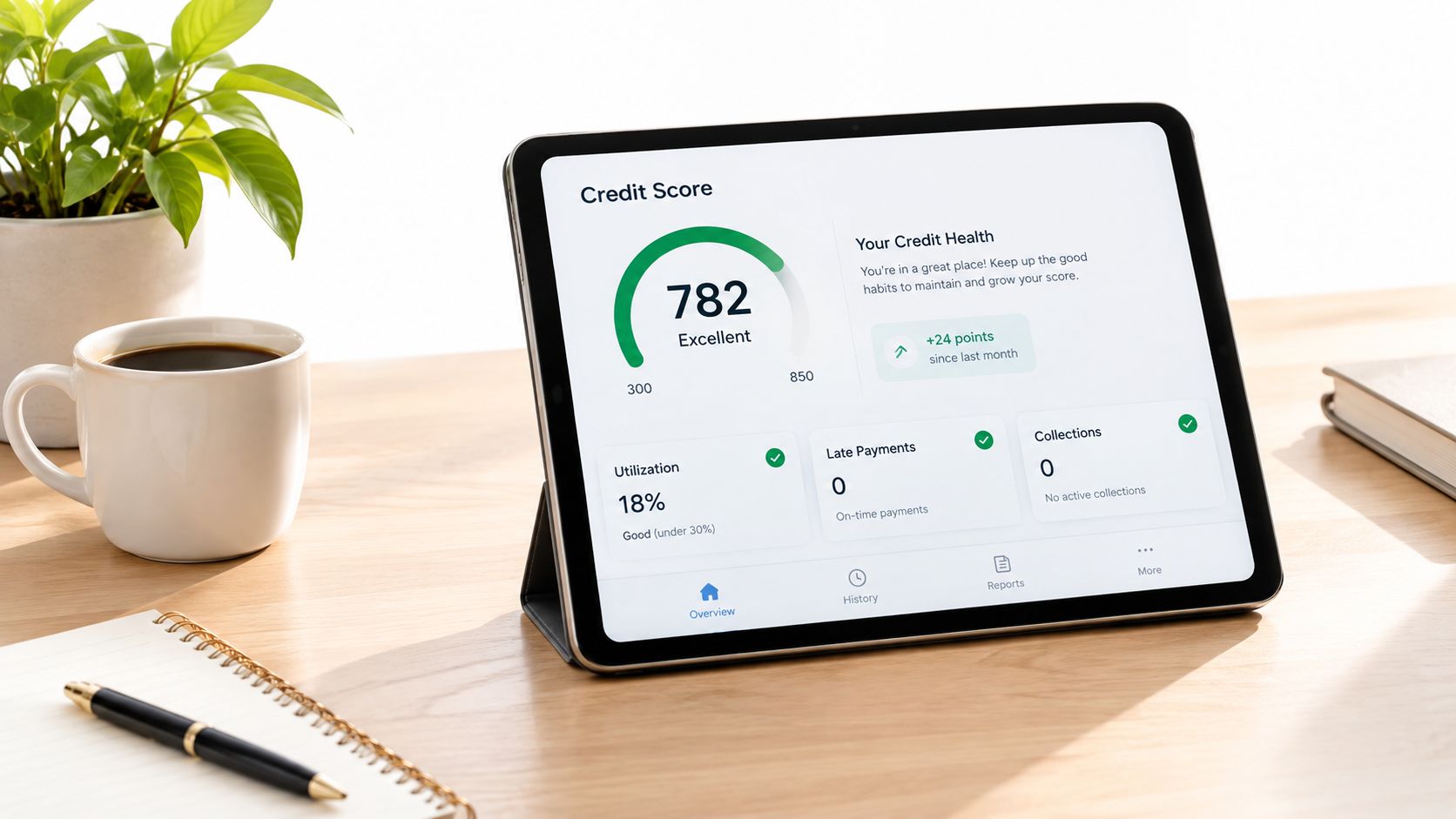
A buyer’s plan should have three checkpoints: which report data are current, how the utilization ratio will change after the next statement, and what the lender needs on the application date. Credit utilization should be low enough to avoid unnecessary revolving pressure, but not purchased with money required for closing. A credit score improvement that is not yet reported may be real progress in the household budget and still be invisible to underwriting.
What is credit utilization measuring when an issuer increases your limit but has not yet reported the new line? The old reported credit limit may still control the displayed percentage until an update arrives. What is credit utilization on a lender’s report if my card balance changed yesterday? It is the percentage derived from the balance and limit actually furnished in the data used for that score calculation, not the live number in your banking app. If a loan decision is imminent, the reported figure matters more than your estimated utilization ratio; keep the latest statement and payment record ready.
What is a good credit utilization ratio after a card issuer lowers the line unexpectedly? First confirm the revised limit is correct, then calculate how much of that line the currently reported balance uses. What is a good credit utilization target when one account has a very small limit? A small limit makes a moderate purchase look large as a percentage, so the card’s own utilization ratio deserves attention alongside the overall number. A good credit utilization ratio for an application is generally low, but no lender should be assumed to offer a better rate at one exact percentage absent its own criteria.
Buyers sometimes compare credit scores taken from different places and dates as if they were consecutive measurements on the same scale. Many credit scores are generated from different models and bureau files; match the model, report date and bureau before attributing a change to credit utilization. For a broader explanation, Superior Credit Repair provides general guidance on reviewing a credit file, but the lender must explain its own underwriting criteria.
Could closing a credit card improve credit scores by reducing the number of open accounts? Not necessarily; closing a credit card account can reduce available revolving credit and cause the utilization ratio to rise. A better question is whether the account has fees, fraud issues or a practical reason to close unrelated to chasing credit score improvement. Do not make an irreversible change simply because an online simulator forecasts a result.
Different types of credit checks also deserve attention. A consumer monitoring their own score generally triggers soft activity, whereas a new application can create a hard inquiry. Before asking for higher credit limits or opening a credit builder card, confirm which types of credit checks the issuer intends to use. New inquiries and accounts may affect credit scoring even if the resulting overall credit utilization looks lower.
Rent reporting, installment payments and responsible credit card use can help build credit over time, but do not treat them as interchangeable. The two types of credit most buyers will encounter—revolving and installment—create different repayment patterns, so the lender may evaluate them differently. Revolving credit accounts influence a credit utilization ratio differently from installment loans. Two types of credit can broaden the file’s credit mix, yet a new account right before mortgage underwriting can add a short-term variable. Credit education should help the buyer choose an appropriate sequence rather than accumulate products.
When a file lacks positive revolving activity, a credit builder card can be a practical longer-term option. Before opening one, check all the terms, the intended credit limit and whether it reports to the credit bureaus; the ability to build credit should be worth more than an advertised score increase. The best credit utilization ratio for the new line will be easier to maintain if the account supports only small planned purchases.
When comparing a consumer credit score with a mortgage lender’s numbers, recognize that there is no single universal score shared by every organization. For a neutral discussion of how scores are built, see the general explanation of credit scoring inputs; the details of the actual loan application should come from the lender. Credit scores are information, not a stand-alone mortgage commitment.
If this guide helped you plan your balances before an application, we would appreciate your honest feedback. You are welcome to share your experience with Superior Credit Repair on our Google Business Profile.
Ultimately, low credit utilization is a tool for reducing the amount of revolving debt the file shows at an important moment. Combine that tool with timely payments, accurate statements and sufficient reserves. The strongest next step is not a secret score threshold; it is a documented, affordable plan for the exact date your lender expects to review the application.
| Loan Type | General Utilization Guideline | Impact on Interest Rates |
|---|---|---|
| FHA | Below 30% is a practical baseline, with below 10% stronger | Lower utilization may support a cleaner overall profile, but pricing depends on the full application |
| VA | Below 30% is a practical baseline, with below 10% stronger | Utilization can contribute to lender confidence, while eligibility and underwriting factors remain important |
| Conventional | Below 30% is a practical baseline, with below 10% often preferred for stronger scoring | Lower reported balances may help borrowers pursue better pricing, but no ratio guarantees a rate |
A payment plan for mortgage applicants
Start by listing every revolving account, its current balance, its credit limit, and the date the issuer typically reports. Don't rely only on a banking app's current balance. The lender and scoring model may see a different reported figure.
Next, prioritize the card with the highest per-card utilization, not merely the account with the largest dollar balance. Then calculate the combined ratio to understand the larger picture. A paydown that reduces one nearly full card may improve the file's presentation even if the overall reduction is modest.
Finally, confirm timing with the card issuer and avoid new charges before the lender pulls credit. If you're unsure how to organize the process, review guidance about credit fix before home buying and discuss the plan with your mortgage professional. Credit repair should never involve disputing accurate information just to obtain a temporary advantage.
Strategic Timing and Payment Cycles for Lower Ratios
Many borrowers confuse the payment due date with the statement closing date. The due date determines when payment must arrive under the card agreement. The statement closing date marks the end of a billing period, and the balance around that point may be the amount reported to the credit bureaus.
That distinction explains why someone can pay a card in full every month and still see high utilization. If substantial spending appears on the statement before the payment is due, the credit report may show that larger balance. A lender pulling the report afterward may evaluate the reported amount rather than the borrower's intention to pay.
Build timing into the plan
Review several statements for each card and identify the normal closing date. Then consider making an early payment before the statement closes, followed by any required payment by the due date. Some consumers divide payments during the month, which can reduce the balance present at reporting time. The strategy must fit your cash flow and shouldn't cause missed payments elsewhere.
Requesting a credit limit increase can also lower utilization if the issuer approves it and the balance doesn't rise. However, an increase isn't guaranteed, and a request may involve a credit review. Opening a new card solely to expand available credit can create new-account considerations and isn't automatically appropriate before a mortgage application.
Reported balance versus current balance: Your card dashboard can show today's amount, while the credit report may show the balance sent during an earlier reporting cycle.
Timing also interacts with other credit concerns. A low utilization ratio won't make an inaccurate collection disappear, and a paid card balance won't correct an incorrectly reported late payment. Before applying, a borrower may need both a balance-management schedule and a review of collections, charge-offs, repossessions, or medical collection entries.
A localized resource such as a Bellevue credit utilization strategy can help explain how reporting schedules fit into a larger mortgage-readiness plan. The important point is to plan before the lender's pull, not to depend on a last-minute payment that hasn't reached the credit report.
Addressing Other Credit Factors Alongside Utilization
Could a low utilization ratio still leave a mortgage application with unanswered questions? Yes. Card balances are only one part of a credit file. Late payments, collections, charge-offs, inaccurate personal information, and accounts that cannot be verified may affect review even after revolving balances fall.
As noted earlier, utilization carries significant weight in major scoring models. It should therefore be handled alongside payment history and reporting accuracy, not treated as a stand-alone approval strategy. A lower ratio can improve one part of the file without correcting a disputed account or an inaccurate late-payment record.
Pair balance control with file accuracy
A compliance-first review begins with documents. Obtain the credit reports, compare account details with statements and other records, and mark information that is inaccurate, outdated, misleading, or unverifiable. A dispute should identify the specific problem, include supporting evidence, and use the appropriate reporting or legal channel. Accurate negative information is not removed only because a borrower is preparing for a mortgage.
Examples include a collection assigned to another person, a late payment attached to the wrong account, incorrect dates on a charge-off, or a reported balance that conflicts with creditor records. Resolving a reporting issue can take time, so mortgage planning should allow for review and verification rather than rely on a last-minute correction.
Borrowers can check LendingXpress credit requirements to see why lender standards may differ. Requirements can change, and the lender makes the final decision. A credit score or utilization target alone cannot guarantee approval.
Superior Credit Repair describes its services as a structured review, dispute, verification, and rebuilding process. Its assistance may help organize credit report errors, collections dispute help, late payment dispute help, and charge-off dispute help, but outcomes vary with the file, evidence, creditor response, and continuing credit behavior. First-time buyers can review first-time homebuyer credit improvement before selecting an approach.
Next Steps – Building a Lender-Ready Credit Profile
Mortgage readiness starts with a complete picture, not a single score. Gather your reports, list every revolving limit and balance, check each card's reporting pattern, and set a realistic target. For many applicants, below 30% is a reasonable baseline, while below 10% can present a stronger utilization profile.
Use the following sequence:
- Review the file: Look for inaccurate, outdated, unverifiable, or misleading accounts and preserve supporting documents.
- Calculate both ratios: Check overall utilization and each card's individual utilization.
- Schedule payments: Aim for balances to be reduced before the statement closing date while still paying by the contractual due date.
- Avoid new risk: Don't add unnecessary applications, large purchases, or new revolving debt before a lender reviews the file.
- Address negative items: Dispute genuine errors through documentation-based processes, and manage accurate accounts responsibly.
- Coordinate with the lender: Ask which credit pull and underwriting milestones matter so your timing plan matches the application.
A lender-ready profile isn't created overnight. It develops through stable payments, controlled revolving balances, accurate reporting, and patience. FHA, VA, USDA, conventional, rental, auto, and personal-financing decisions can each involve different standards, so no company can promise approval, deletion, an immediate score increase, or a particular interest rate.
Consumers who want a structured review can learn more about mortgage readiness with Superior Credit Repair. Superior Credit Repair Online provides educational credit guidance for people preparing for homeownership, refinancing, or rebuilding after hardship. A consultation can help clarify whether the priority is utilization planning, credit report accuracy, dispute documentation, or longer-term rebuilding.
Was this guide helpful?
If this information helped you better understand your credit report or your next steps, we would appreciate your honest feedback. You are welcome to share your experience with Superior Credit Repair on our Google Business Profile. https://share.google/ePRpFvtCXwCjiJwOK
Superior Credit Repair can review your credit report, help identify inaccurate or questionable items, and explain a step-by-step plan for improving your utilization and broader credit profile. Visit Superior Credit Repair to request a free credit analysis or consultation and better understand your options before a mortgage application.