


Understand the numerator and denominator
Credit utilization is the outstanding reported balance divided by the available credit limit, expressed as a percentage. If a card reports $900 against a $3,000 limit, the credit utilization ratio is 30%. Across several cards, the overall credit utilization rate uses the combined reported balances over the combined credit limits. This is one calculation; it should not be confused with income-to-debt comparisons used in underwriting.
A lender may supply your current balance in an app, but the credit report can show an earlier statement balance. That distinction matters because a person may already have paid money that has not appeared in the bureau file. A credit utilization calculation is useful only when the credit limits and dates being compared belong to the same reporting cycle.
The number also looks different card by card. Two accounts with a combined 20% credit utilization can include one nearly maxed-out revolving account, which may be more concerning than two evenly used cards. Record the overall figure and the individual ratios before choosing a payoff order.
What is a credit utilization rate, and how is it calculated?
Credit utilization rate and credit utilization ratio describe the same measure, but the overall figure can hide a problem on one card. Total available credit can look ample even when nearly all reported debt sits on one revolving account. The credit utilization rate on that account may be high even when combined credit limits make the overall figure look modest. Record the credit utilization ratio for each card alongside total available credit before deciding which balance to pay first.
Credit scoring models read that percentage in two ways. The overall credit utilization ratio covers every revolving account together, while credit card utilization on each account shows whether any single card is close to its limit. A card at 95% can weigh on a credit score even when the overall number looks modest, which is why the credit card utilization ratio of each card deserves its own line in your notes.
With a charge card that has no preset spending limit, what is a credit utilization rate meant to measure? Some credit scoring models may rely on a reported high balance or exclude the account when no usable limit is supplied. Because data can vary across the 3 credit bureaus, check each credit report before assuming that account is part of your credit utilization calculation.
The accounts that count
Revolving credit includes most general-purpose cards and certain revolving lines of credit. A conventional installment loan with a fixed repayment schedule is assessed differently, so the same utilization ratio does not simply apply to a car loan or mortgage balance. Review the type of credit listed beside each account and add up credit limits only on revolving credit accounts.
A secured credit card usually functions as a revolving account for scoring when its issuer reports it. The deposit is collateral, not an exemption from credit card utilization. A consumer using a secured credit card to establish credit should still watch the reported balance and pay on schedule.
Credit scores can respond to both individual revolving accounts and their combined use. When a card's reported credit limit is wrong, the credit utilization rate may be distorted even when the balance is accurate. That makes the limit itself worth checking as part of a credit report review.
Home equity lines and business cards
What is a credit utilization rate on a home equity line of credit? A HELOC is revolving debt, but many scoring models score it separately from credit cards, so a large HELOC balance usually weighs less on the revolving ratio than the same amount owed on cards. It still counts in full when a lender works out your debt-to-income ratio, and a missed payment on it does as much damage as one on a card.
A small-business card raises the same issue: what is a credit utilization rate supposed to include when one of your cards is in a company’s name? Most business card issuers report to your personal credit report only if the account goes seriously delinquent, so those balances usually stay out of your personal ratio, but a few issuers report every month. The card agreement or a call to the issuer will tell you which kind you have.
What a lower ratio tells a lender
There is no universal cutoff at which credit utilization suddenly turns good or bad. Credit scores respond along a sliding scale, and different credit scores draw their lines in different places.
A borrower with stable payments and a high utilization rate may see a different risk profile from a borrower whose credit report shows low balances and many recent missed payments. Credit scoring models weigh several factors, and no single percentage creates a guaranteed outcome. FICO Score 8 and newer model versions can produce different credit scores from the same underlying history.
People often ask what is a perfect credit score. On the common FICO and VantageScore scales the highest credit score is 850, but a perfect credit score is not needed for the best loan pricing, since lenders usually reserve their top tier for credit scores well below it. The more useful question is whether current revolving balances are sustainable and accurately reported. A lower utilization ratio reduces one source of pressure without replacing a budget, an emergency reserve or a consistent payment record.
What is a good credit utilization ratio?
What is a good credit utilization ratio for most people? There is no official cutoff, but lenders and score developers commonly point to staying under 30%, and people with the highest credit scores tend to keep revolving credit utilization in the single digits. A good credit utilization ratio is therefore a range rather than a single number: lower generally helps, as long as at least one of your revolving accounts shows some activity.
Before answering the question “What is a good credit utilization level for me?”, check which balance the issuer actually reports. Someone who charges $2,500 a month on a $5,000 credit limit and pays in full may still show 50% if the statement closes before the payment posts. Low credit utilization on the report comes from managing the reporting date, not merely from spending less.
Good credit utilization also differs between one card and the total. Keeping every card under roughly 30% avoids a high utilization flag on a single account, while the overall percentage drives most of the effect. Because most scores in use today have no memory of past utilization, a high month stops counting as soon as a lower balance reports, so good credit utilization can be restored within a billing cycle.
How credit utilization moves credit scores
Credit utilization is one of the few inputs that can move credit scores in either direction within a month. Because credit scores are calculated from whatever the report shows on the day they are pulled, a card that reports at 80% one month and 5% the next can produce two very different credit scores a few weeks apart, with no change in payment history.
Credit scores pulled for a loan should be timed against the card issuer’s reporting cycle. Before applying, ask which type of credit score the lender uses, then reduce reported balances on revolving accounts ahead of their statement dates so updated figures can reach the bureau file. A credit score drop after a large purchase may be temporary when a higher reported balance is the cause, but no fixed point change can be predicted. If you still see a credit score lower than expected after the next report, compare other entries rather than assuming utilization explains everything.
It also means credit scores from different days are not comparable. A lender’s pull, a free app’s weekly update and a card issuer’s monthly credit score may each catch a different snapshot of the same accounts, so compare credit scores only when you know the date and the bureau behind each one.
Zero is not always best. Some credit scoring models give slightly lower credit scores when every revolving account reports a zero balance, because they see no current use of revolving credit. Low credit utilization with one small reported balance, paid in full afterward, avoids that without costing interest.
Trended data and newer credit scoring models
FICO Score 8 and older versions look only at the balances on the current report. Newer credit scoring models can also read trended data, roughly two years of balance and payment history, to see whether balances are rising or falling and whether you pay in full or carry a balance. FICO 10 T and VantageScore 4.0 both use trended data.
Under those newer credit scoring models, one low statement matters less than the direction of your balances over many months. FICO 10 comes in two versions, a base score and FICO 10 T with the trended data added. Federal housing agencies have approved VantageScore 4.0 and FICO 10 T for mortgage lending, and FHA will accept them for FHA cases opened from January 1, 2027, so steady paydown may matter more to future mortgage credit scores than a single well-timed payment.
Timing payments without paying interest unnecessarily
A card issuer often reports a balance from a billing statement, so paying before the statement closes can affect the number other parties see in a later credit report. Paying the statement balance by its due date generally avoids interest on ordinary purchases when the account has an applicable grace period; the exact terms are in the card agreement.
Splitting credit card payments into two smaller payments each month, one mid-cycle and one before the statement closes, keeps the reported balance low without changing what you spend. Credit card payments made after the statement date still count toward the due date, but the higher balance has already reported to the credit bureaus by then.
If several cards report high utilization, prioritize the expensive debt while keeping minimum payments current everywhere else. Sending an additional payment to the account with the highest ratio can improve that particular revolving account without requiring a new application. Requests for higher credit limits work too, but only if spending stays the same, and some issuers run a credit check first.
Late credit card payments hurt far more than high utilization. A payment reported 30 days late can stay on the file for seven years, while a high balance stops affecting most credit scores once a lower one reports. If cash is tight, cover every minimum first and use whatever is left to bring down the card with the highest ratio.
How many credit cards should I have?
How many credit cards should I have? There is no ideal number for credit scores. Two credit cards used lightly can produce an excellent credit utilization rate, while a dozen add little if the balances are high. What matters is total available credit and whether you can track every due date.
Each new account adds to your credit limits, which lowers your credit utilization rate, but getting a new credit card also adds a hard inquiry and lowers the average age of your accounts. Someone with one card and a $500 limit often benefits from a second card; someone with five rarely needs a sixth. The practical answer to how many credit cards you need is the number you can pay on time every month.
Should you close credit cards you no longer use? An unused card with no annual fee usually does more good open, because its limit keeps your ratio down; a small recurring charge on autopay keeps the issuer from closing it for inactivity. Closing a credit card does not erase its history right away, since a closed account in good standing can stay on the credit report for up to ten years. If you do close credit cards, pay down the balances on the others first. Before closing a credit card that charges an annual fee, ask the issuer whether it can switch you to a no-fee version of the same account so the limit and the history stay in place.
Balance transfers, consolidation and borrowing costs
Interest is the hidden cost of high utilization: at a 24% APR, a $4,000 balance costs about $80 a month before any principal is paid. That cost is why many people look at moving debt between credit cards.
What is a balance transfer? It moves debt from one card to another, usually to use an introductory rate. Here is how balance transfers work in practice: the new issuer pays off the old card, adds that amount plus a transfer fee, commonly 3% to 5%, to the new account and charges the promotional rate until the intro period ends.
For your credit utilization rate, a balance transfer shifts the balance rather than shrinking it. Transfer offers often come with modest credit limits, so the new card may show very high utilization even while the old card drops to zero, and opening it adds a hard inquiry. What are balance transfer fees, and when can they outweigh interest savings? Compare the fee with the credit card interest you would pay over the intro period; on a balance you can clear within 12 to 18 months, the saving in card interest usually beats the fee.
Card agreements spell out how balance transfers work for that issuer, including whether new purchases get the promotional rate and how payments are applied. Many issuers apply payments above the minimum to the highest-rate balance first, but new purchases can still pile up interest, so it is usually safest not to spend on a transfer card at all.
What are balance transfers likely to cost once the promotion ends? Whatever is left moves to the card’s regular rate, often above 20%, so divide the transferred balance by the number of promotional months and pay at least that much each month.
What is debt consolidation, and does it lower credit utilization?
What is debt consolidation? It combines several balances into one new debt, usually a personal loan, a balance transfer card or a home equity loan. Consolidation with an installment loan moves the balances off revolving accounts, which can lower credit utilization quickly and lift credit scores, because installment balances are not part of the revolving calculation.
That drop is real but fragile. A debt consolidation loan followed by new card spending leaves you with both the loan and fresh balances. Before choosing consolidation, compare the total interest, the origination fee and the payoff date with paying the cards down directly; bad credit loans used for consolidation often carry origination fees of several percent, which can wipe out the rate saving. If the question is simply how to pay off several cards without new debt, the avalanche method, which targets the highest rate first, saves the most interest, while the snowball method, which clears the smallest balance first, can be easier to stick with.
When the balances on your card statements do not match the accounts in a credit report, the statements are the evidence, and no utilization target matters until the reported numbers are right. A credit report review built around those statements can line up each card’s reported balance and limit against what the issuer actually shows.
Using a home equity loan for consolidation turns unsecured card debt into debt secured by the house. The rate is often lower, but missed payments can put the home at risk, and the freed-up cards are still there to be used again. A home equity loan is the riskiest form of consolidation even when it looks cheapest, so nonprofit credit advice on the payoff plan is worth having first.
A nonprofit debt management plan is a fourth route for credit card debt. The agency negotiates lower rates with your issuers, you make one monthly payment to the agency, and the enrolled cards are usually closed; closing them can push utilization up for a while, but the plan typically clears credit card debt in three to five years without a new loan.
If your file is too thin or damaged for a good rate, getting a personal loan with a cosigner can lower the cost of consolidation, but the loan and any missed payment appear on the cosigner’s credit report and credit history as well. A personal loan with a cosigner makes sense only if either person could cover the payment alone. The average personal loan rate varies widely by credit score, so prequalify with soft inquiries before applying, and treat high-fee bad credit loans as a last resort for paying down cards rather than the first move.
Examples that change the utilization calculation
A card limit increases while its reported balance stays constant
Suppose a card reports a $600 balance on a $2,000 credit limit, a 30% credit utilization rate. If the issuer raises the credit limit to $3,000 and the balance stays at $600, the same card now reports 20%, and overall credit utilization across your cards falls too. Ask whether the issuer reviews the request with a hard credit check or a soft inquiry, and whether higher credit limits would tempt spending that cancels the benefit.
Two cards show very different percentages
Imagine two cards: one at $1,800 of a $2,000 limit, the other at $0 of $8,000. The overall credit utilization rate is 18%, which looks fine, but the credit card utilization ratio on the first card is 90%. Many credit scoring models count how many revolving credit accounts carry high balances as well as the total, so if you are deciding how to pay off two cards like these, paying down high utilization credit cards first can help credit scores more than spreading the same payment evenly across revolving accounts.
A payment arrives after the issuer has reported
Your app shows a current balance of zero because you paid $1,200 in full on the 20th, but the statement closed on the 15th and reported $1,200. The credit report shows the higher figure for a month, and credit scores pulled in that window reflect it. Wait for the next statement to report before deciding a credit score has not responded to the payment.
An authorized user appears on a card
Being added as an authorized user brings that card’s credit limit and balance into your credit utilization rate, for better or worse. A parent’s $10,000 limit with a $500 balance helps; the same limit carrying $9,000 hurts. Confirm the issuer reports authorized users to the credit bureaus, and remember that some credit scoring models and lenders give that history less weight.
Removing yourself as an authorized user takes that card’s limit and balance out of your utilization, which can move your credit score. Credit score changes from a removal appear once the issuer stops reporting the account on your file, usually within one or two cycles.
A secured credit card is nearly maxed out
A credit card secured by a $300 deposit with a $270 balance reports a 90% credit utilization rate, even though the deposit secures the revolving account. Knowing how to use a secured credit card on a limit that small means deliberate timing, which is why many secured credit card holders pay mid-cycle.
A consumer closes one older card
Closing a credit card with a $4,000 limit when your cards have $10,000 in combined credit limits and $1,500 in balances raises overall credit utilization from 15% to 25% overnight. Calculate the new figure and weigh any annual fee against the higher ratio.
What is a credit utilization rate on a closed card that still carries a balance? Depending on the issuer, the account may keep reporting its old limit, a limit of zero or no limit at all, and some scoring models treat a balance with no reported limit as fully used. Paying that balance off is the simplest way to take the question off the table.
A balance transfer offer has a fee
Moving $3,000 from a card with a $5,000 limit to a new card with a $3,500 limit takes the old card to 0% and the new one to about 86%, plus the transfer fee. Total debt is unchanged; overall revolving credit utilization falls only because the new limit adds to total available credit, while the new card itself looks nearly maxed out. A transfer is consolidation onto one card, not forgiveness. The real benefit is lower credit card interest, which only matters if the balance is paid off during the intro period.
Shop for the offer among issuers other than the one holding your current credit cards. What is a balance transfer between two cards at the same bank? In most cases it is not an option, because issuers will not move debt between their own accounts.
A paid collection still shows
A paid collection is not part of card-based credit utilization, although it may affect some credit scores. Investigate the reporting accuracy separately from the revolving credit calculation.
What is a charge off? When a card goes about 180 days unpaid, the issuer writes the balance off as a loss and closes the account, and the debt may be sold to collections. The charge off stays on the credit report for seven years from the first missed payment. Because the account is closed it no longer adds available credit, and it weighs on credit scores as a serious delinquency; if the debt was sold to collections, the collection entry and the original account should not both show a balance owed.
A lender offers a personal loan
If you take a $6,000 personal loan to pay off $6,000 of card debt, revolving credit utilization on those cards drops to zero, while the loan reports as an installment balance that most models weigh differently. The average personal loan payment is fixed, which makes the payoff date predictable; the risk is that the empty cards fill up again, which is why a debt consolidation loan works best with the cards put away.
Lenders rarely release a cosigner early, so getting a personal loan with a cosigner usually ties that person to the debt for the full term, often three to five years. Refinancing in your own name once your credit score has recovered is the usual way to let them off.
A wrong credit limit is a dispute; a correct but high balance is a budgeting problem. If you hire help, get a written description of the work that says which of the two it is addressing, since only the first can be corrected.
No credit history is available
Someone whose only accounts are a student loan and a car loan has no revolving accounts at all, which some credit scoring models read as missing information rather than a good sign. Adding one card with a small credit limit gives the file revolving credit utilization to measure, which can lift credit scores once the card has reported for a few months.
A report shows signs of identity theft
If a card you never opened appears on the credit report, identity theft is more likely than a reporting mistake, and the balance on it counts against your credit utilization rate until it is removed. Call the issuer’s fraud department before paying anything on it.
Different credit score apps disagree
FICO Score 8 and VantageScore 4.0 are distinct credit scoring models that can weigh the same data differently. Name the type of credit score when comparing credit scores, and treat the credit utilization rate as one input.
To see what factors affect your credit score in a particular app, open its key-factors or score-factors list. Lenders receive the same kind of reason codes with every pull, and when balances are high the first one listed is usually the proportion of balances to credit limits on revolving accounts.
Different types of credit scores and what the ranges mean
There are many credit scores, not one. FICO alone publishes base versions such as FICO Score 8, FICO Score 9 and FICO 10, plus industry versions for auto lending and cards, and VantageScore has its own generations. Different types of credit scores weigh credit utilization differently, which is why two apps can show different credit scores on the same day.
The type of credit score most card issuers use is still a FICO base score, often FICO Score 8, while mortgage lenders have long used older FICO versions pulled from each bureau. Ask which type of credit score a lender relies on, because the answer tells you which file and which balance snapshot will be judged.
Credit score ranges for FICO Score 8 and VantageScore 4.0 both run from 300 to 850, while some industry credit scores run from 250 to 900. What is a good credit score on those scales? On the FICO scale, a good credit score generally starts around 670, and credit scores above 800 are treated as exceptional. The highest credit score range is the same 800-to-850 band on both models, but most lenders give their best pricing well before 850.
Lenders also set their own tiers, so what is a good credit score for a credit card may not be enough for the lowest mortgage rate. For many card issuers, a good credit score in the high 600s or above opens most mainstream products, while the highest credit score range mostly brings slightly better pricing rather than new approvals.
On a card application, what is a perfect credit score really buying you? Usually nothing an 800 would not already get you, since issuers’ approval tiers top out well below 850. The extra points work as a cushion: a file at 850 can absorb a high statement balance and still land in the top tier.
How is a credit score calculated? FICO publishes approximate weights for the general population: payment history about 35%, amounts owed about 30%, length of history about 15%, and new credit and credit mix about 10% each, so after payments and balances, your credit history, credit mix and recent applications fill in the rest. If you are asking what factors affect your credit score most, payment history and amounts owed together make up about two-thirds, and credit utilization is the largest part of amounts owed. Among all credit score factors, it is the one that can change within a single billing cycle.
With so many credit scores in use, comparing credit score ranges only works when both numbers come from the same model. A credit score calculated by one bureau’s app can sit 30 points away from the credit score a lender pulls, without either being wrong.
Checking credit, inquiries and new applications
Checking credit yourself is a soft inquiry and never affects your credit scores, so you can check your credit as often as you like through AnnualCreditReport.com or a card issuer’s free credit score tool, though that free score may not be the type of credit score a lender uses. A hard inquiry happens when you apply for new credit; it may cost a few credit score points, it counts in FICO scoring for up to 12 months and it stays on the credit report for two years. Checking credit through a lender’s prequalification tool is usually a soft inquiry as well.
A credit score drop after an application usually comes from the inquiry and the new account lowering the average age of your accounts, not from the new limit. A new card can leave your credit score lower for a few months and then help it by adding available credit, as long as the balance stays small.
Credit inquiries you authorized stay on the credit report until they age off, and they cannot be disputed away. Learning how to remove credit inquiries matters only when one is inaccurate, for example an application you never made, which can also point to identity theft. You can remove credit inquiries of that kind through the bureau’s dispute process, ideally with an identity theft report attached.
If you are denied credit, the lender must send an adverse action notice naming the bureau it used, and you can get a free credit report from that bureau within 60 days. Being denied credit because of high balances is one of the few rejections you can fix in a single statement cycle.
Building a file when history is thin
How to build credit with no credit history
How to build credit with no credit history comes down to getting one or two accounts that report every month and using them lightly. Common starting points are a secured credit card, a student card, a credit-builder loan from a credit union, or becoming an authorized user on a family member’s well-managed card.
For anyone working out how to get credit with no credit at all, a credit-builder loan is often the easiest approval: the lender holds the loan amount in savings while you make payments, then releases it, and each payment reports as installment history that counts toward a credit score. Pairing it with a card gives the file both revolving credit accounts and installment history, and the mix of payment history, length of credit history, credit mix and new credit starts to fill in, which is the core of how to build credit from nothing.
How long does it take to build credit? FICO generally needs an account at least six months old and one that reported within the past six months to produce a credit score, and VantageScore can score thinner files sooner. Most people who build credit with no credit history this way have a usable credit score within about six months and a stronger one after a year or two of on-time payments.
Knowing how to establish credit as a young adult or a recent immigrant follows the same steps, and some issuers accept an ITIN instead of a Social Security number. Establishing credit takes longer when an account does not report, so ask every lender which of the credit bureaus it reports to; someone figuring out how to build credit with no credit should avoid any product that reports nowhere.
If you build credit with credit cards, credit utilization is the part you control every month. The main credit card types for a thin or damaged file are secured cards, student cards, credit-builder cards and store cards; store cards tend to have the smallest credit limits, so a single purchase can produce high utilization. All of these credit card types report as revolving accounts, so the same credit utilization rules apply. Applicants comparing different types of credit should ask whether each account reports, what fees apply and whether the payment is manageable.
The safest way to build credit with credit cards is one small recurring charge on autopay, paid in full. Opening several cards at once to raise credit limits creates new inquiries and makes budgeting harder; how to build credit is ultimately a question of consistent reporting and affordable use, not the number of accounts.
What is a secured credit card?
What is a secured credit card? It is a credit card secured by a cash deposit, often $200 to $500, which usually becomes the credit limit. The deposit protects the issuer, but the account reports like any other revolving account, so payments and credit utilization count toward your credit score.
Because the credit limit is small, a secured credit card is easy to push into high utilization, so learning how to use a secured credit card well mostly means keeping the reported balance small, for example one streaming bill, and paying it in full every month.
Not every credit card secured by a deposit is a good one. Check that the issuer reports to all 3 credit bureaus, that the annual fee is low or zero and that there is a path to an unsecured card and a refund of the deposit; many issuers review secured accounts after six to twelve months for an upgrade or higher credit limits, so you never face closing a credit card just to get your money back. A credit card secured by savings at a credit union can be a cheaper alternative to the big-bank versions.
Lenders reading your report can often tell that an account is a secured credit card. Secured credit lines signal a file in rebuilding mode, which is normal for the first year; after that, an unsecured card with a higher limit does more for both your utilization and the impression your file makes.
Applying for a credit card with bad credit
Applying for a credit card with bad credit is mainly a question of which products will approve you and on what terms. For many people the simplest option is a secured credit card; unsecured cards marketed for poor credit often charge annual, monthly or program fees that eat into small credit limits and raise utilization from day one. Cards advertised with no credit check usually charge more for the convenience.
Before applying for a credit card with bad credit, use issuers’ prequalification tools and read the fee table. Getting a credit card that charges a $75 fee against a $300 limit starts the account at a 25% credit utilization rate before you buy anything. The fee does nothing for your credit score, and its impact on credit utilization lasts until the fee is paid off.
A denial is not a dead end if you were applying for an unsecured credit card. Secured credit versions from the same issuer often approve applicants the issuer turned down for the unsecured card, and the deposit can be as low as $200.
Questions about new credit and credit utilization
Does a new card help or hurt your credit utilization rate?
Getting a new credit card raises total available credit right away, which lowers credit utilization if your balances stay the same. Getting a credit card also brings a hard inquiry and a younger average account age, so the net effect on credit scores is usually small at first and positive after several months of low balances.
What is a credit utilization rate worth in points?
There is no fixed exchange rate between percentage points of utilization and score points, and FICO does not publish one. The effect depends on the rest of the file: a thin file with one card can move by dozens of points on a single statement, while a long history with several low-balance cards may barely change when one balance doubles.
Is it better to have two credit cards or one?
Two credit cards give you a backup if one is lost or frozen and spread the same spending across higher combined credit limits, so each card reports a lower percentage. The second card only helps if you can track two statement dates and two due dates without slipping.
How long does it take to build credit back after a bad year?
How long does it take to build credit back depends on what went wrong. High utilization fixes itself as soon as balances fall, and the credit score follows within a cycle, while late payments lose weight over two or three years and drop off after seven. Learning how to build credit again is mostly the same routine as building it the first time: low balances, payments on time, few new applications.
If the bad year also left errors behind, how to repair your credit starts with those: dispute what is wrong first, then let low balances and on-time payments carry the score the rest of the way.
Can you establish credit without a credit card?
Yes. Knowing how to establish credit without a card mainly means a credit-builder loan, a small installment loan or rent reporting, which some newer credit scoring models count. A file with no revolving account has no credit utilization rate to show, though, so establishing credit with one card later fills in that piece and helps you establish credit across both account types. Newcomers working out how to get credit with no credit history in the U.S. can also ask whether an issuer considers international credit history; some do through partner services.
Does checking your credit score lower it?
Not when you check it yourself, through an app, a card issuer or AnnualCreditReport.com. So does checking your credit score lower it when someone else looks? An employer’s background check never does, insurers’ pulls are soft, and tenant screening can go either way, so ask a landlord which kind of inquiry it uses.
Should you check your credit before applying?
It is worth taking a minute to check your credit before any application, because a wrong credit limit or balance is easier to fix before a lender sees the credit report, and checking your own file has no effect on your credit scores.
If you only have time for one check, pull the credit report. Scores tell you where you stand, but only the report shows which balance, limit or inquiry is behind the number, and spotting an inquiry you never authorized leaves time to learn how to remove credit inquiries of that kind before a lender asks about it.
Unexpected balances and identity theft
An unexplained revolving balance can be a billing error, a delayed transaction, account fraud, identity theft or a mixed file. First review the account statement and contact the issuer through an independently verified channel. If an unfamiliar account appears on the credit report, preserve the relevant report page before contacting anyone else.
Credit monitoring notices can be useful for detecting a change, but no alert can determine its cause. A credit bureau freeze restricts access to a file in ways that help deter certain new-account fraud; it is not a substitute for contesting inaccurate information already posted, and for identity theft the recovery steps below come first.
Once the account is verified, return attention to the credit utilization rate rather than attempting to fix an unrelated credit score problem. An authentic high balance calls for repayment or a budget decision; a false balance calls for evidence and correction.
What is identity theft, and how does it change credit utilization?
What is identity theft in credit terms? Someone uses your name, Social Security number or account details to open accounts or run up charges, and the new balances appear on your credit report. Fraudulent cards can push credit utilization far above your real spending and pull credit scores down, so a sudden jump on one credit report is worth investigating before you pay anything down.
If an unfamiliar card appears on your credit report, identity theft is the first explanation to rule out. Compare the account number, open date and credit limit with your own records, then call the issuer’s fraud department. Card fraud, identity theft and plain reporting errors look alike at first, and deciding what is identity theft and what is a billing mistake depends on those records.
Identity theft victims can report the crime at IdentityTheft.gov, which produces an FTC identity theft report and a recovery plan. That report is what lets you have fraudulent accounts blocked from your file, and once they are gone they no longer count in your credit utilization rate either. A credit report review after identity theft should cover all 3 credit bureaus, because a fraudulent account may report to only one.
Keep a written log of every call and letter during identity theft recovery, with dates and names. Disputes about identity theft often take more than one round, and the log shows an issuer or bureau that you reported the problem promptly.
Be wary of anyone who offers a new credit identity as a fix for identity theft or high balances. So-called credit privacy numbers are often stolen Social Security numbers, and using one on an application is illegal. The better way to protect your credit identity is a freeze at the credit bureaus.
What is a fraud alert, and when do you need a credit freeze?
What is a fraud alert? It is a note on your file asking lenders to take extra steps to confirm your identity before opening credit. Placing one at any bureau adds it at the other two; an initial alert lasts one year, and identity theft victims can get an extended alert lasting seven.
A credit freeze goes further: it blocks most new lenders from seeing your credit report at all, so no new card can be opened in your name until you lift it. Unlike fraud alerts, a credit bureau freeze has to be placed separately at Equifax, Experian and TransUnion, and freezing and unfreezing are free by federal law. A fraud alert and credit freeze are often used together after a data breach or identity theft.
A freeze does not affect your credit score, credit report entries or existing cards, and current issuers can still review your file. A fraud alert and credit freeze also do nothing about charges on a card you already have; those go through the issuer’s fraud process, and credit monitoring is what tells you when something new appears.
Locks are an app-based alternative to fraud alerts and freezes, and like them they prevent new-account identity theft but not misuse of a card you already carry. TransUnion’s CreditLock Plus and similar products from the other bureaus let you lock and unlock a file from your phone, but CreditLock is a contract with the bureau rather than a legal right like a freeze, so read its terms and its privacy notice before enrolling; the privacy notice explains whether your data is used for marketing.
A practical monthly utilization check
Keep a simple record with each card's issuer, reported balance, credit limit, due date and statement-close date. After each cycle, compare the new credit report with the issuer's statement and note any unusual change. This lets credit utilization decisions follow data rather than intuition.
Many card issuers print one of your credit report scores on the monthly statement along with the bureau it came from; noting it next to your utilization figures each month shows how closely the two move together.
Credit card advice is more useful when it fits a workable cash-flow plan. While managing your credit, reserve money for essential bills and automatic charges before making an early card payment; a smaller reported balance is not worth missing rent or utilities. Keep credit card payments on automatic minimums if that prevents missed due dates, but make extra payments only after essentials are covered. If interest is consuming the budget, free credit advice from a nonprofit counselor or credit union can help prioritize repayment, while credit card advice focused only on rewards may miss that immediate problem.
Managing your credit month to month also means checking your credit score, credit report and statements together, not only the apps. Once a quarter, pull a 3 bureau credit report and set it beside each issuer statement, note whether each credit limit is right, and watch for accounts you do not recognize, an early sign of identity theft; the impact on credit utilization from a single wrong credit limit can be larger than a month of extra payments.
If your goal is a mortgage, ask the lender which scoring model and reporting dates it uses before making a costly change. Rate shopping and underwriting are distinct from credit utilization; reducing card balances may help your file, but it does not determine program eligibility on its own. The safest plan protects cash reserves and avoids unnecessary new debt.
When a credit utilization problem traces back to a reporting error, such as a missing credit limit or a balance that was paid but still shows, a credit report review is the quickest way to find it: line up the reported credit limits and balances across the 3 credit bureaus with your statements. You can do that yourself, and a credit report repair service should start from the same comparison rather than a sales pitch.
A credit restoration service can help organize disputes or a budget, but credit restoration cannot change an accurate balance just because it creates high utilization. If you are weighing offers to repair credit near me, ask what the provider will do that the free bureau dispute process does not. You can usually repair your credit file yourself when the problem is a wrong limit or balance, and learning how to repair your credit starts with the statements you already have; credit repair from a paid firm adds organization, not new legal rights.
Why the 3 credit bureaus can show different balances
What is a credit bureau? It is a company that collects account information from lenders and sells credit reports and credit scores; Equifax, Experian and TransUnion are the 3 credit bureaus that matter for most U.S. lending. Issuers do not always report to all 3 credit bureaus on the same day, and a few report to only one or two, so credit utilization can look different on each report in the same week. Before a major application, check all 3 credit bureaus, since card issuers, auto lenders and mortgage lenders may each pull a different one; a 3 bureau comparison also shows whether one file is carrying a balance the others do not, and the guide to why the three bureau reports differ explains the reasons in more detail.
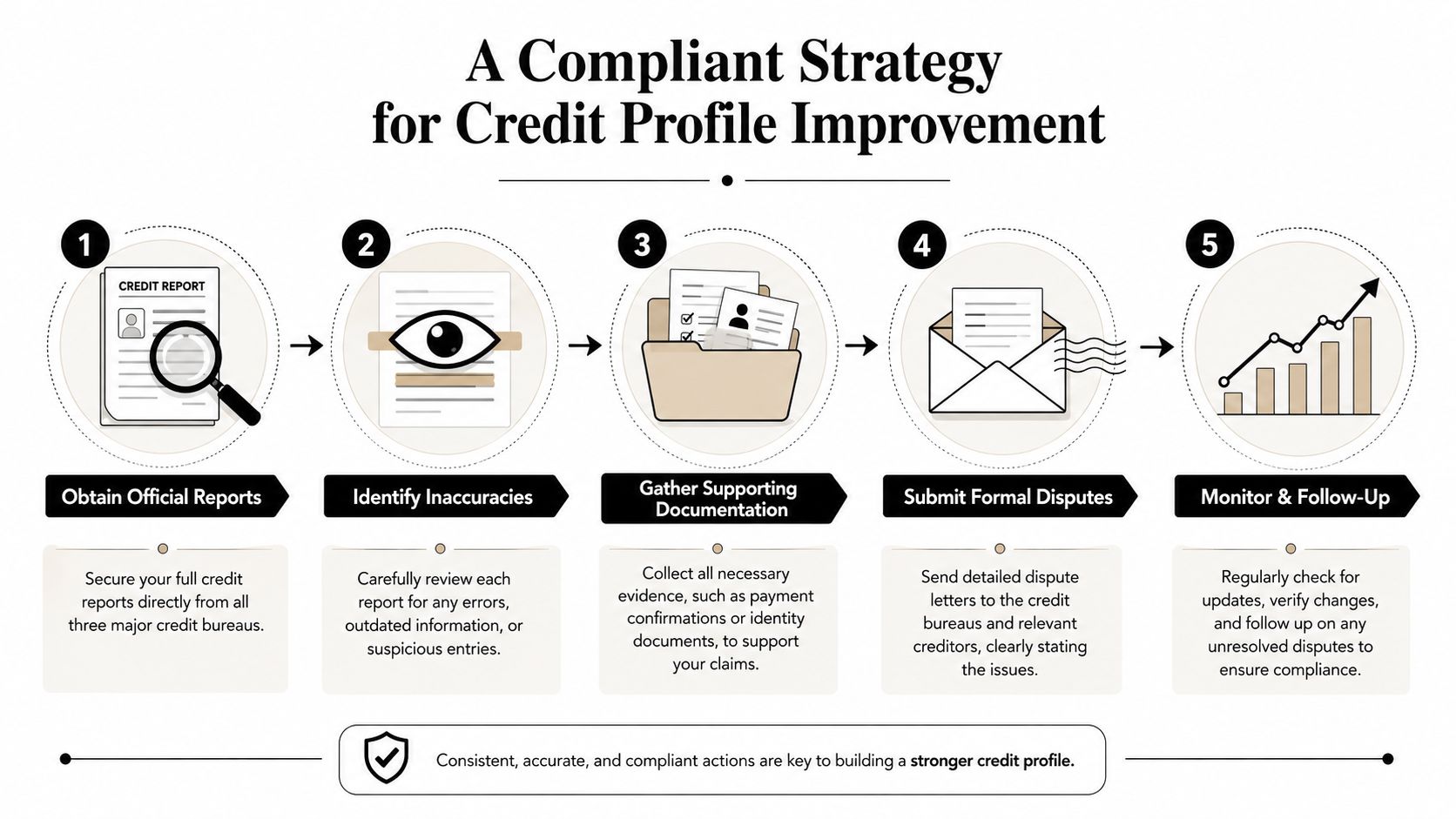
If a balance or credit limit is wrong, dispute it with the credit bureaus that show the error and with the issuer. The credit bureaus forward the dispute to the issuer, and a corrected credit limit can lower your ratio as soon as the new data reports. Attach a statement showing the right figure, and check what makes a dispute valid before you file so the correction is not rejected for missing evidence; that is the same step any credit repair company would take.
What is a credit bureau required to do once your dispute arrives? Under the FCRA it generally has 30 days to investigate, must pass your evidence to the issuer and must report the outcome to you along with a free copy of your updated credit report. Scores recalculate from the corrected data the next time anyone pulls your file.
When utilization matters for a mortgage application
Mortgage underwriters consider revolving balances alongside the complete application, not as a stand-alone credit utilization rule. Before settling on a payoff target, compare the minimum credit score each loan type requires.
Revolving credit accounts drive the usual card-balance calculation; an installment loan does not work the same way. A lender can compare both revolving credit use and monthly payment obligations against the credit report before deciding whether credit utilization presents a risk.
Match the program to the reported balance
A borrower near a lower score band can review what a 550 credit score means for a mortgage. The analysis becomes different again for loans available near a 500 credit score, where program and lender requirements may narrow the available options.
If closing is only weeks away, the mortgage-focused plan for raising a credit score quickly helps separate a statement-date balance reduction from slower reporting corrections.
An applicant considering FHA financing can read about FHA loans for borrowers with bad credit and then check the FHA minimum score rules. Those two issues are distinct: eligibility and the cash needed at closing.
A mortgage shopper should confirm which type of credit score the loan officer will obtain, including its bureau and report date. That type of credit score can differ from the score visible in a banking app; credit scores from separate models are not interchangeable.
A prospective rural buyer should examine USDA guidelines rather than assume the FHA approach applies. For a borrower eligible for military benefits, the overview of VA loans with poor credit covers a different underwriting path.
Local assistance may matter as much as the first score target; investigate first-time buyer programs before choosing a loan program.
Lower reported card balances can also change the monthly minimum payments that enter a debt-to-income calculation. The guide to mortgage brokers who work with bad credit can help you identify a professional to ask which reported payment the lender will count.
During mortgage underwriting, the question “What is a good credit utilization level while an application is pending?” deserves a practical answer: keep reported balances consistent and avoid relying on a one-day payment the lender has not yet seen. Good credit utilization should be assessed alongside other revolving accounts and the timing of their updates, not treated as a universal approval threshold.
If two people apply together, consider a joint mortgage when one applicant has weaker credit; the stronger applicant does not necessarily erase the effects of the weaker file.
The cash reserve is another variable. Check how much down payment a weaker credit score requires and weigh that against the overall plan for buying a house with bad credit rather than treating utilization alone as the mortgage decision.
A reader may reasonably ask, “Can a company repair credit near me before my closing date?” The answer depends on whether the issue is an inaccurate account or ordinary spending. Credit restoration involves correcting documented errors and maintaining better payment behavior, not bypassing the lender review.
Timing matters after the application too, because the rate is usually priced from the credit score. Credit score gains after the rate lock generally do not lower the rate unless the lender agrees to reprice the loan, so finish paying cards down before you lock, not after.
Mortgage lenders usually pull all three credit report scores and use the middle one, or the lower of two borrowers’ middle scores, so a high balance at one bureau matters only if it changes which score lands in the middle.
What is a charge off likely to mean at this stage? Depending on the loan program, an old charge off may be acceptable as it is, while a recent unpaid one may need to be paid or explained in writing before closing.
Compare costly alternatives with waiting for the next report
A short closing deadline can make hard money loans for a primary residence sound appealing, but its interest, origination charges and repayment schedule need careful comparison. Offers from lenders advertising no credit check require equal scrutiny of who actually makes the loan and what verification occurs.
Another credit score reading will be useful only if it comes from a comparable model and a newer report. The credit scores used in underwriting may change as credit utilization changes, but those updates depend on the issuer reporting cycle.
Some portfolio lenders retain more discretion over their loan programs, though the terms can be substantially different. With rent-to-own homes, read the agreement for deposit treatment, purchase price and the possibility that the purchase never closes.
The price of financing through subprime lenders may exceed the benefit of buying immediately. Before choosing any of these routes, compare unconventional mortgage loans against waiting for lower card balances to report.
A credit restoration service cannot make an issuer report a lower card balance before the issuer actually processes it. A credit report repair service should specify a genuine reporting error and its supporting documents instead of promising a particular mortgage score.