


Your rent has come out of the same account on the first of the month for four years. You've got a down payment that took real sacrifice to save, a job with steady raises, and a budget you follow. Then you sit across from a loan officer and hear a sentence that doesn't match any of that: the credit file doesn't show enough history to produce a score.
It's a strange kind of rejection, because nobody said you handled money badly. The system doesn't have enough of your story on paper to reach a conclusion.
That gap between how you manage money and what a credit bureau can see is what this guide is about. We'll cover what a thin credit file is, how it differs from damaged credit, what each loan route wants documented, and how to build evidence an underwriter can work with. Nothing here guarantees an approval or a particular rate. What it does is help you walk into underwriting with a file that answers questions before anyone asks them.
Table of Contents
- Why a Thin Credit File Can Stall a Mortgage
- Which Category Fits You
- Thin File Versus Derogatory Credit
- Nontraditional Credit Requirements for FHA and Fannie Mae
- Gather Proof and Review Items Before Disputing
- Build Payment History Without Hidden Debt
- Choose Your Next Step Before Applying
Why a Thin Credit File Can Stall a Mortgage
Consider a buyer we'll call Dani. Steady job, four years in the same rental, a down payment three years in the making, and a lender who comes back with a question mark instead of a number.
What the underwriter sees is a thin credit file: a credit record holding too little reported information to generate a traditional credit score. That's a statement about missing evidence, not about character. A file can be thin because someone has few active accounts, opened their first card recently, or went years without borrowing at all. Paying rent, utilities and insurance on time doesn't automatically feed the scoring models mortgage underwriting leans on.
Lenders rely on documented repayment behavior because that's what their guidelines let them evaluate. When documentation is sparse, a file can slow down or collect extra conditions, even when every bill has been paid on time. The clearer you make your own evidence, the fewer surprises you meet later, and our guide to lender requirements for first-time homebuyers covers what underwriters weigh beyond the score.
Thin records turn up across plenty of households: young adults who haven't had time to borrow, immigrants who built their financial lives in another country, people rebuilding after a divorce or a stretch of hardship. Mortgage decisions also weigh income, debt-to-income ratio, down payment, existing scores and the full loan profile, so a short file is one factor among several.
There's a sequence that makes this manageable: work out which category your file falls into, separate missing data from negative data, check what your loan route requires, gather proof, review all three reports for errors, build history without hidden debt, then decide your next step. Results vary with your file, your documentation, creditor responses and your current credit behavior. The aim is clear evidence, not a promise.
Which Category Fits You
Thin gets used as a catch-all. It isn't one thing, and the first move isn't the same for each version. In October 2025, the Federal Reserve estimated that approximately 25 million U.S. adults, 9.8% of the adult population, had thin files. Another 7 million adults, or 2.7%, were completely credit invisible because they had no credit history at all. Combined, roughly 32 million adults, about 12.5% of the 258.3 million-person adult population, were considered unscoreable.
That last word is the useful one. It describes a record, not a person. A file can be thin because of few active accounts, recently established credit, or a long stretch with no reported activity, which is not the same as evidence of missed payments.
The Federal Reserve also flagged thin-file and credit-invisible consumers as groups that could benefit from responsibly used alternative data, while noting that such data doesn't automatically replace conventional mortgage qualification standards. In other words, alternative evidence can help a conversation. It doesn't rewrite the rulebook.

Four Files, Four Different First Moves
| Category | What the file shows | What lenders usually need | First step |
|---|---|---|---|
| Credit invisible | No bureau record at all | Documented rent, utility, phone or insurance payment history | Gather 12 months of recurring payment proof |
| Unscored | A bureau file exists but lacks enough usable data for a score | Verified accounts plus corrected or updated data | Review all three reports for stale or wrong data |
| Thin file | Few accounts or a short history | More months of on-time reported activity | Keep existing accounts current and documented |
| Recently scored with derogatory items | A score exists, but late payments, collections or charge-offs appear | An accuracy review, an explanation, and time since the event | Dispute only inaccurate items through the legal process |
The unscored row covers more people than most buyers realize. Federal Reserve Bank of New York work described in a 2025 Federal Reserve Bank of Minneapolis paper estimated about 19 million U.S. consumers, 8% of adults, had unscorable files, split between roughly 9.9 million with insufficiently thick histories and 9.6 million with stale files lacking recent activity. That combined share sat close to the 9.2% estimated in 2011, which tells you this is a structural gap rather than a passing trend.
One practical checkpoint before you go further: pull all three current reports and note which category matches each one. The bureaus don't always agree, and a single report can hide a mixed-file problem that a second report reveals.
Thin File Versus Derogatory Credit
Two files can both produce a missing or low score and still be entirely different problems. One folder is empty. The other is full of paperwork.
A thin file is a blank page. Derogatory credit is a page with marks on it. A blank page needs evidence added. A marked page needs each mark examined, verified, and where it's wrong, corrected. Blurring the two is where most do-it-yourself plans go sideways.

Underwriting makes the distinction explicitly. Under Fannie Mae's HomeReady rules, a borrower whose low score results from too few accounts, accounts that haven't been open long enough, or limited account usage may be eligible for manual underwriting when the lender supplements the file with an acceptable nontraditional credit profile.
The dividing line: alternative credit can show that you handle obligations responsibly. It generally can't erase a low score caused by late payments, collections, charge-offs or other adverse events.
That's where the usual advice fails. Open more accounts, the internet says. More accounts don't create a clean payment record. They create more reporting, and if the underlying problem is a charge-off from three years ago, the new accounts change nothing about how a reviewer reads it.
What a Reviewer Actually Checks
Our team works through inaccurate personal information, collections, charge-offs, late payments, high utilization, repossessions, medical collections, student-loan reporting, bankruptcy or foreclosure history, and account comments that may affect mortgage underwriting, because each of those raises a different question in a loan file.
Sort your own report into two columns. On the left, no evidence of credit risk: short history, few accounts, nothing adverse. On the right, evidence of repayment problems: the late payments, the collection, the charge-off. Items on the right that look wrong on the facts go to an accuracy review. Items that are accurate get addressed through time, on-time payments and a lower balance. That sorting is the difference between a plan and a wish.
Nontraditional Credit Requirements for FHA and Fannie Mae
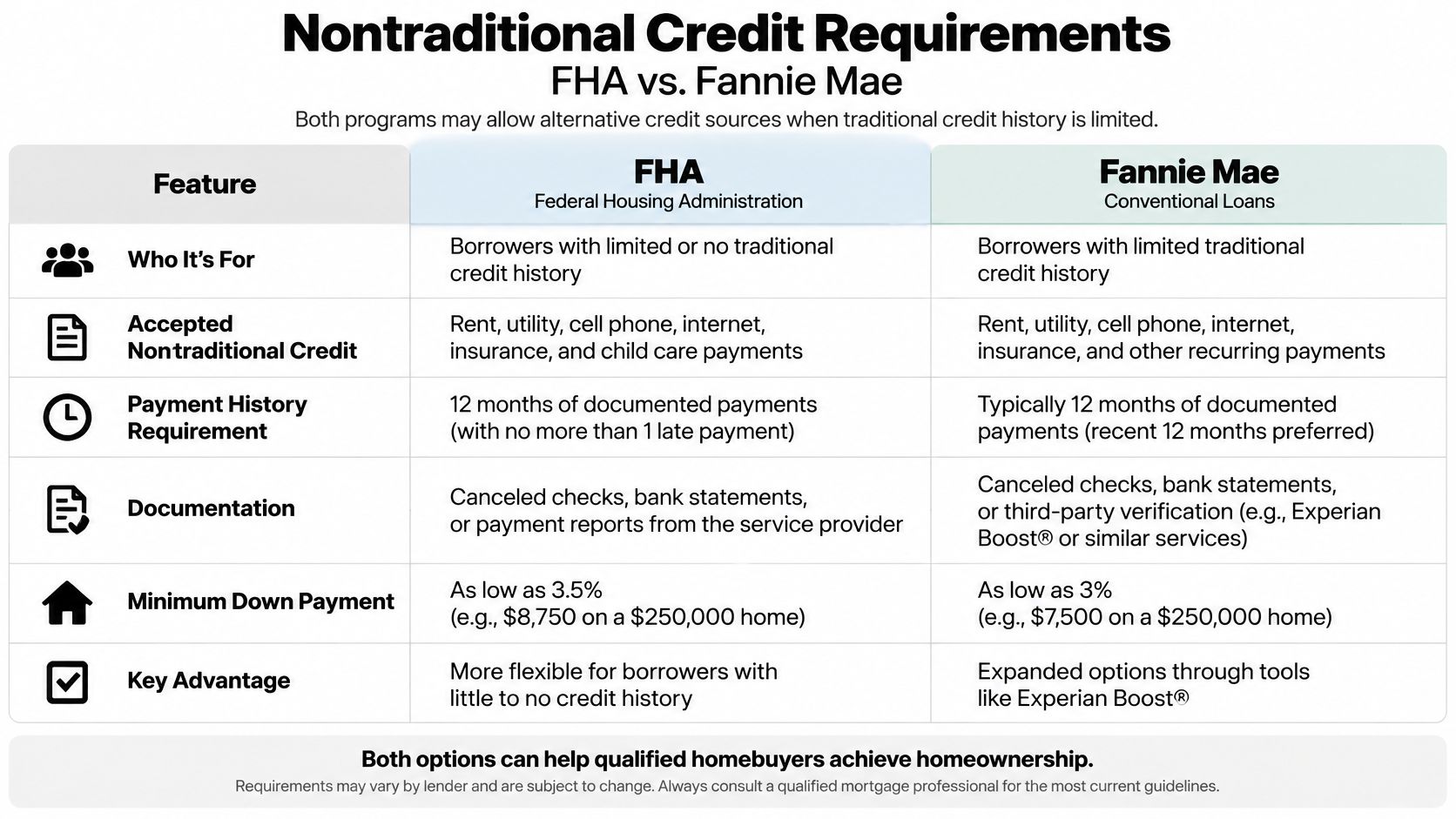
Rent paid on time, a current utility account, and no score on the report: that file is missing the usual credit evidence. FHA and Fannie Mae each name the substitute documents a lender can use, and the lists are not the same.
| Loan route | Payment history required | Delinquency limit | Collections and judgments |
|---|---|---|---|
| FHA nontraditional credit | At least 12 months of payment activity | No rental delinquency; no more than one 30-day delinquency to other creditors | No collections or court records in past 12 months, except medical |
| Fannie Mae nontraditional credit | 12 consecutive months of rent or mortgage payments | No housing delinquency in prior 12 months; no more than one 30-day non-housing delinquency | No non-medical collections or judgments in prior 24 months |
Read each row as a document list. Housing history does most of the work on both routes, the way a reference stands in when a work history is almost blank. The programs split on how recent a late payment or a collection can be.
When a borrower has no credit score, HUD's guidance requires the lender to obtain a Non-Traditional Mortgage Credit Report from a credit-reporting company or to develop the borrower's credit history on its own. Accepted references include rent, utilities, telephone or cellular service, cable television, and local-store accounts. The lender still checks whether each reference is genuine, whether credit was extended, and whether payments were made as agreed.
Fannie Mae sets a tighter box. Fannie Mae's eligibility requirements for nontraditional credit generally limit the loan to a one-unit principal residence, allow a purchase or a limited-cash-out refinance, keep the amount within baseline loan limits, and cap debt-to-income at 36%. Twelve consecutive months of rent or mortgage payments carry most of the weight, because that bill is recent and a lender can usually verify the payee and the amount.
VA, USDA, and other conventional loans follow their own program rules plus each lender's overlays. This table does not cover those routes.
Ask two lenders the same question in writing and compare the answers. Overlay differences are real, and the answer from one loan officer is not a policy.
Before you build a folder around one set of numbers, ask which references that lender accepts and how far back it looks. If the file is already flagged for manual review, the Superior Credit Repair underwriting guide explains what that review adds to the process.
Gather Proof and Review Items Before Disputing
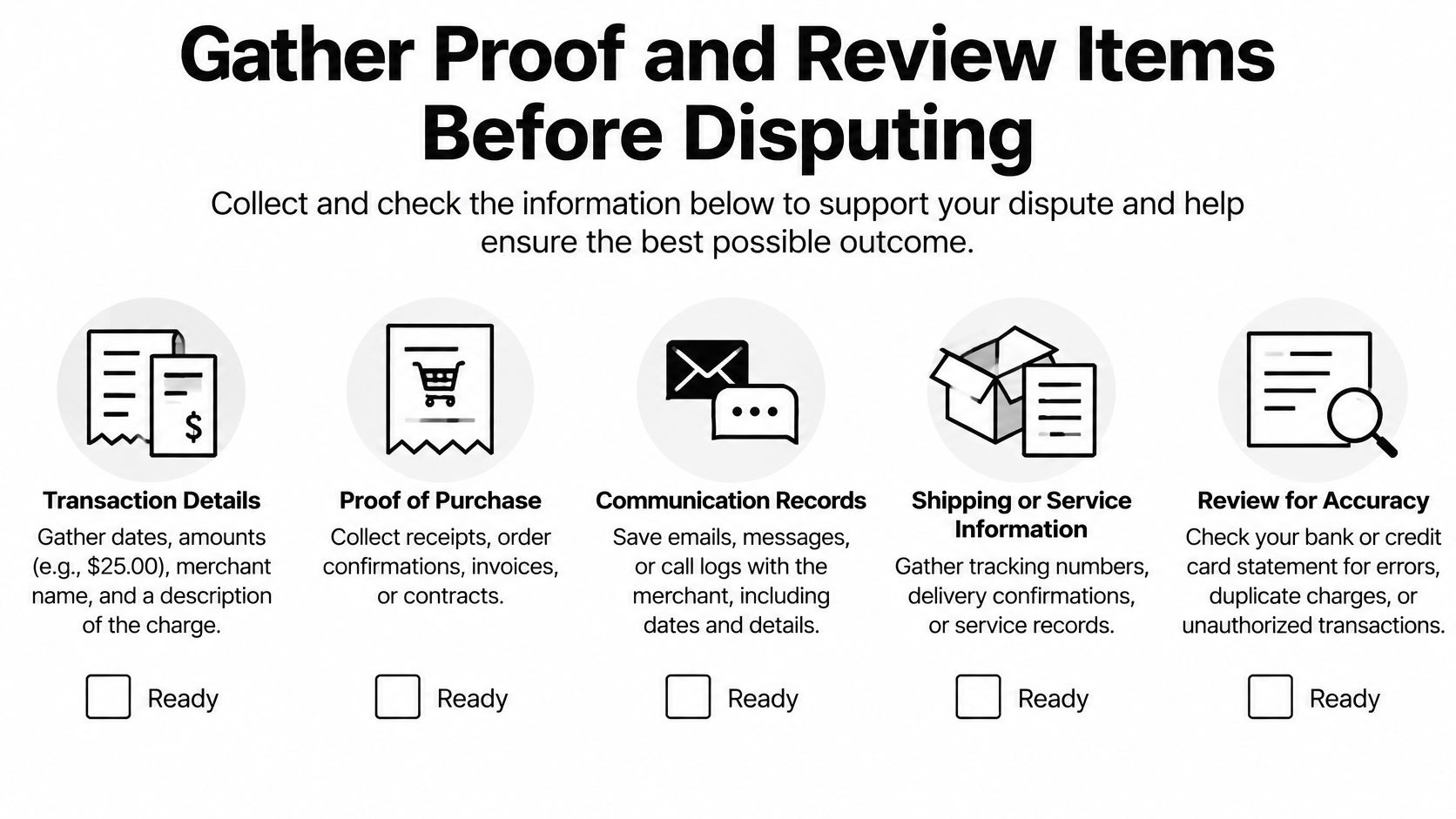
A loan officer asks for March through August of rent. You remember paying. The file does not show it. A thin file is missing evidence: real payments stay invisible until the paperwork names the payee, the amount, and the date. Start with that folder, then decide what, if anything, is worth disputing.
A credit folder works like a school portfolio. The reviewer can grade only the pages you turn in, in order, with dates that match. Fannie Mae's documentation rules for nontraditional credit set that bar for housing history: payments must cover the most recent consecutive 12 months, shown through canceled checks, bank statements, money orders, or another reasonable method that clearly identifies the payee and amount and demonstrates consistent payment.
The Documents to Collect
- Housing payment proof: twelve consecutive months of rent or mortgage that name the landlord or servicer and show amount and date. Bank statements with a recurring outgoing transfer usually work. A screenshot of a payment app usually does not.
- Creditor statements: balances, limits, opening dates, and payment history for each account you plan to discuss. Accuracy decisions rest on these records, not on memory.
- Collection and related paperwork: collection letters, settlement records, debt-buyer notices, and student loan records where the reporting looks off.
- Identity documents: photo identification and proof of your current address. Those are how mixed-file problems get sorted from accounts that belong to you.
- The denial notice: if a lender already declined you, the adverse-action notice names the reasons in writing. Bring it.
Organize by month and by creditor, not by a pile of categories. When someone asks for March through August, one tab should answer the question.
Six Steps to Review Before You Dispute
A measured read comes before any dispute. Rushing a complaint about an item you cannot document wastes the bureau cycle and leaves the thin file just as thin.
- Pull all three reports on the same day. Reports from different dates create false mismatches and wasted effort.
- Read line by line and mark. Look for wrong balances, duplicate accounts, mixed-file entries, outdated information, and details that do not match across bureaus.
- Match each mark to a document. If you cannot point to a statement, a letter, or a payment record that shows the problem, keep the item on a watch list instead of a dispute list.
- Dispute on facts, in writing. A collection, late payment, charge-off, or medical item follows the same rule: name a specific inaccuracy, not a general complaint. This step-by-step dispute letter guidance walks through the format.
- Track what comes back. Timing depends on the account, the documentation, bureau response cycles, furnisher updates, and your current credit behavior. You still have to read each response. Nothing moves on a preferred schedule.
- Re-pull before you apply. Update the file, check that corrections landed, and only then decide whether to start a mortgage application. You choose that timing.
What a Dispute Can and Can't Fix
A dispute can challenge information that is inaccurate, outdated, unverifiable, or misleading. It does not erase accurate negative information. No review can promise a deletion, a score change, or mortgage approval. Results depend on the file, the creditor's response, and what else is on the report. Lender rules, income, debt-to-income ratio, down payment, and the rest of the loan profile still decide the loan.
Accurate obligations get handled the slower way: payments on time, balances coming down, and no new delinquencies. Keep a payment calendar for every open account. Note statement dates so a balance plan matches what will report. Jot down recent inquiries before a financing review, and save anything a lender, landlord, or dealer says about your credit. That feedback usually names the exact concern an underwriter will raise.
For a first conversation, bring the three current credit reports, photo identification, current address information, recent statements for the accounts under review, collection notices, payment confirmations, and any denial or adverse-action notice tied to the application that started the search. One organized folder beats an hour of trying to remember.
Build Payment History Without Hidden Debt
A buyer can pay rent, a phone bill, and utilities for years and still look blank on a mortgage application. The file is short on evidence, not marked by bad credit. Only the payments a bureau receives become part of that record, and those months accumulate at their own pace.
What Actually Moves a File
Payment history carries the heaviest weight in a mortgage review. One late payment on a small card appears on the same report as every larger account. Pay each open account on time, every month.
Utilization is the share of a credit limit that is in use. Issuers typically report the balance as of the statement closing date. That date works like a snapshot: the bureau stores the balance on that day, not the balance after you pay the bill a week later. If the snapshot shows a high balance every cycle, the file looks more indebted than your cash flow. Paying the card down before the statement date is how the reported picture matches what you owe.
A thin file needs months of reported activity. One account you can handle is a practical start: a secured card or starter card, used for a small recurring bill and paid on time. The guide to how starter cards build credit history covers the mechanics and the traps.
Rent reporting can turn a bill you already pay into a line a bureau stores. That documented, recurring payment is the kind of proof nontraditional underwriting looks for when traditional trade lines are scarce.
The Hidden Debt Problem Most Guides Skip
A short credit record and a stack of short-term installment plans can belong to the same person. CFPB research on buy-now-pay-later lending notes that BNPL underwriting commonly relies on soft inquiries, and that many providers historically did not report pay-in-four loans to the credit bureaus. Timely BNPL payments therefore may not build your credit history, while the outstanding obligations can still sit in the background of an underwriting review. BNPL use has grown among consumers who already have a credit record, so a file that looks thin can still hide pay-in-four balances the bureaus never listed.
Before you apply: list every active buy-now-pay-later balance, keep the payment records, avoid new installment purchases until after preapproval, and ask the loan officer how recurring BNPL payments will be counted in debt-to-income.
Reporting practices and program rules keep shifting. Do not treat a general claim that BNPL is harmless, or that it automatically builds credit, as reliable. Get a current answer from the lender reviewing your file. Results vary by file, timing, and lender.
Choose Your Next Step Before Applying
You have the rent receipts, a steady paycheck, and almost nothing on the credit report. A thin file works like a résumé with the employment dates left blank. The underwriter is not reading a stack of bad marks. The file is missing evidence a program can score or review by hand.
What you do next follows what that file contains.
A short record with no derogatory items calls for documentation and steady monitoring, then enough time for new reporting to post. Errors or negative items call for a measured review of each account before any application, so you are not explaining someone else's mistake under deadline pressure. An invisible or unscored file calls for recurring payment proof and a direct question about which nontraditional references that lender will accept.
Denial is common enough to plan around. Roughly 14% of mortgage applicants were denied between 2013 and 2025, according to Federal Reserve Bank of New York data cited by Pew Charitable Trusts. The credit factors behind mortgage denials are more predictable than a surprise rejection feels in the moment. A purchase outside the United States follows local financing rules, and readers comparing that market can start with how overseas buyers finance Israeli homes before returning to the proof a U.S. lender still needs: verified housing payments, account timelines, and a report an underwriter can read.
Three Questions Buyers Ask About Thin Files
Does a thin file automatically mean denial? No. It means the lender needs documented evidence it can evaluate. Outcomes still vary by program, lender, and file. Mortgage approval also depends on lender rules, income, debt-to-income ratio, down payment, credit score, and the full loan profile.
Can you get a mortgage without a credit score? Some routes allow nontraditional credit, subject to a lender review of your documentation. Whether the file qualifies depends on the references you can verify.
How long does building history take? It depends on reporting cycles, account activity, bureau updates, and the file itself. There is no single timeline that fits every report.
When you want help sorting the file, Superior Credit Repair can review your credit report, help identify inaccurate or questionable items, and explain a step-by-step plan for improving the profile. You can request a credit analysis to talk through your options, and the site's Monitor Your Credit option gives you current reports to start from.
If this information helped you better understand your credit report or your next steps, we would appreciate your honest feedback. You are welcome to share your experience with Superior Credit Repair on our Google Business Profile.
Superior Credit Repair works with first-time buyers, veterans, and families preparing for FHA, VA, USDA, or conventional financing, reviewing all three credit reports for inaccurate, outdated, or unverifiable items before an application goes in. The work maps the documentation and rebuilding steps that make a thin or damaged file easier for an underwriter to read. Approval still rests with the lender and the full loan profile, and credit repair cannot guarantee a mortgage decision. Visit Superior Credit Repair to request a credit analysis and talk through your approval target.