

Manual mortgage underwriting is a lender's human review of a borrower's ability and willingness to repay, used when an automated system cannot give an eligible recommendation or the file needs judgment.
You may have paid rent reliably, kept your job, and saved for a home, only to hear that your application needs a closer review. That can feel unsettling, especially if you don't know whether the concern is your credit history, income documentation, or existing debts.
Manual underwriting means preparing evidence, not persuading someone to ignore the rules. Understanding what the lender needs can help you organize your next steps without assuming that a human review guarantees approval.
Table of Contents
- What Manual Underwriting Means in Plain English
- Manual Versus Automated Underwriting Side by Side
- How Manual Reviewers Weigh Your Credit Pattern
- Documents Lenders Usually Request for a Manual Review
- Who Manual Review Helps and Which Loan Programs Allow It
- How to Strengthen Your File Before a Manual Review
- Common Questions About Manual Mortgage Underwriting
- Confirm the Review Path Before You Apply
What Manual Underwriting Means in Plain English
Underwriting is the lender's risk check on a proposed loan. The underwriter asks whether the information is accurate, whether the borrower has managed obligations responsibly, and whether the proposed payment is sustainable.
Think of automated underwriting as a scanner checking a file against a structured rubric. Manual underwriting is more like an experienced reader examining the whole story, while still following that rubric. Neither path lets the lender skip verification.
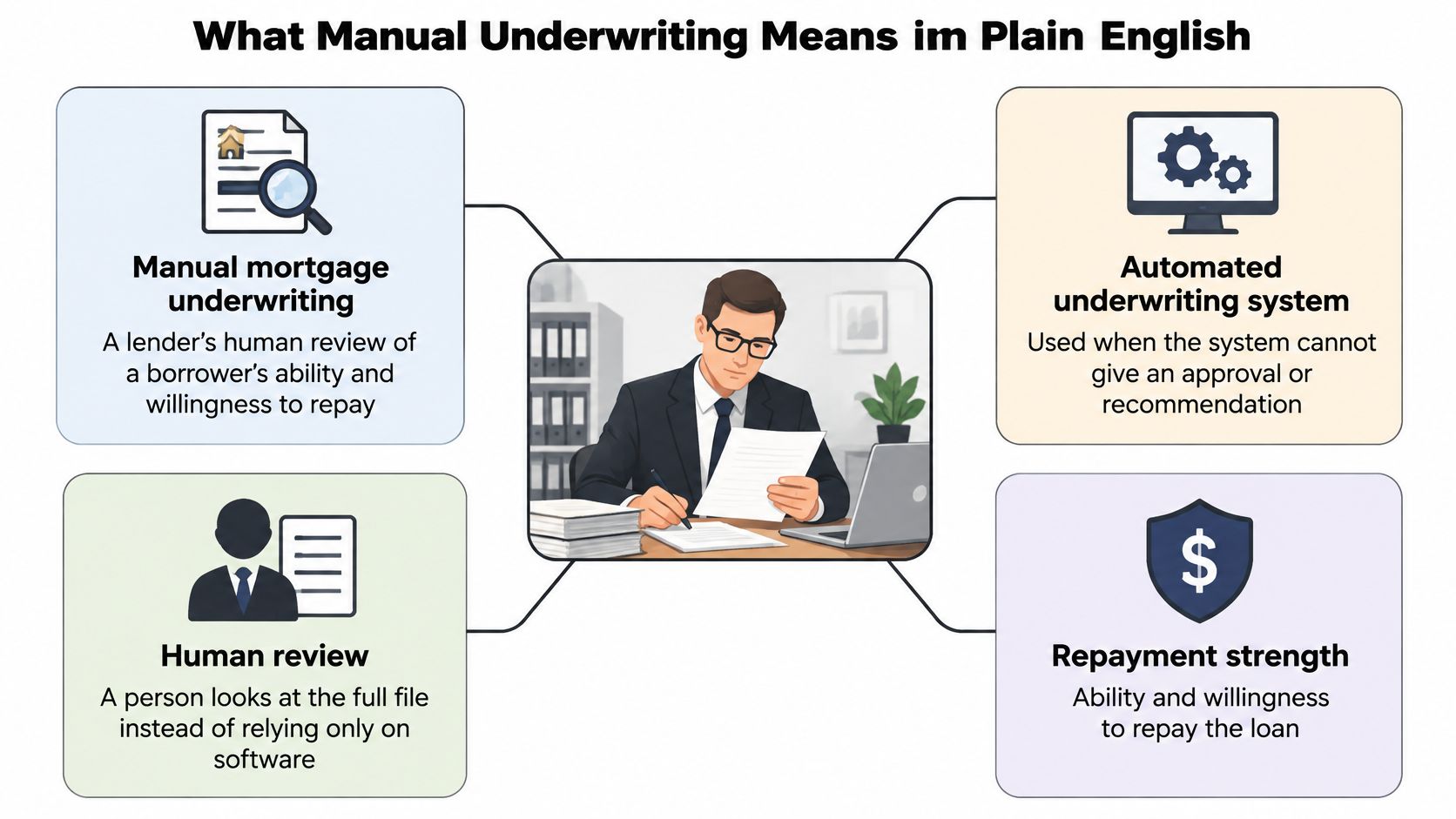
What the underwriter actually checks
The reviewer examines stable income, employment history, assets, liabilities, housing payments, and credit obligations. Assets include money available for the transaction and eligible savings; liabilities are financial obligations you owe.
The lender also evaluates the property and your capacity to repay throughout the loan term. A convincing explanation of a hardship doesn't replace proof of income or sufficient funds.
Two terms help make the process understandable:
- Debt-to-income ratio: Monthly qualifying debt payments divided by qualifying monthly income.
- Compensating factor: A documented financial strength that can address a particular weakness when the loan program permits it.
Why FHA manual underwriting matters
The HUD Single Family Housing Policy Handbook provides a manual-review path for eligible borrowers with limited, nontraditional, or insufficient credit histories, and for applications receiving a TOTAL Mortgage Scorecard Refer result or requiring further human analysis.
That matters if you've managed household bills responsibly but haven't built a substantial traditional credit file. The absence of a usable score doesn't necessarily mean the absence of reliable financial behavior.
Still, manual review isn't permission to overlook weak credit. When a lender uses this label, the useful next question is which documents and financial patterns the reviewer needs to evaluate.
Manual Versus Automated Underwriting Side by Side
Automated underwriting produces a system recommendation using application information and program rules. Manual underwriting requires a human-led evaluation when the file needs that decision path.
The differences below matter more than the assumption that one method is easier.
Manual and automated underwriting compared
For conventional loans sold to Fannie Mae, its debt-to-income ratio guidance generally allows 50% total DTI through automated underwriting, compared with a standard manual maximum of 36%, potentially increasing to 45% when specified credit-score and reserve requirements are met.
| Criterion | Automated underwriting | Manual underwriting |
|---|---|---|
| Who makes the decision | Scoring system issues a recommendation | Human underwriter reviews the full file |
| When it is used | Standard files that fit program rules | Files the system cannot approve, refers, or needs judgment on |
| Maximum total DTI, conventional Fannie Mae | Generally up to 50% | 36% of stable monthly income, up to 45% when credit-score and reserve requirements are met |
| Documentation depth | Standard verification | Deeper verification with written explanations of risk |
| Role of compensating factors | Applied within system rules | Must be documented, relevant, and strong enough to address the weakness |
| Approval guarantee | None | None |
The decision-maker row needs a qualification: an automated recommendation isn't the lender's final commitment. Lender staff must still verify information and resolve conditions before closing.
The DTI row also explains why requesting manual underwriting isn't necessarily a solution to excessive debt. A borrower who fits an automated program's affordability rules might not fit the manual rules for the same loan type.
Why the manual path can require more work
The underwriter must connect the evidence into a supportable decision. Stable employment, for example, doesn't automatically overcome a combination of high obligations, insufficient reserves, and unresolved payment problems.
Practical rule: Ask what remains unverified, not just whether the computer approved or rejected the application.
Additional document checks and written explanations can make manual review more involved. If records conflict, the lender may need clarification before deciding.
Ask your loan officer whether your application received an automated recommendation, whether a manual downgrade occurred, and whether the lender accepts manual files for your intended program. Those answers identify the actual review path instead of leaving you to interpret a generic application status.
How Manual Reviewers Weigh Your Credit Pattern
A payment history tells the underwriter more than the presence of a negative account alone. Housing and utility payments receive attention first in FHA credit-pattern review, followed by installment debts and revolving accounts.
An installment debt has scheduled payments, such as an auto loan. A revolving account, such as a credit card, allows borrowing against a limit as balances change.
An isolated late payment with a documented explanation presents a different question from repeated missed payments across several accounts. Collections and charge-offs also require attention to dates, balances, ownership, and current status, not assumptions based on the account label.
How the affordability calculations work
The housing ratio compares the proposed housing obligation with qualifying effective income. That obligation can include principal, interest, property taxes, insurance, mortgage insurance, association dues, and other applicable housing charges.
The total debt ratio adds recurring obligations to the housing payment before dividing by income. Under HUD's mortgage credit analysis guidance, the commonly cited manual benchmarks are 31% for housing and 43% for total debt, with examples of supporting strengths including comparable housing payments over 12 to 24 months or a down payment of 10% or more.
FHA ratio benchmarks in manual underwriting
HUD's qualifying-ratio guidance describes 37%/47% with one documented factor and 40%/50% with two listed factors for eligible borrowers with scores of 580 or higher, while borrowers below 580 or without scores generally remain at 31%/43%.
| Scenario | Housing ratio | Total debt ratio |
|---|---|---|
| Standard manual benchmark | 31% | 43% |
| Credit score 580 or higher, one documented factor | 37% | 47% |
| Credit score 580 or higher, two listed factors | 40% | 50% |
| Below 580 or no credit score | 31% | 43%, generally no higher |
| Energy-efficient home stretch, special case | 33% | 45% |
The special energy-efficient-home figures of 33% and 45% come from HUD's handbook guidance; they concern qualifying energy savings, not a general exception for excessive debt.
These are program scenarios, not personal approval targets. The lender must apply the rules effective for your transaction and document any permitted justification.
Match each proposed strength to evidence:
- Comparable housing payments: Bank records, canceled checks, or accepted rental verification.
- Accumulated savings: Statements showing a consistent, traceable savings pattern.
- Down payment funds: Account records establishing the amount and source.
- Conservative credit use: Statements and payment records supporting manageable obligations.
For account-specific preparation, understand how underwriters view collection accounts. Results vary by file, and no provider can promise a particular ratio, score, approval, or loan term.
Documents Lenders Usually Request for a Manual Review
A useful document package lets the reviewer connect each statement in your application to reliable evidence. Start with the lender's checklist, then organize records by purpose rather than uploading an unsorted collection of screenshots.
Build a usable evidence file
- Income records: Gather recent pay stubs, W-2s, and tax returns where applicable. Self-employed borrowers should be ready to provide a year-to-date profit and loss statement and any additional business records the lender requests.
- Asset records: Save complete bank statements showing where funds came from, along with relevant retirement statements. If funds were a gift, obtain the gift documentation the lender requires rather than treating the deposit as self-explanatory.
- Housing payment records: Collect rent receipts, canceled checks, payment-platform records, or landlord verification for the period your lender specifies. Include utility payment records only when the lender accepts them as qualifying evidence.
- Credit explanations: Keep collection notices, current balances, payment confirmations, settlement letters, and dispute results together. A short explanation should identify what happened, when it happened, and which supporting record confirms it.
- Current obligations: Provide statements for credit cards, auto loans, student loans, and buy-now-pay-later balances. Don't omit an obligation because it doesn't appear on the credit report you're reviewing.
If your lender requests tax transcripts, Allied Tax Advisors' Form 4506-T transcript instructions can help you understand the request before completing paperwork. Follow your lender's directions about the specific authorization it needs.
Check consistency before submitting
Names, dates, balances, and payment amounts should agree across records. If a creditor statement shows a different balance from your credit report, include documentation explaining the difference rather than changing either document.
Our guidance can help you prepare for mortgage review with late payments using factual explanations and supporting records.
Never create, alter, or backdate a document to influence an underwriting decision.
Use this folder checklist:
- Income and employment: Complete, readable records.
- Assets and deposits: Statements plus source documentation.
- Housing history: Accepted payment evidence.
- Credit and obligations: Notices, explanations, and resolution records.
Who Manual Review Helps and Which Loan Programs Allow It
Manual review tends to matter most for renters with thin credit histories, younger buyers, recent immigrants, and people rebuilding after hardship. Self-employed or commission-based borrowers may also need more human analysis of income, although complex income alone doesn't determine the underwriting path.
A documented medical hardship or divorce can provide context for a payment problem. It doesn't erase the account or replace a program's eligibility requirements.
The Federal Reserve's Consumer & Community Context publication estimates that about 32 million U.S. adults are unscoreable, including approximately 7 million who are credit invisible and 25 million with thin files. For these borrowers, manual review is often the only path to a decision at all.
Separate program rules from lender restrictions
Fannie Mae's comprehensive risk assessment guidance permits documented manual assessment for eligible conventional loans. A lender may nevertheless apply overlays, meaning additional restrictions beyond the underlying program rules.
VA and USDA work differently. Each program leaves manual review largely to lender discretion, so one lender may accept a manually underwritten file while another declines the same profile. Confirm availability with the actual lender before building your application strategy around manual review.
| Loan program | Manual review path | What to confirm |
|---|---|---|
| FHA | Available after a TOTAL Scorecard Refer or a required manual downgrade | Use the FHA ratio table; maximum financing can still apply to eligible thin or nontraditional credit files evaluated manually |
| Conventional, Fannie Mae | Permitted as a documented manual risk assessment | Manual total DTI is tighter than the automated path; credit score and reserves determine eligibility for the higher manual cap |
| VA | Decided by each lender under its own rules and overlays | Residual income receives greater emphasis than the debt ratio; confirm that lender's overlays before applying |
| USDA | Decided by each lender under its own rules and overlays | Don't assume a manual second path; ask whether this lender allows manual review |
Residual income means money remaining after specified housing costs and other obligations. For VA preparation, ask how the lender evaluates that remaining income rather than focusing only on a debt ratio.
Alternative evidence needs advance acceptance
Rent, utility, and deposit records may help explain financial behavior, but acceptance isn't automatic. Ask which records qualify and what period they must cover. A lender that won't accept utility payments as evidence can't be persuaded by a thicker stack of them.
Our Superior Credit Repair thin-file guidance addresses preparation when conventional credit history is limited.
Buy-now-pay-later accounts deserve a direct question during that same conversation. Even when a lender accepts alternative records, a newly reported balance can change the debt picture mid-review.
How to Strengthen Your File Before a Manual Review
The most useful preparation makes your application easier to verify. Concentrate on accuracy, payment stability, and an organized paper trail instead of trying to manufacture a particular underwriting result.
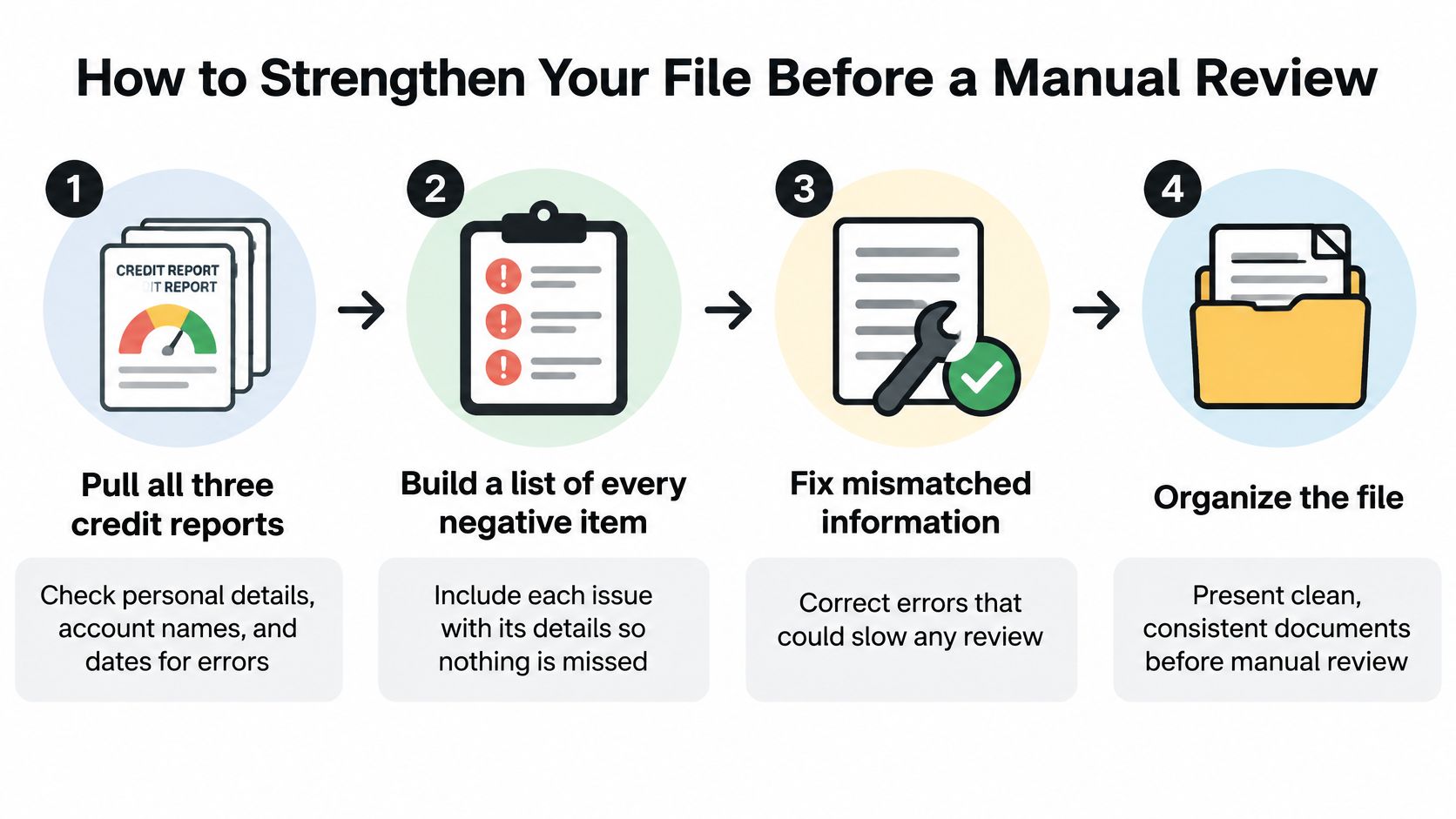
Follow a documentation-first sequence
Review your credit reports. Compare personal information, account names, and dates across the bureaus so mismatches can be investigated. A common mistake is assuming that every report contains identical information.
Inventory negative accounts. Record each account's balance, status, dates, and supporting evidence, then separate accurate reporting from potentially inaccurate, outdated, unverifiable, or misleading information. Don't dispute an account solely because it's unfavorable.
Preserve housing payment proof. Download records before changing banks or losing access to a rental portal. Don't rely on a verbal statement from a landlord when the lender requires written verification.
Plan revolving balance payments. Review statement closing dates and ask your issuer when it normally reports balances. Paying by the due date protects payment timeliness, but assuming that's always the reporting date can leave an unexpectedly high reported balance.
Protect current payments. Use a payment calendar and consider autopay where appropriate. Check available funds and payment completion, because an autopay setting isn't proof that a payment processed.
Keep reserves traceable. Preserve statements and documentation for transfers, gifts, or other deposits. Moving money repeatedly without retaining the source records can make straightforward savings harder to verify.
Avoid unnecessary new borrowing. Discuss credit applications and major purchases with your lender before acting. Store financing and new installment plans still deserve attention even when advertised as convenient payment options.
Write factual explanations. Describe the event, its effect, and what changed, attaching relevant proof. Avoid emotional essays, unsupported claims, or statements that conflict with account records.
Confirm the applicable path. Ask which program, overlays, and alternative records govern your review. Don't assume another borrower's successful application establishes your eligibility.
Coordinate credit preparation with affordability
Understanding how lenders calculate FHA debt ratios helps you distinguish a credit-report problem from an affordability problem. Correcting an account error and reducing an actual monthly obligation are different tasks.
Accuracy comes first: A dispute should address a reporting problem, not serve as a shortcut around mortgage requirements.
These actions take time. Credit restoration is a structured review, legal dispute and verification process, and long-term rebuilding strategy. Results depend on the file and current behavior, not just on submitting disputes.
Common Questions About Manual Mortgage Underwriting
Does manual underwriting mean approval?
No. It means a person will evaluate the application under applicable rules. The lender still needs acceptable evidence of income, debts, assets, and repayment capacity, and may issue conditions or decline the application.
Can I request manual underwriting?
You can ask your loan officer whether it's available, but the lender determines the applicable path based on the program, application, and automated findings. Ask whether the lender accepts manual files and whether any overlay prevents your application from using that option.
Is a collection account an automatic disqualifier?
Not necessarily. The reviewer considers the account's balance, status, dates, and relevant program requirements. An accurate collection may call for documentation, a payment strategy, or time rather than a dispute; an inaccurate account calls for an evidence-based review.
How long does manual underwriting take?
It generally requires more document checking than receiving an automated recommendation, so don't treat the system's response time as a closing estimate. Ask your lender for a file-specific timeline and a list of outstanding conditions, then respond with complete records.
Your own application, available documents, and lender restrictions determine which answers apply. A useful conversation ends with a clear next action, such as providing a missing statement or confirming whether a particular payment record is acceptable.
Confirm the Review Path Before You Apply
Before submitting another application, confirm whether your intended lender and program permit the review your file may need. Then gather the records that support your financial history rather than applying repeatedly without understanding the unresolved concern.
The credit factors mortgage lenders check can help you prepare questions about reporting accuracy, payment history, balances, and account stability.
Bring the records behind the concern
For a first conversation with Superior Credit Repair, bring:
- Current credit reports: The three current bureau reports.
- Identity and address records: Photo identification and current address information.
- Account evidence: Recent statements for accounts to be reviewed.
- Resolution records: Collection notices, payment confirmations, and related correspondence.
- Application feedback: Any denial or adverse-action notice connected to the application that prompted your search.
We can review credit reports and supporting records remotely. You remain responsible for providing accurate information, reading responses, and deciding when to apply for housing or financing.
Our process examines accounts individually. For collections or charge-offs, that includes balances, ownership, dates, status, and bureau differences before determining whether documentation or dispute support is appropriate.
Choose a realistic next step
Superior Credit Repair can review your credit report, help identify inaccurate or questionable items, and explain a step-by-step plan for improving your credit profile. You can request a free credit analysis or consultation to better understand your options.
Was this guide helpful? Superior Credit Repair Online provides educational credit guidance for individuals and families preparing for major financial goals like buying a home, applying for a mortgage, refinancing, or rebuilding after credit challenges.
Credit repair cannot guarantee mortgage, auto, or rental approval. Results vary based on each person's credit file, documentation, creditor responses, account history, and current credit behavior.
If this information helped you better understand your credit report or your next steps, we would appreciate your honest feedback. You are welcome to share your experience with Superior Credit Repair on our Google Business Profile.
Superior Credit Repair offers documentation-based credit review and rebuilding guidance for homebuyers preparing for underwriting. Visit Superior Credit Repair to request a free credit analysis or consultation, and bring your credit reports and lender feedback so we can help you identify practical next steps.