

VA does not impose a universal minimum credit score, while many lenders still look for scores around 620 and judge the whole file. VA credit repair is therefore about correcting reporting problems and strengthening mortgage readiness, not reaching a number that guarantees approval.
The popular advice to raise your score misses an important part of the process. A lender also needs to understand your payment history, income, monthly obligations, and ability to afford the proposed home payment.
For veterans and military families, steady progress starts with separating credit report accuracy from loan qualification. You can work on both, but they aren't interchangeable.
Table of Contents
- VA Loan Credit Expectations Without a Magic Score
- Credit Issues That Complicate VA Approval
- How to Dispute Inaccurate Items Step by Step
- Residual Income and Debts the Score Misses
- Rebuilding Habits Lenders Can Verify
- How Long VA Credit Repair Usually Takes
- Ask for a Review Before You Apply
VA Loan Credit Expectations Without a Magic Score
Say a veteran receives a Certificate of Eligibility and assumes the remaining mortgage process is mostly paperwork. That certificate establishes eligibility for the benefit. It doesn't replace the lender's review of repayment ability.
The VA Buyer's Guide explains that VA doesn't set a minimum credit score, although lenders commonly look for scores around 620 and evaluate the broader application. A lender's additional requirement is often called an overlay, meaning a standard the lender applies alongside program rules.
The Lower guide to VA credit requirements describes lender thresholds around 580–620 and explains why paying a debt after credit concerns arise doesn't erase earlier untimely payments. These are lender practices, not a universal VA qualification range.
VA program rules versus common lender overlays
| Factor | VA program position | What many lenders still review |
|---|---|---|
| Credit score | No VA-imposed universal minimum | Often about 620; some overlays nearer 580–620 |
| Down payment | Often none with sufficient entitlement | Cash reserves or compensating factors may still be requested |
| Monthly mortgage insurance | Generally not charged | Not a VA feature; conventional loans often differ |
| Collections | Not automatically required to be paid if overall credit is acceptable; analyzed on VA Form 26-6393 | Payoff, explanation, or a listed minimum payment may still be counted |
| Residual income | Required amount changes with household size and region | Used with debt-to-income, assets, employment, and payment shock |
| Past-due history | Satisfactory repayment behavior is reviewed | A debt paid only after credit concerns arise does not erase earlier late payments |
The VA's explanation of its home-loan guarantee confirms that borrowers obtain financing through private lenders, with a federal guarantee that can generally eliminate a down payment and monthly mortgage insurance. Those advantages don't eliminate underwriting or make every proposed payment affordable.
Turn eligibility into a documented application
Start by asking the lender what would prevent the current file from moving forward. A score requirement calls for a different response than insufficient income, unexplained delinquency, or missing debt documentation.
Our guide to understanding VA loan credit flexibility can help you frame that conversation without treating flexibility as automatic acceptance.
Credit restoration means creating a clearer, better-documented file. Results vary with each person's report, documentation, creditor responses, account history, and current credit behavior. Neither a cleaner report nor a lender's published threshold promises approval or a particular interest rate.
Credit Issues That Complicate VA Approval
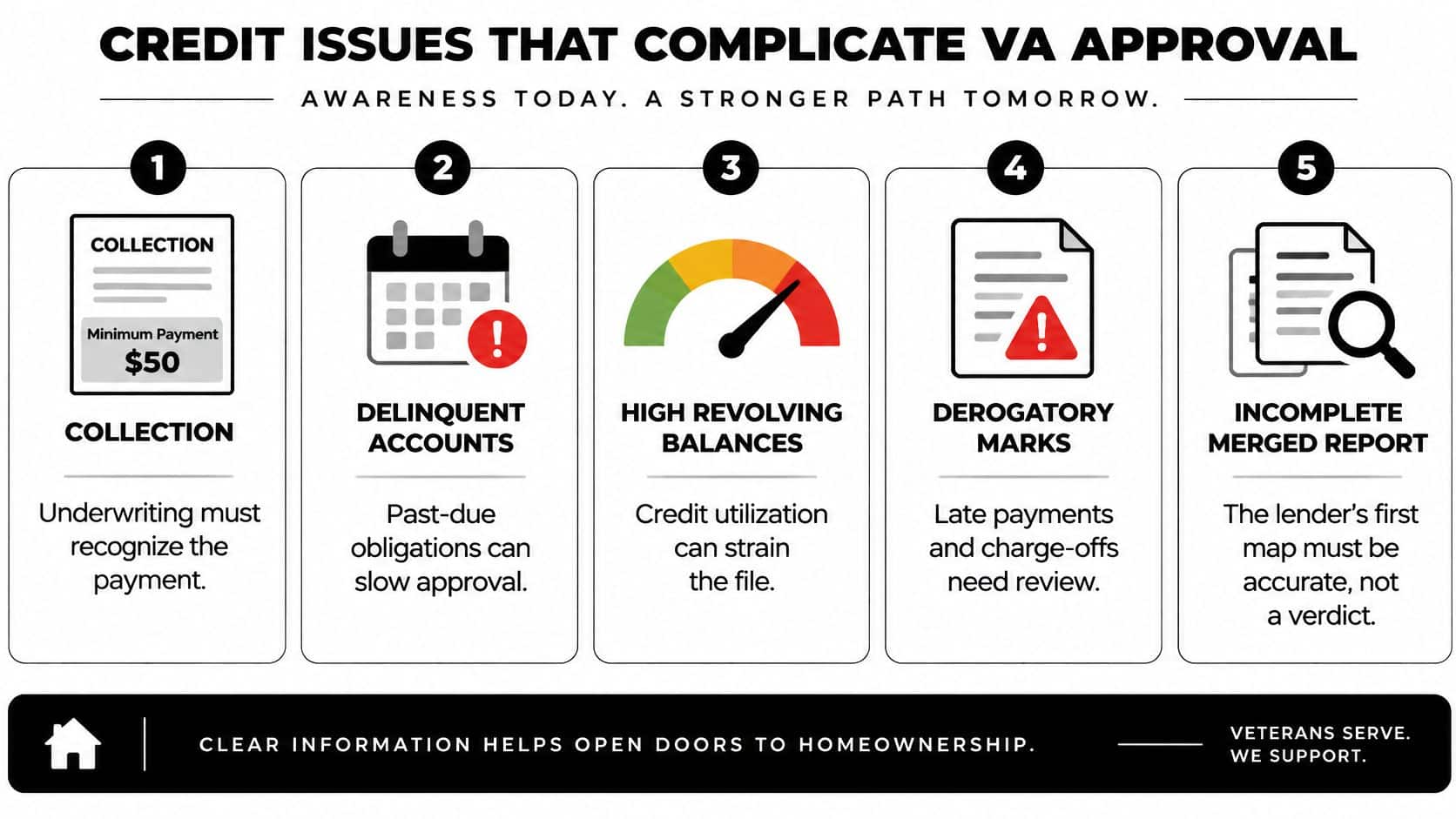
A merged mortgage credit report brings information from multiple credit bureaus into a lender's review. Treat it as the lender's first map of your accounts, not a final verdict about your readiness.
The important question isn't whether an item looks negative. It's whether the information is accurate, what the account requires today, and how the lender must evaluate it.
How to handle items that show up before a VA review
| Item | If reporting looks wrong | If the history is accurate | What underwriting may still do |
|---|---|---|---|
| Collection | Dispute duplicates, wrong balances, or unverifiable ownership with records | Paying or settling does not erase prior delinquency | Analyze it; count a listed minimum payment |
| Charge-off | Challenge incorrect dates, balances, or mixed files | Review the circumstances; don't expect removal because it was paid | Weigh it with the broader payment history |
| Late payment | Dispute a wrong date, amount, or account that was actually current | Later payment does not wipe the late mark | Look for a sustained on-time pattern afterward |
| High utilization | Verify balances and limits are reported correctly | Pay revolving balances down and keep new charges modest | Treat high balances as both risk and cash-flow pressure |
| Medical collection | Check age, duplicates, and whether the balance matches the provider | Accuracy comes before any payment decision | Assess the documented account; no dispute promises deletion |
The VA lender handbook changes presentation explains that collections aren't automatically required to be paid when overall credit is acceptable, but lenders must document their analysis on VA Form 26-6393 and recognize a listed minimum payment. It also directs lenders to consider charge-offs within the borrower's broader negative history and the circumstances surrounding the debt.
A charge-off means the creditor has classified the account as a loss for accounting purposes. Don't interpret that label as proof that the obligation disappeared.
Review first, then choose an action
Before deciding whether to dispute, pay, or negotiate, make an account worksheet. Record the original creditor, current collector, account age, reported balance, status, and any listed payment.
For example, a medical bill appearing under different company names isn't automatically an error. Compare account identifiers and provider records to determine whether the entries represent separate obligations or a duplicated balance.
Before paying: Ask what the lender needs documented, and distinguish resolving an obligation from correcting its reported history.
Use Superior Credit Repair insights on collections to organize the questions you'll bring to a loan officer. Avoid choosing a payment strategy solely because someone predicts a score increase.
Tax problems require a separate review. If a tax lien complicates selling an existing property before buying, Tax Attorney Stephen A Weisberg's resource on IRS liens and home sale options offers context for that distinct issue; a credit dispute isn't a substitute for tax advice.
Also remember that the report may omit obligations. Buy-now-pay-later plans deserve their own budget inventory, even when no collection appears.
How to Dispute Inaccurate Items Step by Step
Credit repair is a structured review and verification process, not a deletion service. A useful dispute identifies a specific reporting problem and gives the bureau or reporting company evidence it can evaluate.
Begin with readable reports and an account-by-account comparison. For help understanding account fields before marking errors, ThriveXDNA's credit report guide provides a practical reading resource.
Build a dispute someone can investigate
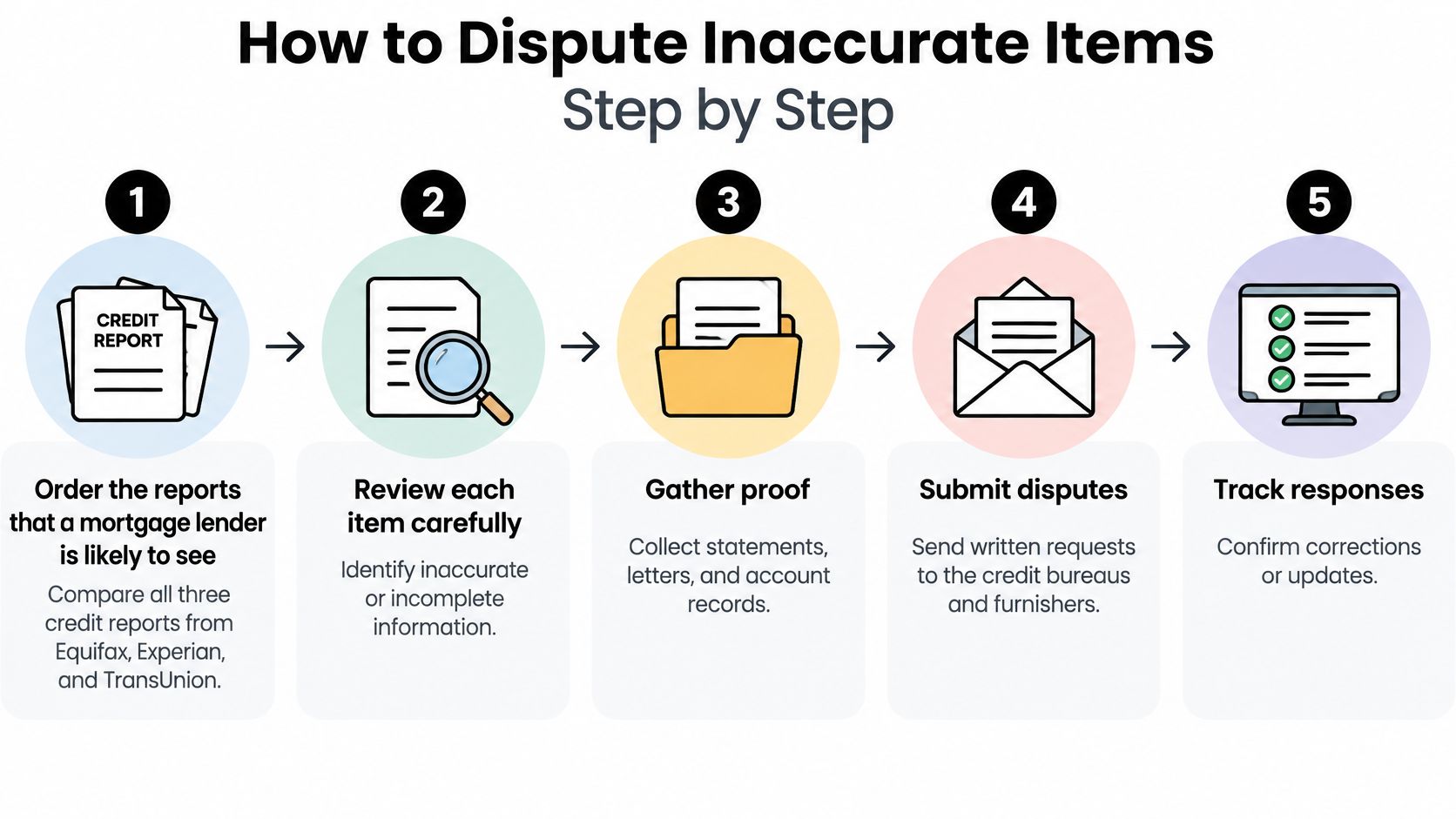
Compare the credit bureau reports. Obtain your reports from each nationwide bureau and ask the mortgage lender what report information it uses. Match the same account across reports, noting differences in balances, dates, ownership, and payment status. Don't assume a consumer monitoring score is the lender's qualification decision.
Match entries to original records. Gather statements, payment receipts, medical bills, correspondence, and relevant leave and earnings statements or retiree pay records. Income records can help explain a financial timeline, but an account statement or receipt is usually more direct evidence of a disputed payment.
Identify the exact problem. Mark information that appears inaccurate, outdated, duplicated, incomplete, misleading, or unverifiable. Separate those concerns from accurate negative history. Disagreeing with an account's effect on your application isn't itself evidence that the reporting is wrong.
Submit a plain-language dispute. Name the account, identify the disputed field, explain the correction you're requesting, and attach relevant copies. Use the bureau's designated dispute channel and, where appropriate, contact the company furnishing the information. Keep originals in your own records.
Read the response against your evidence. A response may confirm the reporting, update part of it, or remove information. Check what changed rather than assuming an investigation produced the outcome you wanted.
Escalate unresolved contradictions carefully. If the account is verified but your records still disagree, explain the remaining conflict and provide the supporting documents through the appropriate follow-up or complaint channel. Repeating a generic letter without addressing the response adds little clarity.
Keep the household current while waiting. Maintain rent, installment payments, card minimums, and other obligations. A pending dispute doesn't pause your bills or make new borrowing harmless to mortgage preparation.
Keep a loan-officer-ready records folder
Our credit dispute paperwork for first-time homebuyers can help you organize the information a factual dispute needs. Retain the relevant report pages, submitted letters, supporting records, submission confirmations or mailing proof, and every response.
Bureaus generally investigate within an applicable response window, but timing and outcomes differ by file and creditor. Read the acknowledgment and response instructions rather than planning a purchase around an assumed completion date.
You can dispute reporting errors yourself. Paid assistance should add organization, document support, time savings, or communication value, not claim exclusive dispute rights.
Avoid services that promise blanket deletions, overnight results, or a specific score jump. A documentation-based process can pursue accuracy; it can't manufacture a different payment history.
Residual Income and Debts the Score Misses
Think of your credit score as a rearview mirror and residual income as the fuel remaining after the proposed home payment and recurring obligations. A favorable view of past borrowing doesn't establish that enough money remains for everyday household expenses.
The VA credit underwriting training materials explain that residual income supplements debt-to-income analysis, with required amounts based on household size and geographic region. They identify strong residual income, liquid assets, lower debt-to-income, long-term employment, and minimal payment shock as compensating factors, while warning that marginal credit combined with marginal income can support denial.

Budget beyond the score
Debt-to-income compares qualifying monthly debt payments with qualifying income. Residual income asks a different question: what remains for the household after the lender accounts for the proposed housing expense and applicable obligations?
Payment shock describes the increase from your current housing expense to the proposed payment. A household moving from manageable rent to a substantially larger mortgage needs more than an acceptable credit report.
Build a complete liability list:
- Family obligations: Document child support and alimony accurately.
- Installment debt: Include auto loans, student loans, and other recurring loan payments.
- Revolving accounts: Record required card payments, not just total balances.
- Cash reserves: Preserve accessible savings rather than spending everything to make the report look cleaner.
The buy-now-pay-later blind spot
The CFPB study of buy-now-pay-later and other unsecured debt explains that BNPL lenders have typically not reported these loans to nationwide credit bureaus, limiting visibility into repeated borrowing and loan stacking.
That gap matters for borrowers using Affirm, Afterpay, Klarna, PayPal, Sezzle, or Zip. A silent credit report doesn't mean the associated payments aren't real obligations.
Consider a household with a car payment and separate app-based installment plans for furniture and electronics. The report may look straightforward, yet the household still has to fund each scheduled withdrawal after paying the mortgage.
Create an inventory showing the provider, remaining balance, payment amount, withdrawal dates, and expected payoff. Avoid stacking new plans before underwriting, and disclose active obligations even if the lender's report doesn't show them.
Lenders may verify obligations missing from credit reports when necessary to complete their analysis. Correcting a report entry can't rescue an unaffordable budget, so discuss realistic payment options before committing to a purchase.
Rebuilding Habits Lenders Can Verify
Consider a hypothetical Navy veteran and spouse who are renting while preparing to buy. They identify a potentially duplicated medical collection and submit supporting records, but they don't put the rest of their financial life on hold.
Their next task is creating a reliable record of current account management. They use payment reminders, review automatic withdrawals, and leave enough money in checking to cover bills before spending on optional purchases.
Make everyday behavior visible in account records
Credit utilization is the share of available revolving credit currently borrowed. A crowded card leaves less room for emergencies and can create a larger required monthly payment.
The couple reduces the balance while limiting new charges. They check the card's statement closing date because, when an issuer reports the statement balance, a payment made before that date may change the balance reported to the bureaus.
They also postpone store-card applications during their mortgage search. Instead of financing furnishings before they own a home, they keep a separate list of purchases that can wait.
For a past hardship, they prepare a short factual explanation: what happened, when it ended, and what changed. They support it with relevant documents rather than asking a bureau to remove accurate history because the circumstances were difficult.
Add accounts only when they serve a purpose
A thin file has limited reported credit history. A secured or starter card used lightly and paid in full may help establish a positive account, but opening credit just to appear more active can create unnecessary obligations.
Our secured card guidance for future homebuyers explains how to approach that decision without treating a new account as a shortcut.
Other rebuilding situations call for equally careful expectations:
- After bankruptcy: Review whether account statuses and balances reflect the applicable records. Later on-time accounts can demonstrate recovery, but rebuilding doesn't erase an accurate public record.
- Rent reporting: Allowable positive-payment reporting may help some files, but coverage and lender use aren't universal. Reporting rent doesn't increase the cash left after monthly bills.
- Savings and employment: Preserve reserves and organize employment documentation. These strengths matter only alongside a realistic proposed payment.
A useful milestone: Finish with records a lender can evaluate, not a score prediction.
The couple's folder contains dispute responses, updated statements, available proof of recent on-time payments, and a budget that includes the proposed housing expense. They also leave room for maintenance, utilities, and ordinary household surprises.
That's meaningful progress even before a lender decides whether to approve the application. The household has reduced uncertainty without confusing preparation with a promise.
How Long VA Credit Repair Usually Takes
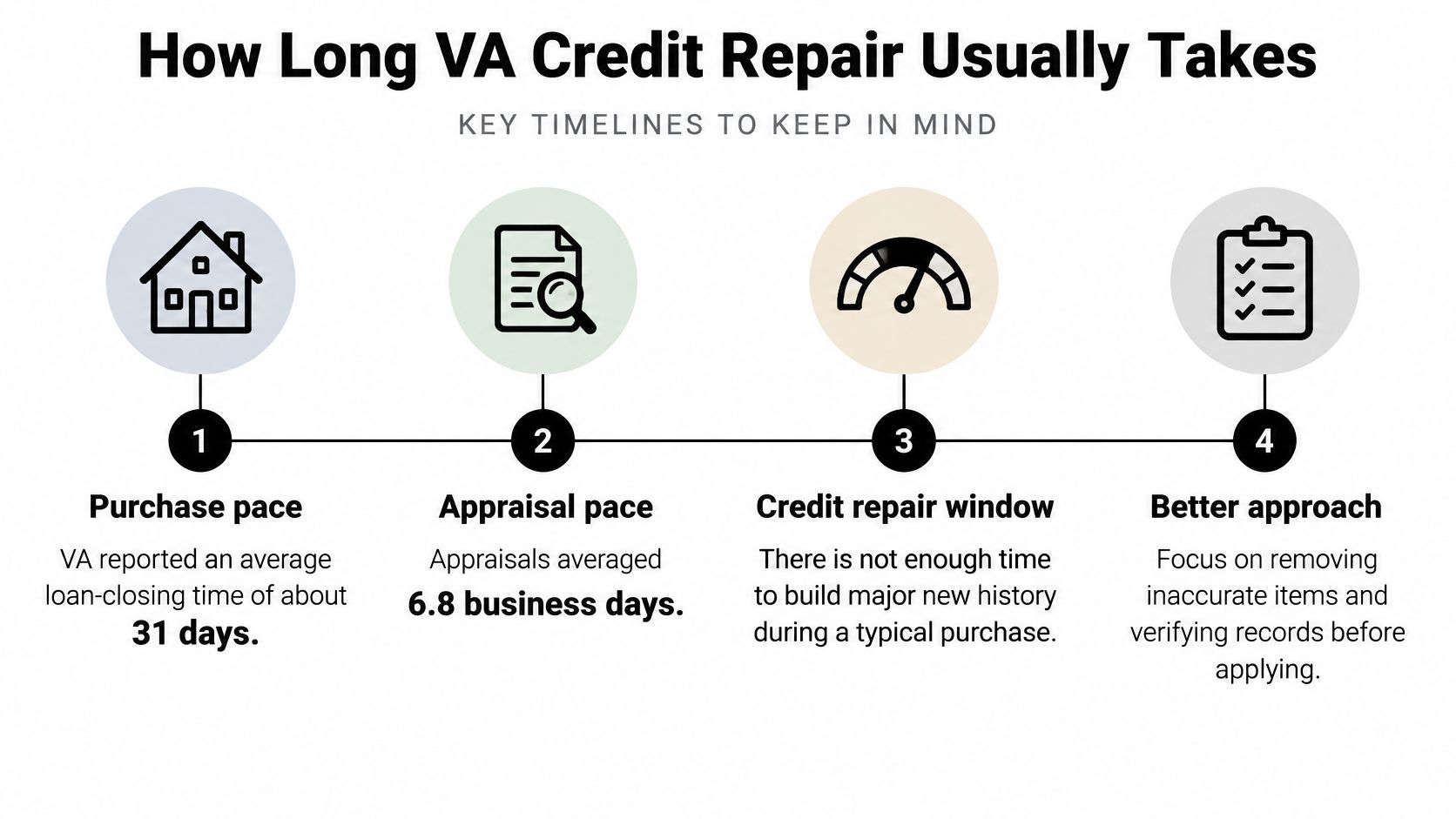
Two clocks run at once during VA credit preparation. One tracks how quickly reporting errors get corrected, and the other tracks how quickly your finances can show a pattern a lender trusts. Confusing the two is where most timeline frustration starts.
VA credit preparation timeline
| Phase | Timing | Action | Result |
|---|---|---|---|
| Review | Several months before house hunting | Pull all three reports, list each negative item, gather statements | Documented starting file |
| Dispute | Allow the bureau's investigation window and possible follow-up | Send documented disputes; keep current accounts paid; avoid new credit | Written responses and records |
| Overlay check | Before preapproval | Confirm the lender's credit overlay and whether collection minimum payments count | Clear lender requirements |
| Preapproval | After documents are organized | Discuss a specific payment with a lender | File ready for lender evaluation |
| Closing | After a purchase contract and completed lender review | Complete appraisal and outstanding documentation requests | Timing tied to file completeness |
Mortgage processing speed varies by lender, appraisal scheduling, and how complete your file is when it reaches underwriting. None of that sets a deadline for credit repair itself. A purchase contract can create pressure to solve everything immediately, but it doesn't give a bureau more evidence, make creditors respond sooner, or create a longer record of reliable payments.
Separate correction time from rebuilding time
Correcting a reporting error and rebuilding a credit pattern are different jobs on different schedules. A correction depends mostly on account records and an investigation response. Rebuilding requires continued on-time payments and lower balances, which no dispute letter can produce.
Paying an old collection illustrates the difference. The balance may update quickly, but the late-payment history behind it stays in your file. An unresolved ownership question, inconsistent bureau reporting, or missing creditor records can also stretch the correction side, so don't assume every account gets resolved in the first response or that each fix will shift a mortgage score.
For a more useful planning discussion, ask:
- What is waiting on documentation? Locate missing statements before submitting another dispute.
- What is waiting on a response? Track submission dates and follow the bureau's instructions.
- What requires ongoing behavior? Continue reducing revolving debt and avoiding new missed payments.
- What requires a lender decision? Confirm the conditions for moving from preparation to preapproval.
Our explanation of when credit repair results appear can help distinguish report updates from broader readiness milestones.
Choose readiness before a deadline
Start before house hunting whenever possible. That leaves room to evaluate responses, collect updated statements, and decide whether a proposed mortgage fits the household budget.
VA sets no universal minimum score, so reaching a lender's threshold is a milestone rather than a finish line. A file can still stall when residual income falls short, when collections need separate analysis, or when undisclosed buy-now-pay-later debts surface late in review. Build time for those questions alongside the disputes.
If you've already signed a contract, tell the loan officer about unresolved reporting questions promptly. Don't launch additional disputes, make a large settlement payment, or open a new account without discussing how the action might affect the active application.
No responsible timeline promises that accurate negatives disappear by closing. Results vary with the file, creditor responses, documentation, and current behavior, so use completed records and lender guidance to decide when to proceed.
Ask for a Review Before You Apply
You may be comfortable handling the process independently when the errors are limited, supporting records are available, and the proposed house payment fits your budget. Keep a written checklist and review each response before choosing another action.
Organized help may be useful when bureaus disagree, collection and charge-off entries overlap, or a previous mortgage denial left you unsure what to address. The value should be clearer documentation and practical next steps, not promises about a future decision.
Decide what kind of help you need
Superior Credit Repair offers a free consultation that starts with what is reporting now, what may be inaccurate, and what steps make sense for your goal. We can review your credit report, help identify inaccurate or questionable items, and explain a step-by-step plan for improving your credit profile.
Our approach focuses on accurate disputes, education, and rebuilding habits. You remain responsible for providing accurate facts, reading responses, and deciding when to apply.
That distinction matters whether your next goal is home, auto, business, or personal financing. Credit repair cannot guarantee mortgage, auto, or rental approval, a score increase, or deletion of accurate negative history.
Does a score around the lender's threshold guarantee a VA loan?
No. The lender still evaluates qualifying income, residual income, obligations, and the full credit history.
Must every collection be paid before preapproval?
Not automatically. Start with account accuracy and the lender's required analysis before choosing a resolution.
Can a dispute finish during a purchase closing?
It might, but you shouldn't rely on that outcome; begin credit preparation before committing to a purchase whenever possible.
Do missing app payments matter if the score looks acceptable?
Yes. Disclose active installment-app obligations so the lender can evaluate your actual monthly commitments.
Was this guide helpful?
Superior Credit Repair Online provides educational credit guidance for individuals and families preparing for major financial goals like buying a home, applying for a mortgage, refinancing, or rebuilding after credit challenges.
If this information helped you better understand your credit report or your next steps, we would appreciate your honest feedback. You are welcome to share your experience with Superior Credit Repair on our Google Business Profile.
Superior Credit Repair offers documentation-focused credit review and rebuilding guidance for veterans preparing to use their home-loan benefit. Visit Superior Credit Repair to request a free consultation, discuss your mortgage goal, and identify practical next steps based on your current reports and supporting records.