

You've started gathering pay stubs, checking home prices, and thinking about mortgage preapproval. Then an unfamiliar number calls about an old medical bill, a credit card balance, or an account you barely remember. A voicemail becomes a text, and a letter arrives just as you're trying to make your credit file look stable for a lender.
A cease and desist collection letter can help control unwanted communication, but it isn't a magic eraser. It generally tells a covered third-party debt collector to stop contacting you about a specific debt. It doesn't automatically cancel the debt, remove accurate credit reporting, stop a lawsuit, or guarantee mortgage approval. The right response depends on whether your priority is privacy, proof that the debt is valid, or correction of a credit-report error.
Table of Contents
- Why Homebuyers Often Face Collection Contact Before Applying
- How to Send a Compliant Cease and Desist Collection Letter
- Cease and Desist Versus Debt Validation and Credit Disputes
- What a Cease and Desist Letter Cannot Do for Mortgage Readiness
- Documentation, Tracking, and Escalation If Contact Continues
- Next Steps for Consumers Preparing for Mortgage Approval
Why Homebuyers Often Face Collection Contact Before Applying
A first-time buyer reviewing a credit report for an FHA, VA, USDA, or conventional mortgage may find a collection account at the worst possible moment. The collector might call during work, text a personal phone, or mail notices to an old address. That contact feels intrusive while the buyer is gathering bank statements, income records, debt information, and down-payment funds.
The mortgage application may not have caused the contact. The buyer may be examining the file for the first time or responding to a recent notice. An older account can also move between collection companies, so an unfamiliar caller may still be contacting the consumer about the same underlying debt.

Start by identifying the problem you need to solve. A cease-and-desist letter is a privacy tool that can limit unwanted communication from a covered third-party debt collector. It does not erase a valid balance, prove that the collector owns the account, or correct inaccurate credit reporting.
Choose the right remedy
The Fair Debt Collection Practices Act, enacted in 1977, provides the federal basis for a written request that a covered debt collector stop communicating with a consumer. The Consumer Financial Protection Bureau's FDCPA annual report explains that later communication generally must be limited to confirming that collection efforts will stop or notifying the consumer about a specific legal remedy.
The report also records approximately 109,900 debt-collection complaints in 2023. Consumers most often reported attempts to collect debts they said they did not owe. Written-notice complaints ranked second, and 69% of consumers raising those concerns said they had not received enough information to verify the debt.
Use a debt validation request when your concern is ownership, the balance, payment history, or whether the collector can substantiate the account. Use an FCRA credit-report dispute when the reported account contains an error, such as an incorrect balance, status, dates, or account identity. A cease-and-desist letter addresses contact. Validation addresses evidence. An FCRA dispute addresses reporting accuracy.
Keep those purposes separate in your records. Sending a payment, ignoring the account, or demanding silence will not automatically make a mortgage file easier for an underwriter to review. An unclear response can leave you without a clean explanation of what happened.
Save every notice, envelope, text, voicemail, and credit-report entry. Record the collector's name, the account reference, the original creditor, and the dates of contact. If household liabilities also need attention, a debt payoff plan for first-time buyers can help organize repayment priorities without treating debt management as a substitute for correcting credit data.
For education about collection accounts appearing on a credit report, review Superior Credit Repair collection help. The goal is a documented, accurate record that protects your privacy and gives you the right basis for addressing the debt before mortgage underwriting.
How to Send a Compliant Cease and Desist Collection Letter
A cease-and-desist notice should be short, specific, and easy to prove. Don't use it as a substitute for a debt dispute, settlement proposal, insurance appeal, or credit-bureau dispute. Send the communication-control request separately from any challenge to ownership, balance, dates, or reporting accuracy.
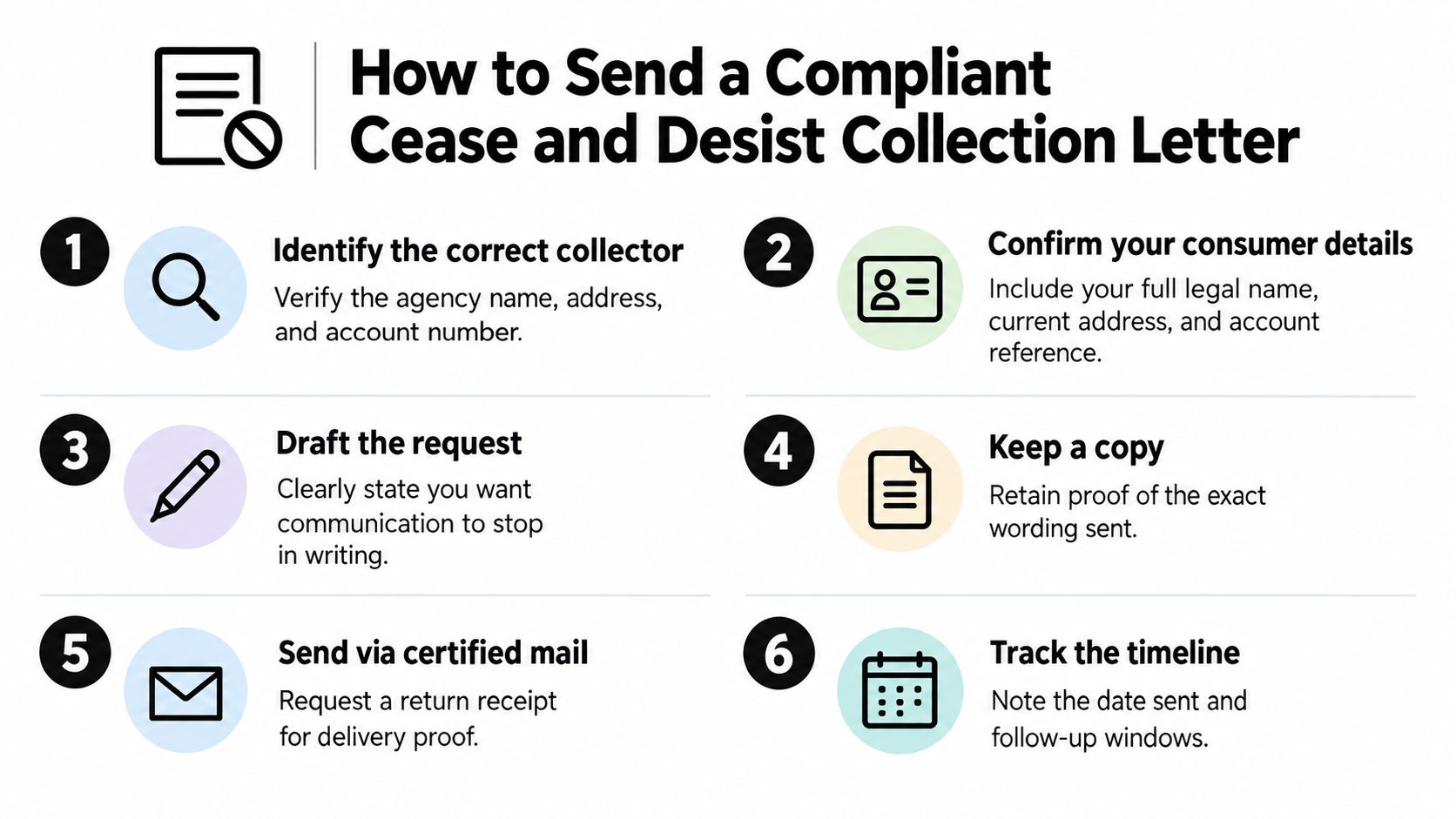
Start with the correct account
Before drafting, collect the collector's legal name, mailing address, account number, original creditor, and your own identifying details. Use the account reference shown in the collector's notice, but don't include unnecessary personal information. The purpose is to make clear which consumer and which debt the notice addresses.
Confirm whether the recipient is a third-party debt collector covered by the FDCPA. The federal rule doesn't automatically apply to every original creditor or every company contacting you. State law may provide additional protections, so a consumer facing unusual circumstances, a threatened lawsuit, or unclear ownership should consider qualified legal advice.
Your letter should clearly say that you're requesting that the collector stop communicating with you about the identified debt. Don't rely on an ambiguous phrase such as “please stop bothering me.” Identify the account and state the communication limit in writing.
Deliver the notice in a trackable way
Use a delivery method that creates evidence of receipt, commonly certified mail with a return receipt. Keep the signed letter, the exact final wording, the mailing receipt, the tracking history, and the returned delivery record together. Electronic delivery can also matter when legally valid. FDIC guidance states that written or electronic requests are complete when received, so a timestamped portal, email, or text record may help document delivery in the right circumstances. The FDIC FDCPA examination manual discusses this receipt-based principle and the limits of the communication restriction.
The request generally becomes effective when the collector receives it. Don't assume that the date you typed the letter is the date the legal restriction began. Record the actual delivery date and time when available.
Preserve a complete intake log
Create a simple log with the collector's identity, account reference, date sent, delivery date, contact channel, and every later message. Save call records, voicemails, letters, emails, texts, account statements, and credit-report snapshots. A collector may still send limited communication confirming that collection efforts will stop or stating that a specific legal remedy, including litigation, may be pursued.
The practical test isn't whether the account disappears. It's whether the collector stops communications that the law prohibits after receiving a valid notice. Don't label every later contact a violation before comparing it with the statutory exceptions and confirming that the same collector and account are involved.
| Checklist Item | Why It Matters |
|---|---|
| Collector name and address | Confirms that the notice reaches the correct company. |
| Original creditor and account reference | Separates the identified debt from unrelated accounts. |
| Consumer name and contact details | Helps the collector match the request to the correct file. |
| Clear written stop-contact request | States the requested remedy without ambiguity. |
| Copy of the exact letter | Preserves what you actually sent. |
| Certified-mail or electronic delivery record | Helps establish when the collector received the request. |
| Contact and response log | Creates an organized record if communication continues. |
Don't combine a cease-and-desist demand with a vague statement that “this debt is illegal” or “delete this from my credit report.” If you need evidence that the collector has authority, the amount is accurate, or the account belongs to you, learn what is a debt validation letter and keep that request distinct.
Cease and Desist Versus Debt Validation and Credit Disputes
These three tools solve different problems. Choosing one based on the actual problem is more effective than sending every possible demand in one document.
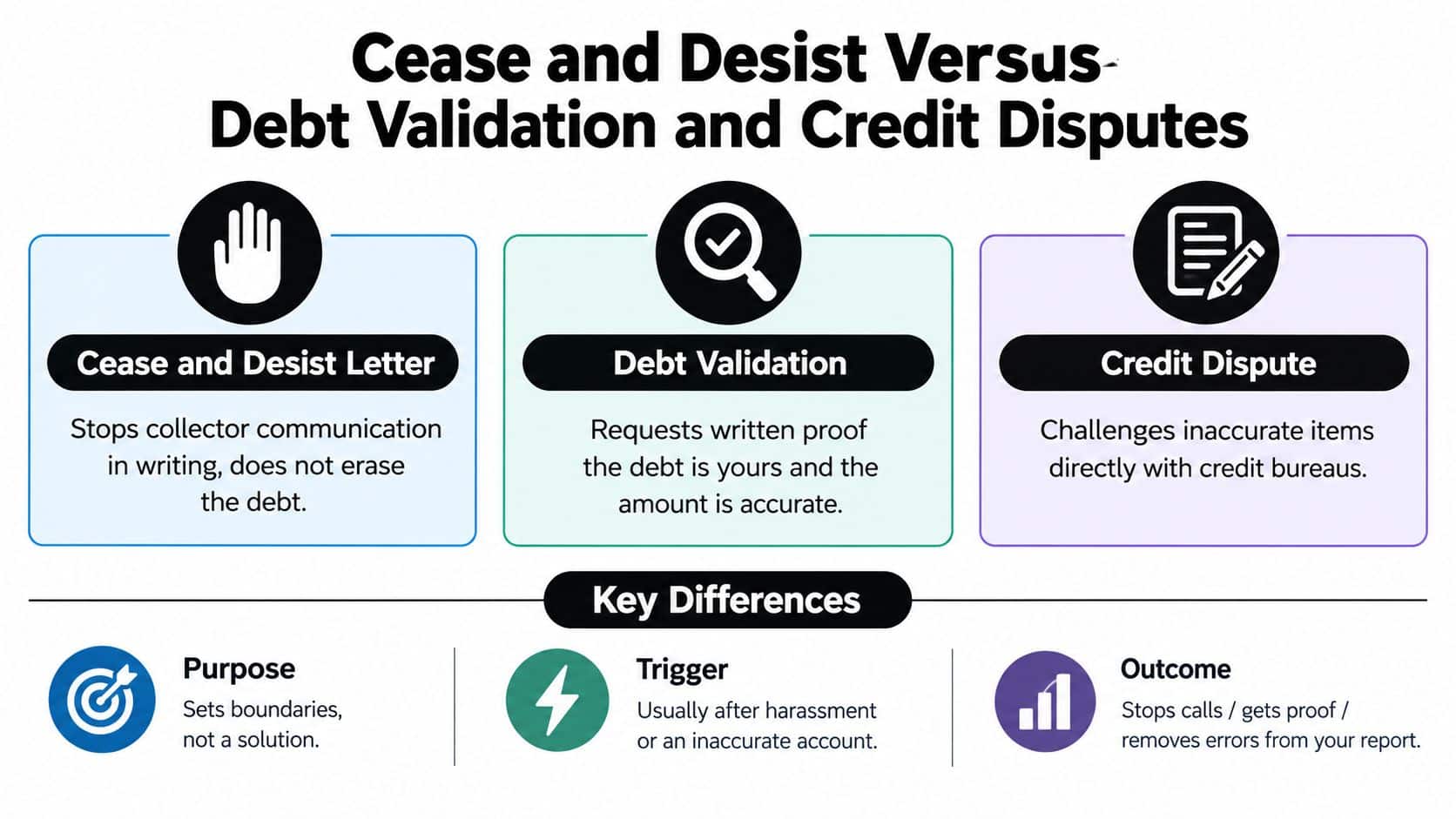
A cease-and-desist letter controls direct communication. A debt validation request seeks information about the debt, such as the creditor, amount, and basis for collection. An FCRA credit-report dispute challenges information appearing on a consumer report as inaccurate, incomplete, outdated, duplicated, or unverifiable.
Match the tool to the problem
Use a cease-and-desist request when privacy or unwanted contact is the immediate concern. Use validation when you need documentation before deciding whether to pay, settle, dispute, or defend the account. Use a credit-report dispute when the information furnished to a bureau is wrong or cannot be verified.
If you dispute a debt in writing within 30 days of receiving validation information, collection activity generally must pause until the collector provides verification, according to the Federal Trade Commission's debt collection FAQs. That process addresses collection activity and documentation. It doesn't replace an accuracy dispute with the credit bureaus.
| Tool | Primary Purpose | Effect on Reporting |
|---|---|---|
| Cease and desist letter | Stop direct collection communications about a specified debt | Doesn't automatically remove or correct accurate reporting |
| Debt validation request | Request information supporting ownership, creditor identity, and amount | Doesn't automatically delete a properly reported account |
| FCRA credit dispute | Challenge inaccurate, incomplete, outdated, duplicated, or unverifiable reporting | May lead to correction, deletion, or blocking when the information can't be verified |
A consumer preparing for a mortgage may need more than one process, but each document should explain its own purpose. For example, a medical collection involving an insurance billing error may require records from the provider and insurer, a validation request to the collector, and a separate dispute to every bureau reporting incorrect information.
Debt strategy still matters after you identify the legal tool. If repayment is appropriate and you're comparing high-interest balances, a resource explaining how the saves interest with avalanche method can help with prioritization. That financial strategy doesn't replace validation or reporting disputes, but it may support responsible repayment decisions.
For a mortgage-focused comparison of the two dispute paths, use this guide to debt validation for homebuyers. The central rule is simple: don't ask a communication letter to perform the job of an accuracy dispute.
What a Cease and Desist Letter Cannot Do for Mortgage Readiness
A cease-and-desist letter can reduce direct contact, but it won't make an unresolved collection invisible to a mortgage lender. Accurate negative information may remain on a credit report, and the debt may still affect how a lender evaluates the file under its applicable guidelines.
The letter also doesn't automatically cancel the balance, prevent the account from being sold, require a settlement, or stop a collector or creditor from filing suit. It can even reduce your opportunity to negotiate or receive routine information about the account. If a legal notice arrives, treat it as a legal deadline, not as another collection call to ignore.
Understand the mortgage consequence
Mortgage readiness depends on the condition of the credit file and the borrower's broader financial picture. Lenders may ask about collections, charge-offs, late payments, current debts, payment history, utilization, debt-to-income concerns, and account stability. Stopping phone calls doesn't answer those questions.
The CFPB reported approximately 207,800 debt-collection complaints in 2024, representing about 7% of all complaints received that year, compared with approximately 109,900 in 2023. The 2024 report states that 77%, or roughly 159,700, were sent to companies for review and response, while 18% were referred to other regulators and 5% were classified as not actionable. Companies responded to approximately 97% of complaints sent to them. These are consumer allegations, not adjudicated findings that every collector violated the law. The CFPB's 2024 debt-collection report identifies disputed debts, written-notice concerns, and threats of negative or legal action as recurring complaint themes.
Those figures reinforce a practical point for buyers. Keep a record that shows what happened, but don't confuse a communication problem with a credit-report problem. If the account is inaccurate, the mortgage file may still need a documented correction.
Consumers should also monitor court notices and limitation-period issues. A request to stop communication doesn't prohibit litigation, and silence doesn't mean the account has been resolved. Before sending the letter, preserve bills, payment records, insurance explanations of benefits, account statements, and notices, especially when the debt is medical, disputed, or approaching a legal deadline.
Mortgage applicants dealing with unresolved accounts should organize documentation for mortgage with collections. A lender may ask for an explanation, proof of resolution, or other records. Prepare those documents before the application rather than hoping fewer calls will eliminate underwriting questions.
Documentation, Tracking, and Escalation If Contact Continues
Treat the letter as the beginning of a recordkeeping process. Keep a dedicated folder containing the original notice, delivery proof, collector correspondence, account statements, call history, voicemail files, text messages, emails, and credit-report snapshots. Name files with the date and communication type so you can reconstruct the timeline without relying on memory.
A spreadsheet or paper log works well. Record the date, time, channel, phone number or sender, account reference, substance of the message, and whether the communication appears to fit a permitted exception. Don't repeatedly call the collector to argue about the notice. Informal conversations can create confusion about what was said and may distract from preserving objective evidence.
Review the source before escalating
Continued contact may come from a different collector, the original creditor, a credit-reporting agency, or a company handling another account. A cease-and-desist request is account-specific and doesn't automatically bind unrelated companies or debts. Third-party contact may also be legally permitted in limited circumstances, so assess the message before calling it unlawful.
Electronic records deserve the same care as paper records. Save complete email headers where available, screenshots that show dates and sender information, text-message threads, and portal confirmations. The FTC's consumer-finance debt-collection guidance explains the broader role of federal rules in addressing abusive and deceptive collection conduct.
If the same covered collector continues prohibited communication after receipt, assemble the timeline before escalating. Consider a complaint to an appropriate regulator or consult a consumer-law attorney, particularly if the collector threatens legal action, contacts your workplace or family improperly, or ignores clear delivery evidence. Don't exaggerate the facts. A precise record is more useful than an angry narrative.
Use these collection dispute documentation tips to keep the file organized. Your documentation should help answer four questions: who contacted you, about which account, when the notice was received, and what happened afterward.
Next Steps for Consumers Preparing for Mortgage Approval
A cease-and-desist notice may restore privacy, but mortgage preparation requires a broader plan. Start by obtaining your credit reports and reviewing collections, late payments, charge-offs, repossessions, medical accounts, high utilization, and personal information for errors. Mark each item as accurate, incomplete, outdated, duplicated, or uncertain, then gather records before sending a dispute.
Build the plan around the actual problem
Use a validation request when you need evidence about ownership or the balance. Use an FCRA dispute when the credit report contains a specific error. A written dispute should identify each item, explain what is wrong, mark the disputed entries on a copy of the report, and include copies of relevant records. The FTC recommends disputing with each bureau that reports the error and contacting the business that furnished the information, while using certified mail with a return receipt to document delivery. Its consumer credit-report dispute guidance explains this documentation-based approach.
When a consumer disputes the accuracy or completeness of information with a credit bureau, the bureau generally must conduct a reasonable reinvestigation within 30 days. If the consumer submits additional relevant information during that period, the bureau may receive up to 15 additional days. The FTC guidance for furnishers explains that the bureau must notify the furnisher, which must investigate and report its findings. Inaccurate, incomplete, or unverifiable information must be corrected, deleted, or permanently blocked from reporting. Information verified as accurate may remain.
Strengthen the parts you control
Pay every current account on time, avoid taking on unnecessary new debt, manage revolving utilization carefully, and keep balances and payment records stable. Review debt-to-income concerns before a lender does. If you're renting, keep housing payments documented. If you're preparing for FHA, VA, USDA, or conventional financing, ask a qualified mortgage professional which account conditions and documentation the chosen program requires.
Don't chase a promised score jump or guaranteed deletion. Credit restoration is a structured review, legal dispute, verification, and rebuilding process. Results vary with the credit file, supporting evidence, creditor responses, account history, and current behavior. A realistic credit score improvement timeline is more useful than a promise of overnight repair.
Frequently asked questions
Will a cease-and-desist letter remove a collection from my credit report
No. It generally controls communication from a covered third-party collector. Accurate reporting can remain, and an inaccurate item requires a separate, documentation-based credit-report dispute.
Should I send a cease-and-desist letter before applying for a mortgage
Send one when unwanted collection contact is the priority, but don't send it just to make a mortgage file appear cleaner. First determine whether you need communication control, debt validation, or correction of inaccurate reporting. Keep copies and delivery proof for your lender file.
Can a collector sue after receiving the letter
Yes. The collector may send a limited notice stating that a specific legal remedy may be pursued, and the letter doesn't prevent litigation. Monitor court notices and obtain legal advice if you receive legal papers.
What if the collection is medical
Preserve the bill, insurance explanation of benefits, payment history, provider statements, and collection notices. A communication ban won't resolve an insurance dispute or prove that the balance is invalid. You may need validation and a separate credit-report dispute if the reporting is inaccurate.
Can Superior Credit Repair guarantee that a collection will be deleted
No reputable company should guarantee deletion, a specific score increase, or mortgage approval. Credit repair should rely on accurate disputes, documentation, verification, and responsible rebuilding. Results vary by individual file and creditor response.
Superior Credit Repair can review your credit report, help identify inaccurate or questionable items, and explain a step-by-step plan for improving your credit profile. You can request a free credit analysis or consultation to better understand your options.
Superior Credit Repair can help consumers organize credit-report reviews, identify inaccurate or unverifiable collection information, and build a documentation-based plan before mortgage, auto, business, or personal financing. Visit the company to discuss your situation without relying on promises of guaranteed deletion or approval.
If this information helped you better understand your credit report or your next steps, we would appreciate your honest feedback. You are welcome to share your experience with Superior Credit Repair on our Google Business Profile. https://share.google/ePRpFvtCXwCjiJwOK