



Severity starts with the unpaid contract, not the method of return
Facing a Difficult Car Loan Decision
A surrender often begins after weeks of missed or partial payments. The vehicle is collateral for the financing, so the creditor can take and sell it after a qualifying default under the contract and applicable law. Before making a decision, ask for the full reinstatement figure and whether the account is already assigned for recovery.
What is a voluntary repossession? It means the borrower cooperates in returning the vehicle instead of waiting for the lender to arrange a pickup without that cooperation. A voluntary repossession is still a repossession for credit-reporting purposes; the difference is primarily how the vehicle is returned and which recovery expenses may arise.
What a Voluntary Repossession Actually Means
Deciding to voluntarily surrender a car can reduce uncertainty around the pickup, but it is not a bargain to forgive the debt. The conversation with the servicer should address who receives the keys, how personal belongings are handled, and whether the borrower has any cure or redemption rights.
If you are weighing another car soon, the current credit score is only one part of affordability. Income stability, existing obligations and the size of the remaining loan balance matter more than a sales promise that the record will simply disappear.
Keep the original loan agreement and all recent statements together. A quick check of the contract often reveals where notices must go and whether deferred payments, an extension or a negotiated sale remains possible.
Returning the vehicle without losing track of the process
How the process usually works
Start by contacting the lender through the phone number on an actual statement. Ask for instructions in writing and record the date, person and reference number. If you voluntarily surrender, get a signed receipt identifying the vehicle identification number, date and condition at the handoff.
Remove your belongings before the agreed surrender, photograph the mileage and condition, and keep spare-key documentation. A creditor may have lawful recovery options outside a voluntary arrangement; in some circumstances its agent may come to your house or recover the car at another permitted location. Rules on notice and breach of peace vary by state.
A borrower who does not respond may discover that a recovery agent can come to your house while the dispute about payments is still unresolved. An agreement with the servicer should be confirmed rather than assumed from a verbal offer.
Ask when and how the vehicle will be offered for sale, where the accounting will be sent, and which fees are permitted. The paperwork matters if a later credit report review shows an amount or status that does not match the lender’s closing statement.
If the loan is jointly signed, make sure all liable borrowers understand the surrender paperwork. Agreements to voluntarily surrender generally do not release a co-borrower without the lender’s express written consent.
The balance that remains after the auction
Do I still owe money after giving the car back?
The auction proceeds may be less than the outstanding payoff. In that case a deficiency can remain after deducting the net sale proceeds from the amount legally owed, with permitted recovery and sale costs included. Ask for a transaction-by-transaction accounting rather than accepting an unexplained lump sum.
What happens after the lender sells the car
A possible deficiency is why a voluntary surrender should be evaluated before a family uses emergency savings to cover other bills. If the creditor claims a balance after the sale, check whether the sale was commercially reasonable under applicable law and whether every fee is authorized.
The shortfall can become a separate collection issue even though the physical car is no longer yours. That situation may produce new credit problems if the account is later transferred or if the consumer ignores correspondence about the claim.
Why the debt often doesn't end
Consider a simple example: a vehicle is surrendered when the net contractual obligation is $16,400 and lawful net auction proceeds total $11,250. The remaining $5,150 is only an illustration before applying any additional contract terms or protections; actual amounts must come from the creditor’s records.
When the deficiency amount looks wrong
If the amount looks wrong, preserve the payment ledger, surrender receipt and sale notice. A credit report repair service may help organize a documented challenge to inaccurate reporting, but it cannot invalidate a valid deficiency just by sending a dispute letter.
Do not agree to an unaffordable settlement without confirming whether it covers the entire obligation and how the account will be updated. If a collector takes over, verify the debt ownership before making arrangements.
How serious the credit reporting can be
How it appears on your credit report
A voluntary repossession normally appears as a serious derogatory event when accurately furnished. The missed payments leading to surrender may already have affected your credit score, so there is no reliable universal number of points that the event will subtract.
How long does a voluntary repossession stay on my credit report?
The clock for most negative auto-loan reporting is generally tied to the delinquency that led to the default, not the date you hand over the keys. A repossession can ordinarily remain on consumer credit reports for about seven years, subject to the applicable reporting rules. This is different from any state limit on suing for an unpaid balance.
How much the credit score changes depends on the rest of the file, the scoring model and whether other recent delinquencies are present. A clean file and a file already carrying several severe marks can react differently, so a quoted point-loss estimate should not determine the surrender decision.
What later lenders and the bureaus will see
On an auto application, lenders may perform a credit check to review the same reporting from one or more bureaus. When car buying, credit score models and underwriting rules vary, so a figure from a free dashboard does not substitute for a lender’s actual decision.
After the sale, check your credit at all nationwide bureaus to confirm the account status and any remaining amount. The entries should be factually consistent with the documents; a reporting error can be disputed, but the original default is not automatically erased.
The Immediate Impact on Your Credit Score and Report
If your priority is car buying, credit score concerns should be paired with a realistic monthly payment ceiling. A higher approval amount is not evidence that the new loan will be affordable.
An inaccurate reported balance may be more actionable than the mere existence of a repossession. Retain a dated credit report review and the creditor’s written explanation before deciding which facts to challenge.
Why a cooperative surrender is not a clean record
Is voluntary repossession better than an involuntary repo for my credit score?
A voluntary surrender can be calmer than a surprise recovery, but the scoring treatment of a voluntary and an involuntary repossession may be similar. A later creditor can still see that the account was not paid according to the loan agreement.
The practical advantage is often better control over where the vehicle is delivered and potentially fewer avoidable expenses. The disadvantage is that a fresh derogatory mark may limit financing options, especially when other recent late payments exist.
Car buying, credit score screening, and lender interviews should be treated as separate steps. One dealer might focus on the number of months since surrender, while another asks for the unpaid deficiency and proof that present bills are current.
Long-Term Consequences Beyond the Score Drop
Ask an auto lender to explain its decision criteria rather than assuming bad credit auto loans all use the same credit score threshold. Loan-to-value limits and down-payment requirements can differ sharply even for applicants with similar files.
The history of late payments before surrender can matter as much as the status label. Read the linked explanation of late-payment reporting when reconstructing the sequence of events.
For a different explanation of how a surrender can appear to a later decision-maker, the archived discussion of voluntary-repossession outcomes addresses the impact from the vehicle-financing perspective.
A secondary discussion of surrender tradeoffs explores costs and alternatives; compare any general claims with your own contract and current state law.

Options worth testing before the final return
Alternatives to Consider Before Surrendering Your Vehicle
Before arranging a voluntary surrender, ask the servicer whether hardship relief, deferred payments or a payment-date change is available. If you decide to voluntarily surrender, record the deadline for collecting your personal belongings. A short extension can be useful when the difficulty is temporary, but written terms should show whether interest continues and whether missed installments move to the end of the contract. Trading the car immediately for bad credit car loans may carry more total cost than curing a manageable delinquency.
Deferred payments can sometimes increase the eventual total cost. Request the revised payment schedule and compare it with the cost of keeping the vehicle; verbal reassurance that the account is safe is not enough.
Selling the car privately may produce more money than a wholesale sale, but the creditor’s lien must be addressed in the transaction. If you need to transfer a car loan to another person, investigate whether the lender allows an actual assumption; simply handing someone the keys does not release the existing borrower.
Options that may reduce the damage
When insurance is part of the budget problem, examine whether gap coverage fits the loan exposure, because a total loss on a loan that is larger than the car is worth can leave a balance much like a deficiency after surrender. Verify exclusions and cancellation terms before you buy or cancel it.
A lien release matters for a private sale. The vehicle-lien explanation provides background on title status, while the lender should supply the actual payoff and release instructions.
For some households an inexpensive replacement vehicle may cost less than a cycle of bad credit auto loans. Calculate maintenance, insurance, tax and commute expenses before signing any financing agreement.
If you cannot get an affordable agreement, decide how to voluntarily surrender in a way that leaves a reliable paper trail. Ask the lender to send its final deficiency statement to a confirmed mailing address.
Financing transportation after a repossession
When you can finance another car after a repossession
There is no national waiting period that automatically bars every applicant from buying another car. Underwriting varies by lender and may depend on what happened after the surrender, whether a deficiency remains, and the borrower’s current capacity to pay.
The common question “How long after a repo can you get another car?” has no single date that applies to every loan application. Some lenders consider an applicant soon after a repo, while others want more time or an explanation of the past loss. Compare bad credit car loans using a written total-cost estimate rather than a verbal statement about monthly payments. Ask whether the next credit check requires a full application and could be recorded as a hard inquiry.
When car buying, credit score checks can reflect different scoring models across lenders. Ask which report was used and whether the offered rate assumes a larger down payment than you can actually make.
Bad credit auto loans may be available, but the approval should be evaluated by annual percentage rate, total finance charge and the cost of the vehicle, not by the mere availability of a payment plan. Among bad credit car loans, compare whether fees are financed or paid upfront.
Keep a copy of every offer and avoid letting numerous applications substitute for a comparison of terms. An authorized credit check is different from a claim that financing requires no review at all. Some bad credit car loans carry add-on charges that must be disclosed and evaluated independently of the stated monthly payment.
Rent-to-own and other high-cost car offers
Rent to own vehicle arrangements can shift maintenance and ownership risks. If a seller advertises rent to own as a path to ownership, read the default and title provisions before making payments.
A second rent to own offer may look cheaper each week while carrying a larger total cost than an ordinary installment contract. The number of payments, fees and repossession provisions should all be compared. Before contrasting it with bad credit car loans, check whether the contract gives you ownership at the end.
Transportation urgency can push someone toward a poor deal. A modest cash vehicle or a delayed purchase can sometimes be safer than a high-cost loan. Even bad credit car loans with small down payments can be difficult to maintain when insurance costs rise.
A carefully targeted recovery guide after voluntary surrender can help separate a correct derogatory record from inaccurate dates. The next step is documenting current payments, not claiming that the repo never occurred.
When researching bad credit auto loans, compare lenders that disclose the full amount financed and ask whether the unpaid old obligation affects approval. A vague answer about “fresh credit” may conceal costly conditions.
Preparing for a mortgage without guessing about approval
What mortgage underwriting weighs after a repossession
Mortgage underwriting weighs repayment history alongside documented income, assets, existing debt obligations and the loan program. A car repossession can raise questions, but no single national rule automatically tells every borrower when a mortgage will be approved.
How a Repossession Affects Mortgage Approval
A lender may require an explanation of the original hardship and documentation of the current deficiency. A prequalification credit check should be distinguished from the final mortgage credit review before any new application is authorized. Car buying, credit score recovery and home purchase readiness are different financial decisions, even when each draws from the same credit report.
A preliminary conversation about what mortgage lenders review can clarify which records should be collected before a formal application. Keep any written lender conditions with the repo paperwork.
Rebuilding with FHA, VA, and Conventional financing in mind
FHA, conventional, VA and USDA products may assess risk differently, and the score model used for a specific application can differ from a consumer tool. A credit restoration service can help organize inaccurate-report disputes, but a mortgage lender makes its own eligibility and pricing decision.
If car buying, credit score recovery and a home search overlap, prioritize monthly payments you can sustain. An auto loan taken immediately before a mortgage could change debt-to-income calculations even if the new vehicle solves a transportation problem.
Avoid a new car loan just before a mortgage application
Some borrowers explore bad credit auto loans just before applying for housing. Compare the effect of that obligation on a proposed housing payment instead of treating every new approval as progress.
Insurance and lender questions for a future home purchase
A future home purchase involves property insurance as well as loan affordability. This homeowners-insurance guide shows how coverage, deductibles and exclusions change the monthly cost of owning a home, which belongs in the budget alongside the mortgage payment.
A broader discussion of longer-term score rebuilding can be useful when setting realistic milestones, but the report must first reflect the actual auto-loan history.A credit-report impact discussion may help frame questions for a lender, while the final underwriting conditions must come from the actual institution processing the application.
Answers that change the next action
Can the repossession be removed merely because it was voluntary?
No. Accurate reporting is not erased just because you arranged the handoff. A credit report repair service is most relevant when the account has an incorrect balance, wrong dates or an item that does not belong to you. Save evidence before opening a factual dispute.
What is a voluntary repossession compared with default?
A voluntary repossession is the method of returning collateral after a loan problem; default is a failure to meet the contract’s terms. You can voluntarily surrender the car yet still face a valid claim for an outstanding balance.
How long after a repo can you get another car?
The answer depends on the lender, the remaining obligation and the new payment. Check your credit and compare written offers, particularly where a dealer advertises bad credit auto loans without describing the actual annual percentage rate.
Will every repossession lead to a mortgage denial?
No universal outcome applies. Review the cause, age and current resolution of the account with the actual lender. Keep a record of repayment arrangements so an underwriter can distinguish today’s affordability from a past loss.
Can credit-restoration work ensure mortgage approval?
No. A credit restoration service or legitimate credit restoration effort can address documented reporting problems, but it cannot promise deletion of accurate information or a particular credit score. Consumers can also dispute mistakes themselves at no cost.
What does “repair credit near me” mean after vehicle surrender?
If you are considering a provider after a repossession, judge the work by specific documents it will review and the written fee and cancellation terms. A provider advertising “repair credit near me” services cannot shorten federal reporting limits for an accurate default.
Are there other risks a family should plan for?
Before borrowing again, check any vehicle lien and clarify who must approve a transfer or payoff. Keep personal property insurance questions separate from the auto-loan accounting so one policy decision does not get mistaken for repayment relief.
How credit repair fits, and where its limits are
For a general view of vehicle repossession and mortgage screening, compare the advice with your loan officer’s written requirements. Additional credit problems should be handled by evidence, not by claims that any negative item can be instantly deleted.
For details about the available process and credit-report assistance, ask what can be verified and corrected. A public feedback channel is also available for customers who want to describe an experience, but it does not affect the consumer’s dispute rights.
If your question began with “repair credit near me,” start with documents: the loan agreement, sale accounting, bureau report and written responses. That documentation helps a credit report review focus on facts rather than promises.
A lot of people start researching voluntary repossession at the same point. The car payment has become too much. Maybe income dropped, expenses went up, or a temporary setback lasted longer than expected. You want to avoid a surprise tow truck, avoid extra chaos, and handle the situation responsibly.
For many families, that feels like the least harmful option. Hand the car back, stop the monthly payment, and move on.
But if you’re asking how bad is a voluntary repossession, especially because you still want to buy a home later, the honest answer is this: it’s a serious negative event. It can affect your credit, leave you with remaining debt, and create extra mortgage hurdles long after the car is gone. The good news is that it doesn’t make recovery impossible. It does mean you need clear expectations and a careful plan.
Table of Contents
- Facing a Difficult Car Loan Decision
- What a Voluntary Repossession Actually Means
- The Immediate Impact on Your Credit Score and Report
- Long-Term Consequences Beyond the Score Drop
- How a Repossession Affects Mortgage Approval
- Alternatives to Consider Before Surrendering Your Vehicle
- Rebuilding Your Credit for Homeownership After a Repossession
- Start with the issues that still affect mortgage approval
- Work on the parts of the credit profile you can improve
- How credit repair fits, and where its limits are
- Rebuilding with FHA, VA, and Conventional financing in mind
- Frequently asked questions
- Can a voluntary repossession stop me from getting a mortgage?
- Is voluntary repossession better than an involuntary repo for my credit score?
- How long does a voluntary repossession stay on my credit report?
- Do I still owe money after giving the car back?
- Can credit repair remove a voluntary repossession?
Facing a Difficult Car Loan Decision
A common situation looks like this. A couple bought a vehicle when work was steady and the payment fit the budget. Then overtime disappeared, daycare went up, groceries cost more, and the car note became the bill that no longer fits. They don’t want to ignore the lender. They’re trying to avoid embarrassment, towing fees, and a scene in the driveway.
That’s why voluntary repossession appeals to people who are under pressure but still trying to act responsibly. It sounds more controlled than waiting for the lender to take the vehicle. In a narrow sense, that’s true. You may get to choose the time and place. You may avoid some towing or storage issues. If you’re trying to understand related auto risk decisions before things get worse, this guide on when gap insurance is a smart buy can help explain why some borrowers still owe money even after a vehicle is gone.
The hard part is that voluntary surrender is still a default on the loan. Lenders and credit scoring systems don’t treat it as a harmless reset. They treat it as a serious sign that the loan was not repaid as agreed.
Practical rule: Voluntary repossession can feel more organized than an involuntary repo, but it isn’t a clean exit from the debt or the credit consequences.
For first-time homebuyers, renters planning to buy, and families preparing for FHA, VA, USDA, or conventional mortgage approval, that difference matters. You’re not just deciding what to do about a car. You’re deciding what kind of credit file a mortgage lender will review later.
What a Voluntary Repossession Actually Means
A voluntary repossession happens when you tell the lender you can’t keep making payments and arrange to return the vehicle. You’re not waiting for a tow truck or a recovery agent. You’re initiating the handoff.
That sounds cooperative, and in a practical sense it is. But legally and financially, the loan still failed. The lender still has a defaulted account. The credit report still reflects severe negative history.
How the process usually works
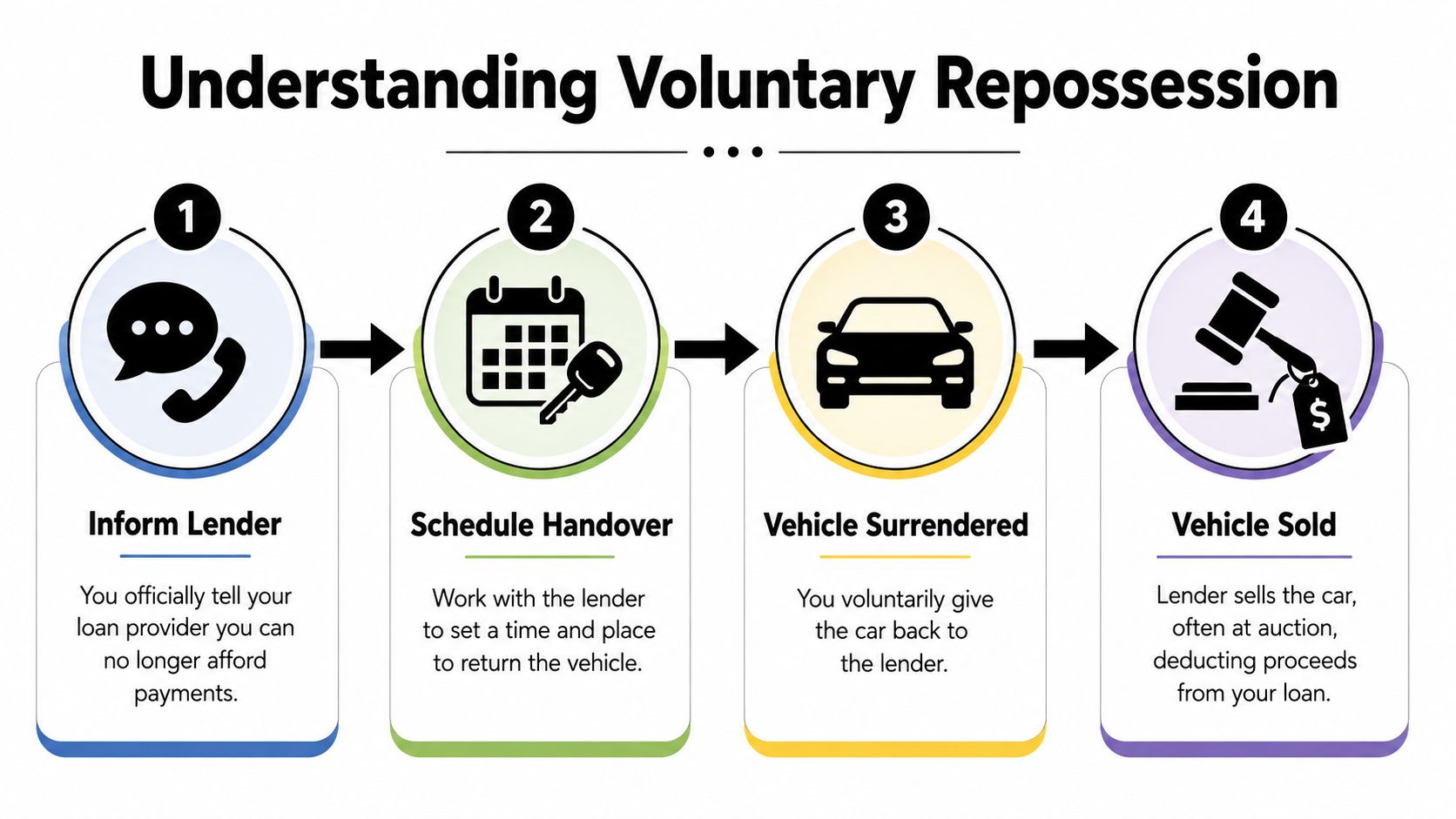
In plain English, the process usually follows a simple pattern:
- You contact the lender and say you can’t continue the payments.
- You arrange a return at a set time and place.
- You surrender the vehicle and any required documents or keys.
- The lender sells the vehicle, often through auction, and applies the proceeds to the loan balance.
A practical benefit does exist. As noted by DebtStoppers, “While a voluntary repossession may allow a debtor to return the vehicle at a specific location and time to avoid towing or storage fees, it does not erase the loan debt or prevent the account from showing serious negative history on the credit report prior to the surrender.” You can review that explanation in their article on voluntary repossession pros and cons.
If you’re sorting through ownership and title issues before making any decision, it can also help to check lien status with VekTracer. Many borrowers don’t fully understand who holds the lien, what interest is recorded, or what has to happen before a vehicle can be sold or surrendered.
For a deeper look at managing credit after voluntary surrender, it helps to separate the emotional relief of returning the car from the financial reality that follows.
Why the debt often doesn’t end
This is the part that confuses people most. Returning the car does not mean the account is settled in full.
If you owe more on the loan than the lender recovers from the sale, the unpaid part doesn’t disappear. That remaining amount is called a deficiency balance. You no longer have the car, but you may still owe part of the debt.
The surrender ends your possession of the vehicle. It doesn’t automatically end your financial responsibility for the loan.
That’s why voluntary repossession should never be viewed as a mutual cancellation agreement. It is better understood as an organized return of collateral after default.
The Immediate Impact on Your Credit Score and Report
The first direct consequence is credit damage. That damage usually starts before the surrender itself because most borrowers have already missed payments by the time they return the vehicle.
How it appears on your credit report
Credit reports may show the event with wording such as voluntary surrender instead of repossession. That label can create false comfort. It may give context to a human reader, but it does not meaningfully soften how the event is calculated in standard credit scoring.
ScoreSense explains that a voluntary surrender notation may appear on the tradeline, but it does not meaningfully change the calculated credit score or reduce the severity of the negative mark compared with an involuntary repossession in its discussion of how a voluntary repossession affects credit.
Missed payments leading up to the surrender also matter. If you want to understand why the damage often starts before the repo line appears, review the effects of late payments on credit scores. Many people focus only on the surrender date and overlook the earlier delinquency pattern that lenders can already see.
How much your score can drop
According to Credit Acceptance, a voluntary repossession causes a credit score drop of approximately 50 to 150 points, remains on the credit report for seven years, and its voluntary nature does not meaningfully change the calculated credit score or reduce the severity of the negative mark compared to an involuntary repossession in its guide on the effect of voluntary repo.
That range is significant. People with stronger credit profiles often see the biggest numerical drop because they have more room to fall. The event is still classified as a serious derogatory item.
A few practical points help explain why this hurts so much:
- Missed payments pile on first. By the time surrender happens, the account may already show late history.
- The repossession entry adds another severe negative mark. It tells future lenders the loan ended in default.
- The reporting timeline is long. The account can stay on the report for seven years from the original delinquency that led to the repo, not just from the date you handed over the keys.
| Credit report issue | Why it matters |
|---|---|
| Missed payments | Damages payment history before the surrender |
| Voluntary surrender notation | Shows the account ended in default |
| Seven-year reporting period | Keeps the event visible to future lenders for a long time |
For anyone asking how bad is a voluntary repossession, this is the short credit answer. It's one of the more serious negative events that can appear on a consumer credit report.
Long-Term Consequences Beyond the Score Drop
The score drop gets attention first because it's visible. The longer-lasting problem is what happens after the lender sells the car.
What happens after the lender sells the car
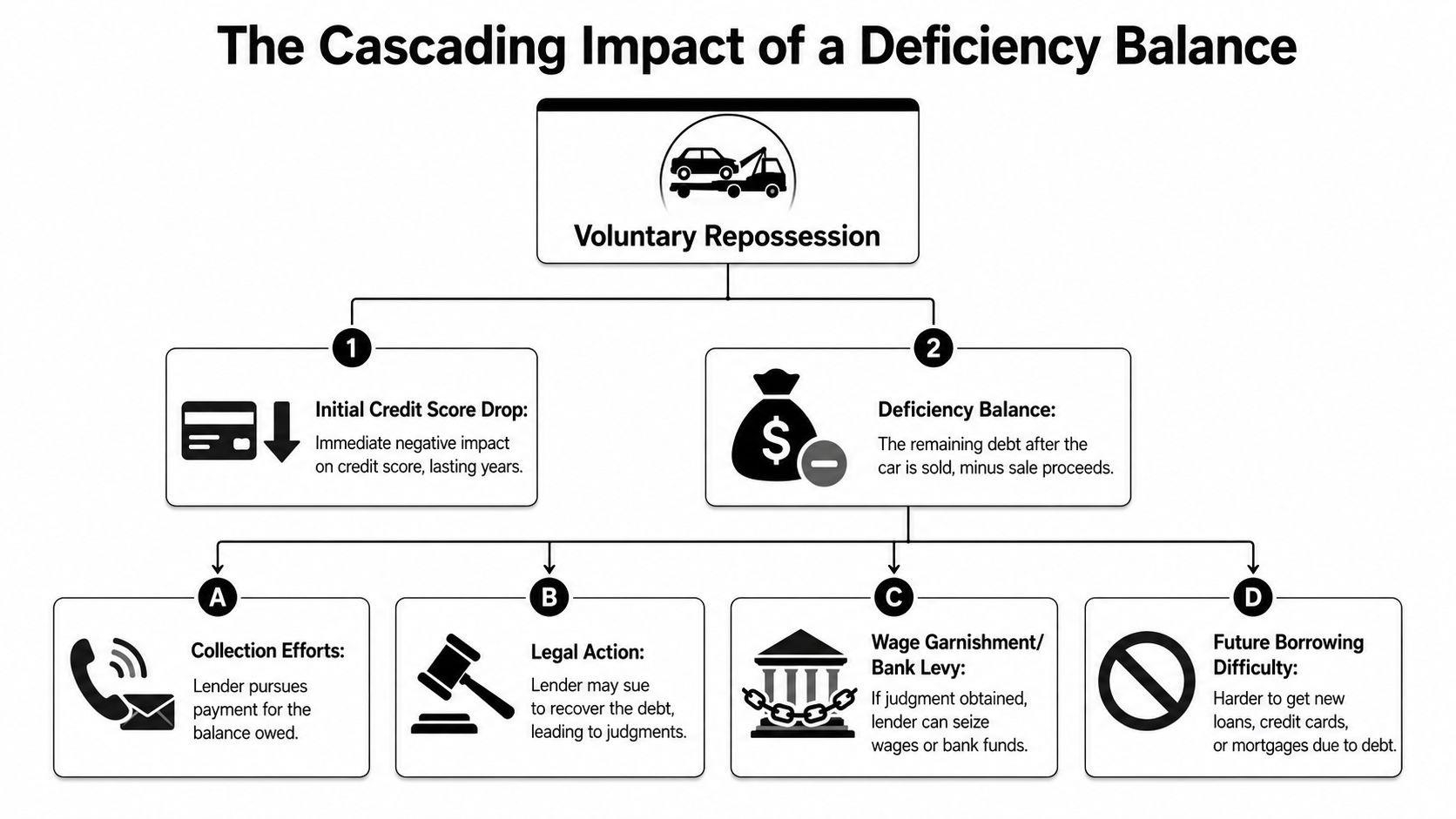
Once the vehicle is surrendered, the lender usually sells it and applies the sale proceeds to the loan. If the proceeds don't cover what you owed, plus any allowed costs, the unpaid amount remains your responsibility.
That unpaid amount is the deficiency balance. It's often the second wave of damage because borrowers assume the surrender closed the account completely.
Here's the practical chain of events many people face:
- The original auto loan shows serious default history on the credit report.
- A remaining balance is still owed after the sale.
- The lender may try to collect it directly.
- The account may be assigned or sold to collections, creating another negative account.
A borrower can end up dealing with two separate problems. One is the repo history itself. The other is a collection account tied to the unpaid deficiency.
Why the problem can keep growing
The financial pressure doesn't always stop with collections calls or letters. If the balance remains unpaid, the creditor or a collector may pursue legal action depending on the account, the documents, and the laws that apply.
That can create new stress at exactly the wrong time, especially if you're trying to become mortgage-ready, rent a new apartment, or qualify for better auto financing later.
Unpaid deficiency debt can follow the repossession and keep affecting borrowing decisions after the vehicle is long gone.
The practical consequences often include:
- Future borrowing gets harder because lenders see unresolved debt.
- Apartment approval and rental screening can become tougher when unpaid collections appear.
- Insurance costs may rise because some insurers view severe credit problems as added risk.
- Mortgage underwriting becomes more complicated if the deficiency remains open or unpaid.
This is why a voluntary repossession isn't just one event. It can become a chain reaction. The surrendered vehicle is only the first step. The deficiency balance is often the issue that keeps the problem alive.
How a Repossession Affects Mortgage Approval
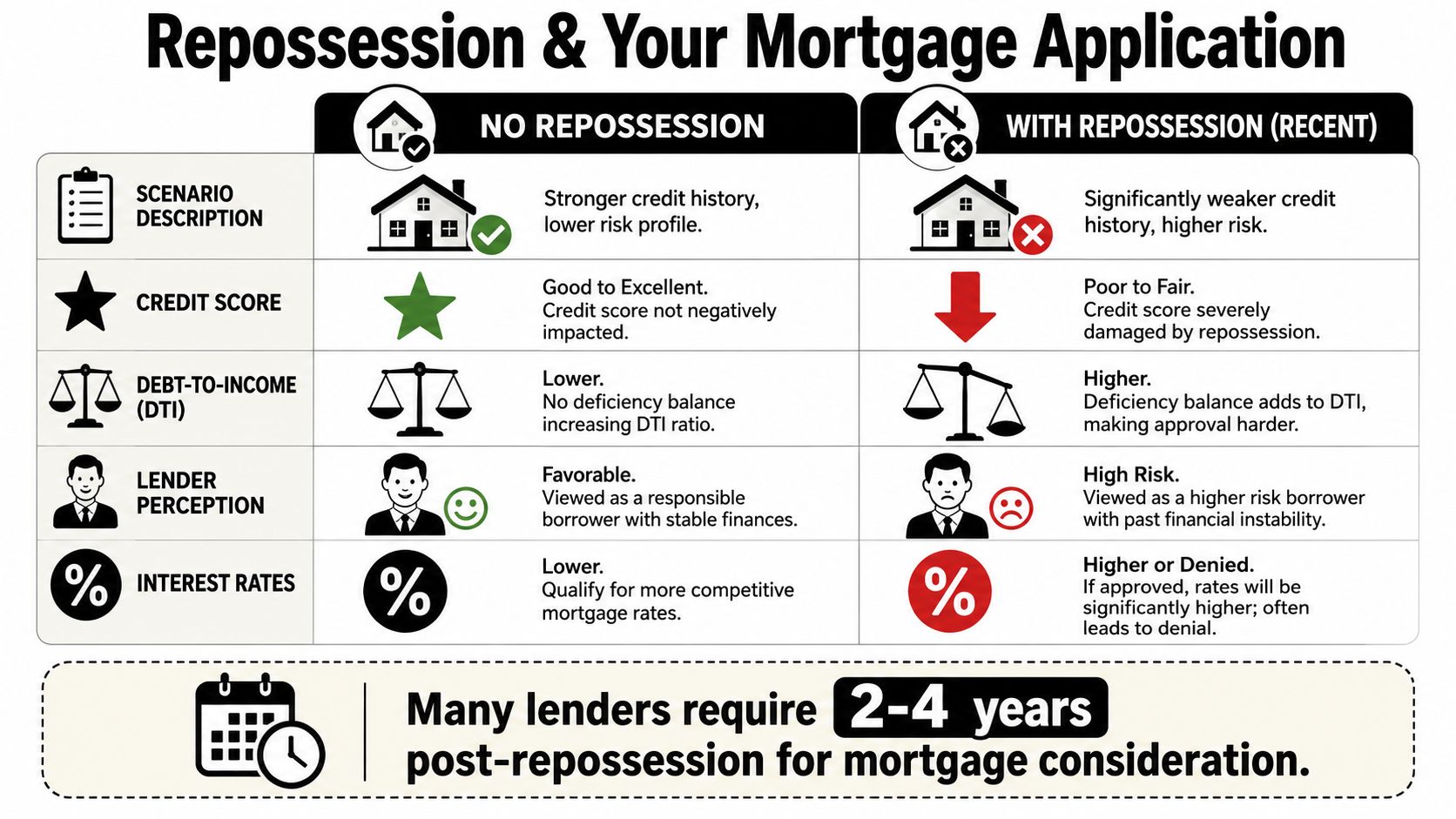
A borrower can be current on rent, save a down payment, and still hit a wall with mortgage approval because of an old car repossession. The problem is not limited to a lower credit score. Mortgage underwriting looks at whether the repo created unpaid debt, whether that debt must be resolved before closing, and whether any payment plan now takes a slice of monthly income that could have gone toward a house payment.
FHA compared with conventional financing
For homebuyers, the main question is usually not "Can I ever get approved?" It is "Which loan program gives me the clearest path, and how much house will I still qualify for?"
That distinction matters.
As noted in an Experian review of how vehicle repossession can affect mortgage approval, FHA may allow approval after a repossession if the deficiency balance is paid or the borrower is on a documented payment plan with at least three on-time payments. Conventional financing can be less flexible because collection accounts tied to a deficiency often must be paid before closing.
Here is the practical difference:
| Loan path | How repo-related debt can affect approval |
|---|---|
| FHA | Approval may still be possible if the deficiency is paid, or if a documented payment plan is established and seasoned with on-time payments |
| Conventional | Deficiency-related collections often need to be resolved before closing, which can delay or block approval |
The payment-plan issue is where many buyers get surprised. Mortgage lenders calculate your debt-to-income ratio, or DTI, by comparing required monthly debt payments to gross monthly income. A repo deficiency payment works like adding another weight to one side of the scale. Even if the payment seems manageable on its own, it can reduce the amount of mortgage payment the lender will allow.
That can lower purchasing power. Experian gives an example showing that a borrower who qualifies for one price range before the added payment may qualify for a lower range once that payment is counted in DTI. The exact impact depends on income, other debts, taxes, insurance, and the loan program, but the basic rule is simple. More required monthly debt usually means less room for the house payment.
If you are trying to clean up your file before applying, it helps to understand what underwriters review before you prepare for mortgage approval.
What this means for VA and USDA borrowers
VA and USDA borrowers often want a fixed waiting period after a voluntary surrender. In practice, the better question is whether the overall file now meets lender and program standards.
Available guidance does not give a single universal seasoning rule that clearly separates voluntary surrender from involuntary repossession in every case. Lenders usually look at the full credit picture instead. That includes whether the deficiency is still open, whether there are collections, how recent the delinquency was, and whether the borrower has re-established steady payment history since then.
For VA and USDA applicants, the safest approach is straightforward:
- resolve repo-related deficiency debt when possible
- document any payment arrangement clearly
- keep all current accounts paid on time
- lower revolving credit balances where you can
- avoid taking on new debt before the mortgage application
A repossession does not automatically end the path to homeownership. It does mean the mortgage file needs to show cleaner debt management, stronger payment history, and enough income left over to support the home payment the borrower wants.
Alternatives to Consider Before Surrendering Your Vehicle
If you haven't given the car back yet, pause before assuming surrender is your only option. In many cases, the least damaging move is the one that prevents the repo from happening at all.
Options that may reduce the damage
Start with the lender. Some borrowers avoid repossession by asking for short-term relief, a payment change, or another workout option. The lender may say no, but asking early is usually better than calling after the account is already far behind.
A private sale can also be worth exploring. It can sometimes produce a better result than letting the lender sell the vehicle after surrender. The goal is simple. If the sale covers more of the loan, you may reduce or avoid a deficiency balance.
Other options may include:
- Refinancing the auto loan if your credit is still in shape to qualify.
- Trading into a more affordable vehicle if the numbers improve your monthly budget.
- Having another qualified buyer take over the obligation, where legally and contractually possible. If that path is worth exploring, read more about how to transfer car loan to another person.
- Reviewing your full monthly budget to identify whether the car payment problem is temporary or permanent.
A short comparison can help:
| Option | Main goal |
|---|---|
| Work with lender | Avoid default and preserve credit history if possible |
| Private sale | Reduce the chance of a deficiency balance |
| Refinance | Lower payment or change term |
| Transfer or replacement strategy | Move into a more sustainable vehicle situation |
None of these options is easy. But if one of them prevents a repossession from hitting your credit report, the long-term payoff can be substantial.
Rebuilding Your Credit for Homeownership After a Repossession
A repossession does not end the path to buying a home. It changes the timeline, the paperwork, and the margin for error.
A good way to view recovery is this. Your mortgage profile is a four-part picture: payment history, debt levels, cash reserves, and time since the negative event. The repossession sits in one corner of that picture. You usually cannot erase that corner overnight, but you can strengthen the other three.
Start with the issues that still affect mortgage approval
Begin by checking whether the auto loan still has unfinished business attached to it. If the lender sold the car for less than you owed, the remaining amount is called a deficiency balance. For a future mortgage application, that balance matters in two separate ways. It can hurt your credit report if it is reported incorrectly or sent to collections, and it can affect debt-to-income ratio if you are making monthly payments on it.
That second point often gets missed by homebuyers.
A mortgage underwriter does not look only at your score. They also ask a simple math question: after counting your monthly debts, is there enough room in your budget for the new house payment? If a deficiency balance adds even a modest monthly obligation, your maximum home payment may shrink. That can reduce purchasing power, especially for FHA and conventional borrowers who are already close to program debt ratio limits.
So the first job is clarity. Review the repossession paperwork, confirm the balance, verify who owns the debt now, and make sure the account is being reported accurately.
Work on the parts of the credit profile you can improve
Credit recovery after a repossession works much like rebuilding a file after any major derogatory event. The negative mark may remain for years, but newer positive behavior can gradually carry more weight.
Focus on these steps:
- Bring all open accounts current and keep them current. A repossession followed by fresh late payments tells a lender the problem is ongoing, not isolated.
- Reduce revolving card balances where possible. Lower credit card utilization can help scores and can also improve debt-to-income flexibility if you are making large monthly card payments.
- Add new credit cautiously, only if it serves a purpose. A secured card or a small starter account can help rebuild positive history if you use it lightly and pay on time.
- Limit unnecessary credit applications. Multiple new inquiries and new accounts can make a mortgage file look unstable during the rebuilding phase.
- Build cash reserves. Savings will not remove a repossession, but reserves can strengthen a mortgage application, especially if the credit file is still recovering.
If your goal is homeownership, budget planning needs to include more than the future mortgage payment. Property taxes, insurance, and maintenance all affect affordability. Buyers in New Jersey who want to estimate ownership costs more accurately can review the Liberty Insurance guide for NJ homeowners.
How credit repair fits, and where its limits are
A voluntary repossession usually stays on the credit report unless the reporting is inaccurate, outdated, or cannot be verified. Time matters here. Accuracy matters too.
Credit repair can help by reviewing the repo account and any related collection entries for reporting problems such as:
- Incorrect balances
- Wrong delinquency dates
- Duplicate accounts
- Collection details that conflict with the original tradeline
- Inaccurate account status or remarks
That work should be document-based and specific. A proper dispute is not a generic request to remove something negative. It is a challenge to information that appears wrong, incomplete, inconsistent, or unverifiable.
For mortgage preparation, that distinction matters. A cleaned-up report with accurate balances, fewer reporting errors, and stronger current payment history gives an underwriter a more reliable file to evaluate. If you want to strengthen the foundation of your scores while preparing for a future home purchase, this guide on how to reach a 700 credit score faster explains the habits that usually matter most.
Rebuilding with FHA, VA, and Conventional financing in mind
Homebuyers often ask the wrong question first. They ask, “How many points did the repossession cost me?” A better question is, “What will an underwriter need to see before approving me for the loan program I want?”
Here is the practical difference:
- FHA borrowers often have a path back sooner if the rest of the file has stabilized. Clean recent payment history, manageable debt, and resolution of any related deficiency or collection issues can matter as much as the score itself.
- VA borrowers are also evaluated on the full credit picture, not just the repossession line by itself. Stable income, acceptable residual income, and a clear explanation of what happened can help.
- Conventional borrowers often face tighter scrutiny on overall credit quality. Lower revolving balances, fewer unresolved derogatory accounts, and stronger reserves can make a bigger difference here.
The common thread is simple. Mortgage approval after a repossession is rarely about one item in isolation. It is about whether the rest of the file now shows stability.
Frequently asked questions
Can a voluntary repossession stop me from getting a mortgage?
It can make approval harder, but it does not automatically block approval. Lenders usually look at the full file, including current credit behavior, any deficiency balance, related collections, and how the repossession affects debt-to-income ratio and cash reserves.
Is voluntary repossession better than an involuntary repo for my credit score?
In scoring terms, the difference is usually limited. A voluntary surrender may provide context in the account history, but the event is still a serious derogatory mark.
How long does a voluntary repossession stay on my credit report?
It can remain for seven years from the original delinquency date that led to the repossession.
Do I still owe money after giving the car back?
You might. If the lender sells the vehicle for less than the total loan balance and fees, the remaining amount may still be owed as a deficiency balance.
Can credit repair remove a voluntary repossession?
It may help remove or correct the item only if the reporting is inaccurate, outdated, inconsistent, or unverifiable. If the account is reported correctly, it usually remains until the reporting period ends.
Good recovery work is steady, documented, and realistic.
Was this guide helpful?
Superior Credit Repair Online provides educational credit guidance for individuals and families preparing for major financial goals like buying a home, applying for a mortgage, refinancing, or rebuilding after credit challenges.
Superior Credit Repair can review your credit report, help identify inaccurate or questionable items, and explain a step-by-step plan for improving your credit profile. If you're dealing with repossessions, collections, late payments, charge-offs, high utilization, or mortgage credit repair concerns, you can request a free credit analysis or consultation through Superior Credit Repair to better understand your options. Results vary based on your credit file, documentation, account history, creditor responses, and current credit behavior.
If this information helped you better understand your credit report or your next steps, we would appreciate your honest feedback. You are welcome to share your experience with Superior Credit Repair on our Google Business Profile. Share your feedback on Google