

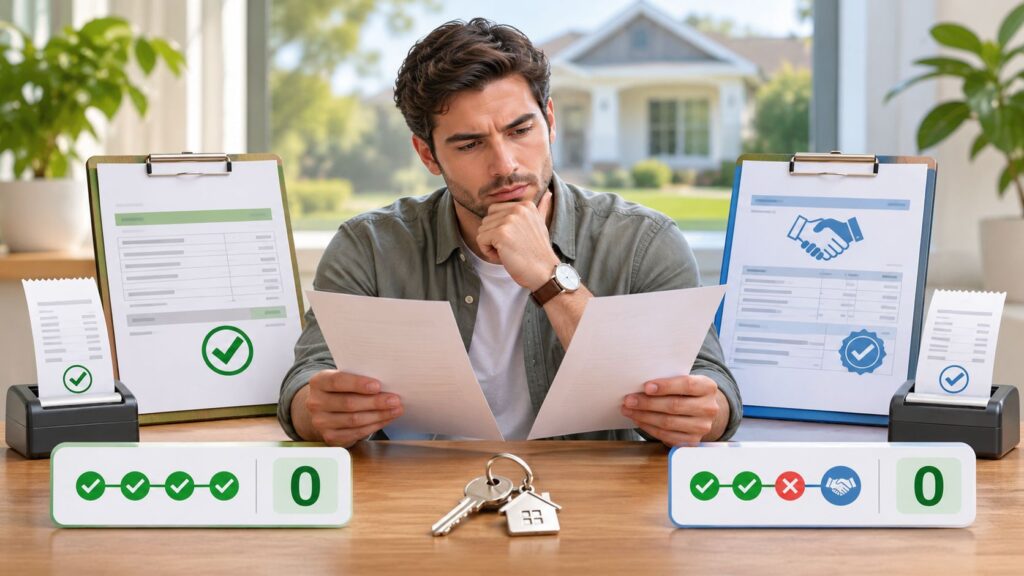
You opened your credit report the week a lender asked for documents, and the collection finally shows $0. Relief hits first. Then you notice the status line. One bureau says paid. Another says settled. A third still looks like the account is open. You are not looking at three different debts. You are looking at three versions of the same resolution, and the wording is what a mortgage reviewer will read.
Paid in full vs settlement on a credit report is a status question, not just a balance question. Both can show nothing owed. They do not tell the same repayment story. Before you apply for a home, a car, or a personal loan, treat that zero as the start of a check, not the finish line.
Table of Contents
- Paid in Full and Settlement Compared at a Glance
- How Lenders and Scoring Models Read Each Status
- Why Settlement Can Strain Your Credit File First
- Mortgage Timing for FHA, VA, USDA and Conventional Loans
- How to Verify Each Account Before You Pay
- Reporting Errors to Dispute After the Account Updates
- Rebuilding Your Profile After the Status Updates
- Frequently Asked Questions About Paid and Settled Accounts
- Confirm the Right Status Before You Apply for a Mortgage
Paid in Full and Settlement Compared at a Glance
A paid in full account means the creditor received the entire reported balance. A settled account means the creditor accepted less than the full amount under a negotiated agreement. After a correct update, both commonly show a $0 balance. The history behind that zero is what still differs.
The same account can also look unfinished, or it can be reported in a way that contradicts the letter you already have. Use the comparison below as a checklist, not as a score forecast.
| Status | What the creditor accepted | Balance after update | Wording to check | Proof to keep |
|---|---|---|---|---|
| Paid in full | Entire reported balance | $0 | Paid status with $0 balance | Payoff confirmation and payment record |
| Settled | Less than the full balance, under a negotiated agreement | $0 | Settled status with $0 balance, not charged off | Signed settlement agreement and payoff letter |
| Open collection | Nothing accepted yet | Amount still owed | Open or unpaid status | Collector notice and recent statements |
| Settled but reported as charged off with balance due | Settlement accepted, but reporting contradicts it | Balance shown as due | Charged off with balance (inaccurate) | Settlement letter and creditor correspondence |
How to read one account on three reports
Pull Experian, Equifax, and TransUnion before you decide the account is finished. The first comparison is the reports themselves, because the same account may show different balances, statuses, dates, limits, payment months, or collection ownership across the bureaus.
Say a medical collection was settled for a reduced amount in March. Experian may already show settled and $0. Equifax may still show the old balance. TransUnion may show a debt buyer you have never heard of. One clean report does not confirm the other two.
Practical rule: Check the status wording first, not only the balance. A zero with the wrong status is still an open question.
Results vary with each person's credit file, documentation, creditor responses, account history, and current credit behavior. No resolution type guarantees a particular score or a lending decision. What you can control now is whether the words on the report match the papers in your folder.
How Lenders and Scoring Models Read Each Status
A collection is an unpaid debt a creditor has sent to a collection agency or a debt buyer. A furnisher is the company that reports account data to the bureaus. A tradeline is one account entry on a credit report. A zero balance means the reported amount owed is $0 after resolution.
Industry guidelines tell furnishers to update a resolved collection so it shows that it was paid or settled and that the balance owed is $0, according to a CFPB report on medical and non-medical collections. In that same analysis, about 8.4% of collection tradelines in a December 2012 snapshot were reported as paid in full or settled for less than the full balance. A related sample of collections first appearing in January 2013 found that an average of 6.7% were later converted to a paid status, from 4.1% for telecommunications accounts to 11.8% for banking accounts.
“Paid” in that guidance can mean either the full balance or a settlement for less. A zero by itself does not prove the original debt was paid in full. Paid in full means the creditor received the entire reported balance. Settled means the creditor accepted less. CFPB-cited Metro 2 guidance also says paid-in-full and settled accounts should not be deleted merely because they were resolved. The history can remain for its reporting period.
What the scorecard actually ignores
FICO's guidance on collections states that FICO Score 9 and the FICO Score 10 suite disregard third-party collections reported with a zero balance, whether the account was paid in full or settled for less. Older models do not work the same way. Under legacy scoring such as FICO Score 8, resolving a collection does not create a clear scoring advantage for paid in full over settled. The collection's presence and the earlier delinquency remain the main signals.
| Scoring model or lender view | How zero-balance collections are treated | What it means for your file |
|---|---|---|
| FICO Score 9 | Disregards third-party collections reported with a zero balance, paid or settled | Accurate $0 coding can carry real weight |
| FICO Score 10 suite | Disregards the same zero-balance collections | Confirm which version the lender uses |
| Legacy models such as FICO Score 8 | Resolution does not create a clear advantage for paid over settled; collection presence and prior delinquency remain key signals | Expect the payment history to matter |
| Lender overlays and manual review | Status, dates, and the repayment pattern are read with the rest of the file | Ask which score model and underwriting rules apply |
Accurate $0 coding matters more than picking a prettier word. A paid-in-full note can still read more cleanly to a person, because it shows the contractual balance was met. A settlement shows that less was accepted. Neither wording replaces the question you should ask the lender: which score model and which underwriting rules will they use?
Each account is reviewed separately. An accurate negative account may need rebuilding, a payment strategy, documentation, or time rather than another dispute. If you want a plain walk-through of what changes after paying collections, start there, then confirm the model with the lender. Do not assume a score increase because the balance went to zero.
Why Settlement Can Strain Your Credit File First
If you are current on your accounts and plan to buy a home within the next year or two, enrolling in a settlement program can affect your credit file before any balance reaches zero. A settled status may close one stage of the process, but the months leading up to it can bring late payments, closed cards, and collection activity.
Congressional testimony citing TransUnion-linked research reported that the average settlement took more than 14 months after enrollment, according to testimony before the House Committee on Financial Services. Among consumers who were current when they enrolled, the median score decline was 96 points, from 645 to 549, six months later. Roughly half of their credit cards were closed within six months. The testimony also reported that third-party settlement participants had average scores around 420, more than 100 points below consumers who settled directly with lenders, and that recovery lagged for years.
These figures describe a reported pattern, not a prediction for every person. Still, they show why the settlement process itself deserves review. Stopping payments so a program can negotiate may add late payments, reduce available revolving credit when cards close, and leave collection activity underway while negotiations continue. A zero balance later does not erase what happened in the meantime.
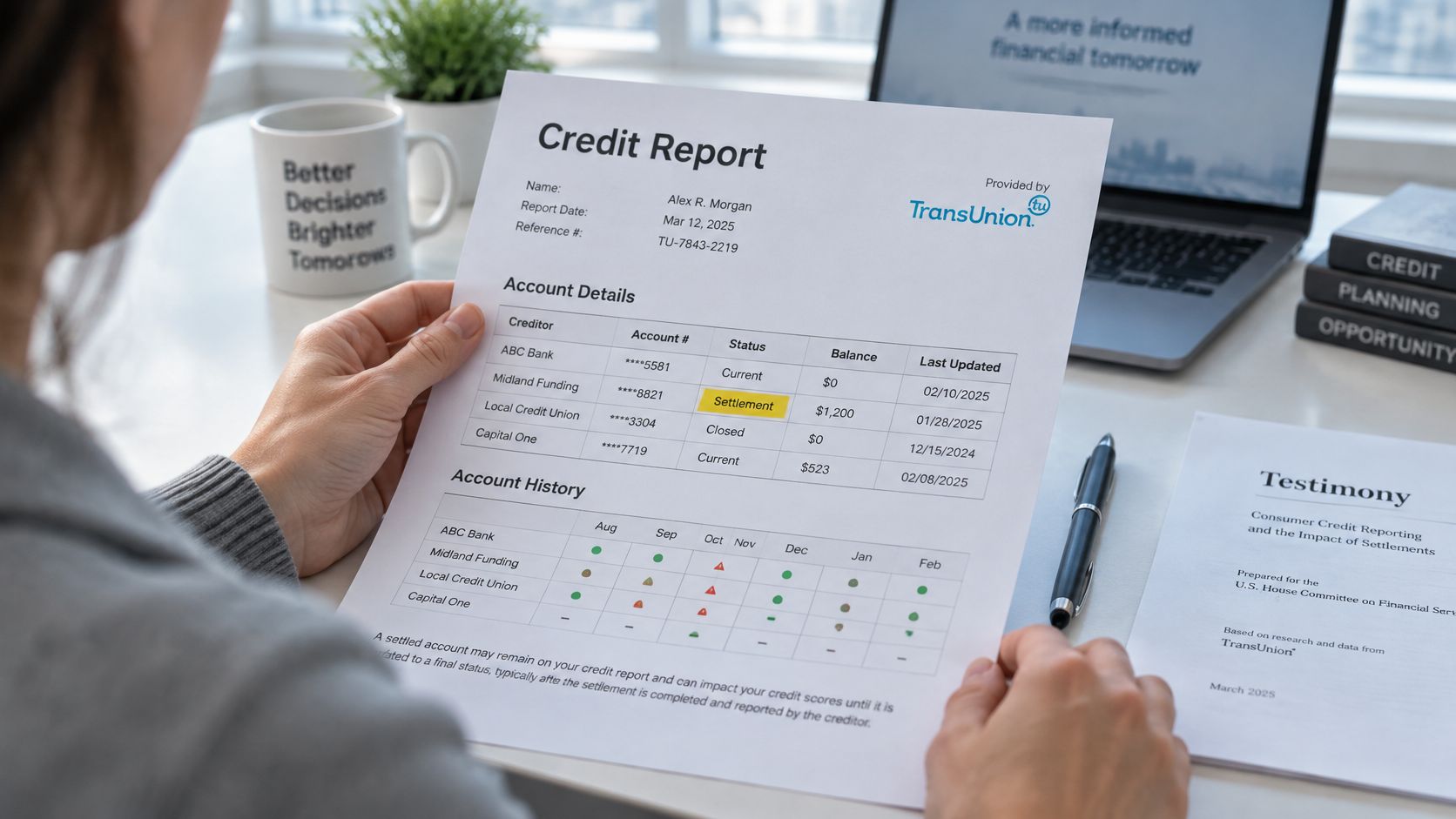
What can go wrong while you wait
- Late payments on accounts you still owe: Each missed due date is a separate negative item. A later settlement does not change the payment history that led up to it.
- Utilization spikes after cards close: When cards close, the same balances are measured against less available credit. That can make utilization look higher.
- Collection activity that continues: A creditor or collector may keep reporting while negotiations are in progress. Check the account status and balance as the process unfolds.
- Fees and possible tax consequences: Program costs and the treatment of forgiven amounts belong in the decision alongside the expected payoff.
Some balance changes may appear within a billing cycle, while disputes, creditor corrections, and positive account age can take longer. The timing varies by account and reporting updates. If a settlement takes more than a year, the eventual zero balance does not undo late payments made during that period.
A decision framework before you enroll
| Option | How it works | Credit file risk to weigh | Question to ask first |
|---|---|---|---|
| Direct creditor hardship arrangement | Negotiated with the original creditor | Earlier late payments may remain even if the creditor offers relief | How will the account be coded in writing? |
| Nonprofit credit counseling | Managed payment plan through an agency | A counseling notation may appear alongside the payment history | How will each creditor report the account? |
| Negotiated payoff | Agreed payoff of a collection balance | Paying less is reported as settled; full payment is reported as paid | Which status wording will appear after payment? |
| Settlement program | A third party negotiates reductions after enrollment | Interim delinquencies and closed cards can lower scores; the average settlement took more than 14 months | How does this timing fit the planned purchase date? |
| Bankruptcy consultation | Legal process reviewed with an attorney | A bankruptcy can stay on the report for seven to ten years depending on the chapter, which may be longer than a settled collection | What does that reporting period mean for the loan goal? |
Choose a strategy for the debt and your broader finances, not only for a possible score change. If a purchase is 12 to 24 months away, ask the lender how the timing and account status may affect its review before enrolling.
When the home timeline is close, a direct hardship arrangement or a documented payoff may be easier to assess than a lengthy enrollment, but the account's actual reporting still needs confirmation. If the debts remain unmanageable, a bankruptcy consultation with an attorney addresses a legal decision, not a credit-repair shortcut. Before acting, make sure you understand the likely timing, the costs, and what documentation will show how the account was resolved.
Mortgage Timing for FHA, VA, USDA and Conventional Loans
A resolved collection does not sit in a separate drawer from the rest of a mortgage file. Reviewers look at collections, late payments, revolving utilization, debt-to-income pressure, and whether the status matches the creditor's records. For buyers, we review collections, late payments, utilization, dispute comments, and credit-report issues before mortgage preapproval or underwriting.
Guideline thresholds change, and each lender adds its own overlays. Nothing below is a promise of approval. It is the question to settle before you pay a program or submit an application.
| Loan type | Main file question | Timing to plan around |
|---|---|---|
| FHA loan | Recent collections, late payments, and how settled accounts are reported | Review the file 12 to 24 months before purchase where possible |
| VA loan | Whether hardship or collection accounts show documented resolution | Confirm with the lender before enrolling in any program |
| USDA loan | Payment history and open collections at underwriting | Verify statuses before preapproval |
| Conventional mortgage | Score model, utilization, and collection status | Ask which score model the lender uses |
FHA files
An FHA reviewer is often looking at how recent the collection is, whether late payments are still fresh, and whether a settled account is coded the way the servicer's letter describes. If you can, start that review 12 to 24 months before you plan to buy. That window is for corrections and for new on-time history, not for a guaranteed outcome.
VA files
A VA file still needs a clear story on hardship and collection accounts. Documented resolution helps a reviewer see that the account is no longer an open obligation. Confirm that story with the lender before you enroll in a settlement program, because a year of new delinquencies can matter more than the eventual zero.
USDA files
USDA underwriting looks hard at payment history and at collections that are still open. Verify every status before you ask for preapproval. An account you believe is settled, but that one bureau still shows as unpaid, can stall the file while you hunt for a letter.
Conventional files and first-time buyers
A conventional review leans on the score model in use, on utilization, and on how collections are statused. Ask which model the lender uses before you assume a zero-balance collection will be ignored. First-time buyers often meet a settled account for the first time when a processor asks about it. Renters preparing to buy face the same read when they apply. Apartment screening can flag the wording too, even when you are not buying yet.
Verify the status several months before you apply, confirm the loan program and the score model, and do not treat any single update as an approval.
A closer look at how underwriters review collection accounts is useful if a USDA or other government-backed file is the goal. Bring the letters with you. The reviewer is comparing your paperwork with the tradeline, not grading your intentions.
How to Verify Each Account Before You Pay
Paying first and checking later is how a settled account becomes a charged-off balance on one bureau and a zero on another. Work in order. Each step exists so you can prove what was agreed.
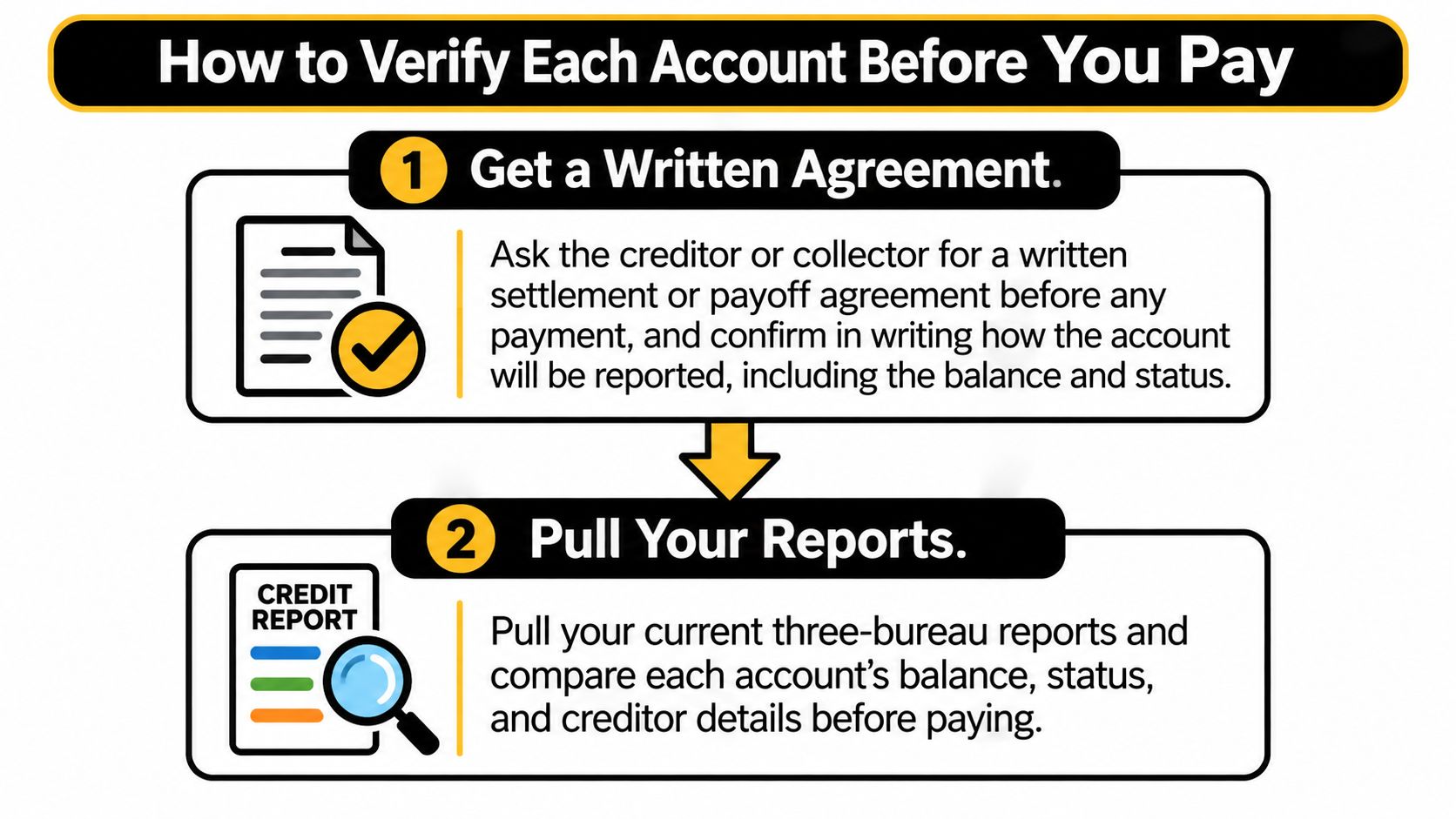
The sequence that keeps the file honest
- Get the agreement in writing before you pay. Ask the creditor or collector for a written settlement or payoff agreement, and confirm how the account will be reported, including the balance and the status. A phone promise is hard to attach to a dispute.
- Pull all three reports and write down what you see. Record the creditor name, account-number fragment, status, balance, dates, and ownership exactly as each bureau displays them. Accuracy documents include current three-bureau reports, creditor statements showing balances, limits, dates, and payment history, plus collection letters, settlement records, student loan records, or debt-buyer notices.
- Match the letter to every bureau. Note any mismatch in balance, status, dates, or owner. If Equifax lists a debt buyer and Experian lists the original creditor, that difference belongs in your notes before money moves.
- Check late payments against your own statements. Pull statements or payment confirmations for the months in question and compare them with the payment history on each bureau. A wrong delinquency month is a date problem, not a feeling that the account “should be gone.”
- Pay only after the wording is clear, and keep every receipt. Save the agreement, the payment record, the payoff letter, and the emails. Read before paying off an old debt if the collector is not the company that opened the account.
- Wait, then recheck all three reports. Some balance changes may show within a billing cycle. Corrections and furnisher updates can take longer. Rechecking one bureau and stopping there leaves the other two unchecked.
- If a mismatch remains, name it. A later dispute should point at one contradiction and attach the matching page. “Please delete this” is weaker than “the March payoff letter says settled and $0, and this tradeline still shows a balance.”
What belongs in the folder
Keep the folder current until you have applied and closed, not only until the first zero appears. You want the agreement, proof of payment, the payoff or settlement letter, the three reports from before you paid, and the three reports after the update. If a landlord, auto lender, or mortgage processor asks what “settled” means on your file, those pages are the answer.
Results still depend on the file, on how the furnisher responds, and on timing. A careful folder does not force a deletion. It lets you see whether the report matches the deal you made.
Reporting Errors to Dispute After the Account Updates
The error that surprises people most is a settled account that still looks unpaid and charged off. In a CFPB consent order involving mortgage servicing, the agency found that some accounts settled in full were furnished as charged off with a balance due. The servicer's own records showed the accounts had been settled, and the inaccurate reporting was not corrected after disputes. The order cited the Fair Credit Reporting Act requirement that furnishers correct information they determine is inaccurate, and it specifically prohibited reporting settled accounts as charged off.
A dispute targets that kind of contradiction. It is not a general request to erase an accurate history.
| Reporting error | Why it matters | Evidence to attach |
|---|---|---|
| Settled account reported as charged off with balance due | Contradicts the creditor's settlement records | Settlement letter and payoff confirmation |
| Zero balance but status still open or unpaid | Shows an unresolved debt in the file | Payoff receipt and updated creditor letter |
| Late payment with an incorrect date | The delinquency date affects how long the item can be reported | Statements or payment confirmations for those months |
| Collection older than the permitted period still shown | Negative data may remain past the stated reporting rules | Original collection notice showing the delinquency date |
| Different balance or owner across bureaus | Mixed or outdated file information | Current three-bureau reports and the debt-buyer notice |
What the reporting period actually covers
CFPB guidance on rebuilding credit states that negative account-payment information can generally be reported for up to seven years, while positive information may remain longer. Late payments are generally reportable for seven years, Chapter 13 bankruptcy for seven years, Chapter 7 bankruptcy for ten years, and foreclosure for seven years. Paying or settling a collection updates the balance. It does not ordinarily restart that period, and it does not guarantee deletion.
For credit report errors, we look for wrong balances, duplicate accounts, mixed-file problems, outdated information, and details that may not match across bureaus. For collections or charge-offs, the review covers balances, ownership, dates, account status, and bureau differences before anyone decides what needs documentation or dispute support.
Accurate history is a different job
An inaccurate charge-off code is a dispute. An accurate settled account, with the right dates and a real zero, may need rebuilding, a payment plan, or time rather than another letter. Medical collections follow the same split. Confirm the balance, status, and dates against the provider's or collector's records. Treat a mismatch as a documented question. Do not assume a medical account vanishes because it was paid.
A strong dispute sentence sounds like this: “Settled in full according to the creditor's letter, but reported as charged off with a balance.” Attach the letter. Name the bureau. Keep a copy.
Superior Credit Repair's dispute form guidance walks through how to submit that kind of specific dispute. We can help identify and document discrepancies for the appropriate process. We do not promise deletion or a particular score result.
Rebuilding Your Profile After the Status Updates
Once the status is accurate, the file changes through habits a lender can see over time. Rebuilding is a long-term plan, not a single update.
Start with on-time payment. Set an automatic minimum on every open account so one missed due date does not add a new late mark while you are cleaning an old one. Then look at revolving utilization, the share of each card limit you are using. Bring balances down before a mortgage application. High balances can weigh on the file even when every account is current.
Keep older cards open when they have no annual fee you cannot justify. Closing them shrinks available credit and can lift utilization, which is the same squeeze people feel when cards are shut during a settlement program. Avoid several new applications close together before a loan. Each one can appear on the report.
Every few months, reread all three reports. Confirm the resolved account still shows $0 and the agreed status, and confirm that no new late payment or collection has appeared. Positive history builds because account age and new on-time payments accumulate over months and years, not over a weekend.
The Money Maniac's guide to improve your credit before applying is a useful companion if you want a habit checklist beside this status work. If collector names and debt-buyer transfers are the confusing part, our notes on handling collector and debt buyer reporting keep that piece separate from day-to-day payment habits.
Results vary with the file, the documents, creditor responses, account history, and what you do with open accounts now. A lender conversation can show which of these habits matters most for the program you want. Progress is gradual, and that is a feature of an accurate file, not a failure of the plan.
Frequently Asked Questions About Paid and Settled Accounts
Does a zero balance mean the account is removed?
No. The account can remain for its reporting period. The zero shows the current amount owed, not that the history was erased.
Is a settled account always worse than a paid-in-full account?
Not on every model. The scorecard the lender uses changes how a zero-balance collection is read, which is why the status wording and the model both belong in your questions. A paid-in-full history is still the cleaner story for a person reading the file.
What if the creditor cannot confirm the status?
Ask for written confirmation of the balance and the status, and keep every letter and payment record. Compare all three bureau reports. If they conflict with the letter, dispute the exact contradiction and attach the page that proves it.
Can a credit repair company guarantee deletion or mortgage approval?
No. We review the file, identify inaccurate or questionable items, and explain options through legal dispute and verification processes. Results vary with each person's file, documentation, creditor responses, account history, and current credit behavior. Timing depends on the account, the documents, bureau response cycles, furnisher updates, and what you do with credit while you wait.
Confirm the Right Status Before You Apply for a Mortgage
You can start this week without guessing at a score.
First, write down the purchase timeline and the loan program you expect to use, whether that is FHA, VA, USDA, or conventional. Second, gather current three-bureau reports, creditor statements, settlement or payoff letters, collection notices, and a payment calendar for every open account. Third, hold each account next to the status table at the top of this article. If the wording and the letter disagree, use the dispute steps and recheck after the furnisher updates. Fourth, talk with a lender before you join a program or send a payoff, and ask which score model and underwriting rules apply.

Superior Credit Repair can review your credit report, help identify inaccurate or questionable items, and explain a step-by-step plan for improving your credit profile. You can request a free credit analysis or consultation to better understand your options.
That free consultation starts with what is reporting now, what may be inaccurate, and which steps fit the goal. You can begin with an online review request so the sequence protects current credit while older issues are reviewed. We can review reports and supporting records remotely. You remain responsible for accurate information, for reading responses, and for deciding when to apply for housing or financing.
Was this guide helpful?
If this information helped you better understand your credit report or your next steps, we would appreciate your honest feedback. You are welcome to share your experience with Superior Credit Repair on our Google Business Profile.
Superior Credit Repair Online provides educational credit guidance for individuals and families preparing for major financial goals like buying a home, applying for a mortgage, refinancing, or rebuilding after credit challenges.
If you are sorting a paid-in-full account from a settlement before an FHA, VA, USDA, or conventional application, Superior Credit Repair can review the three-bureau file, compare it with your letters, and map a documentation-based plan. Results vary, and the review is meant to clarify options rather than promise an outcome. Visit Superior Credit Repair to request a free credit analysis or consultation.