

You've got a lease date on the calendar, a lender asking about your credit before any rate talk, and two card offers that don't look alike. One wants a cash deposit. The other doesn't. That choice matters for an FHA, VA, conventional, or USDA file, and it also matters if a landlord will screen the same reports. The useful question isn't which card feels safer. It's which account can show clean, recent, on-time revolving history without a balance that looks maxed out.
A secured and unsecured credit card can both report payment activity. They don't start from the same place, and they don't cost the same thing. Results vary with your credit file, the documents you can produce, how creditors respond, and how you use the account after it opens. Nothing here promises a score change or a mortgage approval.
Table of Contents
- How Secured and Unsecured Cards Differ at a Glance
- How a Security Deposit Sets Your Credit Limit
- Who Each Card Type Serves Best
- What Each Card Costs Over Time
- How Secured Cards Build Credit and Graduate
- Mortgage Readiness for Secured, Starter and BNPL Accounts
- Choose the Card Your Mortgage Timeline Supports
- Frequently Asked Questions About Secured and Unsecured Credit Cards
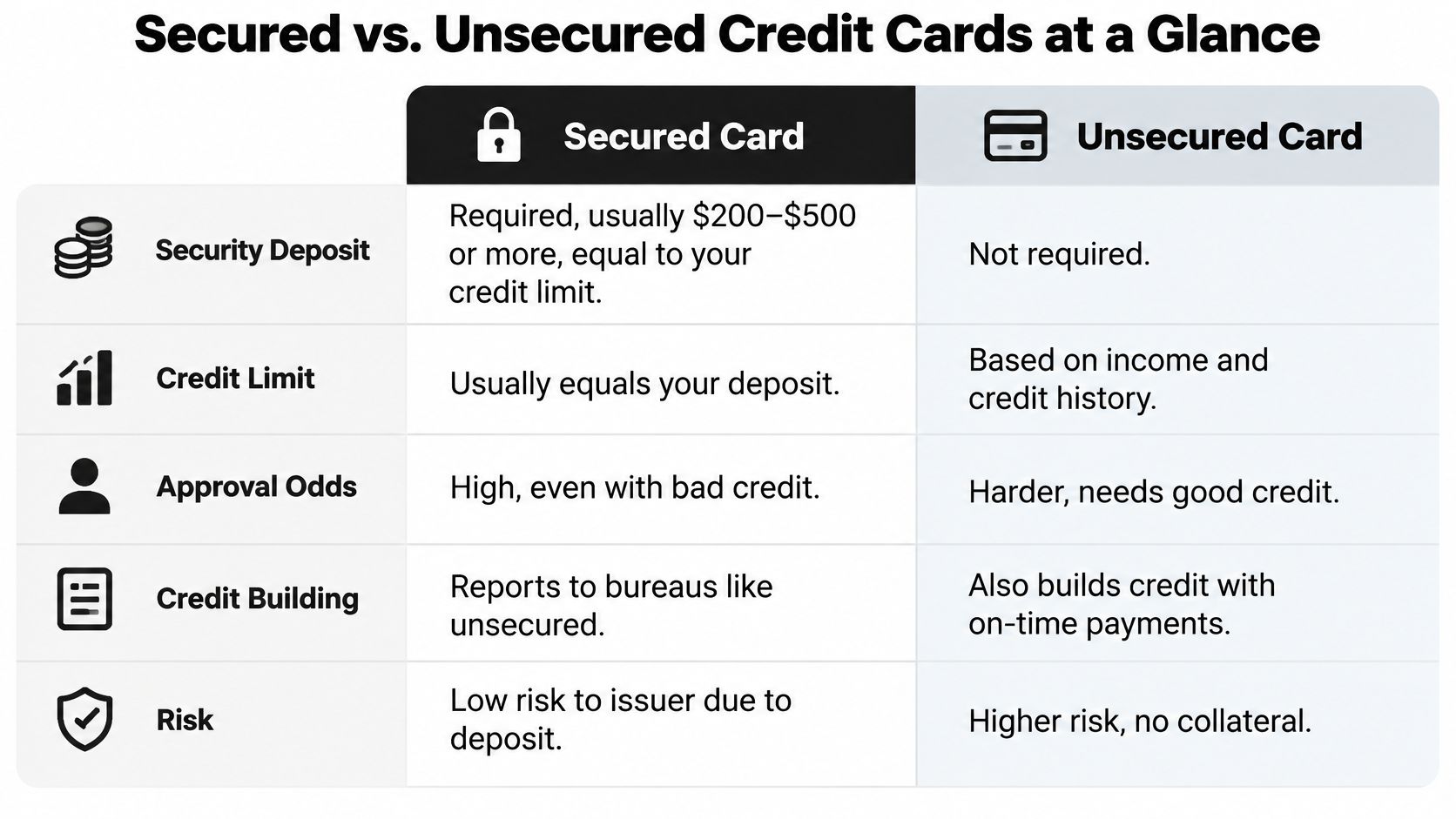
How Secured and Unsecured Cards Differ at a Glance
| Feature | Secured card | Unsecured card |
|---|---|---|
| Security deposit | Required, usually equal to the credit limit | Not required |
| Approval basis | Deposit lowers issuer loss risk, so limited or rebuilding files can qualify more readily | Credit history, income, and existing obligations drive approval and pricing |
| Typical starting limit | Often set at or near the deposit, for example a $500 deposit for about a $500 limit | Set by underwriting for that applicant |
| Graduation path | Possible deposit refund and a move to unsecured status after consistent on-time payments | Not applicable |
A security deposit is cash you give the issuer up front. It is collateral, meaning the issuer can use it if the account isn't paid as agreed. Your credit limit is the most you can borrow on that card. On many secured cards the limit sits at or near the deposit. A $500 deposit commonly supports about a $500 starting limit, though the issuer may set the limit below the deposit, according to the Federal Reserve overview of credit-building products.
That same Federal Reserve note reports that secured cards were about 4% of credit-card originations in 2021, yet more than two-thirds of secured-card recipients had very low credit scores or no score. About 7% of unsecured originations went to that same low-score or no-score group. Roughly half of new secured-card borrowers had no score when the account opened.
An unsecured card has no collateral deposit. Approval and pricing lean on credit history, income, and repayment risk. Graduation means the issuer later reviews the secured account and may raise the limit, return the deposit, or convert it to unsecured status. That path is possible after consistent on-time payments. It isn't promised.
Practical rule: A secured card is a tool for building or rebuilding a thin or damaged file. An unsecured card fits a borrower whose file already qualifies.
How those pieces feed a score is laid out in Superior Credit Repair on score factors. Your own file, your documents, and your payment behavior still decide what changes.
How a Security Deposit Sets Your Credit Limit
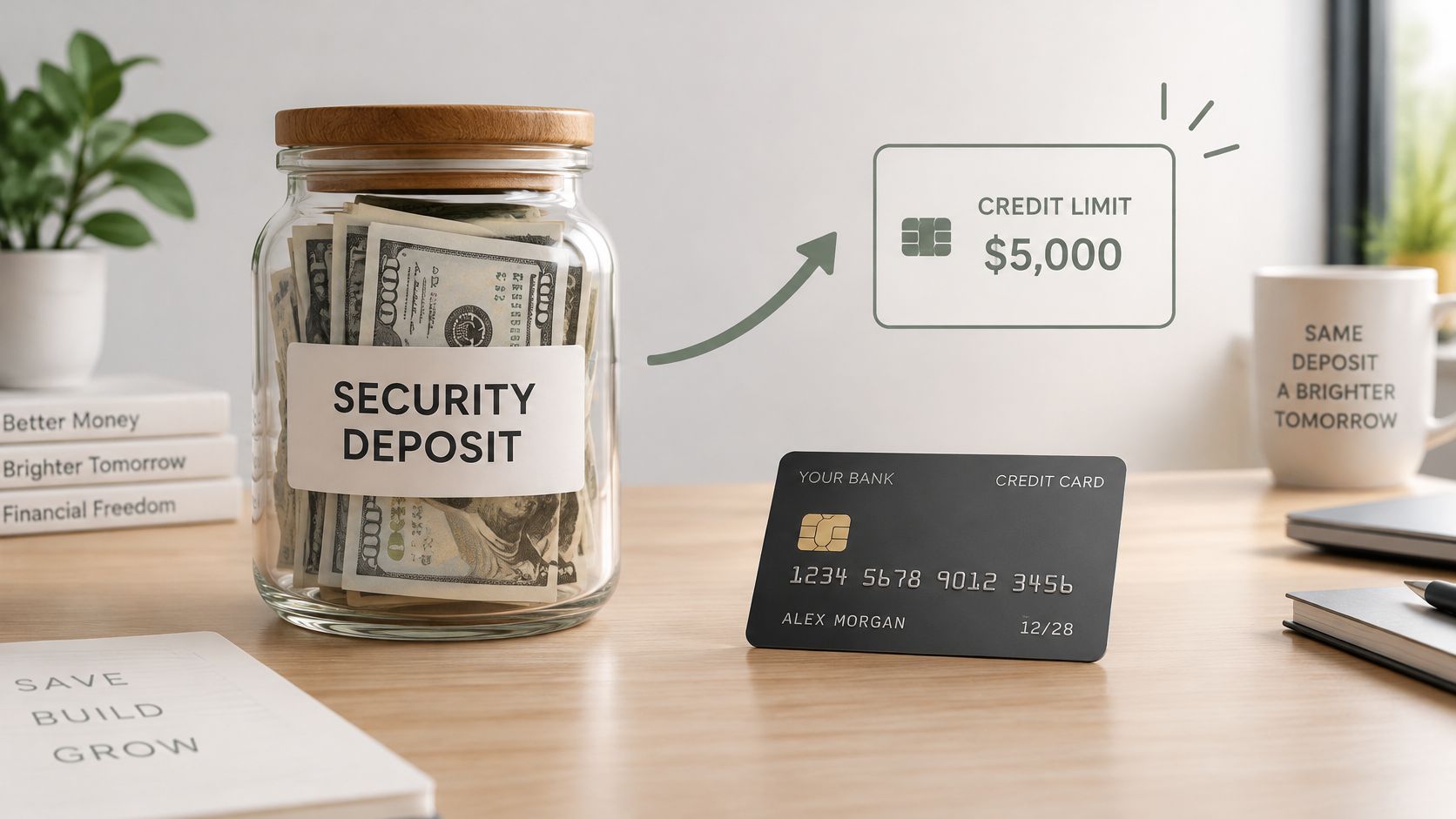
The deposit works like the security deposit on an apartment. It sits aside as collateral and never covers the monthly bill. You still owe the full statement balance, and the deposit may earn no interest while the issuer holds it. A CFPB-filed secured card agreement sets a $100 minimum deposit and bases the opening limit on what you put down, so deposit size is the main lever you control. Collateral cuts the issuer's loss if the bill goes unpaid, which is why a limited or rebuilding file can get a yes more often.
The balance lenders actually see
Utilization is the reported balance divided by the reported limit. Scoring and many lenders use the balance on the statement closing date, not the number in a banking app after you pay. Paying the card down a week later does not undo a balance that already reported. Say you charge $300. On a $500 limit that is 60% utilization. On a $1,500 limit the same $300 is 20%. The purchase didn't change. The limit did.
| Credit limit | Reported balance | Utilization |
|---|---|---|
| $500 | $300 | 60% |
| $1,500 | $300 | 20% |
| $500 | $50 | 10% |
| $1,500 | $150 | 10% |
Same spending, four different files.
A smaller limit isn't automatically "safer" for a mortgage file. It can make ordinary spending look heavy, because a mortgage reviewer sees the reported percentage, not the deposit behind the account. Pick a deposit large enough that normal charges stay low relative to the limit, then pay before the statement closes when you can. Superior Credit Repair plans utilization from each card's limit, current balance, statement closing date, and reporting pattern, never from an app balance alone.
A five-point check before you apply
- Deposit amount: Confirm the minimum and whether you can add more for a higher limit.
- Starting limit: Ask whether the limit equals the deposit or sits below it.
- What gets reported: Confirm the issuer reports both the limit and the balance to all three bureaus, not the balance alone.
- Refund terms: Read when the deposit comes back and whether an unpaid balance can be taken from it.
- Graduation: Ask whether the account can move to unsecured status, and whether you must request that review.
Write down the deposit, the limit, and the statement closing date for every card you're comparing, then set those notes next to the table above. Two cards can cost the same in deposits yet report very differently once a lender pulls the file. For mortgage timing, lowering utilization before applying is a habit, not a one-time payoff.
Who Each Card Type Serves Best
| Profile measure | Secured-card openers | Unsecured-card openers |
|---|---|---|
| Average annual income | About $35,000 | About $50,000 |
| Other open credit-card accounts | 0.43 | 2.58 |
| Existing credit limits | About $1,379 | About $24,032 |
| Average utilization | 14.5% | 31.4% |
A December 2015 Federal Reserve market analysis found secured-card openers had average annual income of about $35,000, versus about $50,000 for unsecured openers, roughly 30% lower. Secured applicants held an average of 0.43 other open credit-card accounts and about $1,379 in existing limits, compared with 2.58 accounts and about $24,032 among unsecured applicants, according to the Philadelphia Fed secured-card analysis.
What those averages do and don't say
Lower utilization among secured users, 14.5% versus 31.4%, mostly shows a small limit used carefully. It isn't proof of stronger credit. The same analysis is a snapshot of typical openers, not a rule for you.
A secured card often fits a thin file with no score, someone rebuilding after hardship, divorce, or a collections stretch, and a renter getting ready to buy. An unsecured card more often fits an established history, steadier income, and obligations that underwriting can already price. A higher-income applicant can still choose a secured card to rebuild a damaged file. A thin-file applicant can still qualify for a modest unsecured limit. Read the card, not the average person in the study.
Before you pick a lane, answer three questions.
- How many open revolving accounts do you hold right now?
- How much existing credit limit sits on those accounts?
- Do any of your three reports show recent late payments or collections?
Few open accounts and a short limit point toward studying a secured card and its deposit. A thicker file with manageable balances points toward an unsecured starter card, if the pricing is livable. Either way, keep one manageable account rather than opening a stack of new cards. Superior Credit Repair mortgage readiness tips walk through how a single starter account fits a homebuyer timeline.
What Each Card Costs Over Time
| Cost factor | Secured cards | Unsecured cards |
|---|---|---|
| Carry an annual fee | 83% of cards | 10% of cards |
| Annual fee range | $18 to $125, with $29 most common | No fee range reported |
| APR below 20% | 35.4% of borrowers | 55.8% of borrowers |
| Offer rewards | 12% of accounts | 47% of accounts |
The CFPB consumer credit card market report, drawing on a December 2015 market analysis, found that 83% of secured cards carried an annual fee, compared with 10% of unsecured cards. Secured annual fees ran from $18 to $125, and $29 was the most common. Among borrowers, 35.4% of secured cardholders had an APR below 20%, versus 55.8% of unsecured cardholders. Rewards showed up on 12% of secured accounts and 47% of unsecured accounts.
Costs the headline fee leaves out
The deposit is the cost people underestimate. It is cash you cannot put toward rent, a down payment fund, or an emergency while the card stays open. Purchase APR applies to any balance carried past the due date, and a small share of secured agreements skip the grace period entirely, so interest starts accruing on the purchase date under those terms.
Reporting is where secured cards pull even. Banks generally report them the same way they report unsecured cards, and the secured flag has little effect on how positive or negative information changes the record. Payment history, reported utilization, account age, and new credit do the work.
Weigh the fee against the limit before you apply. A $500 limit with a $75 annual fee means the fee alone costs 15% of your credit line in year one, before any interest. A rewards rate rarely offsets that on a small limit.
Read these six items on any offer
- Purchase APR: the rate charged if a balance remains after the due date.
- Annual and maintenance fees: total them for the first year, then compare the sum with the limit.
- Grace period: confirm whether purchases can avoid interest when you pay the statement in full.
- Bureaus: ask which of the three major bureaus receive the account.
- Limit policy: ask whether you can raise the limit by adding to the deposit.
- Upgrade terms: ask what the issuer reviews and what happens to the deposit.
A card earns its cost only when you can keep the payments consistent and sustainable. If the fee or the APR would push you to carry a balance, it isn't a rebuilding tool yet.
For a mortgage application, judge a card's cost by what it does to your file as much as to your wallet. Skip opening several accounts in a short window. Keep balances modest before the statement closing date, pay every account on time, and read all three reports for inaccurate late payments, collections, or limits. An accurate negative item stays until its reporting period ends. Disputes are for information that is inaccurate, outdated, unverifiable, or misleading.
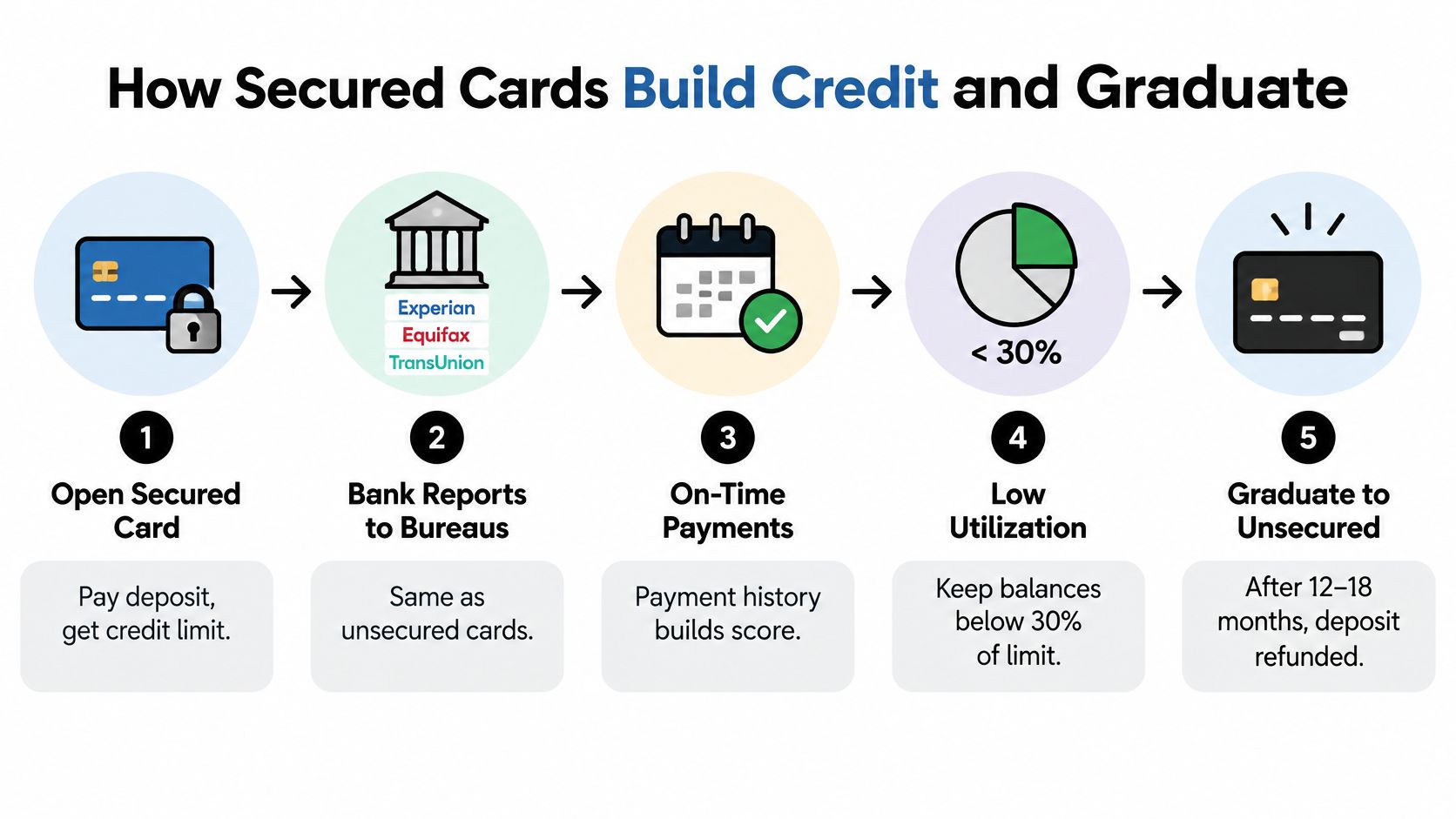
How Secured Cards Build Credit and Graduate
The credit record responds to what gets reported, not to the fact that you posted collateral. Payment history, the balance and limit that post, how long the account has been open, and new credit activity are the levers. A missed payment can hurt a rebuilding file the same way it hurts any other card.
Graduation is an issuer review. The issuer may raise the limit, return the deposit, or move the account to unsecured status. It isn't automatic, and one issuer's results aren't yours.
During January to June 2025, 59% of KeyBank secured-card program participants graduated within 12 months, and 88% graduated within 24 months, according to KeyBank. Those figures describe that program. They don't guarantee a timeline, a deposit refund, or a score outcome for any other reader.
A sequence you can follow
- Confirm three-bureau reporting. Before you fund the deposit, ask whether Experian, Equifax, and TransUnion all receive the limit and the balance, and how often.
- Pay every statement on time. Paying in full avoids interest when the card has a grace period. On time still matters if you can only pay part of the balance.
- Keep the reported balance low relative to the limit. Pay before the statement closes so the figure that posts isn't the high point of the month.
- Review the account around month 12. Ask about a limit increase or graduation. Bring your on-time history. Don't assume the review happens unless the agreement says so.
- Keep the account open after a graduation. Account age and available revolving credit both matter. Closing the card the week it converts can shrink the limit a lender sees.
Accurate negative history remains for its reporting period. One strong month doesn't replace a year of on-time use. If an item on the report is wrong, the path is documentation and a legal dispute, not a promise that it disappears. Day-to-day secured credit card habits during repair keep the new account from working against the file you're trying to steady.
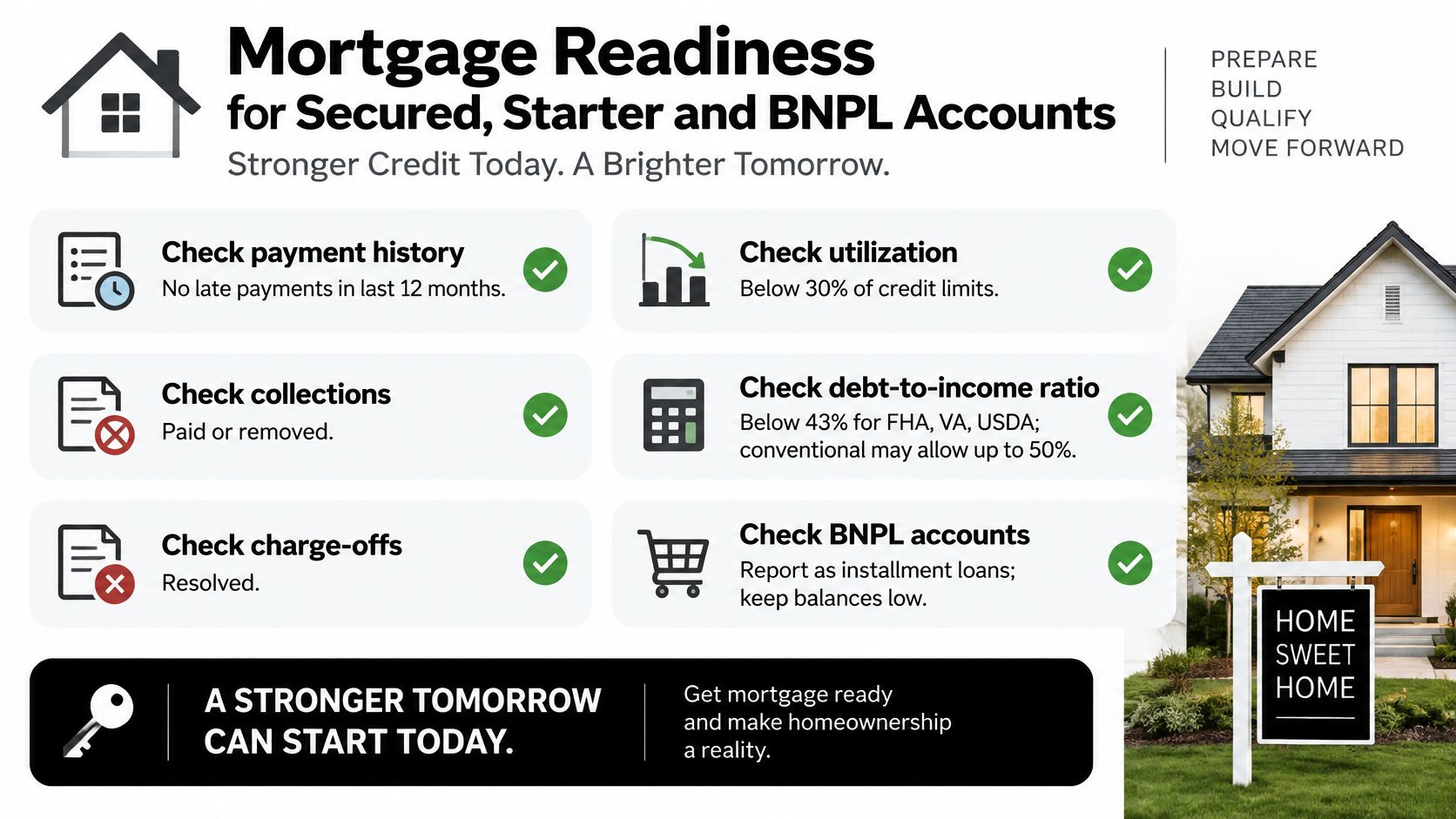
Mortgage Readiness for Secured, Starter and BNPL Accounts
A file can look stable inside a card app and still read thin to an underwriter. FHA, VA, conventional, and USDA reviews weigh payment history, collections, charge-offs, utilization, and your debt-to-income ratio. One new account can touch several of those at once. A secured card adds a revolving tradeline when the issuer reports it. An unsecured starter card can do the same if you already qualify. A buy-now-pay-later plan is a different obligation: it may be installment debt, it may not report everywhere, and several small plans can still read as monthly commitments.
Affirm's expanded Experian reporting covers eligible pay-over-time loans issued from April 1, 2025 onward, including Pay-in-4 products. Those accounts were not expected to affect traditional credit scores right away, though they may matter as scoring models change. On-time BNPL payments may not move a score the way an on-time card payment can, while the obligation can still be counted. If you want the installment math behind those plans, how BNPL instalments really work explains the payment schedule before you add another one.
Inventory the file before you add a card
Start with Experian, Equifax, and TransUnion side by side. The same account can show different balances, statuses, dates, limits, payment months, or collection ownership across the bureaus, so a clean report at one bureau does not prove the file is clean.
- List every fintech plan. Include Affirm, Klarna, Afterpay, Sezzle, and similar pay-over-time accounts, even if an app calls them interest-free.
- Name the bureau. Write down which bureau receives each account, and which ones receive nothing.
- Label the account type. Note whether it is treated as revolving credit or as installment credit.
- Ask the lender. Confirm how that balance is counted in underwriting and in debt-to-income for the loan type you're considering.
When the item is real, and when it isn't
Each account is reviewed on its own. An accurate negative account may need rebuilding, a payment strategy, documentation, or time, rather than another dispute. A collection may need an ownership and balance review. A late payment may need payment-history proof. If the late mark, the balance, or the owner is wrong, a documentation-based dispute is the right tool. If the item is accurate, paying it or waiting out the reporting period is the honest path. No lender outcome is guaranteed, because each lender applies its own criteria on top of the loan program's rules.
Choose the Card Your Mortgage Timeline Supports
A borrower can pay a secured card in full every month and still show high utilization, because the balance that reaches the bureaus is the one on the statement closing date. The same card may also report to only one or two bureaus, leaving the file a lender reviews without the payment history it earned. Payment history alone does not make a card lender-ready. Confirm bureau coverage, the reported limit, statement-date utilization, fees, graduation rules, and how a new inquiry will look.
Match the card to the months you have
- Twelve months or more before you buy. Choose one card that reports to all three bureaus. Keep the balance that posts low relative to the limit, and let on-time months accumulate.
- Six to twelve months out. Stay with that one manageable account. Pay before the statement closes. Don't add a second starter card to "speed things up."
- Inside six months of an application. Avoid new accounts. A hard inquiry and a brand-new tradeline can raise questions in underwriting. Closing an older card can also cut available revolving credit. Coordinate any change with your mortgage professional.
Credit-card delinquency in the Federal Reserve's 2025 data ran about 16.24% among subprime borrowers and 1.29% among prime borrowers in the third quarter, a gap Experian highlights when explaining which accounts help a credit file. Lenders weigh late payments heavily, so documented on-time history is part of mortgage readiness for first-time buyers and for anyone returning after a denial. Pay-over-time plans can sit beside a card on the same reports, and Superior Credit Repair BNPL guidance explains how those accounts are treated.
For a first conversation, bring the three current credit reports, photo identification, your current address, recent statements, collection notices, payment confirmations, and any denial or adverse-action notice. You can request a credit analysis and talk through the approval target.
Superior Credit Repair can review your credit report, help identify inaccurate or questionable items, and explain a step-by-step plan for improving your credit profile. Results vary with each person's credit file, documentation, and account behavior, and no approval is guaranteed for a mortgage, auto loan, or rental review.
Frequently Asked Questions About Secured and Unsecured Credit Cards
Does my secured card deposit count as a payment toward my balance?
No. The deposit is collateral the issuer holds. You still owe the full statement balance under the account terms, and the deposit may earn no interest. If you only "use the deposit," the statement still shows a balance you haven't paid.
Will a secured card build credit as well as an unsecured card?
Banks generally report secured cards the same way they report unsecured cards. Payment history, reported utilization, account age, and new-credit activity drive what changes. Outcomes vary with the file, the issuer's reporting, and how you manage the account. No card promises a specific score result.
Can a secured card hurt a mortgage application?
It can. A card that reports to only some bureaus, or that repeatedly shows a balance close to a small limit, can weaken the picture a lender reviews. Confirm three-bureau reporting and keep the statement balance low before you rely on the account for an FHA, VA, conventional, or USDA file.
Do I need a secured card before buying a home?
Not always. If your file already supports an affordable unsecured card, a deposit may not be the best use of cash you need for closing. The fit depends on your reports, your timeline, and the lender's criteria. No approval is guaranteed.
Superior Credit Repair Online provides educational credit guidance for individuals and families preparing for major financial goals like buying a home, applying for a mortgage, refinancing, or rebuilding after credit challenges.
Was this guide helpful?
If this information helped you better understand your credit report or your next steps, we would appreciate your honest feedback. You are welcome to share your experience with Superior Credit Repair on our Google Business Profile.
If you're weighing a secured card against an unsecured starter card before an FHA, VA, conventional, or USDA application, Superior Credit Repair can walk through your three reports, separate inaccurate items from accurate ones, and map a calm rebuilding plan around deposits, statement dates, and what a lender is likely to see. Request a credit analysis when you're ready, and bring your statements so the conversation starts from your file, not from a generic score goal.