

You might be staring at a lender pre-approval form, a rent payment that keeps rising, and a stack of credit card statements that never seem to shrink. You want a home. You may even be close on income, savings, or job stability. But the debt piece keeps getting in the way.
That's where many people start searching for Trinity debt consolidation. They're not always sure what Trinity offers, whether it helps or hurts mortgage approval, or how a mortgage underwriter will view it. Those are fair questions. Debt solutions can look similar on the surface, but they can affect your credit profile very differently.
If you're preparing for FHA loan preparation, VA loan preparation, USDA loan preparation, or a conventional mortgage, the right move isn't always the fastest-looking one. It's the one that supports payment stability, keeps your credit report accurate, and fits what lenders look for when they review your file.
Table of Contents
- Is Trinity Debt Consolidation Right for Your Homebuying Goals
- Understanding Trinity Debt Management A Plan Not a Loan
- The Trinity Debt Management Plan Process Step by Step
- Trinity DMP vs Consolidation Loans vs Debt Settlement
- How a DMP Impacts Your Credit and Mortgage Readiness
- Beyond Debt Management Credit Repair and Lender Readiness
- Frequently Asked Questions About Debt Plans and Credit
Is Trinity Debt Consolidation Right for Your Homebuying Goals
A common homebuyer situation looks like this. Someone has solid income, pays rent on time, and has enough saved to start thinking seriously about a down payment. But they're carrying several unsecured debts, their credit card utilization is high, and one or two accounts may already be behind. They start wondering whether Trinity debt consolidation could clean things up before they apply for a mortgage.
The first thing to know is that mortgage approval usually comes down to a few connected issues. Lenders look closely at payment history, debt-to-income pressure, and the overall stability of the credit file. If debt is causing late payments or making monthly cash flow too tight, that can create problems even if income looks decent on paper. A useful overview of how mortgage lenders approve loans can help you see why debt structure matters so much.
The real question behind the search
Individuals searching Trinity debt consolidation are really asking a more personal question. They want to know whether this choice moves them closer to homeownership or delays it.
That depends on timing, the type of debt involved, and what your credit report already shows. If your main issue is unsecured debt that needs better structure and lower interest, a debt management approach can sometimes support more consistent repayment. If your report also contains inaccurate collections, outdated late payments, or unverifiable negative accounts, debt management alone won't solve that part.
A mortgage-ready credit profile isn't just about owing less. It's also about showing lenders stable behavior, manageable obligations, and accurate reporting.
When this option may be worth a closer look
A Trinity-style program may deserve attention if you:
- Need payment structure: Multiple unsecured bills are hard to manage each month.
- Need lower interest pressure: Interest charges are keeping balances from dropping.
- Want a guided plan: You'd rather work through a structured repayment program than juggle creditors on your own.
- Care about underwriting optics: You're trying to avoid choices that may create fresh credit complications before a mortgage application.
For a future buyer, the key isn't whether a program sounds helpful. The key is whether it supports long-term credit health without creating avoidable underwriting concerns.
Understanding Trinity Debt Management A Plan Not a Loan
A lot of future homebuyers search "debt consolidation" assuming the company will issue one new loan that pays off everything else. Trinity's model works differently. Its core service is a Debt Management Plan, or DMP, which is a structured repayment program for certain unsecured debts.
What Trinity actually offers
Trinity Debt Management is a non-profit Christian-based organization founded in 1994. According to BestCompany's Trinity Debt Management profile, Trinity offers debt management plans designed to help consumers repay unsecured debt through one monthly program payment, often over several years, and creditors may agree to reduced interest within the plan.
For mortgage preparation, that distinction matters.
A consolidation loan replaces old accounts with new borrowed money. A DMP does not create a new loan account. Instead, it reorganizes repayment of eligible unsecured debts you already have. The agency collects one monthly payment from you and sends funds to participating creditors under the agreed structure.
A simple way to view it is this: a consolidation loan changes the container. A DMP changes the payment process inside the container. Underwriters often care about that difference because new borrowing right before a mortgage application can raise different questions than a documented repayment plan.
Which debts fit and which do not
Trinity's program is aimed at unsecured debt, not every bill in a household budget. That can confuse buyers who hope one program will also handle a mortgage, car note, or tax problem.
Here's the practical breakdown:
| Debt type | Usually fits Trinity DMP | Why it matters for homebuyers |
|---|---|---|
| Credit card debt | Yes | High revolving balances can hurt utilization and monthly cash flow |
| Medical bills | Yes | These accounts can add payment strain and reporting problems |
| Collections | Yes | Unsecured collections may be part of a repayment strategy, but you may also need to focus on clearing collections on your credit report if accuracy issues remain |
| Unsecured personal loans | Yes | These debts may be included if they fit the program rules |
| Mortgage | No | Home loans are secured debt and handled outside a DMP |
| Auto loan | No | Vehicle financing is also secured debt |
| Tax debt | No | Tax balances follow a different resolution process |
| Payday loans | No | These are generally outside Trinity's stated service scope |
Mortgage underwriting looks at the full file, not just one monthly payment. If a DMP helps bring revolving debt under control, that can support stronger payment behavior over time. If the credit report still shows unresolved errors, disputed collections, or other non-DMP issues, those items may still affect lender readiness.
Availability is also limited by state, so a buyer should confirm eligibility before treating Trinity as part of a homebuying timeline.
Practical rule: Trinity's service is a counseling-based repayment plan for eligible unsecured debt. It is not a new loan, and it does not replace the need to review how your credit report will look to a mortgage lender.
The Trinity Debt Management Plan Process Step by Step
The process matters almost as much as the label. Many borrowers hear “debt consolidation” and assume all solutions work the same way. They don't.
How the process usually unfolds
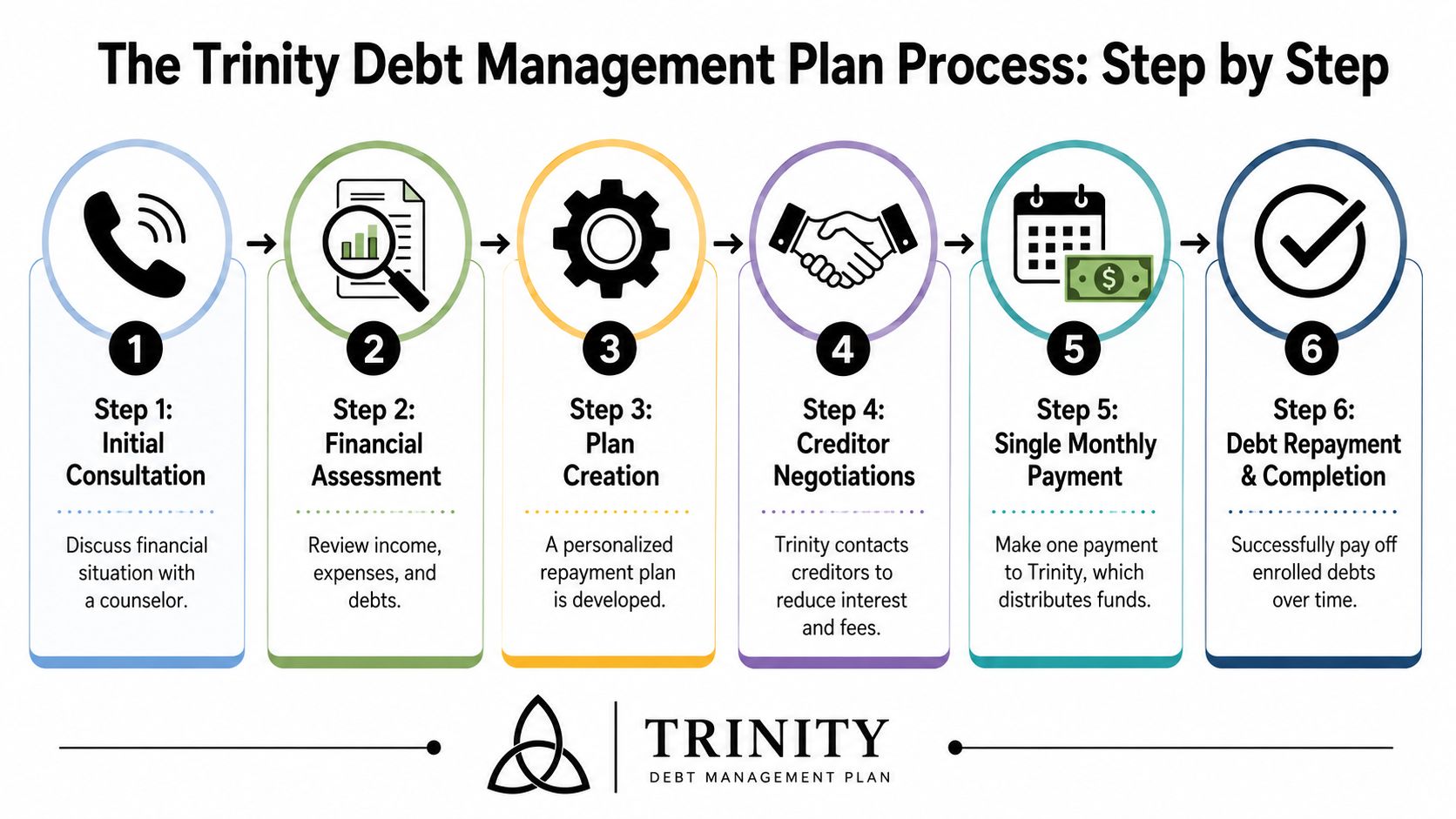
A typical Debt Management Plan follows a sequence that feels more like financial triage than borrowing. You start by reviewing income, expenses, and unsecured debts with a counselor. The purpose is to decide whether your budget can support a structured repayment plan.
After that, creditors are contacted for possible concessions. The plan is built around one monthly payment instead of several scattered due dates. From a budgeting standpoint, this can make the household payment calendar much easier to control.
A simple way to picture the flow:
Financial review
Your income, living expenses, and unsecured accounts are evaluated.Proposed repayment structure
The agency works with creditors on terms that may make repayment more manageable.Single monthly payment
You send one payment into the plan instead of managing multiple unsecured bills separately.Distribution to creditors
The plan administrator sends funds to the enrolled creditors.Completion over time
The program continues until the enrolled debt is repaid under the plan structure.
Where homebuyers need to pay attention
A future mortgage applicant should pause on one issue in particular. Debt plans can improve order and consistency, but they can also change how active credit accounts are handled. That matters because lenders often care about account status, current payment behavior, and whether there are any unresolved problem accounts still floating around the file.
This becomes especially important when collections are part of the problem. If old balances, charged accounts, or collection entries are still affecting your report, budget relief by itself may not fully solve mortgage readiness. Some buyers need to work on repayment structure and also focus on clearing collections on your credit report when items are inaccurate, outdated, or otherwise questionable.
A DMP can help organize repayment. It doesn't automatically clean up how every account is reported.
The best use of a debt management plan is usually very practical. It gives a borrower a way to stop the monthly chaos, build a repeatable payment pattern, and create breathing room. For someone planning to buy a home, that can be useful. But timing still matters. If you're planning to apply soon, it's wise to understand how any enrolled program, account status changes, or unresolved reporting issues may appear to an underwriter.
Trinity DMP vs Consolidation Loans vs Debt Settlement
These three options get lumped together all the time. From a mortgage readiness standpoint, they are not interchangeable.
How each option works for a future homebuyer
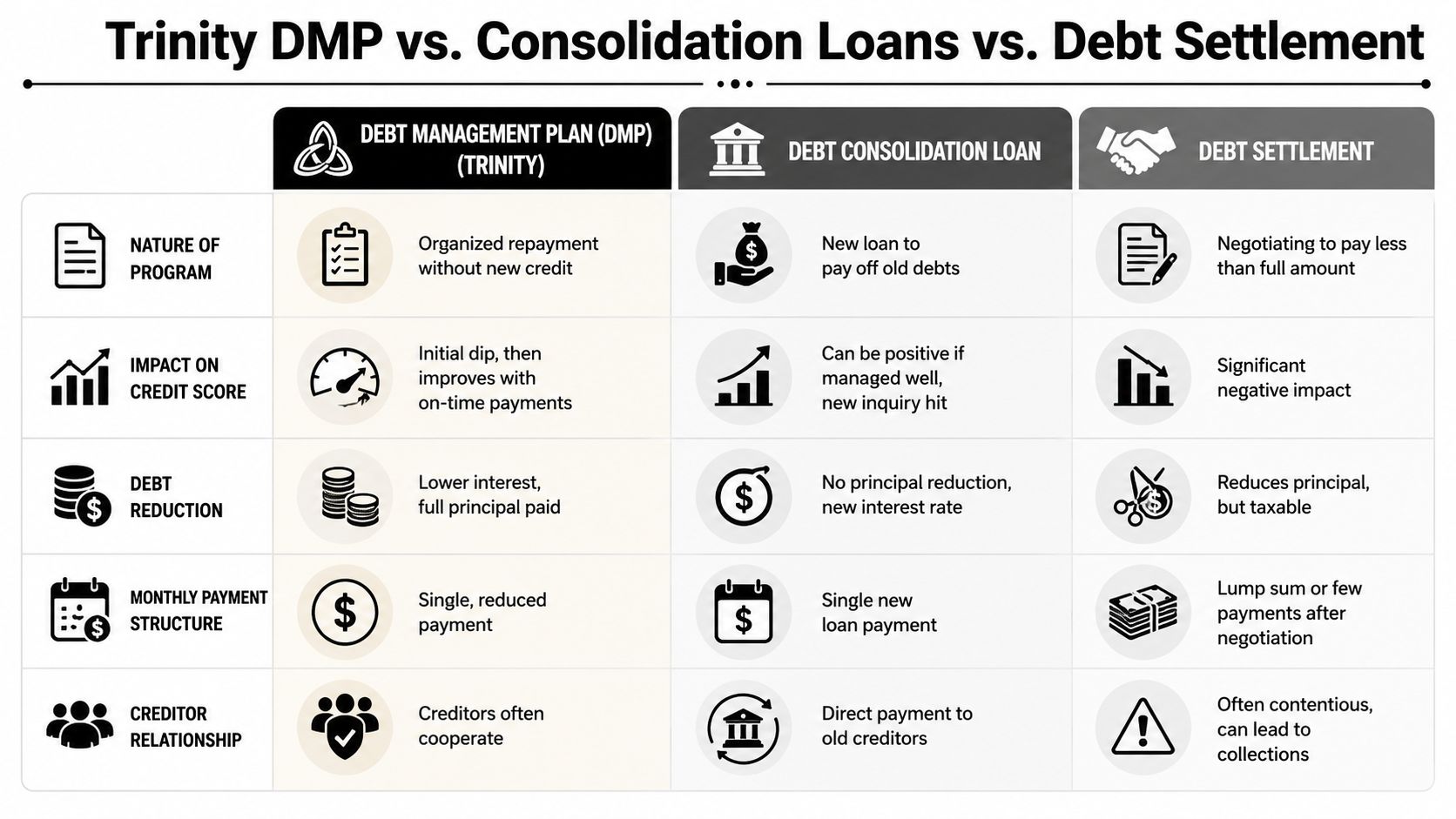
A Debt Management Plan is an organized repayment program. You repay what you owe through a structured plan, and the focus is often on making payments manageable through creditor concessions rather than replacing debt with a new loan.
A debt consolidation loan replaces existing balances with a new loan. That can simplify payments, but it also creates a new account and a new underwriting event.
A debt settlement program aims to resolve debt for less than the full balance owed. That may appeal to borrowers under severe strain, but it can raise different credit and underwriting concerns because settled debt is not the same as fully repaid debt.
According to National Debt Relief's debt consolidation statistics page, borrowers who consolidate credit card debt with a personal loan reduce their card balances by approximately 57% on average. That reflects how a consolidation loan can move revolving balances off cards. The same verified data notes Trinity's DMP approach differs because a counselor negotiates creditor interest rate reductions to between 5% and 10% and eliminates late fees, allowing borrowers to repay the full balance through a structured plan rather than a new loan.
If you're trying to improve cash flow while keeping a longer-term eye on financing, practical budgeting advice can help alongside any formal program. One resource worth reading is Wealth Collective's debt advice, especially if you're trying to tighten spending habits while paying down unsecured balances.
A side by side mortgage readiness view
Here's the short version:
| Option | New debt created | Full balance repaid | Possible underwriting concern |
|---|---|---|---|
| Trinity-style DMP | No | Yes | Program participation and account handling need review |
| Consolidation loan | Yes | Yes, through new loan | New inquiry, new account, and fresh debt obligation |
| Debt settlement | No new loan required | Not typically full balance | Settlement history can be a concern for lenders |
For homebuyers, the strongest question is not “Which one lowers stress fastest?” It's “Which one supports a cleaner path to lender review?”
A DMP often appeals to borrowers who still have enough income to repay what they owe but need structure and lower interest pressure. A consolidation loan may fit someone with strong enough credit to qualify for favorable loan terms and who isn't near mortgage underwriting. Debt settlement is usually a more serious hardship path and may not fit someone trying to present a stable, lender-ready file in the near term.
The same debt problem can call for different solutions depending on whether your next goal is survival, stability, or mortgage approval.
How a DMP Impacts Your Credit and Mortgage Readiness
For a buyer, this is the section that matters most. You don't just want debt relief. You want a credit profile that makes sense to a mortgage lender.
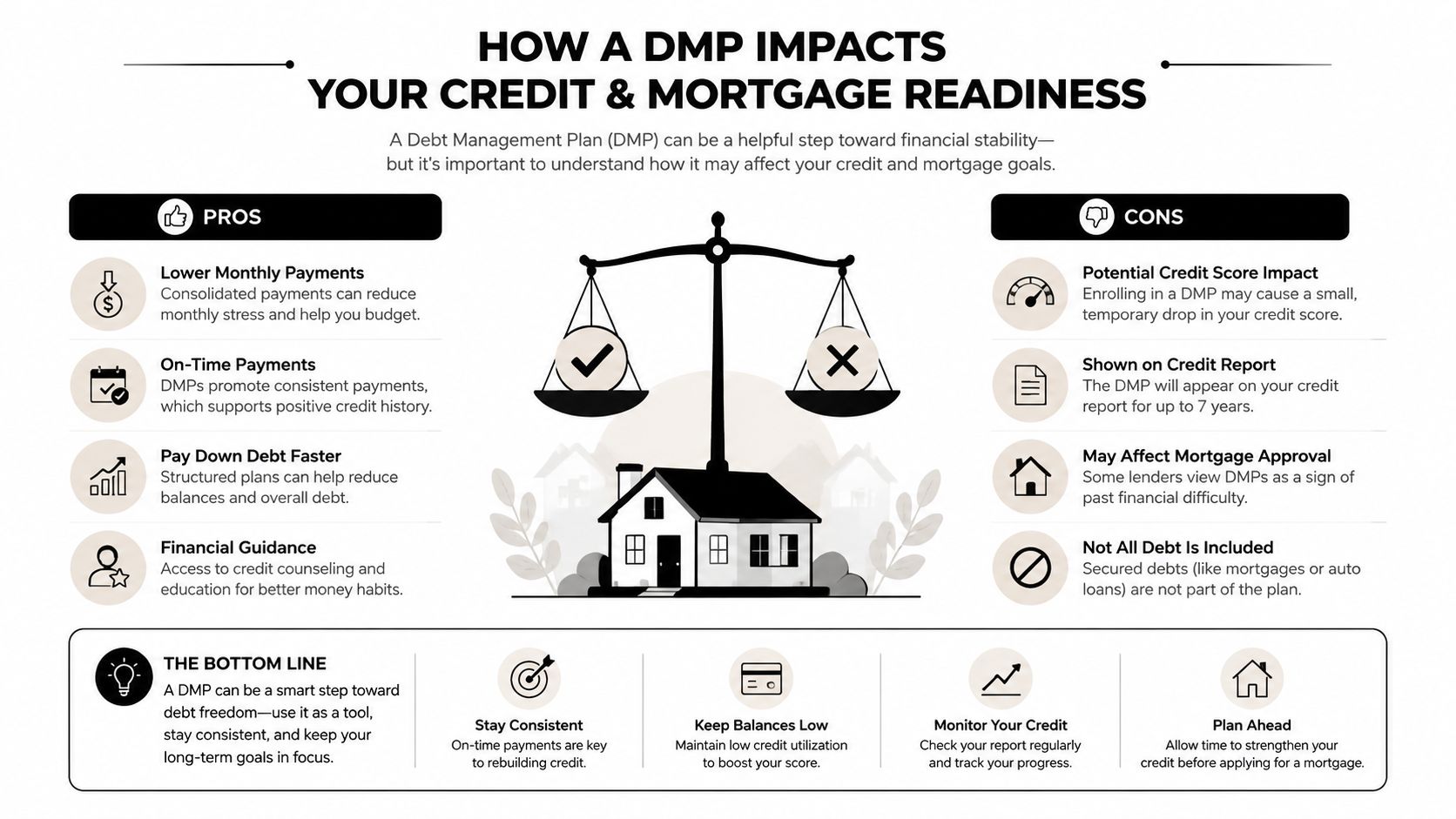
The short term credit effects
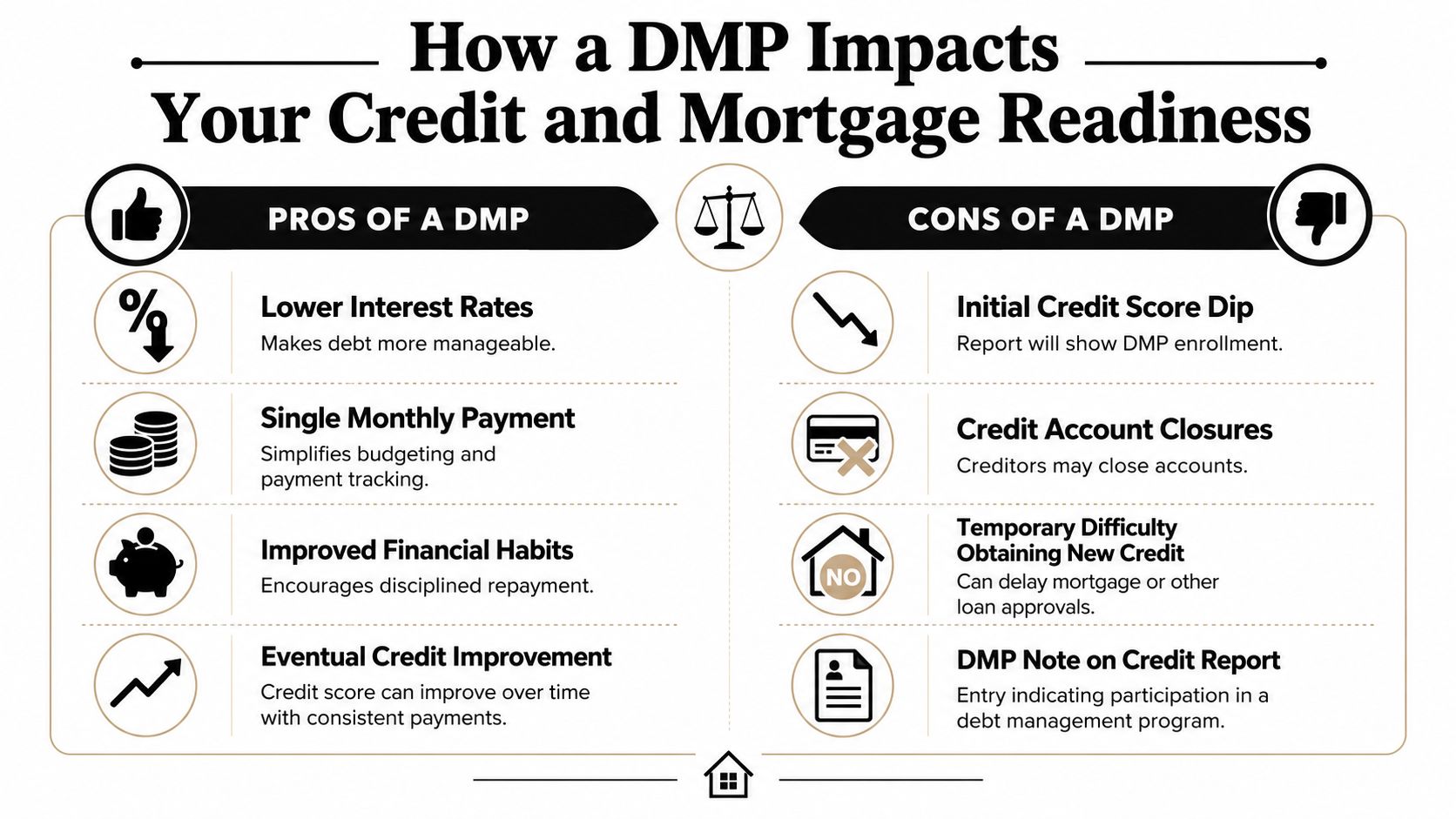
When someone enrolls in a debt management plan, the credit impact isn't always emotionally satisfying at first. People often hope that simplifying payments means their score will immediately improve. Real life is usually more nuanced.
Some accounts may no longer function the way they did before enrollment. Changes in account status can affect utilization patterns, available credit, and how lenders interpret account stability. That means a DMP can create an initial period where your credit profile is in transition.
This is why mortgage timing matters. If you're trying to apply for a home loan very soon, any major debt program should be discussed carefully with your lender or mortgage professional first. A cleaner budget is good, but underwriters also care about what changed, when it changed, and whether the file now looks more stable or merely different.
Why underwriters may view it differently from a new loan
The main mortgage-related advantage of a DMP is that it does not create a new loan. According to LendEDU's Trinity Debt Management review, a DMP consolidates payments without creating a new loan, which allows clients to establish a series of on-time payments and build positive credit history. The same source explains that this can matter for FHA and VA lending because it avoids the “new debt” red flags that consolidation loans can trigger during mortgage underwriting.
That doesn't mean a DMP guarantees mortgage approval. It doesn't. Results vary based on your full credit file, account history, current balances, lender overlays, and documentation. But from a mortgage-readiness standpoint, avoiding a brand-new debt obligation can be meaningful.
Homebuyers also need to watch the monthly payment side of the file. Lenders look at how much of your income is already committed to debt. If you need a clearer grasp of that math, this debt to income ratio guide is a useful plain-English reference, and so is learning more about understanding debt to income ratio before you apply.
A helpful way to think about DMPs for mortgage prep:
- Positive effect: They can create a track record of organized, on-time repayment.
- Caution point: They may still affect account presentation and timing during underwriting.
- Best use case: They often make the most sense when debt chaos is the bigger problem than borrowing capacity.
Mortgage lenders usually prefer a stable pattern they can document. Consistent payment behavior often matters more than a quick-looking financial fix.
If your profile is otherwise close to qualifying, a DMP can support discipline. If your report also has reporting errors, unresolved derogatory items, or old damage that isn't accurate, then debt management may need to be paired with separate credit report review work.
Beyond Debt Management Credit Repair and Lender Readiness
Debt management and credit repair solve different problems. Many consumers blend them together, then feel confused when one doesn't fix the other.
Debt repayment and credit report accuracy are not the same thing
A DMP addresses how you repay valid unsecured debt. It can improve structure, reduce payment confusion, and help you move toward current status. But it doesn't automatically remove inaccurate, outdated, unverifiable, or misleading information from your credit reports.
That's where formal credit repair and credit restoration work becomes relevant. If a report contains errors, the process must be handled through documentation, review, and legal dispute procedures. Under the Fair Credit Reporting Act summary published by Superior Credit Repair Online, credit bureaus must investigate disputes about inaccurate or unverifiable information within 30 days. If the item can't be verified or is found inaccurate, it must be corrected or deleted, and the consumer is entitled to a free updated copy of the report.
This matters for mortgage credit repair because underwriters don't approve files based on intention. They approve based on what the documents and reports show.
What lender ready credit work looks like
A lender-ready file usually involves two parallel tracks.
First, the borrower handles legitimate debt in a consistent, affordable way. That may involve budgeting changes, debt reduction, or a structured plan. Second, the borrower reviews the report itself for items that should not be there, should not be reporting the way they are, or need proper verification.
That can include:
- Credit report errors: Wrong balances, duplicate accounts, or accounts that don't belong to you
- Late payment dispute help: When reporting is inaccurate or unsupported by records
- Collections dispute help: For items that are outdated, misleading, or unverifiable
- Charge-off dispute help: When status details are inconsistent or not properly documented
- Medical collection credit repair: When reporting issues create unnecessary mortgage friction
For borrowers trying to clean up credit history, the important point is simple. Debt repayment supports financial stability. Credit repair focuses on report accuracy. Mortgage readiness often requires both.
Results vary. They depend on your documentation, account history, creditor responses, and current credit behavior. Still, a careful, compliance-based review can prevent a buyer from going into underwriting with a credit file that tells the wrong story.
Frequently Asked Questions About Debt Plans and Credit
Can I apply for a mortgage while I'm in a Debt Management Plan
Sometimes, yes. But the answer depends on the lender, the loan type, your payment history, and how the underwriter interprets the overall file. A DMP doesn't automatically block approval, but buyers should discuss timing with their loan officer before applying.
Does Trinity offer a debt consolidation loan
No. Trinity's offering is a Debt Management Plan, not a new loan product. That distinction matters because a DMP and a consolidation loan can affect underwriting differently.
If I'm paying debt through a DMP do I still need credit repair
You might. A DMP helps organize repayment of legitimate unsecured debt. It does not challenge inaccurate, outdated, or unverifiable reporting. If your report has errors, those issues still need a separate review and dispute process.
How can I tell if a credit repair company is operating legally
A major compliance sign involves billing. Under the federal Credit Repair Organizations Act overview from Super Lawyers, credit repair companies are prohibited from charging advance fees before services are fully performed. That means a pay-as-you-go structure is an important sign of a legitimate agency. You can also review additional credit repair FAQs if you're comparing providers.
Is a DMP better than debt settlement if I want to buy a home
For many future homebuyers, a DMP may be easier to align with mortgage readiness because it focuses on structured repayment rather than settling for less than the full balance. But “better” depends on your hardship level, your timeline, and how much damage already exists in the file. There isn't a one-size-fits-all answer.
Superior Credit Repair Online provides educational credit guidance for individuals and families preparing for major financial goals like buying a home, applying for a mortgage, refinancing, or rebuilding after credit challenges.
Was this guide helpful?
Superior Credit Repair can review your credit report, help identify inaccurate or questionable items, and explain a step-by-step plan for improving your credit profile. If you're preparing for homeownership, apartment approval, refinancing, or better financing terms, a careful review can help you understand what's helping your file and what may still need attention. You can request a free credit analysis or consultation through Superior Credit Repair to better understand your options.
If this information helped you better understand your credit report or your next steps, we would appreciate your honest feedback. You are welcome to share your experience with Superior Credit Repair on our Google Business Profile. Share your feedback on Google