


"Pay off every collection before you apply for a USDA loan." That advice sounds responsible. It's repeated in forum threads, at kitchen tables and by well-meaning realtors, and it's wrong often enough to cost you money you never needed to spend.
The rule that governs a USDA loan with collections doesn't ask whether you have collections. It asks three separate questions. How is each debt classified? How much non-medical collection balance do you carry in total? And does the underwriter reviewing your file believe you're an acceptable credit risk? A hospital bill, a store card and a delinquent federal student obligation can sit on the same credit report, and USDA guidance treats each one differently.
Popular advice turns all of this into a pass-fail grade. It isn't one. The collection question is a liability calculation with an eligibility overlay, and once you see the classifications and the math side by side, your next steps get clearer and considerably less frightening.
Table of Contents
- Collections Do Not Automatically End a USDA Loan
- The 2000 Dollar Rule and Three Lender Options
- Medical Bills Versus Delinquent Federal Debt
- How Collection Balances Change Your Debt Ratios
- Why a Passing GUS Finding Is Not the Whole Story
- How to Review and Document Each Collection
- Prepare Your File Before You Apply
Collections Do Not Automatically End a USDA Loan
Two old hospital bills and a $740 phone collection do not automatically end a USDA loan application. What matters is how each account is classified, the combined balance of non-medical collections, and the lender's review of the borrower's overall credit risk.
Under the Single Family Housing Guaranteed Loan Program, the approved lender's underwriter reviews collection accounts even if automated underwriting returns a favorable finding. A medical bill, a non-medical collection, and delinquent federal debt can lead to different underwriting questions, so the type of debt matters as much as the amount.
The Two Variables That Move a File
Classification comes first. Medical collections, non-medical collections, and delinquent federal debt are treated differently. The balance of a medical bill may be handled differently from an unpaid phone account, while delinquent federal debt can raise a separate eligibility concern.
Cumulative balance comes second for non-medical collections. The underwriter considers those balances together, not just one account at a time. For example, several smaller accounts can add up to more than a single larger collection. The $2,000 test is a liability calculation, not a pass-fail rule; classification and underwriter judgment still affect the outcome.
A credit score alone does not answer these questions. A file with a higher score can still require review of a federal debt, while medical collections in another file may be assessed differently.
For a plain-language overview of mortgage credit requirements, see USDA loan advice from Superior Credit Repair. If you are also planning household purchases before closing, compare furniture financing options carefully because a new monthly payment may affect your budget.
No article or credit review can guarantee mortgage approval. Accurate account details and complete documentation help the lender assess the file.
The 2000 Dollar Rule and Three Lender Options
| Situation | Balance test | Lender treatment | Monthly debt effect |
|---|---|---|---|
| Medical collection | Any balance, generally | Usually does not have to be paid | Generally excluded from total debt-to-income |
| Non-medical collections at or under the test | Cumulative non-medical balance of $2,000 or less | Underwriter still reviews; the over-$2,000 payoff rule is not triggered | Open accounts still listed; ratio use depends on the file |
| Non-medical collections over the test | Cumulative non-medical balance more than $2,000 | Pay in full before closing, use a documented repayment payment, or count 5 percent of the balance | Example: $6,000 can count as $300 a month |
| Any open collection | Balance still outstanding | Enter in GUS or on the application | Explain the entry if excluded from ratios |
| Disputed non-medical collection | Dispute present on the report | Still reviewed as a derogatory account | A dispute does not erase the liability review |
Those five lines cover the whole rule, and the detail behind them sits in chapter 10 of the USDA handbook. Read the middle rows first, because that's where most borrowers misread their own situation.
The $2,000 threshold applies to the combined balance of non-medical collections, not to each account on its own. If you owe $600 to one agency, $700 to another and $900 on a third-party retail account, you're past the test with three balances that each look harmless in isolation.
At or below the threshold, the special payoff requirement isn't triggered, but the underwriter still reviews the accounts. Above it, the lender picks one of three treatments: require payment in full before closing, accept a documented existing or new repayment agreement and count its required monthly payment, or count 5 percent of the outstanding balance as a monthly liability. A $6,000 balance can become a $300 monthly debt under that last option, which is a real number inside your debt-to-income ratio rather than a line item a lender ignores.
How Each Treatment Looks on Paper
Payoff in full clears the account but spends cash you may need for closing costs, and the paid collection still appears in your credit history. A documented repayment agreement keeps cash in your pocket and counts only the required monthly payment, which is often lower than 5 percent of the balance. The 5 percent calculation needs the least paperwork and produces the largest monthly figure of the three.
Weigh them in that order and the choice usually makes itself clear once you know your exact balances.
What Has to Be Reported Either Way
Every open collection has to be entered in the Guaranteed Underwriting System or listed in the lender's liabilities documentation. If the lender excludes an account from the ratio math, that exclusion needs an explanation attached to the file.
The practical rule: paying every collection is not automatically required, and ignoring accounts is not harmless. The lender weighs type, balance, payment arrangement, documentation and your overall credit history.
If a new sofa or mattress is part of the move, a budget-friendly furniture financing guide is worth reading before you sign, since a fresh monthly payment lands in the same ratio as everything you've just added up.
Before you send anyone a payment, total your non-medical balances only, then ask the lender which of the three treatments the file will use and how that number will appear in your debt-to-income calculation.
Medical Bills Versus Delinquent Federal Debt
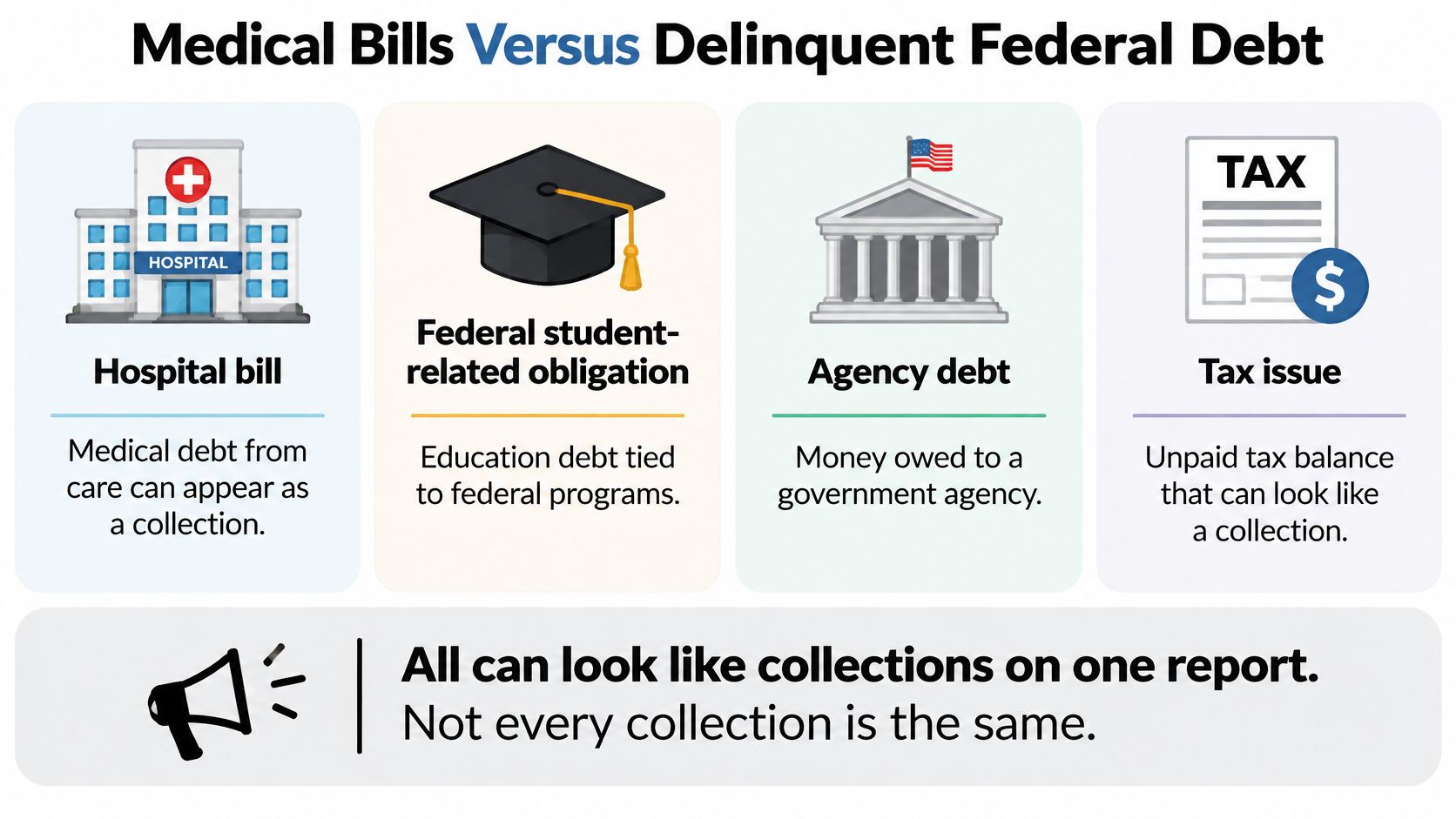
Four debts can land on one credit report and look identical at a glance: a hospital bill from an emergency visit, a federal student-related obligation, money owed to a government agency, and an unpaid tax balance. USDA treats them differently, and the balance is frequently the least important detail. The $2,000 cumulative test applies to non-medical collections, and open collection accounts still have to be reported in GUS, as USDA's guaranteed loan program overview explains.
| Debt type | Cumulative $2,000 test | USDA treatment | Proof the lender needs |
|---|---|---|---|
| Medical collection | Does not count toward the non-medical test | Generally no payoff required; excluded from total debt-to-income | Open account reported in GUS; explanation if excluded from ratios |
| Non-medical collection | Counts toward the cumulative balance | Above $2,000: payoff, documented repayment payment, or 5 percent of balance | Payoff letter, repayment agreement, or current payment record |
| Delinquent non-tax federal debt | Not a collection balance test | Ineligible unless paid, released, or repayment conditions are met | Satisfaction, release, or updated servicer record |
Where the Two Thousand Dollar Test Stops
A medical collection is generally handled inside collection-account underwriting. It usually doesn't have to be paid, and it's generally left out of total debt-to-income.
A delinquent non-tax federal debt is a different problem entirely. USDA lender training treats the applicant as ineligible unless the debt is paid, the liability is released, or an approved repayment agreement has met the required payment conditions. Calculating 5 percent of that balance doesn't cure the eligibility issue. The classification decides the file, not the dollar amount.
Three Files, Three Outcomes
The old medical bill. A $1,900 hospital collection from three years ago gets reported in GUS, excluded from the ratio, and generally needs no payoff. The borrower documents it and moves on.
The store card above the test. A $3,400 non-medical retail collection crosses the cumulative line, so the lender picks one treatment from the table and a monthly figure appears in the ratio. Nothing here is disqualifying on its own.
The federal obligation. A $2,100 delinquent federal balance with no payoff, release or qualifying repayment record is an eligibility problem that outranks every other account on the report. Resolve this one first.
Sending money without paperwork is the most common self-inflicted wound in this category. Without a satisfaction letter, a release of liability, or an updated servicer record, the lender may be unable to verify that the debt is resolved, and the file stalls while you chase a receipt. Qualified legal advice is worth having when collection litigation, title questions or identity rights are involved. For medical accounts specifically, Superior Credit Repair mortgage readiness tips explain how reporting errors on medical debt get documented.
For every line on your report, answer one question first: is this a medical collection, a non-medical collection, or a federal delinquency? Tax-related items sit outside this table and should be verified separately with the lender.
How Collection Balances Change Your Debt Ratios
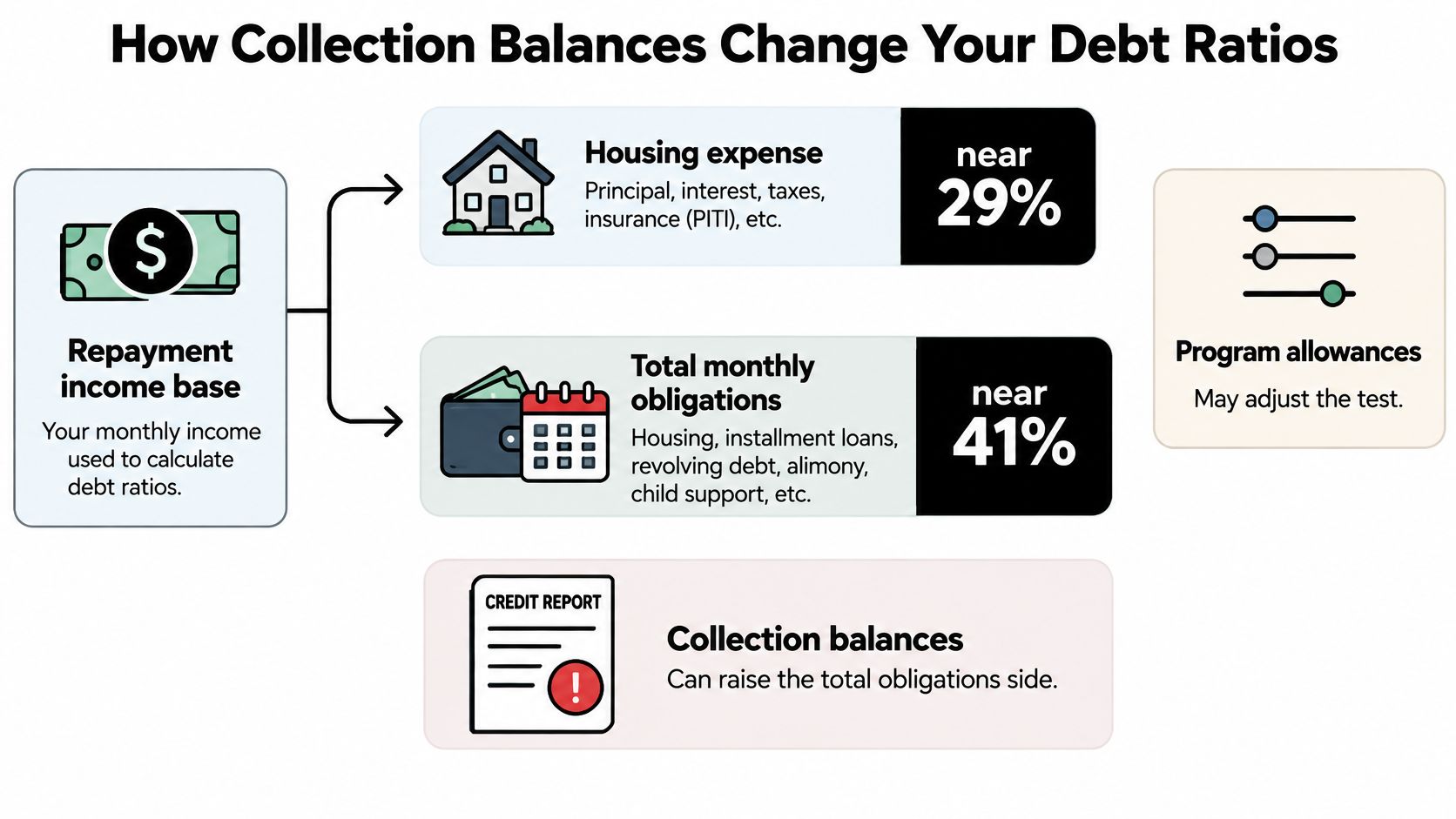
Two ratios carry most of the affordability conversation. Housing expense is measured against repayment income at roughly 29 percent, and total monthly obligations against that same income at roughly 41 percent, subject to program-specific allowances and lender review, as USDA's ratio analysis guidance sets out.
Collection balances feed the second number directly. Under the 5 percent alternative, $2,000 of qualifying non-medical collections adds $100 a month, and $10,000 adds $500 a month. Those figures shrink the maximum payment you can support, or they demand compensating strengths on the other side of the ledger.
| Item | Before collection payment | After adding $300 |
|---|---|---|
| Verified monthly income | $5,000 | $5,000 |
| Proposed housing payment | $1,400 | $1,400 |
| Car and card payments | $450 | $450 |
| Collection liability at 5 percent of $6,000 | $0 | $300 |
| Total monthly obligations | $1,850 | $2,150 |
Where the $300 Lands in a Household Budget
Before the collection liability, $1,850 in total obligations on $5,000 of monthly income comes to 37 percent. Add the $300 and the file moves to $2,150, or 43 percent. That crosses the common 41 percent guide, and the loan either needs more qualifying income, fewer recurring debts, or an underwriter willing to weigh strengths elsewhere in the file. The 41 percent figure is a guide that lender judgment and program allowances can adjust, not a wall.
Notice what changed and what didn't. The house payment stayed put. The car payment stayed put. One collection account moved the file from comfortable to tight.
Compensating Strengths the Underwriter Can Weigh
- Higher verified income: documented overtime, a second job with a stable history, or a co-borrower's qualifying income.
- Lower recurring debt: paying off a small installment loan or reducing a card balance before the file goes to underwriting.
- A documented repayment history: cancelled checks or statements showing consistent payments on the collection itself.
- Stable recent credit behavior: no new late payments, no new collections, no sudden burst of applications.
Paying a collection before closing can remove the monthly liability from the ratio, and that's a legitimate strategy. The lender still evaluates the credit history, and any large deposit used for the payoff has to be sourced and documented.
Before you dispute or settle anything, get four answers in writing: the current creditor balance, whether the account is medical or non-medical, whether any delinquent federal debt exists, and exactly how each account will be entered into the underwriting file. If you want the arithmetic spelled out for your own numbers, this explanation of how USDA lenders calculate DTI is a useful companion.
Why a Passing GUS Finding Is Not the Whole Story
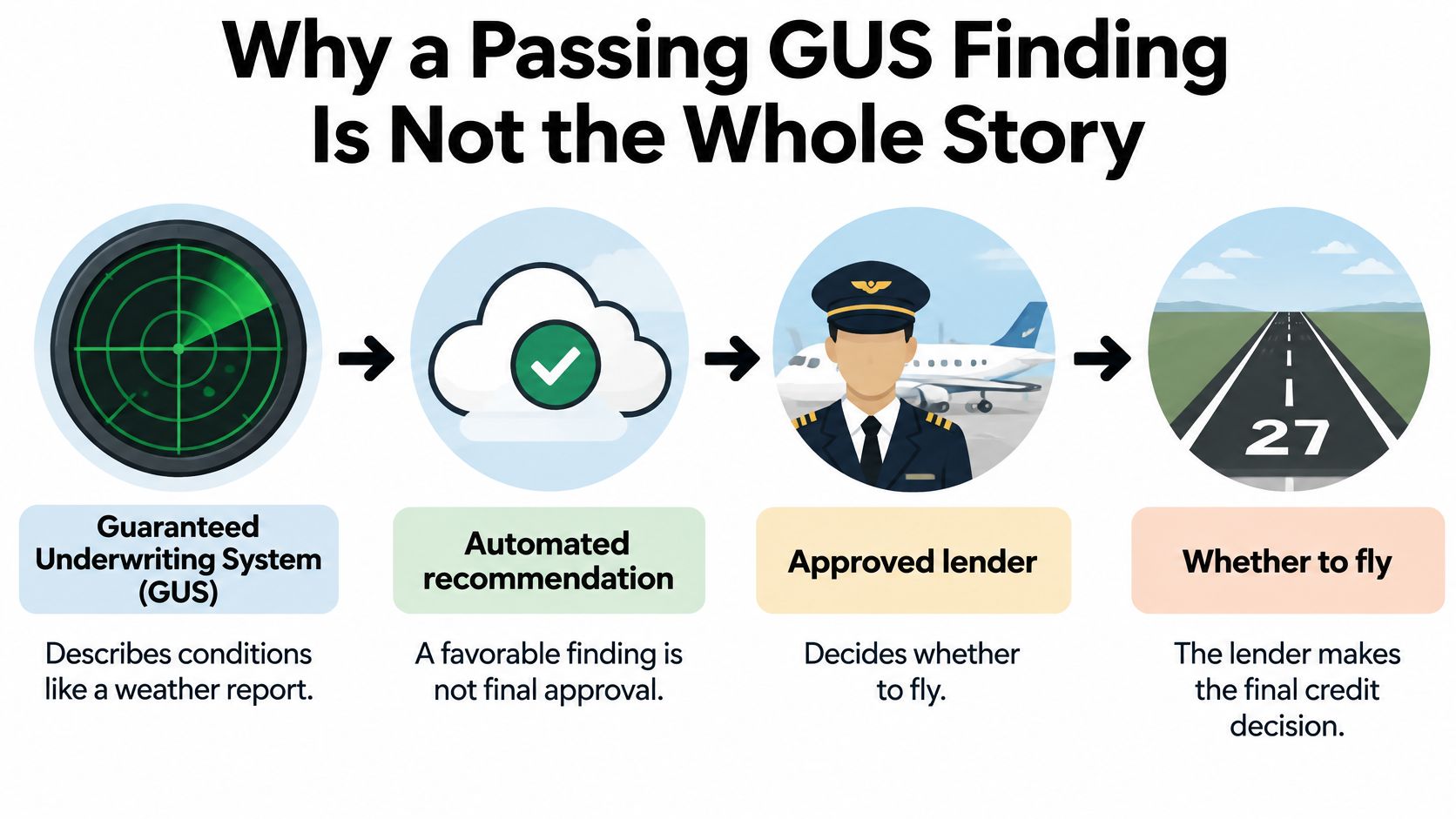
A weather report can describe clear skies along your route without deciding whether the plane takes off. The Guaranteed Underwriting System works the same way. It describes conditions. A person at the approved lender still decides whether to fly.
USDA guidance keeps the creditworthiness decision with that lender, which may request explanations, documentation or additional conditions even when automated underwriting produces an acceptable result, according to the consolidated USDA handbook. A favorable finding is a starting position, not a verdict.
Five Small Accounts Are One Number
Aggregation catches people who treat each account separately. Five $500 non-medical collections are not five small annoyances. They're $2,500 in cumulative non-medical balance, and the over-threshold rules apply to the total.
This is also why paying off one $500 account out of five rarely changes the analysis. You've moved from $2,500 to $2,000, which sits right at the line, and the underwriter is still reviewing every account on the report.
Age Changes the Conversation, Not the Eligibility
An old collection and a recent one can both appear on the report, but recency draws more questions. Late payments in the previous 24 months carry particular weight because they describe how you handle obligations now, not how you handled them years ago.
A six-year-old medical bill with no activity tells a different story than a card that went delinquent eight months ago. Expect the lender to ask about the second one and to ask for a written explanation.
What Counts as Proof of a Repayment Arrangement
A repayment agreement counts when it's documented and the required payment is real. That means a written agreement or creditor statement identifying the amount owed and the monthly payment, plus a payment record showing the arrangement is current. A verbal promise to a collector, or a screenshot of a payment that posts after underwriting, usually isn't enough.
Clearing the collection calculation is progress. It isn't a promise of approval.
The Three Layers Behind a Conditional Approval
Program eligibility is the floor: does the borrower meet USDA's basic requirements, including any federal debt resolution? The automated finding is the second layer, describing how the file looks under the system's rules. Lender overlays sit on top, and they're where individual judgment lives: explanation letters, ownership proof, documentation standards, compensating factors.
A new collection, a fresh credit inquiry or a balance change during escrow can shift findings after a conditional approval. That's why the quiet period matters. Avoid opening new accounts, financing furniture, or letting an old account slide into collections between the conditional approval and the closing table. If a sectional or mattress set is part of the plan, browse pay-later sectionals and mattresses and read the terms before you commit, so the obligation arrives when you expect it rather than mid-underwriting. Our Superior Credit Repair underwriting insights explain how lenders weigh collection accounts in practice.
Ask one question before paying anything: how will this specific lender treat the age, type and documentation of this account? The answer tells you more than any threshold.
How to Review and Document Each Collection
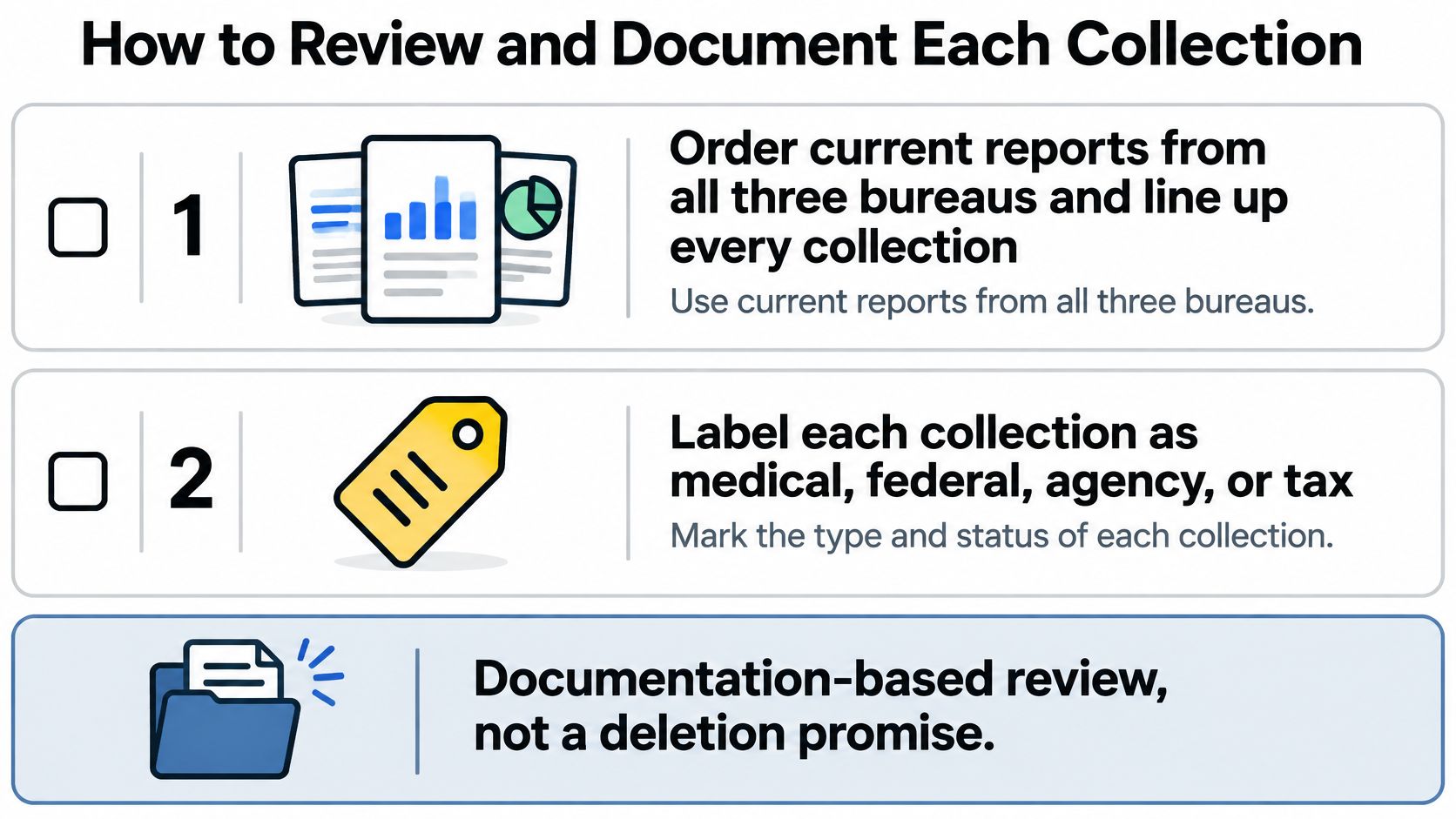
A credit review is a documentation process. Nothing about it guarantees a deletion, a score change or an approval. What it produces is a file a lender can read, verify and defend in an underwriting notes section.
- Order current reports from all three bureaus. Line up every collection account across Equifax, Experian and TransUnion, because the same debt often reports differently at each one.
- Label each account by type. Medical, non-medical, or possible federal debt. Then add only the non-medical balances, since that's the total the threshold applies to.
- Check ownership, balance, dates, status and duplicates. A collection may need an ownership and balance review before anyone decides whether a dispute is appropriate, especially when the account has been sold to a debt buyer.
- Gather the supporting records. Current three-bureau reports, creditor statements showing balances, limits, dates and payment history, plus collection letters, settlement records, student loan records and debt-buyer notices.
- Dispute only what's inaccurate, incomplete, outdated, unverifiable or misleading. Match each dispute to evidence: statements, payment records, identity-theft documentation or creditor correspondence.
- Leave accurate debts alone. A dispute is a correction tool, not a hiding tool, and filing one to make a real debt disappear wastes weeks and changes nothing in the underwriting file.
- Save your satisfaction proof. If a debt is paid or settled, keep the letter or record before you assume the lender will see the update on its own.
What a dispute is for: correcting information that is inaccurate, incomplete, outdated, unverifiable or misleading. It isn't a way to make a real debt invisible to an underwriter.
USDA treats non-medical collections and accounts with late payments in the previous 24 months as disputed derogatory information that must still be considered, as the USDA handbook sets out. A pending dispute doesn't make an account harmless, doesn't remove the underwriter's duty to evaluate it, and doesn't guarantee eligibility.
A collection account may need ownership and balance review, and a late payment may need payment-history proof. That's why the file build comes before the dispute letter, not after. For a closer look at which records carry weight, see this guide to gathering proof for a collection dispute.
Results vary with each credit file, the documents you can produce, creditor responses and your current payment behavior. The goal is simpler than a score target: a file a lender can understand. That same work supports FHA, VA and conventional preparation too, even though each program applies its own rules.
Prepare Your File Before You Apply
Gather everything into one folder before the first lender call, because a complete folder changes the conversation from "what's wrong" to "what's next."
- Three current credit reports, one from each bureau, pulled recently.
- Photo identification and current address history, matching what you'll enter on the application.
- Recent statements for every account you want reviewed, showing balances, limits, dates and payment history.
- Collection notices and settlement letters, including anything from a debt buyer.
- Payment confirmations for accounts you've already paid.
- Any denial or adverse-action letter tied to the application that prompted this search.
The collection review produces most of that folder, so run it first and let the documents fall out of the work.
Can a USDA Loan with Collections Be Approved
Yes, it can be considered. The underwriter must still review each collection account and find you an acceptable credit risk, and a favorable automated finding doesn't remove that responsibility.
Do Medical Collections Have to Be Paid
Generally no. Medical collections usually don't require payoff for USDA qualification and are typically excluded from total debt-to-income, though open accounts still get reported in the system.
What Happens Above the Non-Medical Threshold
The lender chooses one of three treatments: payoff before closing, a documented repayment payment, or 5 percent of the outstanding balance as a monthly liability. That figure then lives inside your debt-to-income calculation.
Will a Dispute Guarantee Approval or Removal
No. Disputes address accuracy, and results vary with the file, the documentation, creditor responses and your current credit behavior. A dispute can correct a reporting error without changing an approval decision.
Superior Credit Repair can review your credit report, help identify inaccurate or questionable items, and explain a step-by-step plan for improving your credit profile. You can request a free credit analysis or consultation to better understand your options. Credit repair cannot guarantee approval for a mortgage, auto or rental review, no matter how clean the file looks at the end.
Was this guide helpful?
Superior Credit Repair Online provides educational credit guidance for individuals and families preparing for major financial goals like buying a home, applying for a mortgage, refinancing, or rebuilding after credit challenges.
If this information helped you better understand your credit report or your next steps, we would appreciate your honest feedback. You are welcome to share your experience with Superior Credit Repair on our Google Business Profile.
Superior Credit Repair works with first-time buyers and families preparing for USDA, FHA, VA and conventional financing, and every review starts with the same raw material a lender will eventually request: three-bureau reports, collection notices, payment records and any adverse-action letter. If you're sorting out a USDA loan with collections, we can review your credit report, help identify inaccurate or questionable items, and map a step-by-step plan for improving your credit profile. Visit Superior Credit Repair to request a free credit analysis or consultation and see where your file stands before you apply.