

You've found a modest home outside town, your rent keeps rising, and a USDA loan with no down payment under program rules sounds like the opening you've waited for. Then you check your credit score and wonder if one number will decide everything. It won't. Learning how to get approved for a USDA loan means building a complete file a lender can verify, document, and defend in underwriting.
Table of Contents
- Why USDA Loan Approval Is About More Than a Credit Score
- Income, DTI, and the Numbers Lenders Actually Underwrite
- What USDA Looks for in Your Credit File
- Your Lender-Ready Documentation Checklist
- Credit Repair and Optimization Actions That Strengthen a USDA File
- Timeline and Next Steps from Application to Closing
- USDA Loan Questions Buyers Ask Most
Why USDA Loan Approval Is About More Than a Credit Score
A family I picture often in this work isn't chasing a luxury property. They're renting in a small town, driving older cars, and trying to buy a three bedroom home close to school and work. They've heard USDA financing can help, but they're fixated on whether their score is high enough. That focus is understandable, and it's incomplete.
USDA approval is built around repayment capacity, stable credit, and an eligible property, not a single universal credit score cutoff, as explained in USDA lender training on repayment capacity and credit review. Your lender is asking a broader question. Can this household afford this payment, on this property, with documented income, manageable debts, and a credit history that shows they'll pay? If one pillar is weak, a decent score doesn't rescue the file.

The Three Pillars Lenders Actually Evaluate
Start with property eligibility. The home must sit in an eligible rural area and you'll occupy it as your primary residence. Check the address before you pay for inspections, an appraisal, or earnest money. A perfect credit file can't make an ineligible address eligible.
Next is repayment capacity. Your lender documents income, employment, assets, and every recurring obligation, then tests whether the new housing payment fits. That's where car loans, student loans, credit card minimums, child support, and other debts matter. A buyer with a fair score and low monthly obligations can present a cleaner capacity picture than a buyer with a higher score and a crowded debt load.
Third is credit behavior. Lenders want evidence of willingness and ability to repay, especially recent on-time housing and installment payments. They review late payments, collections, charge-offs, and new credit in context. Isolated problems with documentation are different from a current pattern of missed payments.
Practical rule: Don't ask only whether your score qualifies. Ask whether a stranger reviewing your income, debts, bank statements, and payment history would conclude you can handle this mortgage every month.
Eligibility Comes Before Credit Shopping
Household income generally must be no more than 115% of area median income for the county, a limit described in the USDA Single Family Housing Guaranteed Loan Program overview. Household size affects that county limit, and lenders look at household income for eligibility even when not every household member is a borrower. Confirm the current limit for your county before you assume you qualify.
You'll also need eligible borrower status, including U.S. citizenship or eligible noncitizen status under program rules. Every borrower must occupy the home as a primary residence. A second home or investment property doesn't fit this program.
One hard stop deserves early attention. Delinquent non-tax federal debt can make an applicant ineligible. If you owe a federal agency and you're behind, resolve or document that status before you spend months on other preparation. Your lender will check federal debt status as part of the file.
Why This Program Is Structured This Way
The USDA Single Family Housing Guaranteed Loan Program has operated nationally since 1991 and USDA guarantees approved lenders up to 90% of the loan amount against certain losses if a borrower defaults, according to USDA reporting on the guaranteed loan program history. That guarantee is why eligible buyers can obtain financing with no down payment. It's also why documentation matters so much.
USDA doesn't make every approval decision directly. An approved lender underwrites your file using USDA requirements plus its own documentation standards. That's why understanding what mortgage lenders look for helps more than memorizing a rumored minimum score from a forum.
Credit repair for homebuyers fits inside this picture, but it isn't the whole picture. Correcting inaccurate balances, duplicate accounts, or outdated information can clean up what an underwriter sees. It can't replace stable income, lower an ineligible property into compliance, or erase a debt load you owe. Results vary based on your file, documentation, creditor responses, account history, and current behavior. Approach USDA readiness as a full-file project, and you'll make better decisions from the first week.
Income, DTI, and the Numbers Lenders Actually Underwrite
Lenders don't underwrite the income you expect to earn next year. They underwrite stable, verified repayment income they can document today. Expect requests for pay stubs, W-2 forms, tax returns, and employer verification. If you're self-employed, expect tax returns and business documentation that show continuity, not just a recent good month.
Overtime, bonuses, commissions, and variable hours get extra scrutiny because the lender must judge whether that income is likely to continue. If part of your pay fluctuates, don't hide it. Bring a longer paper trail and let the lender calculate qualifying income correctly the first time. Surprises late in underwriting stall files.
The Two Ratios That Frame Your Payment
USDA training materials describe standard benchmarks of 29% for the proposed housing payment and 41% for total monthly debt, as detailed in the USDA consolidated handbook guidance on ratio waivers. The first ratio covers PITI, which means principal, interest, taxes, and insurance. The second adds recurring monthly obligations on top of that housing payment.
USDA Underwriting Ratio Tiers at a Glance
| Ratio Tier | PITI Ceiling | Total Debt Ceiling | Credit Score Expectation | Underwriting Path |
|---|---|---|---|---|
| Standard benchmark | 29% | 41% | No universal cutoff, file reviewed in full | Standard underwriting |
| Waiver ceiling | 32% | 44% | At least 680 for all applicants | Waiver with compensating factors |
Files that receive a favorable automated recommendation generally don't need a debt ratio waiver. Manually underwritten files or weaker automated recommendations face tighter scrutiny. If you're qualifying above USDA ratios, expect the lender to substantiate why the payment still works.
What Counts Against You and What Helps
Lenders include applicable recurring obligations, including debts with 10 or more months remaining, child support, installment payments, and garnishments when they apply. Don't run your own math and quietly leave out a payment because you plan to pay it off soon. If it reports or it's court ordered, disclose it and let the lender treat it correctly.
Compensating factors are documented strengths that offset higher ratios. Examples include substantial verified reserves, stable employment, a strong recent housing payment history, and meaningful residual income after obligations. These aren't vague claims in a cover letter. They're bank statements, employment records, canceled rent checks, and other proof in the file.
Your fastest legitimate lever is often reducing monthly obligations before application. Paying down revolving balances can lower minimum payments and improve utilization without opening new accounts. Correcting an inaccurate debt matters too, because a wrong balance can distort your ratios. Don't take on a new car loan, furniture financing, or a large credit card purchase while you're preparing. A high score won't fix payment shock if your new housing cost jumps far above what you've been paying and your debts leave no margin.
What USDA Looks for in Your Credit File
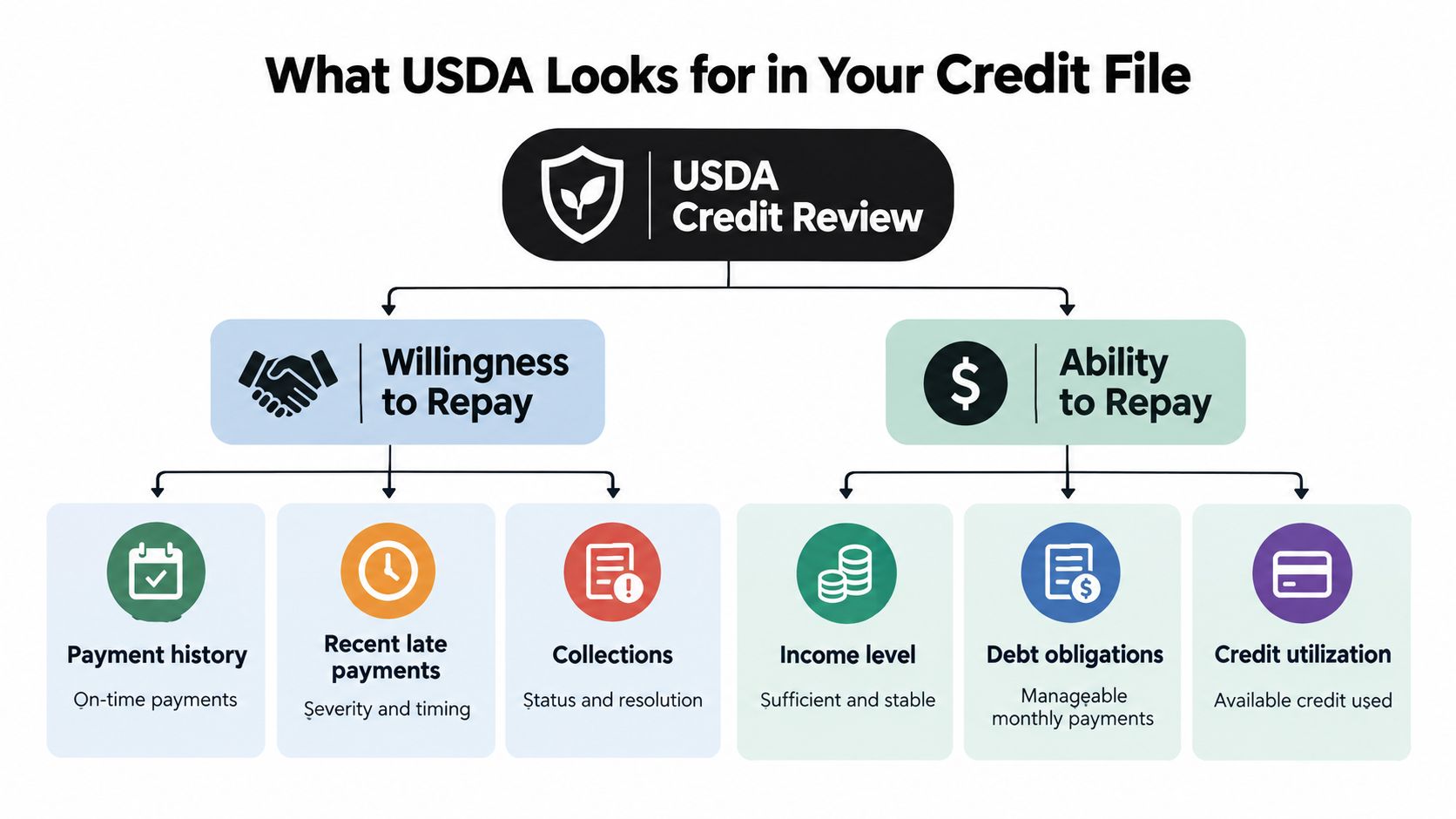
USDA credit review centers on demonstrated ability and willingness to repay rather than a single universal minimum score, as explained in USDA Chapter 10 credit analysis guidance. That doesn't mean scores don't matter. It means your score is read alongside the story your accounts tell.
How GUS and Manual Review Treat Scores
Most files run through USDA's Guaranteed Underwriting System, called GUS. The system evaluates credit, capacity, and collateral and produces recommendations such as Accept, Refer, and Refer with Caution. An Accept doesn't end documentation, and a Refer doesn't automatically end your chances. It changes how carefully a human underwriter must review and support the file.
For manually underwritten loans, lenders validate scores using the middle score when three scores are reported, the lower score when two are reported, or the single reported score when only one is available. If you're preparing with a USDA mortgage credit checklist, pull all three bureau reports early so a weak or inaccurate report doesn't surprise you.
The Behaviors Underwriters Read Closely
Scoring models consider payment history, amounts owed, percentage of credit used, length of credit history, account types, and newly acquired credit. For USDA readiness, recent behavior carries practical weight. On-time housing and installment payments over the recent period help show stability. Recent late payments, repossessions, judgments, unexplained collection balances, and new accounts opened in a rush create questions.
- Late payments: Recency, severity, and pattern matter more than a single label. Document isolated events with records.
- Collections and charge-offs: Lenders look at status, age, and whether the reporting is accurate. Paying an item doesn't automatically guarantee approval.
- Utilization: High balances relative to limits signal strain. Lowering balances without new inquiries supports a cleaner file.
- New credit: Several recent inquiries and accounts can suggest instability during underwriting. Pause unnecessary applications.
Check for credit report errors before your lender does. Duplicate collections, accounts that aren't yours, wrong balances, and outdated statuses can misrepresent your risk. Dispute inaccurate, incomplete, or unverifiable information through a documented process and keep copies. A clean, verifiable report gives GUS and your underwriter the correct facts to judge.
Your Lender-Ready Documentation Checklist
Build one folder, digital or paper, and keep it current. Conditional approvals stall when borrowers hunt for documents one request at a time. A complete folder won't force an approval, but it prevents avoidable delays and shows you're organized.
Identity, Income, and Employment
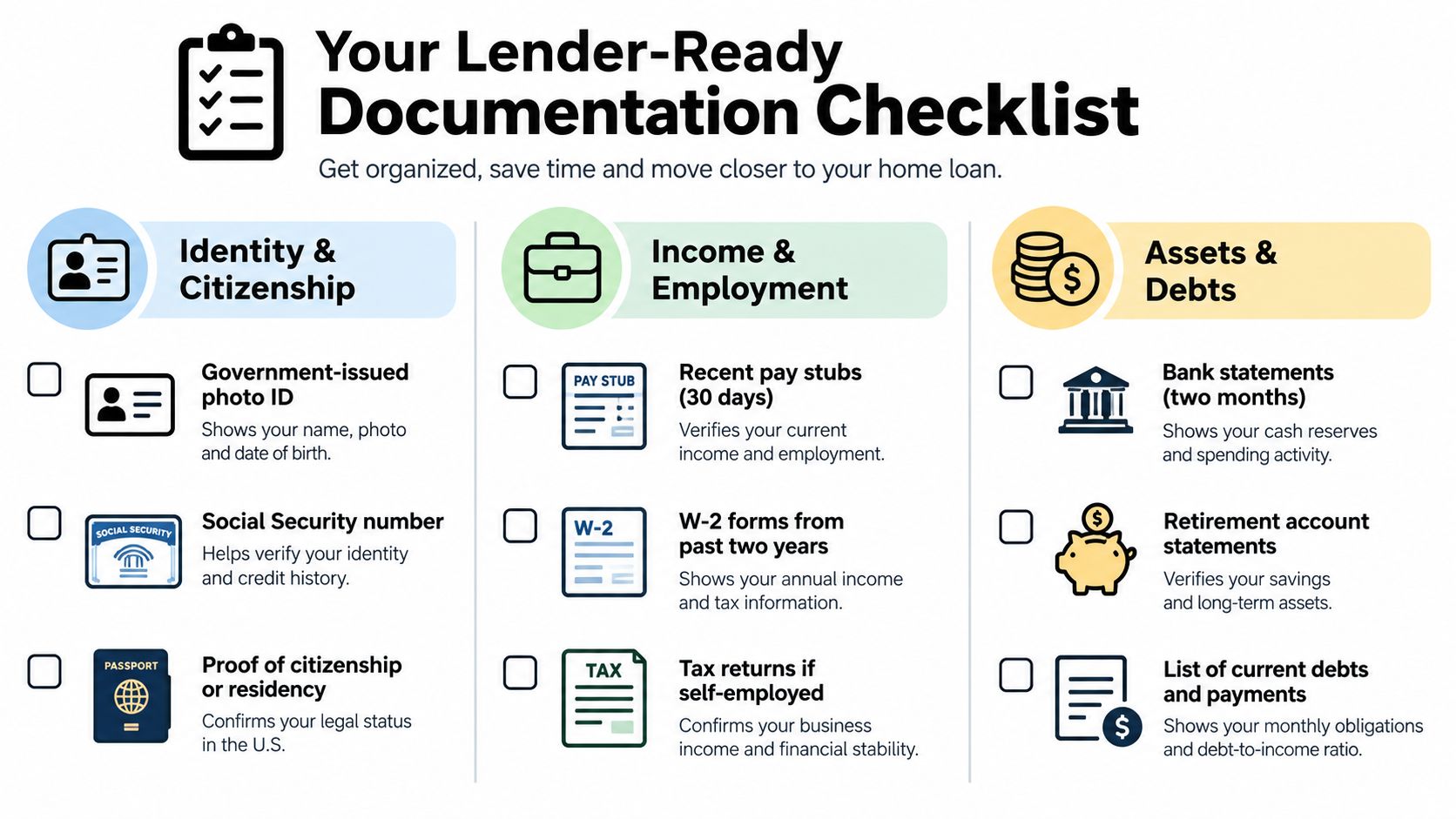
- Identity documents: Government issued photo ID, Social Security number documentation, and proof of citizenship or eligible residency status if requested.
- Recent pay evidence: Recent pay stubs covering your current earnings, plus contact information your lender can use for employment verification.
- Two year history: W-2 forms and tax returns as requested. Self-employed borrowers should prepare business and personal returns and a year to date profit and loss statement if the lender asks.
- Other income records: Award letters or statements for retirement, Social Security, disability, or rental income you want the lender to consider.
Assets, Debts, and Housing History
Gather recent bank statements for every account you'll use for closing costs or reserves. Be ready to source large deposits that aren't payroll. Unexplained deposits create underwriting conditions, so keep gift letters, transfer records, and sale documents with the statements they support.
Make a full debt inventory before your lender builds one from your credit report. List auto loans, student loans, credit cards, personal loans, child support, alimony, and garnishments if they apply. Include creditor names, balances, and monthly payments. If a listed debt is inaccurate or disputed, keep the supporting records in the same folder.
Do not move money between accounts, deposit cash, or pay off a large balance during underwriting without telling your lender first. Even a sensible move needs a paper trail.
For housing history, save rent receipts, canceled checks, landlord contact details, or mortgage statements. That record supports your payment history, especially if your credit file is thin. Write brief, factual explanations for derogatory events and attach proof such as medical billing records, divorce decrees, or correspondence showing an account error. Keep explanations short. Underwriters need dates, causes, resolution, and documentation, not a long personal essay.
Credit Repair and Optimization Actions That Strengthen a USDA File
Consider a buyer with three common problems. A medical collection reports twice for the same bill, a credit card sits near its limit, and one late payment posted during a job change. She doesn't need hype. She needs a sequence. Verify the duplicate reporting, lower the revolving balance, document the employment transition, and keep every current account on time while the file stabilizes.

Start With Accuracy, Not Shortcuts
Mortgage credit repair should be a structured review process. Pull reports from Experian, Equifax, and TransUnion and compare names, addresses, account ownership, balances, payment statuses, and dates. Remove inaccurate items only through legal dispute and verification processes based on documentation. Accurate negative information generally remains reportable, and no company can promise deletion or a specific score.
Superior Credit Repair can review reports for inaccurate, outdated, unverifiable, or misleading information and help clients understand dispute documentation and rebuilding steps as one option for professional support. Whether you do this work yourself or with help, keep dispute letters, bureau responses, creditor records, and proof of mailing or submission. Your lender may ask how an account was resolved.
If old accounts still concern you, review the guidance on USDA loan readiness with old collections before you decide what to pay, dispute, or leave documented. Collections dispute help, late payment dispute help, and charge-off dispute help only make sense when the reporting is wrong, incomplete, duplicated, or unverifiable. If the debt is accurate, ask your lender how payment or settlement would be viewed before you send money that you need for reserves or closing costs.
Lower Strain and Rebuild Positive History
Utilization is the share of your revolving limits you're using. Paying balances down, then keeping them down through statement closing dates, can present a stronger profile. Don't open a new card just to spread balances, and don't close old accounts casually. New inquiries and shorter account age can create fresh questions.
For a thin or damaged file, one small secured or starter card used for a modest recurring purchase and paid on time may help rebuild positive history over time. Rent, utility, or other self-reporting options may add context for some consumers, but they don't replace the tradelines and documentation your lender reviews. Ask whether the account reports to the bureaus before you rely on it.
Timing matters. Credit repair before buying a home works best when you start before you're under contract, because disputes, creditor responses, and new on-time history take time. You can't rebuild a pattern in a weekend. Set autopay for at least minimums, calendar statement dates, and stop using cards you're trying to pay down. The goal is a lender-ready credit profile, meaning accurate reporting, manageable balances, stable accounts, and recent payments that support the mortgage you're requesting. Outcomes vary by file and creditor response, but those habits strengthen any USDA, FHA, VA, or conventional application.
Timeline and Next Steps from Application to Closing
Start with a lender consultation and eligibility check before you shop seriously. Your lender reviews credit, income, debts, and property location, then issues a preapproval based on verified information. A casual online estimate isn't the same thing. Bring your documentation folder to that first conversation so the preapproval reflects your real ratios.
After you're under contract, the lender processes the file, orders the appraisal, verifies employment and assets, and submits the loan through underwriting. The typical 30 to 60 day mortgage timeline is a useful planning frame, but rural appraisal scheduling, title issues, missing conditions, and final USDA review can extend it. Build contract deadlines with your agent and lender, not with optimism.
What Happens During Underwriting
- Processing: The lender organizes your application, disclosures, income, assets, debts, and property documents.
- Appraisal and title: The property value, condition, and ownership records are reviewed. Required repairs or title problems can pause the file.
- Conditions: The underwriter requests missing proof, explanations, or updated statements. Respond completely the first time, with every page requested.
- Final review and clear to close: The lender confirms nothing material changed, then schedules closing and final disclosures.
Protect the File Until Closing Day
Don't open new credit, finance furniture, co-sign a loan, or make a large purchase that raises a monthly payment. Don't change jobs or move from salary to self-employment without telling your lender first. Keep paying every account on time, including accounts you plan to close after the move.
Files stall for ordinary reasons. A large deposit has no source. A tax transcript doesn't match the return provided. A debt appears that wasn't in the original calculation. The appraisal requires repairs. Most of these risks shrink when your documentation is complete, your debts are disclosed, and your credit behavior stays boring from application through closing.
Your first week can be simple. Confirm property and income eligibility, pull all three credit reports, list every monthly debt, gather income and bank documents, and stop new credit applications. Then ask a USDA experienced lender what needs work before you apply. That order saves you from fixing the wrong problem.
USDA Loan Questions Buyers Ask Most
Should I Pay Off Collections Before I Apply
Not automatically. First confirm the account is accurate, yours, and reporting the correct balance and status. Then ask your lender how that specific collection affects USDA underwriting, your reserves, and your ratios. Paying a legitimate collection may be appropriate in one file and unhelpful in another if it drains cash you need to close. Never pay from panic before you have a lender-reviewed plan.
What If I Changed Jobs Recently
A job change doesn't end a file by itself. Lenders focus on stability, continuity of income, and whether your new pay is documented and likely to continue. Moving within the same field with equal or higher documented pay is easier to support than switching to commission only or self-employment. Disclose the change early and provide offer letters, pay stubs, and employer contacts promptly.
Is a Manual Underwrite Worse Than a GUS Accept
It's more document intensive, not a denial. A manual review means a human underwriter must support credit, income, ratios, and compensating factors with stronger documentation. Expect closer attention to housing payment history, reserves, employment stability, and explanations for derogatory items. If your file needs manual review, completeness matters even more.
How Long Should Credit Restoration Run Before Applying
Long enough for disputes to be investigated, balances to report at lower levels, and recent on-time payments to establish a pattern. There's no responsible universal timeline because files differ. If you have credit report errors, high utilization, or a thin history, starting months before house hunting gives you options. People searching for credit repair near me or a local credit repair company should still judge any provider by documentation, transparency, and realistic expectations, not promises.
Can Rental History Help a Thin Credit File
It can support the picture of housing payment responsibility, especially when you provide canceled checks, bank records, or landlord verification. It doesn't replace credit review or income documentation. Keep rent records even if your landlord doesn't report to the bureaus. That paper trail can answer an underwriter's question about how you've handled a housing obligation.
If this information helped you better understand your credit report or your next steps, we would appreciate your honest feedback. You are welcome to share your experience with Superior Credit Repair on our Google Business Profile.
Superior Credit Repair can review your credit report, help identify inaccurate or questionable items, and explain a step-by-step plan for improving your credit profile before a USDA application. Results vary based on your file, documentation, creditor responses, and current credit behavior. Visit Superior Credit Repair to request a free credit analysis or consultation and understand your options.