
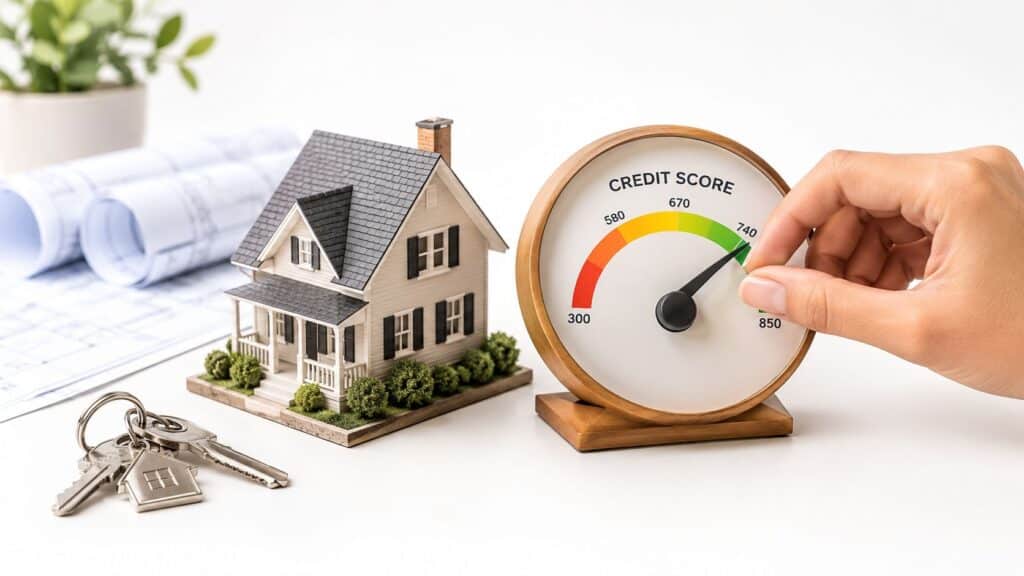
21st Mortgage doesn't publish a strict minimum credit score for most loans, but borrowers scoring below 575 typically need about a 35 percent down payment to compensate for weaker credit. Consolidation or cash-out options generally require at least a 600 credit score.
Could a borrower with damaged credit qualify for a manufactured-home loan even without reaching the score usually expected by a conventional lender? That question exposes a common misunderstanding. A mortgage decision isn't always controlled by one FICO number. For some 21st Mortgage products, the lender may consider the complete application, including available equity, down payment, property condition, income, payment history, and the type of transaction.
That flexibility can help families who have thin credit files, past late payments, collections, or a limited borrowing history. It doesn't mean approval is automatic, and it doesn't make credit reporting accuracy unimportant. It means the path to approval may involve several risk factors rather than one universal cutoff.
Table of Contents
- What 21st Mortgage Actually Looks For Before Approving a Loan
- How 21st Mortgage Underwrites Credit and Down Payments
- 21st Mortgage Credit Rules Compared with FHA, VA, and Conventional Loans
- How Collections, Late Payments, and Charge-Offs Affect Approval
- A Step-by-Step Plan to Improve Credit Before Applying
- Building a Lender-Ready Credit Profile for Homeownership
What 21st Mortgage Actually Looks For Before Approving a Loan
A first-time manufactured-home buyer might walk into a lender conversation expecting one question: “What's your credit score?” If the score is lower than the number commonly associated with a conventional mortgage, the buyer may assume the conversation is over. With 21st Mortgage, that assumption can be too simple.
Published information reports no stated minimum credit score for most 21st Mortgage loan products. However, borrowers scoring below 575 may need a 35 percent down payment, and published application material notes that consolidation or cash-out options generally require at least a 600 credit score. These distinctions are described by Bankrate's 21st Mortgage review.
Consider a hypothetical buyer with a modest score, stable income, and enough savings for a larger down payment. That buyer may present a different level of risk from someone with the same score, little available equity, recent missed payments, and an unstable debt pattern. The score still matters, but the lender can assess how other factors may compensate for weaknesses in the credit file.
Why a single score doesn't tell the whole story
A credit score is a summary produced from information in a credit report. It doesn't explain every reason behind a past hardship, whether a reported collection is accurate, or whether the applicant has recently established reliable payment habits. Underwriting gives the lender an opportunity to review those details alongside the score.
For a borrower, this means preparation should focus on the full profile. Review payment history, revolving balances, collections, charge-offs, income documentation, debts, and the proposed home. If you're still learning what credit score for mortgage pre approval, remember that a pre-approval discussion is about more than finding a magic number.
Practical rule: A lower score may require stronger compensating factors, but compensating factors don't excuse inaccurate information or unaffordable debt.
Down payment size is one important compensating factor because it increases the buyer's equity in the home and reduces the amount being financed. It may also change how the lender views the risk of a weaker credit profile. Still, saving a larger amount shouldn't replace a careful review of the credit report or a realistic budget.
Mortgage decisions can also involve tradeoffs among payment size, loan cost, property type, and long-term affordability. For another plain-language perspective on comparing mortgage terms, ThriveXDNA mortgage advice can help readers think through those choices before applying. The right question isn't only whether a borrower can qualify. It's whether the proposed payment and loan structure remain manageable after closing.
How 21st Mortgage Underwrites Credit and Down Payments
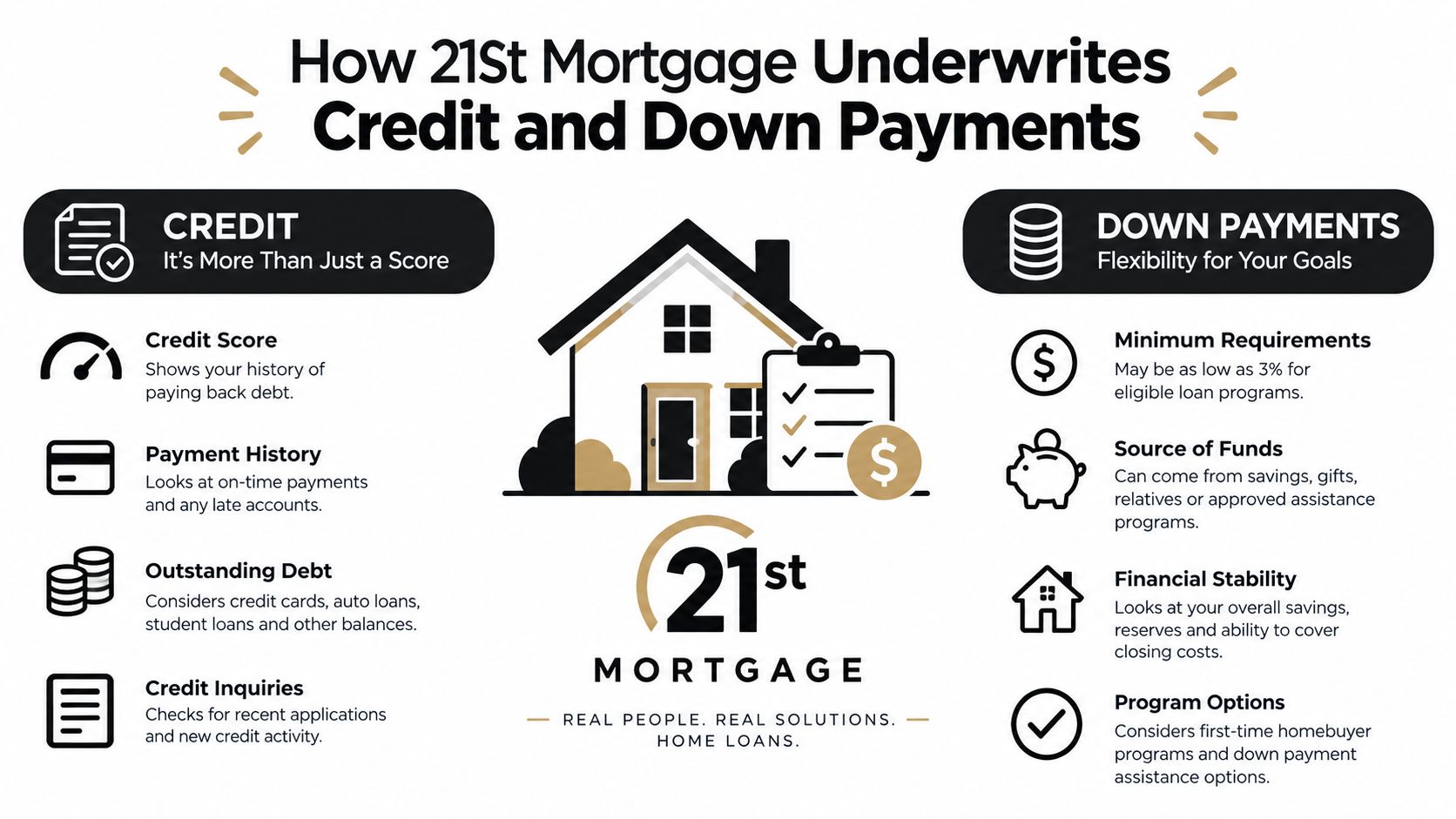
21st Mortgage's published materials describe a down payment range that can extend from zero percent for well-qualified buyers to 5 percent to 35 percent, depending on credit quality, collateral type, and occupancy type. Investment property or buy-for transactions generally require at least 20 percent down, according to the lender material cited in this manufactured-home loan document.
That range shows why the phrase “no minimum score” shouldn't be interpreted as “credit doesn't matter.” The lender can adjust the equity requirement when the borrower, property, or occupancy arrangement creates more risk. A primary residence, an investment property, and a home with different collateral characteristics may not receive the same terms.
How the factors work together
Underwriting is the review process used to decide whether an application fits the lender's guidelines. It may examine:
- Credit history: The reviewer can look at late payments, collections, charge-offs, open accounts, and the age and consistency of reported obligations.
- Down payment and equity: More money invested in the transaction can reduce the amount financed and may offset some credit weakness.
- Collateral: The home itself must be acceptable security for the loan. The lender may consider its condition, type, location, and how it is titled or situated.
- Occupancy: A primary residence can be evaluated differently from an investment or buy-for transaction.
- Debt and income: Existing obligations affect whether the proposed payment fits the borrower's finances. Understanding an ideal debt to income ratio can help applicants organize this part of the file.
A borrower with a recent late payment and high card balances may need more preparation than someone with an older isolated issue and consistently managed accounts. A thin file can create a different challenge because the lender has less payment history to evaluate. In both situations, documentation matters.
What borrowers should prepare
Gather current income records, account statements showing funds for the down payment, information about the home, and explanations for significant credit events. Don't send an emotional explanation without supporting documents. A clear timeline, creditor correspondence, payment evidence, or proof that an account was reported incorrectly can make the file easier to review.
Readers who want a plain-English explanation of the underwriting process can also consult Maya's underwriting glossary. The educational point is straightforward: credit flexibility doesn't eliminate underwriting. It changes the way the lender may balance credit risk against equity, property, occupancy, and overall financial stability.
21st Mortgage Credit Rules Compared with FHA, VA, and Conventional Loans
Many buyers compare 21st Mortgage with FHA, VA, or conventional financing because those programs are familiar. The comparison needs one important qualification: 21st Mortgage is being discussed here in the context of manufactured-home lending, while mainstream mortgage programs may have different property and program rules.
For the broader U.S. mortgage market, commonly cited credit thresholds are about 620 for conventional loans, 580 for FHA loans with 3.5 percent down, and 500 for FHA loans with 10 percent down. VA loans have no official minimum credit score set by the Department of Veterans Affairs. Conventional loans account for about 70 percent of all mortgages, which makes that benchmark especially influential for many homebuyers. These figures are summarized by Chase's mortgage credit-score guidance.
| Loan Type | Typical Minimum Score | Key Condition |
|---|---|---|
| 21st Mortgage, most products | No stated minimum | Borrowers below 575 may need about 35 percent down; product-specific rules apply |
| 21st Mortgage consolidation or cash-out | 600 | The published distinction applies to these options |
| Conventional | About 620 | Common benchmark in the broader mortgage market |
| FHA | 580 | Commonly associated with 3.5 percent down |
| FHA | 500 | Commonly associated with 10 percent down |
| VA | No official VA-set minimum | Individual lenders may apply their own standards |
The table isn't an approval chart. A lender can apply additional rules involving income, debts, property condition, occupancy, reserves, documentation, and loan purpose. A score that meets a common benchmark doesn't guarantee approval, and a score below a benchmark doesn't automatically prove that every financing path is closed.
Choosing the right comparison
An FHA applicant may prioritize correcting collections, organizing explanations for late payments, and meeting the requirements of an FHA-approved lender. A veteran may review Superior Credit Repair VA tips while also confirming the lender's own underwriting standards. A conventional borrower may focus on improving the overall file because a stronger profile can affect eligibility and loan terms.
Manufactured-home buyers should also ask whether the property fits the chosen program. A lender may consider whether the home is permanently attached, how the property is classified, and whether the land and home are financed together. Those questions can be just as important as the score.
The practical lesson is to compare complete loan scenarios, not isolated minimums. Ask about the down payment, projected payment, property requirements, documentation, and total affordability. If one lender evaluates risk through equity and collateral while another relies on a more familiar score threshold, the application strategy may differ.
How Collections, Late Payments, and Charge-Offs Affect Approval
A collection, late payment, or charge-off doesn't automatically explain everything about a borrower's current finances. It does, however, give an underwriter a reason to examine payment behavior, outstanding obligations, and the accuracy of the reported information more closely.
A collection usually indicates that an account was sent to a collection company after a creditor considered it seriously delinquent. A charge-off is an accounting status showing that the original creditor treated the debt as a loss. Neither term means the entry is automatically accurate, current, or impossible to dispute. The consumer still needs to review the report and gather evidence.

Start with accuracy, not appearances
A negative item can be questionable if the account doesn't belong to the consumer, the balance is wrong, the dates conflict, the same debt appears more than once, or the information can't be verified. An outdated item may also require careful review. Consumers should dispute information that is inaccurate, incomplete, misleading, or unverifiable, rather than asking a credit repair company to remove information solely because it's negative.
A responsible review generally follows this order:
- Obtain and read each report: Compare the identifying information, account details, balances, dates, payment status, and collection ownership.
- Collect supporting documents: Keep statements, settlement letters, payment confirmations, identity-theft records, and creditor correspondence.
- Dispute specific errors: Explain what is wrong and attach relevant evidence. Avoid vague complaints that don't identify the problem.
- Track responses: Keep copies of disputes and responses so unresolved issues can be evaluated later.
- Protect current accounts: Continue making accurate, timely payments while a dispute is pending.
High credit-card utilization can also weaken a mortgage profile because it may signal that the borrower depends heavily on revolving credit. Late payments show a different concern, namely whether the borrower can maintain required obligations. A charge-off may lead to questions about the circumstances, resolution, and current financial stability.
Property condition still matters
Credit isn't the only risk factor. 21st Mortgage materials indicate that the home must meet local code requirements and be in livable condition, including working plumbing, appliances, and wiring, without extensive repairs. ConsumerAffairs' 21st Mortgage information describes property condition as part of the approval assessment alongside credit and down payment factors.
That requirement matters for buyers who focus so intensely on credit repair that they overlook the home itself. Ask for property records, inspection information, installation details, and any documentation the lender requests. For consumers who need Superior Credit Repair collection removal, the appropriate objective is accurate reporting and documented resolution, not a guaranteed deletion.
A Step-by-Step Plan to Improve Credit Before Applying
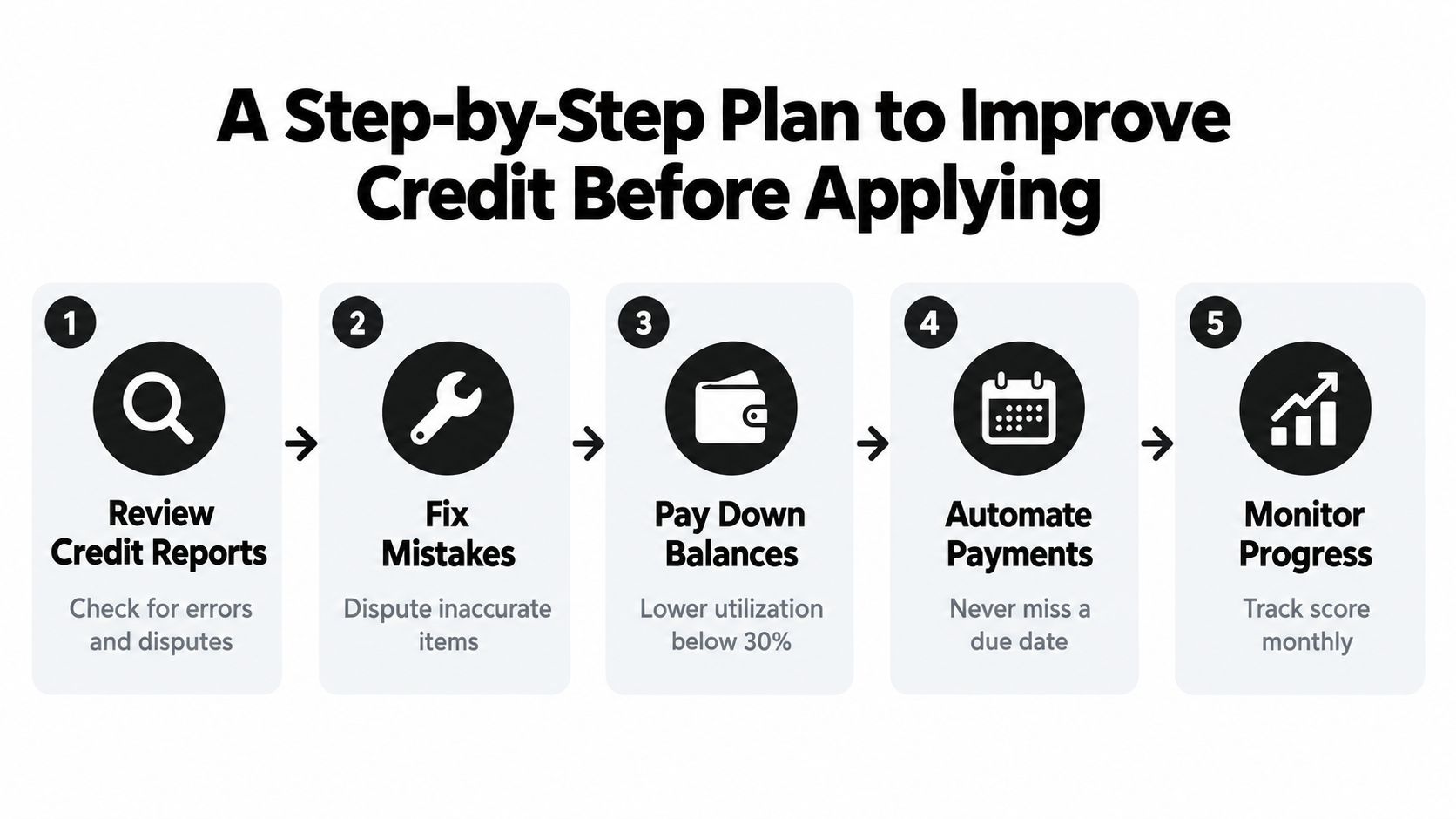
Could improving your credit before applying matter even when 21st Mortgage does not use one hard FICO cutoff? Yes. Its review is better understood as a complete assessment, where payment history, current obligations, documentation, down payment, property, and available equity can work together. For borrowers with damaged credit, the goal is not to chase a perfect number. It is to correct report errors, explain legitimate setbacks, and rebuild reliable financial habits before submitting an application.
Step one, review the file
Obtain every available credit report and read each account line by line. Check personal information, account ownership, balances, payment dates, collection status, and whether duplicate entries appear. Mark accounts that are open and current as well, because positive history shows how you manage obligations now.
A negative account is not automatically inaccurate. If the information is correct, disputing it will not solve the problem. Budgeting, payment arrangements, time, and consistent rebuilding may provide a more suitable response. Separate factual errors from accurate financial history before taking action.
Step two, document and dispute genuine errors
Create a separate record for each questionable entry. Keep the report page, a brief explanation, and documents that support your position. A dispute should identify a specific factual problem and request an appropriate investigation. It should not misrepresent accurate information or repeat unsupported claims.
Superior Credit Repair mortgage help can offer guidance to consumers organizing past late payments, collections, and supporting documents. Ronke Odewumi's credit score guide provides additional educational context on credit-building habits. Results depend on the report, evidence, creditor response, account history, and behavior after the dispute.
Step three, control revolving debt
Credit utilization measures the portion of available revolving credit currently in use. Lower balances can make an application appear less dependent on borrowed funds, but paying down cards should not cause you to miss another bill or exhaust emergency savings. Protect current payment history while creating a realistic repayment plan.
A written budget can show which balances carry the highest interest, which accounts are close to their limits, and whether subscriptions or buy-now-pay-later obligations are creating pressure. If repayment would affect rent, food, utilities, or other necessary expenses, seek qualified financial advice before changing the plan.
Step four, establish dependable payment habits
Set reminders or automatic payments for at least the minimum due, then make extra payments when your budget allows. Check automatic withdrawals regularly so they do not cause overdrafts. A steady record over time is more useful than a brief burst of payments followed by another missed due date.
While preparing, avoid unnecessary applications, unexplained account closures, and new debt. Recent inquiries and new obligations may form part of the lender's overall review. This matters for 21st Mortgage applicants because underwriting can weigh the full file rather than applying a single score cutoff.
Step five, monitor changing scoring methods
Credit evaluation continues to change. Fannie Mae and Freddie Mac now allow VantageScore 4.0, and the Federal Housing Administration is scheduled to begin insuring mortgages underwritten with VantageScore 4.0 and FICO 10T starting January 1, according to CNBC's reporting on mortgage credit scores. These models may consider rent, utility, and phone-payment behavior instead of relying only on traditional credit history.
That change may help some consumers with limited traditional credit, but it does not promise approval or a favorable evaluation. Keep records of positive payments and provide them through the lender's accepted process. A practical preparation plan combines accurate reports, manageable debt, current payments, documented explanations, and patience. For equity-driven loan programs, those details can help show the circumstances behind damaged credit and the borrower's present ability to meet the loan obligation.
Building a Lender-Ready Credit Profile for Homeownership
A lender-ready profile isn't defined by a single score. It combines accurate reporting, current payment behavior, manageable debt, documented income, and a property that satisfies the lender's requirements. For a manufactured-home buyer, it also includes a realistic understanding of how down payment, occupancy, collateral, and loan purpose can affect the review.
Credit restoration should therefore be treated as a structured review process, not a promise of instant improvement. A responsible company may help identify inaccurate, outdated, unverifiable, or misleading information, prepare disputes supported by documentation, explain responses, and develop habits that support long-term rebuilding. No ethical provider can guarantee a deletion, a particular score increase, or mortgage approval.
What readiness looks like
Before applying, ask yourself:
- Are the personal details and account histories on the reports accurate?
- Can you explain every recent late payment, collection, or charge-off?
- Are current accounts being paid consistently?
- Do revolving balances fit comfortably within the household budget?
- Can you document the source of the down payment?
- Does the proposed home meet the lender's property standards?
- Have you compared 21st Mortgage with other suitable loan paths?
Consumers may be preparing for an FHA, VA, conventional, USDA, apartment, refinance, auto, business, or personal financing decision. The details differ, but the foundation is similar. Accurate credit information and stable financial behavior give lenders a clearer basis for evaluating the application.
For readers who want a structured path to a lender-ready credit profile, the next step is a documented review of the current file. Superior Credit Repair provides credit restoration education and dispute support for consumers who want to identify questionable reporting and build stronger credit habits. Results vary, and the process depends on the consumer's records, creditor responses, account history, and behavior going forward.
Frequently asked questions
Does 21st Mortgage have a minimum credit score?
21st Mortgage is reported to have no stated minimum credit score for most loan products. Borrowers below 575 may need about 35 percent down, and consolidation or cash-out options generally require at least 600.
Can bad credit prevent approval?
It can make approval more difficult or change the required down payment and terms, but a low score isn't the only factor. The lender may also evaluate equity, property, occupancy, income, debt, and payment history.
Is credit repair a guarantee of mortgage approval?
No. Credit repair can address inaccurate or unverifiable reporting and support better financial habits, but it can't guarantee deletion, a specific score outcome, loan terms, or approval.
Should I dispute every negative account?
No. Disputes should address information that is inaccurate, incomplete, outdated, misleading, or unverifiable. Accurate negative information generally requires responsible payment management and rebuilding rather than an unsupported dispute.
Can property condition affect the decision?
Yes. The home must meet applicable local code standards and be livable, with key systems and appliances working and without extensive repairs, according to the cited 21st Mortgage information.
Superior Credit Repair can review your credit report, help identify inaccurate or questionable items, and explain a step-by-step plan for improving your credit profile before a mortgage application. Visit Superior Credit Repair to request a free credit analysis or consultation and better understand your options without pressure or promises of guaranteed results.
Was this guide helpful?
If this information helped you better understand your credit report or your next steps, we would appreciate your honest feedback. You are welcome to share your experience with Superior Credit Repair on our Google Business Profile. https://share.google/ePRpFvtCXwCjiJwOK