

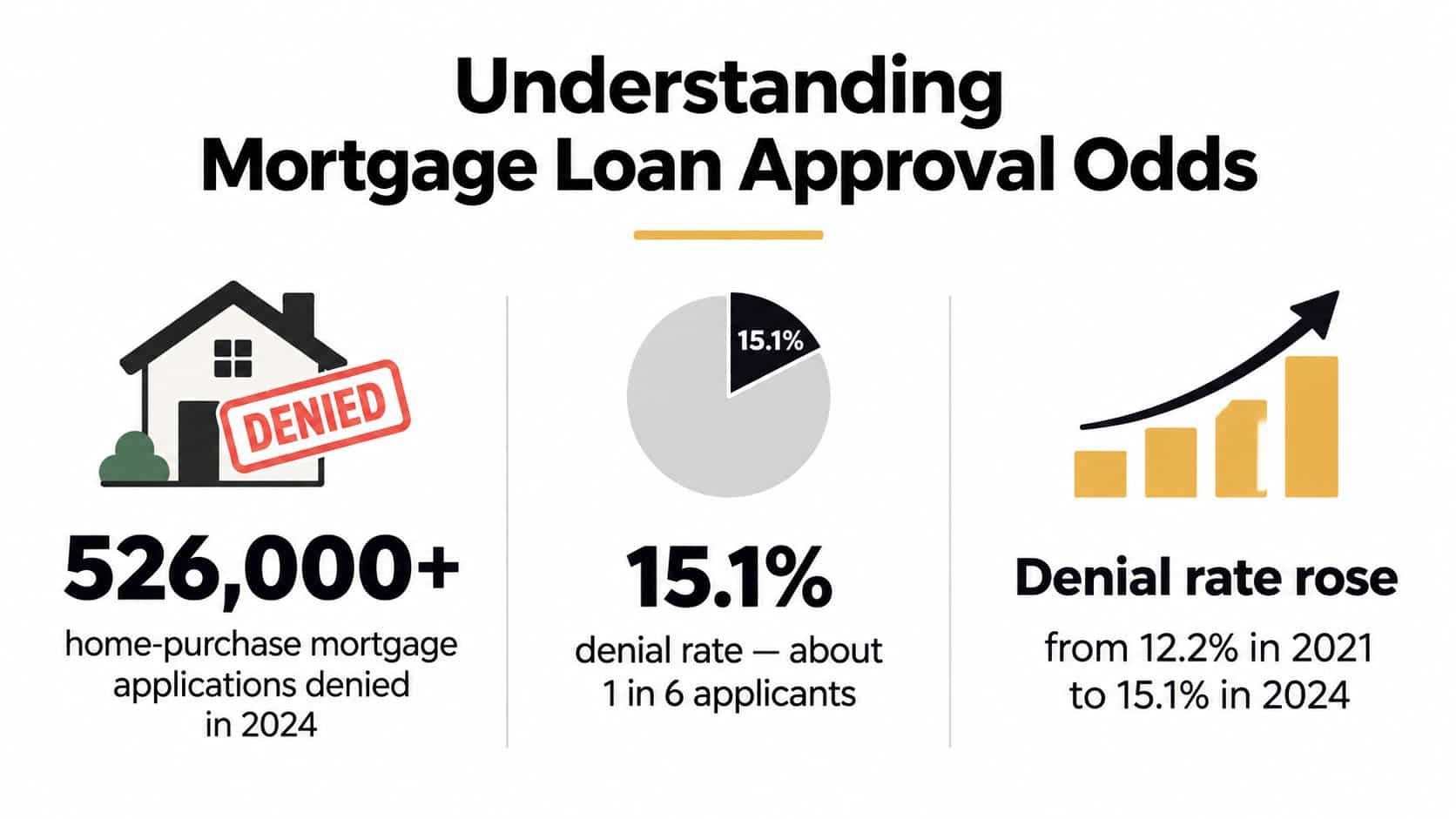
In 2024, the mortgage denial rate was 15.1%, or about one in six home-purchase applications. Your mortgage loan approval odds depend on the combined strength of your credit accuracy, debt-to-income ratio, down payment, documentation, and the lender's own underwriting standards, not on any single credit score.
That distinction matters for first-time buyers, families rebuilding after hardship, veterans preparing for a VA loan, and renters planning to become homeowners. A credit score can open or narrow the conversation, but lenders also need to see that your monthly obligations are manageable, your income is documented, your funds are sufficient, and your credit report tells an accurate story.
A realistic mortgage preparation plan therefore has two parts. First, correct information that is inaccurate, outdated, unverifiable, or misleading. Second, strengthen the financial habits and cash position that help an underwriter view your application as stable. Results vary based on your credit file, documentation, creditor responses, account history, and current credit behavior.
Table of Contents
- Understanding Mortgage Loan Approval Odds
- How Credit Score and Debt-to-Income Shape Approval Odds
- How Collections Charge-offs and Late Payments Affect Approval Odds
- Why Affordability Often Matters More Than Credit Score Alone
- Practical Steps to Improve Mortgage Loan Approval Odds
- What You Should Know Before Improving Your Approval Odds
Understanding Mortgage Loan Approval Odds
In 2024, U.S. lenders denied more than 526,000 home-purchase mortgage applications, representing about one in six applications and a 15.1% denial rate, up from 12.2% in 2021. The Federal Reserve Bank of St. Louis analysis connected the increase with mortgage rates moving from below 3.5% to above 6.5% over the same period. That context shows why approval odds can weaken even when people still want to buy homes.
Approval odds describe the likelihood that a lender will accept your application after reviewing your entire risk profile. They aren't a promise, a public score, or a universal calculator. An applicant may meet a published minimum and still receive a denial because the lender sees excessive monthly obligations, limited funds, unstable income, unresolved credit issues, or documentation gaps.
The underwriting stack
Most mortgage decisions rest on three connected factors:
- Credit profile: Lenders review scores, payment history, balances, account age, collections, charge-offs, and the accuracy of reported information.
- Debt-to-income ratio: DTI compares required monthly debt payments with gross monthly income. It helps the lender estimate whether the proposed housing payment fits your budget.
- Down payment and reserves: Your available funds affect the loan structure, cash needed at closing, and the financial cushion visible to the lender.
Lender overlays add another layer. An overlay is a lender's additional requirement beyond a basic program guideline. Two lenders may evaluate a similar borrower differently because they use different risk policies, documentation standards, or interpretations of compensating factors.
This is why preparing a mortgage file involves more than chasing a score. A person with a strong score may still struggle if revolving balances create a high DTI or if the borrower has little verified cash for closing. Another applicant with past credit problems may have a clearer path after correcting reporting errors, reducing obligations, and documenting stable finances.
Practical rule: Treat your credit report as an underwriting document, not just a scorecard.
A careful review can reveal an account that isn't yours, a balance that doesn't match your records, a collection reported beyond its accurate status, or a late payment that lacks proper documentation. You can also use these mortgage approval tips from Superior Credit Repair while organizing your next steps.
Mortgage readiness also involves understanding the broader lending environment. Professionals who work with housing transactions may benefit from a broker's guide to mortgage leads, while consumers should focus on the specific questions a lender will ask about income, debt, credit history, assets, and the property itself.
How Credit Score and Debt-to-Income Shape Approval Odds
Credit score, DTI, and down payment interact. They shouldn't be treated as separate boxes that a borrower checks independently. A lower score may require stronger compensating factors, while a high DTI can weaken an application even when the score appears acceptable.
Many conventional programs center around a minimum FICO score near 620, and approval odds are generally stronger when DTI is at or below 36% and the borrower can put down 3% to 5% or more, depending on the program and lender. Some conventional guidance describes a 5% minimum down payment, while certain products may begin at 3%, so applicants should confirm the exact terms with a lender. A useful overview of credit score ranges explained can help you understand why a score band isn't the same as a guaranteed approval result.
FHA financing uses different benchmarks. Borrowers with a FICO score of 580 or higher can qualify for the 3.5% minimum down payment, while borrowers with scores from 500 to 579 generally need a 10% down payment, according to FHA credit requirements. FHA underwriting commonly uses 31% for housing costs and 43% for total DTI, as described in FHA loan guidance.
| Program Type | Min Credit Score | Min Down Payment | Max DTI Guidance |
|---|---|---|---|
| Conventional | Near 620 | 3% to 5% or more, depending on program | Better odds at or below 36% |
| FHA | 580 for 3.5% down | 3.5% at 580 or higher, generally 10% at 500 to 579 | 31% housing, 43% total DTI |
These figures are guideposts, not guarantees. The Federal Reserve analysis found denial rates remained relatively flat at roughly 8% to 10% for applicants with DTI ratios between 20% and 50%, then rose sharply above 50% and exceeded 80% for applicants above 60%. The same analysis found that the commonly used 43% DTI threshold didn't create a large statistical cliff by itself. The increase at that point was less than half a percentage point against a home-purchase mortgage denial baseline of about 15% in 2024, as explained by the Federal Reserve Bank of St. Louis.
Consider two otherwise similar applicants with a 640 score. One has a 43% DTI, while the other has a 30% DTI. The second applicant may present less repayment strain, even though both scores are identical. Lowering card balances, paying down installment debt, or avoiding a new monthly obligation can sometimes strengthen the whole file more effectively than focusing on the score alone.
For a plain-language explanation of how lenders calculate this ratio, review this DTI guide for mortgage applicants.
How Collections Charge-offs and Late Payments Affect Approval Odds
A collection account doesn't always produce an automatic mortgage denial, but it can create additional underwriting work. The lender may ask whether the debt is accurate, whether it reflects a continuing payment problem, and whether the account changes your monthly obligations.
FHA underwriting illustrates why context matters. FHA doesn't require every collection account to be paid in full, but the lender must analyze how the accounts affect creditworthiness. If the aggregate outstanding balance of collections is at least $2,000, the lender must conduct a capacity analysis and include a calculated monthly payment in DTI. If you entered a repayment arrangement, that payment must also be counted in the debt ratio, according to HUD FHA underwriting guidance.

How one file can become more complicated
Suppose an applicant has several medical collections, a charge-off, and recent late payments. The collections may not stop the application by themselves, but an FHA lender may need to calculate a payment for the collection balance. That payment can raise DTI, while the late payments and charge-off may prompt questions about whether the borrower's recent payment behavior has stabilized.
The same borrower may also have an account that was paid but still reports an inaccurate balance, or a collection that belongs to someone else. Those are credit reporting problems, not just evidence of current inability to repay. A documentation-based dispute can ask the furnisher or credit bureau to investigate and correct information that is inaccurate, incomplete, outdated, unverifiable, or misleading.
A charge-off deserves careful review because it signals that a creditor treated an account as a serious loss. Paying a charge-off doesn't automatically erase its history or guarantee a score change. The lender may still consider the account's reporting, recency, balance, and relationship to the rest of the file.
Late payments also require context. A recent late payment can be more concerning than an older isolated event, especially when several accounts show similar problems. Before applying, gather statements, payment confirmations, correspondence, and any evidence that supports your position.
- Verify ownership: Confirm that every collection and charge-off belongs to you.
- Check accuracy: Compare balances, dates, account status, and payment history with your records.
- Document disputes: Keep copies of reports, supporting documents, letters, and responses.
- Avoid unsupported promises: No legitimate credit repair process can guarantee deletion or approval.
Read more about collections and mortgage eligibility before deciding whether an account should be paid, disputed, documented, or discussed with a mortgage professional.
Why Affordability Often Matters More Than Credit Score Alone
A decent credit score can create false confidence if the monthly budget doesn't support the loan. In 2025, DTI was cited in 42% of denied home-purchase applications, up from 35% in 2021, while insufficient cash for the down payment and closing costs rose from 8% to 12% over the same period, according to NCRC's HMDA-based mortgage market analysis.
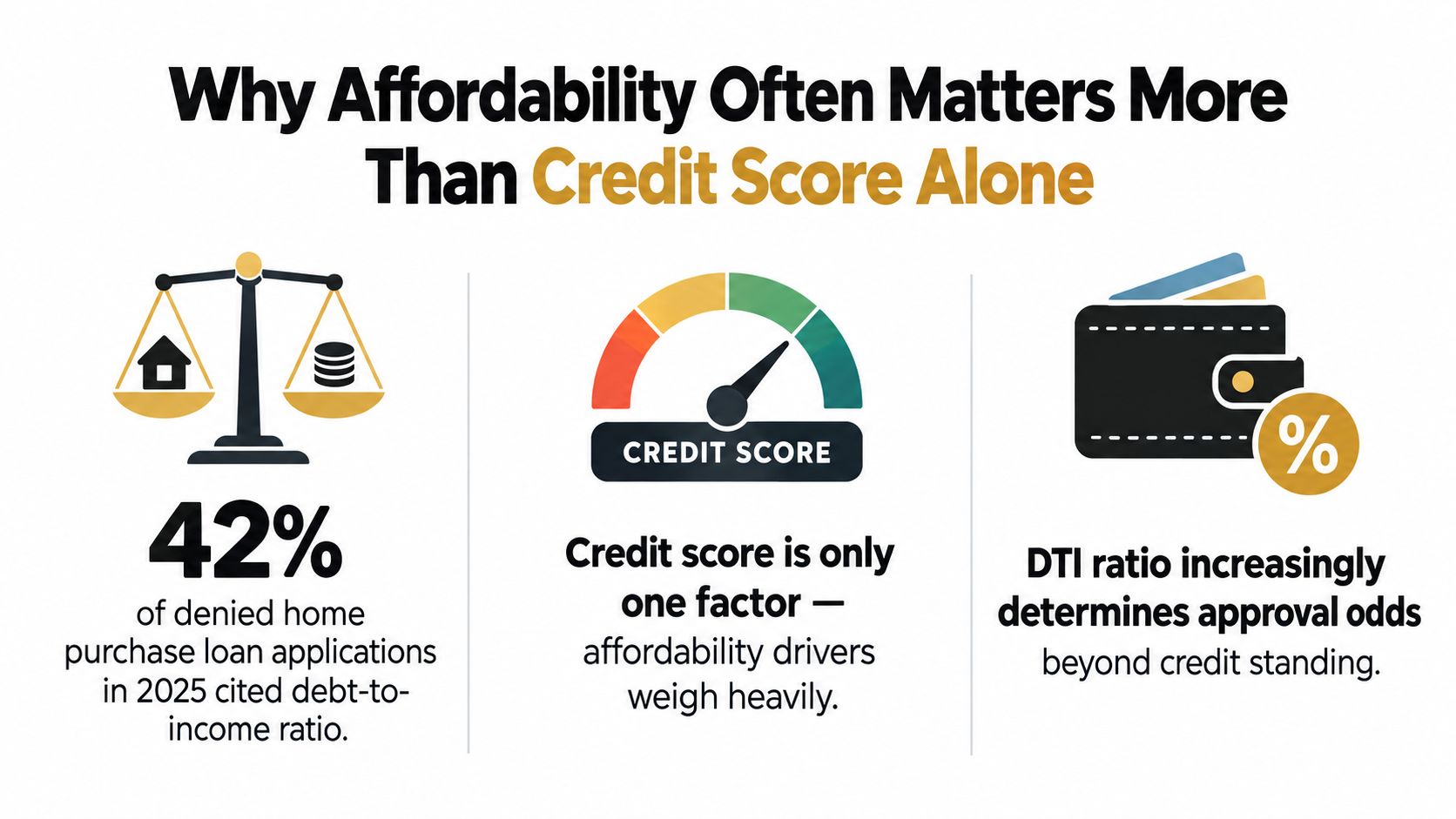
That evidence challenges the familiar idea that mortgage preparation begins and ends with a credit-score target. Lenders still care about credit, but they also need to determine whether your income can support the proposed payment after existing debts, taxes, insurance, fees, and other obligations are considered.
The liquidity problem
Liquidity means having accessible, documented funds for the transaction and for financial stability. A borrower may have a good score but insufficient cash for the down payment, closing costs, or reserves. In that situation, the credit profile can look responsible while the application still appears financially tight.
Higher rates can make affordability harder because the monthly payment may rise even when the property price stays the same. The 2024 denial trend demonstrates how rate shocks can materially weaken mortgage approval odds. Buyers should therefore evaluate the payment they can sustainably manage, not only the amount a lender may technically approve.
A practical preparation plan can focus on three changes:
- Lower revolving balances: Reducing card balances can improve utilization and may reduce required monthly payments.
- Reduce monthly obligations: Paying down or resolving debts can improve DTI, subject to the lender's calculation rules.
- Build verified reserves: Keep funds in accounts that can be documented clearly and avoid unexplained transfers near underwriting.
This approach doesn't mean disputing errors is unimportant. An inaccurate collection, balance, or late payment can distort both the credit profile and the lender's understanding of your obligations. It means accuracy work should happen alongside debt management and cash planning.
The distinction is especially important for first-time buyers and lower-income households. The same credit profile can produce different approval odds depending on housing costs, rate timing, cash reserves, and monthly obligations. Use this homebuyer mortgage approval guide to organize questions before speaking with a lender.
Practical Steps to Improve Mortgage Loan Approval Odds
Mortgage preparation works best as a sequence rather than a last-minute score chase. Give yourself time to identify reporting problems, understand your debts, organize documents, and establish habits that a lender can verify.
Start with the complete credit file
Obtain your reports from the major credit bureaus and review personal information, account ownership, balances, payment history, dates, status codes, and remarks. Look for duplicate accounts, mixed-file information, incorrect collection ownership, outdated reporting, and accounts that don't match your statements.
Write down each questionable item and collect supporting evidence. A dispute should identify the specific information you believe is inaccurate and explain why the documentation supports a correction. Credit restoration is a legal dispute and verification process. It isn't a promise to remove accurate negative information.
Address problems in the right order
Begin with errors that could materially affect underwriting. An inaccurate balance may affect DTI, while an incorrectly reported late payment can affect payment history. A collection that doesn't belong to you should be challenged with identity and account documentation.
- Collections: Confirm the account, balance, dates, and ownership before choosing a response.
- Late payments: Compare the reported history with bank records, creditor statements, and payment confirmations.
- Charge-offs: Check whether the balance, status, and dates are reported accurately.
- Medical debts: Review whether the account details and current status match your records.
- Thin files: Build positive history responsibly rather than opening unnecessary accounts.
Superior Credit Repair can review credit reports, help identify inaccurate or questionable items, and explain a step-by-step plan for improving mortgage readiness. Its services focus on compliance-based dispute work, credit education, utilization planning, and rebuilding strategies, but results vary by credit file, documentation, creditor responses, account history, and current credit behavior.
Manage utilization and monthly debt
Credit utilization is the relationship between revolving balances and available limits. Before a mortgage application, avoid using cards for large purchases that can inflate reported balances. Make payments consistently, monitor statement closing dates, and don't close an older account without understanding how that decision may affect your profile.
At the same time, look beyond credit cards. Auto loans, student loans, personal loans, support obligations, and other reportable debts may affect DTI. Ask a lender how specific obligations will be counted before making a large financial change.
Protect the file during underwriting
Keep payments current and avoid unnecessary new credit applications. Don't move money between accounts without retaining a clear paper trail. Organize income records, bank statements, tax documents, gift documentation if applicable, and explanations for unusual deposits.
A mortgage lender may ask follow-up questions that have nothing to do with your score. Prompt, consistent documentation can help the underwriter understand your financial history without forcing you to reconstruct it under pressure.
What You Should Know Before Improving Your Approval Odds
Mortgage loan approval odds improve when the file becomes more accurate, more affordable, and easier to verify. Credit score remains relevant, but it works alongside payment history, utilization, collections, charge-offs, DTI, down payment, reserves, income stability, and lender overlays.
Start by identifying the facts you can control. Review the report for errors, keep every account current, reduce revolving balances, avoid unnecessary new debt, and document funds carefully. If a negative item is accurate, don't assume that paying it will guarantee removal or a particular score outcome. Ask how the payment, balance, and account status may affect the underwriting review.
You can also use cleaning up your credit report as part of a broader mortgage-readiness plan. Disputes should be specific, supported by documentation, and based on information that is inaccurate, incomplete, outdated, unverifiable, or misleading.
The most important expectation is realistic: no credit repair company can guarantee a deletion, score increase, loan approval, interest rate, or closing date. Results vary according to your individual file, the evidence available, creditor responses, account history, lender requirements, and your ongoing financial behavior.
Superior Credit Repair provides educational credit guidance for individuals and families preparing for major goals such as buying a home, applying for a mortgage, refinancing, or rebuilding after credit challenges. The company serves consumers preparing for FHA, VA, USDA, and conventional financing, as well as renters working toward future homeownership.
Frequently asked questions
What affects mortgage loan approval odds the most?
Lenders usually evaluate the full profile, including credit history, DTI, down payment, reserves, income documentation, and program requirements. A single score can't describe the entire risk picture.
Can I get a mortgage with collections?
Possibly, depending on the loan program, lender, collection details, and overall file. FHA underwriting doesn't require every collection to be paid, but certain collection balances and repayment arrangements can affect DTI and require additional analysis.
Is a 620 credit score enough for a conventional mortgage?
A score near 620 is commonly used as a conventional minimum benchmark, but it isn't a guarantee. DTI, down payment, reserves, income, property details, credit history, and lender overlays still matter.
Can credit repair guarantee mortgage approval?
No. Ethical credit repair is a documentation-based review, dispute, verification, and rebuilding process. It can't guarantee deletions, score changes, approval, or loan terms.
Should I pay every collection before applying?
Not automatically. Payment decisions can affect your cash position, DTI, and underwriting review. First verify the account and ask a qualified mortgage professional how the specific debt will be treated.
Superior Credit Repair can review your credit report, help identify inaccurate or questionable items, and explain a step-by-step plan for improving your mortgage-ready credit profile. Visit Superior Credit Repair to request a free credit analysis or consultation and better understand your options without pressure or guaranteed outcomes.
If this information helped you better understand your credit report or your next steps, we would appreciate your honest feedback. You are welcome to share your experience with Superior Credit Repair on our Google Business Profile. https://share.google/ePRpFvtCXwCjiJwOK