


Most credit card issuers report your account to Experian, Equifax and TransUnion about once a month, usually around the statement closing date, when the statement balance is calculated. The payment due date, which commonly lands 21 to 27 days after that closing date, is not the reporting date.
So why does a card you paid off three weeks ago still show a four-figure balance on the report your lender is about to pull? Because a credit report isn't a live feed of your checking account. It's a monthly photograph, and that photograph was taken on the day your statement closed. Anything that happened afterward, including your payment, waits for the next roll of film.
That gap between paying and reporting causes more mortgage confusion than almost any other detail in a credit file. A buyer with a perfect payment record walks into underwriting carrying a balance the lender can see, a utilization ratio that looks worse than the household's real spending, and no clear idea which date matters. The answer isn't complicated. It's a calendar, a handful of statement dates, and an accurate picture of what all three bureaus currently show.
None of this means paying on time is optional. Payment history and reported balance are two separate things, and a lender looks at both. The difference between a smooth approval and a string of uncomfortable questions is usually whether the borrower knew the closing date before applying, not whether they paid by the due date.
Table of Contents
- When Card Balances Reach Your Credit Report
- How Utilization Turns One Snapshot Into a Score Factor
- Build Your Reporting Calendar Before You Apply
- How Long Changes Take to Appear
- Mortgage Timing and Lender Reviews
- Frequently Asked Questions and Next Steps
When Card Balances Reach Your Credit Report
A card's closing date helps determine which balance may appear on your credit reports. Issuers generally report to Experian, Equifax, and TransUnion around the end of a billing cycle, when the statement balance is calculated, as Experian explains in its overview of balances and utilization. Billing cycles commonly last 28 to 31 days. The payment due date generally falls 21 to 27 days after the statement closes, but it serves a different purpose.
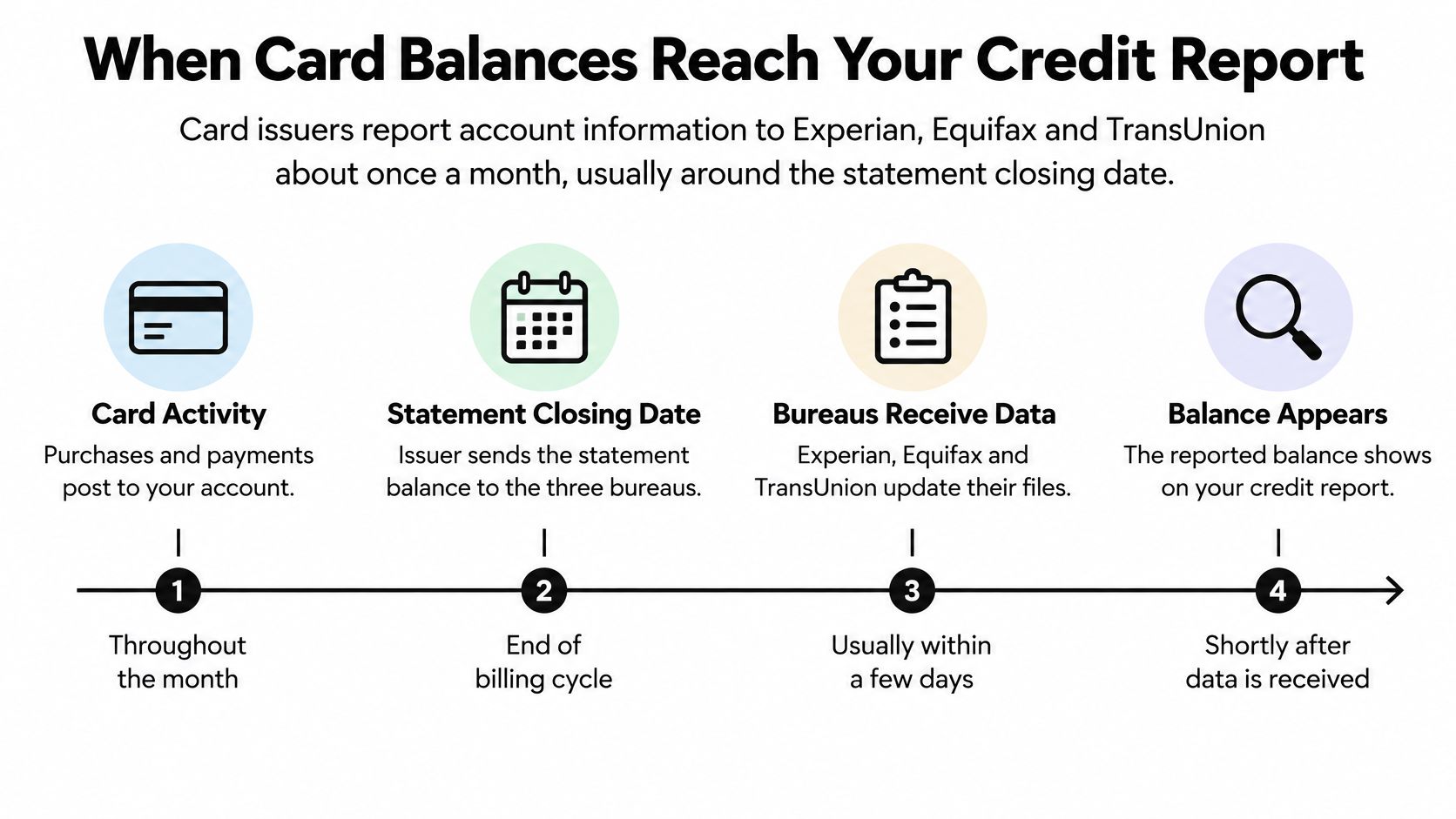
The closing date is a photograph, the due date is a deadline
The billing cycle works like a window: purchases post while it is open, and the issuer totals the account when it closes. That closing-date balance becomes the statement balance. The due date comes later, giving you a deadline to pay without being marked late.
| Milestone | When it happens | What the credit report may show |
|---|---|---|
| Purchases post | During the billing cycle | The balance changes as purchases post |
| Statement closing date | Last day of the billing cycle, typically 28 to 31 days after the prior close | The statement balance is calculated; this is the usual reporting point |
| Issuer sends data to bureaus | Usually monthly, around the closing date; exact day varies by issuer and bureau | The balance and limit may remain on the report until the next update |
| Payment due date | Commonly 21 to 27 days after the statement closing date | The deadline to avoid a late payment; paying then usually does not change the balance already reported |
The date to watch: To have a lower balance appear before a lender reviews your file, plan around the statement closing date, not just the payment due date.
Four terms worth separating
These terms describe different parts of the billing cycle:
- Statement balance: The amount owed on the closing date, shown on the statement and used to calculate the minimum payment.
- Current balance: The amount owed now, including purchases made after the statement closed.
- Minimum payment: The smallest amount that must arrive by the due date to keep the account current.
- Late payment: A payment that misses the due date. It can affect payment history, which is separate from the balance reported.
For example, a card closes on March 15 with a $1,800 statement balance and an April 9 due date. Paying $1,800 on April 9 keeps the account current, but the March 15 balance may already have been reported. It can remain on the credit reports until the next update. A purchase made on March 20 falls in the next billing cycle and does not change the March 15 snapshot.
Regulation Z requires each statement to disclose the billing cycle's closing date and the account balance outstanding on that date. A CFPB-filed card agreement describes the billing period as starting the day after the previous closing date and ending on the current closing date. That date anchors the statement balance.
The issuer controls when it sends account data, and bureau update schedules can also affect when a change appears. Check your statements and reports from Experian, Equifax, and TransUnion before applying, since the same account may not display identically across all three. Paying by the due date still matters for payment history, one of the factors behind your credit score.
How Utilization Turns One Snapshot Into a Score Factor
Utilization is the reported balance divided by the reported limit. Scoring files show it twice: once for each card and once across all revolving accounts combined. Both views carry weight, because one card sitting near its limit can look strained even when every other account is quiet.
| Credit limit | Balance at statement close | Reported utilization | What controls the figure |
|---|---|---|---|
| $5,000 | $2,000 | 40% | Closing balance is reported even if paid in full by the due date |
| $5,000 | $1,250 | 25% | Paying down before the closing date lowers the snapshot |
| $5,000 | $500 | 10% | Lower snapshot; the next update must occur to show it |
| $5,000 | $150 | 3% | Low snapshot; the report still depends on the issuer's update schedule |
The math is plain division. What isn't plain is that the same cardholder can produce all four rows in three months without changing their spending at all, just by shifting when payments land relative to the closing date.
Two cards, two closing dates, one household
Picture a household with two cards. Card A carries a $3,000 limit and closes on the 8th. Card B carries a $10,000 limit and closes on the 22nd. Card A shows $2,400 at close, which is 80% on that card. Card B shows $900, or 9%. Combined, the household reports $3,300 against $13,000 in limits, about 25% overall.
Card A is the one that draws attention from an underwriter because of the per-card figure, even though the household total looks reasonable. Paying Card A down to $600 before the 8th would drop that card to 20% and the combined figure to roughly 11.5%. Moving the same balance onto Card B would lower Card A's percentage but leave the total unchanged, which is why shuffling debt between cards rarely helps as much as people expect.
Start with facts, not the app. Utilization planning begins with each card's limit, current balance, statement closing date, and reporting pattern, not an estimate pulled from a banking app that may show a different moment in the cycle. Paying down before the closing date is the lever that changes the snapshot.
Utilization is one input among several in scoring models, and models weight it differently. No specific score change follows from any single balance, which is why the practical goal is a calmer reported figure before a lender reviews the file. For the arithmetic in detail, this walkthrough of how to calculate credit utilization covers per-card and aggregate ratios side by side. Mortgage underwriters also review revolving balances as part of the full file rather than in isolation.
Build Your Reporting Calendar Before You Apply
A reporting calendar is one page that tells you, for every open card, which date the balance is captured and which date the bill is due. Build it once, update it monthly, and the guesswork disappears.
- Pull all three reports. Start with current files from Experian, Equifax, and TransUnion through AnnualCreditReport.com or your monitoring service. Comparing the three comes first because the same account may show different balances, statuses, dates, limits, payment months, or collection ownership across bureaus.
- Write down four facts per card. For each account, record the credit limit, the statement closing date, the due date, and the statement balance from the most recent statement. These four fields drive every later decision.
- Copy the bureau display exactly. Company name, account number fragment, status, balance, payment history, and dates get recorded as each bureau shows them, without paraphrasing or rounding. Exact notes are what make a later discrepancy provable.
- Compare the three files line by line. A card reporting $1,150 to one bureau and $0 to another isn't necessarily an error, but the difference needs an explanation before a lender asks for one.
- Match balances to closing dates. Take each bureau balance and find the statement it corresponds to. If a $900 figure lines up with the March statement, you know that file reflects the March cycle and not April.
- Ask the issuer when it transmits. If the match isn't obvious, call and ask which day the account data goes to the bureaus. Write the answer and the date you called next to the card.
- Mark every closing date a few days early. A reminder four days before the close gives you room to make a payment that lands before the snapshot, and a follow-up reminder two days after the close to check whether the report updated.
- Keep payment confirmations. Save the confirmation number and date for each payment during the months a lender will review. A canceled check or screenshot resolves a lot faster than a memory.
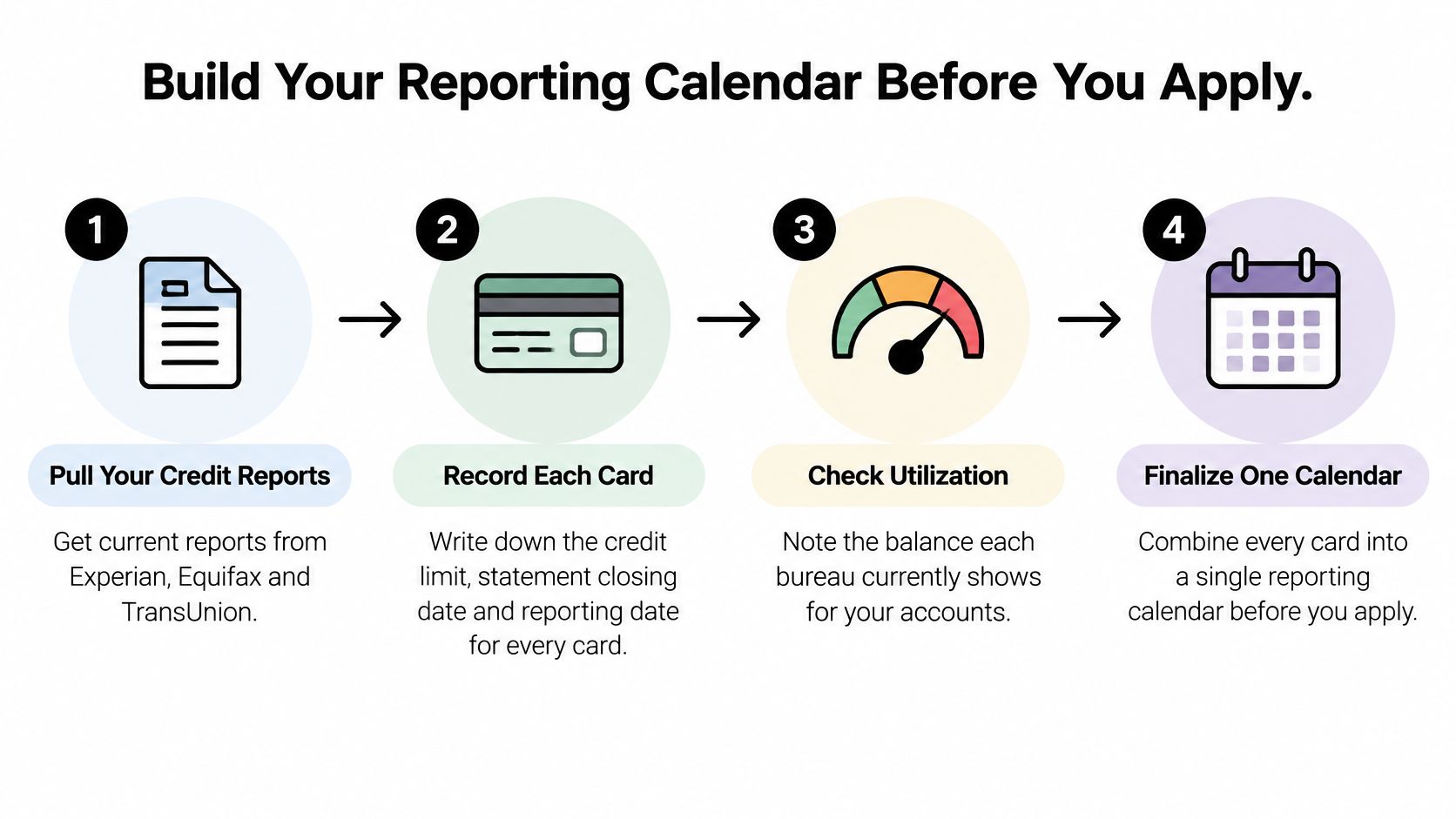
What each issuer actually does
Issuers don't follow one shared calendar. Equifax notes that reporting generally happens monthly around the billing-cycle or statement date, while some creditors report mid-month, at month-end, or on another schedule, and smaller issuers may send just one file per month. That's the reason a friend's card updates on the 3rd and yours updates on the 19th.
Practical rule: the calendar earns its keep in the two weeks before an application. Anything you change after that point may not reach the bureaus in time to matter.
One row per card at the finish
The finished page should read like a small ledger: one row per card, showing the limit, the closing date, the due date, the balance on each of the three bureaus, and the expected next update. Keep the current month and the prior month visible so you can spot a report that hasn't refreshed.
A consumer who wants help reading the reports, spotting which items deserve scrutiny, and sequencing the work so current accounts stay protected can begin with an online review request. Our team works from the reports themselves, comparing Experian, Equifax, and TransUnion first, then mapping each account to a closing date so the plan matches the actual reporting pattern instead of a guess. For additional planning detail, these utilization tips from Superior Credit Repair show how to sequence payments around closing dates.
How Long Changes Take to Appear
Timing depends on what is changing. A payment that lowers a balance often appears with the next monthly issuer update, while a disputed item follows an investigation calendar, and account age can't be hurried at all. Treat the estimates below as normal patterns, not promises.
| Type of change | Typical timing | What controls the timing |
|---|---|---|
| Balance change after a payment | Next monthly issuer update | Issuer reporting schedule |
| Dispute investigation | Often a standard 30-day period, which can extend | Bureau volume and creditor response times |
| Correction of a verified error | Varies with documentation and furnisher updates | Account records and creditor verification |
| Positive account age | Grows over time and cannot be rushed | Length of the account history |
| Changes that need several cycles | More than one reporting cycle | Reinvestigation cycles and new account activity |
Some balance changes report within a billing cycle, while disputes, creditor corrections, and positive account age take longer. Many bureau investigations run within standard 30-day periods, and responses may stretch depending on bureau volume and how quickly a creditor replies.
What stretches the timeline
A handful of events reliably push a file sideways. New negative accounts arriving while a review is underway reset the picture. Late or skipped payments on active accounts during the same window add fresh history. Creditors verifying accounts mid-investigation take their own time to respond, and a reinvestigation cycle can begin again if new documentation arrives. Sharp swings in credit usage do the same thing, because each swing produces another report worth checking.
A single lower score after a statement closes is often a reporting artifact rather than a crisis, and responding to score drops without panic is its own skill. Two cards closing in the same week can make a quiet file look busy for no reason beyond calendar overlap.
When several cards close on different days, track balances across multiple accounts in one place so you're comparing same-day figures instead of a mix of cycle dates.
The planning consequence is simple. If a report needs to show a specific change before a lender pulls credit, plan on more than one reporting cycle and keep new activity quiet during that window. Results vary with each person's credit file, documentation, creditor responses, account history, and current credit behavior.
Mortgage Timing and Lender Reviews
A mortgage underwriter reads the whole file: revolving balances, utilization, payment history, collections, and debt-to-income ratio. FHA, VA, conventional, and USDA programs each publish their own guidelines, so confirm program specifics with your loan officer rather than assuming one rule covers all four.

First-time buyers, applicants who were recently denied, and renters preparing to buy usually learn about reporting timing after an application is already moving. The documents to assemble before preapproval are straightforward: statements showing the closing date for every card, a payment calendar for all open accounts, notes on recent credit inquiries, and any feedback a lender, landlord, or dealer has given about the file.
Obligations that never appear as a tradeline
Buy-now-pay-later products complicate this picture. The Federal Reserve's consumer and community context report notes that most BNPL lenders do not report these loans to credit bureaus, partly because pay-in-four products don't fit existing reporting infrastructure. A CFPB study cited in that report found 53.6 million U.S. consumers, about one in five adults, used BNPL in 2023, up 12% from 2022.
The consequence for a mortgage applicant is specific. Card utilization can look tidy while meaningful short-term repayment obligations sit outside the credit file entirely, and a lender may still find them through bank statements, debt disclosures, or underwriting questions. Keep a private ledger of every buy-now-pay-later balance and payment date, save the receipts, disclose the obligations accurately to your loan officer, and avoid opening several new accounts before underwriting.
A clean report isn't the same as low debt exposure. Underwriting looks at both, and mismatch between them is far easier to explain before closing than after.
Automated review tools now pull more signals into the decision than a single tradeline summary, and understanding AI-driven underwriting automation helps a borrower see why a bank statement question can matter as much as a reported balance. Collections, charge-offs, and late payments each need documentation and a lender conversation; any dispute process is legal, documentation-based, and follows the bureaus' procedures, with outcomes that vary by file. Apartment and rental screening use similar reports, so the same calendar serves both goals. Buy-now-pay-later and fintech obligations belong in that conversation even when no monthly account appears, and our Superior Credit Repair utilization guide shows how closing dates feed into a mortgage-ready plan.
Frequently Asked Questions and Next Steps
Why does my card still show a balance after I paid it in full?
The card issuer may have reported the statement balance before your payment arrived. That reported snapshot can remain on your credit file until the issuer sends an update. The CFPB's guide to understanding your credit report explains that lenders typically update report information monthly.
Does paying before the closing date change what gets reported?
It may lower the balance captured for the next update. Your due date is when the payment is owed; the statement closing date usually determines which balance is recorded on the statement. Issuers' reporting patterns vary, so check the closing date and reporting pattern for each card.
Do buy-now-pay-later loans appear on my credit report?
Reporting can vary by provider. Keep track of these payments and disclose obligations accurately on applications. A balance that does not appear as a tradeline is still an obligation to account for.
How long does a dispute take?
Many bureau investigations operate within standard 30-day periods, though responses may take longer depending on bureau volume and creditor response times. If a change requires creditor documentation or a furnisher update, it may take longer to appear.
Superior Credit Repair helps clients understand their credit reports, identify items to examine, and choose a realistic next step. You can start with an online review request, and the team will help you understand your report and identify which items to examine. Results vary by credit file and behavior; no deletion, score change, approval, or specific outcome is guaranteed.
Superior Credit Repair provides educational credit guidance for individuals and families preparing for major financial goals. If this information helped you understand your credit report or next steps, you can share your honest feedback on the Google Business Profile.
If your closing date and due date have been doing different jobs in your head, clarify the difference before applying. The statement closing date usually sets the balance captured for reporting, while the due date is when your payment is owed. Compare your Experian, Equifax, and TransUnion reports, since the same account may show different balances or dates across bureaus. You can submit an online review request to Superior Credit Repair for help understanding your report and identifying items to examine.