

You've received your Certificate of Eligibility, started looking at homes, and begun imagining the move. Then your lender asks about an old collection, a deposit in your checking account, and a gap in your employment history. It can feel like you're being asked to qualify all over again.
The VA loan approval process becomes easier to manage when you understand which decision the lender is making and what evidence answers its questions. You don't need to chase a magic credit score. You need an accurate credit file, documented income, manageable obligations, and a property that meets the program's requirements.
Table of Contents
- Two Separate Decisions Behind Every VA Loan
- How to Move Through Each VA Loan Approval Stage
- Documents Lenders Review Before Deciding
- Credit Score and Debt-to-Income Targets Explained
- Underwriting Issues That Slow or Stop Approval
- Documented Credit Repair Steps to Improve Readiness
- Confirm Your Next Step Before Contacting a Lender
Two Separate Decisions Behind Every VA Loan
Receiving a Certificate of Eligibility, or COE, is an important milestone. But it's understandable to mistake that certificate for mortgage approval, especially when you've already started discussing a purchase price.
The COE documents your eligibility for the VA benefit based on your service history and duty status. The lender makes a different decision: whether your finances support the specific mortgage you're requesting.

Eligibility and financial qualification answer different questions
Think of the decisions side by side:
- VA eligibility: Does your service qualify you to use the benefit?
- Lender qualification: Do your credit history, income, debts, assets, intended occupancy, and proposed payment support approval?
As the Consumer Financial Protection Bureau explains, the VA establishes program rules and guarantees a portion of eligible loans, while a private lender handles underwriting, closing, and servicing.
The benefit can substantially reduce the upfront barrier to homeownership. According to the VA's home loan eligibility guidance, nearly 90% of VA-backed loans are made without a down payment, while the maximum loan amount for an individual property is generally limited by the appraised value or purchase price, whichever is lower.
Prepare for the lender's decision
No required down payment doesn't mean no financial review. A lender still needs to establish that you can reasonably afford the payment and that the property supports the transaction.
Practical rule: Treat your COE as proof of access to the program, not permission to stop preparing your financial file.
Request or confirm your COE, then gather records for a lender conversation. For broader preparation, the mortgage approval insights from Superior Credit Repair can help you organize questions about your readiness before committing to a purchase.
How to Move Through Each VA Loan Approval Stage
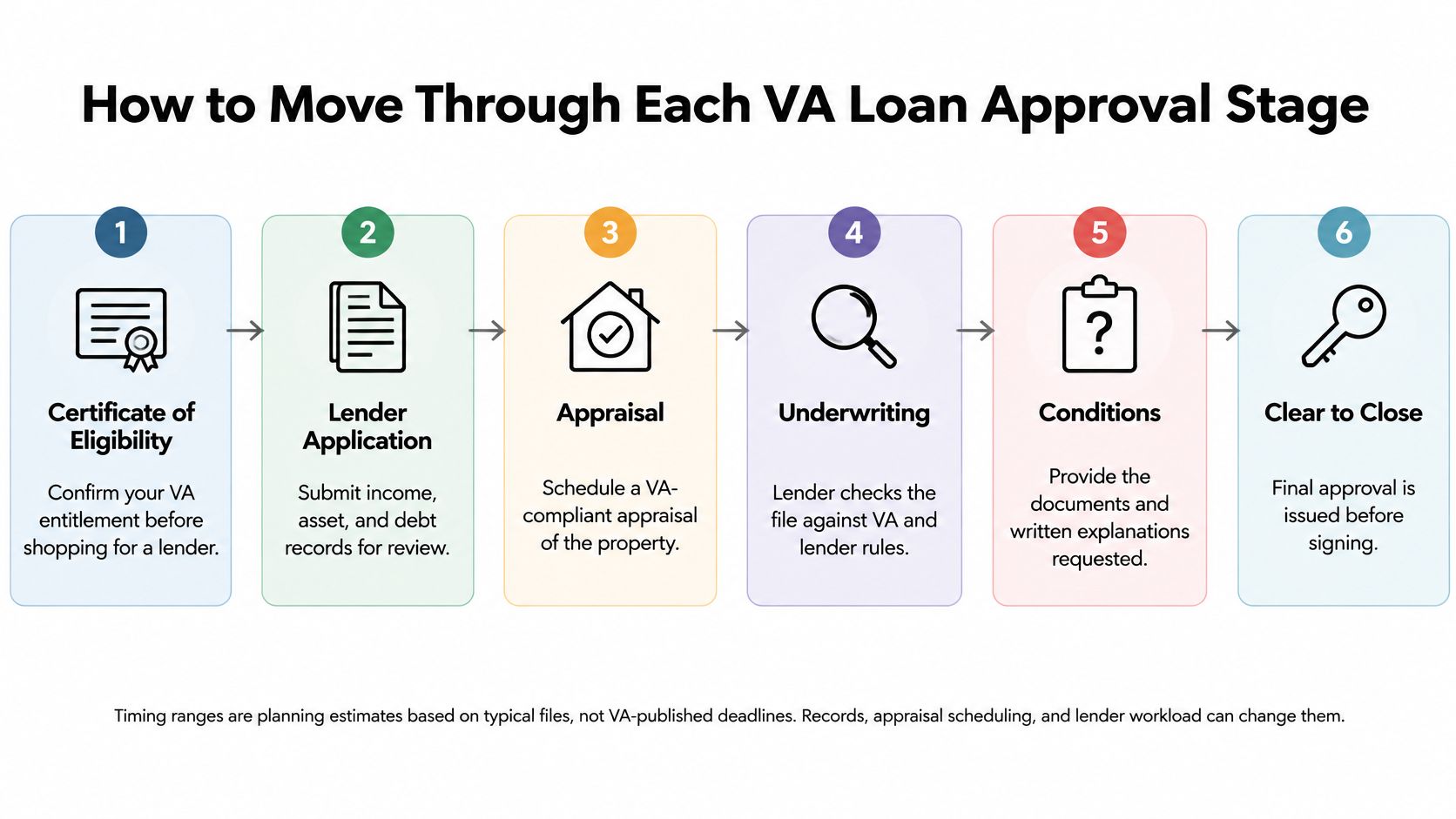
The timing ranges below are planning estimates for typical files, not VA-published deadlines. Missing records, appraisal scheduling, property repairs, and lender workload can change them. Some stages overlap, so don't add every range together to predict your closing date.
VA loan approval stages and typical timing
| Stage | What Happens | Typical Timing |
|---|---|---|
| 1. Eligibility and COE | Service history verified and COE issued | Same day to several weeks, depending on records |
| 2. Preliminary qualification | Income, debts, assets, and credit reviewed | Usually 1 to 3 business days for initial review |
| 3. Purchase contract | Contract signed and sent to the lender | Set by the contract and lender intake |
| 4. Appraisal order | Lender orders the VA appraisal through the VA system | Scheduling often takes 1 to 2 weeks |
| 5. Appraisal and Notice of Value | Appraiser checks value and VA minimum property requirements; reviewer issues NOV | Often 1 to 3 weeks after the order |
| 6. Final underwriting | Updated credit, income, assets, and debts reconciled with the NOV | Commonly 1 to 3 weeks |
| 7. Conditions cleared | Borrower answers lender requests and supplies explanations | Ongoing; often days per request |
| 8. Final approval and closing | Final decision, closing disclosure, and signing | Frequently 30 to 45 days from contract, although actual timing can change |
The process moves from confirming your benefit to documenting the borrower and evaluating the home.
What each stage needs from you
Confirm eligibility and obtain the COE. Resolve missing service records early. Assuming the lender already has the correct certificate can leave a basic requirement unfinished.
Get preliminary qualification. The lender reviews your financial starting point and identifies missing evidence. Don't submit only your strongest pay stub while leaving variable earnings unexplained. Use the document checklist below to prepare a complete package.
Sign and deliver the purchase contract. Your lender needs the executed agreement to work from the actual transaction terms. Send amendments too, rather than assuming your agent forwarded everything.
Let the lender order the VA appraisal. The order goes through the VA system. Don't confuse arranging a private home inspection with completing this lender-controlled step.
Complete the appraisal and Notice of Value review. The appraiser evaluates value and minimum property requirements, and a Staff Appraisal Reviewer issues the Notice of Value. The VA underwriting guidance distinguishes this property review from the credit decision. Unresolved repair conditions can prevent closing even when the borrower's finances are acceptable.
Complete final underwriting. The underwriter reconciles the property findings with updated financial records and occupancy information. A new car loan during processing can change the application the lender originally reviewed.
Answer conditions with records. A condition is a requirement that remains outstanding. Reply with the requested document and a clear explanation, rather than a partial answer that creates another round of questions.
Receive final approval and complete closing. Review the closing disclosure and signing instructions carefully. Don't treat a scheduled appointment as confirmation that every condition has cleared.
A VA appraisal isn't a home inspection. Arrange a separate inspection to understand the home's condition beyond the appraisal's purpose.
A satisfactory borrower review can't overcome every property problem. A low value or unresolved condition issue may require renegotiation, repairs, or a different property. Approval isn't final until lender conditions are cleared and closing documents are issued.
Documents Lenders Review Before Deciding
Underwriting relies on formal records, not just what appears on a credit-score screen. Your application tells the lender what your finances look like; supporting documents allow the lender to verify that description.
Build a complete application folder
The VA Lender's Handbook directs lenders to verify at least two years of employment and obtain an appropriate credit report generally less than 120 days old, with a permitted age of 180 days for new construction.
Prepare these records, then confirm the exact requirements with your lender:
- Employment history: List employers, employment dates, and gaps so the lender can reconcile your work history.
- Pay stubs and W-2s: These help establish current earnings and compare them with prior compensation.
- Federal tax returns: Self-employment, business expenses, or variable earnings may require a deeper income review.
- Bank statements: Provide the period your lender requests, commonly the most recent two months, including all pages. Statements help document available funds and trace unusual deposits.
- Complete debt list: Include balances, payments, and obligations that might not appear accurately on your reports.
- COE: Keep a readable copy with your eligibility records.
- Written explanations: Attach supporting evidence for late payments, inquiries, employment gaps, or unusual transactions.
Say your paycheck includes overtime. The deposit alone doesn't explain whether that overtime is consistent or likely to continue. Payroll records and employer verification help the lender distinguish dependable income from occasional earnings.
For broader context about how lenders evaluate homebuyers, focus on how each document supports income, obligations, funds, or account history.
Understand the checks behind the paperwork
The lender obtains a three-file merged credit report or Residential Mortgage Credit Report, rather than relying on a consumer-facing score alone. It also initiates the VA and Credit Alert Interactive Voice Response System inquiry, commonly called CAIVRS, to identify certain federal delinquent debts or claims requiring attention.
An automated underwriting system may assist with processing, but a VA-approved credit underwriter makes the final credit decision. A Staff Appraisal Reviewer's authority to review the appraisal doesn't, by itself, authorize that person to approve the borrower's credit.
Tax returns contain sensitive information. When preparing to transmit them, FaxZen's secure tax document guide offers useful handling considerations; confirm your lender's approved delivery method before sending anything.
Keep documents dated, labeled, and organized in one folder. Use filenames that identify the document and statement period, and retain copies of everything you submit.
Credit Score and Debt-to-Income Targets Explained
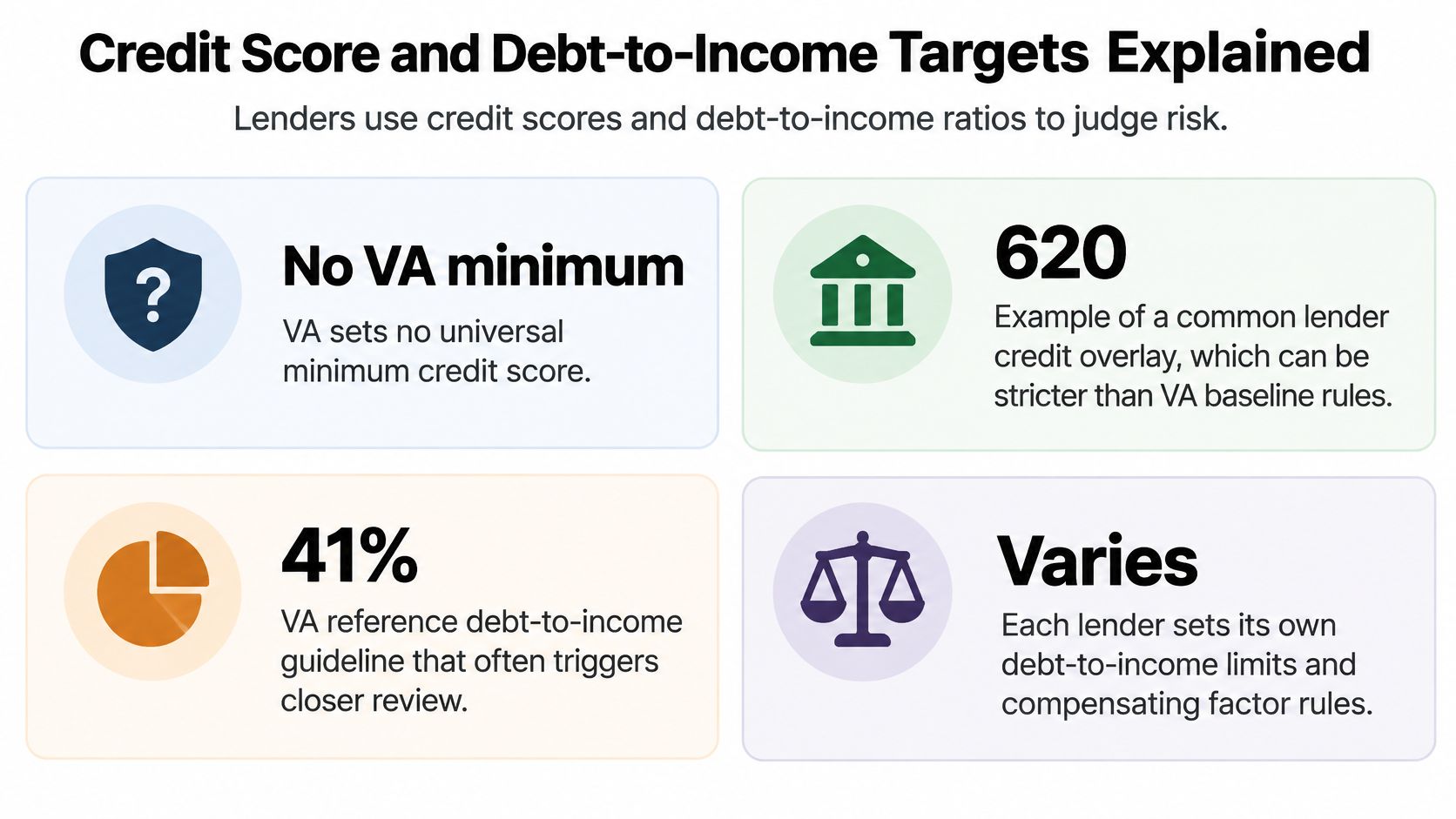
VA sets no universal minimum credit score. Individual lenders establish their own credit requirements, sometimes called overlays, and may use scores when evaluating risk and pricing.
That's why a number found online isn't a substitute for your lender's written policy. A denial under one lender's overlay doesn't establish universal VA ineligibility.
Credit and debt factors in VA underwriting
The VA Buyer's Guide explains that 41% debt-to-income is a reference point, not an automatic denial threshold; ratios above that benchmark require closer scrutiny and documented compensating factors.
| Factor | VA Baseline | What Lenders Commonly Review | What It Means for You |
|---|---|---|---|
| Credit score | No universal VA minimum | Lender-set score requirements and credit history | Confirm your lender's written minimum |
| Debt-to-income ratio | Reference benchmark, not automatic denial | Elevated ratios and documented compensating factors | A high ratio needs supporting evidence |
| Residual income | Money left after housing and debts | Regional guideline amounts by family size | Available cash flow matters alongside the ratio |
| Verified income | Stable and documented | Employment history and consistent deposits | Stated income needs supporting records |
| Cash reserves | Lender-specific review | Funds remaining after closing | Preserving reserves supports the file |
| Recent payment history | Evaluated within the overall credit review | Recent late payments and account conduct | Keep accounts current during processing |
Debt-to-income ratio, or DTI, compares your monthly debt obligations with your qualifying monthly income. Residual income looks at what remains after housing and other obligations, using applicable regional and household-size guidance.
These measurements answer different questions. A ratio describes how much income is committed, while residual income helps the underwriter evaluate whether enough money remains for everyday needs.
Distinguish missing evidence from insufficient income
Say your application includes overtime that you regularly receive, but the lender hasn't verified it. That's an evidence problem. If the lender verifies all qualifying income and the payment still leaves insufficient residual income, the issue is repayment capacity.
Cash reserves and a stable recent payment record can support an application, but they don't excuse missing documentation or automatically overcome affordability concerns. A higher score also won't turn unverifiable earnings into qualifying income.
For borrowers exploring VA loans with lower credit scores, the useful question is which lender requirements remain unmet and what documentation or financial change could address them.
Ask before spending: Request the lender's minimum credit score, debt-ratio guidance, and documentation list in writing before paying for an appraisal.
Don't open an account just because someone says it could improve your score. Ask how the proposed change would affect the mortgage application, monthly obligations, available cash, and underwriting review.
Underwriting Issues That Slow or Stop Approval
Collections and charge-offs deserve an accuracy review before a payment decision. Confirm that the account belongs to you and that its balance, status, and dates are reported correctly.
A charge-off means a creditor recorded an account as a loss; it doesn't necessarily mean the obligation disappeared. An accurate unpaid collection requires a different response from an account reported under the wrong person's name.
Underwriting issues, causes and remediation paths
| Issue | Why Underwriters Flag It | Documented Remediation Path |
|---|---|---|
| Collections or charge-offs | Signals unpaid obligations and repayment risk | Verify accuracy; dispute inaccuracies or unverifiable reporting; document payment or settlement when appropriate |
| Recent late payments | Raises concern about current payment reliability | Bring accounts current; explain circumstances; dispute reporting errors |
| High credit card utilization | Signals heavy reliance on credit; required payments affect DTI | Build a paydown plan; consider payments before statement dates |
| Unexplained deposits | Lender must verify the source of funds | Gather statements and a paper trail; use gift documentation only where permitted |
| New accounts or inquiries | May indicate debt missing from the application | Explain the purpose and disclose resulting obligations |
| Missing or incorrect debts | Distorts the repayment calculation | Provide a complete debt list and address reporting errors |
| Medical collections | Reviewed under the lender's policy | Verify accuracy and request the lender's written standard |
Credit utilization means how much revolving credit you're using compared with your available limits. A high balance and a high required payment are related concerns, but they aren't interchangeable: the required payment directly affects the debt calculation.
For an accurate collection, ask what your lender requires before paying or settling. Obtain any agreement in writing and retain proof of payment. Payment doesn't guarantee deletion or approval.
Diagnose the condition before trying to solve it
A deposit from selling a vehicle can be legitimate but still require evidence. A bill of sale, deposit record, and relevant account statement can answer the lender's question more clearly than a verbal explanation.
Likewise, an inquiry might reflect rate shopping or a newly opened account. Tell the lender which it was and provide the resulting account records when applicable. The mortgage readiness guidance for veterans can help frame questions about collections and charge-offs.
After a denial or conditional decline, request the specific reasons in writing and sort them into:
- Documentation gaps: Missing income records, unexplained funds, or inconsistent account information.
- Repayment concerns: Insufficient cash flow, unaffordable obligations, or a pattern of recent missed payments.
Documentation gaps need records. Repayment concerns may require changes sustained over time. Ask whether corrected evidence permits reconsideration, and whether the issue reflects that lender's overlay rather than a program-wide restriction.
Documented Credit Repair Steps to Improve Readiness
Credit repair is a structured review, legal dispute and verification process, and long-term rebuilding strategy. Its purpose is to address reporting problems and strengthen financial habits, not erase accurate history because a mortgage application is approaching.
Start with accuracy and supporting evidence
Obtain reports from the major credit bureaus and compare each account line by line. Check ownership, balances, payment status, dates, and whether the same obligation appears inconsistently.
Build a documentation file containing statements, payment confirmations, creditor correspondence, and any relevant identity records. Describe the exact information you believe is wrong rather than submitting a general request to remove every negative account.
- Identify the error: Explain which field is inaccurate, outdated, unverifiable, or misleading.
- Submit a focused dispute: Use the legal dispute process with the bureau and, where appropriate, the creditor or information furnisher.
- Keep a dated record: Save submissions, supporting documents, delivery confirmations, and responses.
- Review the outcome: Compare updated reporting with the response and your evidence.
The Fair Credit Reporting Act provides a process for disputing reported information. Investigation requirements and timing can depend on the circumstances, so don't build a purchase contract around an assumed completion date.
Dispute information because you have a good-faith accuracy concern, not because someone promises that every negative account can disappear.
Rebuild without destabilizing the mortgage application
Keep revolving balances manageable relative to their limits. Payments before a statement closes may reduce the balance reflected on that statement, although reporting schedules aren't identical across creditors.
Avoid closing older cards or adding new accounts without reviewing the consequences. Authorized-user arrangements also warrant a lender conversation because an underwriter may examine the account and your relationship to it.
For households balancing competing obligations, Morgan & Morgan Attorneys at Law P.C.’s credit score advice for debt-burdened households provides additional rebuilding context. Prioritize a payment plan you can maintain rather than shifting money in ways that create new missed payments.
Options include organizing disputes yourself, working directly with creditors, or obtaining professional support. Credit rebuilding with Superior Credit Repair combines documented review, dispute support, and rebuilding guidance for consumers preparing for financing.
Results vary with the credit file, documentation, creditor responses, account history, and current credit behavior. No legitimate readiness plan can promise deletions, a particular score increase, or mortgage approval.
Confirm Your Next Step Before Contacting a Lender
Before contacting a lender, gather the records that explain your situation and make a short list of questions. You do not need perfect credit to ask what remains before you can apply.
Use this checklist to prepare:
- Eligibility: Request or confirm your Certificate of Eligibility (COE).
- Credit report: Note any reporting concerns and keep supporting records.
- Income and debts: Organize employment documents and a complete list of obligations.
- Bank records: Keep documentation for large deposits.
- Lender guidance: Ask for written information about credit and debt requirements.
- File history: Keep dated records of disputes and document requests.
If you are comparing communities, Dream Destin Realty's resource on buying a home in Destin can help with location research. Keep your housing choices within a payment amount your lender can support with your financial records.
Does a COE mean I can make an offer confidently?
A COE confirms benefit eligibility, not how much you can afford to borrow. Ask a lender to discuss your budget before deciding what offer to make.
Should I settle a collection before applying?
First ask the lender what documentation or resolution it requires. Keep the settlement terms and proof of payment if you resolve the account.
Can I use an employment offer instead of pay stubs?
Ask which income records the lender will accept in your circumstances. An offer letter alone may not establish qualifying income.
What should I do if underwriting asks for another explanation?
Answer the specific question, attach relevant records, and keep a copy of what you submit. If the request is unclear, ask the lender to explain what is missing.
Was this guide helpful?
Superior Credit Repair Online provides educational credit guidance for people preparing for goals such as buying a home, applying for a mortgage, refinancing, or rebuilding after credit challenges. If this information helped you understand your credit report or consider your next steps, you can share your experience on the Google Business Profile.
Superior Credit Repair can review your credit report, help identify inaccurate or questionable items, and explain a documentation-based plan for VA mortgage readiness. Request a credit analysis or consultation to understand your options. Results depend on your credit file, documentation, creditor responses, and account behavior, and are not a promise of approval.