

The VA sets no minimum credit score for a VA loan, but most lenders use an overlay around 620, and approval depends on the full file, including residual income and compensating factors. A borrower below 620 may still qualify with some lenders, while a borrower above 620 can still be declined if the rest of the application is weak.
That answer challenges the most repeated advice about the credit score needed for a VA loan. “There's no minimum” is technically correct, but it can leave military families unprepared for the private lender rules they'll face. The practical question isn't only whether the VA permits your score. It's whether a particular lender will approve your complete credit, income, debt, and risk profile.
Your result can vary because lenders use different underwriting standards. One lender may decline a borrower, while another approves the same veteran with the same VA eligibility. The difference may come from lender overlays, residual-income analysis, payment history, debt levels, automated underwriting, manual review, or compensating factors.
For first-time buyers, renters preparing to purchase, and families rebuilding after hardship, this distinction matters. A focused credit review can help you understand whether you're dealing with a genuine credit-report error, a lender threshold, high utilization, collections, late payments, charge-offs, or a broader debt concern. You can also explore mortgage-ready credit repair for buyers when preparing for VA, FHA, USDA, or conventional financing.
Table of Contents
- Introduction Why There Is No Single VA Score Cutoff
- How VA Rules and Lender Overlays Actually Work
- What Lenders Really Look for by Score Range and Loan Type
- How Credit Scores Affect VA Approval Rates and Terms
- Prioritized Steps to Strengthen Your VA Approval Odds
- Building a Lender Ready Credit Profile With Professional Support
- VA Loan Credit Questions Answered and Next Steps
Introduction Why There Is No Single VA Score Cutoff
A single national score cutoff does not decide every VA loan. The VA buyer guide explains that the Department of Veterans Affairs evaluates overall creditworthiness, while lenders use credit scores to help assess risk and set pricing. VA rules do not establish one program-wide minimum score.
The lender's policy becomes the second set of rules. 620 FICO is a common lender floor, but it comes from private underwriting policy rather than VA eligibility requirements. Some lenders may review lower scores when the file shows a reliable payment history, manageable debt, adequate residual income, and other compensating factors.
Why the same borrower can receive different answers
Two veterans can have the same score, similar service eligibility, and comparable income, yet receive different decisions. One lender may use an automated underwriting path that accepts the file. Another may apply a stricter overlay, require manual underwriting, or decline because recent late payments and high revolving balances increase risk.
The VA rules did not change between those applications. The lenders assessed the same risk differently. VA eligibility is one gate. The lender's underwriting policy is another. Shopping lenders can therefore mean comparing overlays and review practices, not asking whether a lender offers VA loans.
What this means before you apply
Treat your score as one part of the application, not a magic approval number or an automatic dead end. Review the information a lender will see alongside it:
- Payment history: Recent late payments can raise more concern than older, isolated problems.
- Utilization: High revolving balances can weaken a file even when payments remain current.
- Collections and charge-offs: Lenders may examine the age, status, balance, and circumstances of negative accounts.
- Debt profile: Monthly obligations shape the lender's view of repayment ability.
- Documentation: Clear records can explain disputed, corrected, or resolved information.
Credit repair for VA loans should focus on accuracy, documentation, and sustainable rebuilding, without promising a particular score or approval result. Buyers preparing for VA, FHA, USDA, or conventional financing can also explore mortgage-ready credit repair for buyers as part of that preparation.
How VA Rules and Lender Overlays Actually Work
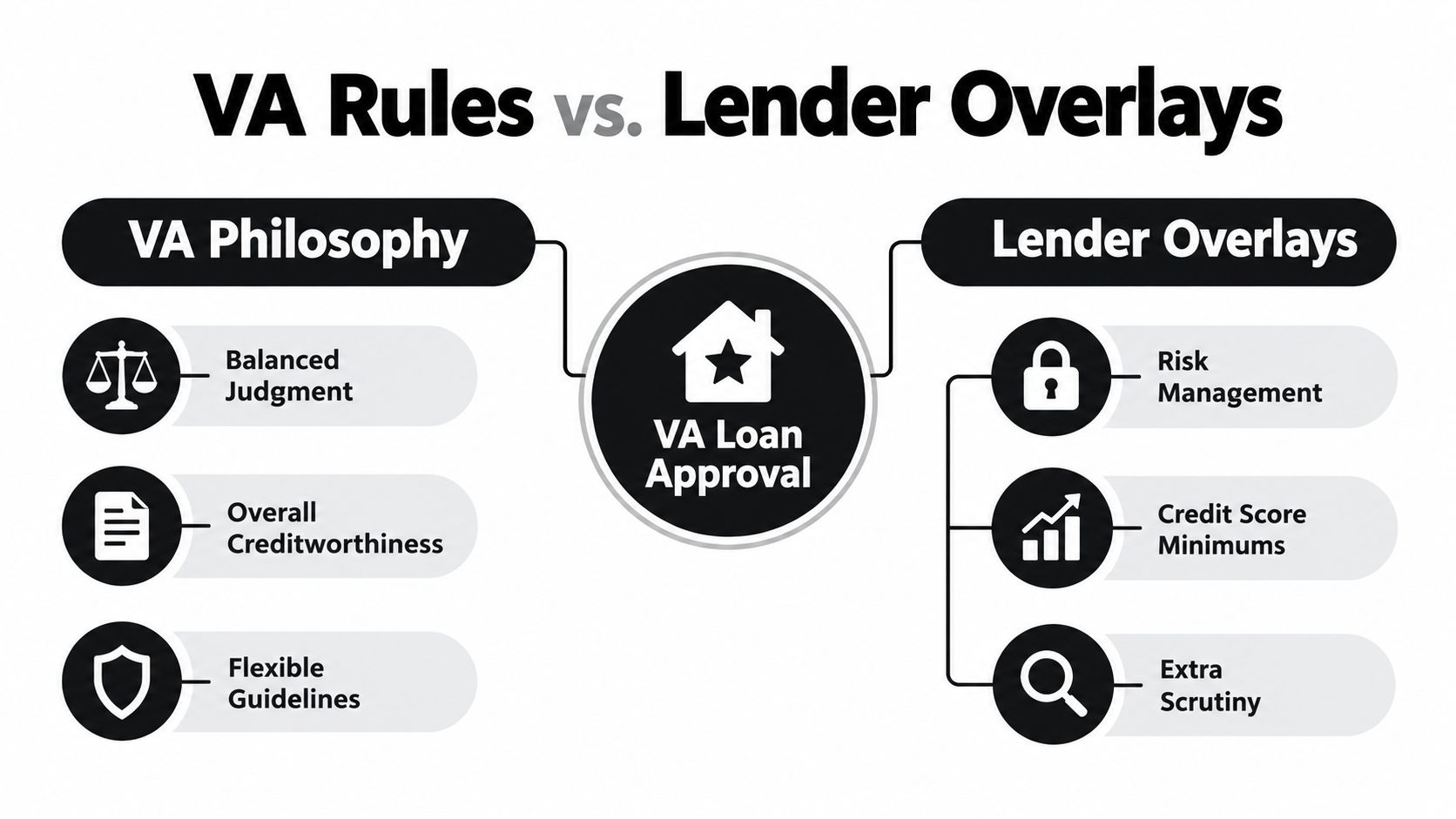
The VA and the private lender perform different jobs. The VA provides the loan-guarantee framework and directs lenders to evaluate overall creditworthiness. The lender decides whether the complete application meets its own risk standards and whether the loan can move through its underwriting and delivery process efficiently.
The VA credit underwriting guidance emphasizes case-by-case evaluation, good judgment, and flexibility when warranted. That doesn't mean every lender must approve every borderline application. It means the decision should consider the full file rather than rely on one isolated number.
Think of two separate gates
A useful analogy is to picture the VA as the program gate and the lender as the risk gate.
The program gate asks whether the borrower has qualifying VA eligibility and is using the loan for an eligible purpose. The risk gate asks whether the lender is comfortable approving this specific file under its own standards. The second gate may include a credit-score overlay, stricter treatment of recent delinquencies, additional requirements for manual underwriting, or special rules for larger loan amounts.
That's why “no VA minimum credit score” doesn't mean “every lender accepts every score.” It means the federal program itself hasn't created one universal score barrier.
Why 620 appears so often
A lender overlay is an internal requirement added on top of the VA's program guidance. A common overlay is a score floor around 620, although some lenders publish lower or higher floors. According to the VA lender training material, the score isn't the VA eligibility gate, but it can affect the lender's risk analysis, available underwriting path, and willingness to approve.
Borrowers below a lender's overlay usually face more scrutiny and fewer options. The lender may request additional documentation, examine payment patterns more closely, or send the application for manual review. Borrowers at or above the overlay may move more easily through standard automated workflows, but approval still depends on the complete file.
Ask better questions before submitting applications
Instead of asking only, “What credit score do I need for a VA loan?” ask:
- Does this lender have a published minimum score for VA purchases?
- Does the lender use a different floor for manual underwriting?
- How does it treat recent late payments, collections, or charge-offs?
- Does the lender impose a higher overlay for VA jumbo loans?
- What compensating factors can support a borderline application?
Those questions turn lender shopping into a strategy rather than a search for a single national cutoff. A detailed review of how a VA lender reviews your credit can also help you prepare questions before seeking preapproval.
What Lenders Really Look for by Score Range and Loan Type
A score range gives you a starting point, not a final answer. Current published lender material shows floors ranging from 580 to 640, depending on the lender and loan profile, as described by Rocket Mortgage's VA credit-score guide. The lender may also apply a higher overlay when the loan amount, underwriting path, or risk profile changes.
| Loan Profile | Common Lender Floor | What Changes for Borrower |
|---|---|---|
| Standard VA purchase with a more flexible lender | 580 | The lender may require stronger documentation, compensating factors, or manual review. |
| Standard VA purchase with a common market overlay | 620 | The file may move more easily through standard automated underwriting, subject to other requirements. |
| VA purchase with a stricter lender | 640 | Borrowers may have fewer lender choices if their score is below the overlay. |
| VA jumbo or layered-risk profile | 640 to 700 or higher | Loan size and added risk layers may create stricter underwriting and additional documentation. |
The table shows why a borrower with a score in the 580 to 619 range shouldn't assume the loan is impossible. That borrower may be viable with a lender willing to review the full file, but the application generally faces tighter scrutiny and fewer lender options. A score at or above 620 may create a smoother path with many lenders, yet it doesn't erase concerns about recent delinquencies, high utilization, or excessive monthly obligations.
Loan size changes the conversation
A standard purchase loan and a VA jumbo loan aren't always evaluated under identical rules. Larger balances can lead lenders to apply stronger overlays, particularly when the application also includes borderline credit, variable income, significant debt, or a manual-underwrite requirement.
This is why the right question is specific: What score does this lender require for this loan size and underwriting path? A borrower who is acceptable for a standard VA purchase may not receive the same answer for a jumbo transaction.
Score source and file quality matter
Mortgage lenders may review scores and credit data through their own systems. Consumers often see different numbers depending on the scoring model, reporting date, and bureau information. Before planning around a score, take steps to determine your true credit score and ask the lender which score information it uses for the application.
Your score is only one summary of the file. A lender can also examine the account-level details behind that number, including whether negative information is accurate, whether balances are rising, and whether recent payment behavior supports the application.
How Credit Scores Affect VA Approval Rates and Terms
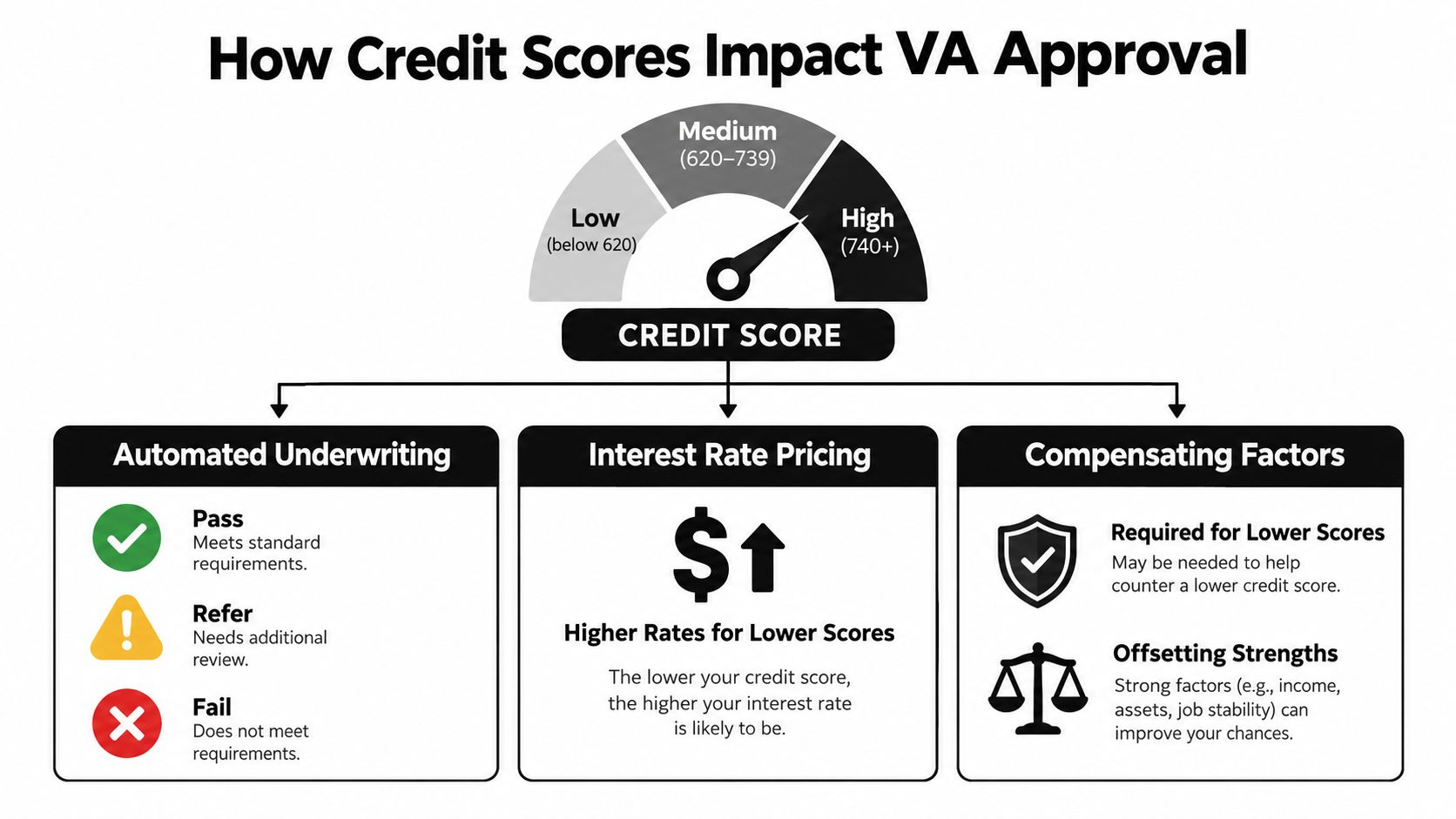
A VA loan does not produce one predictable result for every borrower with the same score. Credit can affect whether a lender's automated underwriting system approves the file, sends it for human review, adds conditions, or offers different pricing. The VA program sets broad eligibility standards, while each lender may add its own risk requirements. That difference explains why two veterans with similar scores can receive different answers.
Automated underwriting versus manual review
Automated underwriting reviews the application through the lender's underwriting system. A favorable result may keep the file on a standard processing path. A refer or caution result can require more documentation or a manual review.
Manual underwriting gives an underwriter more opportunity to consider context, but the lender still applies its own risk standards. The review may focus on why late payments occurred, whether on-time payments have resumed, how much debt remains, and whether the household has enough money after recurring obligations.
Residual income can strengthen a borderline file
Residual income is the money left after required debts and major obligations are considered. VA underwriting uses fixed residual-income amounts based on region, family size, and loan amount. For loans of $80,000 or more, a family of four needs $1,003 per month in the Midwest or South, $1,025 in the Northeast, and $1,117 in the West. A single borrower needs $441, $450, or $491, respectively, as detailed in the VA residual-income requirements.
Strong residual income may act as a compensating factor when a score is near the lender's threshold. It cannot guarantee approval, but it helps show whether the household can manage ordinary expenses after debt payments.
The account details behind the score
An underwriter may connect the score with:
- Payment history: Whether payments are current and whether recent delinquencies appear.
- Credit utilization: How much available revolving credit is being used.
- Collections: Whether accounts are accurate, active, resolved, disputed, or aging.
- Charge-offs: Whether the balance and reporting status are correct.
- Debt levels: Whether monthly obligations leave enough income for household needs.
The practical takeaway is simple: a borderline score with clean recent behavior and strong residual income may receive a different review from the same score paired with new late payments and rising card balances. Ask each lender how its overlays apply to your score, loan type, and underwriting path before assuming one lender's answer represents the entire VA market.
Prioritized Steps to Strengthen Your VA Approval Odds
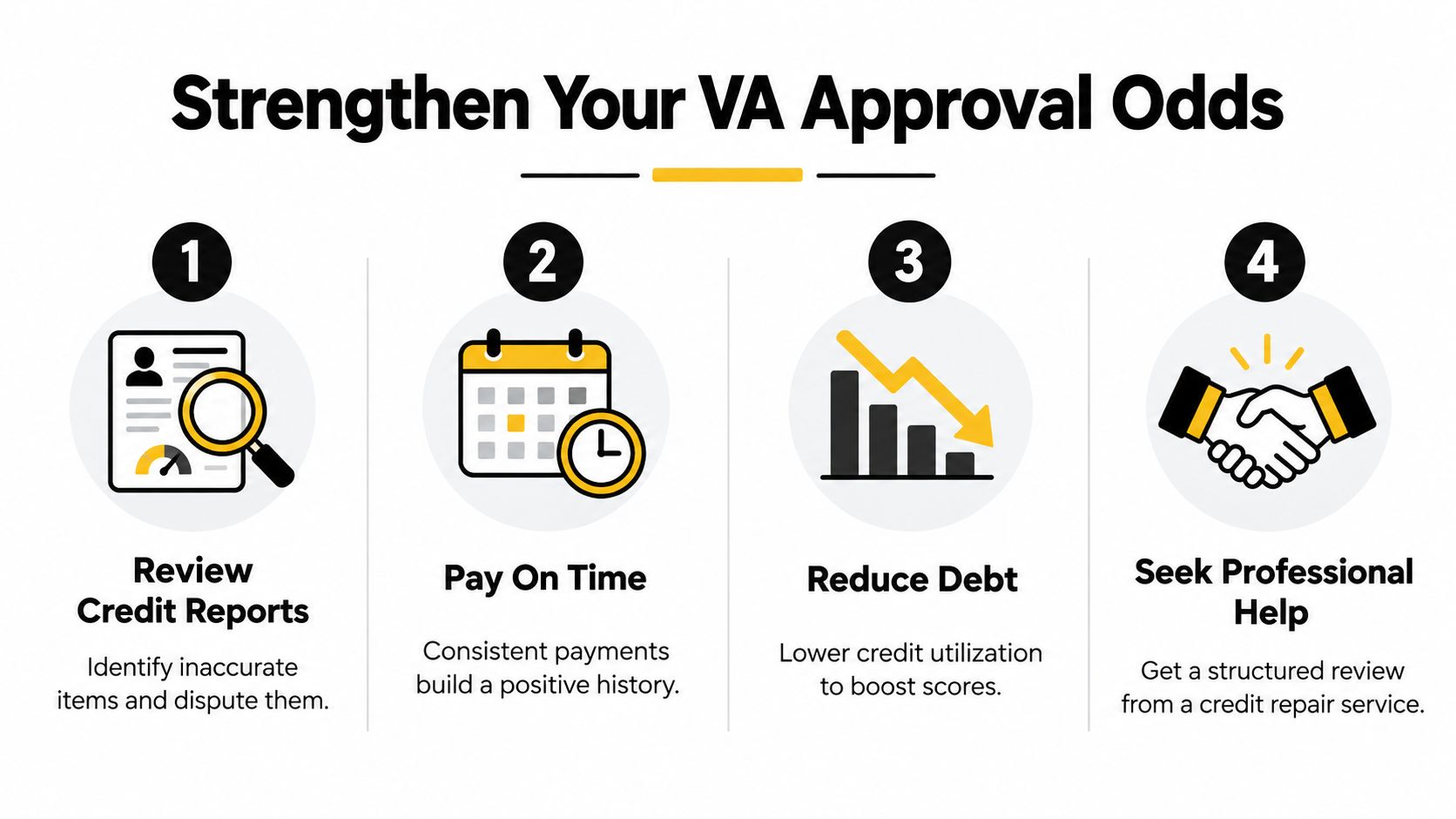
Credit preparation works best as a documented process. It doesn't promise a deletion, a particular score increase, or mortgage approval. Results vary according to the credit file, available records, creditor responses, account history, and current financial behavior.
Start with accuracy
Obtain your credit reports and review each account line by line. Look for inaccurate balances, accounts that don't belong to you, outdated information, duplicate reporting, incorrect payment history, and entries that lenders or furnishers can't verify.
A legitimate dispute should identify the specific information being challenged and include supporting documentation when available. Credit restoration is a legal dispute and verification process, not a request to remove accurate negative information because it harms a score.
Stabilize current accounts
New missed payments can undermine a mortgage-readiness plan. Set reminders, use automatic payments when appropriate, and contact creditors promptly if a payment problem is developing. Consistent current payments give lenders a clearer picture of present behavior.
Keep older accounts open unless there's a sound reason to close them. Avoid unnecessary new applications while preparing for a mortgage, because new credit activity can complicate the lender's review.
Reduce revolving utilization
Utilization describes the relationship between revolving balances and available credit. High balances can pressure a score and may signal that the borrower is relying heavily on credit. Focus on a sustainable payoff plan rather than moving balances around without reducing the underlying debt.
A practical review should consider statement dates, payment timing, interest costs, and the household budget. Don't drain funds needed for housing reserves to change a reported balance.
Address collections and charge-offs carefully
Don't pay or dispute an account without understanding what it is, who reported it, and whether the information is accurate. Gather statements, settlement records, identity-theft documentation, insurance records, and correspondence that may explain the account.
For families preparing for a mortgage, it can be helpful to resolve collections before mortgage approval while coordinating with the lender. The lender may have specific instructions about documentation, account status, and acceptable resolution.
Build positive history for thin files
A thin file has limited credit history, which can make it difficult for a lender to assess repayment behavior. Responsible use of an appropriate starter or secured card may help create positive reporting over time, but consumers should understand the fees, terms, reporting practices, and budget impact before opening an account.
No single action works for every borrower. A structured plan should match the actual credit profile and the timeline for purchasing.
Building a Lender Ready Credit Profile With Professional Support
Mortgage readiness involves more than trying to remove negative accounts. A lender-ready profile should show accurate reporting, stable recent behavior, manageable balances, explainable past problems, and documentation that supports the borrower's circumstances.

What a structured review can include
A compliant credit review may identify inaccurate, outdated, unverifiable, or misleading information. It can also organize supporting documents, explain the dispute and verification process, and separate genuine reporting errors from accurate information that must be addressed through repayment or rebuilding.
That distinction protects consumers. Accurate negative information generally requires responsible financial planning, not an unsupported dispute. Creditor responses also vary, so no ethical provider should promise guaranteed deletions, overnight credit repair, immediate score increases, or guaranteed mortgage approval.
Rebuilding belongs beside dispute work
After reviewing the reports, a plan may address utilization, payment reminders, secured or starter card options, self-reporting possibilities, and account stability. Consumers should be cautious with any service or app that presents credit improvement as automatic or effortless. For a neutral perspective, a realistic credit repair app review can help readers compare app-based monitoring or guidance with individualized documentation and dispute support.
Superior Credit Repair provides credit restoration services based on report review, documentation, dispute education, and rebuilding guidance. Its process includes no setup fees, no long-term contracts, and pay-as-you-go billing after work is performed, while outcomes vary by the consumer's file, creditor responses, and ongoing behavior.
Preparation should fit the mortgage goal
A veteran preparing for a VA loan may need a different plan from someone working toward FHA, USDA, conventional mortgage, apartment approval, auto financing, or personal financing. A consumer dealing with medical collections, repossessions, BNPL accounts, divorce-related obligations, or a thin file needs a review that accounts for the details rather than a generic score target.
Nationwide support for nationwide credit score improvement can help consumers organize the next steps before speaking with a lender. The purpose isn't to promise a result. It's to create a clearer, more accurate, and more stable credit profile over time.
VA Loan Credit Questions Answered and Next Steps
Can I apply with more than one VA lender after a denial?
Yes, lender policies differ. Ask the next lender whether the denial came from a score overlay, recent account activity, debt concerns, residual-income analysis, or another underwriting issue. Don't submit applications blindly. First request the adverse-action explanation and gather the documents that address the stated concern.
Can residual income help with a borderline score?
It can be a meaningful compensating factor, particularly when the rest of the file shows stable income, responsible recent payments, and manageable obligations. It isn't a substitute for a lender's requirements, and each lender may weigh the information differently.
Does a lower score affect approval or only the interest rate?
It can affect both. A lower score may lead to stricter underwriting, fewer lender options, additional documentation, and different pricing. The VA buyer guide confirms that lenders use scores to help determine rates and manage risk, but the final decision still depends on the complete application.
Should I repair credit before requesting preapproval?
A report review can be useful before preapproval, especially when you see inaccurate collections, late payments, charge-offs, identity issues, or high utilization. Credit repair should be documentation-based and focused on valid disputes and long-term rebuilding. No company can ethically guarantee deletion, a specific score outcome, or mortgage approval.
If this information helped you better understand your credit report or your next steps, we would appreciate your honest feedback. You are welcome to share your experience with Superior Credit Repair on our Google Business Profile.
Superior Credit Repair can review your credit report, help identify inaccurate or questionable items, and explain a step-by-step plan for improving your credit profile before a VA loan application. Visit Superior Credit Repair to request a free credit analysis or consultation and better understand your options.