

A renter renews an apartment lease, then notices a first-time homebuyer discussion online. The conversation quickly turns to credit scores, and one number feels final: 580. If your score is below that point, you may assume homeownership is off the table. If it's above that point, you may still worry that collections, late payments, or high card balances will stop a lender from saying yes.
The practical answer to “can I buy a house with bad credit?” is yes, sometimes, but the route changes. Your score can affect the loan program available to you, the down payment you need, the lender's review, and the overall cost of borrowing. A mortgage application is never just a score. Underwriters also examine income, debt, payment history, assets, and the accuracy of the information appearing in your credit reports.
You don't need a perfect file to begin preparing. You do need an honest assessment, clean documentation, and a plan that addresses the problems a lender is most likely to question.
Table of Contents
- The Short Answer for Bad Credit Homebuyers
- Loan Programs That Accept Lower Credit Scores
- Cleaning Up Your Credit Report Before You Apply
- Building Stronger Credit Habits That Lenders Notice
- Down Payment and Compensating Factor Strategies
- Less Obvious Items That Can Derail Your Mortgage
- Your 90-Day Mortgage Readiness Plan and Next Steps
The Short Answer for Bad Credit Homebuyers
Bad credit doesn't automatically block homeownership. For many U.S. buyers, an FHA loan is the most widely used government-backed starting point. Borrowers with a FICO score of 580 or higher can generally qualify for the FHA program's 3.5% minimum down payment, while borrowers in the 500 to 579 range may still be eligible but generally need at least 10% down, according to Chase's explanation of FHA credit requirements.
That difference matters. Moving from below 580 to 580 does not guarantee approval, but it can reduce the down payment hurdle by 6.5 percentage points. For a household already balancing rent, debt, closing costs, and moving expenses, that can change whether a purchase is realistic.
Practical rule: Treat 580 as an important FHA milestone, not as a promise of approval.
The trade-offs can be serious at the lower end of the credit range. You may need more cash upfront, face more detailed underwriting, receive less favorable pricing, or have fewer lenders willing to review the application. Conventional lending is typically less flexible for damaged credit, and many lenders use internal floors around 620, even though FHA's federal baseline can be lower. Rocket Mortgage explains the FHA score bands and the difference between the federal guideline and lender requirements.
The right question isn't only, “Will someone approve me?” Ask instead:
- Which loan program fits my eligibility and credit profile?
- Are the negative accounts accurate and documented?
- Can I handle the proposed payment without creating new late payments?
- Would waiting improve my choices or reduce the cash burden?
If your goal involves land rather than an immediate home purchase, the financing process can be different. A practical overview of how to buy land with bad credit can help you separate land financing from mortgage preparation.
FHA, VA, and USDA loans may give qualified borrowers more workable entry points than a conventional mortgage. Still, the program label won't erase a recent late payment, unexplained debt, unstable income, or a disputed account. Fix the file before you submit an application whenever the problem is within your control.
Loan Programs That Accept Lower Credit Scores
The four main paths are FHA, VA, USDA, and conventional financing. Each one has a credit framework, but lenders also apply their own underwriting standards. The score opens or narrows a door. It doesn't complete the application.
| Loan Program | Minimum Score | Min. Down Payment | Key Non-Score Requirement |
|---|---|---|---|
| FHA | 580 for 3.5% down, 500 to 579 generally requires 10% down | 3.5% at 580 or higher, generally 10% from 500 to 579 | Lender approval, income and debt review, acceptable property |
| VA | No official VA minimum | Program rules may allow no down payment for eligible borrowers | Military eligibility, lender requirements, occupancy and underwriting |
| USDA | Many lenders commonly use about 640 | Program rules may permit no down payment for eligible borrowers | Eligible rural location, income limits, lender requirements |
| Conventional | Many lenders commonly use about 620 | Depends on the lender and borrower profile | Stronger credit and full conventional underwriting |
The FHA structure is usually the clearest starting point for a borrower rebuilding after late payments, collections, or charge-offs. A score from 500 to 579 may still qualify under the FHA framework, but the larger down payment and tighter lender review can make the transaction harder. Some lenders set a higher minimum than FHA itself, so you must ask each lender about its internal requirements. Experian's FHA guidance describes these score and down payment thresholds.
VA loans are designed for eligible service members, veterans, and surviving spouses. The Department of Veterans Affairs doesn't set an official minimum score, but lenders commonly apply their own overlays, often around 620. USDA loans can be useful for eligible buyers purchasing in qualifying areas, but lenders commonly use a score around 640 and the program carries income and property-location rules. The practical lesson is simple: eligibility for a government-backed program doesn't remove the need to document income, debts, assets, and payment ability.
Conventional loans are usually the least forgiving option for a damaged file. A borrower near the conventional score floor may need strong compensating factors, accurate reports, manageable debt, and stable finances. Fannie Mae's selling guide outlines the role of credit scores in conventional underwriting.
First-time buyers should compare programs before assuming FHA is automatically best. FHA may be more accessible, while VA or USDA may offer different benefits for eligible borrowers. If you're exploring financing connected to a business or entity, read a specialized Business Loan Warrior mortgage guide for LLCs and confirm the structure with a qualified mortgage professional.
A useful first step is learning more about qualifying for an FHA loan with bad credit, then comparing that path against VA, USDA, and conventional requirements. Don't choose based on the score chart alone. Choose the program your entire file can support.
Cleaning Up Your Credit Report Before You Apply
Mortgage preparation starts with accuracy. Pull your reports from all three major credit reporting agencies through AnnualCreditReport.com, then review each report separately. One bureau may show an account differently from another, and a problem appearing on one report can still affect the application.
Look for more than obvious collections. Check account ownership, balances, payment status, dates, duplicate entries, accounts marked open after closure, and addresses you've never used. A late payment attached to the wrong account, a collection that belongs to someone else, or a balance that doesn't match your records deserves investigation.
Build an evidence file
Create a simple record for every questionable item:
- Account identification: Record the creditor name, account number, bureau, and the exact line you're challenging.
- Specific error: Explain whether the balance, payment history, ownership, status, or date is inaccurate or incomplete.
- Supporting documents: Include statements, payment confirmations, settlement records, identity documents, or correspondence that supports your position.
- Written outcome: Request written confirmation of the investigation result and keep the response with your records.
A dispute isn't a request to delete accurate information. It's a formal request to investigate information that may be inaccurate, incomplete, outdated, or unverifiable. The process generally moves from you to the credit reporting agency, then to the furnisher, which investigates before the agency reports the outcome. The Federal Reserve describes this FCRA dispute sequence.
Send disputes in writing and retain copies of everything. Government guidance recommends including supporting documents and using certified mail with return receipt requested so you can document delivery. This government consumer guidance explains how to prepare and document a written dispute.
Under the FCRA, reporting agencies usually must complete an investigation within 30 days. The period can extend to 45 days if you provide additional relevant information during the investigation. Experian explains the dispute investigation timeline.
A successful dispute may update the report and affect the score, but no dispute guarantees a deletion or score change. If the furnisher verifies accurate information, the account can remain. That's why documentation and precision matter more than sending a large volume of generic letters.
For a practical mortgage-focused review, learn how to fix credit for mortgage preparation. The objective is a lender-ready file, not a cosmetically empty report.
Building Stronger Credit Habits That Lenders Notice
Credit improvement comes from repeated behavior. A one-time payment or dispute may help address one issue, but lenders want to see that your current accounts are controlled and stable.
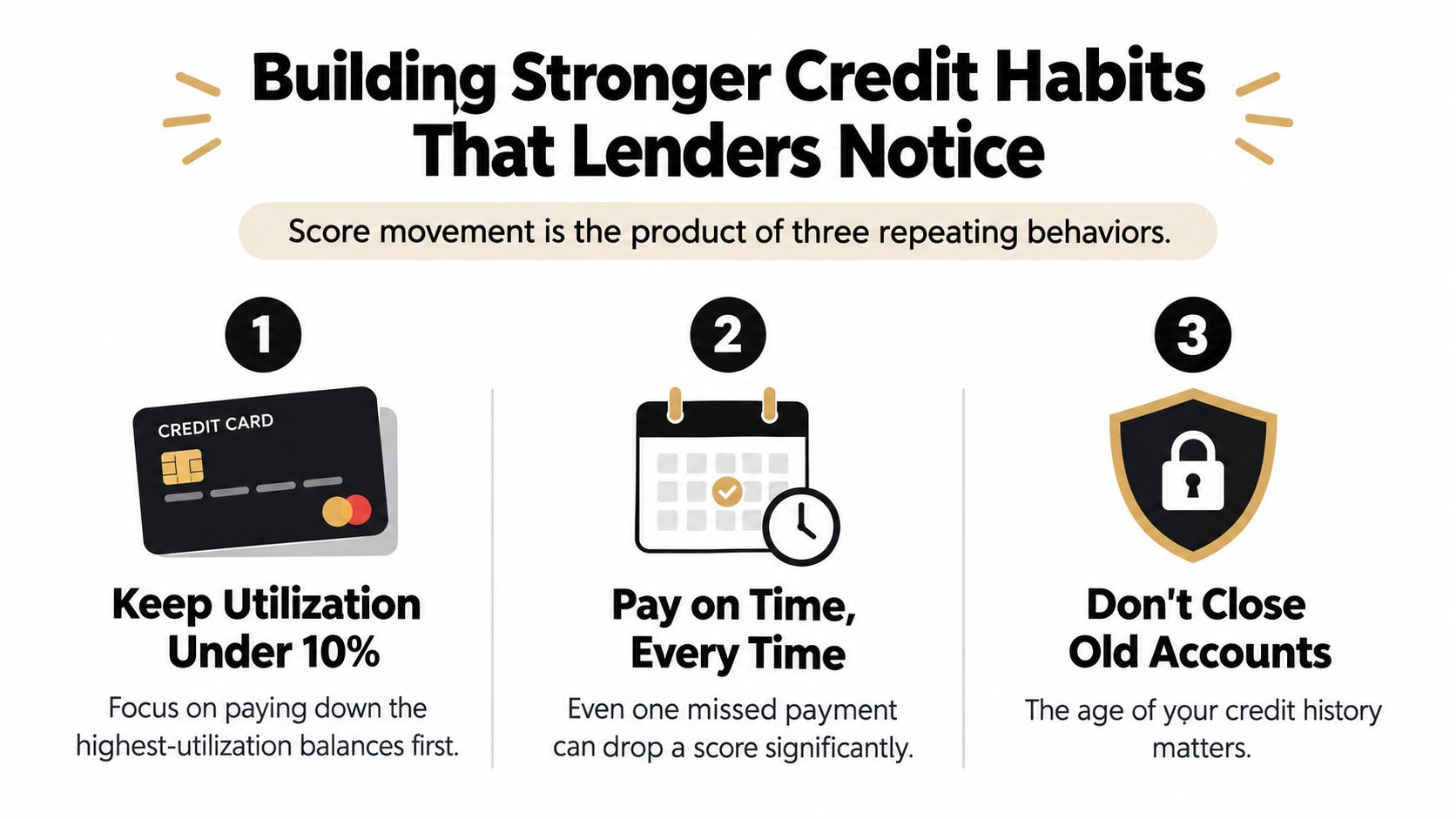
Start with revolving utilization. This is the portion of your available credit limits being used on credit cards and lines of credit. Prioritize the cards using the largest share of their limits, while keeping every account current. The plan notes for mortgage preparation use 10% as a target for revolving utilization, but your lender may evaluate the complete profile rather than one isolated percentage.
Don't close older cards just because you paid them down. Closing an account can reduce available credit and may change the way the scoring system evaluates your file. Keep accounts open only when you can manage them responsibly and without creating new fees or debt.
Protect payment history
Payment history deserves daily attention. Set reminders, use automatic payments when safe, and keep enough money in the payment account to avoid failed drafts. A minimum payment made on time is generally safer for your mortgage preparation than an ambitious payment plan that causes another missed due date.
Recent behavior can give an underwriter more confidence than a file that shows one improvement followed by another setback. Give yourself time to establish consistency before requesting preapproval. The exact readiness point depends on the lender, account history, income, and overall application.
Avoid opening new credit just to create activity. New cards, financing plans, and personal loans can add inquiries and debt, complicating the application. If you're unsure whether a proposed account will help, ask a mortgage professional before applying.
You can raise your credit score gradually by combining accurate reporting with sustainable habits. Results vary based on the credit file, creditor reporting, current balances, and payment behavior. No company can responsibly promise an immediate score increase.
Down Payment and Compensating Factor Strategies
A lender doesn't read your score in isolation. The underwriter evaluates how much money you're contributing, how much debt you carry, whether your income is dependable, and whether your recent financial behavior supports the proposed payment.
A larger down payment can reduce the lender's exposure because you're borrowing less relative to the property value. For FHA borrowers, the difference between a score below 580 and a score at or above 580 is already tied to a larger versus smaller minimum down payment. Conventional lenders may also view additional funds favorably, but the exact effect depends on the program and file.
Make the file easy to verify
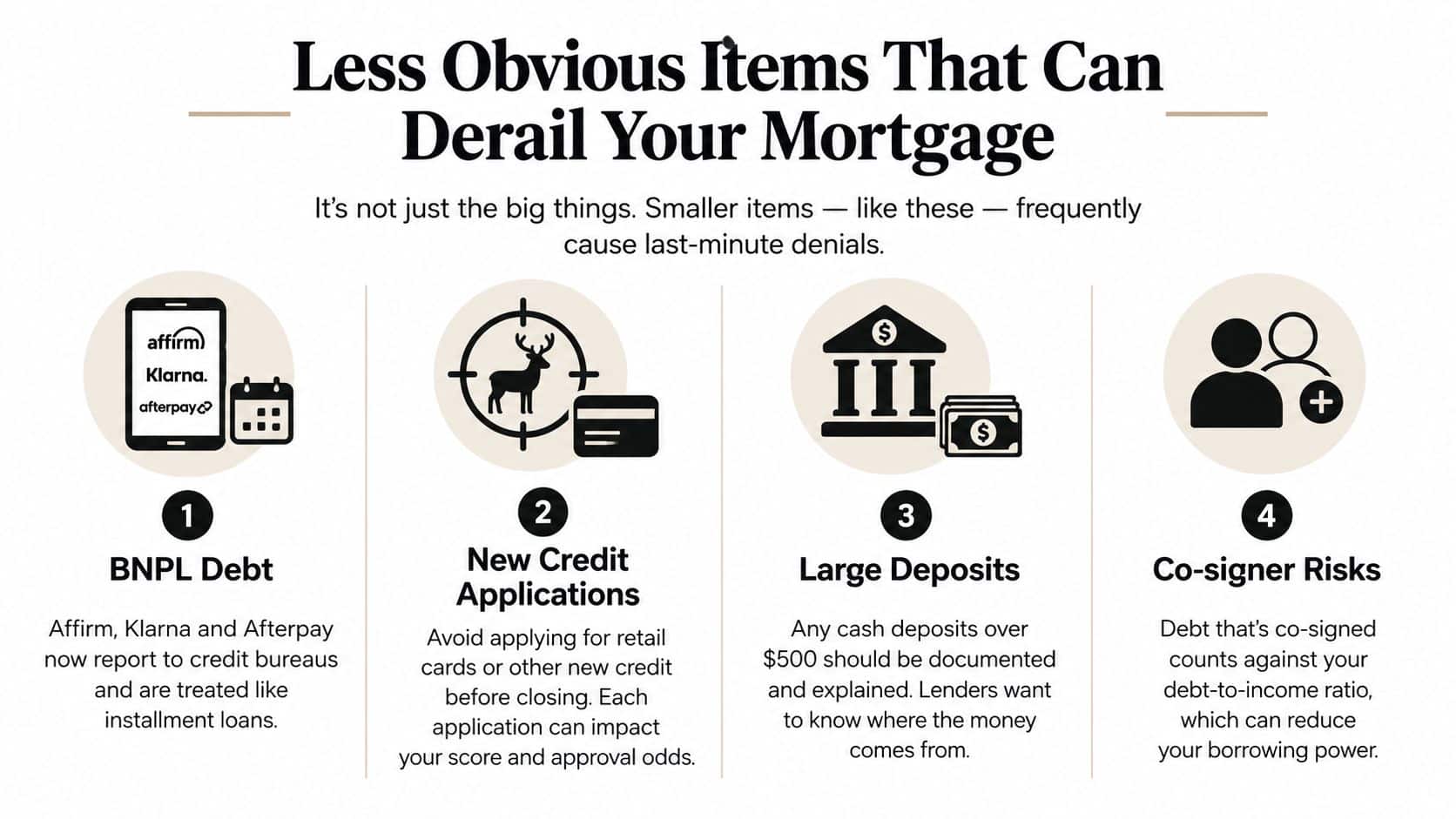
Document the source of your funds before applying. Keep statements showing savings activity, preserve gift documentation when applicable, and be ready to explain unusual deposits. Money that cannot be sourced can create conditions or delay underwriting, even if the account balance looks sufficient.
Other factors can support a borderline application:
- Debt management: A lower debt-to-income ratio gives the lender more room to assess the proposed housing payment.
- Employment stability: Consistent, documented income is easier to evaluate than unexplained job changes or irregular deposits.
- Rental history: Verifiable on-time rent can help demonstrate payment discipline, although the lender decides how it will use that information.
- Cash reserves: Accessible savings can show that you have a cushion after closing, subject to the loan program and lender rules.
- Co-borrower strength: A financially stronger co-borrower may improve the application, but both applicants' debts, income, and credit histories receive review.
| Compensating Factor | Typical Underwriter View | Minimum Threshold |
|---|---|---|
| Larger documented down payment | Reduces the amount financed and may offset some risk | Program and lender specific |
| Lower debt-to-income ratio | Shows more income remains after recurring debts | Lender and program specific |
| Stable documented income | Supports the ability to make payments | Lender and program specific |
| Verifiable rental history | May demonstrate consistent housing payments | Lender and documentation specific |
| Liquid reserves | Provides funds for unexpected expenses | Lender and program specific |
| Strong co-borrower | Adds income or credit strength, with full review of both files | Eligibility and lender specific |
Don't borrow the down payment without understanding how the new debt will affect your application. Don't move money between accounts without retaining records. Mortgage underwriting rewards clarity.
If you're working with a professional team, ask how they improve credit for Superior Credit Repair clients and how that work fits alongside lender requirements. Credit restoration can address report problems, but it can't replace income documentation, savings, or responsible financial behavior.
Less Obvious Items That Can Derail Your Mortgage
Many applicants focus on the score and overlook the accounts underneath it. That's a mistake. A score can look acceptable while recent obligations, reporting errors, or unexplained payment patterns create underwriting concerns.
Buy-now-pay-later accounts deserve special attention. Affirm, Klarna, Afterpay, and similar products may appear in the broader credit file or be identified during underwriting. A lender may treat the obligation as debt when calculating affordability, even if each installment is current. Review every account, including fintech products that you don't think of as traditional loans.
Review the small details
Medical collections, charge-offs, payday-loan history, settlements, and student-loan status can all prompt questions. Don't assume a small balance is harmless, and don't pay an account blindly without understanding how the payment will be documented and reported. Ask the lender how the specific loan program treats each item.
An account in active dispute can also complicate underwriting. Resolve the reporting issue and provide the lender with clear documentation before submitting the final application. Student-loan deferments and forbearances require careful documentation because the lender may still need to calculate a payment.
Avoid new retail cards, financing plans, and unnecessary credit checks while preparing to close. Keep bank activity orderly, and explain deposits that don't match normal income. A single recent bounced payment may lead to additional questions about available funds and payment stability.
For housing guidance beyond mortgage approval, Practical housing help 2026 may help renters and buyers consider affordability, housing options, and support resources.
Consumers dealing with BNPL reporting can review Superior Credit Repair on BNPL apps for education about these obligations. The goal isn't to hide debt. It's to make sure the lender sees a complete, accurate, and explainable financial picture.
Your 90-Day Mortgage Readiness Plan and Next Steps
A focused 90-day mortgage readiness plan can turn an anxious application into an organized project. It won't guarantee approval, but it can help you identify problems before a lender does.
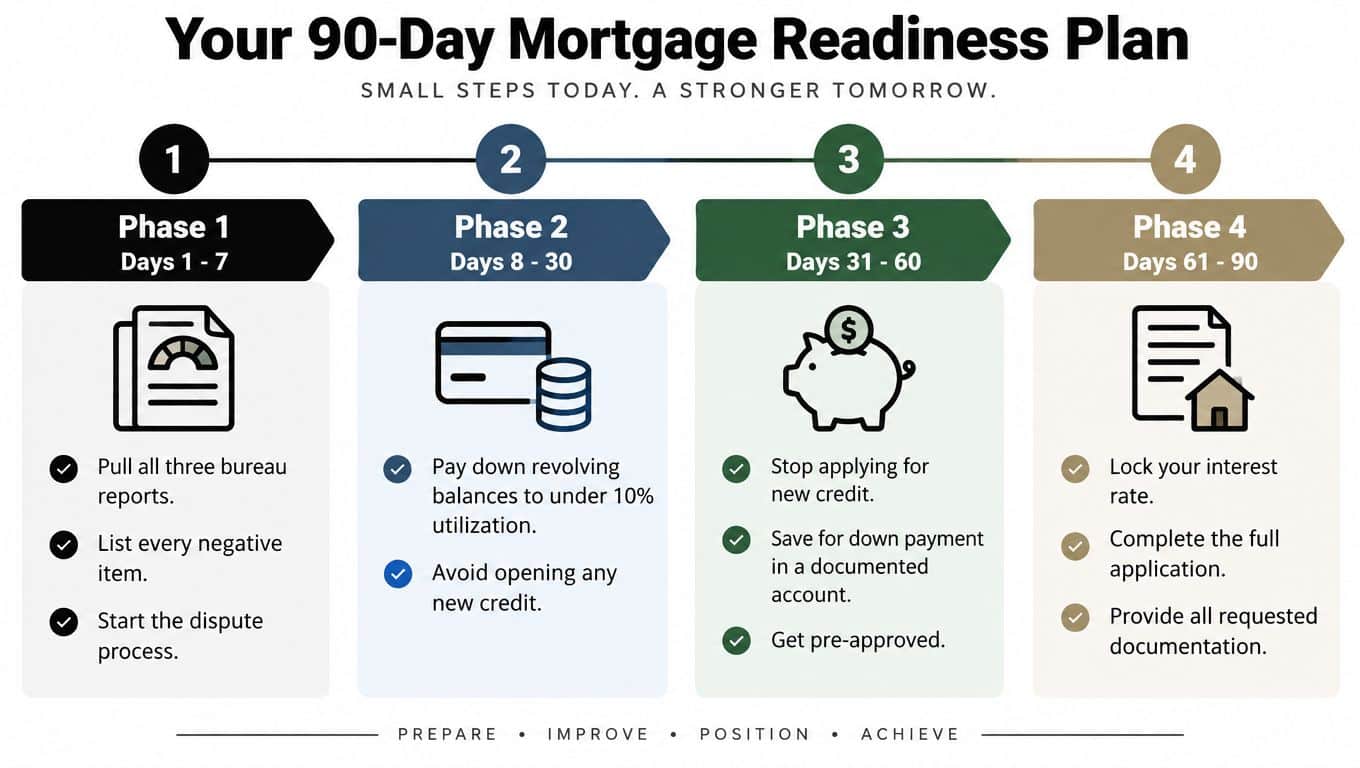
Days 1 through 7: Pull all three credit reports. List collections, late payments, charge-offs, high balances, unfamiliar accounts, and possible errors. Start documented disputes for inaccurate information, then set every current bill to be paid on time.
Days 8 through 30: Reduce revolving balances, with 10% utilization as a useful planning target when feasible. Don't open new accounts. Gather account statements and keep records for every payment, settlement, or correction.
Days 31 through 60: Organize income documents, bank statements, down payment records, and explanations for unusual deposits. Compare lenders carefully and ask about overlays for FHA, VA, USDA, or conventional loans before allowing a hard inquiry.
Days 61 through 90: Review updated reports, address remaining collection questions under the applicable program rules, and request preapproval only when your documentation is ready. Don't change jobs, finance a vehicle, open store credit, or move funds without discussing the effect with your lender.
Frequently asked questions
Can I buy a house with a 580 credit score?
You may qualify for an FHA loan with the program's 3.5% down payment minimum at a score of 580 or higher, but lender requirements, income, debt, property, and payment history still matter. Approval isn't automatic.
Can I get an FHA loan below 580?
Borrowers from 500 to 579 may still be eligible for FHA financing but generally need at least 10% down. Some lenders impose higher minimums than the FHA baseline.
Should I repair my credit before applying for a mortgage?
Yes, if your report contains inaccurate information, high revolving balances, recent late payments, or unclear debts. Correcting errors and building stable habits can improve lender readiness, but results vary and no credit repair company can guarantee approval or deletion.
Do collections and BNPL accounts matter if my score is acceptable?
They can. Underwriters may review the complete file, including collections, charge-offs, payment patterns, and BNPL obligations. Ask the lender how each account will affect debt calculations and underwriting.
Is conventional financing possible with bad credit?
It may be possible for some borrowers, but conventional lending is typically less flexible than FHA. Many lenders use an internal score floor around 620, along with additional requirements for income, debt, assets, and credit history.
Superior Credit Repair can review your credit report, help identify inaccurate or questionable items, and explain a step-by-step plan for improving your credit profile. You can request a free credit analysis or consultation to better understand your options.
Superior Credit Repair offers documentation-based credit report reviews, legal dispute support, and mortgage-readiness education for consumers preparing for FHA, VA, USDA, or conventional financing. Visit Superior Credit Repair to discuss inaccurate items, collections, late payments, utilization, or other issues affecting your homebuying preparation.
If this information helped you better understand your credit report or your next steps, we would appreciate your honest feedback. You are welcome to share your experience with Superior Credit Repair on our Google Business Profile. Share your feedback on Google.