

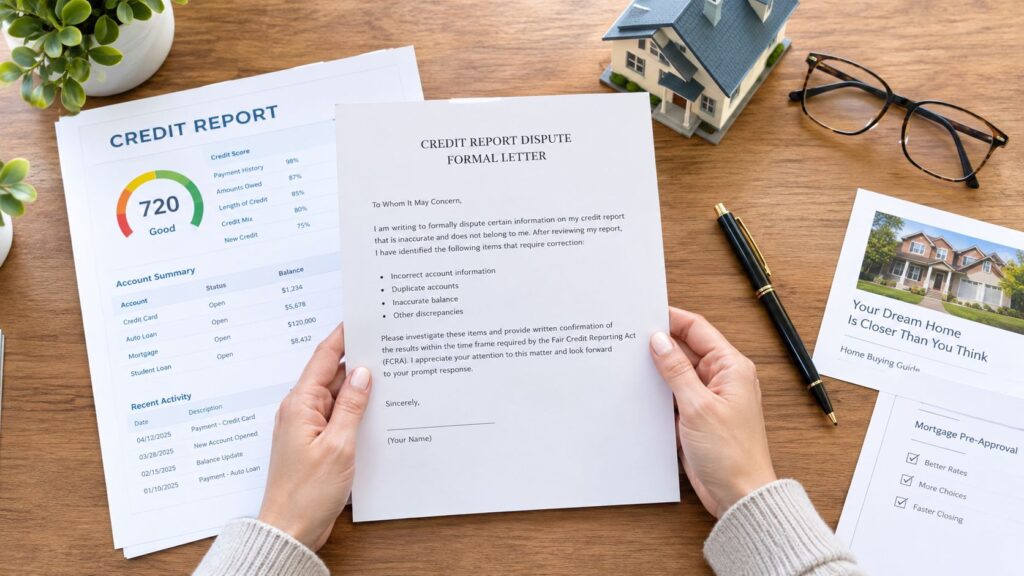
The most popular advice about a 609 dispute letter is also the advice that causes many first-time homebuyers to lose valuable time. A template that demands deletion of every negative account won't erase accurate reporting, and citing Section 609 doesn't turn a verified late payment or collection into a removable error. For mortgage preparation, the useful question isn't, “How can I make the bureau delete this?” It's, “What specific information is wrong, incomplete, outdated, duplicated, or impossible to verify, and what evidence proves it?”
A practical credit repair process separates those questions. It reviews all three credit reports, identifies account-level discrepancies, sends a focused dispute through the proper channel, tracks the investigation, and continues building stable credit habits. Results vary with the credit file, documentation, creditor response, account history, and current credit behavior, so no ethical company can promise a deletion, score increase, or mortgage approval.
Table of Contents
- The Legal Reality Behind Section 609 Requests
- Preparing Your Evidence Before Drafting a Letter
- Drafting a Compliant and Effective Dispute Letter
- Navigating Bureau and Furnisher Investigation Timelines
- Handling Complex Accounts and Mortgage Underwriting Realities
- Building Long-Term Credit Stability for Homeownership
The Legal Reality Behind Section 609 Requests
A “609 dispute letter” is commonly associated with Section 609 of the Fair Credit Reporting Act, codified at 15 U.S.C. § 1681g. The provision gives consumers access to information in their file, including information held by a consumer reporting agency, the sources of that information, and certain details about parties that obtained the consumer's report. It doesn't create an automatic right to delete accurate negative information, and it excludes credit scores and other risk predictors from the file disclosure requirement.
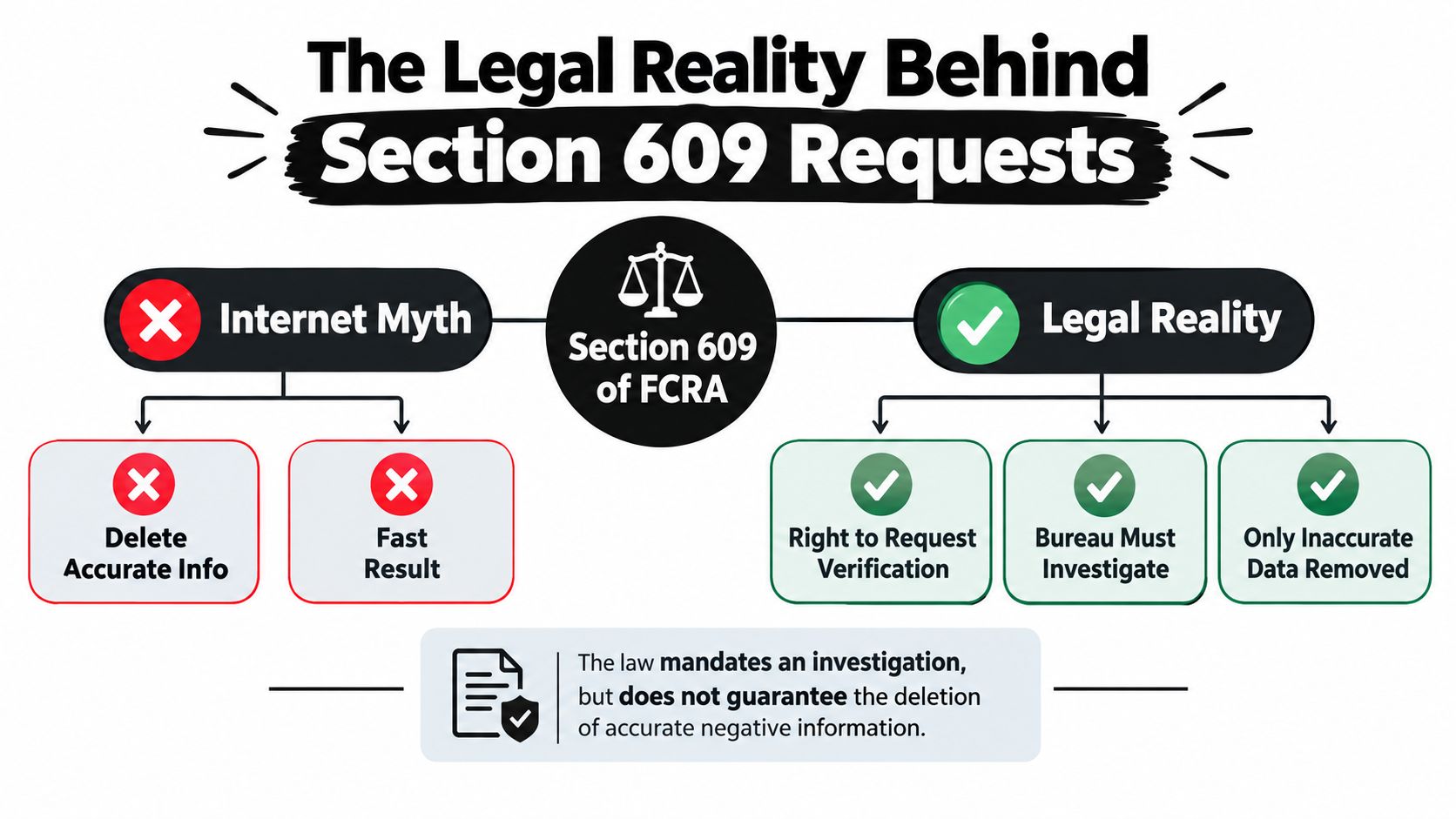
The legal distinction matters. A file-access request asks what information the bureau has and where it came from. An accuracy dispute challenges a specific factual problem and invokes the investigation process associated with the FCRA's dispute provisions. A request for file information can help you identify a furnisher or understand an account's reporting history, but it isn't a deletion loophole.
Why the magic-letter theory fails
A generic demand that says, “Delete this account because you can't produce an original signed contract,” usually doesn't address whether the account is being reported accurately. The absence of a document that matches a template seller's theory doesn't, by itself, establish that the balance, dates, ownership, payment history, or account status is wrong.
Mortgage applicants should be especially cautious. A bureau or furnisher needs enough information to conduct a reasonable, account-specific investigation. A vague challenge can be treated as frivolous or irrelevant, while an accurate negative item can remain on the report during the legally permitted reporting period.
Practical rule: Use Section 609 to understand the information in your file. Use a precise FCRA accuracy dispute when you can identify a factual reporting problem.
A useful letter might say that an account is not yours, that a payment was recorded late despite documented timely payment, that the balance doesn't match the account statement, or that the same collection appears more than once. It should request a specific correction, deletion, or permanent block only where the evidence supports that outcome. Consumers who want broader education can review how credit repair laws protect you before sending correspondence.
The compliance lesson for homebuyers
Section 609 was enacted within the federal consumer-reporting framework in 1970. Its purpose is connected to access, accuracy, fairness, and privacy, not guaranteed removal of information that happens to hurt a credit score. If you need help organizing administrative research or document workflows, a resource such as Hire Virtual Legal Assistants in California may be useful for general support, but legal advice about an individual FCRA matter should come from a qualified attorney.
The best mortgage-readiness strategy is therefore straightforward: request the file information you need, isolate the actual error, document it, and dispute it through the appropriate process.
Preparing Your Evidence Before Drafting a Letter
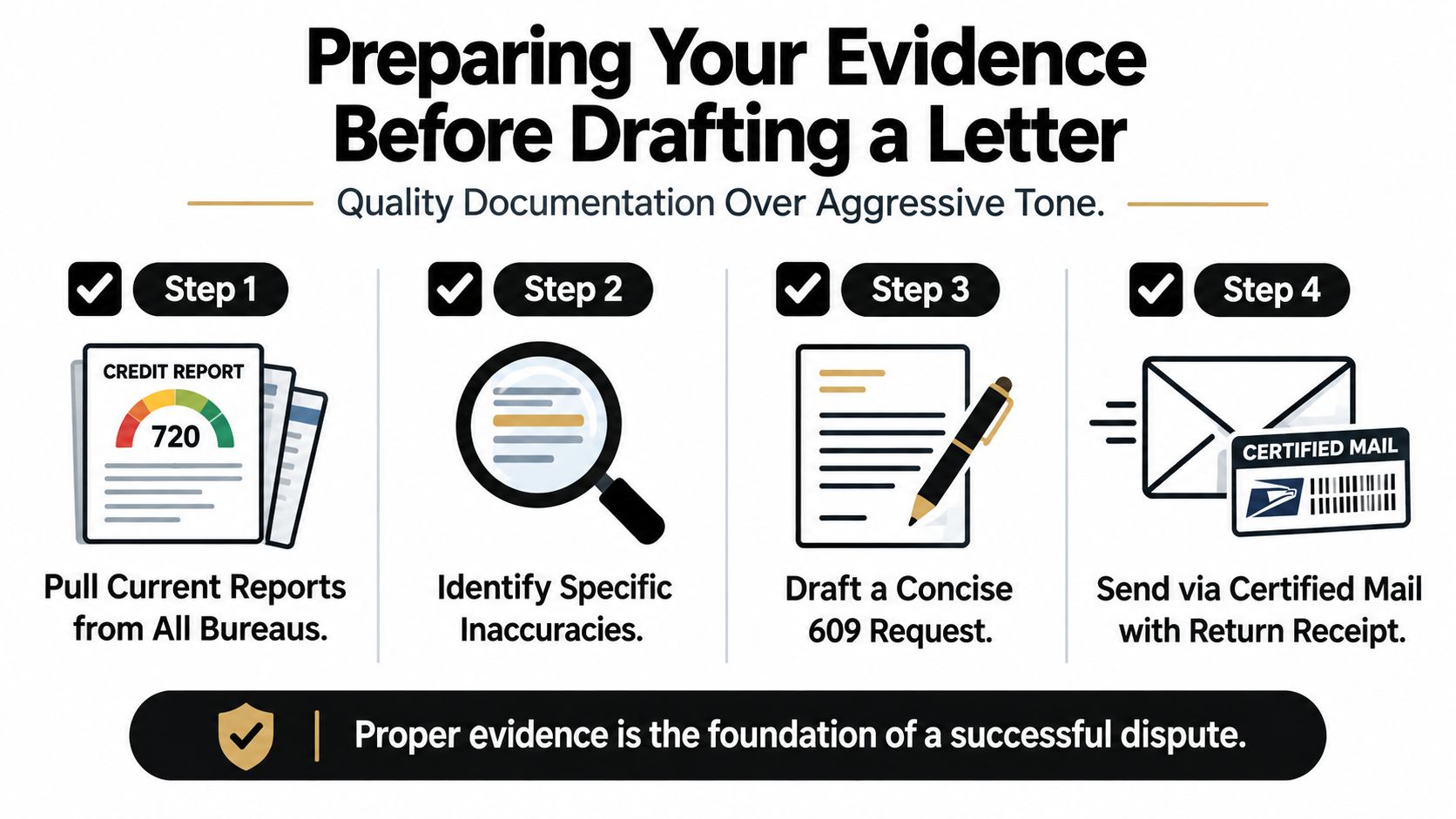
A strong credit dispute begins before anyone writes the first sentence. Pull current reports from Equifax, Experian, and TransUnion, then compare the same tradeline across each report. An account can appear correctly on one report and incorrectly on another, or the same underlying problem can appear with different balances, dates, statuses, or furnisher names.
Build an error matrix
Create a simple table or spreadsheet with one row for each disputed tradeline. Include the account name, partial account identifier, bureau reporting it, field in question, factual explanation, requested correction, and supporting document.
| Field | What to record |
|---|---|
| Account identity | Furnisher name and partial account number |
| Reporting problem | Balance, date, status, ownership, payment history, or duplication |
| Evidence | Statement, payment record, identity document, court record, or correspondence |
| Requested action | Correct, delete, update, or permanently block the inaccurate information |
| Delivery record | Date sent, delivery confirmation, and response date |
This structure prevents a common mistake, disputing an entire account without explaining what is wrong. A compliant challenge should identify each tradeline precisely, explain the factual basis, and attach relevant evidence, as described in the Federal Trade Commission's Fair Credit Reporting Act materials.
Match every allegation to proof
Look for errors that can be demonstrated rather than merely argued. Common examples include:
- Wrong balance: Compare the reported balance with account statements, settlement documents, or payment confirmations.
- Duplicate collection: Show that two entries refer to the same debt, using matching account details, collector information, or balance history.
- Misattributed account: Provide identity documents and records showing that the account doesn't belong to you.
- Incorrect payment history: Match the reported late payment against bank records, canceled payments, or creditor correspondence.
- Outdated or incomplete data: Compare reporting dates and account status with available records.
- Incorrect ownership or status: Use transfer notices, court records, settlement letters, or correspondence from the original creditor and collector.
Don't send every document you own without an explanation. Index the attachments, label the relevant pages, and connect each exhibit to one allegation. A mortgage applicant benefits from a clean evidence trail because a lender may later ask why a report changed or why an account remains under dispute.
Your documentation should also protect personal information. Include only what the recipient needs to identify you and investigate the account. Keep copies of the letter, report pages, attachments, delivery receipt, and every response in one file.
The strongest dispute is rarely the most aggressive one. It's the one a reviewer can understand, verify, and resolve without guessing what the consumer means.
If an item is accurate but unpleasant, don't manufacture a dispute. Focus instead on payment consistency, balances, utilization, and an explanation for the lender when context matters more than accuracy.
Drafting a Compliant and Effective Dispute Letter
A useful 609 dispute letter should read like a documented accuracy challenge, not a mass-produced demand. The technical benchmark isn't a promised deletion percentage. Federal agencies don't establish a universal success rate. The stronger measure is whether the submission enables a reasonable, account-specific investigation, as explained in the Consumer Financial Protection Bureau's guidance on furnisher results.
Start with your identifying information, the recipient's address, the date, and a clear subject line. State whether you're requesting file information under Section 609, disputing inaccurate or incomplete information, or doing both. Don't blur those purposes.
Use one theory per item
For each account, identify:
- The account: Name the furnisher and include the account identifier shown on the report.
- The exact field: Identify the balance, payment status, date, ownership, account type, or other entry you believe is wrong.
- The factual basis: Explain what the report says and what your records show.
- The requested correction: Ask the bureau or furnisher to correct, delete, or permanently block information that is inaccurate, incomplete, or unverifiable.
- The evidence: Reference each attachment by exhibit label and page.
A concise chronology can clarify the issue. For example, explain when a payment was made, when the account was transferred, or when you notified the creditor of an identity-related problem. Avoid emotional accusations, legal conclusions you can't support, and broad statements such as “everything on my report is invalid.”
The credit report dispute letter guide can help with organization, but no template can replace account-specific facts. A form is only a starting structure.
Avoid tactics that weaken credibility
Unsupported identity-theft claims, repeated vague challenges, and disputes of information known to be accurate can undermine the investigation. So can demanding an “original wet-ink contract” when the actual reporting issue concerns a wrong balance or payment date. The bureau needs a clear reason to investigate the reported information, not a slogan copied from a social media post.
Send the dispute to the bureau reporting the error. When appropriate, send a separate direct dispute to the furnisher at the address designated for credit-reporting disputes or the address shown on the report. Use a delivery method that creates a record, retain the confirmation, and note the date the recipient received the package.
Your requested outcome should be proportional to the evidence. If the balance is wrong, request a balance correction. If the account isn't yours and cannot be verified as belonging to you, explain why deletion or blocking is appropriate. A precise request demonstrates that your purpose is accurate reporting, not removal of a valid obligation.
Navigating Bureau and Furnisher Investigation Timelines
Sending a letter doesn't resolve an account immediately. It starts an investigation process involving the credit-reporting company, and sometimes the company that furnished the information. Planning around those timelines is important for anyone preparing for an FHA, VA, USDA, or conventional mortgage.
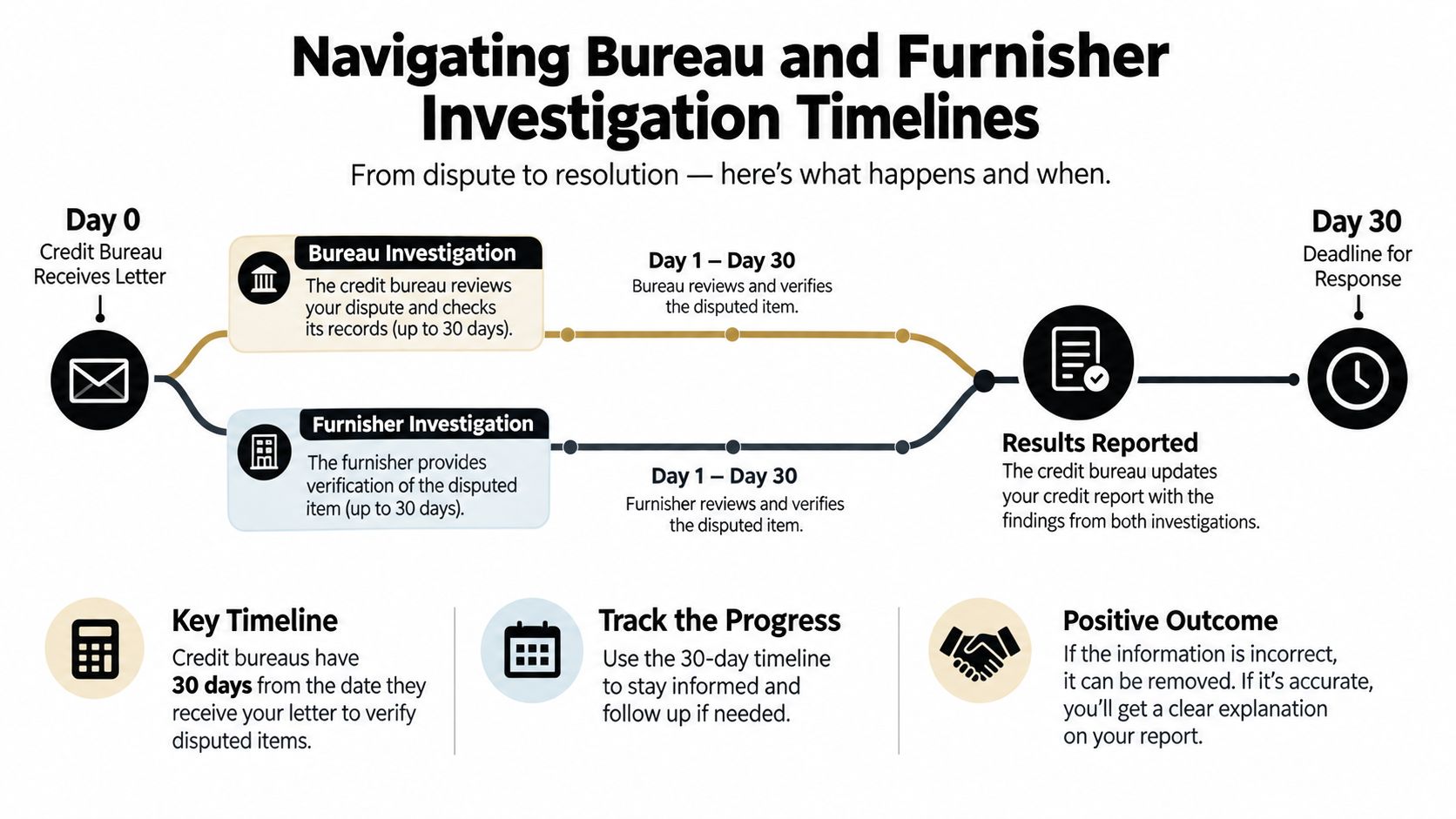
A credit-reporting company generally must investigate within 30 days of receiving a dispute. The period can extend to 45 days when the consumer submits the dispute after obtaining a free annual credit report or provides additional relevant information during the initial 30-day period, according to Consumer Financial Protection Bureau guidance on credit-report errors.
After completing the investigation, the bureau generally has five business days to notify the consumer of the result. The notice should explain the outcome and ordinarily include an updated credit report. Track these dates from confirmed delivery rather than from the day you placed the envelope in the mail.
Understand the two-track process
The bureau reviews the dispute and typically contacts the furnisher through its reporting system. The furnisher, such as a lender, creditor, or collection agency, must review the relevant information and report findings. If the furnisher determines that the data is inaccurate, incomplete, or unverifiable, it must correct, delete, or permanently block the information and provide corrected information to the reporting companies.
A direct furnisher dispute can be useful when the original company has records that the bureau doesn't appear to have considered. Send it to the address designated for credit-reporting disputes or the address listed on the report. Preserve the same evidence package, but tailor the explanation to the company's records.
Mortgage timing matters: Don't wait until underwriting to discover that a material correction is still pending. A lender may need to review the original report, the dispute result, updated balances, and the stability of your credit afterward.
When results arrive, compare the updated reports from all three bureaus. Confirm that the balance, status, dates, ownership, and payment history were corrected consistently. If a bureau says the item was verified but the factual error remains, request the method or explanation of verification where appropriate and consider escalation through a regulator or legal channel.
For address and delivery details, use Superior Credit Repair's TransUnion guide as a practical reference. Mailing information can change, so confirm the current instructions before sending a time-sensitive package.
Handling Complex Accounts and Mortgage Underwriting Realities
A dispute outcome is only one part of mortgage readiness. Underwriters may review the broader financial picture, including payment behavior, credit card balances, collections, debt-to-income concerns, account stability, and documentation outside the credit report. Correcting a real error can help the file reflect reality, but it can't make an accurate obligation disappear.
Medical debt illustrates why current, product-specific review matters. The CFPB's 2025 medical-debt rule was vacated by a federal district court in July 2025, so consumers shouldn't assume that all medical debt is categorically barred from credit reporting. Treatment depends on applicable rules and the information reported, which means the correct approach is to verify the furnisher, balance, dates, ownership, and reporting status before disputing a medical collection.
BNPL accounts require a separate review. CFPB research found that providers typically don't report ordinary repayment histories to the three major bureaus, while collections and selected provider practices can produce different reporting outcomes. Even when a BNPL account isn't visible as a conventional tradeline, a lender may still consider obligations through bank statements, debt-to-income analysis, or underwriting documentation.
Match the dispute to the account type
For a medical collection, check whether insurance payments, charity-care decisions, settlement records, or creditor adjustments changed the amount reported. For a BNPL account, identify the provider, payment history, collection status, and any obligation disclosed during the mortgage application. Don't dispute an item just because it's unfamiliar or inconvenient.
Accurate adverse information generally may remain on a credit report for up to seven years, while bankruptcy may generally be reported for up to ten years, according to Federal Trade Commission training materials on credit reporting law. Those timelines don't mean every account should be ignored. They mean the dispute should focus on accuracy, completeness, verification, and lawful reporting periods.
Mortgage borrowers also need to distinguish credit correction from property evaluation. A credit dispute addresses consumer-report information, while a valuation addresses the property and lender risk. Readers comparing those roles may find lender vs surveyor valuation explained helpful for understanding why a corrected credit file doesn't replace the lender's other underwriting reviews.
Keep the lender informed appropriately
A material dispute can affect underwriting questions, especially if the lender sees an account marked as disputed, a balance change, or a recently updated collection. Ask your loan professional how the lender wants documentation presented. Don't close accounts, take on new financing, or move money around solely to chase a score without understanding the underwriting consequences.
For a plain-English review of derogatory marks and credit reporting timelines, focus on the account's actual facts rather than an internet promise. The right goal is a report that accurately reflects your financial history and a mortgage file that explains unresolved issues clearly.
Building Long-Term Credit Stability for Homeownership
Credit restoration doesn't end when a bureau sends an investigation result. A buyer can correct a duplicated collection and still weaken mortgage readiness by missing new payments, carrying high revolving balances, opening unnecessary accounts, or allowing financial records to become disorganized.
Start with payment control. Set reminders or automatic minimum payments where appropriate, then review statements so an autopay failure doesn't go unnoticed. Payment history is a central part of how lenders evaluate reliability, and a clean recent pattern can provide useful context after an earlier hardship, divorce, or period of unemployment.
Manage the habits lenders can see
Credit card utilization is the relationship between revolving balances and available limits. High utilization can make a profile look strained even when every payment is on time. Pay attention to statement balances, avoid charging more than your budget can support, and don't transfer balances or close accounts without considering fees, limits, account age, and the effect on the overall profile.
For a thin file, a secured or starter card may help establish payment history when used carefully. The account should fit the budget, carry only manageable activity, and receive on-time payments. A new account isn't automatically beneficial, and no product can guarantee a particular score outcome.
A practical rebuilding routine includes:
- Review reports periodically: Look for new errors, unexpected collections, balance changes, and accounts you don't recognize.
- Keep records organized: Save statements, payment confirmations, settlement letters, and correspondence in a secure folder.
- Limit unnecessary applications: Ask whether new credit supports your financial plan before submitting an application.
- Protect cash flow: Maintain room in the monthly budget for housing costs, insurance, taxes, repairs, and existing debt.
- Plan before the mortgage application: Give yourself time to correct factual problems and document explanations.
Renters preparing to buy may also need a stable housing plan while they work on credit. Practical bad credit apartment hunting tips can help address rental screening concerns while a longer mortgage-readiness strategy develops.
If the process feels difficult to manage, Superior Credit Repair can provide structured review and dispute support focused on inaccurate, outdated, unverifiable, or misleading information, along with education about utilization and rebuilding habits. The work should remain documentation-based, and outcomes still depend on the individual file and creditor responses. A disciplined plan can help you rebuild your credit profile before pursuing home, auto, business, or personal financing.
Frequently asked questions
Can a 609 dispute letter remove accurate negative information?
No. Section 609 supports access to information in a consumer file. Accurate negative information generally isn't removable merely because it lowers a score or complicates mortgage approval.
Should I dispute with the bureau or the furnisher?
It depends on the problem. Dispute with each bureau showing the error, and consider a direct dispute with the creditor or collector that supplied the information when its records are central to the correction.
How long should I wait before following up?
A bureau generally has 30 days to investigate, with the period potentially extending to 45 days in specified circumstances. After completing the investigation, it generally has five business days to notify you. Keep delivery records and follow up based on confirmed receipt.
Can medical debt or BNPL affect mortgage approval?
They can affect the review in different ways. Medical reporting depends on applicable rules and the information reported, while BNPL obligations may appear through collections, provider practices, bank statements, debt-to-income analysis, or underwriting documentation even when ordinary repayment history isn't reported as a standard tradeline.
Does credit repair guarantee mortgage approval?
No. Credit repair can help identify and challenge report inaccuracies and support stronger habits, but approval depends on the lender's standards, income, assets, debt obligations, credit history, documentation, property, and other underwriting factors.
Superior Credit Repair can review your credit report, help identify inaccurate or questionable items, and explain a step-by-step plan for improving your credit profile before a mortgage application. Request a free credit analysis or consultation by visiting Superior Credit Repair to better understand your options, with no guarantee of deletion, score improvement, or loan approval.
If this information helped you better understand your credit report or your next steps, we would appreciate your honest feedback. You are welcome to share your experience with Superior Credit Repair on our Google Business Profile. Share your feedback on Google