


A rapid rescore is a lender-initiated process that submits verified account updates to a credit bureau so a refreshed credit report and score appear in about 2 to 5 days instead of the 30 to 60 days a creditor might otherwise take to report the same change on its own.
So why do most borrowers hear the phrase for the first time inside a live mortgage file, days before a rate lock expires, when the only changes a rapid rescore can speed up are ones that already happened weeks earlier?
That gap is worth closing before you ever call a lender. A rapid rescore is a timing tool. It moves a documented fact onto your credit file ahead of the creditor's normal reporting schedule, and it does nothing else. It doesn't create history, and it doesn't make an accurate late payment vanish. Understanding that single distinction reshapes how you plan the weeks before an application, which paperwork you keep, and what you ask your loan officer.
Table of Contents
- What a Rapid Rescore Is and Why Lenders Use It
- Rapid Rescore Timing Compared With Normal Reporting
- How the Rapid Rescore Process Works Step by Step
- Which Accounts Usually Respond to a Rapid Rescore
- Limits, Misconceptions and Results That Vary
- Mortgage Programs and Where a Rapid Rescore Fits
- Rapid Rescore Questions Answered
- Decide Whether to Ask Your Lender for a Rapid Rescore
What a Rapid Rescore Is and Why Lenders Use It
Chase's credit education team describes a rapid rescore as an expedited mortgage-lending process that updates verified information on a borrower's credit report and triggers a new credit-score calculation (Chase). The mortgage lender gathers supporting documents, such as a creditor letter, an updated statement or proof of payment, and sends them to a credit-reporting company. That company then requests an accelerated update from Experian, Equifax or TransUnion.
Picture the loan officer holding that paperwork while you wait.

Think of the difference as a receipt delivered by hand. A normal update waits for the mail: you pay a card down, the creditor batches its records at the end of a billing cycle, and the bureau posts whatever arrives in that batch. A rapid rescore is someone carrying the same receipt straight to the counter and asking for it to be processed now. The receipt doesn't change. The queue does.
Three terms worth separating
- Credit report: the file itself, meaning every account, balance, credit limit, status and payment history line the bureaus hold under your name.
- Credit score: a number calculated from that file at a moment in time. Change the file, and the next calculation changes with it.
- Reporting cycle: the schedule a creditor follows when it sends updates to the bureaus. You don't set it, and each creditor runs its own.
Lenders reach for the tool when a file sits close to a line that changes the outcome: a debt-to-income limit, a utilization threshold an underwriter watches, or a pricing tier that decides your rate. When a verified change would cross one of those lines, seeing it days sooner can affect the decision in front of them rather than the one after it. The lender starts the request, not the borrower, which is why the process lives inside underwriting conversations instead of as a standalone consumer service.
A rapid rescore does not create new credit history, erase accurate negative information or guarantee a higher score. It allows verified changes to appear sooner.
A rapid rescore updates verified facts faster. It does not change the facts.
You can tell whether this applies to you with two checks. Is there an active mortgage application, or an underwriting decision close enough that days matter? Has the change already happened and been recorded by the creditor? Two yeses mean it's worth raising with your loan officer. One no usually means the better move is to correct the underlying account first and apply later.
Rapid Rescore Timing Compared With Normal Reporting
| Update path | Typical timing | Who starts it | Documentation usually needed |
|---|---|---|---|
| Normal creditor reporting | About 30 to 60 days | The creditor, on its own reporting schedule | None from the borrower |
| Rapid rescore | About 2 to 5 days after complete documents are submitted | The mortgage lender, through a credit-reporting vendor | Creditor letter, updated statement or proof of payment |
| Consumer-requested rapid update | Not generally available | Only the lender can start it | Not applicable |
The gap is the entire product. Underwriting reads the report the lender pulls on the day it reviews your file, and every threshold in a mortgage decision is measured against that snapshot. A balance reduction that posts on day 38 has no effect on a decision made on day 6.
What actually sets the clock
Timing depends on the account involved, the documentation, the bureaus' response cycles, the furnisher's own update schedule, and your current credit behavior. Those inputs explain why two borrowers with the same card balance can see different turnaround times on the same day.
Say a card balance is paid on the 3rd. The issuer may not report that new balance until the next statement closes, which could be three weeks out, and the bureau posts it after that. Your lender doesn't have to wait for the cycle: with a current statement and proof of payment, the loan officer can ask for the update sooner. Statement dates differ by issuer, and the Superior Credit Repair reporting timeline explains how issuers report by statement date rather than by payment date.
Worth doing early: write down each card's statement date and the balance that will appear on it. That page tells your loan officer which update is worth requesting and when to request it.
Before any application, pull your statements and note those dates. The lender can then sequence requests around real reporting dates instead of guessing, and you avoid paying for an update that the normal cycle would have delivered anyway.
How the Rapid Rescore Process Works Step by Step
A rapid rescore is a lender-ordered mortgage process, not a consumer-initiated credit-repair service, and it doesn't replace a dispute (CNBC Select). The lender or broker works with a credit-reporting vendor, submits documentation showing a creditor has already corrected or updated an item, and requests a refreshed report and score.
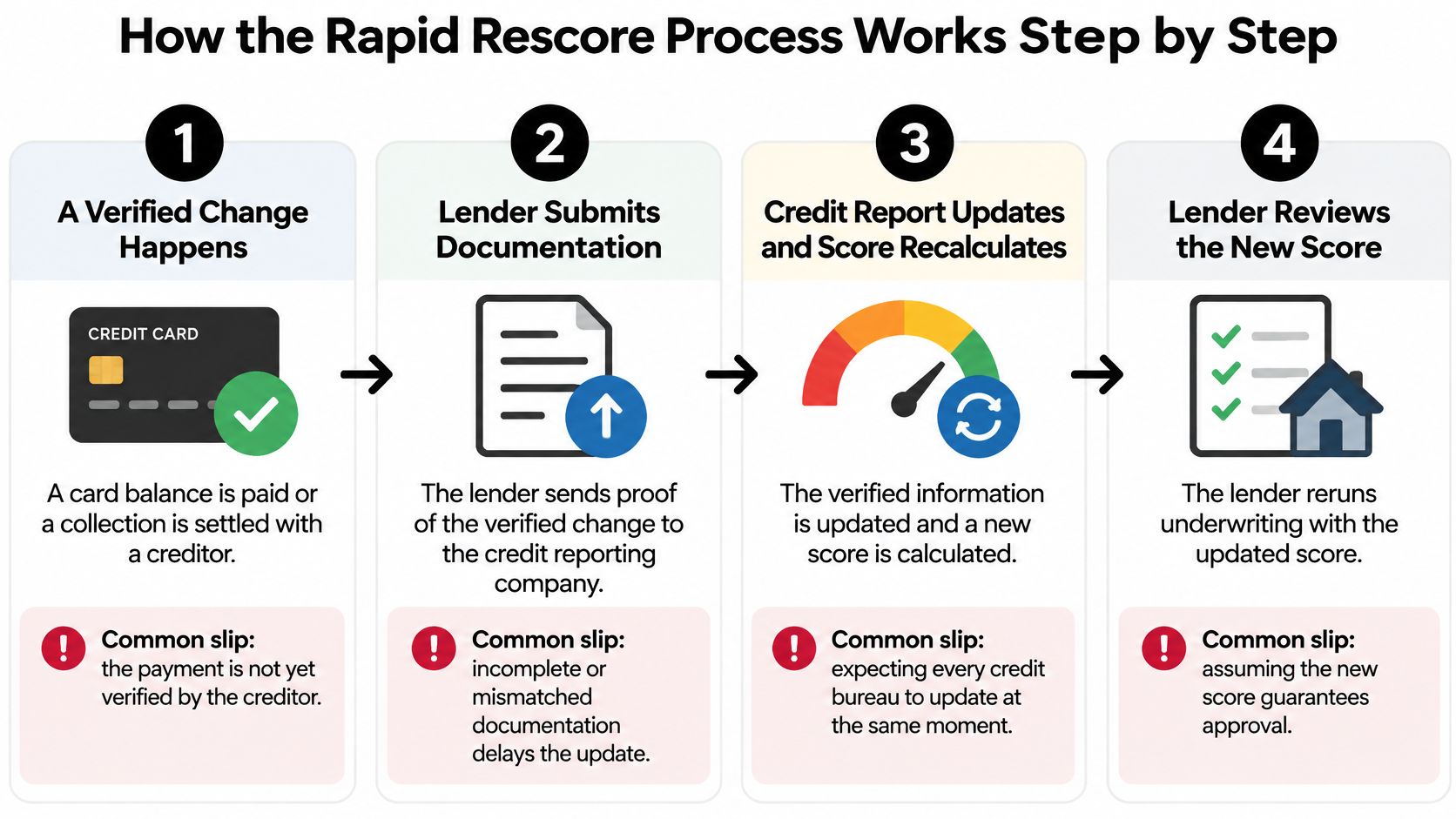
The sequence runs in a fixed order, and each step has one predictable slip.
- A verified change happens. A card balance is paid or a collection is settled. The slip: the payment hasn't posted, so the creditor's record still shows the old figure.
- The creditor records the change and issues a letter or updated statement. The slip: the letter confirms a payment but not the corrected balance the lender needs.
- You send the proof to the mortgage lender. The lender starts the request, not you. The slip: the statement you forward predates the payment.
- The lender submits the documentation to a credit-reporting vendor. The slip: a partial package, which sends the file back to the beginning.
- The vendor asks the bureau or bureaus holding the file for an accelerated update. The slip: assuming all three bureaus refresh at the same moment.
- The bureau refreshes the report and recalculates the score. The slip: expecting the update to remove an item that was accurate.
- The lender reviews the refreshed score in underwriting. The slip: treating a new number as an approval.
The clock starts only when the lender holds a complete package. An incomplete file doesn't run slow; it restarts. Keep every letter, statement and confirmation in one folder, each with its issue date, so you can hand the whole set over in a single email.
Which Accounts Usually Respond to a Rapid Rescore
| Account change | Usually relevant? | Why it matters | Documentation needed |
|---|---|---|---|
| Credit card balance reduced | Often | Changes reported utilization and may move a pricing or eligibility threshold | Current statement showing the new balance |
| Collection paid or settled | Sometimes | The updated status must be verified by the creditor before it can reflect | Creditor letter or payment confirmation |
| Late payment corrected with proof | Sometimes | Only applies when the original record was documented as wrong | Payment history from the creditor |
| Identity or account-status error corrected | Sometimes | Changes a reported detail the lender relies on | Corrected record or creditor confirmation |
| New credit account opened | Usually not a rescore target | Adds new activity rather than correcting existing data | Not applicable |
| Accurate negative history | Not applicable | A rapid rescore does not remove accurate information | Not applicable |
The arithmetic is what makes card balances the usual first target. A card with a $5,000 limit reporting a $3,000 balance shows 60% utilization. If a verified statement shows the same card at $1,000, the reported figure falls to 20%. Because utilization is calculated from reported balances, that single change can shift a score more than a paid collection ever will. The 30% utilization benchmark explained here is a useful reference point, though moving from 60% to 20% is what gets an underwriter's attention.
Prioritizing instead of guessing
A lender may run a score-impact simulator or an underwriting comparison to rank scenarios before submitting anything, then target the accounts where a verified balance reduction could cross a pricing or eligibility line, as myFICO community members describe in this rapid rescore discussion. A paid collection helps only when the creditor's update is documented. An identity error or a wrong account status needs proof of the correction. Accurate negative history stays put, no matter who asks.
Opening new accounts mid-application works against you. Each new account adds activity and an inquiry rather than correcting existing data, and it complicates the file an underwriter is already reviewing. Hold off until closing.
Bring a short packet to the lender: current statements for every revolving account, payment confirmations with posted dates, and any creditor letters showing a corrected figure. If you'd like a slower, habit-focused companion to all of this, 24hourEDU's credit score tips cover the months-long work of rebuilding. A full-file review for mortgage readiness also covers inaccurate personal information, collections, charge-offs, late payments, high utilization, repossessions, medical collections, student-loan reporting, bankruptcy or foreclosure history, and account comments that can affect underwriting.
Limits, Misconceptions and Results That Vary
Most borrowers meet the term in the wrong context. Someone tells them a rapid rescore will clean up the report before closing, and they picture negative items dropping off. Building a plan around that assumption burns weeks you may not have.
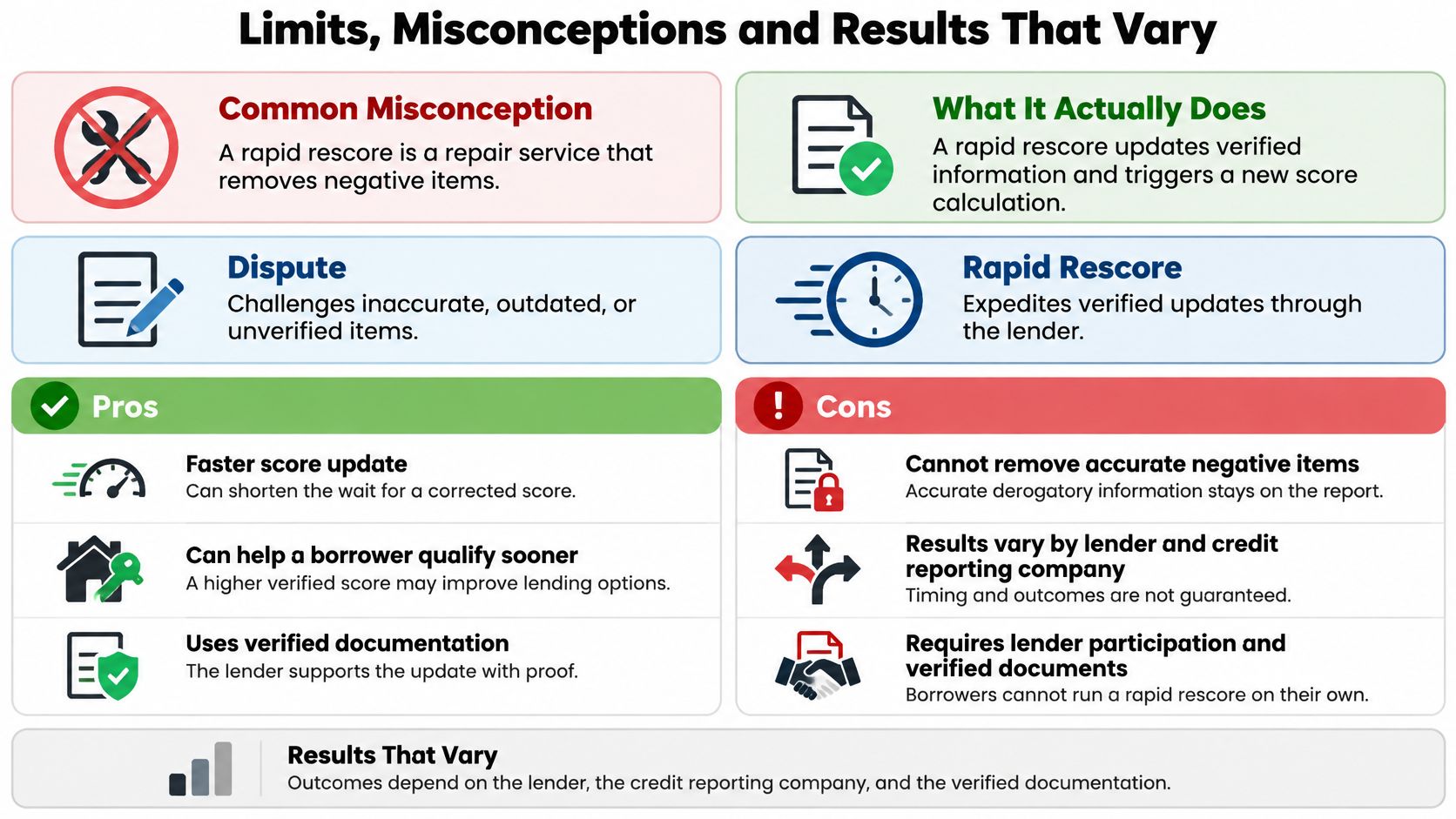
A dispute and a rescore solve different problems
A dispute is a legal challenge to information you believe is inaccurate, outdated, unverifiable or misleading. The bureau investigates and responds. A rapid rescore reflects an update the creditor already made. You can pursue both, but they aren't interchangeable, and a rescore cannot force a deletion.
It cannot do the following:
- Remove accurate negative history. Late payments, charge-offs and bankruptcies that were reported correctly stay on the file for their legal lifespan.
- Create new credit history. A thin file stays thin.
- Guarantee a higher score. The number recalculates; it doesn't obligingly rise.
- Guarantee mortgage approval. Credit is one input among income, assets, down payment and property condition.
- Fix a problem that was never documented. No letter, no update.
Results can be neutral, and occasionally worse. If the information your lender submits reveals a higher balance, a missed payment or another adverse change, the refreshed score can fall. The file is being updated, not improved on request. A small score change also doesn't always change your rate or eligibility, because pricing tiers and program cutoffs sit at fixed points. Landing two points higher inside the same band leaves your terms where they were.
Outcomes vary by lender, vendor, bureau, creditor response, account history and the quality of the documentation. No credit professional can promise a deletion, a score increase, an approval or a timeframe. Treat a rescore as one timing tool inside a broader file review rather than as the plan itself, and handle payoff decisions deliberately, since our Superior Credit Repair collection payoff guide explains how payment timing changes what gets reported.
Mortgage Programs and Where a Rapid Rescore Fits
Each mortgage program applies its own credit rules, and none of them approves a loan because a score moved. Still, the fit differs by loan type, and knowing which credit factor your program watches tells you whether a rescore is even worth discussing.
FHA loans often allow more flexible credit standards, but underwriters still review collections, late payments and utilization closely. When your file sits near a program limit, a documented balance reduction can matter.
VA loans involve a lender review of the full credit file under program rules. A verified correction can be relevant to the underwriter's decision, particularly when a stale balance overstates what you owe.
Conventional loans price by score bands, so a small verified change can be more visible here than anywhere else. Crossing into a better band is exactly the scenario a rescore is built for, and the score requirements for first-time homebuyers explain where those bands typically fall.
USDA loans weigh income and area eligibility alongside credit, so a rescore matters mainly when credit is the one factor holding the file back.
Ask early: confirm with your loan officer that your program accepts a rapid rescore update, and in what form the documentation needs to arrive.
First-time buyers face a separate timing issue. A collection or late payment reported close to the application can slow a file even when the loan program is otherwise a good fit. If your file involves a federal tax lien, resolving the lien's status usually comes before any score conversation, and applying for a certificate of subordination is a related step that lets a lender take priority over an existing lien. Credit readiness remains a long process, not a single request.
Rapid Rescore Questions Answered
What documentation do lenders usually want?
A creditor letter on letterhead stating the corrected figure, a dated statement showing the new balance, and a payment confirmation showing the posted date and amount. A screenshot of your account page usually isn't enough, because the lender has to submit evidence a bureau will accept from the furnisher.
Can a rapid rescore change my score for future loans?
The refreshed report reflects the verified update, so the corrected information stays on your file and can affect later applications. The change itself is only as durable as the underlying account activity. A balance that climbs back next month reports at the higher figure again.
What if my score drops after the update?
A lower score usually reflects newly reported information, such as a higher balance or a recently opened account. Ask the lender to review the scenario before the loan closes rather than assuming the file is now worse. Sometimes the drop is temporary and tied to a balance that will report lower next cycle.
Does a rapid rescore help with auto loan or rental applications?
The process is designed for mortgage underwriting, so it usually isn't available elsewhere. Auto lenders and landlords apply their own criteria and typically won't request one. If a car loan or lease is close, focus on the accuracy and age of the underlying accounts instead.
Decide Whether to Ask Your Lender for a Rapid Rescore
Run through five checks before you ask.
- Confirm the change already happened and posted. Check the creditor's own record, not your memory of the payment.
- Ask for a written what-if analysis. Request the likely effect on your score and on loan terms, including whether the update crosses a threshold at all.
- Ask which bureaus will be updated and what each charge covers. Get the fees in writing before anyone submits.
- Keep the application steady. Avoid new accounts and unexplained credit moves until closing.
- Ask for a review if the refreshed score falls. A lower number is information, not a verdict.
Superior Credit Repair can review your credit report, help identify inaccurate or questionable items, and explain a step-by-step plan for improving your credit profile before a mortgage application. A free credit analysis or consultation is available on request, and it starts with what's reporting now, what may be inaccurate, and which steps fit your goal. Call (888) 715-2400 or email superiorcreditschedule@gmail.com to ask about the review process. The company does not promise deletions, score increases or approvals, and results vary with each person's file.
Was this guide helpful? Superior Credit Repair Online provides educational credit guidance for individuals and families preparing for major financial goals like buying a home, applying for a mortgage, refinancing, or rebuilding after credit challenges.
If this information helped you better understand your credit report or your next steps, we would appreciate your honest feedback. You are welcome to share your experience with Superior Credit Repair on our Google Business Profile.
Superior Credit Repair works with first-time homebuyers, veterans, and families who want a cleaner, more stable credit file before underwriting begins. We review what's reporting now, flag inaccurate or questionable items, and map the documentation a lender will want when a verified update is worth requesting. Visit Superior Credit Repair to request a free credit analysis and start with your own file rather than a guess.