


Two benchmarks answer the question veterans ask first: a VA loan after bankruptcy typically becomes available about 24 months after a Chapter 7 discharge and about 1 year after a Chapter 13 discharge. Both figures are starting lines rather than approval dates, because the lender still reviews the entire file.
So why do two veterans discharged in the same month get different answers from different lenders? The common advice is to wait. Almost nobody asks the follow-up question: wait for what, exactly, and measured from which date?
Two clocks run at once here. One is the calendar, the seasoning period that begins at your discharge. The other is the lender's full-file review, which looks at your income, your debts, the credit you've opened since the bankruptcy, and how you've handled it. Passing the first clock doesn't stop the second one, and that gap is where most frustration lives.
Consider a veteran who filed Chapter 7, received a discharge, and now wants to know whether to wait out the full period or start rebuilding immediately. The honest answer is that both happen at once. The calendar runs whether you work on your file or not. What you do during those months decides whether the file is ready when the date arrives.
The sequence that settles the outcome is partly legal and partly practical: the timing rules, the lender's underwriting review, the documentation file, the accuracy of your credit reports, the habits you build, and one early conversation that sets your application date. Results vary by each person's credit file, documentation, and the lender's own decision. No company can promise an approval.
Table of Contents
- Why a Bankruptcy Does Not Automatically End VA Loan Eligibility
- VA Loan Waiting Periods by Bankruptcy Type
- What Lenders Review Beyond the Waiting Period
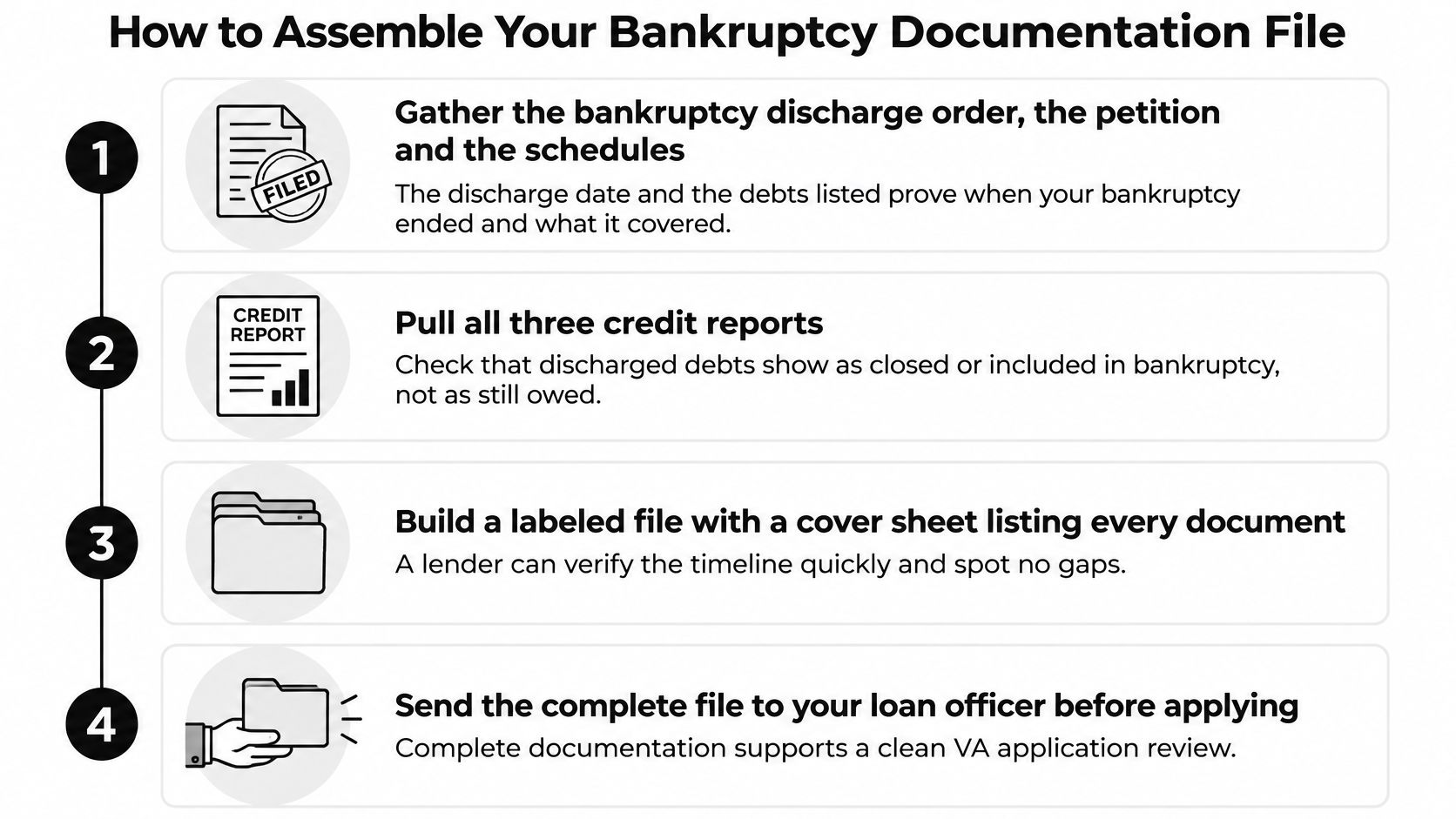
- How to Assemble Your Bankruptcy Documentation File
- Report Errors and Overlapping Events to Check
- Building Credit Habits That Support a VA Application
- Frequently Asked Questions About VA Loans After Bankruptcy
- Confirm Your Timeline and Take the Next Step
Why a Bankruptcy Does Not Automatically End VA Loan Eligibility
Many veterans arrive at this search convinced that a bankruptcy shuts them out of a VA-guaranteed mortgage for years. The VA Lender's Handbook doesn't support that fear. It directs lenders to weigh the type of bankruptcy, its discharge date, the borrower's credit behavior after the filing, and overall ability to repay. A bankruptcy notation on a credit report is not a verdict on its own.
Two questions get tangled together in most conversations about this, and untangling them is the main work. The first is when the waiting period starts and how long it runs. The second is whether the file is ready for underwriting on the day it's submitted. A borrower can pass the first test and still fail the second.
For Chapter 7, the clearest standard path is 24 months after discharge. Applications made inside months 12 through 24 are possible but harder, requiring documented re-established credit and evidence that the bankruptcy came from circumstances beyond the borrower's control. What counts is generally the discharge date, not the filing date, which is a distinction that trips up plenty of people reading their own court paperwork.
The practical milestone: 24 months after a Chapter 7 discharge is the standard road. Everything between month 12 and month 24 requires stronger compensating factors and a lender willing to underwrite them.
Now picture a veteran discharged fourteen months ago, weighing whether to keep waiting or start rebuilding. The answer isn't a single date on a calendar. It's a set of conditions a lender has to be able to verify, plus that lender's own standards, which can be stricter than the baseline VA guidance. Something as basic as the minimum credit score for VA financing varies by lender because the VA doesn't set one.
Timing, lender review, documentation, report accuracy, and rebuilding habits all feed the same decision. Getting the calendar right only tells you when the conversation can begin.
VA Loan Waiting Periods by Bankruptcy Type
Could the same number of months after bankruptcy lead to different VA loan outcomes? Yes. The discharge date starts one clock, while the lender's review of the complete file runs on another. Meeting a typical waiting period may make a borrower eligible for consideration, but it does not settle whether the lender will approve the application.
The VA Buyer's Guide describes a typical two-year waiting period after a Chapter 7 discharge and a one-year waiting period after Chapter 13 discharge for a VA-guaranteed loan. These are guidelines, not automatic approval dates. Lenders consider the bankruptcy type and reason, along with the borrower's overall credit history.
| Scenario | Typical waiting period | Starting point | Key condition |
|---|---|---|---|
| Chapter 7, standard path | 24 months | Discharge date | Lender reviews bankruptcy type, cause and later credit behavior |
| Chapter 7, exception | As early as 12 months | Discharge date | Documented circumstances beyond the borrower's control and re-established credit |
| Chapter 13, typical | About 1 year | Discharge date, or 12 months of satisfactory plan payments | Trustee or bankruptcy judge approves new credit |
| Chapter 13, plan completed | Satisfactory credit once the plan is finished | Plan completion | All payments made as agreed |
| Bankruptcy with foreclosure, deed-in-lieu or short sale | Measured from the later event | Later of discharge date or title transfer date | Lender reviews credit use and payments after that date |
Reading the Table in Order
Start with the bankruptcy chapter, then identify the event that starts the clock. Finally, check the condition in the last column. That condition matters because the lender must be able to document it.
The middle column is a timing guide, not a permission slip. It indicates when a lender may consider the file under the stated guideline. It does not require a lender to approve the application.
What Chapter 7 Looks Like in Practice
Chapter 7 is a liquidation case that usually ends with a discharge, when the court releases the borrower from covered debts. The standard path is 24 months from discharge to closing on a new loan. Within that period, a lender generally needs evidence both that the borrower has obtained and satisfactorily paid credit since the bankruptcy, and that the filing resulted from circumstances beyond the borrower's control.
The cause is part of the review. A lender may examine documented job loss, medical bills not covered by insurance, or a prolonged strike. Divorce is generally not treated as a circumstance beyond the borrower's control. A failed business receives closer review. A self-employed borrower whose business failed may need to show a permanent position afterward, clean credit before and after the filing, and no misconduct in the business failure.
What Chapter 13 Looks Like in Practice
Chapter 13 involves a repayment plan supervised by the court. Because the borrower makes payments under that plan, the lender can review that repayment history as part of the credit picture. Chapter 13 plans run for several years under court supervision.
A borrower who completes the plan and makes all payments satisfactorily may be considered to have re-established satisfactory credit. Before the plan is complete, a lender may give favorable consideration after at least 12 months of satisfactory plan payments, provided the bankruptcy trustee or judge approves the new credit.
That approval is a separate condition from the elapsed time. The lender must document that payments were made as agreed, obtain the required trustee or court permission, and determine that the borrower is an acceptable credit risk. Missed plan payments, unresolved debts, unstable income, or weak credit after filing can still affect a review after the minimum period has passed.
One Discharge Month, Two Different Files
Consider two borrowers at different points in their bankruptcy timelines. One is 18 months into an active Chapter 13 plan, has made every payment as agreed, and has written trustee approval for new credit. The payment record and approval give the lender concrete evidence to review.
The other borrower received a Chapter 7 discharge fourteen months ago, has opened no new credit since, and has little post-discharge history. Although both are seeking a VA loan after bankruptcy, their files present different evidence. One shows repayment during a court-supervised plan. The other offers little recent credit activity for a lender to assess.
Practical rule: the waiting period tells you when a lender may review the file under the applicable guideline. The payment record and required approvals help determine how that review proceeds.
The Four Things to Confirm Before You Call a Lender
- Your discharge date, from the discharge order rather than memory or a credit-report notation.
- Your filing chapter, because it determines which timing guideline and conditions apply.
- Trustee or court approval, if you are still in an active Chapter 13 plan and seeking new credit.
- Any late payment since discharge, on any account. A recent missed payment may complicate the lender's review even after the typical waiting period has passed.
What Lenders Review Beyond the Waiting Period
The calendar opens the review. It doesn't decide it. Once the seasoning period is satisfied, an underwriter works through the file in a fairly consistent order, and each step asks a different question about your ability to carry a mortgage.
Income comes first. The lender wants stable, verifiable earnings, and it wants them to continue. Then debts, measured as debt-to-income ratio, meaning the share of your gross monthly income that goes to minimum debt payments. A high DTI doesn't just look risky. It squeezes what's left over. That leftover figure is residual income, the money remaining after housing and existing obligations are covered, and the VA pays close attention to it because it reflects your real monthly cushion. When you're comparing affordability, the payment itself is only part of the picture, and this guide to accounting for taxes, insurance and HOA fees shows what a mortgage really leaves in the budget.
Then comes credit history since the discharge. On-time payments on revolving and installment accounts, recent delinquencies, unpaid obligations, and whether new credit has been handled responsibly. Underwriters also document the filing type, the cause, the discharge or dismissal status, and your behavior afterward. That sequence is worth walking through with a veteran home loan approval walkthrough before you submit, so nothing surprises you mid-review.
The Cause-and-Effect Test
Elapsed time alone is insufficient if recent revolving-account delinquencies, unpaid obligations, or unstable repayment patterns show that credit risk remains high. That's the closest thing to a formula in this process. Say you were discharged 22 months ago and a credit card went 30 days late 14 months after discharge. An underwriter can ask for a written explanation and more recent history, and the calendar date stops carrying the file.
Why Two Lenders Can Reach Different Answers
The VA sets baseline guidance. Lenders add overlays, which are stricter rules layered on top of that baseline for their own risk reasons. Two lenders reviewing the same discharge date, the same income, and the same credit history may ask for different documents or apply different minimums. Mortgage approval still depends on lender rules, underwriting, income, debt-to-income ratio, down payment, credit score, and the full loan profile.
There's also a distinction that matters for how you respond. Accurate adverse history, a genuine late payment or a real collection, must be explained and documented. Inaccurate reporting can be disputed through a lawful process. Neither path guarantees a lender's decision, and no single credit step settles one.
How to Assemble Your Bankruptcy Documentation File
A complete file lets you and the lender answer the same questions quickly, without email tag over records you could have gathered months earlier. Think of it as a planning tool you build once and update, not a promise of approval.
- Gather the discharge order, the petition, and the schedules. The discharge date and the debts listed decide which dates the lender uses, and the schedules show what the bankruptcy covered.
- Collect trustee records and, for Chapter 13, the plan payment history. Each payment marked as made as agreed is the evidence behind any favorable consideration during an active plan.
- Build a timeline with four dates. Filing, discharge, any foreclosure or title transfer, and the first on-time payment after discharge. Seeing them side by side exposes which date a lender will count from.
- Pull all three credit reports. Compare every account against the timeline and note each mismatch in writing, because an included debt showing an active balance is a question a lender will ask.
- Save proof of post-discharge payments. Statements and receipts for every open account. If a payment can be automated, automate it, and if a record might matter later, save it now.
- Write a brief factual explanation of the event. Job loss, medical bills, a separation. Two or three sentences, no drama, supported by documents where you have them.
- Set up a payment calendar with statement dates. Note when each card reports its balance, because reported utilization is what most lenders see, and knowing the dates lets you plan the balance rather than react to it.
- Keep notes on recent inquiries and any feedback from lenders, landlords, or dealers. Patterns in that feedback tell you what the file still looks like from the outside.
If the file is thin, some of this work overlaps with a plan to rebuild credit before applying for a mortgage, and the earlier that starts, the more of the waiting period it uses.
Report Errors and Overlapping Events to Check
Now take the documents you've gathered and set them against the credit reports line by line. Start with the distinction that governs everything else: correcting inaccurate information is a lawful dispute process, while accurate adverse history has to be explained, not removed. Mixing those two up wastes months.
| Report item | What to check | Supporting document |
|---|---|---|
| Discharged debt | Shows an active balance or unexpected delinquency | Discharge order and creditor list |
| Charge-off or collection | Status, first delinquency date and reporting date | Creditor letters and account statements |
| Foreclosure or title transfer | Transfer date compared with discharge date | Settlement statement and trustee records |
| Late payment date | Matches the actual due date and payment record | Payment history and bank statements |
| Personal information | Name, address and identity details are correct | Government ID and address history |
| Account comments | Accurate and consistent with case status | Court and creditor correspondence |
A charge-off needs status and date review: balances, sale or transfer status, reporting dates, and the creditor's own documentation. A utilization problem often needs statement-date planning rather than a dispute, because the balance is real and the timing of when it's reported is the issue. A student loan reporting concern may need servicer history and status documentation before anything else.
When Bankruptcy and Foreclosure Overlap
The VA credit underwriting chapter gives a specific rule for this: when a bankruptcy and a foreclosure, deed-in-lieu, or short sale overlap, the later date of the bankruptcy discharge or the transfer of title establishes the beginning date for re-established credit.
Suppose a Chapter 7 discharge came through in March 2025 and the foreclosure sale closed in September 2025. The later, foreclosure-related date may control the analysis, so the calendar starts there. A foreclosure, deed-in-lieu, or short sale doesn't disqualify a borrower by itself, but the lender evaluates credit use and payment performance after that date. Anyone assuming the discharge alone started every clock would be figuring from the wrong month.
Choosing Between a Dispute and an Explanation
Compare every report line with your timeline before deciding. If a discharged debt shows an active balance, or a delinquency is dated after the discharge, that's a candidate for review against the discharge order and a dispute under the Fair Credit Reporting Act process, where credit bureaus and creditors verify the item. Outcomes vary, and items verified as accurate stay on the report and get explained through documentation instead. These are the same credit dispute steps before FHA approval that apply to any mortgage program, since the report is the same document either way.
Building Credit Habits That Support a VA Application
Timing gets you to the door. Habits decide what the lender sees when it opens the file during the months before your application, when a stable pattern matters more than a single good month.

Payment protection comes first, because one new late payment undoes a long stretch of clean history. Set automatic payments of at least the minimum on every open account, including utilities and phone service, so no due date depends on memory.
Balance timing is second. Keep revolving balances low relative to your limits, and note each card's statement date, since the balance reported on that date is what most lenders see. Paying before the statement closes can change what appears on the report, and that's planning, not manipulation.
Inquiry control means limiting new credit applications during the months before a mortgage review. Each application can appear on the report, and a cluster of them reads as someone scrambling for money.
On tradelines, a secured card or a starter card used for small recurring charges and paid in full builds a repayment record. Those accounts can demonstrate you've handled new credit responsibly. They can't erase what's already there, and they don't create an instant history.
Debt-to-income planning deserves equal attention. Reducing a monthly obligation before you apply can matter as much as any score change, because it frees up the residual income a lender needs to see. The same discipline helps with handling collections while rebuilding credit, where the goal is resolution and accurate reporting rather than a quick removal.
The quiet window: aim for a stretch before your application with no new credit, no new collections, and no late payments. It gives an underwriter nothing new to question.
Our rebuild plan covers payment protection, balance timing, inquiry control, and quiet-window planning. Improvements take time. There's no fixed score increase and no fixed timeline, because results vary by file.
Frequently Asked Questions About VA Loans After Bankruptcy
Can I apply for a VA loan right after a bankruptcy discharge
Generally no. The standard Chapter 7 benchmark is 24 months after discharge, and an exception may be considered after about 12 months when circumstances were beyond the borrower's control and credit has been re-established. Applying earlier usually means the lender can't yet conclude you're a satisfactory credit risk.
Does a bankruptcy automatically disqualify a VA borrower
No. The VA Lender's Handbook directs lenders to review the type of bankruptcy, the discharge date, credit behavior after the bankruptcy, and overall ability to repay. The filing is a fact to be analyzed, not an automatic bar.
Do I need trustee approval during a Chapter 13 plan
Often yes. The trustee or bankruptcy judge must approve new credit before a lender may give favorable consideration, and missed plan payments can delay review even after the minimum period has passed.
Can credit repair guarantee a VA loan approval
No. Credit repair is a legal, documentation-based review of the credit file. Results vary based on each person's credit file, documentation, creditor responses, account history, and current credit behavior. Approval decisions belong to the lender.
Confirm Your Timeline and Take the Next Step
Have you confirmed which dates the lender will use before choosing an application date? The bankruptcy calendar and the lender's full-file review are separate clocks. Reaching a waiting-period benchmark does not by itself settle eligibility.
Ask a VA-approved lender which date applies to your case, whether trustee or court approval is needed, and what lender requirements apply beyond VA guidance. Also ask which documents underwriters want. The answers can clarify whether to apply soon or continue preparing.
Bring the dates and documents you gathered during your report review. A lender can then discuss your specific file rather than a hypothetical one. Approval still depends on the lender's rules and review of your overall loan profile.
Credit repair cannot guarantee approval for a mortgage, auto loan, or rental review. Superior Credit Repair offers rebuilding guidance after bankruptcy and can create a next-step plan for people who were denied or are preparing to reapply. Its credit-file review is documentation-based, and results vary according to the file, supporting records, creditor responses, account history, and current credit behavior.
To have your credit file reviewed against your discharge date, contact Superior Credit Repair at www.superiorcreditrepaironline.com and ask for a review. The company offers guidance for people preparing for major financial goals, including home loans, refinancing, and rebuilding after credit challenges.
If this information helped clarify your credit report or next steps, you can share your experience on Superior Credit Repair's Google Business Profile: https://share.google/ePRpFvtCXwCjiJwOK
Superior Credit Repair serves clients nationwide, including veterans and families preparing for mortgage approval. A review can identify inaccurate, outdated, or unverifiable items and help map a realistic preparation timeline around your discharge date. The lender makes the final decision.