

You have your Certificate of Eligibility in a folder, a house you keep looking at, and a credit score that makes you pause before you call a lender. Maybe the number looks low. Maybe you barely have a score because you paid cash for years. Or the score looks fine, and a late payment from last spring is still on the report.
VA loan credit requirements are easier to misread than many expect. The Department of Veterans Affairs does not publish one score that secures the benefit. A private lender still has to say yes. That gap is where many veterans get stuck, and it is also where a thinner file or a lower score can still be workable if the rest of the file is steady.
Table of Contents
- VA Loan Credit Requirements at a Glance
- Why VA Standards and Lender Rules Differ
- Debt-to-Income and Residual Income Explained
- Credit Reports, Thin Files and Payment History
- Three Borrowers, Three Different Credit Paths
- How to Prepare Your Credit File Step by Step
- Common Questions About VA Credit Approval
- Confirm Your VA Credit Plan Before You Apply
VA Loan Credit Requirements at a Glance
Two separate decisions stand between you and a VA-backed mortgage. The Department of Veterans Affairs sets program rules and confirms your eligibility for the benefit. A private lender decides whether to fund the loan. You can clear the federal standard and still be declined by one company, because VA eligibility and lender underwriting are different standards measured against different checklists.
There is no federal minimum credit score for a VA loan. Your score is one input beside documented income, residual-income capacity, existing debts, and your recent history of meeting obligations. That is why a modest score with clean recent payments can still have a workable path, while a higher score weighed down by fresh late payments or heavy monthly debt may stall.
| Factor | VA program rule | Typical lender practice | What to check first |
|---|---|---|---|
| Credit score | No federal minimum score | Lender overlays, with about 620 cited as a common benchmark | The lender's written credit guidelines |
| Debt-to-income ratio | 41% is generally acceptable | Higher ratios reviewed case by case with compensating factors | Monthly debts divided by gross monthly income |
| Residual income | Required amount varies by household size and region | Reviewed after housing costs and debts | Income left after monthly obligations |
| Credit report | A three-file merged report or a Residential Mortgage Credit Report, under 120 days old (180 days for new construction) | The lender orders the report | Report date and age |
| Thin credit file | Lack of history is not automatically adverse | Rent, utility, and insurance payments may be reviewed | Consistent payment records |
| Collections, late payments, charge-offs | Evaluated during underwriting | Lender-specific policies | Account status, dates, and balances |
| Bankruptcy or foreclosure | Evaluated during underwriting | Lender-specific waiting periods | Discharge or dismissal papers and foreclosure completion dates |
Start with the last column. Each row names the document or number a lender will ask for first, whether that is written credit guidelines, the report date, or monthly debts divided by gross monthly income.
Treat the table as a map. Your file and the lender's decision determine the outcome, and results vary.
Before you apply, pull all three major credit reports and confirm that account statuses, balances, and dates are accurate. Avoid new debt and late payments in the months before a preapproval review. Correcting a genuine reporting error or lowering credit card utilization may strengthen the file. No credit-repair action guarantees approval, because lender overlays and the full underwriting file control the decision.
Why VA Standards and Lender Rules Differ
Think of VA rules as the building code and each lender as an inspector who can add a stricter checklist on top. VA eligibility and lender approval are separate decisions. You can clear the federal standard and still miss one company's internal policy.
The VA Buyer's Guide identifies approximately 620 as a commonly used lender benchmark, although exceptions may be possible when other risk factors are strong. The U.S. Department of Veterans Affairs does not impose a universal minimum credit-score threshold. The lender looks at repayment history, current obligations, income, assets, and overall ability to repay.
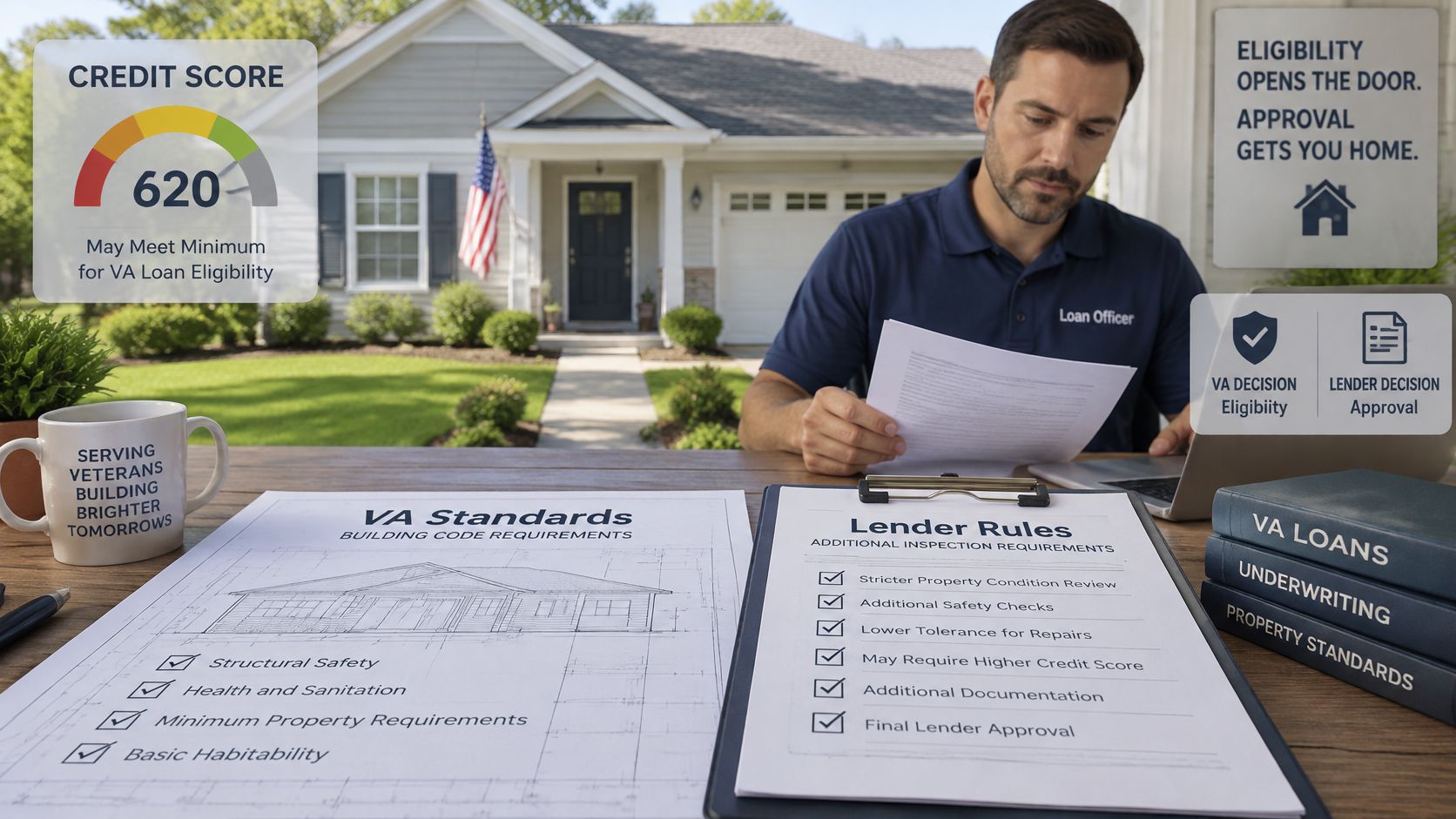
Say a borrower sits at 610, with steady income and low monthly debt. One lender declines the file because it falls under that company's overlay. Another lender, using manual underwriting, reviews the same income, payment pattern, and debts and moves the file forward. The score did not change. The policy did.
Lenders often group scores into broad bands. Each band can carry different pricing, documentation, and manual-review rules. The 620 figure is one benchmark inside that structure, not a federal cutoff. Ask which band the lender uses, and how it treats a score just under its line.
Mortgage approval still depends on lender rules, underwriting, income, debt-to-income ratio, down payment, credit score, and the full loan profile. Mortgage-readiness work prepares a cleaner file before preapproval. It does not replace the lender's review, and a credit repair company does not make the final decision. Results vary by file.
Ask each lender these three questions, then compare at least two VA lenders:
- Score overlay: What is your minimum score, and is it your own overlay rather than a VA rule?
- Derogatory accounts: How do you treat collections, charge-offs, and recent late payments?
- Debt limit: What debt-to-income limit do you apply, and when will you look past it?
If you are under one lender's stated threshold, compare other VA lenders instead of assuming you are ineligible for the program. At the same time, address recent delinquencies, revolving utilization, unresolved reporting errors, and unstable credit behavior before you apply.
Debt-to-Income and Residual Income Explained
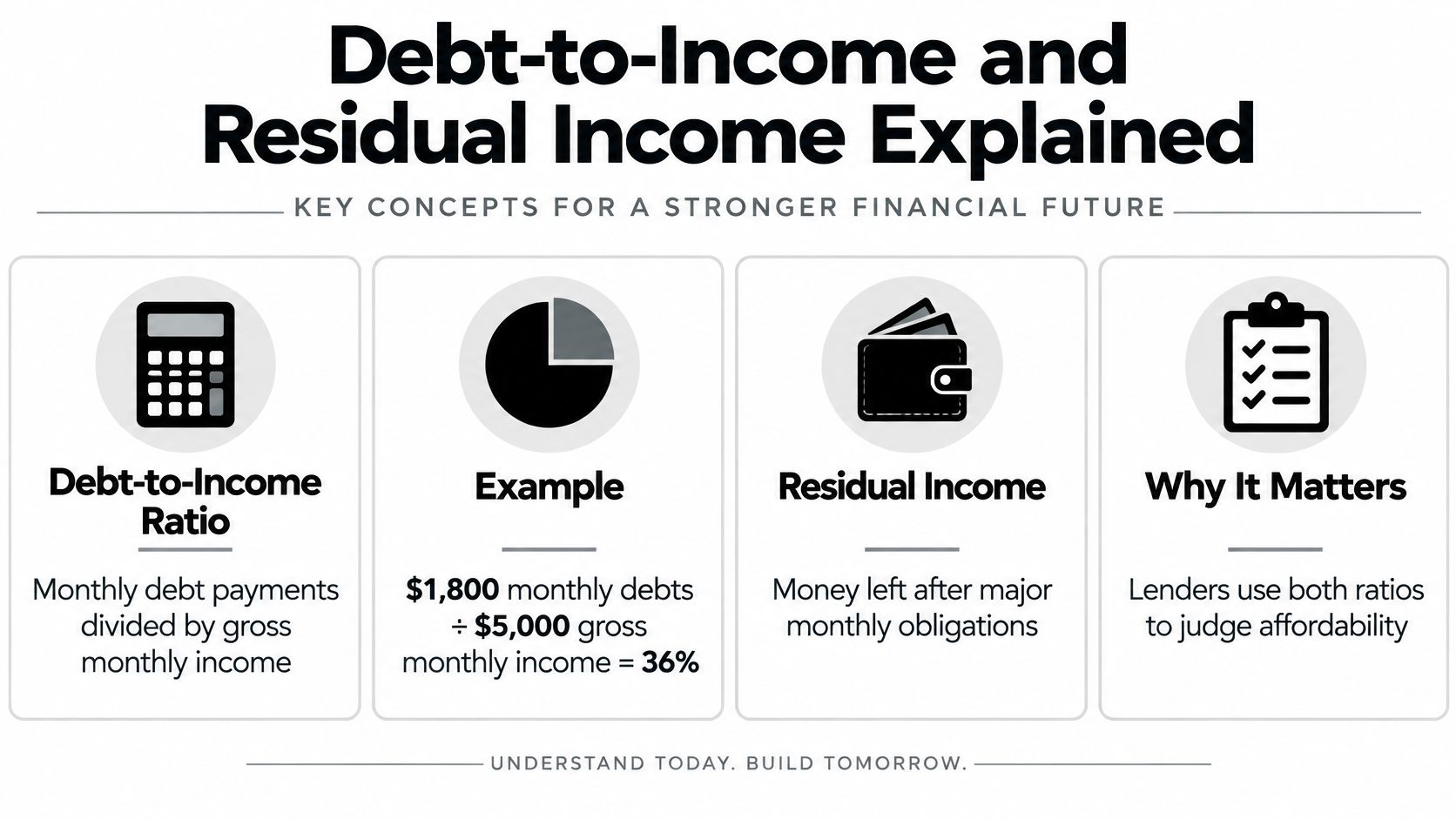
Start with the math, not the slogan. Debt-to-income ratio is monthly debt payments divided by gross monthly income.
Say a household has $1,800 in monthly debts and $5,000 in gross monthly income. Divide 1,800 by 5,000 and you get 36%. The same household with $2,300 in debts lands at 46%. Debts in that figure usually include car loans, credit card minimum payments, student loans, and court-ordered support. Housing will be added once you have a payment to test.
The guideline and the exception
VA guidance on debt-to-income identifies 41% as the generally acceptable debt-to-income ratio. A ratio above 41% does not automatically disqualify a borrower. That is the first idea. The second idea is separate. An exception may be considered when residual income exceeds the applicable requirement by approximately 20%, among other compensating factors.
Residual income is the money left after housing costs and other obligations. It helps show whether the household can meet ordinary living expenses after those payments. VA underwriting does not rely only on a credit score. It also asks whether enough income remains.
When the monthly debt figure is wrong
An outdated balance or a wrong minimum payment can inflate the debt side of the ratio. That inflated number can make a workable budget look too tight. Check reported balances and minimum payments on all three bureau reports, then compare them with current statements.
If you want a plain walk-through of how DTI affects mortgage approval, read that guide beside your own numbers. We can help you identify reporting inaccuracies that affect monthly obligations. The lender, not a credit repair company, makes the final underwriting decision. Results vary with your income documents, your debts, and the lender's compensating-factor review.
Credit Reports, Thin Files and Payment History
A VA lender reads a merged file, and the clock on that file matters. VA credit-report guidance generally calls for a three-file merged credit report or a Residential Mortgage Credit Report that is less than 120 days old, with up to 180 days permitted for new construction. If the report is older than the limit that applies to your loan, expect a fresh pull before closing. Note each report date the day you receive it.
Line up the three bureaus
Compare Equifax, Experian, and TransUnion account by account. Look for mismatched identity details, accounts that are not yours, duplicate collections, and balances that disagree. For late payments, match the reported dates and account timelines to your creditor statements. A date that is off by a month can make an old problem look recent, or a resolved one look open.
Superior Credit Repair's review step covers the credit report, bureau differences, negative items, utilization, public-record history, and your approval goal. Bring the records that show what the file should say: current three-bureau reports, creditor statements with balances, limits, dates and payment history, and any collection letters or settlement records. A corrected item can still leave the score where it was. Accuracy and score movement are separate outcomes.
When there is little or no traditional credit
An applicant without an established credit history is not automatically treated as having adverse credit. Underwriters may examine payment records for rent, utilities, automobile insurance, or other recurring expenses. That path matters for recently discharged veterans, households that mostly used cash, and people rebuilding after bankruptcy or another disruptive event.
A thin file rewards documentation. Pull consistent rent and utility records, keep the dates aligned across providers, and save payment confirmations rather than relying on memory. If you are choosing accounts to build history before a mortgage review, see Superior Credit Repair on pre-mortgage cards for how starter cards fit a thin file. Dispute only information you can support as inaccurate, incomplete, outdated, or unverifiable. Bureaus verify with the furnisher, creditor responses vary, and a dispute does not guarantee removal.
If the property you want is undeveloped land and a VA mortgage is not the right tool for that parcel, you can explore seller financing for land while you keep preparing a mortgage-ready file for a primary home.
Three Borrowers, Three Different Credit Paths
The useful question is often not "What score do I need?" It is "What does this file show?" VA home loan guidance allows underwriters to look at alternative payment records when conventional credit is thin or missing. These three cases are illustrations, not predictions.
Recently discharged, no credit cards
Alex left active duty eight months ago, never opened a credit card, and has paid rent and utilities on time for two years. A score target is the wrong first move. The file needs rent and utility records, a short explanation for the missing traditional accounts, and stable income documentation. The outlook changes if a lender will manually review those records. The file still needs that paperwork in one place, with dates that match.
A stronger score with fresh problems
Jordan's score is 680. Monthly debts put the ratio near 45%, and two 30-day late payments landed in the last few months. The score does not carry this file. The priority is lowering monthly obligations, correcting any balance or status that is reported wrong, and showing several months of on-time payments before applying. Until those late payments age and the debts come down, a higher score can be less workable than a lower score with clean recent behavior. Our mortgage readiness guidance for veterans walks through collections and charge-offs in that same spirit.
Rebuilt after bankruptcy
Morgan's score is about 600, four years after a bankruptcy, with steady income the whole time. The lender's policy on bankruptcy timing and manual review decides whether this file moves. Morgan should ask lenders directly and gather the discharge paperwork, not assume a waiting period from a friend's loan. What changes the outlook is a lender willing to read the full history. What the file still needs is the court papers, proof of on-time payments since discharge, and income documents that match the application.
Each case turns on documents and recent credit behavior, plus the lender's policy. Results depend on the full file. Nothing here is a forecast of approval.
How to Prepare Your Credit File Step by Step
A ready file is current, accurate, documented, and aimed at a lender whose rules you already know. Work in this order.
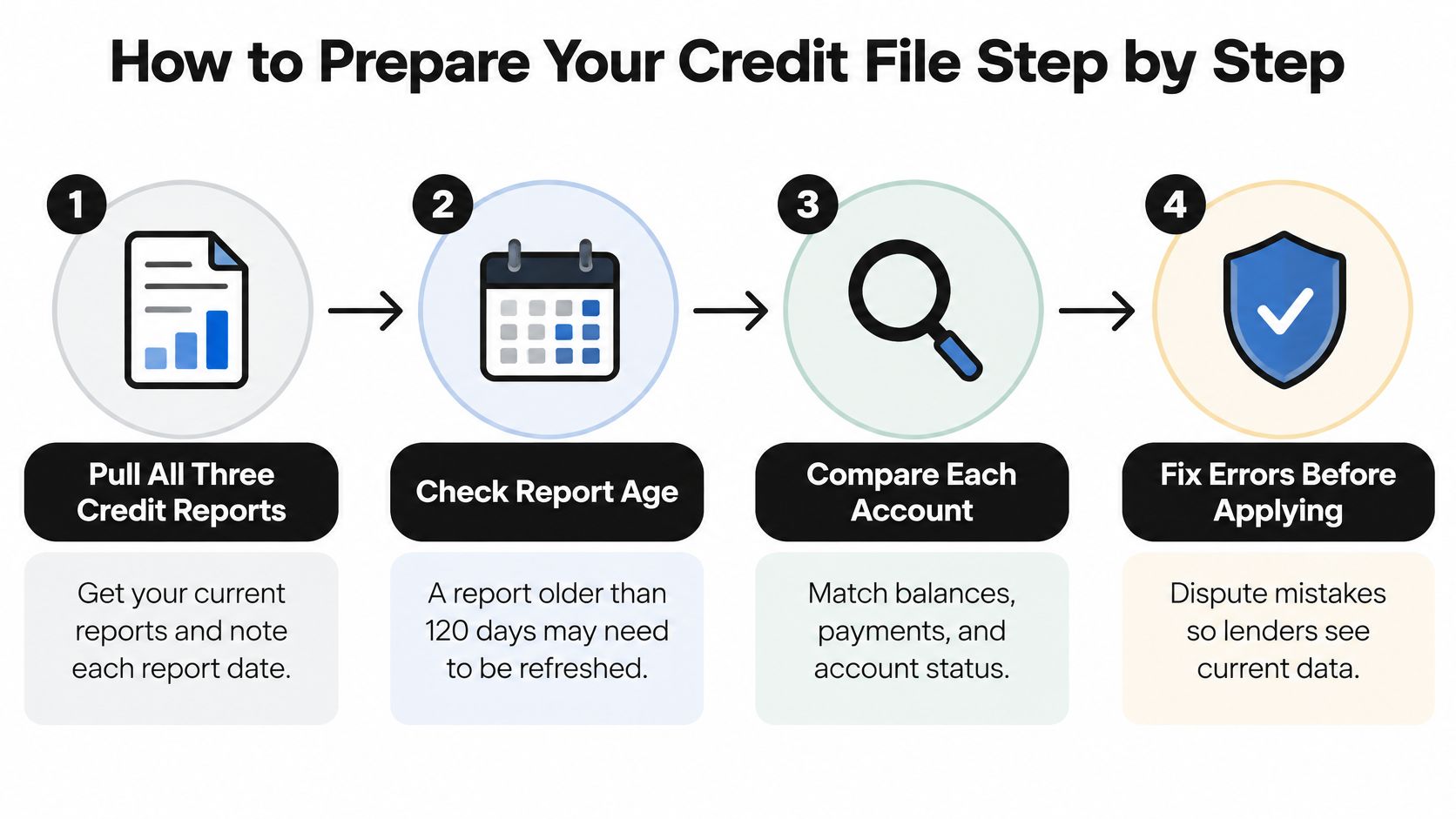
- Pull all three current credit reports and write down each report date, because a report older than 120 days may need to be refreshed before a lender will rely on it.
- Compare every account across the three reports for balances, payment status, identity details, and accounts that are not yours. Reviewing only one bureau is the common slip, and the other two can still block the loan.
- Gather accuracy documents: current three-bureau reports, creditor statements showing balances, limits, dates, and payment history, plus collection letters, settlement records, student loan records, or debt-buyer notices. Add rent or utility records if your file is thin.
- Review collections and charge-offs for correct status and dates. A charge-off may need status and date review, a utilization issue may need statement-date planning rather than a dispute, and a student loan reporting concern may need servicer history and status documentation.
- Keep every current account paid on time, set a payment calendar, and avoid new debt before you apply. Opening a new card in the middle of this process is a common slip that adds an inquiry and a new account.
- Dispute only items you can support as inaccurate, incomplete, outdated, or unverifiable. Submit the dispute in writing, keep copies, and track each bureau response, because timing depends on the account, the documentation, bureau response cycles, and furnisher updates.
- Ask each lender for its credit-score minimum, its collection and bankruptcy policy, and its debt-to-income limit, then compare at least two lenders before you pick a target.
For mortgage preparation after a late payment, match the reported dates to your statements before you decide whether a dispute or a waiting period fits. A ready file has current reports, accurate accounts, documented payment history, and a clear lender target. Results still vary with creditor responses and your current credit behavior.
Common Questions About VA Credit Approval
Is there a minimum credit score for a VA loan?
VA does not set a federal minimum score. Lenders may apply their own overlays, and many use a mid-600s benchmark with room for exceptions when the rest of the file is strong. Read the lender-rules discussion above before you treat any one number as a pass or fail.
Can a borrower with a thin file qualify?
A lack of traditional credit history is not automatically adverse. An underwriter may review rent, utility, and insurance payment records if you can document them. The thin-file section above explains which records to gather.
Does a dispute guarantee removal of a negative item?
No. A dispute is a verification process, creditor responses vary, and no deletion or score change is guaranteed. Dispute only what you can support with documents.
How current does a credit report need to be?
For loan analysis, the report must generally be under 120 days old, or 180 days for new construction. If yours is older, plan on a new pull before the lender finishes the file.
Confirm Your VA Credit Plan Before You Apply
A lender-ready file usually comes down to three checks. First, all three reports should be current and accurate. Second, the debts on those reports should match your statements closely enough that debt-to-income and residual income can be read without surprises. Third, the paperwork for a thin file, collection, late payment, or past bankruptcy should be organized before an underwriter asks for it.
That last point matters because VA rules and lender rules are not the same test. The VA standard leaves room for a lower score or a shorter history when the rest of the file is documented, while a lender overlay can still turn away a higher score with recent late payments or heavy monthly debt. Aim for a file that explains itself clearly, not one that only looks good on a single number.
You can request a credit analysis and discuss your approval target with Superior Credit Repair. The review can cover bureau differences, negative items, utilization, public-record history, and the approval goal, then help pinpoint documentation needs and practical next steps. Credit repair cannot guarantee approval for a mortgage, auto, or rental review, and timing depends on the account, documentation, bureau response cycles, furnisher updates, and current credit behavior.
For a first conversation, bring the three current credit reports, photo identification, current address information, recent statements for accounts to be reviewed, collection notices, payment confirmations, and any denial or adverse-action notice tied to the application that prompted the search. Review can happen remotely. You stay responsible for accurate information, reading responses, and deciding when to apply.
If you want the sequence from eligibility through closing, our steps to VA loan approval sit beside this credit plan. Use both before you submit an application you are not ready to support.
Was this guide helpful?
Superior Credit Repair Online provides educational credit guidance for individuals and families preparing for major financial goals like buying a home, applying for a mortgage, refinancing, or rebuilding after credit challenges.
If this information helped you better understand your credit report or your next steps, we would appreciate your honest feedback. You are welcome to share your experience with Superior Credit Repair on our Google Business Profile.
Superior Credit Repair reviews credit reports for veterans and military families preparing for a VA loan, including payment history, collections, charge-offs, utilization, and thin-file records. If you want a calm, documentation-based look at your file before you talk with lenders, request a credit analysis and visit Superior Credit Repair to start that conversation.