


The most common advice about qualifying for a VA loan with bad credit is to reach a particular score before doing anything else. That advice leaves out the question that matters most: Can a lender document that you can repay the mortgage while meeting your other obligations? A score is part of that decision, not the entire decision.
If you're trying to understand how to qualify for a VA loan with bad credit, start by separating official VA requirements from individual lender policies. Then build a file that explains past problems, accurately reports current accounts, and demonstrates financial stability. That approach gives you useful next steps without treating credit repair as a promise of mortgage approval.
Table of Contents
- What the VA Requires, Residual Income and Compensating Factors
- Six Steps to a Lender-Ready VA File
- Sorting Report Errors from Legitimate Negative Items
- Rebuilding Utilization and Payment History
- Confirm Your Next Step Before You Apply
What the VA Requires, Residual Income and Compensating Factors
The VA doesn't set a universal minimum credit score. Many lenders commonly look for a score around 620, but that's a lender overlay, not a VA requirement, as explained in the VA Buyer's Guide. An overlay is an additional requirement a lender uses when deciding which applications it will accept.
VA rules compared with lender overlays
| Factor | What VA sets | What lenders add |
|---|---|---|
| Minimum credit score | No universal minimum set by VA | Often around the score described above as a lender overlay |
| Debt-to-income | 41% is generally acceptable, not an automatic cutoff, according to VA homeownership guidance | Lender policy may be stricter or more flexible within applicable underwriting requirements |
| Residual income | Money left after housing and recurring debts, evaluated by household size and region under federal VA underwriting regulations | Lender must document the calculation |
| Lender risk | VA guarantees approximately 25% of lender risk, as described in VA loan guidance | Lender still applies its own underwriting standards |
A denial from one lender doesn't establish that you're ineligible for the VA program. Ask whether the obstacle was its score overlay, your payment history, insufficient qualifying income, or another underwriting concern. Those are different problems, and they require different responses.
The guarantee protects the lender against part of its risk. It doesn't replace the lender's responsibility to assess your application, and it doesn't release you from repayment obligations.
What the underwriter actually evaluates
Underwriting is the lender's review of whether the proposed loan meets its requirements. A valid Certificate of Eligibility, satisfactory credit, verified income, existing debts, assets, and repayment ability all matter, according to the VA's homebuyer guidance.
Your Certificate of Eligibility, often called a COE, establishes eligibility for the benefit. It isn't a financial approval. Think of eligibility and mortgage qualification as separate reviews that both need to be completed.
For example, a borrower might have older credit problems but now maintain steady employment, manageable balances, and savings. Another borrower might have a stronger score but carry obligations that leave little room for a housing payment. A lender needs the details behind each file rather than a score alone.
Practical rule: Ask what prevented approval and what documentation could resolve that concern. Don't assume every denial means you need a higher score.
Mortgage approval still depends on lender rules, underwriting, income, debt-to-income ratio, down payment, credit score, and the full loan profile. Improving a credit report can address one part of that review, but it cannot substitute for sufficient income or an affordable payment.
How to test residual income accurately
Debt-to-income ratio, or DTI, compares monthly debt obligations with gross monthly income before taxes. Residual income asks a different question: How much usable income remains after the proposed housing payment and required obligations?
VA underwriting guidance identifies high residual income, significant liquid assets, and low DTI as compensating strengths, while warning against incorrect income adjustments and unsupported debt exclusions in its underwriting circular. These strengths can support a marginal file, but they aren't automatic exceptions.
Build your affordability review in this order:
- Establish qualifying income. Gather records showing income that the lender can verify and reasonably consider ongoing. Your paycheck total and your qualifying mortgage income aren't necessarily identical.
- Identify the household correctly. Include all household members required by the applicable residual-income rules. Don't assume only the people signing the mortgage count.
- List obligations accurately. Include installment loans, revolving accounts, and other required payments. Flag unfamiliar balances for review rather than leaving them off the application.
- Use the full housing cost. Test principal, interest, property taxes, insurance, and applicable assessments. A principal-and-interest estimate alone can understate the commitment.
Be careful with non-taxable income gross-ups. A lender may adjust eligible non-taxable income for DTI analysis, but that adjustment must be handled correctly and removed when calculating residual income.
Spouse or co-borrower debts also deserve careful attention. Don't assume an obligation can be excluded because you don't personally make its payment. Any exclusion needs documented support.
Past hardship needs context and recovery
Bankruptcy doesn't automatically end the possibility of a VA loan. The VA bankruptcy guidance identifies typical waiting periods of two years after Chapter 7 discharge and one year after Chapter 13 discharge, and describes credit as generally re-established after 12 months of satisfactory payments following satisfaction of the last derogatory item.
Those are guideposts, not promises. The lender still considers the bankruptcy circumstances, subsequent behavior, and complete application.
For collections and charge-offs, a VA loan credit review after collections can help you organize the questions that need answers. The practical test is whether you can explain each event, demonstrate reliable current payments, and retain enough income after debts and housing costs. Results vary by credit file, documentation, and lender policy.
Six Steps to a Lender-Ready VA File
Use this sequence to organize your preparation, not to predict an approval date. The timing below is a planning estimate rather than a guaranteed processing schedule; access to records, investigation requirements, and lender responses can change it.
Lender-readiness sequence and typical timing
| Phase | Main action | Typical timeframe |
|---|---|---|
| 1. Eligibility and reports | Get Certificate of Eligibility and all three credit reports | Allow one to two weeks for planning |
| 2. Error review | Dispute inaccurate entries with proof; document accurate ones | Dispute responses often take up to 30 days; timing varies |
| 3. Payment stability | Autopay on every account; no new late payments | Ongoing before applying |
| 4. Utilization | Pay revolving balances before statement dates | Allow one or two statement cycles for planning |
| 5. Lender comparison | Prequalification with several VA-approved lenders | Allow one to two weeks for planning |
| 6. Document file | Income, assets, debts and explanations in writing | Allow two to four weeks for planning |
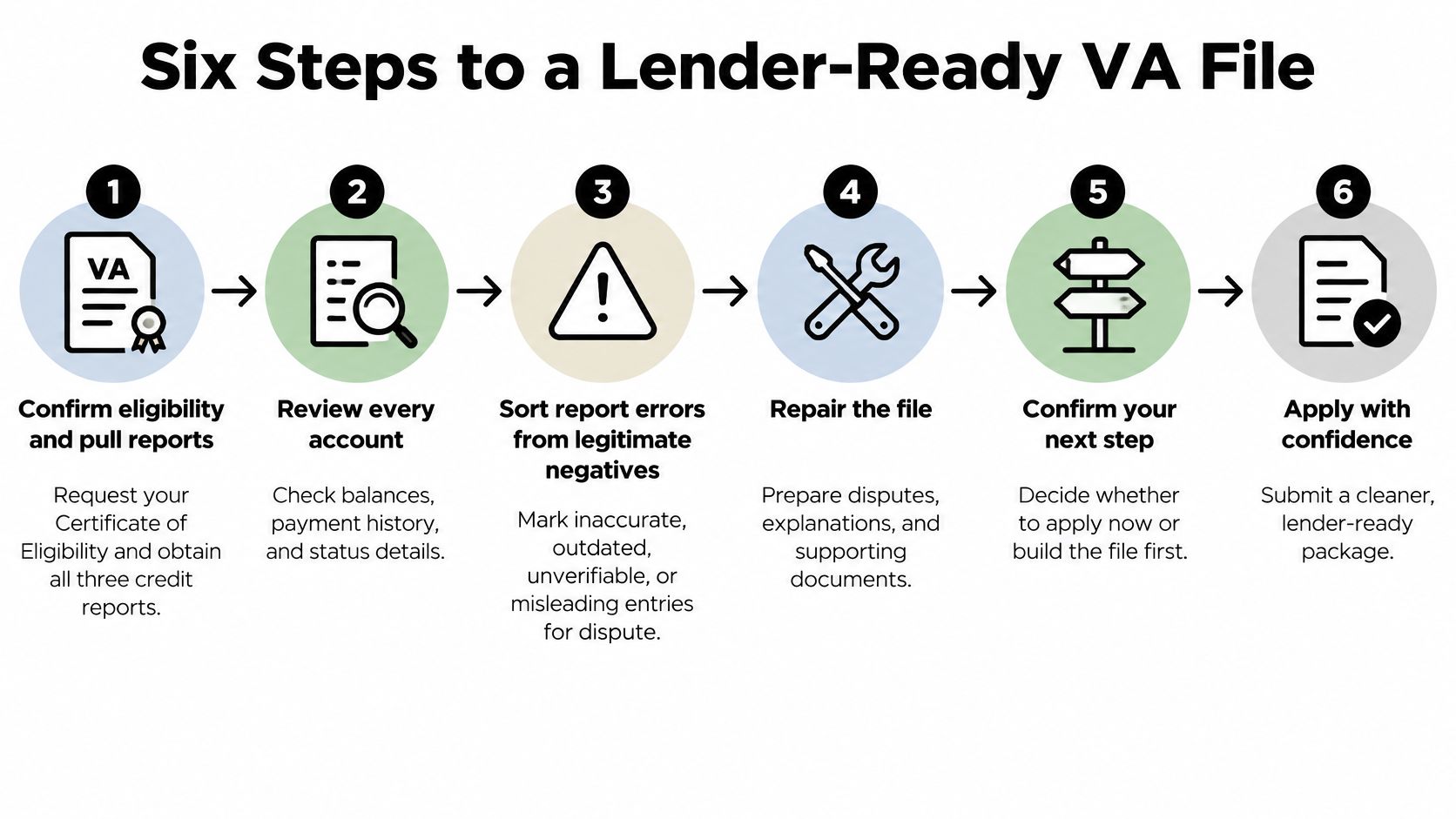
Complete the preparation in a deliberate order
Confirm eligibility and pull reports. Request your COE and obtain your reports from all three credit bureaus, recording each account's balance, status, and reporting date. The common slip is checking only a score dashboard, which can leave you without the account details needed to investigate discrepancies.
Sort errors from accurate negatives. Mark accounts you don't recognize, incorrect balances, and potentially duplicate collections, then match them against supporting records. Disputing accurate information just because it hurts your application wastes effort and doesn't establish mortgage readiness.
Stabilize every payment. Set up autopay where appropriate and maintain enough money in the payment account to cover withdrawals. A common mistake is assuming enrollment completed successfully without confirming the first payment or monitoring a changed minimum amount.
Reduce revolving utilization. Direct available funds toward card balances and coordinate payments with statement dates so lower balances can be reflected in reporting. Don't pay down a card and immediately refill it with purchases you can't cover.
Compare VA-approved lenders. Request prequalification and ask for a written explanation of score overlays, documentation requirements, and whether manual underwriting is available for your circumstances. Comparing only advertised rates can miss the requirements that determine whether a lender will consider your file.
Gather the supporting documents. Organize pay stubs, applicable tax returns, bank statements, debt records, rent or utility history, and concise explanations for past delinquencies. Avoid vague hardship letters that don't explain what happened, what changed, and how you now manage the obligation.
The VA's credit-underwriting training materials emphasize reviewing the complete credit profile and documenting manual underwriting when an application is referred from automated underwriting. A score increase alone doesn't resolve unexplained delinquencies, unverified debts, or unstable income.
A prequalification is an initial assessment, not a final commitment. Use the conversation to identify missing evidence and understand whether the lender needs additional review.
Your readiness checkpoint is practical: no unexplained recent delinquencies, organized supporting records, and a lender conversation booked.
For a broader application checklist, use our steps to VA loan approval to keep credit preparation connected to the mortgage process.
Sorting Report Errors from Legitimate Negative Items
Disputing every negative account is a common mistake. The correct action follows the reporting issue, not how much you dislike the account.
Report items, how to check them and the likely action
| Item | How to check | Likely action |
|---|---|---|
| Wrong balance or status | Compare each report against statements | Dispute with proof |
| Account not yours or duplicate collection | Match names, addresses and account numbers | Dispute as inaccurate |
| Charge-off with accurate status | Review status and date accuracy | Document status; dispute only if date or status is wrong |
| Late payment with wrong date | Check reported dates against bank records | Dispute with payment proof |
| Late payment that is accurate | Review account timeline | Document with a written explanation |
| High utilization | Check statement dates and reported limits | Plan balance timing, not a dispute |
| Student loan reporting concern | Gather servicer history and status letters | Document with servicer records |
| Medical collection | Verify provider and amount | Dispute if unverifiable; document if valid |
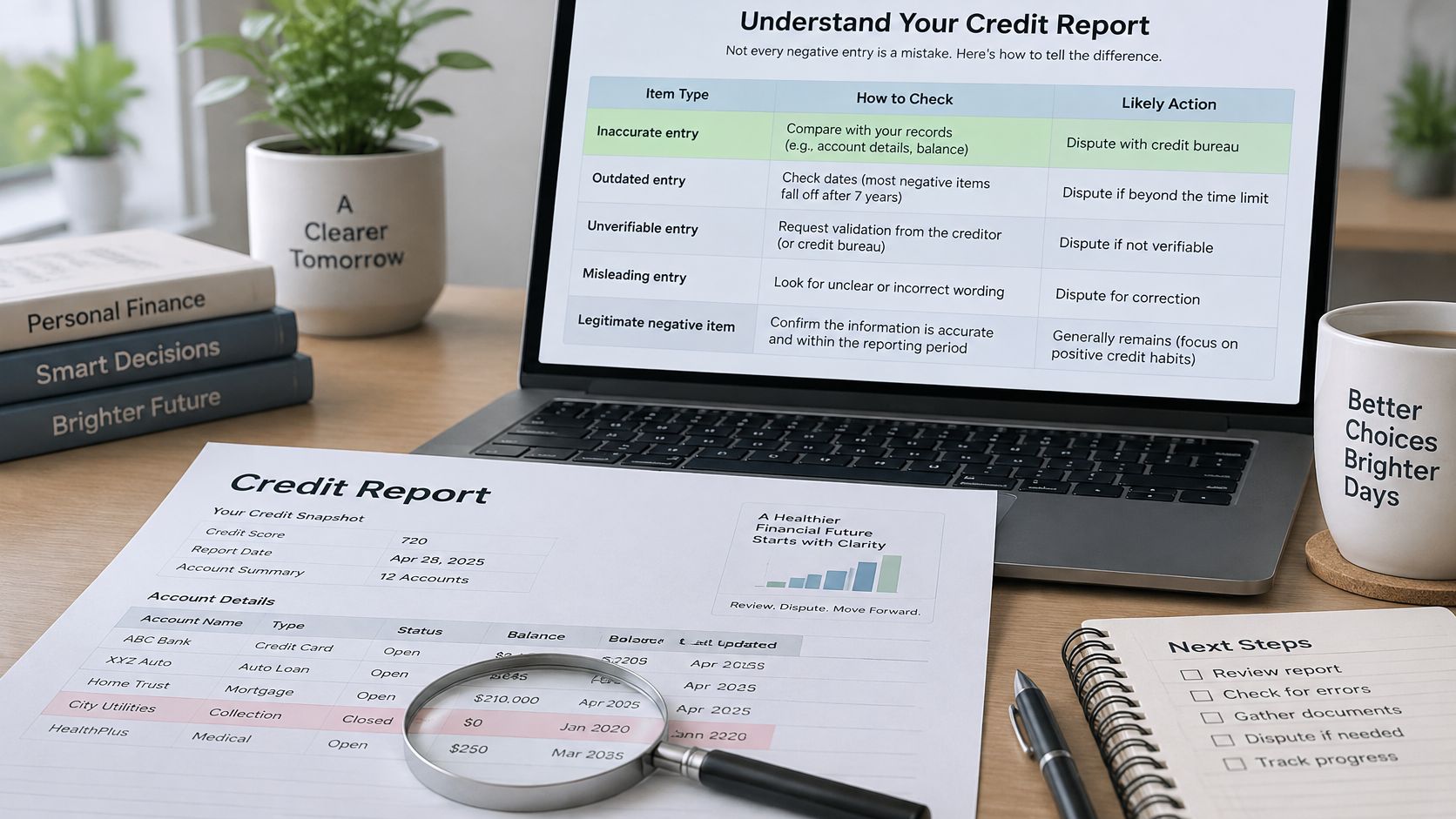
Match the evidence to the problem
For late payments, compare the reported month with the account timeline, payment due date, bank records, and creditor statements. A bank withdrawal alone may not explain when a creditor received or applied a payment, so preserve the full record.
At Superior Credit Repair, we review payment-history accuracy, reporting dates, account timelines, and proof before a lender, landlord, or auto finance company reviews the file. An accurate late payment needs honest context and subsequent responsible management, not an unsupported claim that it never happened.
A charge-off is an accounting status indicating that a creditor treated an account as a loss. It doesn't, by itself, establish that the debt disappeared. Check the status and dates before deciding whether a dispute is appropriate.
For a student loan concern, obtain the servicer's account history and status letters, especially when repayment arrangements or servicing changed. For a medical collection, match the provider, amount, billing records, and any insurance explanation before deciding what is inaccurate or unsupported.
Use a documented dispute process
Credit restoration should follow the Fair Credit Reporting Act's bureau and furnisher dispute procedures. The furnisher is the organization supplying account information to the credit bureau. Identify the specific error, explain why you believe it is wrong, and include relevant supporting documents.
Accurate negative information isn't eligible for removal merely because you're preparing to buy a home. Investigations and creditor responses vary, and outcomes depend on the file's documentation and accuracy; no particular correction or deletion is guaranteed.
Use this week's sorting checklist:
- Identify the field. Record the exact balance, date, status, or ownership detail you question.
- Save the evidence. Keep statements, correspondence, payment confirmations, and report copies together.
- Separate the actions. Label each item for dispute, explanation, repayment discussion, or monitoring.
- Read every response. Compare updated reporting with the actual investigation outcome.
Our guide to addressing reporting errors before mortgage applications can help organize that work. If you're renting while preparing to buy, VerticalRent's guidance can also help you fix screening errors with VerticalRent, since rental screening concerns deserve their own review rather than an assumption that a mortgage-report correction resolves everything.
Rebuilding Utilization and Payment History
Utilization and payment habits are areas you can influence directly, but a stronger file takes consistent management. Don't open several accounts to create activity before a mortgage application.
Credit utilization is the share of your revolving credit limits you're using. Lenders may see a balance reported around a card's statement closing date, which isn't necessarily the balance you see after making a later payment.
Choose tools that fit the mortgage timeline
Before adding an account, consider whether its deposit, fees, and monthly payment fit your budget. If you're close to applying, discuss proposed new credit with your lender first.
Credit-building tools and what to watch for
| Tool or habit | How it helps the file | Watch for |
|---|---|---|
| Secured credit card | Deposit generally becomes the limit; on-time payments are reported when the issuer reports them | Annual fees and a held deposit |
| Credit-builder loan | Reported payments build installment history | Interest and fees; confirm reporting |
| Authorized-user account | May add an account history to the file | Use only a legitimate, well-managed account |
| Rent and utility reporting | Documented payments may support a thin file | Confirm the lender accepts them; not every bureau captures them |
| Balance paydown | Lowers utilization when reduced balances are reported | Avoid new charges while paying down |
A secured credit card uses a deposit as security. That deposit isn't your monthly payment, so you still need to pay the bill. Read the issuer's terms and confirm credit reporting before applying.
A credit-builder loan is designed to establish payment history, often with funds held until the arrangement is completed. It adds an obligation, so it isn't automatically useful for someone whose mortgage application already has affordability concerns.
An authorized-user arrangement should involve a real, reputable relationship and an account managed responsibly. Don't assume purchased account access will satisfy mortgage underwriting or produce a particular score result.
Build only what you can maintain. An additional account isn't progress if its payment strains your budget.
Turn balance planning into a repeatable habit
Check each card's statement closing date, due date, current balance, and limit. Keep balances low relative to limits, and pay before statement closing when you want a lower balance reflected in the next report.
For example, a borrower who pays after the statement closes may avoid being late while still having a substantial statement balance reported. Moving part of that payment earlier can better align reported balances with the borrower's actual repayment plan.
For additional explanations, explore Coveredly's credit utilization articles and our guidance on how lenders evaluate credit card utilization. Don't carry interest-bearing debt merely to show card use.
A 90-day habit plan
Use 90 days as a personal planning window, not a forecast of score improvement. Start with autopay and alerts, then use one small, budgeted charge per active card only when you can cover it.
Review reports monthly, retain updated statements, and track whether balances and payment statuses match your records. Stabilize existing accounts before adding positive tradelines, then reassess whether additional credit is necessary.
No tool produces an immediate or specific score change. Results vary with account history, reporting, documentation, creditor responses, and current credit behavior.
Confirm Your Next Step Before You Apply
Apply when the file is supportable, not when you feel pressure to buy. If an account is currently late, address the immediate payment problem before adding a mortgage application to your workload.
If you already have a VA loan in trouble, contact your servicer immediately and involve a VA loan technician if the servicer can't resolve the issue. VA guidance also warns that a government loss after foreclosure, short sale, or deed in lieu may need repayment to restore future entitlement, as discussed in the VA Loan Guaranty report.

For a stable but thin file, gather written payment records and let the lender identify what it can accept. Review Superior Credit Repair preapproval precautions before making financial changes that could complicate the review.
Does a denial mean every VA lender will decline me?
No. Ask for the specific reason and distinguish a lender overlay from an unresolved underwriting problem. Approach another lender with the explanation and supporting records, not just a new application.
Must I pay every collection before closing?
Collections aren't automatically required to be paid before closing when overall credit is acceptable, but the underwriter must address them. Get the lender's direction before committing savings to a payoff that could affect your available funds.
Can I qualify after bankruptcy?
Bankruptcy isn't automatic disqualification. Discharge documentation, applicable waiting periods, re-established payment behavior, and lender review determine the next practical step.
Can credit repair guarantee VA approval?
No. Credit repair cannot guarantee approval for a mortgage, auto, or rental review. It can support a structured review, legal dispute and verification process, and long-term rebuilding strategy.
We can review credit reports and supporting records remotely, while you remain responsible for providing accurate information, reading responses, and deciding when to apply. You can discuss your approval target without committing to an application before you're ready.
Was this guide helpful?
Superior Credit Repair Online provides educational credit guidance for individuals and families preparing for major financial goals like buying a home, applying for a mortgage, refinancing, or rebuilding after credit challenges.
If this information helped you better understand your credit report or your next steps, we would appreciate your honest feedback. You are welcome to share your experience with Superior Credit Repair on our Google Business Profile.
Superior Credit Repair can review your credit report, help identify inaccurate or questionable items, and explain a step-by-step plan for improving your credit profile before a VA loan application. Visit Superior Credit Repair to request a free consultation or credit analysis and discuss your mortgage-readiness goals without a promise of approval or a specific score outcome.