

Mortgage lenders typically use specialized FICO mortgage scores from Equifax, Experian, and TransUnion, then calculate a middle score for each borrower rather than relying on one universal number. The score in your banking app may be useful for monitoring, but it may not be the score used for mortgage underwriting.
You may be looking at homes, checking estimated payments, and feeling ready to speak with a lender. Then you open your banking app and see one credit score, check another service and find a different number, or receive a lender's credit result that doesn't match either one. That experience is common, and it doesn't automatically mean someone made a mistake.
The important question isn't only, “What's my credit score?” It's which scoring model, credit bureau data, and report date will the lender use for this mortgage application? Understanding that difference can help you prepare more intelligently, especially if you're dealing with collections, late payments, charge-offs, high credit utilization, or a recent dispute.
Table of Contents
- Understanding Which Credit Score Mortgage Lenders Actually Use
- The Three Bureau-Specific FICO Mortgage Models Explained
- How Lenders Calculate Your Mortgage Credit Score
- Why Your Mortgage Score Differs From Your App Score
- The Evolving Landscape of Mortgage Credit Scoring Models
- How Mortgage Underwriters Evaluate Your Full Credit Profile
- Taking Action to Prepare Your Credit for Mortgage Approval
- Frequently Asked Questions About Mortgage Credit Scores
Understanding Which Credit Score Mortgage Lenders Actually Use
Many first-time homebuyers assume the score displayed by a bank, credit card issuer, or monitoring app is the same number a mortgage lender will review. Often, it isn't. Consumer-facing services may show a general-purpose FICO score, VantageScore, or another educational score, while a mortgage lender traditionally orders specialized scores designed for home-loan risk assessment.
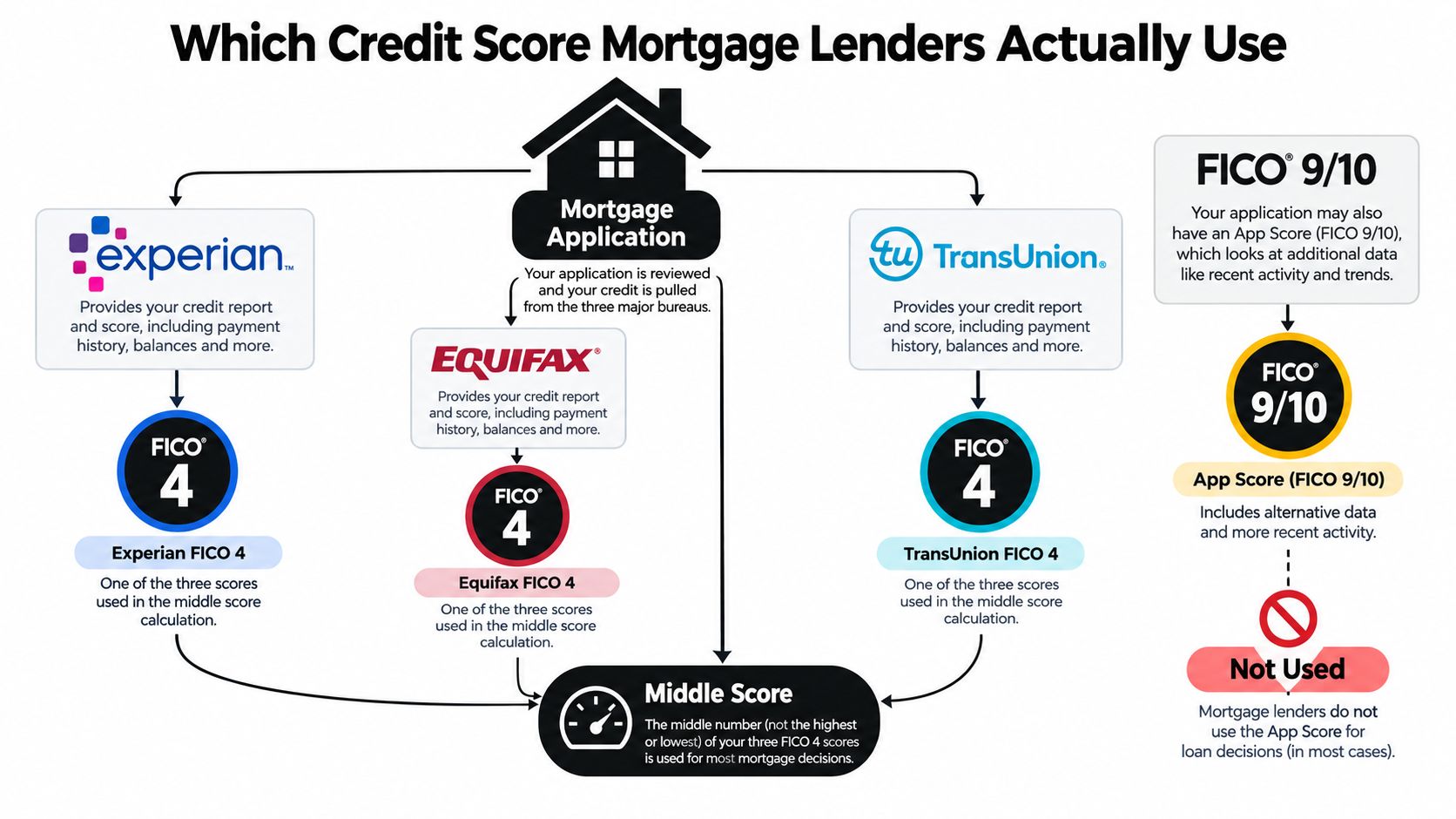
The Consumer Financial Protection Bureau's mortgage credit score guidance explains that most mortgage lenders use FICO scores and generally review information from Equifax, Experian, and TransUnion. Each bureau may receive different account information or update an account at a different time, so the resulting scores can vary even when the underlying consumer is the same.
Start with the report, not the app number
A mortgage lender traditionally requests a tri-merge credit report, meaning information from all three nationwide credit-reporting companies is brought together. The lender then applies the relevant mortgage scoring models to the bureau data available at the time of the credit pull.
That distinction matters if you recently paid down a credit card, disputed a collection, opened a buy-now-pay-later account, or corrected a late payment. An app may refresh from one bureau or use a different model, while the lender's report may contain a different balance, account status, or update date.
Mortgage preparation should therefore focus on the accuracy and stability of your full credit file. A separate guide from EHF Mortgages credit score guide can also help readers compare how mortgage scoring questions are explained in another lending context. For practical preparation, review these Superior Credit Repair approval tips before assuming that any single displayed score predicts approval.
The Three Bureau-Specific FICO Mortgage Models Explained
Traditional mortgage underwriting uses bureau-specific FICO models. The commonly identified mapping is FICO Score 5 from Equifax, FICO Score 2 from Experian, and FICO Score 4 from TransUnion, although Fannie Mae names these models in its selling guidance as Equifax Beacon 5.0, Experian/Fair Isaac Risk Model Version 2, and TransUnion FICO Risk Score Classic 04.
These scores are often called Classic FICO mortgage scores. They're different from the general-purpose FICO Score 8 that many consumers see in banking apps and credit-monitoring services. They also differ from newer FICO versions and from VantageScore products.
The difference isn't merely a product label. A scoring model is a set of rules that evaluates information in a credit report. Two models can review the same broad credit history and assign different importance to account age, collections, revolving utilization, payment behavior, or recent credit activity. A bureau can also have information that another bureau doesn't have.
Why the same borrower can receive different scores
Suppose one bureau reports a collection while another bureau hasn't updated that account. Or suppose a credit card balance was paid down after one bureau's reporting date but before another bureau's update. The scores may differ because the underlying data differs, even before the scoring models apply their separate calculations.
Most FICO scores use a 300-to-850 scale, but the scale alone doesn't tell you which model produced the number. The report data and the model both matter. That's why a higher consumer score doesn't automatically replace a mortgage-specific score during underwriting.
Fannie Mae's current credit score requirements identify the established bureau-specific models for applicable automated and manually underwritten loans. Readers who want a plain-language explanation of the broader scoring process can review the Superior Credit Repair credit score breakdown, but the practical mortgage lesson is simple: check all three reports and ask the lender which models apply to your loan.
A credit repair or credit restoration review should examine the actual accounts behind the scores. That includes inaccurate late payments, collections, charge-offs, account ownership problems, incorrect balances, and outdated information. The purpose isn't to challenge accurate negative information just because it lowers a score. It's to identify reporting that may be inaccurate, incomplete, unverifiable, or misleading.
How Lenders Calculate Your Mortgage Credit Score
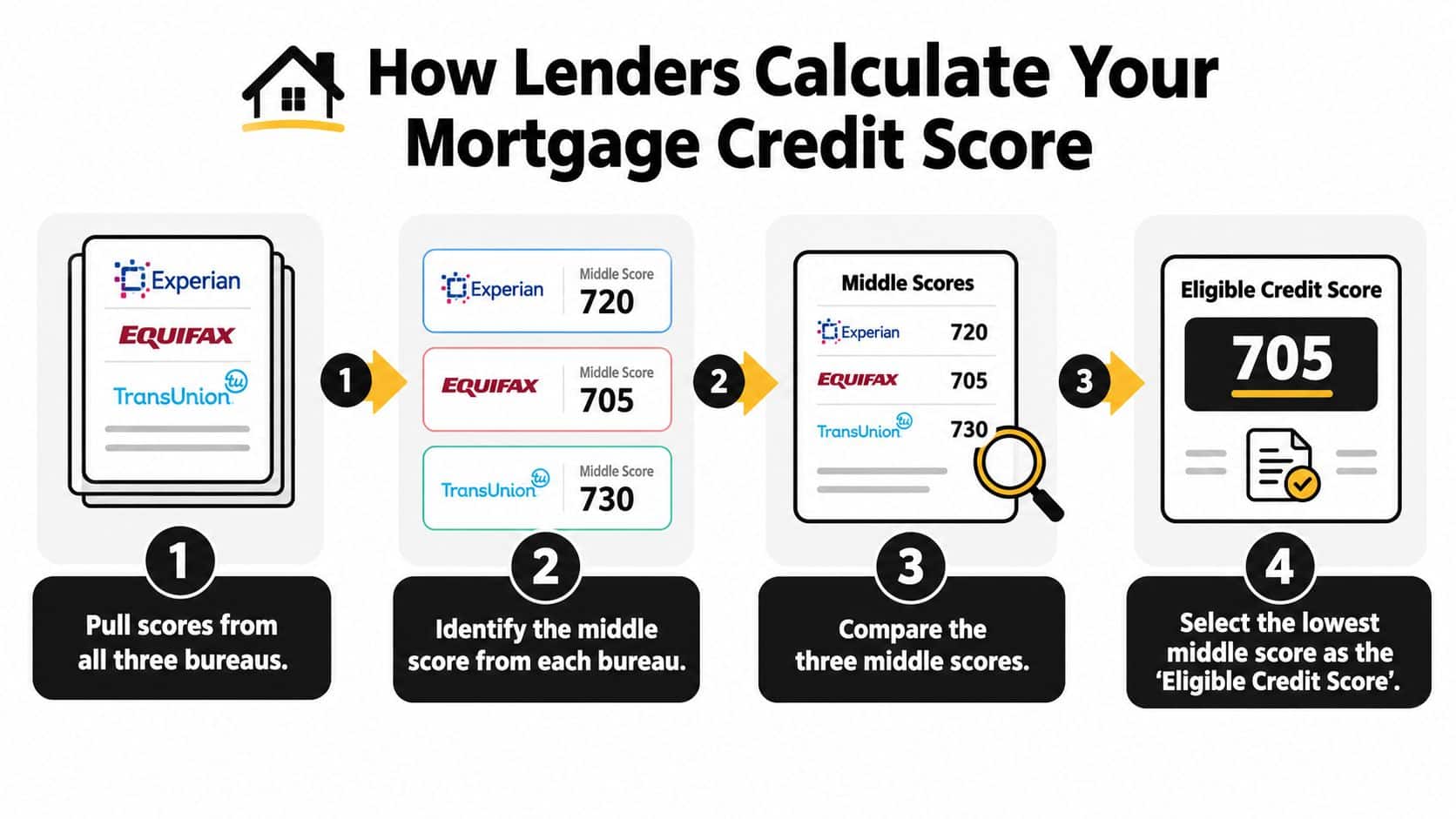
Once a lender has the relevant scores, the lender generally selects a representative score for each borrower. For one borrower with three available scores, the representative score is the middle score, not the average and not necessarily the highest score.
For example, if the relevant scores are 680, 700, and 720, the middle score is 700. The lender doesn't add the three scores and divide by three. The middle score can affect underwriting eligibility and pricing, including loan-level price adjustments.
The selection process for one borrower
The process generally looks like this:
- Pull the bureau data. The lender obtains information from the applicable credit repositories.
- Identify available scores. The lender reviews the relevant mortgage score from each bureau.
- Select the middle score. With three scores, the middle value represents that borrower.
- Apply underwriting rules. The lender considers the representative score along with the rest of the file.
If only two scores are available for one borrower, the lower score is generally used under Fannie Mae's mortgage-credit-score procedure. This is one reason a missing or incomplete bureau record shouldn't be ignored before applying.
Joint applications require another question
A joint mortgage application can involve more than comparing two people's highest scores. Each borrower may first receive an individual representative score. Under one Fannie Mae Desktop Underwriter framework, effective September 2021, the system uses the average of each borrower's median score for certain multiple-borrower minimum-score testing, with 0.5 or higher rounded up. Each borrower's median is the middle of three scores or the lower of two scores.
That rule doesn't mean every lender or loan program uses the same calculation for every underwriting decision. FHA, VA, USDA, conventional, portfolio, and jumbo lenders may have different procedures or overlays. Couples should ask which underwriting system and loan rules apply instead of assuming that one applicant's strongest score controls the file.
A first-time buyer who needs program-specific context may also benefit from speaking with a veteran FHA real estate agent. Before authorizing a mortgage credit pull, review these credit check tips for mortgages and ask the lender which score calculation will be used.
Why Your Mortgage Score Differs From Your App Score
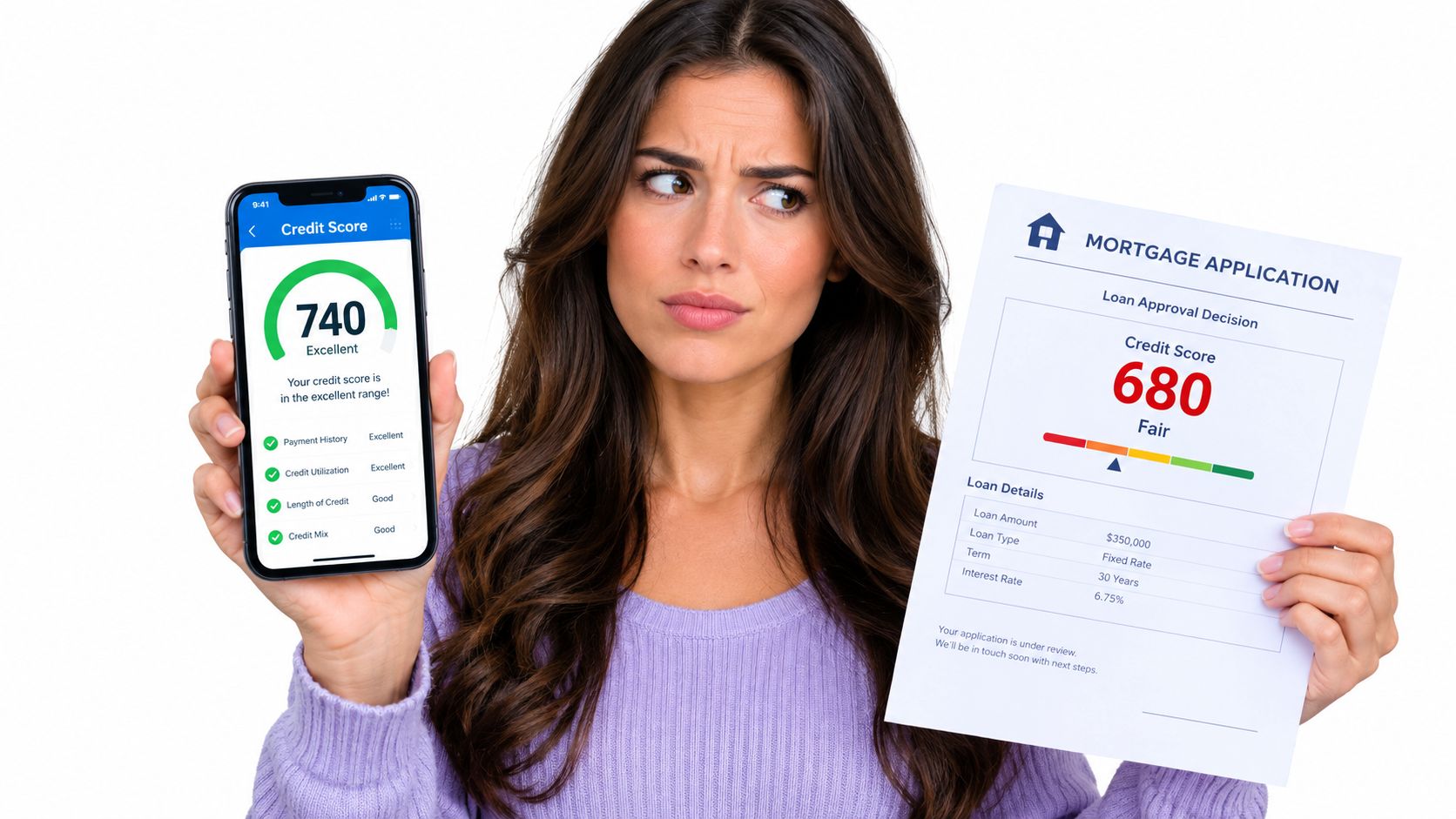
A difference between an app score and a mortgage score usually has a practical explanation. The scores may come from different models, different bureaus, different report dates, or different underlying account information.
An app may display VantageScore 4.0 or a newer general-purpose FICO version. A traditional mortgage process may use FICO Score 2, FICO Score 4, and FICO Score 5 from the three bureaus. Even if both services use information that appears similar, the models can evaluate collections, revolving balances, payment history, and account age differently.
Timing can change the result
Credit reporting isn't a single instant event. A card issuer may report a balance before you make a payment, or a collection agency may update an account after your monitoring service has refreshed. A dispute may also be under investigation while one report still shows the original information.
That creates several common situations:
- Paid-down cards: Your app may show a lower balance before the mortgage report captures the change, or the reverse may occur.
- Disputed errors: One bureau may reflect a correction while another still lists the disputed information.
- New accounts: A buy-now-pay-later account or other recently opened account may appear in one report before the others.
- Resolved collections: A furnisher's update may not reach every report at the same time.
The right response isn't to chase whichever number looks highest. Start with understanding credit bureau discrepancies and compare the report date, bureau, model, account balances, and account status.
Practical rule: Ask your lender which model, bureau scores, and report date were used. That question is more useful than asking whether an app score is “good enough.”
A mortgage score that differs from an app score doesn't prove fraud, and an app score increase doesn't guarantee a matching mortgage increase. Focus on accurate reporting, low revolving balances, consistent payments, and documentation that explains recent changes.
The Evolving Landscape of Mortgage Credit Scoring Models
Mortgage scoring is moving from one traditional framework toward several federally approved model options, but the transition is gradual. In October 2022, the Federal Housing Finance Agency announced validation and approval of FICO 10T and VantageScore 4.0 for potential use by Fannie Mae and Freddie Mac. The agency also described a tri-merge report using Equifax, Experian, and TransUnion, along with a bi-merge report using two of the three bureaus. FHFA's credit score model fact sheet explains that implementation requirements affect which models and reporting structures are available in a particular transaction.
VantageScore 4.0 isn't universal
A common assumption is that every mortgage lender now uses VantageScore 4.0. That isn't correct. Under the interim framework, lenders may choose between Classic FICO and VantageScore 4.0 for loans delivered to Fannie Mae and Freddie Mac, but the policy doesn't require every lender or every loan channel to select VantageScore.
The distinction matters because the loan's destination and the lender's participation can affect the available process. FHA, VA, USDA, portfolio, and jumbo lending may involve different requirements. Even within conventional lending, a participating lender and a nonparticipating lender may not use the same model at the same stage.
Fannie Mae's guide lists Classic FICO, VantageScore 4.0, and FICO 10T as FHFA-approved models while also stating that its traditional underwriting process currently requires the established bureau-specific Classic FICO versions for applicable loans. Mortgage scoring is therefore evolving, not settled.
How to plan around the transition
If an app shows VantageScore 4.0, that information can help you monitor changes, but it doesn't tell you which model your chosen lender will use. Before making a major credit move, ask:
- Which loan program am I applying for?
- Will the lender use Classic FICO or VantageScore 4.0?
- Will the report be tri-merge or bi-merge?
- Which accounts or balances need documentation?
- Does the lender impose standards beyond the program's published requirements?
The FHFA policy information on credit scores provides additional context for the evolving framework. Your strategy should be based on the actual lender and loan program, not on the assumption that a policy option has become a universal industry rule.
How Mortgage Underwriters Evaluate Your Full Credit Profile
A mortgage lender doesn't reduce approval to one score threshold. The representative score is important, but it's one input in a broader risk assessment.
Fannie Mae's guidance identifies the classic mortgage models for applicable automated and manually underwritten loans and requires the lender to request scores through a three-in-file merged report. Its Desktop Underwriter system analyzes the underlying credit-report data, not merely the number printed beside the score.
The file contains more than a score
Underwriters may examine payment history, outstanding obligations, credit depth, recent inquiries, and debt-to-income capacity. Debt-to-income ratio compares required monthly debt payments with qualifying income, so a strong score cannot automatically compensate for excessive monthly obligations or unverifiable income.
The same principle applies to negative accounts. A recent delinquency, collection, charge-off, repossession, or unresolved reporting error may require explanation or documentation. A high score doesn't automatically erase the significance of recent payment problems or unstable credit activity.
A lender may also review:
- Payment history: Whether accounts were paid as agreed and whether recent delinquencies appear.
- Revolving utilization: How much of available revolving credit is being reported.
- Credit depth: How much usable history supports the application.
- Recent inquiries and accounts: Whether new borrowing creates additional risk.
- Debt-to-income capacity: Whether income can support existing and proposed obligations.
These factors affect conventional mortgage preparation and can also matter for FHA, VA, and USDA loan preparation. Rental screening and apartment approval may use different scoring methods, but accurate reports and stable payment habits remain valuable across financing decisions.
The practical goal is a lender-ready credit profile, not a perfect-looking app number. Keep documentation for corrected accounts, avoid unnecessary new credit, and discuss debt-to-income concerns with the lender early.
Taking Action to Prepare Your Credit for Mortgage Approval
Credit preparation works best when you start with the reports. Obtain information from all three bureaus, compare account names, balances, dates, payment histories, collections, charge-offs, and ownership details, then separate factual errors from accurate negative information.
A legitimate dispute must identify a specific accuracy problem. The Consumer Financial Protection Bureau's dispute guidance explains that consumers generally should contact both the credit reporting company and the furnisher, such as a creditor or collection agency.
Build a documented review process
A credit reporting company generally has 30 days to investigate a dispute. In certain circumstances, the period can extend to 45 days, including when additional relevant information is submitted during the investigation or the dispute follows receipt of an annual credit report. After the investigation, the company generally has five business days to send written results.
If a furnisher determines that information is wrong or can't be verified, it must update or remove the information and notify the reporting companies to which it supplied the inaccurate data. That process is different from asking a company to remove accurate information just because it makes mortgage approval harder.
A careful review may include:
- Late payments: Check whether the reported date, status, and account ownership are accurate.
- Collections: Confirm the original creditor, balance, dates, and reporting status.
- Charge-offs: Compare the account history with your records and settlement documents.
- Medical accounts: Verify whether the item belongs to you and whether the reported details are correct.
- Revolving balances: Review what was reported, not only what was due on the payment date.
- Recent corrections: Keep letters, statements, and investigation results for lender review.
Paying down revolving balances before the reporting date can help the lender see lower reported utilization, although results vary by model, bureau timing, and account activity. Use the best ratio for mortgage pricing as a planning topic to discuss with a qualified professional, not as a promise of a particular outcome.
Begin before the application
Starting several months before a mortgage application gives you time to identify errors, submit documentation, wait for investigations, and establish stable habits. Avoid opening unnecessary accounts, keep payments current, and ask the lender how recently corrected information should be documented.
Superior Credit Repair can review reports, organize factual documentation, and support a compliance-focused dispute and rebuilding process. Results vary based on the credit file, documentation, creditor responses, account history, and current behavior, so responsible credit restoration doesn't promise a deletion, score increase, or mortgage approval.
Frequently Asked Questions About Mortgage Credit Scores
Will paying a collection immediately improve my mortgage score?
Not necessarily. The result depends on the scoring model, the account's reporting status, and when each bureau updates its information. Paying an account also doesn't automatically remove accurate history.
Should I wait for VantageScore 4.0 to become standard?
No. Lender participation and loan-program rules vary, and Classic FICO remains part of the traditional process. Ask your chosen lender which model applies.
Does a high app score guarantee mortgage approval?
No. Underwriting also considers payment history, utilization, obligations, credit depth, income documentation, and debt-to-income capacity.
When should I review my credit?
Start several months before applying so you have time to check reports, dispute genuine errors, document corrections, and build stable habits. If you're also learning terms such as what HUD means in real estate, keep the focus on the specific loan program and lender requirements.
Superior Credit Repair can review your credit reports, help identify inaccurate or questionable information, and explain a step-by-step plan for mortgage readiness without promising a specific result. Visit Superior Credit Repair to request a credit analysis or consultation and better understand your options before speaking with a lender.
If this information helped you better understand your credit report or your next steps, we would appreciate your honest feedback. You are welcome to share your experience with Superior Credit Repair on our Google Business Profile. Share your feedback on Google.