


Below 10% is generally the optimal credit utilization ratio for borrowers seeking the strongest mortgage pricing, while below 30% remains the common baseline for good scores. Lower ratios generally perform better, although the 30% guideline isn't a hard cutoff.
Have you ever checked your credit score, felt reassured by the number, and then learned that a lender was also concerned about your credit card balances? That experience can feel confusing, especially when you've paid on time and saved carefully for a down payment. A strong score matters, but it doesn't tell the whole story.
Table of Contents
- Introduction – The Hidden Factor in Your Mortgage Dreams
- What Is Credit Utilization and How Is It Calculated
- Why Utilization Weighs Heavily in Credit Scoring Models
- Target Ratios for FHA, VA, and Conventional Loans
- Strategic Timing and Payment Cycles for Lower Ratios
- Addressing Other Credit Factors Alongside Utilization
- Next Steps – Building a Lender-Ready Credit Profile
Introduction – The Hidden Factor in Your Mortgage Dreams
A first-time homebuyer might spend months building savings, comparing FHA, VA, USDA, and conventional loan options, and checking a credit score. Then a lender reviews the credit report and notices that one card is carrying a balance close to its limit. The buyer hasn't missed a payment, yet the application may still need closer review because the reported balance suggests heavy reliance on revolving credit.
Credit utilization is the portion of available revolving credit that appears to be in use. FICO-linked guidance places amounts owed at about 30% of a FICO Score, while payment history accounts for about 35%. That means perfect payment habits don't automatically eliminate the effect of high balances. You can read a plain-English explanation of what affects your credit score before deciding which part of your file needs attention.
Mortgage perspective: A score is a snapshot of your credit standing, but utilization helps show how much of your available revolving credit you rely on.
The practical opportunity is that utilization can often be managed through legitimate, documented habits. Paying down balances, understanding reporting dates, reviewing each card separately, and correcting inaccurate account information can improve the way your file is presented. None of these steps guarantees a score change, mortgage approval, deletion, or a lower interest rate. Results vary according to your credit history, documentation, creditor responses, and current behavior.
This guide focuses on the best credit utilization ratio for mortgage readiness, the math behind it, and the timing decisions that can matter before a lender pulls your credit.
What Is Credit Utilization and How Is It Calculated
How can the same card debt present a different utilization picture to a mortgage lender? The answer is the relationship between revolving balances and their credit limits.
Calculate credit utilization by dividing revolving balances by revolving credit limits. Credit cards and lines of credit generally belong in this calculation. Mortgages, auto loans, and other installment accounts do not count toward revolving utilization.
For example, $3,000 in balances on $10,000 of total limits equals 30% utilization. The same $3,000 spread across $30,000 of limits equals 10% utilization. The debt amount stays the same, but the ratio changes because available credit changes. A person with $900 on a $3,000 limit is already at 30%, even if that balance seems manageable by itself. The calculation is explained in FICO's credit utilization guidance.
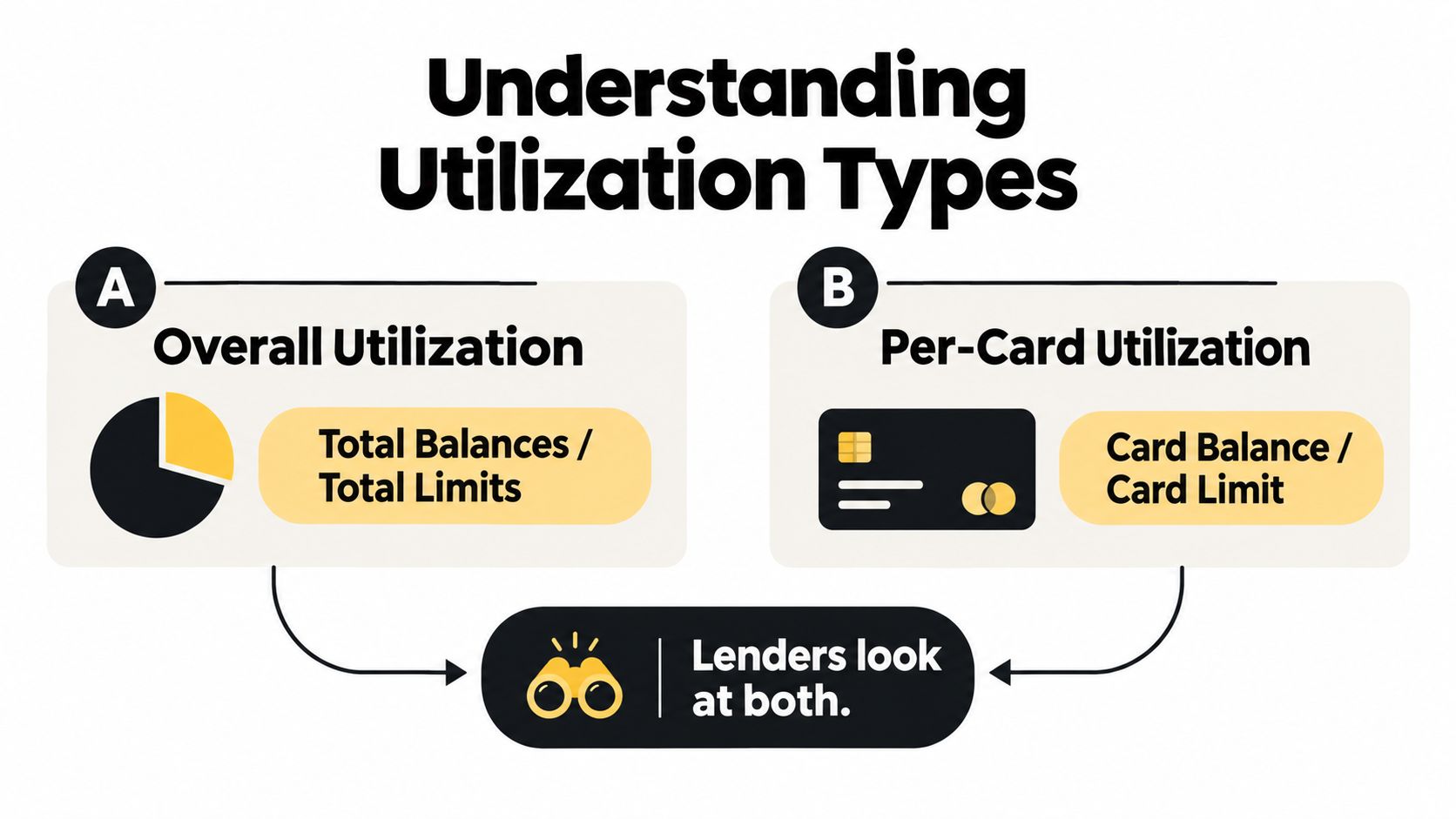
Lenders and scoring systems may view utilization in two ways:
- Overall utilization: Add balances across revolving accounts, then divide by the sum of their limits.
- Per-card utilization: Divide each card's balance by that card's individual limit.
A low overall ratio can conceal a nearly full card. A high-limit card with a small balance may dilute the combined figure while another card carries significant concentration. Review both calculations before a mortgage credit pull, because checking only the total can hide an account-level concern.
FICO and VantageScore use different scoring formulas, so utilization may affect results differently. Equifax's explanation of VantageScore ranges provides context for that model. The practical takeaway is to calculate the ratio using the balances and limits likely to appear on the report, then allow time for creditors to report updated information before underwriting review. A lower reported ratio does not guarantee approval, a score increase, or better loan terms.
Why Utilization Weighs Heavily in Credit Scoring Models
Credit models treat revolving utilization as a risk signal because it shows how much of a borrower's available card capacity is occupied. A low balance relative to the limit can suggest financial flexibility. A high balance may indicate that the borrower has less room to absorb an emergency, even when payments are current.
The weighting differs by scoring model, but the practical message is consistent. FICO-linked educational material places amounts owed at about 30% of a FICO Score, and VantageScore 3.0 assigns utilization 20% of its score. Those figures don't mean utilization determines your entire credit profile. Payment history, account age, new credit, credit mix, collections, late payments, and charge-offs can all matter too.
The target is low, not perfect
The general benchmark is below 30%, but consumers aiming for stronger mortgage positioning often work toward single-digit utilization. Experian's guidance reports average utilization of 15.2% for very good scores and 7.1% for exceptional scores, supporting the practical value of a lower target for borrowers seeking favorable pricing or trying to offset other weaknesses in a file. The data appears in Experian's credit utilization education.
A zero balance isn't automatically the best strategy. VantageScore guidance recommends staying below 30% if possible while remaining above 0%, because some scoring information comes from active card use. That doesn't mean you should carry costly interest. A consumer can use a card lightly, allow a small balance to report, and pay according to the account terms. The right approach depends on the issuer's reporting behavior and the borrower's ability to pay in full.
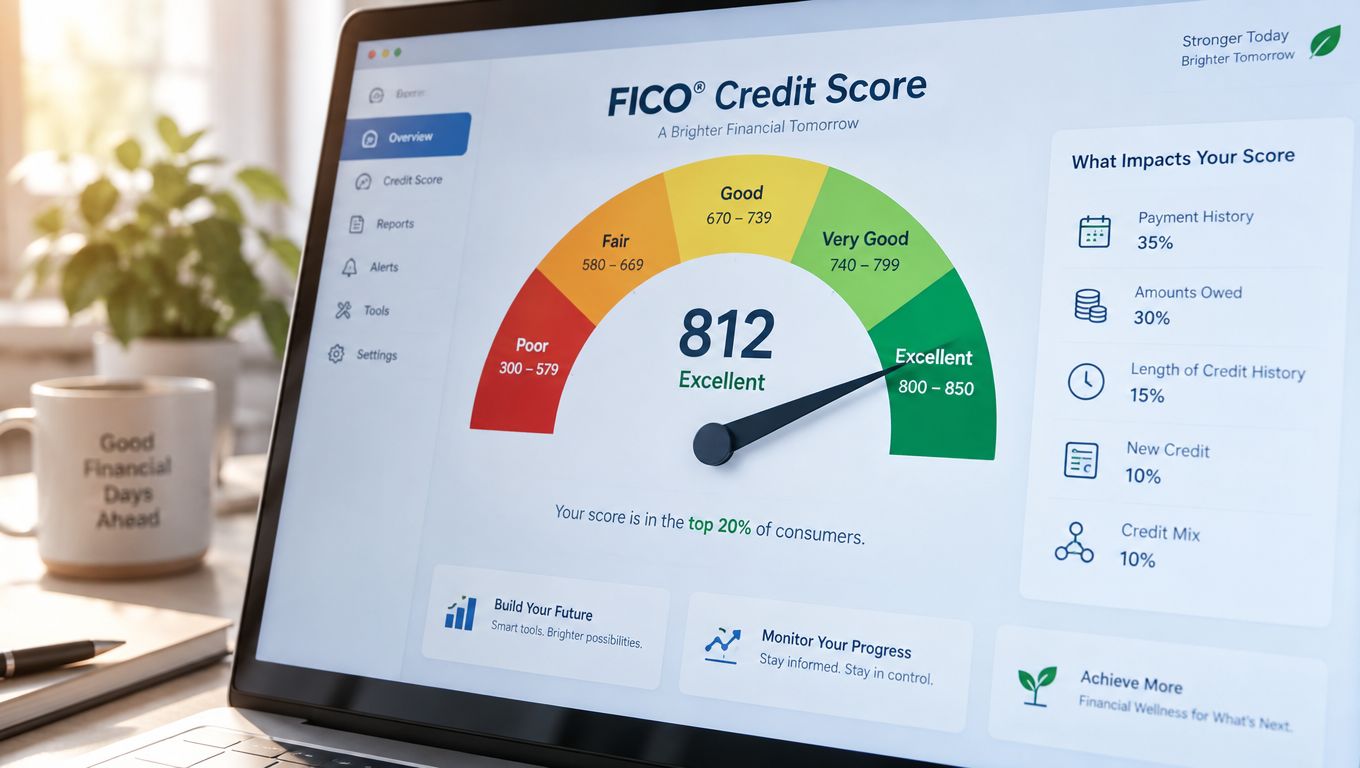
Mortgage applicants should also avoid assuming that a temporary high balance is harmless. The reported balance can affect the score used in a lender's review, even if the borrower plans to pay the bill before the due date. A lower balance can help, but it won't erase a verified late payment, collection, or charge-off. Credit repair is a broader documentation and dispute process, not a substitute for consistent repayment.
Target Ratios for FHA, VA, and Conventional Loans
Mortgage programs don't create separate mathematical definitions for utilization. Your revolving balances and limits still produce the same ratio. The difference is how each lender evaluates the complete file, including payment history, debt-to-income concerns, income documentation, reserves, loan requirements, and overall stability.
FHA preparation may be more forgiving in some circumstances, but that doesn't make high utilization irrelevant. VA applicants may benefit from program-specific eligibility features, yet revolving debt behavior can still influence a lender's risk assessment. Conventional borrowers seeking the best available pricing may have a stronger reason to pursue single-digit utilization, particularly when other parts of the file need support.
| Loan Type | General Utilization Guideline | Impact on Interest Rates |
|---|---|---|
| FHA | Below 30% is a practical baseline, with below 10% stronger | Lower utilization may support a cleaner overall profile, but pricing depends on the full application |
| VA | Below 30% is a practical baseline, with below 10% stronger | Utilization can contribute to lender confidence, while eligibility and underwriting factors remain important |
| Conventional | Below 30% is a practical baseline, with below 10% often preferred for stronger scoring | Lower reported balances may help borrowers pursue better pricing, but no ratio guarantees a rate |
A payment plan for mortgage applicants
Start by listing every revolving account, its current balance, its credit limit, and the date the issuer typically reports. Don't rely only on a banking app's current balance. The lender and scoring model may see a different reported figure.
Next, prioritize the card with the highest per-card utilization, not merely the account with the largest dollar balance. Then calculate the combined ratio to understand the larger picture. A paydown that reduces one nearly full card may improve the file's presentation even if the overall reduction is modest.
Finally, confirm timing with the card issuer and avoid new charges before the lender pulls credit. If you're unsure how to organize the process, review guidance about credit fix before home buying and discuss the plan with your mortgage professional. Credit repair should never involve disputing accurate information just to obtain a temporary advantage.
Strategic Timing and Payment Cycles for Lower Ratios
Many borrowers confuse the payment due date with the statement closing date. The due date determines when payment must arrive under the card agreement. The statement closing date marks the end of a billing period, and the balance around that point may be the amount reported to the credit bureaus.
That distinction explains why someone can pay a card in full every month and still see high utilization. If substantial spending appears on the statement before the payment is due, the credit report may show that larger balance. A lender pulling the report afterward may evaluate the reported amount rather than the borrower's intention to pay.
Build timing into the plan
Review several statements for each card and identify the normal closing date. Then consider making an early payment before the statement closes, followed by any required payment by the due date. Some consumers divide payments during the month, which can reduce the balance present at reporting time. The strategy must fit your cash flow and shouldn't cause missed payments elsewhere.
Requesting a credit limit increase can also lower utilization if the issuer approves it and the balance doesn't rise. However, an increase isn't guaranteed, and a request may involve a credit review. Opening a new card solely to expand available credit can create new-account considerations and isn't automatically appropriate before a mortgage application.
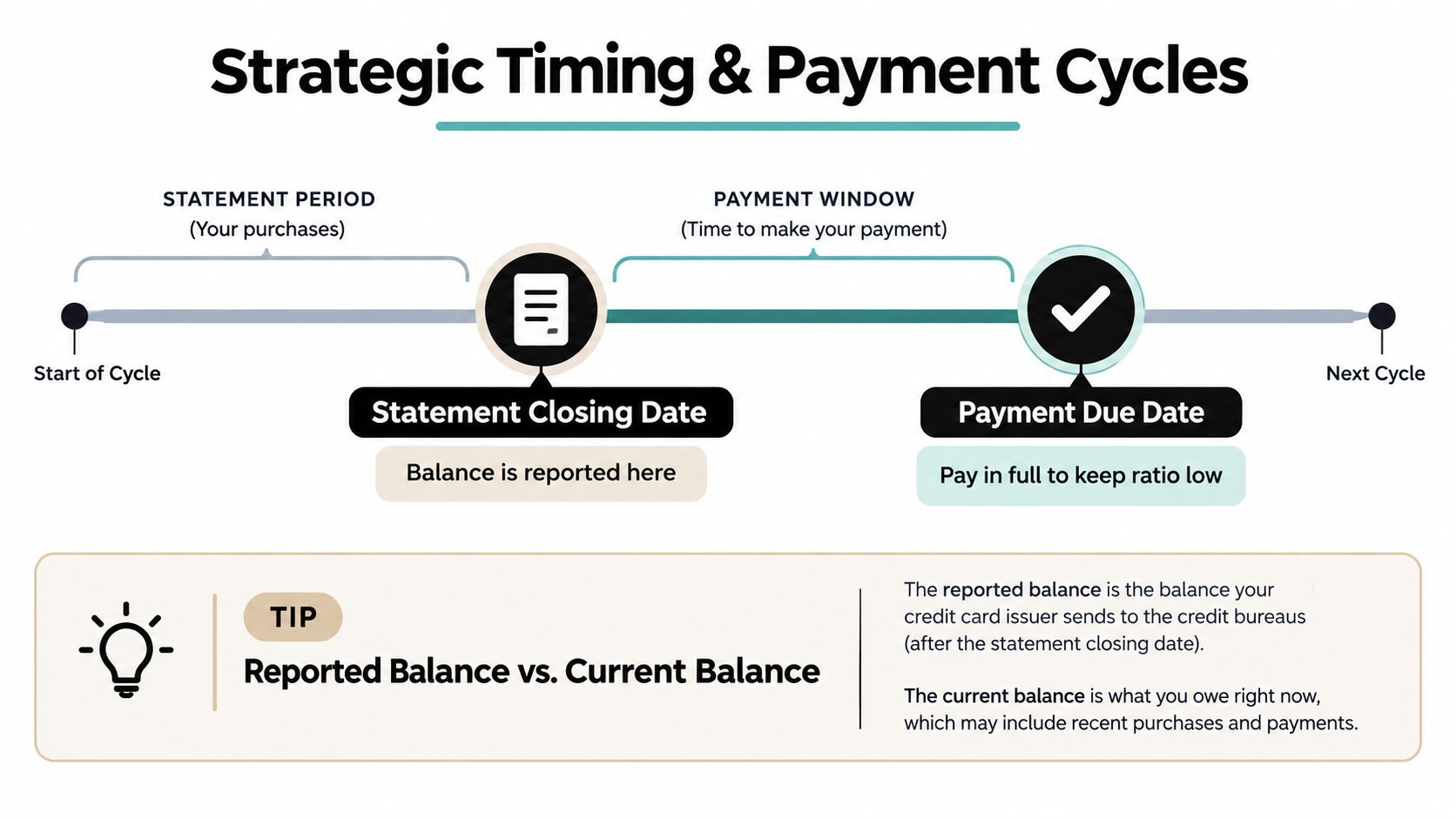
Reported balance versus current balance: Your card dashboard can show today's amount, while the credit report may show the balance sent during an earlier reporting cycle.
Timing also interacts with other credit concerns. A low utilization ratio won't make an inaccurate collection disappear, and a paid card balance won't correct an incorrectly reported late payment. Before applying, a borrower may need both a balance-management schedule and a review of collections, charge-offs, repossessions, or medical collection entries.
A localized resource such as a Bellevue credit utilization strategy can help explain how reporting schedules fit into a larger mortgage-readiness plan. The important point is to plan before the lender's pull, not to depend on a last-minute payment that hasn't reached the credit report.
Addressing Other Credit Factors Alongside Utilization
Could a low utilization ratio still leave a mortgage application with unanswered questions? Yes. Card balances are only one part of a credit file. Late payments, collections, charge-offs, inaccurate personal information, and accounts that cannot be verified may affect review even after revolving balances fall.
As noted earlier, utilization carries significant weight in major scoring models. It should therefore be handled alongside payment history and reporting accuracy, not treated as a stand-alone approval strategy. A lower ratio can improve one part of the file without correcting a disputed account or an inaccurate late-payment record.
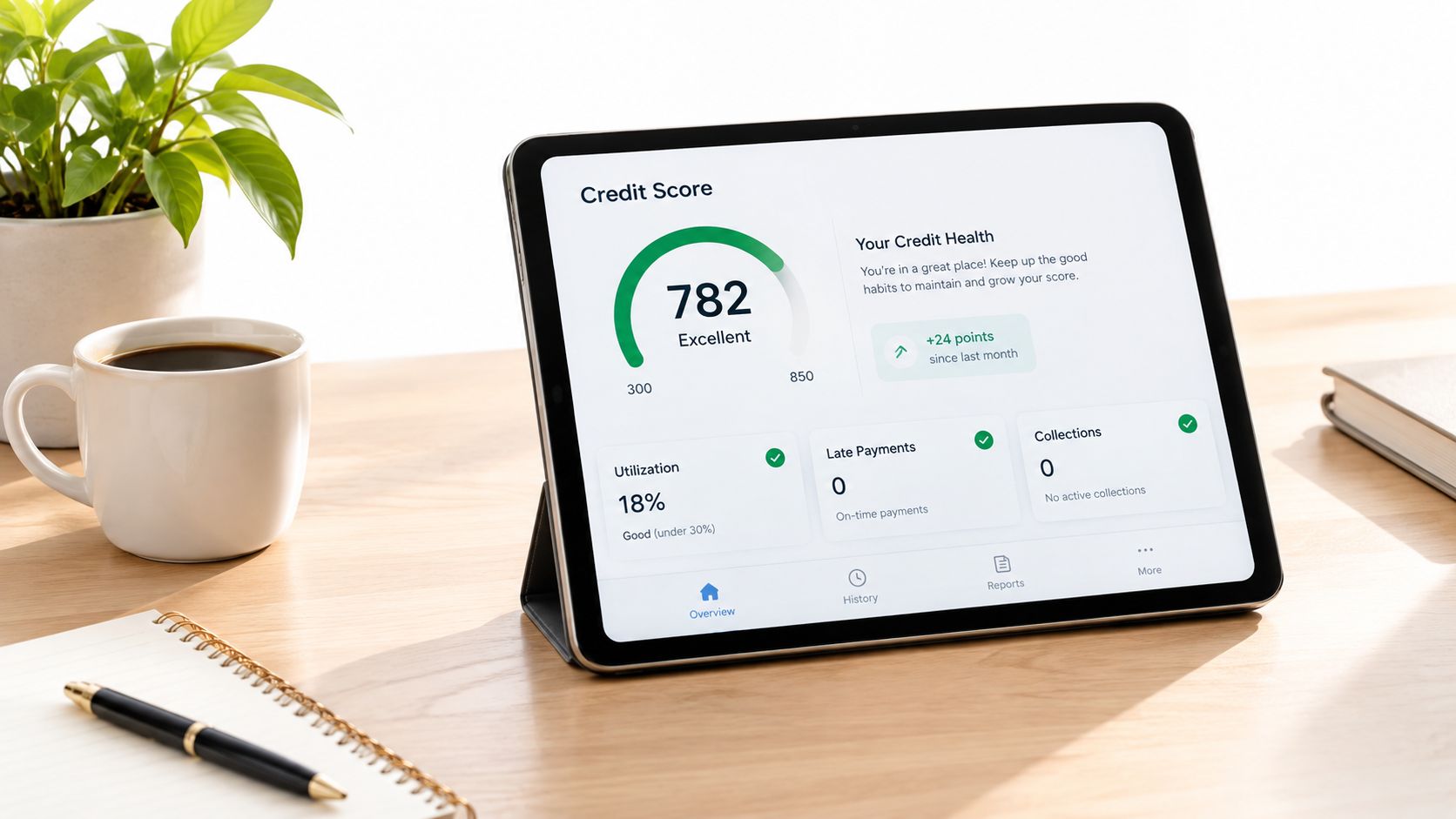
Pair balance control with file accuracy
A compliance-first review begins with documents. Obtain the credit reports, compare account details with statements and other records, and mark information that is inaccurate, outdated, misleading, or unverifiable. A dispute should identify the specific problem, include supporting evidence, and use the appropriate reporting or legal channel. Accurate negative information is not removed only because a borrower is preparing for a mortgage.
Examples include a collection assigned to another person, a late payment attached to the wrong account, incorrect dates on a charge-off, or a reported balance that conflicts with creditor records. Resolving a reporting issue can take time, so mortgage planning should allow for review and verification rather than rely on a last-minute correction.
Borrowers can check LendingXpress credit requirements to see why lender standards may differ. Requirements can change, and the lender makes the final decision. A credit score or utilization target alone cannot guarantee approval.
Superior Credit Repair describes its services as a structured review, dispute, verification, and rebuilding process. Its assistance may help organize credit report errors, collections dispute help, late payment dispute help, and charge-off dispute help, but outcomes vary with the file, evidence, creditor response, and continuing credit behavior. First-time buyers can review first-time homebuyer credit improvement before selecting an approach.
Next Steps – Building a Lender-Ready Credit Profile
Mortgage readiness starts with a complete picture, not a single score. Gather your reports, list every revolving limit and balance, check each card's reporting pattern, and set a realistic target. For many applicants, below 30% is a reasonable baseline, while below 10% can present a stronger utilization profile.
Use the following sequence:
- Review the file: Look for inaccurate, outdated, unverifiable, or misleading accounts and preserve supporting documents.
- Calculate both ratios: Check overall utilization and each card's individual utilization.
- Schedule payments: Aim for balances to be reduced before the statement closing date while still paying by the contractual due date.
- Avoid new risk: Don't add unnecessary applications, large purchases, or new revolving debt before a lender reviews the file.
- Address negative items: Dispute genuine errors through documentation-based processes, and manage accurate accounts responsibly.
- Coordinate with the lender: Ask which credit pull and underwriting milestones matter so your timing plan matches the application.
A lender-ready profile isn't created overnight. It develops through stable payments, controlled revolving balances, accurate reporting, and patience. FHA, VA, USDA, conventional, rental, auto, and personal-financing decisions can each involve different standards, so no company can promise approval, deletion, an immediate score increase, or a particular interest rate.
Consumers who want a structured review can learn more about mortgage readiness with Superior Credit Repair. Superior Credit Repair Online provides educational credit guidance for people preparing for homeownership, refinancing, or rebuilding after hardship. A consultation can help clarify whether the priority is utilization planning, credit report accuracy, dispute documentation, or longer-term rebuilding.
Was this guide helpful?
If this information helped you better understand your credit report or your next steps, we would appreciate your honest feedback. You are welcome to share your experience with Superior Credit Repair on our Google Business Profile. https://share.google/ePRpFvtCXwCjiJwOK
Superior Credit Repair can review your credit report, help identify inaccurate or questionable items, and explain a step-by-step plan for improving your utilization and broader credit profile. Visit Superior Credit Repair to request a free credit analysis or consultation and better understand your options before a mortgage application.