


The call usually comes at a bad time. You're at work, in the grocery store, or trying to figure out how to get your kids where they need to go. The lender says the vehicle has been taken back, or a tow notice shows up, or you learn the car was sold and there's still money owed. People land in the same mental place after that. They assume the credit damage is permanent and that buying a home later is off the table.
That assumption is wrong.
A repossession is serious, but it's not the end of your credit profile. It's a problem with two separate parts. First, there's the credit report entry tied to the auto loan. Second, there's the deficiency balance, which is the amount still owed after the vehicle is sold. Those two issues affect mortgage readiness in different ways, and treating them like one big blur is where people make expensive mistakes.
At Superior Credit Repair, we tell clients to slow down and get organized. Panic payments, random disputes, and opening too many new accounts usually make things worse. A better approach is simple. Verify the reporting. Challenge anything inaccurate, outdated, unverifiable, or misleading. Resolve the remaining balance strategically. Add controlled positive accounts. Protect every payment going forward. Then build a lender-ready file that makes sense for FHA, VA, USDA, or conventional loan preparation.
Table of Contents
- Starting From a Repossession Without Losing Direction
- How a Repossession Is Dated on Your Credit Report
- Checking the Repo Entry and Filing the Right Disputes
- Resolving the Deficiency Balance Behind the Repo
- Adding Positive Tradelines After a Repossession
- Building Habits That Keep Your Recovery on Track
- Preparing a Lender-Ready Credit Profile and Common Questions
Starting From a Repossession Without Losing Direction
A borrower in this situation usually has three concerns at once. They need transportation, they're dealing with collection pressure, and they're worried a future lender will only see the repo and stop there. That fear leads to rushed decisions, especially if someone hopes to buy a home in the next few years.
The better way to think about how to rebuild credit after a repossession is as an ordered recovery plan. One track deals with what's being reported. The other track deals with what's still owed. If you ignore the report, bad data can sit there untouched. If you ignore the balance, an underwriter may view it as an active liability even if the repossession itself is old.
Treat the Repo as Two Problems
People often focus only on the embarrassment of losing the car. Lenders focus on documentation. They want to know whether the account is being reported accurately and whether the unpaid balance is still hanging over your monthly budget.
That's why the first move isn't opening new credit. It's getting clear on the facts.
Practical rule: Don't try to rebuild on top of bad reporting you haven't reviewed yet.
If your situation involved a voluntary surrender, the credit consequences still need close review. The reporting timeline and the remaining debt matter more than the label many consumers use. If you're sorting out the credit impact of returning your car, look at the file the same way you would after an involuntary repo. Verify the dates, balances, and account status before doing anything else.
Use a Sequence, Not Panic
A strong recovery path usually looks like this:
- Pull all three reports and identify how the repo is listed.
- Verify the date of first delinquency and the current balance.
- Dispute errors early if dates, balances, ownership, or duplicate reporting are wrong.
- Resolve the deficiency balance with written terms if money is still owed.
- Add positive tradelines carefully instead of applying for everything at once.
- Protect current accounts so no new late payments undo the progress.
- Prepare for underwriting by shaping a file that looks stable, documented, and current.
A repossession doesn't disappear overnight, and no ethical credit repair company should suggest otherwise. But older damage loses power when you stop adding new damage and start building stronger history around it.
How a Repossession Is Dated on Your Credit Report
The date that matters most is usually not the day the lender took the vehicle.
A repossession can remain on your credit report for seven years from the first missed payment that led to the repossession, not from the date the car was recovered, according to Experian's explanation of repossession reporting. Nolo explains the same timing rule under the Fair Credit Reporting Act and ties it to the legal reporting limit for negative items in its guide on how long negative information stays on a credit report.
That distinction controls your timeline for disputes, rebuilding, and mortgage planning.
What to Look For on the Tradeline
When you review the auto loan account, you're trying to separate the date of first delinquency from later events like repossession, charge-off, or collections. The lender may report the loan with a repossession remark, a charged-off status, a balance, or a zero balance if the debt was transferred.
Here's the field-level view that matters most.
| Report Field | What It Records | Why It Matters |
|---|---|---|
| Account status | Whether the loan is open, closed, charged off, or marked with repossession language | Tells you how the lender is characterizing the account today |
| Date of first delinquency | The first missed payment after which the account was never brought current | Drives the seven-year reporting window |
| Current balance | Amount still shown as owed on the original tradeline | Helps you check whether the debt is still active or has been transferred |
| Creditor name | Original lender or current reporting entity | Helps catch ownership errors or mixed reporting |
| Remarks or comments | Notes such as repossession, voluntary surrender, or transferred/sold | Provides context for how underwriters may read the file |
Why Duplicate-Looking Entries Show Up
Consumers often think the bureaus added the same debt twice. Sometimes that's true. Sometimes it only looks that way.
You may see the original auto loan tradeline and a separate collection account tied to the same default. That doesn't automatically mean the file is inaccurate. It means the original lender may still be reporting the defaulted loan while a collector reports the unpaid deficiency. What matters is whether each entry is accurate, tied to the right dates, and not overstating the amount owed.
A later repo date doesn't restart the reporting clock. The first missed payment that led to the default is the anchor.
That's why mortgage timing should be based on the delinquency date and the rest of the current file, not on the date the tow truck showed up.
Checking the Repo Entry and Filing the Right Disputes
Most consumers don't need more “tips.” They need a clean review process.
Start with all three credit reports and line up the repo account side by side. Compare the account number, creditor name, date of first delinquency, current balance, payment history, and any remark about repossession, charge-off, or transfer. Then compare that information to your original loan agreement, lender notices, auction or sale paperwork, and any deficiency letters you received.
Catch the Errors That Matter
The common problems are not subtle. They include the wrong balance, the wrong creditor, duplicate reporting, a delinquency date that doesn't match the actual payment history, or a collection account that doesn't line up with the original loan.
If you want to understand how negative accounts are commonly categorized before you review your own file, it can help to browse derogatory marks and see how lenders and data systems often label them.
Use this checklist:
- Match the ownership. The creditor name should reflect the actual lender or the party with authority to report.
- Check the balance trail. If the original tradeline shows a full balance and the collection account also shows the same amount without explanation, that deserves scrutiny.
- Review the dates carefully. The delinquency timeline should make sense from missed payment to default to repossession to any later transfer.
- Look for stale remarks. An account that was resolved should not keep reporting in a way that misstates its current condition.
- Watch for mixed-file errors. Similar names, shared addresses, or family members can create reporting confusion.
Use the Right Dispute at the Right Time
There are two very different dispute strategies.
Early disputes focus on accuracy and verification. You use them when the reporting appears incorrect, misleading, outdated in substance, or unsupported by the available documents. Late disputes focus on obsolescence, meaning the account appears to be past its legal reporting window based on the original delinquency date. America Credit Care explains that an obsolete-account dispute should be based on that original delinquency date in its overview of removing repossessions through the dispute process.
Keep your disputes specific. Boilerplate letters often fail because they don't identify the actual issue. If you need help drafting a focused letter, this guide on how to dispute credit report inaccuracies is a useful starting point.
Send disputes with records attached, keep copies, and track every response date. A dispute without documentation is often just a complaint.
What to Expect From the Process
A real dispute process is not a magic eraser. Sometimes the item is corrected. Sometimes it's deleted. Sometimes it comes back verified because the furnisher had records to support it.
The goal is to clean up reporting that shouldn't be there as currently stated. That's a legitimate part of credit restoration. It's also why compliance matters. Results vary based on the file, the documentation, and the creditor's response.
Resolving the Deficiency Balance Behind the Repo
Many mortgage applicants lose momentum.
The repossession mark hurts, but the unpaid deficiency balance can create a second problem that underwriters care about just as much. A deficiency balance is the amount left after the lender sells the repossessed vehicle and applies the sale proceeds to the loan. If the sale doesn't cover the debt and allowed charges, the remaining amount may continue as a charged-off balance or move to collections.
Capital One's mortgage-focused guidance points out a problem many generic articles skip. The outstanding car-loan balance can matter more than the repo mark itself because lenders may treat it as a separate active liability when reviewing debt-to-income and approval timelines for mortgage products. You can read that angle in its article on repossession and credit.
Why This Balance Changes Mortgage Readiness
A home loan underwriter doesn't just read your score. They review obligations.
If the deficiency is still open, it may affect your file in several ways:
- Debt-to-income pressure. An unresolved balance can weigh against affordability.
- Collection exposure. The account may trigger follow-up collection activity or legal action.
- Documentation problems. If the balance was settled verbally but never updated properly, your reports may still look unstable.
- Program-specific friction. FHA, VA, USDA, and conventional loans all depend on the lender's review of the full file, and unresolved debt can complicate that review.
Compare the Main Resolution Options
Here's the practical decision framework.
| Resolution Path | Typical Outcome on Credit Report | Impact on DTI | Key Risk to Consider |
|---|---|---|---|
| Lump-sum settlement | May update to settled or paid for less than full balance | Can reduce active liability concerns once updated | Verbal deals are risky if not confirmed in writing |
| Structured payment plan | May show as being paid over time while balance remains active until completion | Liability may still affect underwriting while open | Missed plan payments can create fresh damage |
| Paid in full | Can update to paid or closed with zero balance if handled correctly | Often cleaner for underwriting review | Requires enough funds to finish the account |
| Negotiated reporting change | May include a specific reporting update if the creditor agrees in writing | Depends on whether balance is fully resolved | Not every creditor will agree to special terms |
If you're facing a lawsuit risk or trying to understand state-level consequences, this overview of Connecticut deficiency judgment help gives useful context on how deficiency claims can develop after collateral is sold.
Get Everything in Writing
Never rely on a phone promise. If you settle, insist on written terms before sending money. After payment, confirm the account updates on your reports within 30 to 60 days, which is part of the practical rebuilding sequence described by the Consumer Financial Protection Bureau in its answer on what happens if your car is repossessed.
If the deficiency is already in collections, your next move may involve a more targeted collection account dispute strategy alongside the payoff or settlement plan.
One more point matters. If part of the deficiency is forgiven, tax consequences may follow. Get tax advice before you assume a discounted settlement is the end of the story.
Adding Positive Tradelines After a Repossession
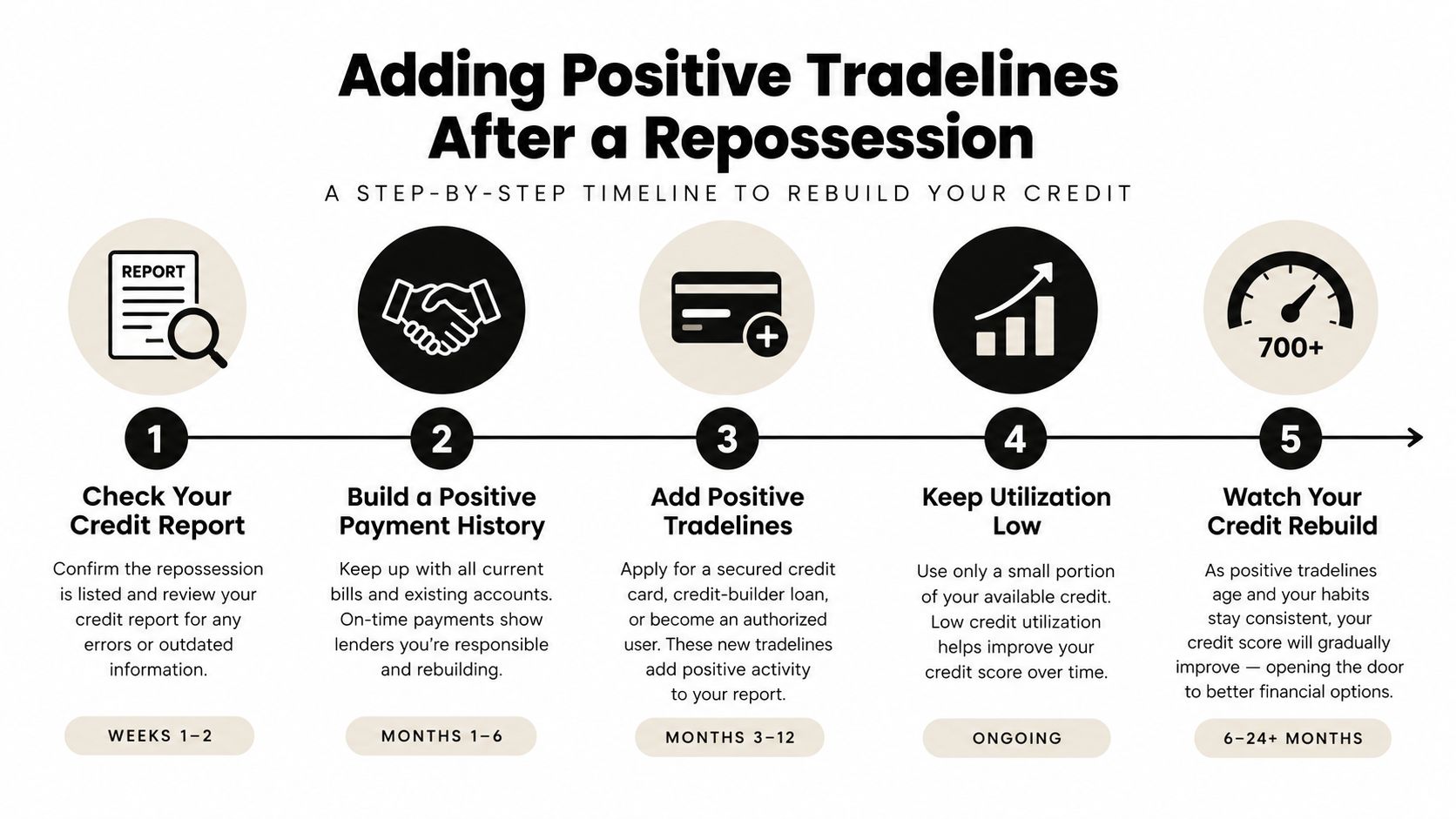
Once the reporting is reviewed and the deficiency plan is clear, then it makes sense to add positive credit.
They go too fast here. They apply for several cards, accept expensive offers, and create new risk. That's the wrong move. Rebuilding works better when each account has a job. You're not collecting credit products. You're building a cleaner file that a future lender can understand.
Start With Controlled Accounts
The Consumer Financial Protection Bureau's guidance is practical here. If the repo is behind you, the next gains usually come from bringing other accounts current, resolving the remaining repo-related balance, and then adding positive revolving credit such as a secured card that reports to the major bureaus within 30 to 60 days through normal reporting cycles, as explained in the CFPB's repossession guidance already cited above.
Use this order:
- Banking stability first. Open and maintain checking and savings accounts at a mainstream institution if you don't already have them.
- Secured revolving credit next. A secured card is often the cleanest first tradeline because it limits exposure while building payment history.
- A small credit-builder loan after that. This can help add installment history if the payment is comfortably affordable.
- One traditional revolving account later. Only consider this after your first rebuilding account has reported cleanly for a while.
- Pause before adding anything else. More accounts don't automatically mean better results.
Keep the Purpose Tied to Mortgage Readiness
The goal isn't a busy credit file. The goal is a stable one.
A well-chosen secured card can help improve utilization management and show current positive behavior. A small installment account can round out the profile. What you don't want is a file full of new inquiries, retail cards you didn't need, and balances that drift upward because the limits are small.
Open new credit only if you can pay it perfectly with your current income, not the income you hope to have later.
Authorized-user strategies can help in some situations, but they shouldn't be treated as a substitute for your own payment history. Modern underwriting puts more weight on tradelines you manage.
For borrowers who need a structured rebuilding plan, mortgage-ready credit repair help can include reviewing which accounts support long-term financing goals and which ones add noise.
This is also one area where Superior Credit Repair may fit as one option. A compliance-based credit restoration review can help identify whether you should focus first on disputes, balance resolution, utilization planning, or adding a specific type of positive account.
Building Habits That Keep Your Recovery on Track
A repossession recovery plan doesn't fail because of one old account. It usually fails because new mistakes show up while the old one is still aging.
That's why the daily and monthly habits matter more than dramatic actions. If you want to improve credit score results after a repo, you need clean current behavior. Nothing else replaces that.
Use Your Revolving Accounts Carefully
Credit utilization is a major score factor, and the FICO model is widely described as assigning it a 30% weight in the overall score, as discussed by The Credit People in its explanation of utilization and FICO scoring. In plain English, utilization is the share of your available credit that you're using.
A practical target is to keep balances below 30% of the limit, and for mortgage preparation many advisors now push for under 10% when possible. That tighter threshold is increasingly relevant for applicants trying to rebuild quickly, and newer guidance notes it more often than the older 30% rule, as discussed in this piece on rebuilding credit after losing a home.
Use these habits:
- Pay before the statement closes. That lowers the balance most scoring models are likely to see.
- Keep one small balance if needed. Letting every card report high at once is a mistake.
- Avoid maxing small-limit cards. A low limit doesn't give you room for careless spending.
- Request limit increases carefully. Higher limits can help utilization if spending stays controlled.
Protect Payment History Like It's the Main Event
Set automatic minimum payments on every open account. Then add a calendar reminder to confirm each payment posted. Banks make mistakes, cards expire, and account changes happen. Autopay is useful, but autopay without verification is lazy.
New derogatory items are the fastest way to stall progress. More nuanced guidance after repossession warns that every new missed payment adds another setback and extends the path back to stability. That's why no new account should be opened unless it would remain affordable even after a rough month.
One new late payment can do more harm than a new secured card can do good.
Review Your File on a Schedule
Run a credit report check every quarter until the repo is old enough to fall away. You're looking for balance updates, status changes, and new collection activity. If the repossession remains past its legal reporting period, that's when an obsolete-account dispute becomes relevant based on the original delinquency date, not the recovery date.
Don't close older accounts casually, especially if they're helping your available credit and they aren't costing you money. At the same time, don't keep accounts open that create annual fees or tempt overspending. The right choice is the one that supports stable long-term behavior.
Preparing a Lender-Ready Credit Profile and Common Questions
By the time a repossession has aged a bit, the question changes. It's no longer just “How bad was this?” It becomes “What does my file look like today?”
For mortgage approval, current stability matters. The Federal Housing Administration does not set a special mandatory waiting period just for a repossession the way it does for bankruptcy or foreclosure. Repo-related underwriting depends on the rest of the borrower's file and the lender's review, as noted in this discussion of buying a house with a repo on your credit. That means your preparation work matters.
What a Lender-Ready File Usually Shows
A stronger mortgage file after a repossession typically has these features:
- Current payment stability. Open accounts are paid on time.
- Managed revolving debt. Credit cards aren't carrying aggressive balances.
- Resolved or documented liabilities. The repo deficiency isn't sitting there unexplained.
- Clean recent history. No fresh collections, charge-offs, or late payments.
- A file that makes sense on paper. Income, reserves, account status, and explanations line up.
If your credit history is still thin even after rebuilding, this guide on how to build a mortgage-ready credit profile can help you think through what lenders may want to see before prequalification.
For people under broader financial stress, a neutral educational resource like this pre-bankruptcy counseling guide can also help frame budgeting and debt decisions before you add more obligations.
Recovery Timelines Need Realism
Guidance from mortgage and credit-oriented sources suggests the score decline from a repossession often bottoms out within the first 3 to 6 months after final reporting. Improvement can become noticeable within 12 to 18 months if the borrower keeps clean payment behavior and builds 1 to 2 positive tradelines. More substantial recovery commonly takes 2 to 3 years, and reaching 700+ may take 5+ years depending on the rest of the file, according to DMVCT's summary of auto repossession credit impact.
That's not a promise. It's a reminder that time helps only when behavior improves with it.
Common Questions
Should I pay a charged-off deficiency right before applying for a mortgage
Usually, you want this decision made before you're deep into the mortgage process. An unresolved deficiency can affect debt-to-income and underwriting review. Paying or settling may help present a cleaner file, but the timing should be coordinated with your loan officer and based on how the account is being reported.
Can a lender deny me even if my score looks better
Yes. Mortgage approval isn't based on score alone. Lenders also review current liabilities, payment history, reserves, income consistency, and overlays that go beyond the base loan program. A repo with an unpaid balance can still create friction even if the score has recovered somewhat.
When does a non-QM lender become the practical option
A non-QM path can become more realistic when the credit event is still recent, the file has strong compensating factors, or standard overlays are too restrictive. It's not automatically better. It's another lane when conventional, FHA, VA, or USDA qualification isn't ready yet.
Do co-signers fix a repossession problem
Not necessarily. A co-signer may help on some applications, but mortgage underwriting still reviews your own credit history, liabilities, and overall readiness. If your report is inaccurate or your deficiency remains unresolved, a co-signer doesn't erase those facts.
Does rapid rescoring solve this
Rapid rescoring can help update verified changes that already occurred, such as a corrected balance or a paid account that hasn't hit the bureaus yet. It doesn't remove accurate repossession history, and it doesn't replace the work of cleaning up the file first.
Was this guide helpful?
Superior Credit Repair Online provides educational credit guidance for individuals and families preparing for major financial goals like buying a home, applying for a mortgage, refinancing, or rebuilding after credit challenges.
Superior Credit Repair can review your credit report, help identify inaccurate or questionable items, and explain a step-by-step plan for improving your credit profile after a repossession. If you want a clear, compliance-focused strategy for dispute work, deficiency balance review, and mortgage readiness, visit Superior Credit Repair to request a free credit analysis or consultation and better understand your options.
If this information helped you better understand your credit report or your next steps, we would appreciate your honest feedback. You are welcome to share your experience with Superior Credit Repair on our Google Business Profile. Superior Credit Repair Google Business Profile