


You're saving for a home, you're watching a card balance sit higher than you'd like, and someone suggests requesting a credit line increase so your utilization looks lower. That's a reasonable idea to consider, but it isn't a free score boost. It's a timing, documentation, and spending decision. The pages below walk through the arithmetic, the inquiry risk, and the lender's view in plain English, so you can decide before you submit anything.
Table of Contents
- Decide Whether a Higher Limit Helps Your Profile
- How Soft and Hard Inquiries Affect Your Score
- How to Request a Credit Limit Increase Step by Step
- Timing a Request Around a Mortgage Application
- Why Issuers Decline and What to Do Next
- Confirm Your Next Step Before You Submit
- Frequently Asked Questions About Credit Limit Requests
Decide Whether a Higher Limit Helps Your Profile
Say you're planning an FHA application in about six months and you're carrying $3,000 on a card with a $10,000 limit. You're paying on time, but that balance feels stubborn. A higher limit sounds like progress because the percentage used would fall even though you haven't paid the balance down yet.
That percentage is credit utilization. In plain English, it's your balance divided by your credit limit. Lenders and scoring models look at it for each card and across all of your revolving accounts combined, so one maxed-out card can matter even if your total across several cards looks moderate.
What the Math Actually Changes
A limit increase changes the denominator, not the balance. Your $3,000 balance on a $10,000 limit is 30% utilization. If the issuer raises the limit to $15,000 and your balance stays at $3,000, utilization falls to 20%. Nothing about your debt changed. Only the ratio changed, which is why spending control matters more than the approval itself.
For wider context, the Consumer Financial Protection Bureau consumer credit card market report found that general-purpose cardholders used 23% of their approved credit in 2023. That national picture also matters for mortgage preparation because lenders review revolving balances, payment behavior, and overall file stability, not whether a higher limit exists.
| Balance | Current limit | Utilization now | Approved increase | Utilization after increase |
|---|---|---|---|---|
| $3,000 | $10,000 | 30% | $5,000 | 20% |
| $4,500 | $10,000 | 45% | $5,000 | 30% |
| $2,000 | $8,000 | 25% | $2,000 | 20% |
| $6,000 | $10,000 | 60% | $5,000 | 40% |
| $4,500 + $1,500 new spending = $6,000 | $10,000 | 60% | $5,000 | 40% |
Read the last row carefully. The card starts at $4,500, then $1,500 of new spending pushes the balance to $6,000 before the increase reports. The higher limit still helps compared with 60%, but a large part of the expected gain is gone. If spending kept rising, utilization could return to where it started.
Practical rule: A higher limit helps your profile only if your balance holds steady or falls after approval.
The Three Numbers to Gather First
Don't estimate from an app's current balance alone. Utilization planning starts with each card's limit, current balance, statement closing date, and reporting pattern, because the balance on the statement closing date is often what gets reported. Our guidance on credit utilization before a mortgage uses that same starting point.
Before you decide, write down three things for every card:
- Current balance: The amount likely to report, not just today's app total.
- Current limit: The exact limit on your most recent statement.
- Statement closing date: The date that determines when a lower balance or higher limit can first appear.
If those numbers show utilization is your main gap and your payments are steady, a request may be worth considering. If late payments, collections, or report errors are the bigger problem, a higher limit won't address them. Results vary by credit file and issuer decision, and no increase guarantees a score change or financing approval.
How Soft and Hard Inquiries Affect Your Score
A soft inquiry does not affect credit scores, while a hard inquiry may cause a small, temporary decline. That's the whole distinction, and it's the first question to settle before you ask any issuer for more credit.
Issuers don't all handle requests the same way. One may review your account with a soft pull you never see in scoring. Another may run a hard pull, the same type used when you apply for new credit. You can't assume which one applies from the size of the request or from what happened with a different card.
How Much a Hard Inquiry Can Matter
According to Experian guidance on credit limit increases, a hard inquiry can lower a FICO Score by up to five points, its scoring impact generally fades after about one year, and the inquiry itself can remain on a credit report for two years. That's small for many files, but small isn't the same as irrelevant when a mortgage application is close.
| Review type | Effect on credit score | How long it stays on the report | What to ask the issuer |
|---|---|---|---|
| Soft inquiry | Does not affect credit scores | Not shown to lenders as a scored inquiry | Confirm in writing that the review is soft |
| Hard inquiry | May cause a small, temporary decline; Experian reports up to five FICO points | Up to two years on the report; scoring effect generally fades after about one year | Ask whether the request triggers a hard pull before you submit |
Consider two patterns. In the first, you make one request to one issuer during a quiet period, months before any loan application. In the second, you make two requests to two issuers within a few weeks because the first answer was slow. The second pattern creates more new inquiries in a short window, and it can look like you're actively seeking more borrowing capacity.
How a Mortgage Lender May See It
A lender reviewing your file doesn't look at an inquiry in isolation. Recent inquiries sit alongside your balances, payment history, and existing obligations. A fresh inquiry plus rising balances tells a different story than a single inquiry followed by flat balances and on-time payments.
If you're a first-time buyer, review inquiry guidance for first-time homebuyers before you add anything new to your report. Then answer one decision question: does the possible utilization benefit outweigh a temporary dip during the months before you apply for financing?
A soft-pull approval and a hard-pull approval can produce the same new limit, but they don't carry the same near-term cost.
If the issuer can't confirm the inquiry type, treat that as useful information and pause. The score effect varies by credit file, and a thin file or a file with several recent applications may react differently than a long, stable one. Asking first costs you nothing. Submitting blindly might.
How to Request a Credit Limit Increase Step by Step
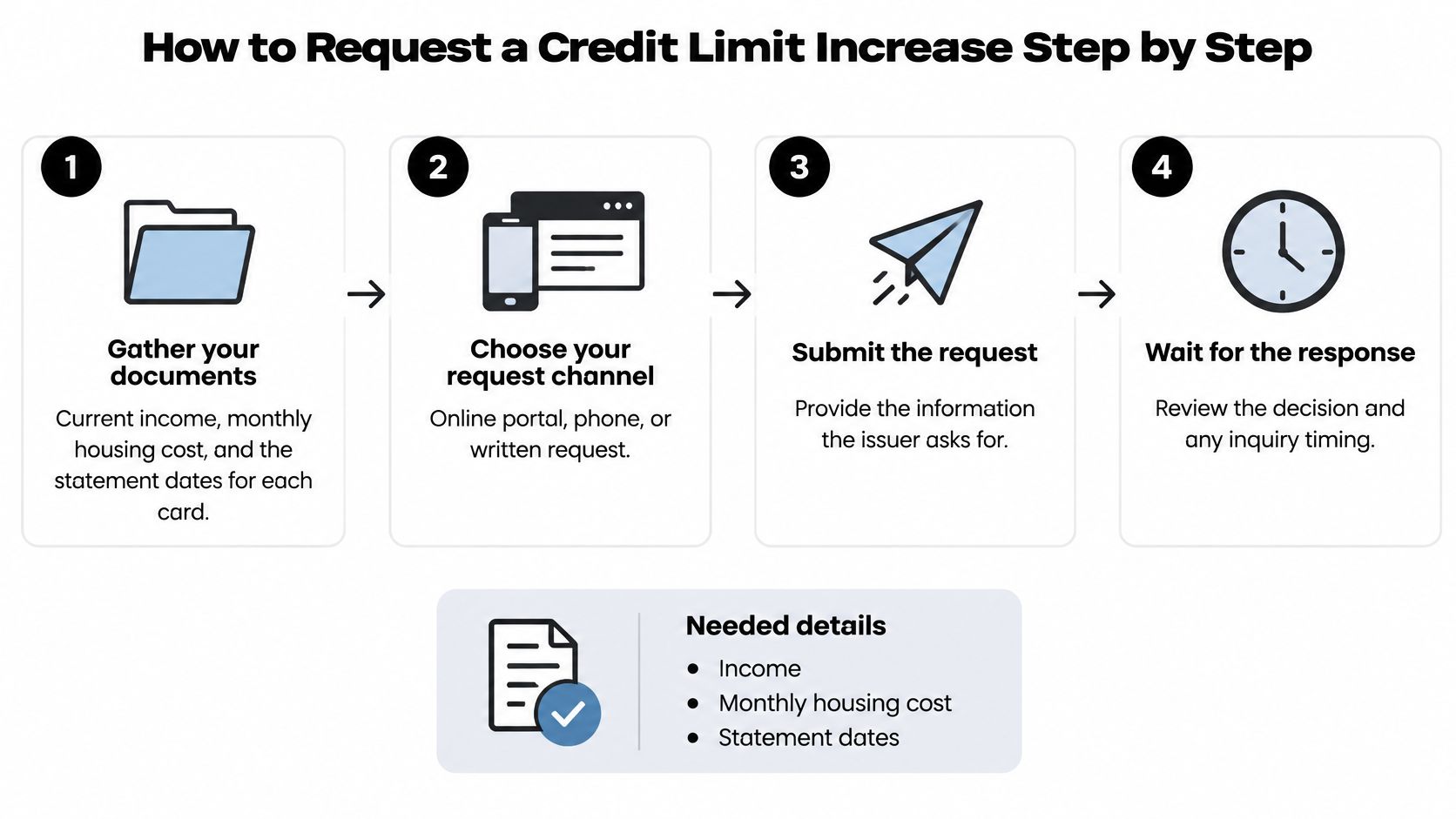
A clean request is mostly preparation. You're giving the issuer current income and housing information, confirming how they'll review it, and keeping proof of what was decided. Follow the steps in order, and don't skip the record-keeping.
The Six Steps
- Gather your numbers. Write down your current income, your monthly housing cost, and the statement dates for each card. Issuers ask for income and housing costs because they need to judge whether you can handle a larger line.
- Choose a channel. Pick the online portal, phone, or a written request using the comparison below. The best channel is the one that lets you ask your questions and keep a record.
- Ask before you submit. Confirm whether the review is a soft or hard inquiry and whether an account-age or income threshold applies. If the answer is a hard pull and your timeline is tight, you can still walk away.
- Submit one request with a short, factual reason. For example: I would like a higher limit to lower my reported utilization, and my income has changed since I opened this account. Keep it accurate and brief.
- Record the details. Note the date, any reference number, and the representative's name if you spoke by phone. Save screenshots or confirmation pages for online requests.
- Confirm the result. If you're approved, get the new limit in writing and check that it appears on your next reported statement. The benefit can't show in your file until the issuer reports it.
Choosing Your Request Channel
Use the online account portal for a quick request that leaves a written trail, and save the confirmation or request number. Use the phone when you have questions to ask before you submit, and write down the reference number, the date, and the representative's name. Use a written or secure-message request when you want the complete record, attaching a copy of a recent statement and keeping proof of delivery.
| Channel | What to have ready | What to keep as a record | Best use |
|---|---|---|---|
| Online portal | Income, housing cost, requested amount | Confirmation screen and request number | A straightforward request with a written trail |
| Phone | Income, housing cost, your questions | Date, reference number, representative's name | Asking about inquiry type before submitting |
| Written or secure message | Recent statement and your written reason | Copy of the request and proof of delivery | Keeping the most complete paper record |
Payment calendars and statement-date notes make the request easier to track. Rebuilding documents include statement dates for credit card utilization planning, payment calendars for all open accounts, recent inquiry notes before a financing review, and any lender, landlord, or dealer feedback about credit concerns. Keep those in one folder so you can answer questions without guessing.
For scale, Capital One Shopping Research on credit card ownership reported that in 2025, 17.4% of cardholders requested a credit-limit increase during the previous year, and 74.3% of those requests were approved. Treat that as a national average, not a forecast for your account. Your income, payment history, and existing debt will drive your own result when requesting a credit line increase.
Timing a Request Around a Mortgage Application
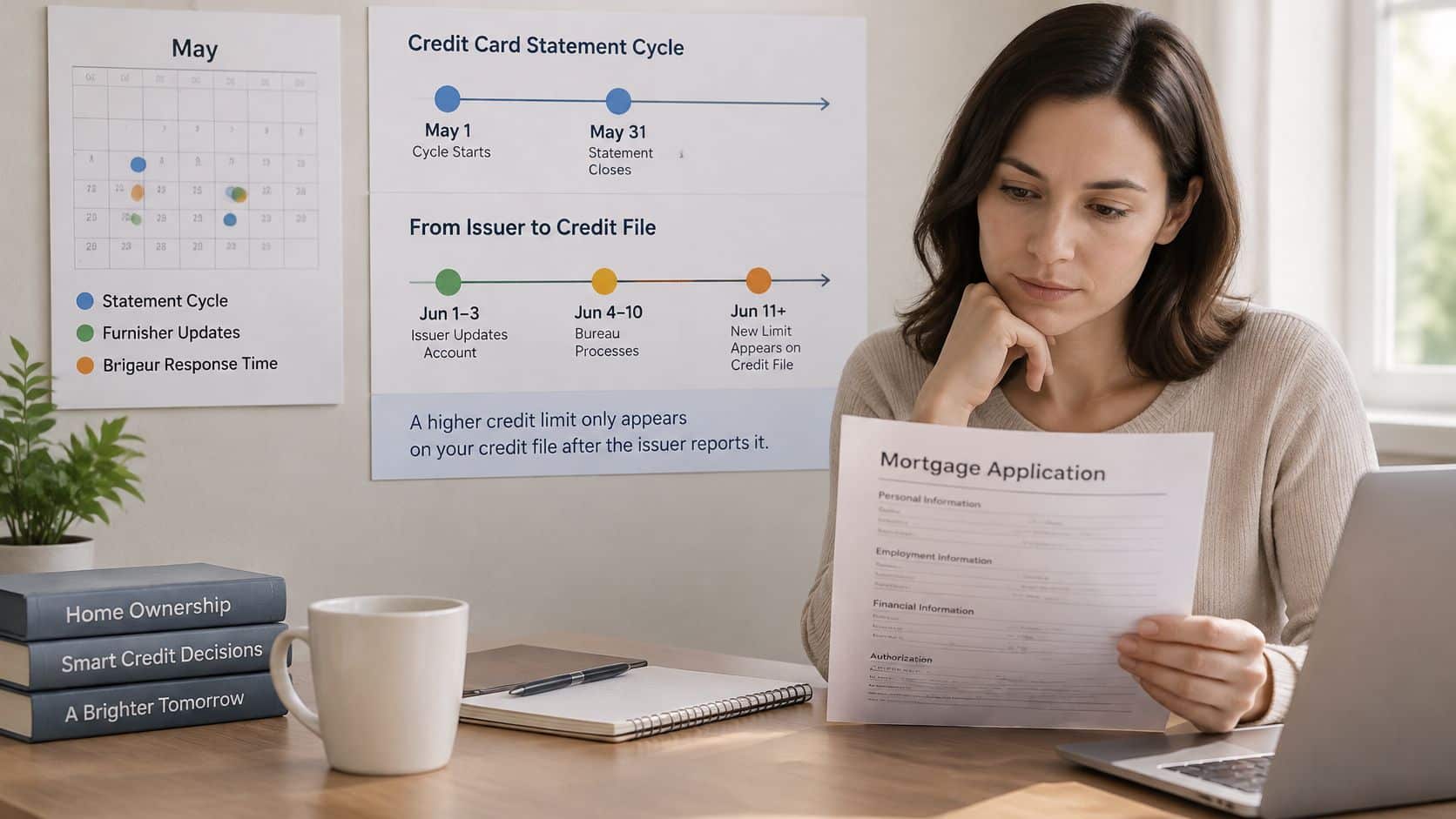
Approval from your card issuer and a change on your credit report aren't the same event. A new limit reaches your file only after the issuer reports it to the bureaus. That timing depends on your statement cycle, furnisher updates, and bureau response times, so no one can promise you a fixed number of days.
Mortgage-bound borrowers can get tripped up here. You request an increase, you're approved, and you assume your file already looks better. If your lender pulls credit before the new limit reports, the lender sees the old utilization and possibly a brand-new inquiry. You've taken the risk without yet receiving the benefit.
A Four to Six Month Sequence
If you're planning a loan in four to six months, work in calendar order:
- About five months before the planned loan, decide. That leaves room for the new limit to report across at least one full statement cycle. If the math doesn't clearly help, skip the request.
- Avoid new credit applications during that window. Additional applications add inquiries and can complicate the picture your lender sees.
- Keep every payment on time. A single new late payment can outweigh any utilization improvement and create a bigger mortgage problem.
- Hold card balances flat. A higher limit gives no benefit if spending grows before closing, and higher balances can also affect your debt-to-income calculations.
Timing depends on the account, documentation, bureau response cycles, furnisher updates, and current credit behavior. Our blog makes the same point about file reviews generally: the first step should be a measured review rather than a rushed dispute. The same patience applies here.
Questions for Your Loan Officer
FHA, VA, USDA, and conventional lenders set their own credit-refresh timing, and some pull credit again before closing. Don't guess about your lender's process. Ask directly, and use Superior Credit Repair utilization advice to prepare for that conversation.
- Pull timing: When will you pull my credit, and will you pull it again before closing?
- Inquiry impact: Would a new inquiry during this period create a problem for my file?
- Reporting proof: Does a reported limit change need to appear on a statement before submission?
Timing rule: If your loan officer says to keep your credit file quiet, that instruction outweighs a utilization idea from the internet.
Treat a higher limit as a timing decision for your whole file, not a one-step fix before preapproval. Credit repair for homebuyers works best as a structured, documented plan that protects payment history and file stability while you prepare. When the timeline is unclear, waiting until after closing is often the calmer choice.
Why Issuers Decline and What to Do Next
The most common reason people are surprised by a denial is simple. They judged the request by whether a higher limit would lower their utilization. The issuer judged it by income, existing obligations, payment history, and overall risk. Those are different questions, and the issuer's question controls the answer.
Under Federal Regulation Z on credit card rules, a card issuer generally may not increase a credit limit unless it considers your independent ability to make required minimum payments using information about income or assets and current obligations. So a borrower with high utilization can be declined precisely because the issuer sees heavy obligations or recent late payments. High utilization alone doesn't make you eligible.
Matching Denial Reasons to First Steps
Your adverse-action notice states the issuer's reasons. Use it as a diagnostic tool instead of treating it as a dead end.
| Reason on the notice | What it may point to | First step |
|---|---|---|
| Income too low for the requested limit | Income may not support the new limit under the issuer's ability-to-pay review | Confirm reported income is current and accurate |
| Recent late payments | Payment history is a major factor in the issuer's and lender's view | Set up automatic minimum payments and document the on-time record going forward |
| High existing debt | Obligations may be heavy relative to reported income | Reduce balances before the next statement closing date |
| Thin or short account history | Limited history gives the issuer less to evaluate | Keep payments on time and ask whether a future review is available |
| Inaccurate balance or late mark on a report | A reporting error may be affecting the decision | Pull all three reports and document the factual error for an accuracy review |
Your Recovery Sequence After a Denial
First, read the notice and note the stated reason and date. Second, pause new card applications for a period rather than applying to several issuers, since repeated hard inquiries can add temporary score pressure. Third, pull all three credit reports and check each account for balance, late-payment, or status errors.
That review needs to match the problem. A charge-off may need status and date review, a utilization problem may need statement-date planning rather than a dispute, and a student loan concern may need servicer payment history and status documentation. Accuracy documents include current three-bureau credit reports, creditor statements showing balances, limits, dates, and payment history, plus collection letters, settlement records, student loan records, or debt-buyer notices.
If you find a factual error, document it clearly and follow an accuracy review process based on records, not assumptions. If there's no error, your better path may be paying balances down before the statement closing date or asking whether the issuer offers an automatic or soft-pull review later. You can also prepare your credit for a loan by focusing on the file issues a lender will review. Results vary by credit file, issuer decision, and documentation, and a denial doesn't mean your mortgage goal is closed.
Confirm Your Next Step Before You Submit
Before you click submit or make the call, answer three questions in writing. Your answers will usually tell you whether to request now, wait, or ask your lender first. This is also where credit-score optimization and lender readiness separate, because they're related but they aren't identical goals.

The Three-Question Checklist
- Is reported utilization the main gap in my file? If collections, late payments, or credit report errors are the larger issue, a limit increase won't address the underlying problem. Review credit scoring basics for first-time homebuyers if you're unsure which factor is holding you back.
- Do I have documentation for income, payments, and balances? You should be able to support every number you give the issuer and track what reports afterward.
- Does a possible new inquiry fit my timeline? If preapproval or closing is near, even a small temporary change may not be worth it.
If the answer to the first question is no, pause. Requesting a credit line increase may feel productive, but it doesn't correct inaccurate items, rebuild a thin file, or fix a debt-to-income concern. Credit restoration works when each step matches an actual problem in the file.
Request Now, Wait, or Ask the Lender First
Request now when your timeline and documentation fit, your payments are current, and you've confirmed the inquiry type. Wait when a loan application is near or a recent late payment is still reporting, because the issuer may decline and the inquiry may arrive at the worst moment. Ask the lender first when timing is unclear, since your loan officer knows when credit will be pulled again.
The right next step is the one that fits your documented file and your financing date, not the one that sounds fastest.
For a first conversation about your file, bring the three current credit reports, photo identification, current address information, recent statements for accounts under review, collection notices, payment confirmations, and any adverse-action notice tied to the application. Customers can request a credit analysis and discuss the approval target with Superior Credit Repair. The service should help you understand your credit file, document factual problems, and choose a realistic next action.
Superior Credit Repair can review your credit report, help identify inaccurate or questionable items, and explain a step-by-step plan for improving your credit profile. You can request a free credit analysis or consultation to better understand your options. Results vary by credit file, documentation, creditor responses, account history, and current credit behavior, and no outcome is guaranteed.
Frequently Asked Questions About Credit Limit Requests
Can I Ask for an Increase on Every Card
Each issuer decides on its own, so approval on one card doesn't predict approval on another. Several requests in a short period can create multiple hard inquiries, which adds avoidable pressure before financing. Space requests out, start with the card where the utilization math helps most, and ask about inquiry type before each submission.
What If My Issuer Raises My Limit Without My Asking
An issuer-initiated increase reflects the issuer's ongoing account review. It isn't permanent proof that your credit profile is stronger, and it isn't a signal to spend more. Confirm the new limit on your next statement, keep your balance plan unchanged, and let the lower reported utilization do its quiet work.
How Much Should I Ask For
Request a defensible amount supported by your reported income and steady payment history, not the largest limit you can imagine. The issuer's ability-to-pay review still applies, and an oversized request can be declined even when a smaller one might have been approved. Use the utilization formula to find the amount that changes your percentage.
What If I Am Denied
Read the reason on your adverse-action notice first, then follow a documented recovery path instead of reapplying right away. Check your reports for inaccurate balances or late marks, correct factual errors through a proper accuracy review, and reduce balances before statement closing dates where you can. A denial is information about what to fix next, whether that's credit repair before buying a home or simple balance timing.
Was This Guide Helpful
If this information helped you better understand your credit report or your next steps, we would appreciate your honest feedback. You are welcome to share your experience with Superior Credit Repair on our Google Business Profile.
If you're weighing a limit request against an upcoming mortgage application, we can review your credit reports, help you identify inaccurate or questionable items, and map a documented, step-by-step plan that fits your timeline. Visit Superior Credit Repair to request a free credit analysis or consultation and discuss your options in plain English, with no pressure and no guaranteed outcomes.