


A charge-off isn't an automatic mortgage denial, and it doesn't mean the debt has been forgiven. The program table below shows what changes by loan path, including whether an unpaid balance enters the debt calculation and what documentation a lender may need.
You may already have a home savings account, steady paychecks, and a neighborhood in mind, only to notice an old charged-off card on your credit report. Before spending your down payment money on that account, separate reporting accuracy, repayment decisions, and mortgage underwriting. Those are related tasks, but they aren't interchangeable.
Table of Contents
- What a Charge-Off Changes for a Homebuyer
- How Major Loan Programs Treat Charge-Offs
- When an Unpaid Balance Still Matters
- Two Homebuyers Facing Different Charge-Offs
- How to Dispute an Inaccurate Charge-Off
- Building Stability Around an Accurate Charge-Off
- Get Lender Ready Before You Apply
What a Charge-Off Changes for a Homebuyer
Say a buyer is told that a charged-off credit card ends the home search. That conclusion skips the information a mortgage lender needs: what happened, whether the reporting is correct, and how the buyer manages money today.
A charge-off is an accounting action. A creditor removes a loan or lease from its books and charges it against loss reserves, somewhat like a store recognizing a loss on unsold inventory. The accounting entry doesn't establish that the borrower has been legally released from the debt.
For perspective, the Federal Reserve's charge-off release reports second-quarter 2025 seasonally adjusted rates of 2.92% for consumer loans, 0.66% for all loans, and 0.09% for all real-estate loans at commercial banks, annualized and net of recoveries, measures of portfolio losses rather than this applicant's approval odds.
Record the facts before choosing a remedy
The buyer should compare current reports from Experian, Equifax, and TransUnion, making a simple account worksheet:
- Balance and status: Record whether the account shows unpaid, paid, settled, or transferred.
- Dates: Note the charge-off date and distinguish it from a later reporting update.
- Ownership: Identify whether the original creditor retained or sold the debt.
- Later payment history: Check whether open accounts show consistent payments after the hardship.
The balance, transfer history, and dates can still affect underwriting questions or documentation. Paying an account doesn't automatically erase its history, and filing a dispute doesn't establish that the reporting is wrong.
Practical rule: Identify the reporting problem before choosing the credit repair action.
Keep housing defaults separate
A charged-off card or personal loan isn't the same as a prior mortgage default. A housing-credit event needs its own eligibility review rather than the assumptions used for an old revolving account.
If bankruptcy is also part of the buyer's history, homeownership guidance from LifeBack Law Firm, published by LifeBack Law Firm, P.A., offers relevant context for that separate issue.
Lenders weigh income, assets, debt-to-income ratio, down payment, credit scores, and the full loan profile together. No single tradeline settles the outcome, and results vary.
How Major Loan Programs Treat Charge-Offs
A charge-off from a credit card or personal loan can be treated differently across mortgage programs. One lender may exclude an unpaid balance from monthly debt calculations while still asking about its history. The table offers a starting point, not a prediction of approval.
How loan paths treat a non-mortgage charge-off
| Loan path | Must it be paid first | Counted in monthly debt | Extra review to expect |
|---|---|---|---|
| FHA | Not automatically disqualifying or automatically required to be paid | Generally excluded from liabilities and debt | A supported explanation for each outstanding charge-off and the lender's documented reason for approval |
| Conventional automated underwriting | No universal payoff rule for every non-mortgage charge-off | May be excluded in some scenarios | Lender overlays, disputes, and a derogatory pattern can prompt closer or manual review |
| VA | Confirm with the VA lender whether the charge-off must be paid under current program guidance and lender requirements | The lender determines how the balance affects monthly debt under its current calculation | Credit-history review, including compensating factors and residual income |
| USDA | Confirm with the USDA lender whether the charge-off must be paid under current program guidance and lender requirements | The lender determines how the balance affects monthly debt under its current calculation | Credit review; recent derogatory history may need an explanation |
| Prior mortgage charge-off or foreclosure | Requires a separate housing-event eligibility review | Requires its own timeline review | Applicable waiting periods and housing-credit history, separate from revolving-account treatment |
For a VA or USDA application, ask the loan officer directly whether payment is required and how the balance will be treated in the monthly debt calculation. A VA loan credit review after charge-offs can help a veteran organize questions, but it does not replace the lender's program-specific review.
FHA exclusion doesn't eliminate the explanation
The HUD FHA handbook says outstanding charge-offs are not automatically disqualifying and generally do not have to be included in liabilities or debt. The lender must still determine whether they resulted from disregard of financial obligations, inability to manage debt, or documented extenuating circumstances.
When approving the mortgage, the lender must document its reasons and obtain the borrower's letter of explanation with supporting documentation for each outstanding charge-off. The mortgagee is the lender responsible for that review.
Consider a buyer whose account became delinquent during a documented employment interruption. A useful explanation connects the interruption to the account timeline, describes the return to employment, and explains the buyer's current ability to manage obligations. A brief statement that money was tight may leave important questions unanswered.
The letter must match the file. If it says the account was settled, the settlement record and reported status should support that statement.
Automated findings and lender requirements aren't identical
An automated underwriting system evaluates application and credit information against a loan program's criteria. The lender must still verify information and meet applicable conditions before closing.
An overlay is an additional lender requirement beyond the underlying program's standards. A conventional automated finding therefore does not mean every lender will accept the same unpaid account. Disputes, the pattern of derogatory history, and other file details may also lead to closer or manual review.
FHA, VA, Fannie Mae, and Freddie Mac approval channels use nationwide consumer credit reports. Accurate reporting matters across loan paths, even though the programs and lenders may treat a particular debt differently.
Mortgage approval still depends on lender rules, underwriting, income, debt-to-income ratio, down payment, credit score, and the full loan profile. Ask the loan officer which requirement applies to the account and how it affects the application. A general statement that every charge-off must be paid does not establish the rule for a specific loan.
When an Unpaid Balance Still Matters
A buyer with limited savings may need to choose between paying an old account and preserving funds for a down payment, closing expenses, current bills, and emergency savings. Paying every old account before speaking with a lender can use cash that may be needed elsewhere.
The key question is whether paying the charge-off changes the mortgage requirements enough to justify spending that money. As Gustan Cho Associates' discussion of mortgage charge-off balances explains, an account's treatment in monthly debt calculations is separate from the lender's broader review of payment patterns, overlays, and financial stability.
Use the same decision criteria for each account
When an unpaid charge-off still affects approval
| Situation | Effect on the file | Practical choice |
|---|---|---|
| Recent charge-off | Recency can weaken the file outside debt-to-income calculations | Prepare to explain the circumstances and show renewed payment stability |
| Several charge-offs | The pattern may raise concerns about managing debt | Document the cause and recovery |
| Late payments afterward | The financial difficulty may be continuing | Prioritize bringing open accounts current |
| Account marked in dispute | The dispute may complicate automated findings or lead to manual review | Resolve inaccurate information before underwriting |
| Thin reserves | Paying an old balance can reduce homebuying funds | Ask whether the loan path requires payoff |
| Lender overlay | The lender may set stricter requirements than the base program | Get the lender's specific condition |
| Older settled card with clean later payments | It may carry less weight than a recent pattern of derogatory activity | Preserve needed reserves and keep settlement proof |
| Missing payment information for a charge account that is not a charge-off | Separate payment-documentation requirements may apply | Obtain the latest statement instead of assuming the balance is excluded |
Manual underwriting means a person evaluates the circumstances and recovery, rather than relying only on a balance field. A recent unpaid account alongside continuing late payments can raise different concerns from an older settled account followed by reliable payments.
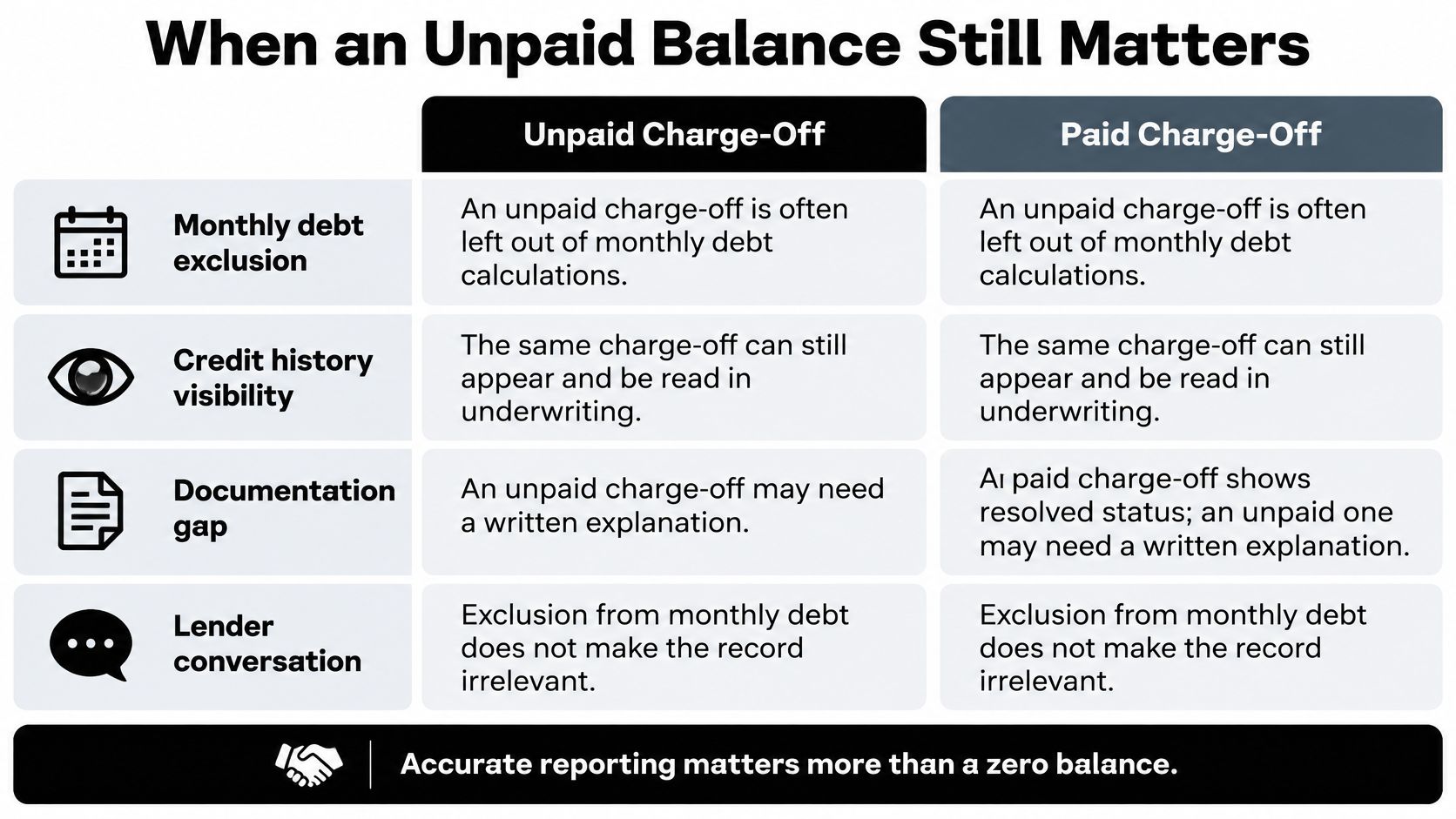
Exclusion from monthly debt calculations does not exclude an account from the lender's review.
Don't confuse a charge account with a charge-off
A charge account with missing payment information is a separate issue from a charge-off. Older FHA guidance described obtaining the latest statement or using a payment assumption when the required information was unavailable. That documentation mechanic should not be mistaken for FHA's general treatment of charge-offs.
For a first-time buyer with an old unpaid card and strong later payments, asking the lender before paying may help preserve funds needed for reserves. Superior Credit Repair collection review tips cover questions such as account ownership and balance review.
Ask the lender:
- Recency: How does the age of this charge-off affect the application?
- Pattern: Does the surrounding payment history raise another concern?
- Cash choice: Would paying the balance change eligibility, or mainly reduce reserves?
An unpaid non-mortgage charge-off may be excluded from debt-to-income calculations and still matter through its recency, the broader payment pattern, a dispute, lender overlays, or the need to preserve limited cash. No single choice guarantees approval.
Two Homebuyers Facing Different Charge-Offs
Maya and Andre are hypothetical buyers with different preparation needs. Their situations show why charge offs and mortgage approval can't be reduced to a paid-versus-unpaid checkbox.

Maya needs a consistent explanation
Suppose Maya is a renter and first-time buyer whose credit-card charge-off followed a job loss four years earlier. She settled the balance and has paid every open account on time since returning to work.
She's comparing FHA financing with a conventional option. Her preparation task is to make the account history easy to understand, not to dispute a settled debt merely because it remains visible.
Maya assembles her settlement letter, current pay stubs, and available employment records. Her short explanation identifies the hardship, the settlement, and the payment practices she uses now.
- Her account problem: The old negative history remains, although the balance was resolved.
- Her preparation choice: Match the explanation to the documents and retain money needed for reserves.
She checks each bureau's entry because wording and updates may differ. A recent update date alone shouldn't be confused with proof that a new charge-off occurred.
Maya doesn't need to invent a more persuasive story. She needs an accurate account of the events that matches the records.
Andre needs to resolve conflicting reporting
Suppose Andre has already received a denial and still has a recent unpaid charge-off. A debt buyer also reports the account, but the balances don't match and a bureau shows a different status.
His immediate task isn't a blanket payoff. He collects the original creditor's statement and debt-buyer letter, then compares ownership, balance, transfer status, and dates.
The presence of an original-creditor entry and a collection entry doesn't alone prove improper duplication. Andre must identify what each entry represents and which particular facts conflict.
- His account problem: Inconsistent reporting makes the obligation difficult to interpret.
- His preparation choice: Dispute supported errors while separately addressing any accurate remaining history.
If the corrected account still reflects a recent charge-off, Andre may need additional months of reliable payments before reapplying. Correcting the report doesn't remove the lender's responsibility to assess his current ability to repay.
A personal-loan charge-off calls for the same basic fact-checking, and a medically related debt still requires identifying the actual account type rather than assuming all medical collections and charge-offs follow identical rules. If either buyer chooses VA or USDA financing, the relevant lender must evaluate that program's requirements.
Both buyers have constructive next steps. Neither example predicts a score change, deletion, interest rate, or approval.
How to Dispute an Inaccurate Charge-Off
A charge-off dispute should identify a reporting defect and support a reasonable correction. Credit restoration is a documentation and verification process, not a method for making accurate history disappear.
Build a record someone can investigate
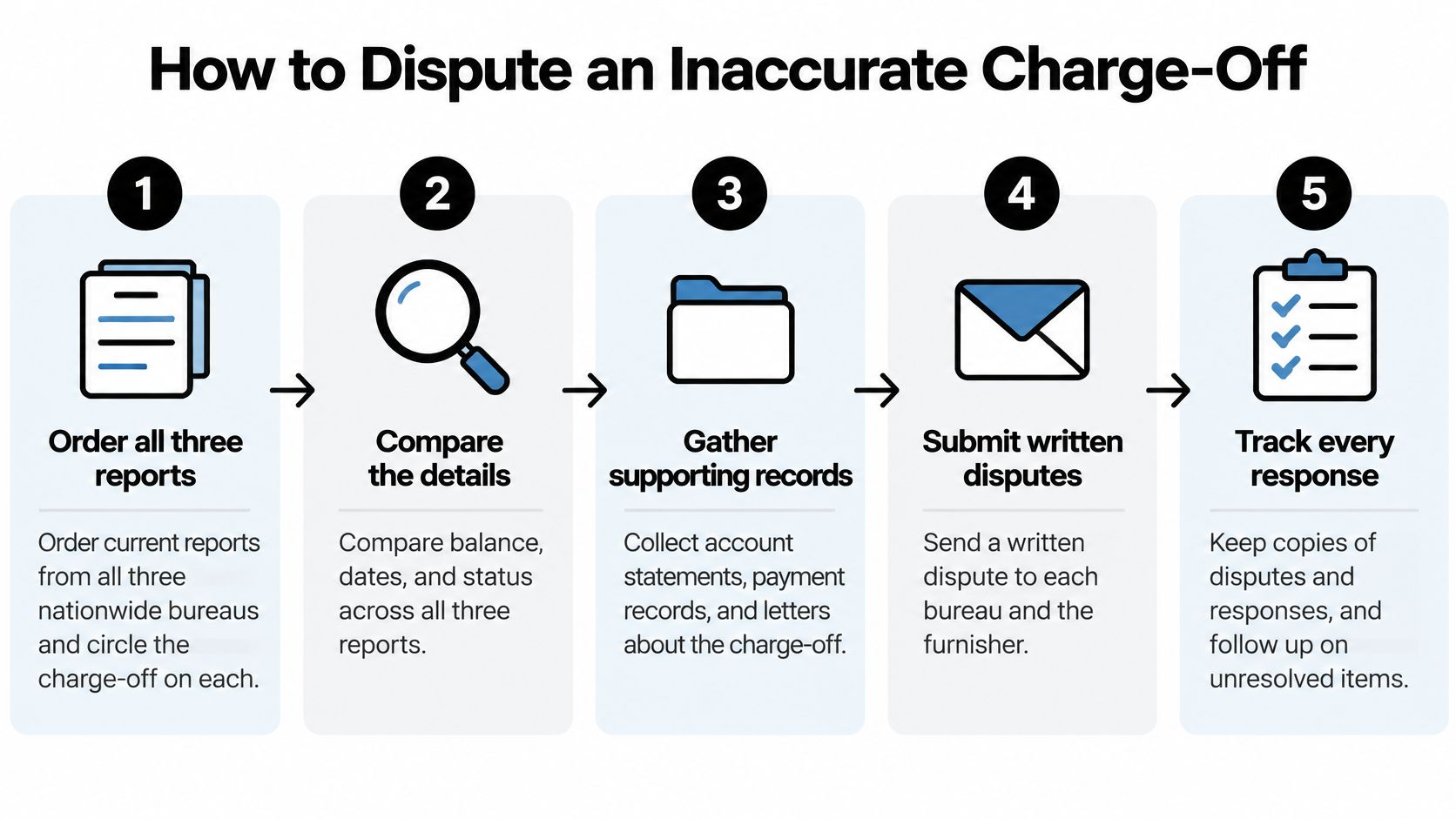
Order current reports. Obtain reports from all nationwide bureaus and mark the relevant account on each. Save complete copies so you can compare the original reporting with the investigation results.
Compare individual fields. Review balance, charge-off date, last activity, ownership, sale or transfer status, and any related collection entry. Identify the precise conflict rather than labeling the entire account incorrect.
Gather the document that proves the issue. Use creditor statements showing balances, limits, dates, and payment history; collection letters; debt-buyer notices; and settlement or payment records. Include identity-theft documentation only when identity theft is involved.
Submit a specific dispute. Explain the inaccurate, outdated, unverifiable, or misleading fact to the reporting bureau and, when appropriate, the furnisher, meaning the company supplying the account information. Ask for the correction supported by your evidence and keep submission records.
For example, if an account shows an unpaid balance after a documented settlement, attach the settlement confirmation and identify the conflicting balance field. Avoid unsupported requests to delete every negative entry.
Track the investigation without assuming the outcome
Allow the investigation. HUD housing-counselor training materials describe investigations as usually completed within 30 days, unless the dispute is considered frivolous; that timetable doesn't promise deletion, a higher score, or mortgage approval.
Read and retain the results. Compare the response with the evidence you submitted and save the updated report. If the investigation didn't address the documented issue, consider a focused follow-up or appropriate complaint channel rather than repeatedly sending the same unsupported claim.
Keep disputes accuracy-based. Don't file a dispute solely to hide an accurate account during underwriting. Dispute comments can create additional lender questions or complicate automated findings.
Accurate, current negative information generally stays when there isn't a legitimate basis for correction or removal. Start early enough to review the response before a mortgage application becomes time-sensitive.
Our documentation framework to fix charge-off balance errors before FHA helps organize an account-specific review. A charge-off may need status and date evidence, while high utilization may need statement-date planning instead of a dispute.
Student-loan reporting concerns may require servicer history and status documentation. Choosing the right evidence matters more than sending a generic dispute letter.
Results depend on the credit file, supporting records, creditor or furnisher responses, account history, and current credit behavior. A lawful dispute is an opportunity to investigate a supported concern, not a promised outcome.
Building Stability Around an Accurate Charge-Off
Once reporting is accurate, the buyer's task changes from correction to demonstrating financial control. A lender needs to understand how the borrower handles obligations now, not only why an older account failed.
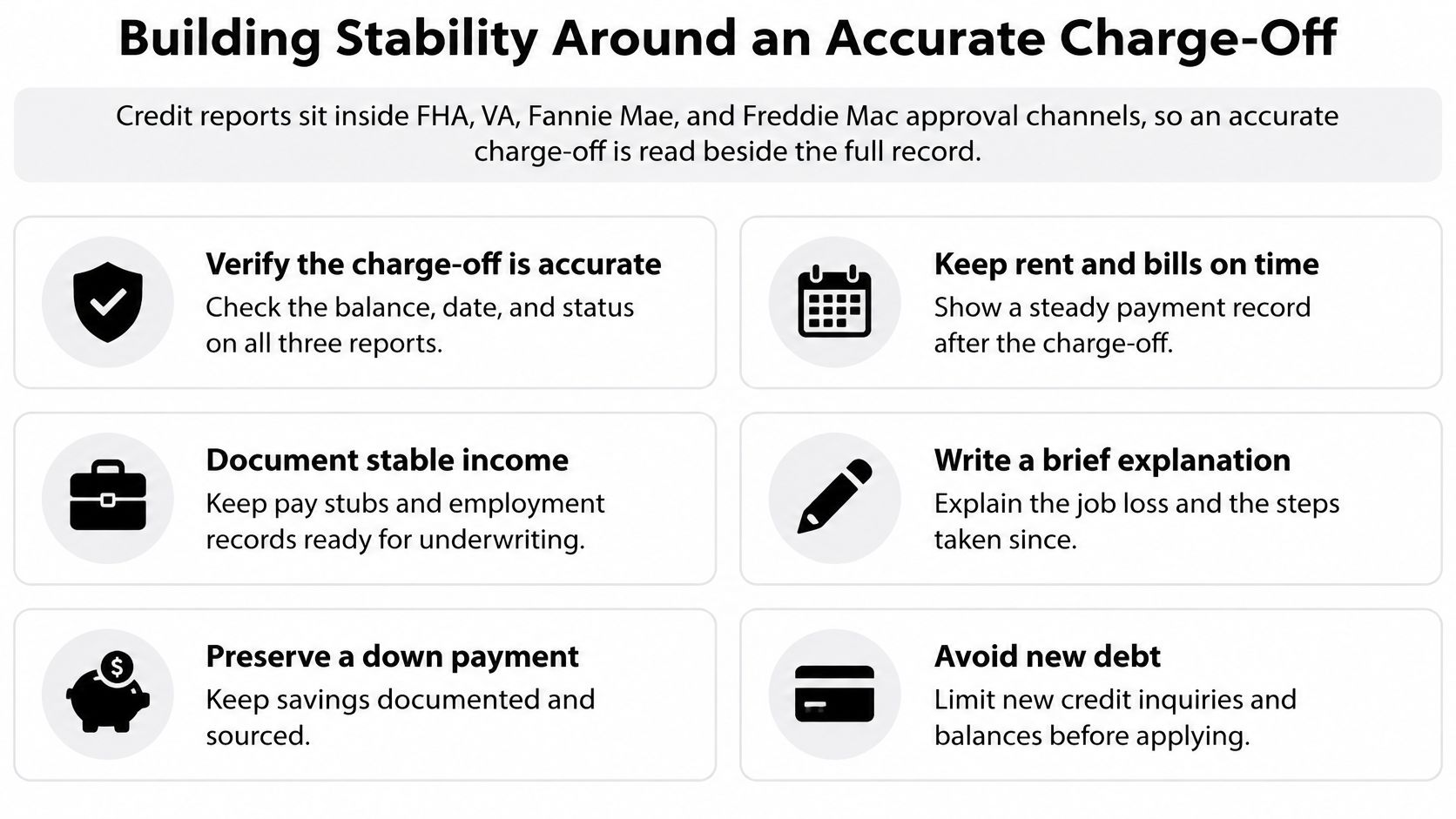
The Consumer Financial Protection Bureau's credit-reporting white paper explains that FHA, VA, Fannie Mae, and Freddie Mac underwriting processes require lenders to obtain a nationwide consumer credit report before the relevant insurance, guarantee, or purchase. Credit history is part of those approval channels, not optional background.
Make reliable payments easier to maintain
A buyer recovering from a hardship needs a workable routine, not a complicated system. Use a payment calendar that includes due dates, scheduled payments, and confirmation that payments cleared.
- Protect open accounts: Prioritize required payments and address any current delinquency.
- Plan card balances: Review statement dates and reduce balances before reporting when affordable.
- Limit unnecessary applications: Pause nonessential credit shopping while preparing for preapproval.
- Keep a cash buffer: Avoid a plan that leaves no money for an unexpected bill.
Credit utilization means the portion of available revolving credit being used. A high reported balance can be accurate, so improving that situation usually requires balance management rather than disputing valid information.
A payment before a statement closes may affect what the creditor reports, but reporting practices differ. Keep the statement and verify the resulting balance instead of assuming a particular score response.
Give the lender a coherent recovery record
A useful explanation letter addresses what happened, relevant dates, what was paid or remains outstanding, and what is different now. Supporting records may include a job-loss notice, medical documentation, divorce-related records, or other evidence relevant to the actual hardship.
Documentation principle: A short explanation supported by records is more useful than a lengthy explanation that conflicts with the application.
Keep stable-income evidence and sourced savings records together. Reserves are funds available beyond the money needed to close, and they can help demonstrate financial capacity without changing the account's history.
Debt-to-income ratio is a separate calculation comparing qualifying monthly debt obligations with qualifying income. Better reporting doesn't necessarily solve that math, just as lower debt doesn't automatically resolve an inaccurate tradeline.
The Superior Credit Repair 90-day plan offers a framework for organizing rebuilding tasks, not a deadline for a promised result. First-time, FHA, VA, conventional, and USDA buyers should bring their records to a lender early.
Months of on-time history can help a reviewer assess renewed control. No habit guarantees a score jump, required deletion, or approval.
Get Lender Ready Before You Apply
A lender-ready file answers questions with records rather than assumptions. Use this checklist before authorizing payments, submitting disputes, or selecting an application date.
- Save current bureau reports. Keep complete copies and note where account information differs.
- Create a charge-off worksheet. Record balance, dates, owner, sale or transfer status, and supporting creditor documentation.
- Separate errors from accurate history. Reserve dispute paperwork for facts you can explain and support.
- Match explanations to evidence. Keep the letter and its supporting records together.
- Plan upcoming statements. Coordinate affordable card payments with reporting dates while protecting required payments.
- Confirm payoff requirements. Ask the lender what must be resolved before using money intended for closing or reserves.
A related collection entry deserves ownership and balance comparison, not an automatic duplicate-account accusation. Likewise, a housing default requires the appropriate housing-event review rather than an old-card repayment strategy.
Our guide to what mortgage lenders look for can help you organize the broader application questions. We can help organize the credit review, pinpoint documentation needs, and build practical next steps connected to a real approval target.
Questions homebuyers still ask
Can credit repair guarantee a mortgage approval?
No. Credit repair cannot guarantee approval for a mortgage, auto loan, or rental review, and correcting an error doesn't establish that the remaining application meets underwriting requirements.
Should I wait until underwriting to review my reports?
Start earlier if possible. You'll have more room to collect records, evaluate investigation responses, and ask the lender how unresolved issues affect the proposed loan.
Will settling a charge-off improve my score?
There's no guaranteed score result. Evaluate settlement as a debt-resolution and mortgage-preparation decision, using the lender's actual requirements rather than a predicted increase.
What should I bring after a denial?
Bring the lender's explanation, current reports, relevant account documents, and your intended financing goal. That information helps distinguish a reporting problem from an income, debt, savings, or eligibility concern.
Was this guide helpful?
Superior Credit Repair Online provides educational credit guidance for individuals and families preparing for major financial goals like buying a home, applying for a mortgage, refinancing, or rebuilding after credit challenges.
If this information helped you better understand your credit report or your next steps, we would appreciate your honest feedback. You are welcome to share your experience with Superior Credit Repair on our Google Business Profile.
Superior Credit Repair can review your credit report, help identify inaccurate or questionable charge-off information, and explain a documentation-based plan for improving mortgage readiness. Visit Superior Credit Repair to request a free credit analysis or consultation and better understand your next steps, with results that vary by your file and no guarantee of deletion, score improvement, or approval.