


You're probably here because you want a home in Kansas City, but the normal path isn't cooperating. Maybe a lender said your credit needs work. Maybe you're still saving. Maybe you're tired of renting and want your next payment to move you toward ownership instead of another lease renewal.
That's exactly why rent to own homes in Kansas City get so much attention. The idea sounds practical. Move in now. Buy later. Fix credit during the lease. Build momentum.
But this path only works when the contract is solid, the home is priced fairly, and your credit plan starts immediately. In Kansas City, that matters even more because the market isn't driven only by individual sellers. It's shaped by large owners and investor-controlled inventory. According to reporting from Flatland, about 13% of single-family rentals are owned by out-of-state businesses, and five companies own some 8,000 homes in the area. That alters the power dynamic, contract flexibility, and your margin for error.
If you approach rent-to-own casually, you can lose money and still end up without a mortgage.
If you approach it like a compliance-minded buyer, you give yourself a real chance.
Table of Contents
- Is Rent-to-Own in Kansas City the Right Path for You
- Understanding the Kansas City Housing Market
- How to Decode Your Rent-to-Own Contract
- Vetting a Kansas City Rent-to-Own Opportunity
- Building Your Mortgage-Ready Credit Profile
- Your Timeline From Lease Agreement to Closing Day
- Common Questions About Renting to Own in KC
Is Rent-to-Own in Kansas City the Right Path for You
You find a house that fits your family, the seller offers a lease-option, and the monthly payment looks close enough to your current rent. It feels like a second chance after a credit setback. Then the option fee is gone, the lease ends, and the mortgage still does not happen because your credit, cash reserves, or debt ratio never got fixed.
That is a key test in Kansas City. Rent-to-own only works if you use the lease term to become financeable.
When rent-to-own makes sense
Use this path if you have a clear, fixable reason you cannot qualify today and a realistic plan to correct it before the purchase deadline. That usually means credit report problems that need review, revolving debt that needs to be paid down, or a recent period of instability that can be offset by steady income and on-time payments.
It also fits buyers who need time to prepare for FHA, VA, USDA, or conventional underwriting and are ready to treat the lease term like pre-approval prep, not a waiting period.
Practical rule: If your credit profile, savings, and debt load will look materially better by the end of the lease, rent-to-own can be useful. If those numbers will look the same, skip it.
When it's the wrong move
Do not sign a rent-to-own deal because you are tired of being denied for a mortgage. Frustration is not a plan.
This is a bad fit if your income swings month to month, your budget is already stretched, or you have not reviewed your credit reports line by line. It is also a bad fit if you are counting on vague promises from a seller instead of written terms and a documented path to mortgage approval.
Kansas City adds pressure because many sellers and investor-owned properties use standardized contracts and enforce them hard. Assume the agreement protects the owner first, your option fee second, and your future purchase goal last.
Read the investor side before you sign from the buyer side. This real estate investor lease option guide shows how these deals are often structured and where the profit and control usually sit.
If your file needs work, handle that before you hand over an option fee. A professional review can separate reporting errors from real risk factors such as high utilization, recent late payments, or weak savings habits. If you need outside help, review these expert credit repair services before you commit to a lease-option contract.
Rent-to-own is not a shortcut to homeownership. In Kansas City, it is a deadline. Treat it that way.
Understanding the Kansas City Housing Market
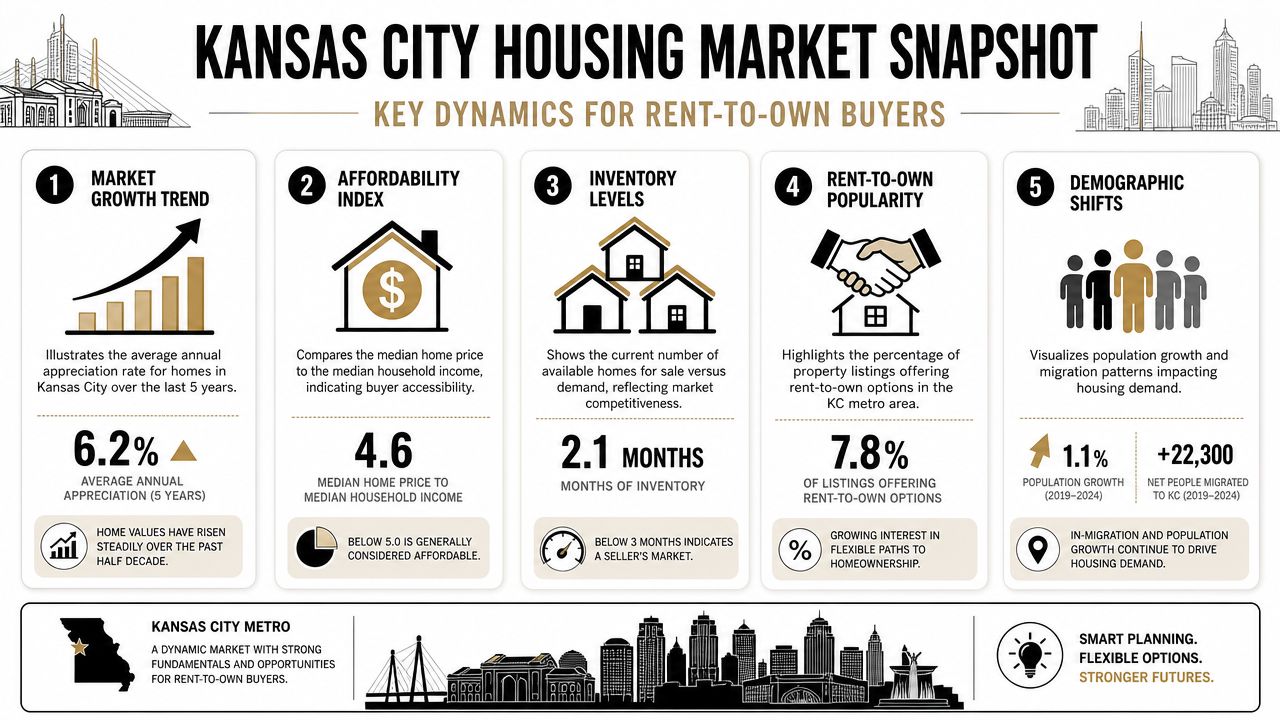
Kansas City is not a casual market for rent-to-own buyers. You need to understand who owns the inventory, what that means for contract behavior, and how current rents affect affordability.
Why Kansas City requires a stricter screening process
A Mid-America Regional Council study, cited by KCUR, found that rentals make up nearly a quarter of all single-family homes in the nine-county Kansas City region. The same reporting notes that in Jackson County, almost 45% of those single-family rentals are owned by investors holding 100 or more properties.
That's not a minor detail. It tells you the local housing search is shaped by concentrated ownership.
Here's how that affects you in practice:
- Less flexibility on terms because large owners often rely on standardized contracts.
- More pressure on available homes because investor-controlled inventory can reduce the number of owner-directed opportunities.
- Harder negotiations when the other side treats the property as part of a portfolio instead of a one-off sale.
- More need for independent review because institutional paperwork often looks polished even when key buyer protections are weak.
You should assume every term needs to be verified, not trusted.
Kansas City buyers should stop thinking only about finding a house. The real job is finding a house and a contract that still makes sense at mortgage time.
What the rental numbers mean for your monthly budget
Rent-to-own isn't just a housing search. It's a cash-flow test.
HUD's Kansas City housing market profile reported that average apartment rent in the metro rose 5% year over year to $1,310 in the first quarter of 2024. In Downtown Kansas City, the average was $1,547, up less than 1% from a year earlier. The same report said there were about 6,950 apartment units under construction and roughly 5,850 rental units permitted during the 12 months ending March 2024, down 24% from 7,700 permitted the prior year.
For you, the takeaway is simple. Kansas City rents are already substantial. A rent-to-own payment may include a premium on top of normal rent, and that can strain a household that also needs to pay down debt, clean up collections, and save for closing.
Use this quick reality check:
| Question | Why it matters |
|---|---|
| Can you handle the monthly payment comfortably? | You need room for debt reduction and emergency expenses. |
| Will the contract clearly state any rent credit? | If it's vague, treat it as nonexistent. |
| Are you still saving while paying the lease? | Mortgage closing costs and reserves don't disappear. |
If the monthly structure leaves you with no breathing room, it's not a bridge to ownership. It's a countdown to default.
How to Decode Your Rent-to-Own Contract
The contract decides whether this arrangement is a useful bridge or an expensive trap. Don't sign based on a sales pitch, a verbal promise, or the feeling that you finally found a house.
Lease-option versus lease-purchase
This distinction is absolute.
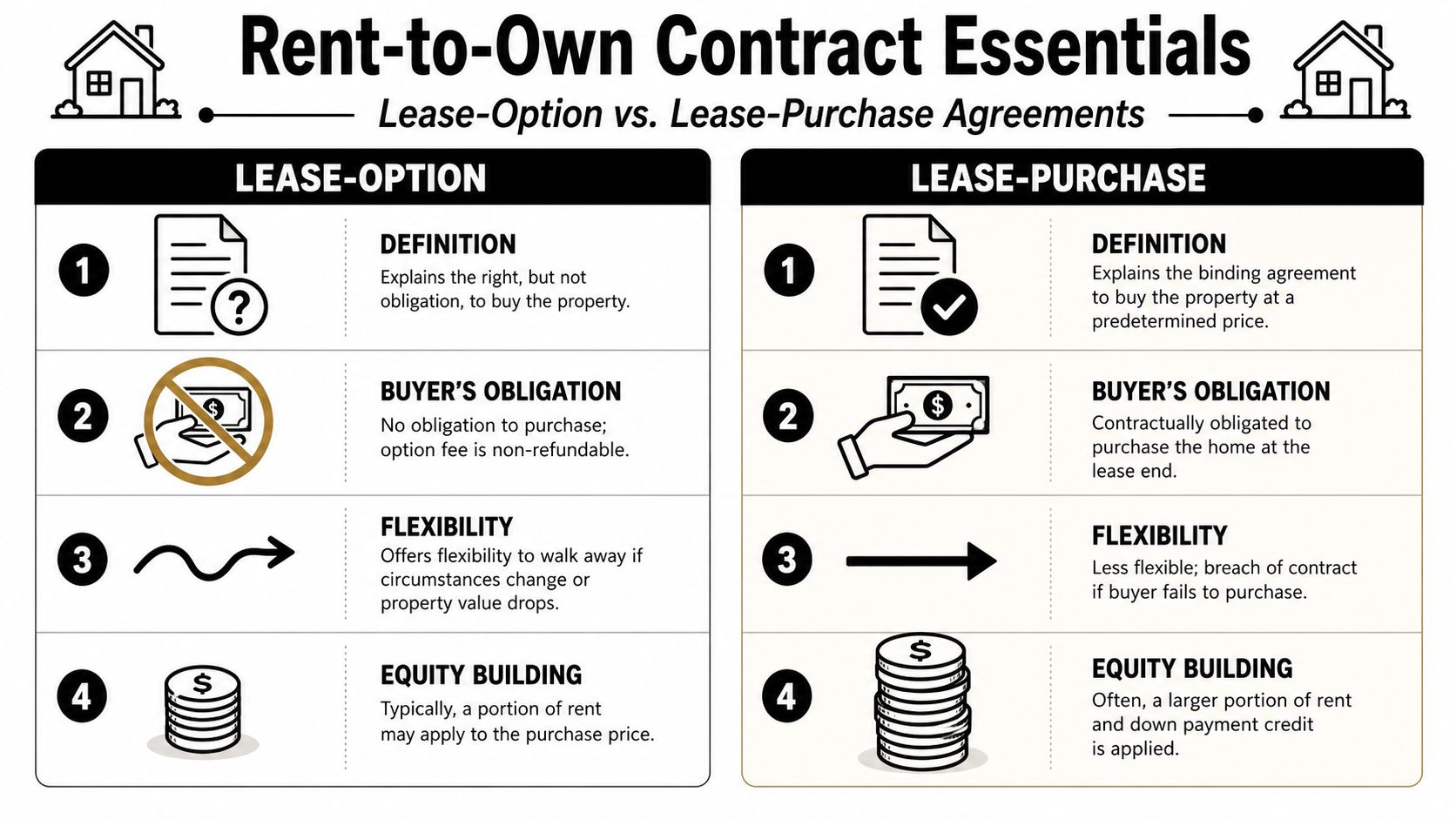
A lease-option gives you the right, but not the obligation, to buy. A lease-purchase requires the transaction to close at the end of the term. According to UpNest's overview of rent-to-own agreements, most agreements run 1 to 3 years, and buyers need to begin mortgage qualification well before expiration because lenders still require full underwriting.
That means a lease-purchase carries more legal and financial pressure. If your mortgage plan falls apart, the contract problem doesn't disappear just because your financing did.
Here's the practical comparison:
| Contract type | What it means for you |
|---|---|
| Lease-option | You can buy, but you don't have to. You may still lose money tied to the option and credits if you walk away. |
| Lease-purchase | You are expected to buy. Failure to close can create bigger legal and financial consequences. |
If your credit is still in repair mode, lease-option is usually the safer structure to evaluate.
The clauses that deserve your full attention
Don't skim. Read every line that controls money, timing, and default.
Focus on these points first:
Option fee language
You need to know the exact amount, when it's due, whether it applies to the purchase, and what happens if you don't buy.Rent credit terms
The agreement must say how credits accrue, when they apply, and whether a missed or late payment causes forfeiture.Purchase price
If the price is locked now, compare it to current comparable sales and decide whether you're paying for flexibility or overpaying in advance.Maintenance and repair duties
Many buyers underestimate this section. If the roof, HVAC, plumbing, or foundation becomes your responsibility, your mortgage prep budget can collapse fast.Default triggers
Look for harsh clauses tied to late payments, notice periods, missed deadlines, or technical breaches.
A rent credit that isn't written clearly into the contract is not an asset. It's a talking point.
Attorney review is not optional. Neither is understanding the legal framework for credit repair, because your mortgage-readiness plan needs to rely on lawful dispute and documentation processes, not shortcuts or score myths.
If the seller or manager pressures you to sign fast, slow down. A legitimate opportunity can survive review. A weak deal usually can't.
Vetting a Kansas City Rent-to-Own Opportunity
Once you find a property, your job changes. You're no longer shopping. You're investigating.

The biggest mistake people make here is getting emotionally attached before they've checked the ownership, the value, and the condition.
Your property due diligence checklist
The upfront fee is where the risk gets real. As explained in this AmeriSave rent-to-own guide, the option fee typically ranges from 2% to 7% of the home's value and is usually non-refundable. On a $250,000 home, a 3% option fee would be $7,500.
That is enough money to justify full due diligence before signing anything.
Use this checklist:
- Confirm ownership first. Make sure the person or company offering the home has the legal right to lease and sell it.
- Check for title problems. Liens, unresolved claims, or foreclosure issues can turn your future purchase into a legal mess.
- Order a professional home inspection. Don't rely on appearance. A clean kitchen doesn't tell you what's happening in the foundation, attic, or major systems.
- Get attorney review before signing. Prior to signing, seek legal counsel.
- Read every deadline twice. Option exercise dates, notice requirements, and payment rules are where buyers often find themselves at a disadvantage.
What a fair offer review should include
Don't accept a locked-in purchase price just because someone says the market will justify it later. Price discipline matters now.
A useful starting point is learning how fair market value is typically framed. These Saleswise real estate pricing insights can help you think more clearly about how asking price, property condition, and comparables interact.
Then apply that thinking to your specific deal:
- Compare recent local sales. Look for similar homes, not wishful matches.
- Match condition to price. A home that needs repairs should not be priced like fully updated competition.
- Review who pays for what. Taxes, insurance, maintenance, HOA costs, and major repairs can make a deal much more expensive than it looks.
- Pressure-test your exit plan. If the home appraises low later, can you still buy it without overextending yourself?
If you wouldn't pay the option fee after seeing the inspection report, you shouldn't pay it before seeing the inspection report.
A careful buyer asks boring questions. That's how expensive surprises get avoided.
Building Your Mortgage-Ready Credit Profile
Most rent-to-own plans fail, not at move-in, but at mortgage time.
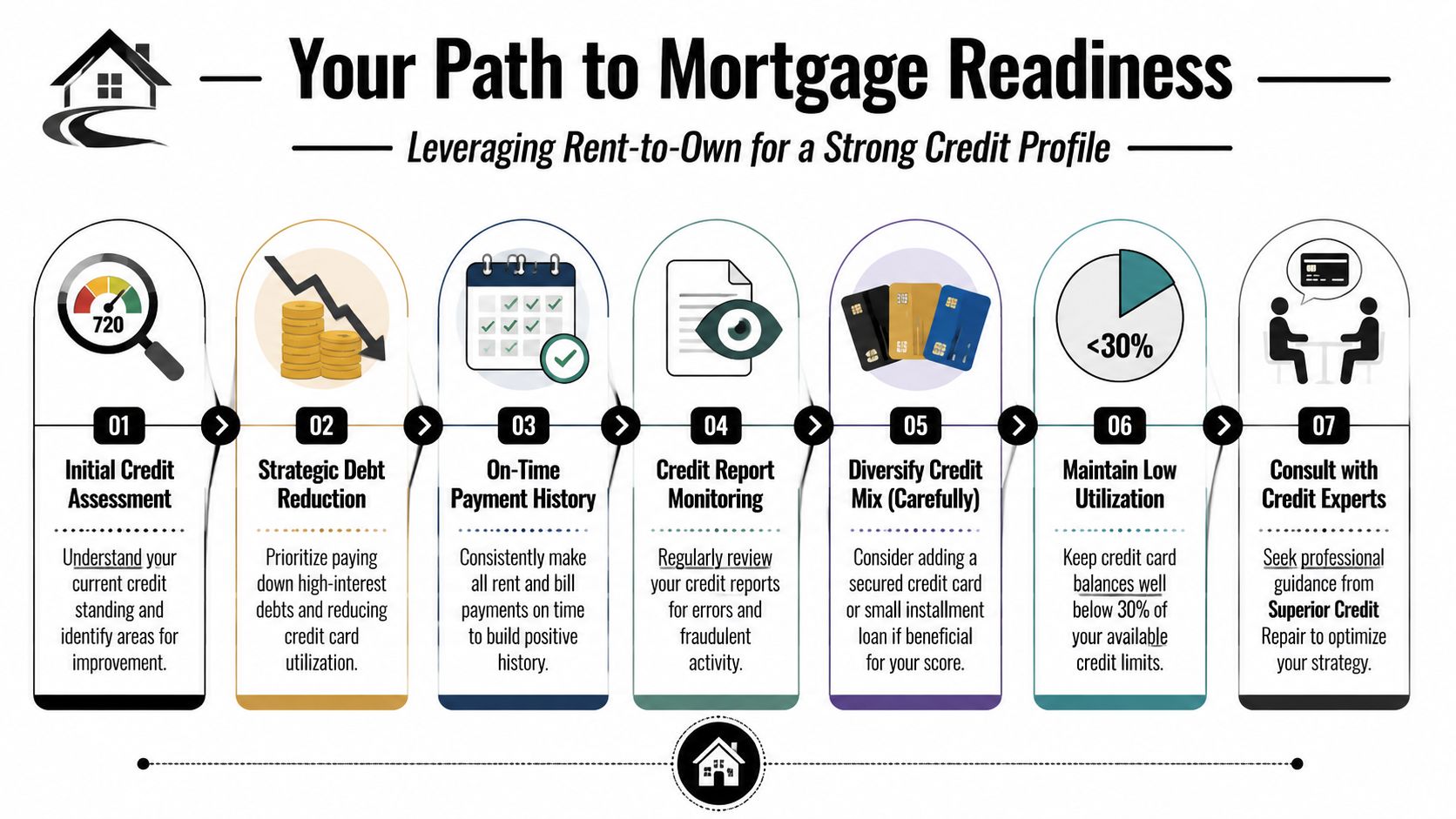
A rent-to-own lease does not replace underwriting. It delays it. If your credit file still shows unresolved derogatory items, unstable payment behavior, high utilization, or avoidable reporting problems when the lease ends, the seller's contract won't matter much. You still need a lender willing to approve the loan.
That's why I'm direct about this. The lease term is not waiting time. It is preparation time.
Treat the lease term like underwriting prep
One of the biggest gaps in typical advice is the failure to explain what has to improve before the lease expires. As noted by PMI Destination's discussion of rent-to-own readiness, success depends on using the lease period to resolve derogatory issues and reduce underwriting risk, not just moving into the property and hoping approval comes later.
Your file needs to become cleaner, more stable, and easier for a lender to trust.
That usually means focusing on the basics that matter:
- Credit report accuracy. Review all three reports carefully for inaccurate, outdated, unverifiable, or misleading negative items.
- Payment stability. Every on-time payment during the lease matters.
- Revolving debt control. High card balances can hurt mortgage readiness even when income is decent.
- Collections and charge-offs. These often need strategy, documentation, and lender-aware planning.
- Cash-flow discipline. You need room for reserves, appraisal costs, inspection costs, and closing expenses.
If you're trying to qualify for FHA, VA, USDA, or conventional financing later, don't wait until the final month to figure out what your file still needs.
What to work on before the lease ends
Here's the practical approach I recommend.
First, pull and review your reports in detail. Don't just look at the score. Scores move around. Underwriting decisions come from the underlying file. Identify disputed ownership issues, duplicate collections, wrong dates, outdated balances, and any account that doesn't appear accurate or fully verifiable.
Second, build a targeted dispute and documentation plan where appropriate. Credit repair should always be handled as a legal, documentation-based process. Results vary based on the file, the evidence, the furnisher's response, and your current behavior.
Third, reduce revolving balances aggressively if they're high. Utilization is one of the fastest ways to weaken an otherwise decent file. Lower balances also improve monthly cash flow, which helps with debt-to-income pressure.
Fourth, stop creating fresh problems. Don't miss payments during a lease-option term because you assume the future purchase matters more than the current account. Lenders care about recent behavior.
Here's a simple lender-readiness checklist:
| Focus area | What to ask yourself |
|---|---|
| Report accuracy | Are there items that appear inaccurate, outdated, unverifiable, or misleading? |
| Collections | Do I have unresolved accounts that could complicate underwriting? |
| Utilization | Are my revolving balances too high for a mortgage review? |
| Payment history | Have I created a consistent recent pattern of on-time payments? |
| Debt load | Can I reasonably handle a future mortgage payment plus normal living costs? |
For readers trying to benchmark their target, this guide on how to reach a 700 credit score can help you understand the habits and file management that often support stronger mortgage readiness.
If you need help organizing the work, Superior Credit Repair can review your credit reports, help identify questionable reporting issues, and explain a step-by-step credit restoration and rebuilding plan. That may include dispute work for inaccurate items, utilization planning, and lender-readiness guidance. Results vary, and no ethical company should promise deletions or mortgage approval.
Your future lender is not grading your intentions. They're reviewing your file.
Your Timeline From Lease Agreement to Closing Day
Rent-to-own gets easier when you put it on a timeline. Most mistakes happen because buyers delay key tasks until the end, then discover their file, savings, or paperwork isn't ready.
The first phase
The first stretch should be about verification and stabilization.
Get the signed agreement organized. Keep every receipt, notice, and payment record. Order the inspection if it wasn't completed before signing and keep the report with your housing file. Review your credit reports early and determine whether the biggest issues are accuracy problems, debt load, payment history, or a mix of all three.
If you've never gone through this process, it helps to understand how long credit repair takes so your expectations match reality. Real dispute work and rebuilding don't follow a magic timeline.
The middle phase
Here, discipline is key.
Pay every obligation on time. Bring revolving balances down. Avoid unnecessary new debt. Keep your lease records clean. If you're planning for mortgage approval, treat every month like part of your future underwriting file.
Use this phase to fix what can be fixed:
- Address reporting issues with documentation.
- Reduce utilization if cards are carrying too much balance.
- Clear up unresolved account problems before they become last-minute underwriting obstacles.
- Preserve savings so you're not house-poor before closing even starts.
The final phase
Don't wait until the lease is nearly over. Start lender conversations well ahead of expiration, gather updated income and asset documents, and verify whether the home still makes sense at the agreed price.
You'll also want to revisit inspection concerns, appraisal expectations, and any contract notice deadlines tied to exercising the option.
A clean closing path usually looks like this:
- Confirm intent to purchase under the contract terms.
- Begin mortgage qualification early enough to solve issues before the deadline.
- Prepare for appraisal and underwriting review with current documentation.
- Close only if the numbers still work for both the home and your budget.
Rent to own homes in Kansas City can work. But they work for buyers who plan early, document everything, and treat credit repair and mortgage preparation as active jobs.
Common Questions About Renting to Own in KC
Should I work with a local attorney before signing
Yes. Every time.
A Kansas City real estate attorney can review whether the agreement clearly states the option fee treatment, rent credits, maintenance duties, purchase deadlines, and default consequences. If a contract is vague, that usually helps the seller, not you.
What if the home value changes before I buy
That depends on the purchase price written into the agreement. If the locked price ends up above what the home is worth later, you may be forced to decide between overpaying or walking away from money already invested. That's why you need comparable-sale review and a realistic exit plan before you sign.
Can rent-to-own help if my credit is damaged
It can give you time, but time alone doesn't fix a credit file. You still need to review reports, dispute inaccurate items where appropriate, reduce debt, maintain on-time payments, and prepare for full lender underwriting at the end of the lease.
What if I have a dispute with the seller during the lease
Get documentation in writing and involve an attorney quickly if the issue affects repairs, payments, credits, deadlines, or your right to purchase. Waiting usually makes these disputes worse.
Where can I learn more about credit issues before applying for a mortgage
If you want more plain-English answers about lender readiness, dispute work, rebuilding strategy, and mortgage prep, review these credit repair FAQs for homebuyers.
Superior Credit Repair can review your credit report, help identify inaccurate or questionable items, and explain a step-by-step plan for improving your credit profile. You can request a free credit analysis or consultation through Superior Credit Repair to better understand your options.
Was this guide helpful?
Superior Credit Repair Online provides educational credit guidance for individuals and families preparing for major financial goals like buying a home, applying for a mortgage, refinancing, or rebuilding after credit challenges.
If this information helped you better understand your credit report or your next steps, we would appreciate your honest feedback. You are welcome to share your experience with Superior Credit Repair on our Google Business Profile.