


You're six weeks away from talking to a loan officer about buying your first home, and you finally pull your credit reports to make sure there aren't any surprises. Scrolling down the page, you spot a medical collection from an urgent care visit you barely remember. You've seen headlines claiming medical bills were banned from credit reports, so your first reaction is confusion: shouldn't this already be gone, and if you pay it today, will your mortgage application stay on track?
That confusion is completely understandable. Medical collections laws aren't governed by one simple national rule. Instead, they're a layered mix of voluntary credit-bureau policies, federal statutes, recent court rulings, state-level bans, and individual mortgage lender guidelines. What applies to your file depends on when the debt was incurred, where you live, what the original balance was, and which loan program you're targeting.
Getting clarity starts with separating three questions that often get blended together: whether a medical bill is still legally collectible, whether a collector can legally report it to a credit bureau, and whether a mortgage underwriter will factor it into an approval decision. Once you view each question on its own terms, you can review your reports with calm precision and build a realistic, documentation-based plan toward financing readiness.
Table of Contents
- Medical Collection Rules That Apply Today
- Three Questions Behind Every Medical Collection
- How State Laws Change the Answer
- What Happened to the Federal Medical Debt Rule
- How Lenders Use Medical Collections in Mortgage Decisions
- Medical Collection Errors Worth Disputing
- How to Check and Dispute a Medical Collection Step by Step
- Confirm Your Next Step and Answer Common Questions
Medical Collection Rules That Apply Today
Imagine a first-time homebuyer preparing for mortgage preapproval who finds an unpaid hospital collection sitting on one of her credit reports. She paid her insurance deductible years ago and assumed recent rule changes cleared medical debt from credit files altogether. Before she pays a dollar or files a dispute, she needs to know which rules govern credit reporting right now.
Medical bills have historically dominated consumer collection files. In 2021, medical debts represented 58% of debts reported in collection, according to Consumer Financial Protection Bureau data cited by the Congressional Research Service. Because billing errors and slow insurance processing frequently pushed patients into collections, credit reporting practices went through major shifts over the past few years.
Current Medical Collection Reporting Rules
Use the table below as a starting checklist for your own credit file. Rules vary by state and by reporting date, so match each entry on your report against the applicable threshold.
| Rule | Source or effective date | What it means for your report |
|---|---|---|
| Unpaid medical collections | Nationwide bureau policy from July 1, 2022 | One-year waiting period before reporting, up from 180 days |
| Paid medical collections | Nationwide bureau policy from July 1, 2022 | Removed from consumer reports |
| Original balance under $500 | Nationwide bureau policy from April 2023 | Excluded from consumer reports |
| New York Fair Medical Debt Reporting Act | Effective December 13, 2023 | Bars reporting of medical debt in the state, regardless of when it was incurred |
| Maryland medical debt law | 2025 legislation | Bars providers and collectors from reporting medical debt and restricts lender use |
| CFPB Regulation V medical debt rule | Finalized January 7, 2025; vacated July 11, 2025 | Not operative; verify current status before relying on it |
| General FCRA limit for obsolete negative information | Federal statute | Generally up to seven years, subject to state rules |
The three nationwide bureau changes aren't a single federal statute. Equifax, Experian, and TransUnion adopted them as voluntary industry policies, according to the CFPB report on recent changes in medical collections. Beginning July 1, 2022, the bureaus extended the waiting period for unpaid medical collections from 180 days to one year and stopped displaying paid medical collections, then removed medical collections with original balances below $500 starting in April 2023.
Those changes reshaped millions of consumer credit files, yet they didn't eliminate medical collections everywhere. The CFPB estimated that roughly two-thirds of medical-collection tradelines would be removed, and the share of consumers with medical collections on their credit records fell from roughly 14% in March 2022 to roughly 5% in June 2023. Even after those reforms, about 15 million Americans still had medical bills on their credit reports as of June 2023.
If you're working through mortgage credit repair or reviewing an older bill, compare every medical tradeline against the Superior Credit Repair medical debt guide and the checklist above. Because policies depend on report dates, balances, and state protections, checking your exact file is the only reliable way to know where you stand.
Three Questions Behind Every Medical Collection
Think of a medical collection like a heavy front door fitted with three separate deadbolts. Opening one bolt doesn't automatically swing the door open, and each lock uses a different key. Consumers often get tripped up because they assume a rule that opens one lock opens all three.
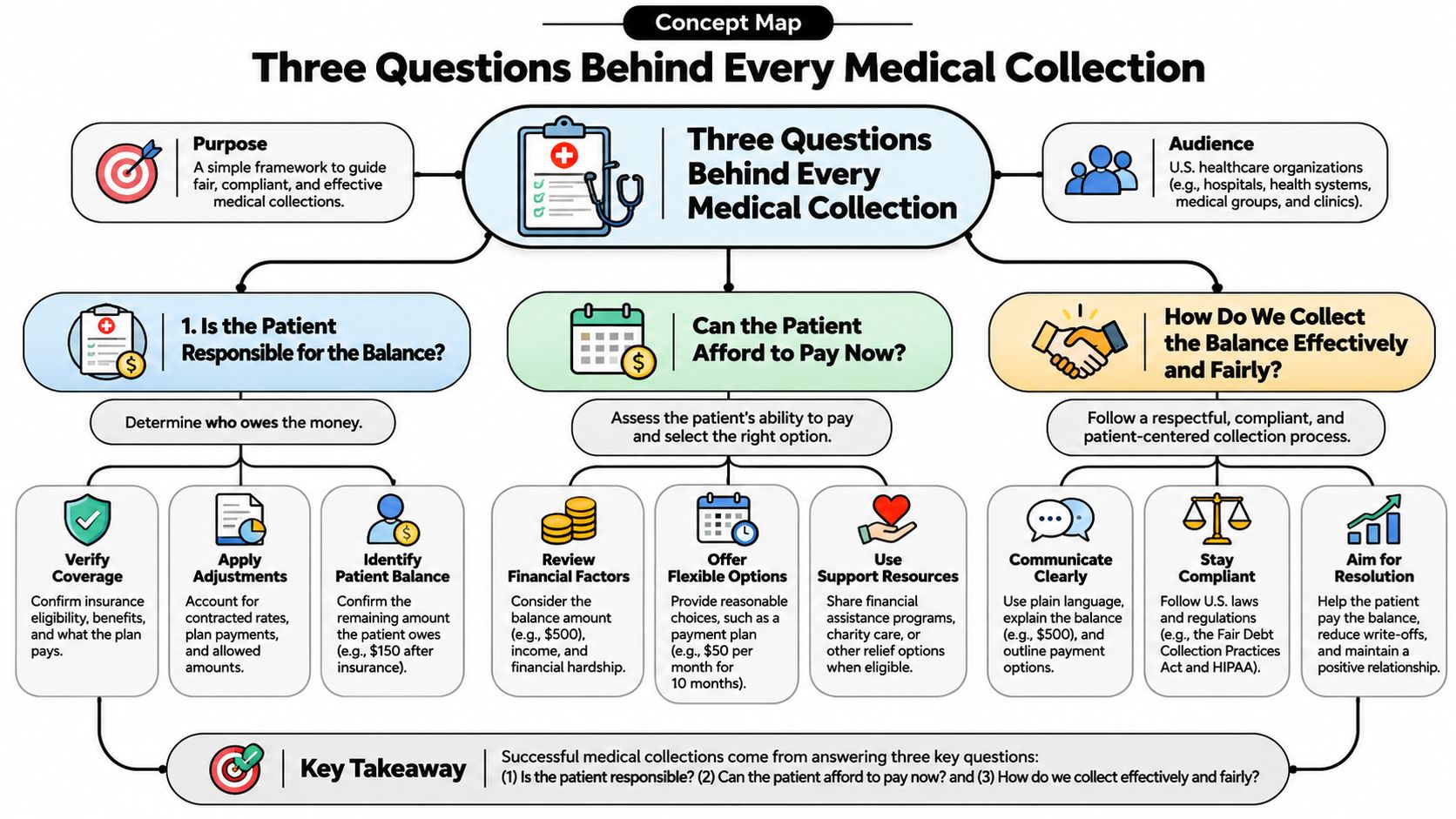
As the CFPB analysis of paid and low-balance medical collections explains, you need to separate three distinct legal and underwriting questions before taking action on any account:
- Lock 1, Legal collectibility: Does the provider or debt collector still have the legal right to collect the balance? That answer depends on the underlying agreement, the collector's legal obligations, and your state's statute of limitations on collection lawsuits.
- Lock 2, Credit-bureau reportability: Can a furnisher legally place the account on your credit reports? Under the Fair Credit Reporting Act (FCRA), a medical collection can generally remain on a consumer report for up to seven years, measured under the statute's rules for obsolete negative information, unless a bureau policy or stricter state ban blocks it sooner.
- Lock 3, Lender underwriting use: Will a mortgage, auto, or rental underwriter hold the account against your application? Loan guidelines and lender overlays for FHA, VA, USDA, and conventional mortgages treat medical collections differently from standard retail or credit card collections.
Key Terms You Will See on Your Reports
Reading a collection entry gets much easier when you know what four common terms mean in plain English.
- Collection account: An unpaid debt that a third-party collection agency or debt buyer has taken over from the original provider.
- Original creditor: The hospital, clinic, physician group, or company that first billed you for the service.
- Furnisher: Any business, lender, or debt collector that sends account data to Equifax, Experian, or TransUnion.
- Credit utilization: The percentage of your available revolving credit limits, such as credit cards, that you're currently using.
Testing the Three Locks With Two Scenarios
Picture two homebuyers pulling their files before starting verifying collections before mortgage approval. Each buyer faces a very different set of locks.
Say the first buyer had a $180 medical collection that she paid in full in 2021. Under the voluntary paid-collection exclusion and the low-balance threshold, that account shouldn't appear on her nationwide credit reports today. If it's absent from her reports, there's no reporting error to dispute, though a mortgage lender could still ask for a receipt if the payment shows up in bank records or an older credit pull.
Now consider a second buyer who finds a $2,400 unpaid medical collection that's 14 months past due. Because the balance exceeds the low-balance threshold and has passed the one-year waiting period, it's reportable in states without a reporting ban. However, when he checks the collector's notice, the account belongs to a patient with a similar name and a different date of birth.
That second account gives him clear grounds for a targeted FCRA dispute backed by identity and billing documentation. Paying or settling an account doesn't automatically erase every reporting mistake, and an accurate, legally reportable collection can't be removed by filing a dispute alone. Every lock requires its own answer, and every answer comes directly from your written records.
How State Laws Change the Answer
Voluntary bureau policies create a nationwide baseline, yet state legislatures have started building much stronger walls around consumer credit files. Depending on where you live, state law can override the standard waiting periods and balance cutoffs completely.
New York provides one of the clearest examples. Through the Fair Medical Debt Reporting Act, which took effect on December 13, 2023, New York prohibits Equifax, Experian, and TransUnion from placing or maintaining information about medical debt on a resident's credit report, regardless of when the debt was incurred, according to guidance from the New York State Attorney General. The statute even extends to medical debt charged to a medical credit card, closing a gap that nationwide bureau policies don't cover.
Other states have followed similar paths with their own legal mechanisms. As of June 2025, 11 states had enacted laws restricting or banning medical-debt credit reporting, according to the National Consumer Law Center. Maryland's 2025 legislation, for instance, prohibits healthcare providers and collectors from reporting medical debt, bars consumer reporting agencies from maintaining related adverse information, and restricts lenders from using that data in credit evaluations.
Figuring Out Which State Law Applies to Your File
For families who relocate for work, military households moving on orders, or patients who travel across state borders for specialty care, jurisdiction questions can get murky fast. Does the protection follow your current state of residence, the state where the hospital is located, the state where the credit bureau operates, or the lender's internal underwriting policy?
Because the answer isn't always obvious from a single credit report line, run through three practical checks before deciding how to respond to a collection:
- Confirm your state of residence at reporting: Check the address tied to your credit file when the account was first furnished, especially if you moved between receiving care and applying for a mortgage.
- Read your state attorney general's consumer guidance: State attorney general websites usually publish plain-English summaries of effective dates, covered providers, and how to file a state-level complaint if a collector ignores a ban. You should also check your state's medical debt deadline to understand how long a collector can legally pursue payment in court.
- Ask your loan officer which underwriting policy applies: Confirm whether the lender applies state-specific exclusions automatically or requires written documentation showing the account is protected or resolved.
Compliance boundary: A state credit-reporting ban keeps medical debt off covered credit reports, yet it doesn't cancel the underlying bill, erase the account from every provider or collector database, stop a lawful collection lawsuit, or guarantee mortgage approval.
If you've been served with a summons or face complex legal questions over ownership, take extra care. Qualified legal advice is recommended when collection litigation, repossession, title, or identity rights are involved. Credit restoration helps you address credit report errors and build stronger habits, while an attorney protects your rights in court.
What Happened to the Federal Medical Debt Rule
A borrower who read a January headline could reasonably think medical debt vanished from credit reports during 2025. A borrower applying for a mortgage later that year could make a costly mistake by relying on that memory. The federal position changed after the rule was announced, so the date on the advice matters as much as the advice itself.

On January 7, 2025, the Consumer Financial Protection Bureau issued a final rule under Regulation V that generally prohibited creditors from considering medical-debt information and barred consumer reporting agencies from including medical-debt entries on consumer reports, as documented in the CFPB Regulation V final rule notice.
That nationwide ban did not stay in force. A federal district court later set the rule aside after the CFPB and the challengers jointly asked for vacatur. The practical result is narrower than early headlines suggested: medical debt did not become automatically reportable everywhere, and it did not become automatically barred everywhere either. The controlling answer depends on the account dates, the state that applies, and whether a lender sees the obligation as unresolved.
Federal Protections That Still Apply
Even without the Regulation V ban, collectors and credit bureaus still have duties. Three federal standards remain relevant when medical accounts are sent to collections or furnished to bureaus:
- Pre-furnishing notice duties: Under Regulation F debt-collection rules effective November 30, 2021, a debt collector must take specified steps to convey information about a debt before furnishing that debt to a consumer reporting agency, a standard described in the CFPB Regulation F debt-collection rule materials.
- Accuracy and fair-collection mandates: Furnishers and consumer reporting agencies remain bound by the FCRA, while the Fair Debt Collection Practices Act (FDCPA) prohibits false, deceptive, or misleading representations during collection efforts, according to CFPB guidance on medical debt collection.
- Billing-limit issues: If a balance includes charges that federal surprise-billing protections restrict, the amount being collected or reported can be challenged as inaccurate before the reporting question is even reached.
Treat every medical collection as three separate findings: whether the balance is legally collectible, whether current law allows it to be furnished, and whether a mortgage file will treat it as unresolved. The federal answer moved during 2025, so the rule that controls is the one in effect on the dates tied to the account, your state, and your application.
How Lenders Use Medical Collections in Mortgage Decisions
Clearing or hiding a medical collection doesn't automatically turn a borderline credit file into a lender-ready credit profile. Mortgage underwriting looks at your entire financial picture, not just one line item.
Under CFPB consumer guidance cited in the Federal Register medical-information rulemaking record, unpaid medical debt over $500 and more than 365 days delinquent from the date of service can still show up on credit reports. Yet even when an account is excluded from a report or removed after a dispute, mortgage lenders evaluate payment history, credit utilization, debt-to-income ratio, cash reserves, active dispute remarks, and documentation of unresolved obligations.
Consumers also frequently ask whether paying off an older medical collection will automatically boost their score. Because bureau suppression policies already exclude paid collections and balances under the low-balance threshold, paying an account that isn't currently reported may change your credit score little or nothing. On the other hand, high credit utilization before a mortgage or recent late payments before buying a home can hurt your approval readiness far more than a single excluded medical bill.
How Loan Programs Handle Medical Accounts Differently
Each mortgage program sets its own baseline, and individual lenders often add stricter internal rules called overlays:
- FHA loan preparation: Federal Housing Administration guidelines generally treat medical collections more leniently than non-medical collections, though an underwriter can still review unresolved balances or active dispute comments.
- VA loan preparation and USDA loan preparation: Veterans Affairs and U.S. Department of Agriculture loan underwriters look closely at overall credit history, recent payment patterns, and debt-to-income stability, and lender overlays vary from one mortgage company to the next.
- Conventional mortgage preparation and rental screening: Conventional loan guidelines and apartment approval screening systems use different scoring models and risk thresholds, meaning an entry that doesn't block one loan could prompt questions on a lease or refinance.
To see what lenders check on collections in detail, review your program's specific thresholds well ahead of submitting a formal application.
Mortgage Readiness Checklist for Medical Collections
- Confirm your loan program's exact collection guidelines. Speak with your loan officer early so you know which federal program rules and internal lender overlays apply to your mortgage type.
- Ask what paperwork a paid or disputed collection requires. Find out whether underwriting will need a payoff letter, settlement confirmation, or written explanation before you take action, since open dispute remarks on credit reports can sometimes pause automated underwriting.
- Review credit utilization and debt-to-income ratio alongside medical accounts. Lowering revolving card balances and maintaining clean on-time payments often strengthens a mortgage profile alongside addressing collection errors.
- Organize payment and settlement records into one folder. Keeping receipts, insurance paperwork, and collector letters together prevents last-minute delays once your file enters underwriting.
Time any payment, settlement, or dispute carefully around your target application date. Remember that your lender's written underwriting decision controls loan approval, medical debt is only one factor among many, and results vary based on each borrower's overall credit file. No single credit-repair step guarantees mortgage approval.
Medical Collection Errors Worth Disputing
Before you challenge any entry on a credit report, draw a firm line between an error and a valid debt. A legal credit dispute targets inaccurate, outdated, unverifiable, duplicated, or misleading information. It isn't a loophole for erasing an accurate, current, and legally reportable balance.
Healthcare billing is notoriously prone to clerical mistakes. As Equifax, Experian, and TransUnion noted in their March 2022 announcement on medical collection reporting changes, the extended waiting period was designed specifically to give patients time to resolve insurance billing issues or work directly with providers. Still, collectors sometimes furnish data prematurely, report balances insurance already paid, or send updates to only one or two bureaus.
Medical Collection Error Types Evidence and Dispute Basis
Because Equifax, Experian, and TransUnion don't always display identical information, review all three reports separately and match any discrepancy against the table below.
| Error to check | Evidence to gather | Dispute basis |
|---|---|---|
| Paid collection still shown | Proof of payment or settlement letter | Paid medical collections are generally excluded from bureau reports |
| Collection reported before the one-year waiting period | Billing records showing service or first delinquency date | Reported earlier than the applicable waiting period |
| Original balance under $500 still listed | Itemized statement and collector notice | Balance falls below the bureau threshold |
| Wrong collector or original creditor | Collector notice and original creditor statement | Ownership does not match the records |
| Balance differs across bureaus | Provider and collector statements for each balance | Inconsistent information across reports |
| Duplicate account for the same debt | Both collection notices | Same debt reported more than once |
| Debt belonging to another person | Identity documents and report identifiers | Identity error or mixed file |
Separating Disputable Errors From Valid Balances
An account isn't inaccurate because it came from a doctor's office or hospital. If the original balance exceeds the bureau threshold, passed the one-year waiting period, isn't barred by your state's law, and matches your itemized bill after insurance payments, disputing it as "not mine" won't hold up once the furnisher verifies the records.
Instead, verify whether your insurer processed the claim properly by matching the provider's itemized statement against your insurance Explanation of Benefits (EOB). If an insurance coding error inflated the balance, work with the hospital's billing department and insurer first, then keep written proof of the adjustment. If the debt is valid and accurate, contact the provider or collector to discuss hospital financial assistance, an interest-free payment plan, or a documented settlement so you can resolve medical collections before mortgage approval on your own terms.
Diagnostic filter: Identify the exact reporting discrepancy first, pair it with written evidence, and decide whether the account calls for a credit-report dispute or a billing resolution with the provider.
How to Check and Dispute a Medical Collection Step by Step
Effective medical collection credit repair is a structured, documentation-based verification process, never a guessing game. Even when a bill is removed or suppressed from your credit report, the CFPB overview of medical bills on credit reports points out that a valid balance may still be owed to a provider or collector. Comparing your own paperwork against each bureau's data keeps your disputes focused, accurate, and compliant.
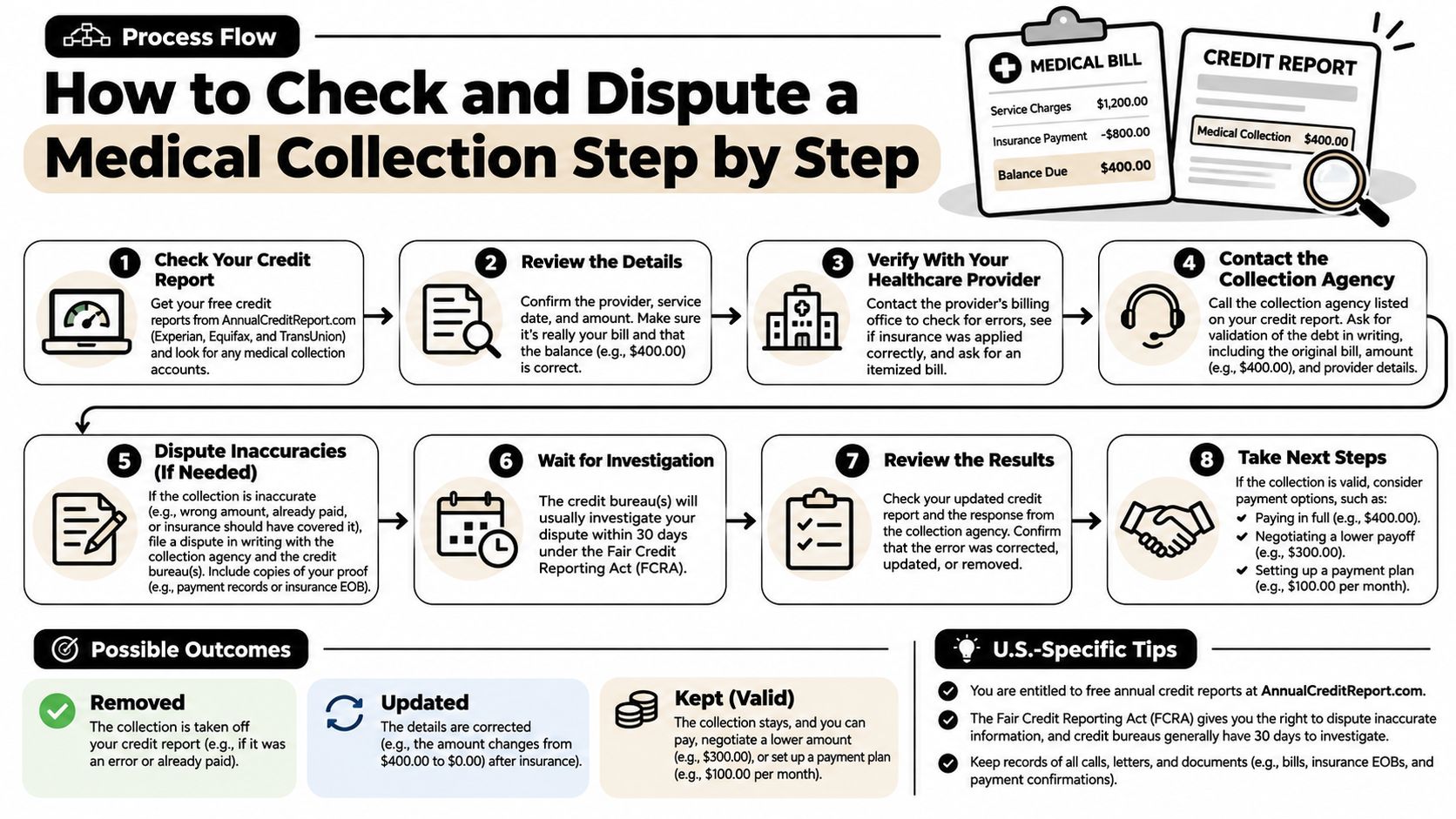
Follow these seven steps in order so every dispute rests on verifiable facts:
- Pull current credit reports from all three nationwide bureaus. Accuracy reviews start with current reports from Equifax, Experian, and TransUnion because furnishers don't always report identically across all three databases. Common slip: checking a single credit-monitoring app and missing an inaccurate collection sitting on another bureau.
- Compare each collection line by line against your notice. Check the collector name, original creditor, reported balance, account status, and key dates directly against the collection letter you received. Common slip: scanning only the dollar balance and overlooking an inaccurate delinquency date or outdated paid status.
- Assemble your complete accuracy folder. Gather itemized provider bills, insurance explanations of benefits, payment confirmations, settlement or payoff letters, creditor statements showing balances, limits, dates, and payment history, debt-buyer or collector notices, and government identification. Common slip: tossing receipts or EOBs after paying a bill, leaving yourself without proof if the account resurfaces later.
- Request written debt validation if anything is unclear. Before challenging an unfamiliar entry with a bureau, send a written request to the debt collector asking them to validate account ownership, the original creditor, and the balance calculation. Common slip: filing a generic credit bureau dispute before confirming whether the debt belongs to you or was transferred to a new agency.
- Pinpoint each specific error and match it to a document. Write down the exact mistake, such as a paid balance still reporting open, a duplicate entry from two collectors, or a balance contradicting your EOB, and attach the matching record. Common slip: disputing a valid, accurate, and legally reportable debt just hoping it gets deleted.
- Submit a clear written dispute to the bureau and, when relevant, the furnisher. Send copies of your supporting documents along with a plain-English explanation of every specific inaccuracy. Keep copies of every dispute letter, attachment, delivery record, bureau response, and creditor response, and always keep irreplaceable original documents safely in your own files rather than mailing them away. Common slip: mailing original settlement letters or forgetting to save proof of delivery.
- Audit the investigation results against your updated reports. Once the bureau completes its review, read both the decision notice and the newly updated credit report to confirm every field was corrected properly. Common slip: assuming the matter is finished the day you drop a dispute letter in the mail.
Building Long-Term Credit Profile Stability
Correcting inaccurate medical collections is only one piece of a stronger credit profile. Lenders reviewing applications for mortgages, auto loans, or business financing look closely at your ongoing habits across every account on file.
Cleaning up credit report errors removes unfair drag, while consistent on-time payments and low revolving balances build the score stability lenders trust.
Alongside addressing collections dispute help, charge-off dispute help, or late payment dispute help when records show inaccuracies, keep credit card balances low relative to limits, pay active accounts on time every month, and avoid opening unnecessary new credit lines right before mortgage underwriting. Results always vary based on each person's credit file, available documentation, creditor responses, account history, and current credit behavior.
Confirm Your Next Step and Answer Common Questions
Practical questions usually appear after the checklist, when a medical collection sits at the crossroads of debt, credit reporting, and mortgage review. Keep those three issues separate. A debt may be collectible, a collector may have reporting rights, and a lender may still treat the entry under its own underwriting rules.
Can a Dispute Remove a Valid Medical Collection
A credit dispute is designed to correct inaccurate, outdated, unverifiable, or misleading information on a credit report. No company can legally remove accurate, current, or verifiable information, and results vary by consumer file, supporting documentation, and bureau or creditor responses. If a medical collection is accurate and legally reportable in your state, resolving the balance directly with the provider or collector is the compliant path forward.
Think of the report entry as a labeled box. The dispute process checks whether the label and contents match the records. It does not erase a box because the balance feels uncomfortable.
How Long Does a Medical Collection Dispute Take
Under the Fair Credit Reporting Act, a credit bureau generally has 30 days to investigate a consumer dispute, though that window can extend to 45 days in certain situations, such as when you submit additional supporting information during an open investigation. Exact timing also depends on how quickly the furnisher or creditor responds, and no specific timeline or deletion outcome is guaranteed.
Do You Need a Lawyer for a Medical Collection Issue
You do not need an attorney to review your credit reports, organize billing records, or submit documentation-based accuracy disputes, whether you handle the process yourself or work with a compliance-focused credit restoration team. Qualified legal advice is recommended when collection litigation, repossession, title, or identity rights are involved. Knowing where credit education ends and legal representation begins keeps you protected.
Your Next Practical Move
Start with one concrete step this week: pull your current credit reports from Equifax, Experian, and TransUnion, compare every medical collection line by line against your billing and insurance records, and confirm your lender's underwriting policy before making a payment or sending a dispute. Taking those actions in order prevents costly missteps during FHA, VA, USDA, conventional mortgage, or rental preparation.
Superior Credit Repair can review your credit report, identify inaccurate or questionable items, and explain a step-by-step plan for improving your credit profile. You can request a credit analysis or consultation to better understand your options, and you are welcome to call (888) 715-2400 before sharing documents to learn what information is needed.
Was this guide helpful? Superior Credit Repair Online provides educational credit guidance for individuals and families preparing for major financial goals like buying a home, applying for a mortgage, refinancing, or rebuilding after credit challenges. If this information helped you better understand your credit report or your next steps, we would appreciate your honest feedback. You are welcome to share your experience with Superior Credit Repair on our Google Business Profile.
Preparing for a mortgage or major loan gets easier with a compliance-based plan for reviewing medical collections, checking credit report errors, and strengthening your overall credit profile. Superior Credit Repair works with individuals and families nationwide through documentation-backed disputes and practical rebuilding strategies designed for lender readiness, with no setup fees or long-term contracts. Request a credit analysis to take your next confident step toward financing approval.