


You're getting ready to speak with a mortgage lender when you notice a late payment on your credit report. Maybe you remember paying that bill. Maybe you missed it during a move, a divorce, or an unexpected expense, and now you're wondering whether homeownership has to wait.
A late payment deserves attention, but it doesn't tell the whole story. Its date, seriousness, and place within your broader payment history matter. At Superior Credit Repair, we approach credit restoration through accurate records, documented disputes, and practical rebuilding habits, not promises of quick removal.
Table of Contents
- Late Payment Timeline and How Long It Stays
- How Recency and Pattern Change Score Impact
- How Mortgage Underwriters Read Late Payments
- Buy Now, Pay Later Lates That Stay Off Reports
- How to Verify a Late Payment and Dispute Errors
- Building a Lender-Ready Payment Record
- Frequently Asked Questions About Late Payments
- Confirm Your Next Step Before You Apply
Late Payment Timeline and How Long It Stays
In the United States, a payment generally becomes eligible for reporting to nationwide credit bureaus once it is at least 30 days past due, according to Capital One's late-payment guide. Paying before that point may prevent a reported delinquency, although the creditor may still charge a late fee.
A delinquency means a payment remains unpaid after its due date. Creditors use progressively deeper delinquency categories to describe how far behind an account has fallen.
Late payment stages and reporting status
The reporting stages described in the Capital One guide distinguish timing and severity as follows.
| Days past due | Reporting status | Typical severity |
|---|---|---|
| Under 30 days | Generally not reported to nationwide bureaus | Creditor may still apply its own late fee |
| 30 days | First late-payment notation can be reported | Lower severity than deeper delinquencies |
| 60 days | Second delinquency stage reported | Higher severity; pattern becomes visible |
| 90 days | Serious delinquency reported | Substantially more damaging than a 30-day late |
| 120 days | Deep delinquency reported | Severe; often precedes charge-off review |
| 150 days | Most serious listed delinquency stage before charge-off | Severe; strong negative signal to lenders |
| Charge-off | Creditor writes the debt off as a loss | Substantially more severe than curing before this point |
A charge-off is an accounting action, not a statement that you no longer owe the debt. Bringing a past-due account current can update its present status, but it doesn't automatically erase its historical payment record.
Track the delinquency timeline
Most negative payment-history information may remain for up to seven years from the original delinquency date; paying the debt doesn't restart or eliminate that reporting period, explains Equifax's credit-report retention guide. The reporting period is separate from questions about whether a debt remains legally enforceable.
Our first step is comparing Experian, Equifax, and TransUnion reports. The same account may show different balances, statuses, dates, limits, payment months, or collection ownership across the bureaus, and those differences need careful review rather than assumptions.
Use the Superior Credit Repair reporting timeline guide to organize your review. For each late, record the first delinquency date, the reported status and its reporting date, and the expected removal date, if available.
How Recency and Pattern Change Score Impact
Not every late payment affects every borrower the same way. Payment history is the largest single category in conventional credit scoring, but a scoring model evaluates that history within the rest of your file.
FICO's explanation of late payments identifies recency, severity, and frequency as important dimensions and explains that a recent 30-day late can matter more than several older late payments. Recency asks when it happened, severity asks how far behind you fell, and frequency asks whether it happened repeatedly.
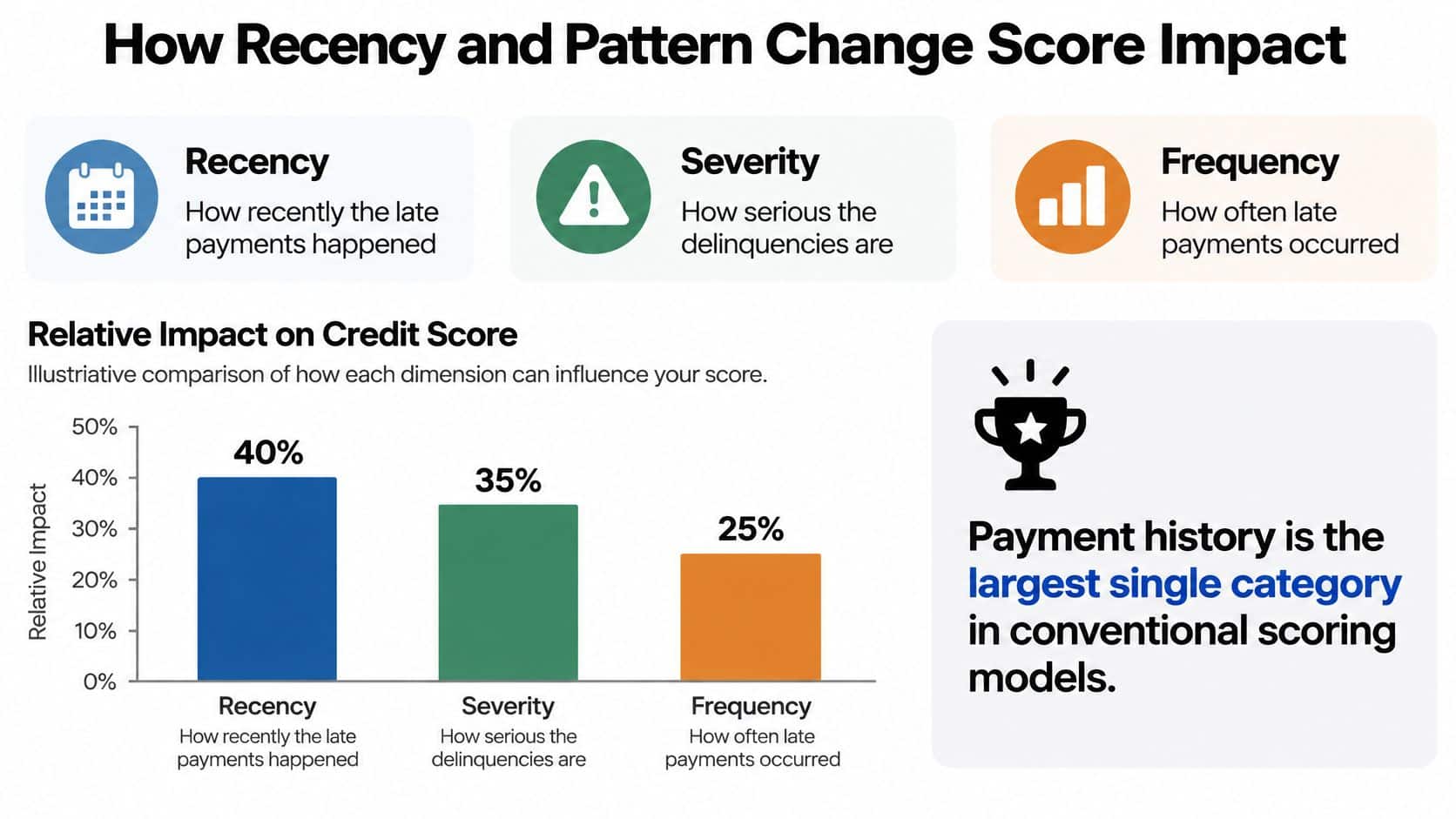
Think of a dashboard warning light. A mechanic pays close attention to a light that's on today, even if an older warning was resolved long ago.
How late payment profiles weigh in scoring and underwriting
These are qualitative comparisons, not predictions of score changes or lender decisions.
| Late payment profile | Relative scoring weight | Typical underwriting concern |
|---|---|---|
| Recent 90-day late | Heavier | High; usually needs a clear explanation |
| Recent 30-day late | Heavier than older lates | Moderate; lender checks whether it is a one-time event |
| Older isolated 30-day late | Lighter | Lower; often viewed as a past event |
| Repeated lates within 24 months | Heavier | Pattern concern; lender reviews payment behavior closely |
An unresolved delinquency can develop into a charge-off or collection. A collection means an account has moved into a debt-collection process, potentially adding another issue that needs ownership, balance, and reporting review.
For broader context, our explanation of how payment history affects credit scores helps separate payment behavior from other scoring factors. If bankruptcy is also part of your history, Lein Law Offices offers credit recovery guidance for Wisconsin bankruptcy filers, a separate resource for that legal and financial situation.
Practical exercise: Sort your late-payment entries from newest to oldest, then identify the deepest delinquency on each account. Look for an isolated interruption versus repeated missed obligations.
No company can legally remove accurate, current, verifiable negative history just because it hurts. Results vary by consumer file and bureau or creditor responses.
How Mortgage Underwriters Read Late Payments
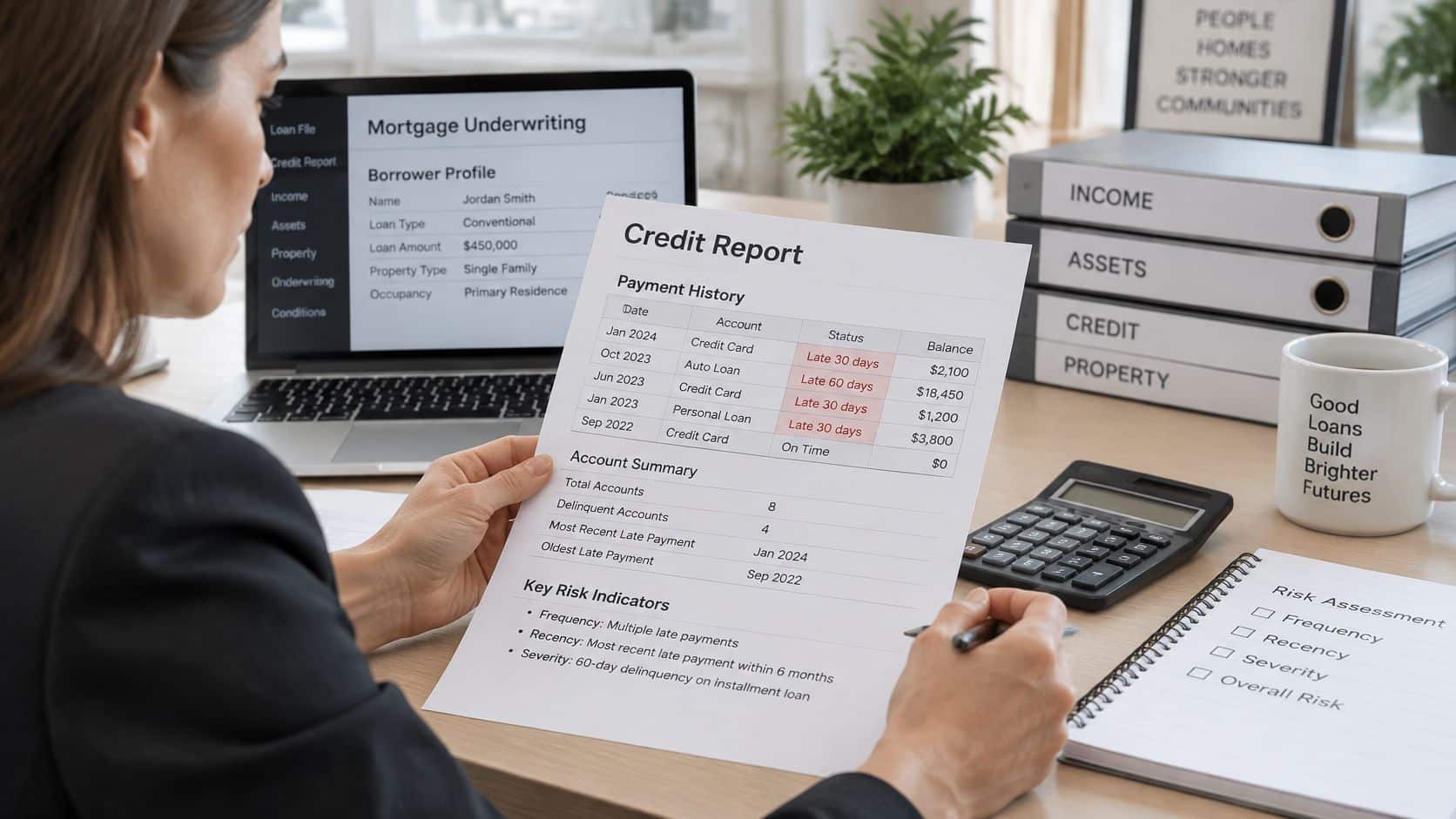
A mortgage underwriter reads your credit history as a pattern of financial decisions and circumstances, not just a score. The central question is whether your current finances support reliable future payments.
Fannie Mae's payment-history guidance directs lenders to examine frequency, recency, and severity, and treats recent delinquencies as higher risk than comparable lates more than 24 months old. That guidance also defines excessive prior mortgage delinquency as at least one 60-, 90-, 120-, or 150-day mortgage delinquency within the 12 months before the credit-report date, which can make a loan ineligible for delivery to Fannie Mae.
Separate program rules from individual review
That mortgage-history rule isn't a universal rule for every loan program. FHA, VA, USDA, and conventional mortgage requirements differ, and lenders may apply additional requirements called overlays.
Consider a hypothetical buyer with a missed payment, a credit card near its limit, and two new applications in the same quarter. A lender may view that combination differently from an isolated late followed by manageable balances and otherwise stable accounts.
The lender may request:
- A letter of explanation describing the circumstances and what changed.
- Bank statements supporting the buyer's available funds and payment activity.
- A debt-to-income review, comparing required monthly debt payments with qualifying income.
- Reserve documentation, showing funds available after closing.
Our review includes inaccurate personal information, collections, charge-offs, late payments, utilization, repossessions, medical collections, student-loan reporting, bankruptcy or foreclosure history, and account comments that may affect underwriting.
Keep the financing purpose in view
The financial factors mortgage lenders consider extend beyond payment history. For readers considering investment-property financing rather than a primary residence, investment loan approval insights from LendingXpress provide additional underwriting context.
Preventing new mortgage lates and establishing a clean recent record usually deserve priority over pursuing any single correction. A corrected report helps establish accuracy, but the lender still decides whether the complete application meets its requirements. Results vary by file and lender.
Buy Now, Pay Later Lates That Stay Off Reports
A clean-looking credit report may not show every payment obligation. The Federal Reserve's household economic-well-being findings for 2025 reported that slightly more than one-fourth of buy now, pay later users were late making a payment; among users who were late, 64% were charged an additional amount, representing 17% of all BNPL users.
Traditional credit reports organize reported delinquencies into standard categories. Buy now, pay later, or BNPL, providers differ in whether and when they report accounts, so absence from a report doesn't establish that an obligation is irrelevant.
Distinguish the reporting situations
FICO's discussion of BNPL borrowing explains that most BNPL lenders don't report these loans to credit bureaus, while accounts sent to collections can appear in credit-reporting data. For a homebuyer, the practical distinction is between these situations:
- An unreported late payment. The payment problem may not appear as a bureau delinquency, but the underlying installment still affects your budget.
- A lender-reported account. Check the reported balance, due dates, payment history, and account status against the provider's records.
- A third-party collection. Review who owns or collects the debt, the amount claimed, and whether the account belongs to you.
A mortgage lender may identify obligations through bank statements, your loan application, account reviews, or debt-to-income analysis. Not reported doesn't mean irrelevant to underwriting.
For example, a buyer may have several small installment plans scheduled around the same payday. Each payment seems manageable alone, but their combined withdrawals can leave too little cash for a car payment or credit card bill.
Build a complete installment inventory
List every active plan, including the provider, remaining balance, payment amount, withdrawal account, and next due date. Compare overlapping installments with your income schedule rather than reviewing each purchase separately.
Save payment confirmations and check that automatic withdrawals clear. Avoid opening new plans before mortgage preapproval, and disclose obligations accurately when the lender asks about debts.
Our guide to understanding buy now pay later reporting can help you distinguish reporting questions from cash-flow questions. If an item appears questionable, preserve the records needed to evaluate it rather than assuming every BNPL entry should be disputed.
Credit repair can correct inaccurate information, but it can't legally erase accurate negative history or guarantee a score increase. The useful outcome is a stable, documented payment pattern, not merely a report that appears to contain fewer obligations.
How to Verify a Late Payment and Dispute Errors
A mortgage applicant spots a late payment on one credit report, but the same account looks current on another. Before assuming the entry is wrong, compare the reported month with the creditor's records. A payment confirmation can show when you scheduled a payment, while the creditor's records show when it posted, whether it covered the required amount, and which billing period it satisfied.
A useful dispute identifies the precise mismatch. It focuses on the account detail that needs correction, not on the effect the entry may have on a mortgage application.
Assemble the evidence before filing
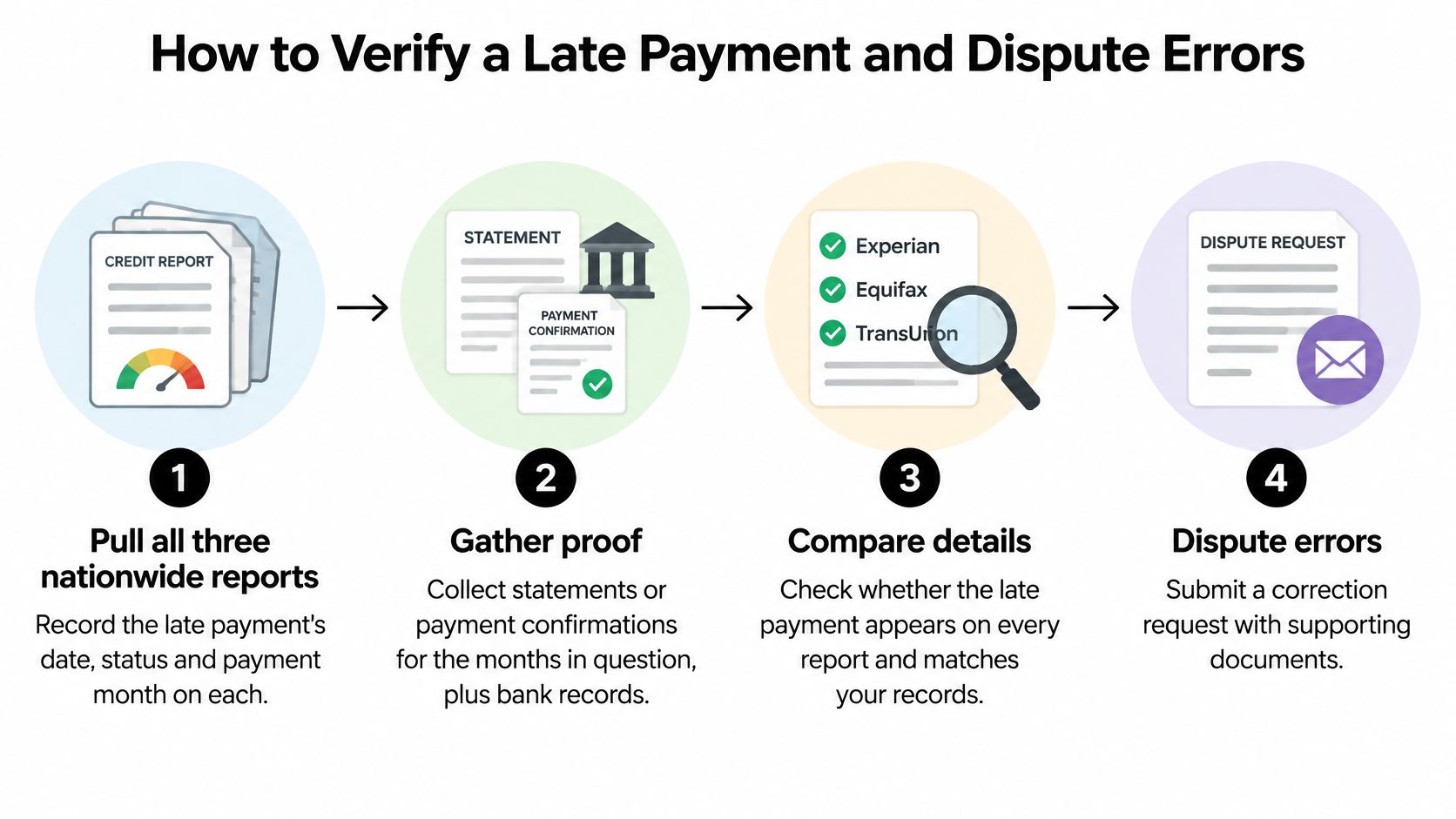
Compare your three bureau reports. Record the company name, account-number fragment, status, balance, payment history, and dates exactly as each bureau displays them. The same account can show different information across reports, so keep copies for comparison.
Gather records for the months in question. Pull creditor statements and payment confirmations, then compare them with the payment history shown by each bureau. Bank records can help clarify payment activity. Collection letters, settlement records, student-loan records, and debt-buyer notices may also help explain an account.
Check the reported month against the account timeline. Compare the bureau's delinquency status with the creditor's due date and payment records. Check whether the payment was returned, applied to another amount, or too small to bring the account current.
Describe the specific error. A dispute may concern a wrong delinquency date, a duplicate account, an account that is not yours, or outdated information. A difference between bureaus is a reason to investigate, not proof on its own that an entry is inaccurate.
Send relevant documents with the dispute. Contact each bureau displaying the error and consider disputing directly with the furnisher, the company that supplied the information. Identify the correction you are requesting and include copies that support it.
Follow the investigation through completion
Track the investigation. Under the Fair Credit Reporting Act, bureaus generally investigate disputes within about 30 days, with limited extensions. Information that cannot be verified must be removed.
Review the outcome and keep your records. Compare the response with updated reports. Keep copies of your dispute, supporting documents, correspondence, and delivery confirmations. If the result does not address the mismatch, organize the remaining evidence before deciding whether to follow up.
If the recipient accepts faxed documents, follow its submission instructions and prepare documents for a customer service fax. Confirm the accepted method and destination before sending sensitive records.
Learn more about credit report rights for future homebuyers.
A dispute is a process for checking and correcting inaccurate information. Accurate negative history cannot legally be erased just because it affects a mortgage review, and dispute results vary by file and by bureau or creditor response.
Building a Lender-Ready Payment Record
The most useful rebuilding plan protects the accounts you have today while older reporting issues are reviewed. You don't have to postpone better payment habits until an investigation finishes.
Start with a system you can maintain during a busy week, not one that depends on remembering every due date.
Put account stability on your calendar
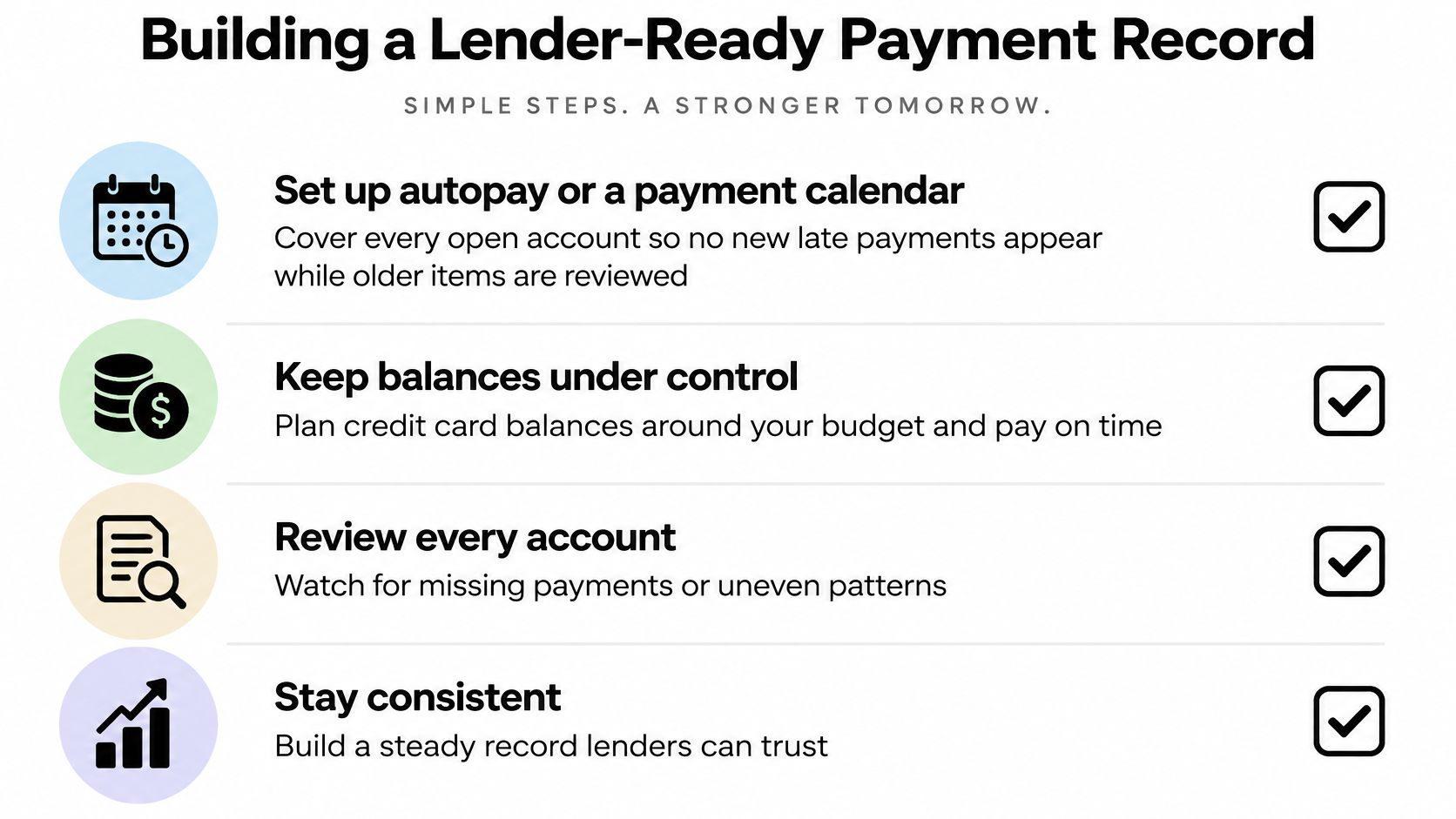
- Set up autopay or payment reminders. Cover every open account and confirm that the withdrawal account has sufficient funds. Autopay still needs monitoring for returned payments and changed payment amounts.
- Plan balances around statement dates. Credit utilization means the share of available revolving credit you're using. Keep statement dates alongside due dates so balance reduction supports your budget and reporting plan.
- Pause unnecessary applications. Keep notes about recent inquiries and avoid adding new credit or BNPL obligations before a financing review.
- Keep a readiness folder. Save payment proof, any explanation letter, and lender, landlord, or dealer feedback about credit concerns.
A payment calendar should include accounts that don't appear on your credit reports. Otherwise, an overlooked installment can disrupt the funds reserved for a reported account.
Match your application timing to your actual file
Ask your mortgage lender what recent payment history it expects for the program you're considering. Credit repair for FHA approval, VA loan preparation, USDA financing, and conventional mortgage preparation shouldn't be treated as interchangeable timelines.
Our rebuilding documents include statement dates, payment calendars, inquiry notes, and financing feedback. The process is designed to preserve current accounts from new late payments while the review continues, but it still depends on payments being made.
Overall duration can change when new negative accounts report, active accounts become late, creditors verify disputed information, additional investigation rounds become necessary, or credit usage changes. A completed dispute doesn't mean every part of mortgage preparation is complete.
Readiness priority: Stabilizing every account and demonstrating sustained on-time behavior may be more useful than challenging a late payment that your records confirm is accurate.
No improvement timeline is guaranteed. Your credit file, available documentation, creditor responses, and current behavior all affect what happens next.
Frequently Asked Questions About Late Payments
Does a late payment on a closed account still count?
Yes. Closing an account doesn't automatically remove its payment history or make a reported delinquency irrelevant. Review the historical entry separately from the account's present closed status, because those fields describe different things.
Can a letter of explanation help with mortgage review?
Yes, a lender may request a written explanation to understand an isolated payment problem. Explain what happened, how you resolved it, and what now prevents a repeat, using supporting records when available. The letter provides context; it doesn't change the credit-report entry or require the lender to approve the loan.
Does checking my own credit report lower my score?
Checking your own credit report is generally a soft inquiry and doesn't typically affect your credit score. That's different from applying for financing, which may involve a lender's hard inquiry. Reviewing your report before applying gives you an opportunity to understand potential concerns without submitting a new credit application.
Who decides whether a dispute succeeds?
The credit bureau investigates, and the furnisher verifies the information it supplied. The outcome depends on the records, the issue identified, and the responses received, not on how strongly a consumer requests deletion.
A verified account may remain, an incorrect field may be updated, or information may be removed when the applicable process requires it. Results vary by each person's credit file, documentation, creditor responses, account history, and current credit behavior.
Confirm Your Next Step Before You Apply
Before applying for financing, review each late-payment entry against your own records. Note the account, payment month, and reporting status, then identify which entries need closer examination. Keeping current accounts paid on time helps prevent new late payments while older items are reviewed.
If you are preparing for an apartment screening, keep any landlord feedback about credit concerns with your report-review documents. That helps focus your next steps on the issue the landlord identified.
Request a review with a defined purpose
Superior Credit Repair reviews payment-history accuracy, reporting dates, account timelines, and supporting proof before a lender, landlord, or auto finance company reviews a file. You can submit an online review request to get help understanding your report, identifying potential dispute targets, and deciding what to address first.
Credit repair cannot guarantee approval for a mortgage, auto, or rental review. Results vary by credit file and by bureau or creditor responses.
Was this guide helpful? Superior Credit Repair provides educational credit guidance for individuals and families preparing for goals such as buying a home, applying for a mortgage, refinancing, or rebuilding after credit challenges. If this information helped you understand your report or possible next steps, you can share your honest feedback on the Superior Credit Repair Google Business Profile.
Superior Credit Repair offers documentation-based reviews of late-payment reporting and guidance on protecting current accounts while questionable history is investigated. Visit Superior Credit Repair to submit an online review request and discuss a practical sequence before your next financing application.