

The Fair Credit Reporting Act is the 1970 federal law that sets accuracy, privacy, access, and dispute rules for consumer reports. If you're renting now and preparing to buy, that law is what lets you see what's in your credit file, challenge information that doesn't match your records, and require companies to investigate instead of guessing.
Table of Contents
- What the Fair Credit Reporting Act Means
- Rights and Deadlines You Can Use
- How a Credit Report Dispute Actually Works
- How Long Negative Items May Remain
- Mortgage and Medical Debt Situations
- Promises the Law Never Makes
- Review Your File and Take the Next Step
What the Fair Credit Reporting Act Means
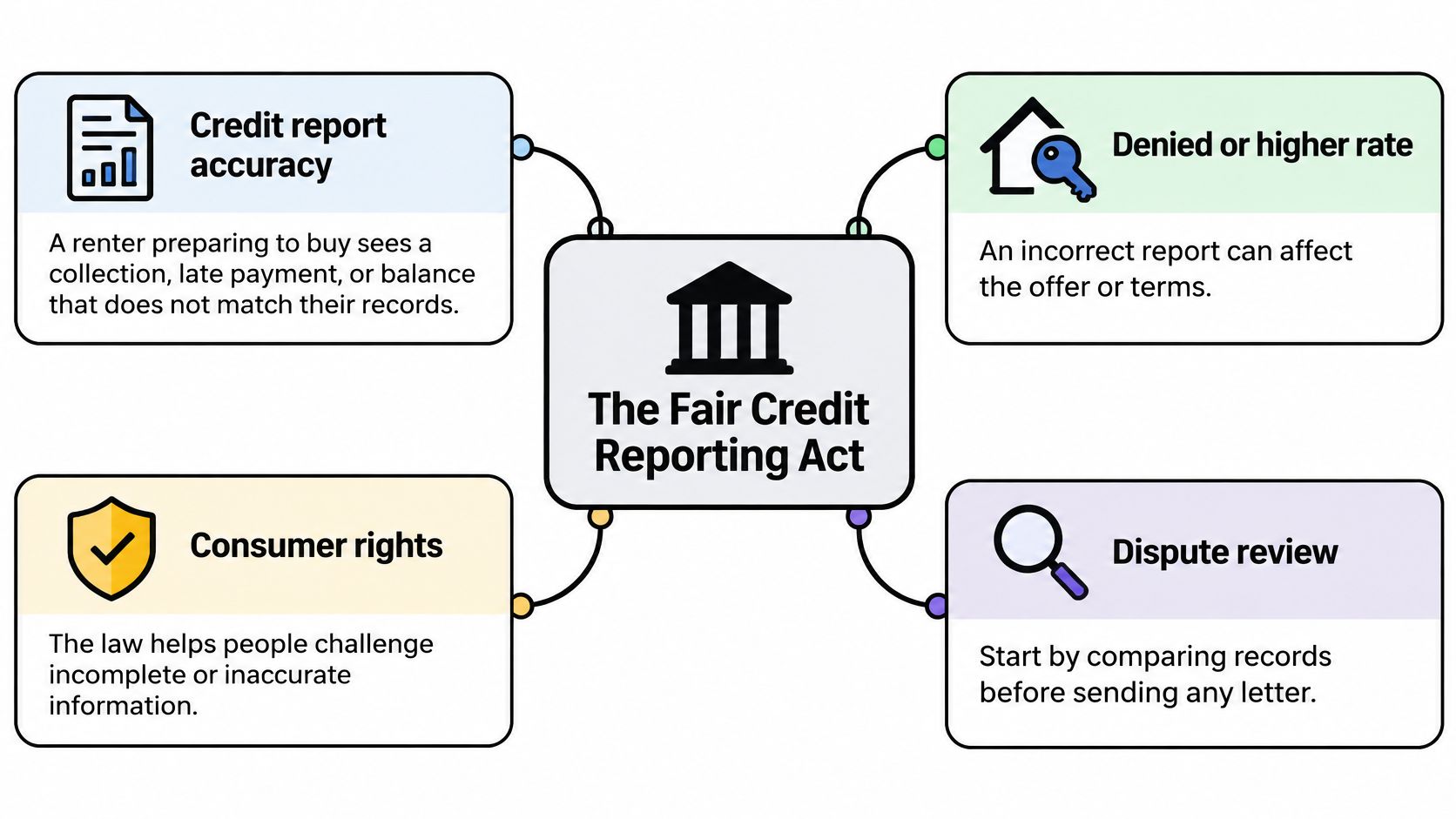
Say you're a renter who's saved for a down payment. A lender pulls your credit, offers a higher rate than you expected, or pauses your application because of a collection, a late payment, or a balance you don't recognize. You check your statements and the numbers don't line up. That gap between your records and your report is exactly where this law matters.
So, what is the Fair Credit Reporting Act in practical terms? It's the federal law governing how consumer reports are assembled, who may obtain them, and how you can challenge inaccurate or incomplete information. It became law on October 26, 1970, as Public Law 91-508, and the Federal Trade Commission history of the FCRA describes it as the nation's first consumer financial privacy statute. Congress acted because reporting agencies had become central to decisions about credit, insurance, employment, housing, and other eligibility questions.
Three roles you need to tell apart
The system has three kinds of players, and confusing them is where many disputes go off track.
- Consumer reporting agencies: These are the bureaus, such as Experian, Equifax, and TransUnion, that assemble and sell consumer reports.
- Furnishers: These are creditors, servicers, collectors, and debt buyers that supply account information to the bureaus.
- Users: These are businesses that obtain a report to make a decision, such as a mortgage lender, auto lender, or landlord.
Reports were meant to be assembled and provided for specific permissible purposes, not sold indiscriminately. A permissible purpose is a legal reason a business may obtain your report, such as underwriting a mortgage you applied for.
The original duties still anchor the law. Bureaus must follow procedures designed for maximum possible accuracy, protect privacy, limit access to authorized users, and let you learn and challenge what's maintained about you. Amendments in 1996 and 2003 expanded furnisher duties and consumer access, but they didn't change that central balance between useful data and accuracy, privacy, and procedural protection. If you work for an organization that screens people, the VolunteerBadge guide to FCRA compliance is a useful reminder that the same access and fairness ideas reach beyond lending.
Plain English for terms you'll see
A collection is an unpaid debt a creditor has sent to a collector or sold to a debt buyer. A charge-off is a creditor's accounting write-off of a debt it has stopped expecting to collect, which doesn't mean the balance vanished. A tradeline is a single account listed on your report.
For homebuyers, the FCRA is the legal framework for addressing inaccurate collections, late payments, charge-offs, and repossessions before underwriting. It turns a dispute into a compliance right, not a score trick. It also has a clear boundary. Accurate, current, verifiable history isn't erased because it's inconvenient for a mortgage timeline.
Understanding where this law fits with other credit repair laws and consumer rights helps you keep credit restoration grounded in accuracy. You're not asking for a favor when you challenge a wrong balance. You're using a defined legal process.
Rights and Deadlines You Can Use
| Protection | Who must act | Deadline or limit | What you do |
|---|---|---|---|
| Bureau reinvestigation | Consumer reporting agency | 30 days after receipt, plus up to 15 days if you add relevant information | Name the exact inaccurate field and attach documents |
| Furnisher investigation | Creditor, servicer, or debt buyer | Generally 30 days after the furnisher receives the dispute | Send a specific dispute with statements or letters |
| Free file disclosure | Each nationwide bureau | One free report per year through the authorized system | Pull Experian, Equifax, and TransUnion before applying |
| Adverse-action notice | User of the report | When a report contributes to a denial or worse terms | Save the notice and note which bureau was named |
| Permissible purpose | Lender, insurer, landlord, collector, or employer | A legally recognized purpose before access; employment generally needs written consent | Question a pull that does not match an application you made |
| Accuracy duty | Bureaus and furnishers | Ongoing; no fixed deletion date | Compare balances, dates, limits, and ownership across bureaus |
How to read the two dispute clocks
The table shows two separate clocks, and that's the detail homebuyers miss most often. A dispute to a bureau starts the bureau's reinvestigation duty. A dispute to the company that furnished the information starts that furnisher's duty. The Consumer Financial Protection Bureau dispute guidance explains that furnishers generally must investigate and respond within 30 days of receiving the dispute.
A letter to a collector doesn't start the bureau clock, and a bureau dispute doesn't replace a direct furnisher dispute when the furnisher's own records are the problem. If you're preparing for credit repair for FHA approval, a VA loan, or a conventional mortgage, write down who received what, and on what date. Lenders care about readiness, and vague timelines make planning harder.
The history behind those rows matters. The Consumer Credit Reporting Reform Act of 1996 expanded furnisher responsibilities for accuracy and dispute handling, since the original law placed most obligations on bureaus. The Fair and Accurate Credit Transactions Act of 2003 expanded access, including one free annual credit report from each nationwide consumer reporting agency through the federally authorized system.
Using the other rows before you apply
Pull your free reports through AnnualCreditReport.com before you compare errors or talk to a lender. Look at the same account on all three reports. A balance, status, limit, or payment month that differs across bureaus is often your first clue that something needs a closer look.
Keep any denial or less favorable terms notice. When a report contributes to an adverse decision, the user generally must identify the bureau that supplied it. That notice tells you where to look first instead of guessing which report hurt you.
The permissible purpose row protects you in a different way. A lender, insurer, landlord, collector, or employer needs a legally recognized purpose before obtaining your report, and employment access generally requires your written authorization. If you see an inquiry tied to an application you never made, that's worth questioning.
The accuracy row is ongoing. Bureaus must use reasonable procedures aimed at maximum possible accuracy, and furnishers generally may not report information they know or have reasonable cause to believe is inaccurate.
Practical rule: Identify the exact field, such as the balance, status, date of first delinquency, or account owner, rather than sending a blanket claim that everything negative is wrong.
A disputed item can affect underwriting, interest rates, debt calculations, and approval readiness. But the outcome depends on your documentation and the investigation response, not on the mere act of disputing. The law requires accurate, complete, properly investigated reporting. It doesn't guarantee deletion of accurate negative information.
How a Credit Report Dispute Actually Works
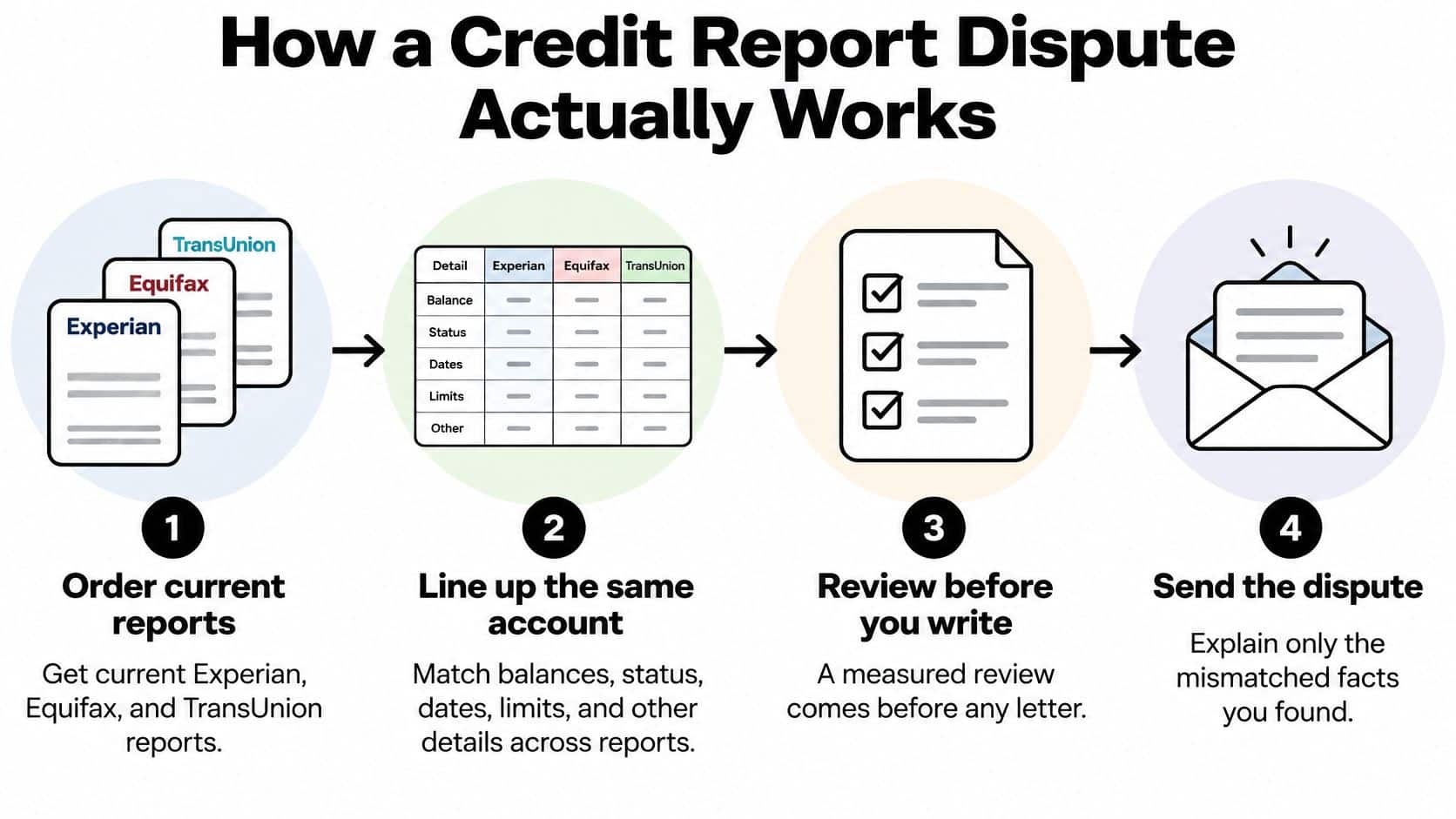
A measured review comes before any letter. Rushing a dispute with incomplete records wastes the process and can leave you without a clear record of what you claimed. The sequence below uses one running example, a medical collection from a mixed file that shows a wrong balance and belongs, in part, to someone with a similar name.
The eight steps in order
- Order current reports: Get your current Experian, Equifax, and TransUnion reports and line up the same account on each one. The first step is comparing the three reports, because the same account may show different balances, statuses, dates, limits, payment months, or collection ownership across bureaus.
- Record exactly what's displayed: Write down the furnisher name, account number fragment, status, balance, payment history, and dates exactly as each bureau displays them. In our example, one bureau might show the medical collection as open with a balance, while another shows a different collector name.
- Gather proof: Collect statements, collection or settlement letters, payment confirmations, insurance explanations, and any denial notice. For a mixed file, identification and address records can also help show which information belongs to you.
- Write a specific dispute: Name the wrong field and the correction you're requesting. Say the balance should reflect a payment, or the account isn't yours, instead of demanding that everything negative be removed. Guidance on how to dispute inaccurate credit report items can help you keep the letter focused.
- Send it to the right place: You may send your dispute to the bureau, the furnisher, or both, depending on where the error lives. Keep copies and dates for each submission, because the clocks are separate.
- Let the reinvestigation run: The bureau must conduct a reasonable reinvestigation and forward relevant dispute information for review. Use the clock in the table in the previous section to track timing rather than relying on informal updates. The FCRA reinvestigation statute requires that process to be free of charge.
- Read the outcome carefully: The bureau must record the item's current status or delete it if it cannot be verified. If the information is verified as accurate, it can remain, even if it's unfavorable.
- Decide your next move: Update your notes, then decide whether a brief statement of dispute, a furnisher follow-up with new documents, or a change to your financing timeline makes sense.
Documentation beats volume. One clear dispute with matching statements is stronger than a stack of letters challenging every account you dislike.
Where professional help fits
Our review at Superior Credit Repair starts the same way, by comparing the three reports and recording fields exactly as they appear. Our blog makes the same point, that the first step in a credit file review should be a measured review rather than a rushed dispute. You still supply accurate records, read the responses, and decide when to apply for financing.
This is collections dispute help and late payment dispute help in the lawful sense. It's a documentation-based verification process. No step in it promises a deletion or a score change, because the bureau and furnisher responses control what happens next.
How Long Negative Items May Remain
The FCRA restricts how long certain adverse information may appear, but it doesn't make accurate, unfavorable history disappear early. That limit comes before the hope. The FCRA statute text bars reporting bankruptcy cases older than 10 years from the relevant filing or adjudication date, while many other adverse categories are subject to a seven-year limit measured under the statute's applicable rules.
| Item | Reporting ceiling | Clock to check | What is not a dispute |
|---|---|---|---|
| Bankruptcy | 10 years | Relevant filing or adjudication date | An accurate case still inside 10 years |
| Collections and many other adverse items | Seven years | Date of first delinquency, the usual reference point | A verified unpaid collection that is simply unfavorable |
| Charge-offs and related late history | Seven years | Date of first delinquency versus a later sale or open date | A correct charge-off inside the period |
| Re-aged or duplicate accounts | Same statutory ceiling, not a new one | Whether a later collector restarted the apparent age or reported the debt twice | A new collection that is actually a different debt |
| Paid or settled accounts | Payment does not by itself end the ceiling | Status and balance after payment, not the payoff date alone | A demand to delete a paid account solely because it was paid |
Three date problems that can support a dispute
A wrong start date can keep an item looking newer, or keep it reportable longer, than it should. A duplicate can make one debt look like two obligations. Re-aging happens when a later collector makes an old account appear newer than the original delinquency supports.
Say a conventional mortgage applicant has a charge-off. The date of first delinquency on the original creditor tradeline is years earlier than the open date a debt buyer shows. The buyer's open date doesn't restart the clock, so comparing those dates is a legitimate accuracy check.
Say an FHA applicant sees the same collection on two bureaus with different balances. That isn't automatically two debts, and it isn't automatically an error in timing. It's a mismatch to document before anyone sends a dispute. Reading about seven-year credit reporting periods can help you separate the reporting clock from a lender's own waiting policies.
What payment does and doesn't do
Paid collections aren't automatically deleted on the payment date. A settlement letter is evidence of status and balance, not a timer reset and not a deletion order. If the status or balance doesn't update after payment, that's a specific field you can challenge with the letter attached.
If you're preparing for FHA, VA, USDA, conventional, auto, or personal financing, write down the date each bureau shows before you dispute anything. Incorrect start dates, duplicate reporting, re-aged accounts, and outdated records can create legitimate compliance concerns.
Accurate bankruptcies, foreclosures, and late payments that are inside the reporting period and verified can stay. Lenders may also apply their own overlays while an item is still reportable, so a reportable item and a lender-ready file aren't always the same thing.
A date error belongs in a dispute. A true item belongs in a rebuilding plan built on on-time payments, lower utilization, and stable accounts over time. Keeping those two paths separate is how you rebuild your credit profile without wasting disputes on accurate history.
Mortgage and Medical Debt Situations
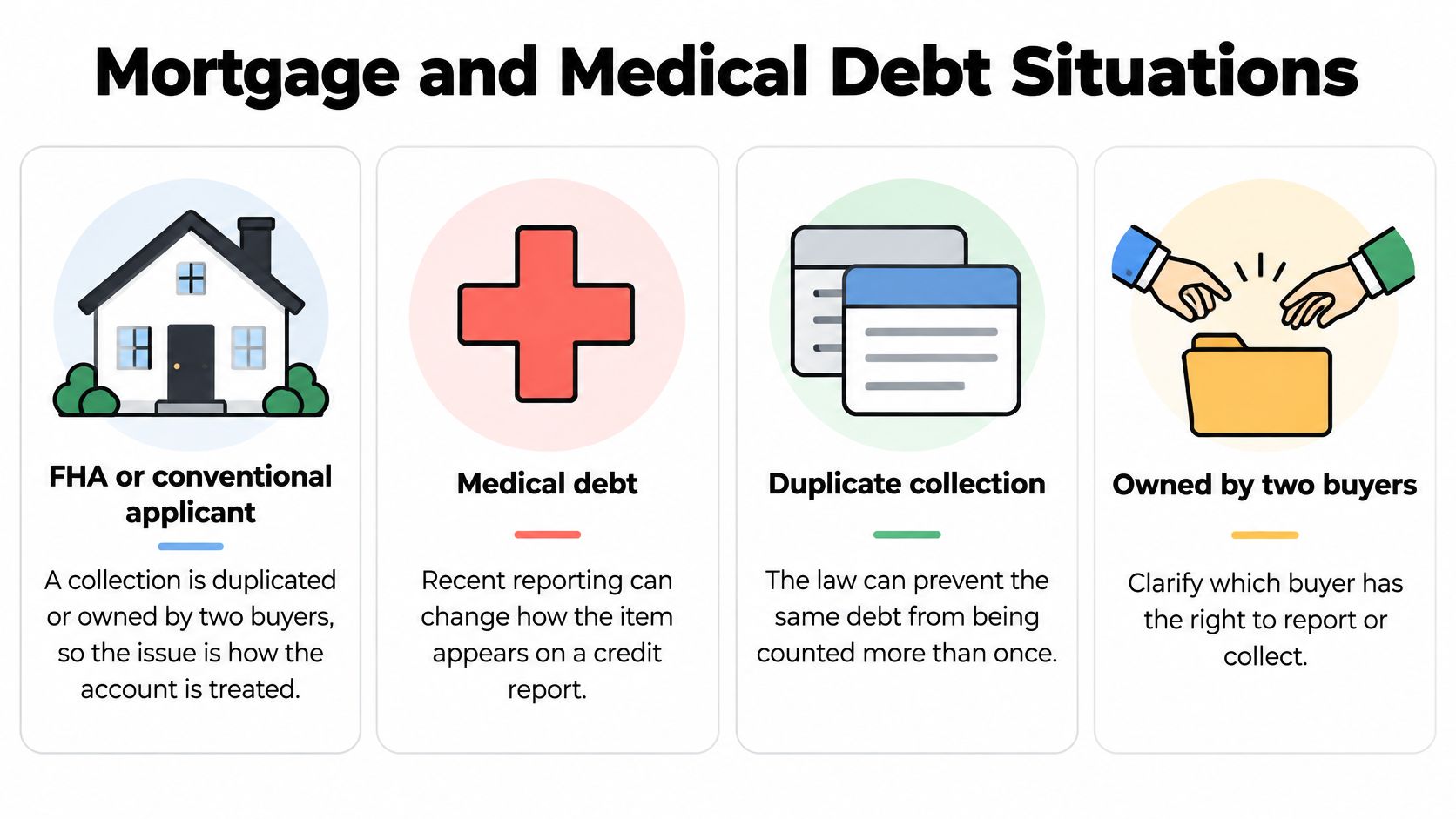
Four common situations show what the law changes, and what it doesn't, when you're preparing for a home loan. The pattern is consistent. Accuracy problems belong in the dispute process, while accurate history and high balances belong in a rebuilding and payoff plan.
Duplicate collections and real late payments
An FHA or conventional applicant finds one collection reported twice, or claimed by two debt buyers at once. The issue is accuracy and verification, because duplicated debt can distort how a lender reads your obligations and your debt-to-income picture. Correcting a duplicate doesn't guarantee approval, but it can make the file a fairer basis for underwriting.
A VA or USDA buyer has late payments that are real. The FCRA doesn't remove them because a move or a deployment made life hard. The useful work is confirming that the dates and severity are reported correctly, then rebuilding with consistent on-time payments before applying.
High credit utilization is different again. The statute doesn't cap your card balances, so there's nothing to dispute if the balances are accurate. A plan that pairs payments with statement reporting dates is a credit habit, separate from mortgage credit repair dispute work, and it can support a cleaner file before a lender reviews it.
The medical debt gap many explainers miss
Medical collections deserve special care because recent headlines were easy to misread. Many consumer explanations presented a January 2025 CFPB medical-information rule as settled law, but the CFPB FCRA compliance resource sits against a changed backdrop, since a federal court vacated that rule in July 2025 after the CFPB and plaintiffs jointly requested vacatur. The court concluded the rule exceeded the CFPB's authority and conflicted with the FCRA.
So medical bills aren't banned from credit reports under federal law. Medical debt may generally be reported or considered when the information doesn't identify, or allow inference of, the specific provider or nature of the medical services. That's a narrower, more technical protection than a blanket ban.
A family with a medical collection should separate five questions. What's the federal baseline, what voluntary industry policies may apply, what state protections exist, what's the item's reporting status, and is the item inaccurate, outdated, duplicated, paid, or unverifiable?
The practical question isn't only whether medical debt can appear. It's what exactly is being reported, who supplied it, whether it's legally reportable, and which field you should dispute if it's wrong. That's why checking medical debt reporting errors starts with insurance and payment records, not assumptions. medical collection credit repair has to stay precise.
Renters face a related issue. Landlords are users who need a permissible purpose, and a rental denial tied to a report is a reason to pull the named report and check it. Apartment approval and mortgage approval both suffer when a mixed file or wrong balance goes unexamined.
Lender overlays for FHA, VA, USDA, and conventional loans sit on top of the FCRA. No dispute guarantees approval, a rate, or a single score point. Credit repair before buying a home works best as mortgage readiness, a cleaner and more accurate file presented to a lender who still makes its own decision.
Promises the Law Never Makes
The most common promise in credit repair advertising is guaranteed deletion. The FCRA makes no such promise, and neither can any company working under it. No company can legally remove accurate, current, or verifiable information, and results vary by consumer file and by bureau or creditor responses.
Claims to walk away from
- Guaranteed deletions: Don't accept a promise that specific accounts will be removed. Do look for a structured review that identifies factual mismatches and documents them.
- A set score jump: Don't trust a predicted point increase. Credit repair can correct inaccurate information but cannot legally erase accurate negative history or guarantee a score increase.
- Overnight repair: Don't expect a reinvestigation process to finish on a marketing timeline. Do plan around documented submission and response dates.
- Guaranteed loan approval: Don't treat a cleaner report as an approval promise for FHA, VA, USDA, or conventional financing. Do treat it as one part of lender readiness alongside income, assets, and payment habits.
- A form letter for everything: Don't dispute every negative item without a factual error. Do spend the dispute process on fields you can support with records.
A blanket letter isn't a compliance strategy. It can waste the investigation on claims you can't support, while the one real error in your file gets less attention. Specific beats broad every time.
What payment and time actually do
Paying a collection, settling a charge-off, or entering a payment plan doesn't press a statutory delete button. It updates status only as the furnisher reports the new information. If that update is wrong, the settlement or payment record becomes your dispute evidence.
A verified late payment inside the reporting period remains part of your payment history, which lenders weigh heavily. You can't dispute it away because you've paid on time since. You can dilute its impact over time with a longer run of on-time payments, lower utilization, and fewer new inquiries before an application.
You may dispute errors on your own, and many people do. A company can help organize reports, records, and letters, but it can't promise a furnisher's answer. Planning mortgage prep after credit disputes means building your timeline around responses you don't control.
Results vary with your file, your documents, your account history, and your current behavior. That's not a disclaimer to hide behind. It's the honest shape of a legal dispute and verification process.
There's still real hope inside that boundary. Correcting a wrong balance, separating a mixed file, or removing an unverifiable duplicate after a proper investigation can give a lender a fairer picture of you. Honest negative history is handled by time and better habits, not by a loophole. That's how you improve your credit score and credit profile in a way that holds up under scrutiny.
Review Your File and Take the Next Step
Start with paper, not letters. Pull all three current reports, keep any denial notice, and list only the items with a concrete mismatch you can describe in one sentence. If you can't name the wrong field yet, you're still in the review stage, and that's fine.
For a first conversation with us, bring your three current credit reports, photo identification, current address information, recent statements for accounts to be reviewed, collection notices, payment confirmations, and any denial or adverse-action notice tied to the application that prompted your search. Those records let the review focus on facts instead of memory.
If your address itself is reporting incorrectly, that's worth fixing early, since identity mismatches can complicate everything else. The walkthrough on credit bureau address corrections with Cloud Residents is a helpful companion for that specific cleanup step.
We offer a free consultation that starts with what's reporting now, what may be inaccurate, and which sequence fits your goal, whether that's an FHA, VA, USDA, or conventional application. You can also request a credit analysis on our website. You remain responsible for providing accurate records, reading responses, and deciding when to apply.
Superior Credit Repair can review your credit report, help identify inaccurate or questionable items, and explain a step-by-step plan for improving your credit profile. You can request a free credit analysis or consultation to better understand your options.
Four questions readers ask next
Does disputing lower your score by itself? The act of disputing isn't a score penalty. Verified negative information, new inquiries, higher balances, and missed payments still affect scores while a dispute is pending, so protect your current accounts during the process.
Can you contact both the bureau and the furnisher? Yes. Each has its own investigation duty and response clock, which is why copies and submission dates matter. Searching for a credit repair near me or a local credit repair company doesn't change those duties, since the process can be handled with organized records.
What if the bureau says the item is verified? Read the results, compare them with your documents, and send additional evidence if you have it. You can also consider a brief statement of dispute for your file, while accepting that accurate data can remain and lenders may still weigh it.
Is hiring help illegal? No, when the work is accuracy-based and doesn't promise erasure of true history. Credit repair for homebuyers is lawful when it's a documentation-based review and dispute process paired with rebuilding guidance.
Was this guide helpful?
Superior Credit Repair Online provides educational credit guidance for individuals and families preparing for major financial goals like buying a home, applying for a mortgage, refinancing, or rebuilding after credit challenges.
If this information helped you better understand your credit report or your next steps, we would appreciate your honest feedback. You are welcome to share your experience with Superior Credit Repair on our Google Business Profile.
If a wrong balance, duplicate collection, or outdated account is standing between you and a mortgage application, we can review your three reports, help you document the specific fields that don't match your records, and explain a realistic sequence for disputes and rebuilding. Visit Superior Credit Repair to request a free credit analysis and talk through your next step before you apply.